
Cardinals Trade Nolan Arenado To Diamondbacks
After more than a yearlong residency on the rumor mill, Nolan Arenado‘s time in St. Louis is over. The Cardinals announced Tuesday that they’ve traded Arenado and cash to the D-backs in exchange for minor league right-hander Jack Martinez (Arizona’s eighth-round pick in the 2025 draft). The Diamondbacks are reportedly on the hook for a total of $11MM of the remaining $42MM owed to Arenado over the next two seasons. The Cardinals owe the remaining $31MM. Arizona’s 40-man roster had a vacancy but is now at capacity with the addition of Arenado.
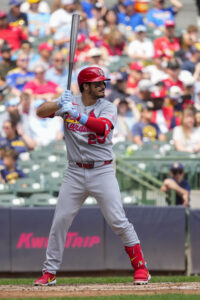
With the Cardinals entering a rebuild under new president of baseball operations Chaim Bloom, trading the 34-year-old Arenado (35 in April) has been a primary goal this offseason. St. Louis has finally achieved that goal but paid a hefty price to do so. Arizona will be on the hook for just $5MM this season and $6MM next year.
Three years ago, a salary dump of Arenado would’ve been hard to imagine. He was a National League MVP finalist after hitting .293/.358/.533 with 30 home runs and his typical brand of elite defense during that 2022 season. His offense slipped considerably in 2023 (.266/.315/.459) but was still north of league average. It dipped to about average in 2024, however, and plummeted well below par this past season.
In 436 plate appearances with the Cardinals in 2025, Arenado turned in an anemic .237/.289/.377 batting line. By measure of wRC+, he was 16% worse than an average hitter at the plate. Arenado’s 12 home runs were his lowest in a full season since his rookie year back in 2013. This year’s 6.4% walk rate was his lowest since 2015. When considering that his 34.1% chase rate on pitches off the plate was also his worst since 2015, that’s not particularly surprising. Arenado’s 11.2% strikeout rate was one of the lowest in MLB and one of the best in his career, but he also posted his highest-ever infield fly rate — 16.5% of his fly-balls were harmless pop-ups — and recorded some of the worst exit velocity and hard-hit numbers of his career.
Suffice it to say, Arenado’s decline at the plate has been steep. He still possesses plus contact skills but will need to scale back his chase rate and cut out some of those weak pop-ups if he’s to improve in a meaningful way. Fortunately for Arenado, he’s going to a more favorable offensive environment than the one he’s been calling home in St. Louis. While Phoenix’s Chase Field isn’t the hitters’ haven it once was, it plays largely neutral to right-handed power now — a stark gain for Arenado relative to St. Louis’ Busch Stadium, which is the fifth-worst park for right-handed home run power over the past three years, per Statcast’s Park Factors.
Prior to adding Arenado, the Diamondbacks had been involved in the market for Alex Bregman. A match there always seemed like something of a long shot, given Arizona’s intent to reduce payroll in 2026, but the interest was legitimate. The Snakes quickly pivoted and brought in a much more affordable option to hold down the hot corner for the next two seasons. Arenado’s glove has also taken some steps back in recent years, but he’s still an above-average defender. He’ll give manager Torey Lovullo a quality pair of defenders on the left side of the infield, joining breakout shortstop Geraldo Perdomo in that regard.
Acquiring Arenado leaves the Diamondbacks with little opportunity for former No. 6 overall pick and top prospect Jordan Lawlar. Perdomo’s breakout appeared to push Lawlar down the defensive spectrum to third base, but he looked overmatched both with the glove and in the batter’s box during his first few tests against MLB pitching. The D-backs were considering giving him some time in the outfield, and perhaps with Jake McCarthy now in Colorado following this weekend’s trade, there’ll be a clearer path to that experiment. If not, Lawlar has a minor league option remaining and can be sent back to Triple-A (where he’s routinely thrashed opposing pitchers) — or even included in a potential trade package to address needs elsewhere on the roster.
Even with the Snakes looking to cut payroll, the addition of that fraction of Arenado’s contract amounts to little more than a footnote. He’s effectively replacing a league-minimum player, so this trade adds a net $4.2MM to the team’s books. Per RosterResource’s estimates, that brings Arizona’s payroll just north of $170MM. That’s more than $17MM shy of last year’s Opening Day payroll. An exact target isn’t clear, but there should be room to add a reliever or two, at the very least, and further trades could always change the payroll outlook one way or another.
If the money changing hands (and the frequent reporting in the year-plus leading up to today’s trade) wasn’t indicative enough that this amounts to a salary dump for St. Louis, the return should be. Martinez hasn’t pitched an inning in professional ball yet. The Diamondbacks selected him with their eighth-round pick last year out of Arizona State University. His $167K signing bonus checked in south of his No. 243 overall selection’s $223K slot value.
A 6’4″, 215-pound righty, Martinez started his college career playing Division-III ball before transferring twice and ending up in the Sun Devils’ rotation as a senior. He was tagged for a 5.47 ERA through 15 starts during his senior year. It’s not an encouraging number, but Martinez punched out 32.3% of his opponents and can run his fastball up to 97 mph, per MLB.com’s scouting report. He has a four-pitch mix with a changeup serving as his best secondary offering, but Martinez is a pure lottery ticket for the Cardinals’ reshaped player development department.
A year ago, the Cardinals thought they had worked out a trade to send Arenado the Astros. Arenado, however, invoked his no-trade protection to nix that arrangement, reportedly due to reservations about the Astros’ commitment to contending; Houston had just traded Kyle Tucker to the Cubs days prior to the nixed Arenado deal. Heading into the current offseason, Arenado was forthcoming about the fact that he’d be more open-minded to offseason trade scenarios than he was last winter.
That clearly seems to be the case, but the D-backs might’ve been a viable landing spot for him even if he were continuing to remain selective. Arizona may be scaling back payroll, but their signings of Merrill Kelly and Michael Soroka — plus their reported interest in the aforementioned Bregman — all signal a commitment to try to field a contender in 2026. Beyond that, Arenado is a Southern California native with a home in Arizona. There are geographic benefits that surely played into his decision to waive that no-trade clause for a move to the desert.
For the Cardinals, moving Arenado now clears a relatively nominal sum from the long-term books and furthers their goal of creating opportunities for younger players. It remains to be seen whether Arenado’s third base reps will go to Nolan Gorman, top prospect JJ Wetherholt or even former top prospect/third baseman-turned-outfielder Jordan Walker. Whoever takes up regular work at the hot corner will be a more viable long-term option at the position than Arenado is as he enters his mid-30s.
The trade of Arenado is the third of a big-name veteran on a large contract for the Cardinals this offseason. They’ve already traded Sonny Gray and Willson Contreras to the Red Sox. Those players were shipped out in separate deals, with St. Louis eating notable portions of money in those trades, too. Between Gray, Contreras and now Arenado, the Cardinals will be shelling out $59MM over the next two seasons to three players who are no longer on their books.
Eating that amount of money to facilitate the trades of three former All-Stars is unprecedented, but the Cardinals have been clear about their intent to rebuild the organization from the ground up, modernizing the player development department, analytics staff and various other components of the team’s baseball operations setup — all while affording younger and more controllable players the opportunity to establish themselves in the majors. With three pricey veterans gone, much of the heavy lifting has been taken care of, but the Cardinals are still widely expected to trade second baseman Brendan Donovan and left-handed reliever JoJo Romero before the season begins.
Katie Woo of The Athletic first reported that the two sides were in serious discussions. John Gambadoro of 98.7 FM Arizona Sports broke the news that an agreement was in place and added that Martinez was going back to St. Louis. Nick Piecoro of the Arizona Republic first reported details on the cash changing hands.
Red Sox Rumors: Suarez, Bichette, Valdez, Rotation
The Red Sox are still reeling from Alex Bregman‘s departure for the Cubs but have minimal time to lick their wounds. The free agent and trade markets have begun to pick up some steam, and whatever Boston’s pivot from losing Bregman will be, it’ll need to come together before terribly long. The Bregman deal and the trade of Nolan Arenado from St. Louis to Arizona both figure to get the ball rolling with regard to the infield market. There are also indications that the market for top free agent Kyle Tucker is gaining steam as well. Even though Tucker understandably isn’t a target for a Red Sox team that’s deep in lefty-swinging outfielders, reports of him nearing a decision only give further credence to the idea that the market will accelerate with pitchers and catchers just a month from reporting to spring training.
It’s not entirely clear how Boston will look to counteract Bregman’s defection just yet. Both Bo Bichette and Eugenio Suarez have been mentioned as possible fallback options. The fit in either case makes sense. Both swing right-handed and have batted-ball profiles that would fit well at Fenway Park. Suarez could step into Bregman’s spot at third base. Bichette could play third base or second base. Former top prospects Marcelo Mayer and Kristian Campbell could factor in at whichever of those two positions is not filled externally.
Sean McAdam and Chris Cotillo of MassLive provide some context in their latest column, as does Alex Speier of the Boston Globe. Per McAdam and Cotillo, the Red Sox showed preliminary interest in Suarez earlier in the offseason but were first waiting to see how the markets for not only Bregman but also Ketel Marte and Jorge Polanco played out. Suarez’s camp is operating under the assumption that there’s some interest and will soon be told whether the Sox plan to make a serious bid, per the report. Speier’s report generally backs up that line of thinking; he writes that the Red Sox have viewed Suarez as a fallback and had not seriously engaged with his camp prior to Bregman’s signing.
Suarez, 35 in July, popped 49 homers last season but hit .228/.298/.526 overall. He once graded as a strong defender at the hot corner but has seen his defensive grades slip as he’s aged into his mid-30s — as is often the case. His thunderous right-handed power and pull-happy approach make him a natural fit at Fenway Park, where he could pummel the Green Monster with line drives and clear it with regularity, but Suarez finished the season on a down note; his production waned after a trade from the D-backs to the Mariners last summer. After hitting .248/.320/.576 with a 26.8% strikeout rate for the Snakes, he posted a .189/.255/.428 slash with a 36% strikeout rate in 53 games for the M’s.
At the outset of free agency, MLBTR predicted a three-year deal worth a bit more than $20MM annually for Suarez. That contract seemed likely if a team were to make him a priority. That he’s been viewed as something of a fallback to sluggers like Kyle Schwarber and Pete Alonso, as well as top infield free agents like Bregman and Bichette, would at least seem to imply that a two-year deal may now be likelier. A two-year contract certainly would align with the Red Sox’ apparent aversion to long-term deals for players in their 30s, but Boston will face competition in signing him. The Mariners remain open to a reunion, and the Pirates, who’ve spent the offseason searching for power upgrades, have interest as well.
The Sox will face competition with regard to Bichette, too — if they plan to pursue him at all. Bichette is 27 and won’t turn 28 until March. His age makes him a candidate to sign the type of long-term deal the Red Sox have been reluctant to put forth to free agents. Both the MassLive and Globe reports cast significant doubt on whether the Red Sox would actually engage in a legitimate bidding war with a team like the Phillies, who met with Bichette just yesterday and are far more comfortable doling out long-term contracts (at least based on recent history).
Depending on how or even if the Red Sox end up accomplishing their goal of adding another hitter, a reallocation of the funds previously earmarked for Bregman could come into play. Both MassLive and the Globe suggest that a pivot to the rotation is something the Sox could now pursue. Speier suggests that the Sox are “open-minded” with regard to the position another impact player could fill. That could mean the rotation or, speculatively speaking, perhaps a run at improving the catching corps. J.T. Realmuto is still a free agent, and the Phillies reportedly don’t think they can sign both Bichette and Realmuto.
If the Sox pivot to the rotation, there are still some notable names on the market. Tim Healey of the Boston Globe reports that as far back as November, Red Sox brass had an in-person sit-down with Framber Valdez‘s camp. That meeting came at the GM Meetings, where Valdez reportedly met with at least the Giants and Orioles as well.
Valdez, 32 next year, might not have been a top target after the Red Sox acquired Sonny Gray and pivoted to upgrading the lineup. However, he’d fit the stated goal of adding a No. 2 starter for a playoff series more directly than Gray. A postseason rotation with options including Garrett Crochet, Valdez, Gray and Brayan Bello would be quite strong, and it’s always possible that a touted young arm like Payton Tolle or Connelly Early forces his way into the mix.
Valdez became a free agent for the first time this offseason when he rejected a qualifying offer from the Astros, the only organization he’s ever known. He’s topped 190 innings in three of the past four seasons, pitching to a collective 3.21 ERA in 767 2/3 frames along the way. Valdez’s strikeout rate, walk rate and especially his 60% ground-ball rate have all been far better than the league average during that four-year span.
Signing Valdez, however, would require the Red Sox to punt their second- and fifth-highest selections in this summer’s draft, as well as $1MM of space in next year’s bonus pool for international free agent amateurs. The same is true of longtime Phillies southpaw Ranger Suarez and longtime D-backs righty Zac Gallen, both of whom rejected QOs as well. Whether they’d make those future concessions while simultaneously easing their reluctance to commit long-term deals to veterans in their 30s is an open question, but the Red Sox have now missed out on Bregman, Alonso and Schwarber in free agency, and top trade target Marte doesn’t sound like he’ll be moved at all. They’ll need to find a new plan of attack in the coming days, particularly with offseason activity picking back up following the annual holiday-season lull.
Guardians Sign Carter Kieboom To Minor League Deal
The Guardians announced Tuesday that they’ve signed former top prospect Carter Kieboom to a minor league contract. The ACES client will be in major league camp as a non-roster invitee this spring.
Now 28 years old, Kieboom was a first-round pick by the Nationals back in 2016 and has previously ranked among the game’s top 100 prospects. He never made good on that billing in parts of four seasons with Washington, however, slashing just .199/.297/.301 in 508 major league plate appearances. He spent the 2025 season with the Angels after signing as a minor league free agent. Kieboom batted .319/.368/.449 in an extremely hitter-friendly Pacific Coast League setting and went 2-for-8 with a pair of singles in three games with the major league club. The Angels outrighted him following the season.
Kieboom has played third base and shortstop extensively in pro ball, logging more than 2100 innings at each position. He’s also played nearly 600 innings at second base. At the height of his prospect status, Kieboom was regarded as a safe bet to hit thanks to good pitch recognition, strong plate discipline and a quality all-fields approach at the plate. That hasn’t played out in the majors, but he’s a career .288/.380/.439 hitter in 1597 plate appearances at the Triple-A level.
Cleveland is set at third base with Jose Ramirez and has one of the top prospects in baseball, 2024 No. 1 overall pick Travis Bazzana, likely to make his debut at second base this coming season. Kieboom is presumably viewed as a bench/depth option with a tinge of upside remaining who could compete for a role in which he backs up multiple positions. If he doesn’t make the club, he’ll head to Triple-A Columbus as a depth piece.
MLBTR Chat Transcript
Steve Adams
- Happy Tuesday! I’ll get going at 1pm CT, give or take a couple minutes. As always, feel free to submit some questions ahead of time. I’ll take a mix of preloaded ones and live ones after we begin!
- Greetings! Apparently someone re-lit the stove.
Toronto Mike
- Reports state that Bo is seeking 300 million. Do you see him getting this kind of money?
Steve Adams
- No, I don’t, but if the real goal is something like $250MM, then of course you say you’re looking closer to 300.I still think it’s probably somewhere in the 225 range, but we’ll see.
Jagger
- Do you think Colin Rea gets traded to a club that needs pitching now that he is on the outside of the Cubs rotation?
Steve Adams
- Rea signed as a free agent, meaning he can’t be traded without his consent until June 15. This is his second straight one-year deal with the Cubs, and he’s a midwest guy who wants to be in the midwest. He’s not getting traded. He’ll be in a swing role, which is surely fine with him. He’s used to it. And with injuries, he’ll probably still start 10+ games (as long as he remains healthy himself)
Nolan Arenado
- Assuming St Louis can’t trade me, why not take a page from the Angels book and defer the remaining contract over 3 or 4 years and cut me loose?
Steve Adams
- One of the very earliest questions from this morning, ha. What a difference a few hours makes!
brewers fan
- Thoughts on the Nolan arenado trade?
Giants Aggressively Pursuing Second Base Upgrade
That the Giants are in the market for help at second base is well known at this point, but ESPN’s Jeff Passan reports that San Francisco has been particularly “aggressive” in its pursuit of late, with recent talks regarding a pair of NL Central standouts: Nico Hoerner of the Cubs and Brendan Donovan of the Cardinals. Both were known targets for the Giants already, but it’s notable that they’re ostensibly ramping up their efforts to make a deal happen.
Giants second basemen were among the least-productive in all of baseball in 2025, hitting a combined .217/.273/.343. The resulting 73 wRC+ (indicating they were 27% worse than average at the plate) ranked 27th in the majors, leading only the Angels, A’s and Rockies. Tyler Fitzgerald led San Francisco with 233 plate appearances as the team’s second baseman, followed by Casey Schmitt (193), Christian Koss (137) and Brett Wisely (43). All four posted well below-average numbers with the bat while playing second base (though Schmitt hit better while playing other positions and was close to league-average with the bat overall).
Either Donovan or Hoerner would stand as a major upgrade. Both will play next season at 29 years old. Both are established contact hitters with defensive versatility, although the presence of Matt Chapman and Willy Adames on the left side of the infield would lessen the Giants’ need to take advantage of that positional flexibility. Donovan, who agreed to a one-year deal worth $5.8MM to avoid arbitration last week, is controlled through the 2027 season. Hoerner is owed $12MM in the final season of his three-year, $35MM contract this season.
Donovan figures to be the more readily available of the two in trade talks. The Cardinals are in the early stages of a multiyear rebuilding effort under new president of baseball operations Chaim Bloom. They’ve already shipped out Sonny Gray and Willson Contreras in separate trades to the Red Sox, and they’ve been fielding interest in lefty JoJo Romero while also working to find a taker for Nolan Arenado. Donovan’s remaining two years of club control don’t align with a realistic path to contention in St. Louis, and of all the team’s offseason trade assets, he stands as the one most likely to net a significant return.
Since making his MLB debut four years ago, Donovan has done nothing but hit. He carries a lifetime .282/.361/.411 slash in the batter’s box (119 wRC+) and has regularly proven to be one of the game’s toughest strikeouts. He drew a walk in 8.2% of his plate appearances in 2025 (9.1% career) and fanned at only a 13% clip (13.5% career). Donovan’s power is below average — he’s never topped 14 homers in a season — but he’s a former All-Star and Gold Glove winner who can also handle third base and the outfield corners (and perhaps some shortstop, in a pinch).
Hoerner is statistically one of Donovan’s most comparable hitters. Over the past five seasons, his .285/.342/.388 line (106 wRC+) closely resembles Donovan’s production. Hoerner runs far more often (131 steals to Donovan’s 15) and would be a plus defender at shortstop if not for the fact that he slid over to second base in deference to Dansby Swanson at shortstop.
Unlike the Cardinals, however, the Cubs are in clear win-now mode. Trading Hoerner just days after agreeing to a five-year deal with Alex Bregman would offset much of the good brought about by that Bregman signing. Given that, it seems quite likely that the Cubs would seek immediate MLB talent in any trade involving Hoerner, and the cost of acquisition would be fairly steep. Chicago could always move former top prospect Matt Shaw to second base — he might be the heir-apparent there now anyhow — but the Cubs could also simply keep all three infielders for the 2026 season and use Shaw in a utility role before handing second base to him full-time in 2027.
Payroll-wise, the Giants should have little problem fitting either player into the picture. RosterResource currently projects a $185MM payroll for San Francisco. That’s up a few million from last year’s levels but also a ways shy of the $200MM franchise record set back in 2018. And considering the fact that over the past 18 months, ownership has made three separate nine-figure commitments (Chapman’s $151MM extension, Adames’ $182MM contract, the $250MM+ remaining on Devers’ contract), it stands to reason that they’re at least open to further additions.
It bears mentioning that there’s no indication from Passan that Hoerner and Donovan are the only two targets on which the Giants are focused. The free-agent market still has one high-profile option in Bo Bichette, and even if he lands elsewhere, that deal itself could create some potential avenues for the Giants to explore. If Bichette were to sign in Philadelphia, for instance, the Phillies might be more inclined to part with Bryson Stott than would otherwise be the case. If he ended up in Boston, the Red Sox might have some additional infielders to discuss in trades. There are various paths the Giants can consider and other needs left to address on the roster (namely the bullpen), but having added Tyler Mahle and Adrian Houser in the rotation, it appears second base is their focus for the time being.
Diamondbacks, Shawn Dubin Agree To Minor League Deal
The D-backs and free agent righty Shawn Dubin agreed to a minor league deal, per Baseball America’s Matt Eddy. The agreement was actually reached last month, based on Dubin’s transaction log at MLB.com, but apparently didn’t become finalized until more recently. He’s represented by Excel Sports Management.
Dubin, 30, has spent nearly his entire career in the Astros organization. Houston selected him in the 13th round of the 2018 draft, and he’s pitched in parts of each of the past three seasons with them. Dubin has posted decent results and strong strikeout rates in the upper minors, and he showed some promise with the ’24 Astros when he logged 45 1/3 innings with a 4.17 ERA and a 23.7% strikeout rate. Command has long been an issue for the righty, however, and that was the case in ’24 as well, when he issued a walk to 12.6% of his opponents.
In 2025, Dubin turned in strong Triple-A results in a small sample (one run, four hits, one walk, 14 strikeouts in 8 2/3 innings) before being summoned to the majors. He was tagged for a 5.61 ERA with a surprisingly sharp 7.2% walk rate but also a diminished 18.9% strikeout rate in 25 2/3 innings. Houston designated him for assignment in late August.
The Orioles claimed Dubin, and he pitched eight innings for them in the final few weeks of the season. He allowed only three runs in that time, but he missed time with an elbow injury. Dubin has typically sat 94-96 mph with his fastball, but his average velocity with the Orioles checked in at 93.6 mph, which stood as a clear red flag. Imaging on did not reveal any major damage, however, and Dubin told the Orioles beat in September that he expected to avoid surgery and have a normal offseason after a few weeks of downtime (via the Baltimore Banner’s Andy Kostka). Baltimore outrighted him off the roster following the season. He elected to become a minor league free agent.
Dubin has extensive experience working as both a starter and a reliever. Assuming he’s healthy and invited to major league camp this spring, he can compete for a swingman role on a D-backs staff that is generally short on innings. Re-signing Merrill Kelly gave the Snakes a veteran anchor, and he’ll join Ryne Nelson, Brandon Pfaadt, Eduardo Rodriguez and Michael Soroka in the rotation as things currently stand. Rodriguez and especially Soroka have both missed time with injuries in recent seasons, however, and the depth options beyond that top quintet are mostly lacking in major league experience.
Trade Rumors Front Office Subscriber Chat Transcript
Steve Adams
- Good afternoon! I'll get going around 3pm CT, give or take a couple minutes. Feel free to ask questions ahead of time, as always! Looking forward to another chat.
- Hello! Let's get underway!
Rangers13
- With the Soderstrom extension as a comp, what would a Wyatt Langford extension look like?
Steve Adams
- Both 24-year-old OFs with 2+ years of service and four to go until free agency. I would think a Langfor deal looks relatively similar, though I can see his camp pushing for a bit more since he'd likely have had a larger starting point in arbitration; he's been a productive all-around hitter for two seasons now, while Soderstrom took a few to get there and thus had a weaker pre-arb platform. I don't think the gap should be immense, though.
Guards4Life
- Noah Cameron or Cade Horton. Who are you building a rotation around?
Steve Adams
- I suppose it depends on the context of the rest of this mystery new team I'm starting, haha. What's my payroll?! :)I would take Horton over Cameron in a bubble. I think he has a higher ceiling based on the stuff, but Cameron probably has better command and a higher floor. If you told me: "One of these two is going to be a rock solid No. 4 starter for the next four to five years and the other will end up in the bullpen," I would assume it's Cameron the SP and Horton in the 'pen.
That said, I also think Horton has the better chance at pitching like a true No. 2-3 starter over a longer period. I'd probably go with him, but if you preferred a more certain, bankable source of innings and felt Cameron was the preferable route, it's defensible enough.
Brewers Fan
- Last night Mark said even after the Cabrera and Bregman deals he's not sure he'd pick the Cubs over the Brewers. You agree? Think the brewers need to make a move to keep pace or are okay standing pat?

Unlock Subscriber-Exclusive Articles Like This One With a Trade Rumors Front Office Subscription
- Access weekly subscriber-only articles by Tim Dierkes, Steve Adams, and Anthony Franco.
- Join exclusive weekly live chats with Anthony.
- Remove ads and support our writers.
- Access GM-caliber tools like our MLB Contract Tracker
Rangers Focused On Pitching, Unlikely To Pursue Additional Bats
It’s been a relatively active offseason for the Rangers. That’s not true to the same extent as their infamous half-billion dollar offseason that saw them sign Corey Seager, Marcus Semien and Jon Gray, but Texas has still swung one major trade (Semien for Brandon Nimmo), signed four free agents to major league deals (Danny Jansen, Chris Martin, Alexis Diaz, Tyler Alexander) and made multiple waiver claims (Michel Otañez, Willie MacIver, Zak Kent).
Reshaping the team’s offense has been a focal point, but president of baseball operations Chris Young strongly suggested over the weekend that his club is unlikely to add further to its position player group. Meeting with the Texas beat, Young said that “pitching is the main focus” and that the Rangers “feel pretty good” about their group of bats heading into the season (link via Shawn McFarland of the Dallas Morning News). Young didn’t expressly rule out another addition and noted that he’d continue to be “opportunistic” as the late stages of the market come together, but it was a pretty clear and candid description of where his baseball operations group’s focus currently rests.
On the one hand, it’s not entirely a shock. Texas has effectively plugged Nimmo into the non-tendered Adolis Garcia‘s spot in the lineup, resolving one position the team sought to upgrade. The aforementioned Jansen will get the bulk of the reps behind the plate, stepping in for another non-tendered veteran, Jonah Heim. Texas already signaled after trading Semien to the Mets that second base was likely to be filled internally; Josh Smith has been the favorite for reps there since that point.
Much of the remaining lineup is set. Seager and Wyatt Langford were the team’s two best hitters last year and will be back in the heart of the order in 2026. Evan Carter hasn’t replicated his brilliant 2023 rookie numbers but has been a solid hitter when healthy (a major caveat the past couple seasons). Young third baseman Josh Jung could’ve been a change-of-scenery candidate alongside sluggers Jake Burger and Joc Pederson, but it seems all three will get the chance to rebound. In Pederson’s case, there was likely little choice; he’s owed $18.5MM in 2026, and no team was going to pick up much of that salary after Pederson hit just .181/.285/.328 last season.
Given the struggles at the infield corners last year and the suspect composition of the current bench group, the Rangers very arguably could use at least one more bat in the infield/designated hitter mix. Anyone who could play some combination of first base, second base and third base would seemingly fit the bill. At the same time, it’s also been clear throughout the winter that the Rangers are working to scale back the payroll. RosterResource currently projects a roughly $176MM payroll, which puts Texas about $40MM south of the $216MM at which they opened the 2025 season.
[Related: The Rangers’ Wide Open Infield Mix]
It’s not clear exactly how much ownership is willing to spend on the 2026 group, but a major acquisition on either side of the ball certainly doesn’t seem likely. It’s plausible that teams missing out on free agents like Alex Bregman, Bo Bichette and others might check in on the Rangers’ willingness to sell low on Jung — perhaps in exchange for a former top pitching prospect in a similar change-of-scenery setup — but to this point, that seemingly hasn’t happened. Texas was said to be seeking a right-handed bat and some rotation help in mid-December after signing Jansen, Diaz and Alexander. That righty bat may still be on the wishlist but doesn’t appear to be a top priority at the moment.
It’s not all that hard to see why. The Rangers’ rotation features an impressive top three, with Jacob deGrom, Nathan Eovaldi and Jack Leiter claiming those positions. Left-hander Cody Bradford will be sidelined into the second half following June UCL surgery. As things currently stand, the Rangers would need two of Kumar Rocker, Jacob Latz, Jose Corniell and non-roster invitee Nabil Crismatt to step up in the rotation.
Rocker is a notable prospect but has yet to put things together in the majors. Latz pitched well in both a relief and starting role last year, but his 2.84 ERA isn’t supported by the rest of his profile (21.8 K%, 10.6 BB%, 4.37 SIERA). Both deGrom and Eovaldi, of course, have notable injury histories. The former bounced all the way back with 172 2/3 innings after making only nine MLB starts from 2023-24. The latter was limited to 22 starts thanks to elbow and shoulder troubles; he also underwent sports hernia surgery in the offseason.
It’s a top-heavy group with questionable depth. One injury to any of deGrom, Eovaldi or Leiter would leave the Rangers reeling. Two would put them on the verge of fielding an almost entirely untested rotation. Even reuniting with Patrick Corbin or a similar back-of-the-rotation veteran on a one-year deal (e.g. Chris Paddack, Aaron Civale) would give the Rangers some more stability.
Another reliever certainly wouldn’t hurt, either. Holdovers Robert Garcia and Cole Winn will be joined by free agent additions like Diaz, Alexander and Martin (who re-signed on a second one-year deal with the Rangers, his hometown club). Diaz and Alexander were signed as rebound candidates. Winn’s rate stats suggest his sub-2.00 ERA is due for some notable regression. The Rangers currently have two unsettled spots and arguably three, if you don’t assume that Rule 5 pick Carter Baumler has a spot locked down. There should be several seasoned arms looking for low-cost, one-year deals late in free agency.
Dave Giusti Passes Away
Former big league right-hander Dave Giusti has passed away, the Pirates announced this morning. He was 86 years old.
“We are saddened by the loss of such a beloved member of the Pirates family,” Pirates chairman Bob Nutting said in this morning’s press release. “He was a vital member of our World Series winning team in 1971 and spent seven of his 15 big-league seasons with the Pirates before eventually making Pittsburgh his home. We extend our sincere condolences to his wife, Ginny, his daughters, Laura and Cynthia, and the entire Giusti family.”
Giusti made his major league debut in 1962 — his age-22 campaign — with the Houston Colt .45s and posted an inauspicious 5.62 earned run average through his first 73 2/3 innings. He didn’t pitch in the majors in ’63 and logged only 25 2/3 MLB frames in ’64. In 1965, he established himself as a member of Houston’s staff, tossing 131 1/3 innings with a 4.32 ERA. That was a ways higher than the 3.50 league average at that time (77 ERA+, 125 ERA-), but it kicked off a run of four seasons that saw Giusti log regular work as a starter in Houston. From 1965-68, he pitched a combined 814 innings with a 3.90 ERA.
Houston traded Giusti to the Cardinals in the 1968-69 offseason. The Cardinals lost him to the Padres in October 1968’s expansion draft, only to reacquire him two months later. He spent one season with the Cards (3.61 ERA, 99 2/3 innings) before being traded to the Pirates, with whom he’d make his lone All-Star team, tally three separate top-10 finishes in National League Cy Young voting, and win a World Series.
Giusti had been almost exclusively a starting pitcher over his final seasons in Houston, but he made only one start with Pittsburgh in 1970 and only three over his seven seasons in black and gold. Giusti transitioned near seamlessly to relief at a time when doing so wasn’t nearly as common as it is in today’s game. He saved 26 games for the Pirates in 1970, pitching 103 innings with a 3.61 ERA along the way.
Over the next several years, Giusti was a pivotal endgame arm for the Bucs. He saved a career-high 30 games in 1971, pitching to a 2.93 ERA in 86 regular-season frames before tossing 10 1/3 shutout innings during the playoffs as the Pirates went on to win the World Series. Overall, Giusti pitched 618 regular-season innings with the Pirates from 1970-76, piling up 133 saves and a recording a tidy 2.94 earned run average along the way.
The Pirates traded Giusti to the A’s in the 1976-77 offseason — part of a nine-player swap that included notable names like Phil Garner, Rick Langford and Tony Armas. Giusti pitched 85 2/3 innings between the A’s and Cubs, working to a 3.89 ERA in the 15th and final season of his major league career.
Giusti retired with a career 100-93 record, 145 saves, a 3.60 ERA and 1103 strikeouts in 1716 2/3 innings pitched. He won a World Series with the Pirates in ’71, made the All-Star team in ’73, garnered MVP votes in ’70 (sixth) and ’71 (14th), and drew Cy Young votes in ’70 (fourth), ’73 (seventh) and ’74 (ninth).
Fans of Giusti will want to check out Jason Mackey’s tribute to him over at the Pittsburgh Post-Gazette, wherein former teammates Milt May and Steve Blass discuss the right-hander’s transition to the bullpen, the efficacy of his signature palmball, and the never-give-in mentality that made him such a natural fit for high-leverage spots late in the game. We at MLBTR extend our condolences to Giusti’s family, friends, former teammates and the countless fans he amassed over a lengthy and successful big league career.
Twins Hire Michael A. Taylor As Outfield Instructor
The Twins have hired recently retired outfielder Michael A. Taylor as an outfield instructor, per Bobby Nightengale of the Minneapolis Star Tribune. He won’t be a member of the big league coaching staff but will be in camp for several weeks this spring and will visit the Twins’ minor league affiliates to work with their up-and-coming outfielders throughout the 2026 season.
Taylor, 34, retired following the 2025 season. He played in parts of 12 major league seasons and spent the 2023 season as a member of the Twins, hitting .220/.278/.442 with a career-high 21 home runs. Taylor spent his final season in 2025 with the White Sox and also played with the Nationals, Royals and Pirates (under new Twins skipper Derek Shelton). He retired as a career .232/.288/.379 hitter with 109 home runs, 128 steals, 156 doubles and 15 triples in 3801 major league plate appearances.
It was below-average production on the whole, but Taylor’s calling card was always his defense and baserunning. He played 7473 innings of center field in his major league career and logged outstanding marks in both Defensive Runs Saved (83) and Outs Above Average (58). His work in the corners was more limited but also above-average, per both metrics. Overall, Taylor finished his playing days with 97 DRS and 61 OAA in just under 9000 defensive innings. He chipped in 128 steals in 163 tries — a 79% success rate.
Taylor “only” won one Gold Glove in his big league career, although that’s due to his frequent status as a fourth outfielder. His penchant for strikeouts (and thus batting average/on-base percentage marks) kept him from picking up enough innings in the outfield to garner consideration in most seasons. On a rate basis, however, Taylor is one of the elite defenders of this generation — at any position. From the time of his 2014 debut through his final game late this season, only six players amassed more DRS than his 97: Kevin Kiermaier, Nolan Arenado, Andrelton Simmons, Mookie Betts, Jason Heyward and Matt Chapman. His 61 OAA tie him for 12th among all big leaguers in that same window.
Though the role with the Twins is a relatively limited one, Nightengale suggests that the intent is to give Taylor some experience working with younger players as he gauges whether he wants to pursue a second act in baseball as a coach. For the time being, a Twins organization that has a long lineage of plus defenders in center field — Taylor briefly among them — will have one of the better outfield defenders in recent memory working with its young players in an effort to continue that hallmark.