
Reds Activate Eugenio Suarez, Place Ke’Bryan Hayes On 10-Day IL
The Reds placed third baseman Ke’Bryan Hayes on the 10-day injured list yesterday, while also activating third baseman Eugenio Suarez from the 10-day IL. Suarez returns after missing a month due to an oblique strain, while Hayes (whose placement is retroactive to May 21) is dealing with a lumbar bulging disc.
Back problems have been a recurring issue for Hayes over the years, and Cincinnati manager Terry Francona told The Athletic’s C. Trent Rosecrans and other reporters that Hayes has been bothered by a bad back at various points this season. “I think the spasming has gotten to the point where it’s kind of getting in the way,” Francona said, so the decision was made to let Hayes fully recover during an IL stint.
Beyond just getting healthy, Francona suggested that Hayes’ rehab process will include a stint working on his offensive mechanics at the Reds’ Spring Training facility in Arizona. The Reds were hoping that Hayes might find some untapped hitting potential after he was acquired from the Pirates at last year’s trade deadline, but whatever changes Hayes has made with his new team haven’t worked. Never known for his offense even at the best of times, Hayes’ bat has completely cratered this year, as he has hit only .142/.195/.225 over 128 plate appearances.
While Hayes remains one of baseball’s top defensive third basemen, excellent glovework only goes so far when a player has a 12 wRC+ — the lowest of any player in baseball with at least 120 PA. Sal Stewart had already started to receive some starts at third base even before Hayes went on the IL, and Stewart will likely get the majority of time at the hot corner while Suarez may make the odd start but is more likely to again factor heavily in the DH mix.
Cincinnati’s struggling offense will naturally get a boost from inserting Suarez in Hayes’ place, even if Suarez himself has yet to get going in 2026. After signing a one-year, $15MM free agent deal this past winter, Suarez’s encore in a Reds uniform has thus far resulted in three homers and a .231/.300/.363 slash line over an even 100 PA before the oblique strain sent the veteran to the injured list.
Poll: Who Will Be The Odd Man Out In The Reds’ Lineup?
The Reds were perhaps the most surprising playoff club of the 2025 season, as they managed to squeak into the third NL Wild Card spot with an 83-79 record. That return to the postseason came to an abrupt end when they were dispatched by the eventual World Champion Dodgers in the Wild Card round, but that didn’t stop them from making some upgrades to the team this winter. The return of veteran slugger Eugenio Suarez is surely the most impactful addition of the team’s offseason, but it also creates a bit of a logjam within the roster for their existing players. While Suarez is an impactful offensive addition coming off a 49-homer campaign, he’ll surely cut into the playing time of one of the club’s other regulars. That’s especially true given the addition of JJ Bleday to the club’s outfield mix, which effectively replaced the traded Gavin Lux on the roster.
While a reduction in playing time for the rest of the roster is inevitable, the Reds have enough positional flexibility on their roster that exactly how playing time will be divvied up remains an open question. With so many potential lineup configurations, who will end up getting the short end of the stick? There’s a few obvious players who won’t be losing playing time this year. Tyler Stephenson and Jose Trevino are more or less locked in as the club’s catching tandem. Shortstop Elly De La Cruz is a star and will surely be in the lineup every day as long as he’s healthy. TJ Friedl projects as the regular center fielder, and Suarez himself is sure to play everyday as long as he’s healthy.
For virtually every other player on the roster, however, it’s not impossible to imagine them getting squeezed out. Spencer Steer is perhaps the most established player among the rest of the roster, but even he doesn’t seem to be guaranteed everyday at-bats. That’s in part because he’s without a position. While he was a strong defensive first baseman for the Reds last year, his 97 wRC+ isn’t exactly the sort of impact one expects from that spot in the lineup. That could leave Steer handling any number of positions, as he’s at least passable when playing each of second base, third base, and the outfield corners in addition to first base and DH. That leaves the players at each of those positions (aside from Suarez) with a capable, if unspectacular player breathing down their necks in the hunt for playing time.
At first base, the Reds currently figure to utilize Sal Stewart. A consensus top prospect entering 2026, the rookie got an 18-game cup of coffee in the majors down the stretch last year and did everything one could’ve hoped for with the opportunity. He slashed .255/.293/.545 with five homers and a double in just 58 trips to the plate while managing to keep his strikeout rate at a reasonable 25.9%. He also succeeded when the lights were brightest, going 2-for-4 with a walk and four RBI against Los Angeles in the playoffs while the rest of the team struggled to produce. That’s enough that it should earn him a starting job, and he’s spent plenty of time at third and even second base in addition to first, offering some potential flexibility regarding where he’ll play. With that, said, if the rookie struggles at some point this year it wouldn’t be a shock to see him sent down to Triple-A, where the Reds could garner another year of team control over Stewart if he stays in the minors long enough.
While Stewart’s service time considerations could make Cincinnati a bit more willing to pull him out of the lineup than the rest of their players, that doesn’t mean the others are safe in their playing time. Ke’Bryan Hayes was the team’s most notable deadline addition last year, and his elite glove should mean that the Reds’ pitchers are consistently rooting for him to be in the lineup at third base on a regular basis. With that being said, Hayes is undoubtedly the weakest offensive player on the roster. While he flashed upside earlier in his career with the Pirates, he also hit just .235/.290/.306 (65 wRC+) last year after posting a 60 wRC+ the year prior. If Hayes can’t get his offensive production back into the 90 wRC+ range it sat in from 2021-2023, then it could be hard for the team to justify playing him regularly unless the rest of the lineup is mashing.
Hayes’s offensive woes also apply, at least to some extent, to Matt McLain. McLain appeared in 147 games last year after missing the entire 2024 season due to injury, and his results left a lot to be desired. He hit just .220/.300/.343 with a wRC+ of 77. While he turned in a solid 9.5% walk rate to save his overall slash line somewhat, the combination of a 28.5% strikeout rate and a .124 ISO simply isn’t going to cut it if he wants to be even an average big league hitter. McLain is a former top prospect who showed substantial upside in 2023 with a 129 wRC+ in 89 games, but his leash could wind up being somewhat short if he struggles, given that several other players on the team are capable of handling the keystone.
One such player is Noelvi Marte, who spent last season in right field but has been an infielder for most of his career. Marte had a disastrous 2024 season where he hit just .210/.248/.301 after returning from an 80-game PED suspension, but 2025 saw him take a step in the right direction as he posted a 101 wRC+ in 90 games despite losing two months to an oblique strain. Prior to that injury, Marte looked to be in the midst of a breakout, and while a brutal month of September put a damper on his overall season numbers, it’s not hard to see the 24-year-old taking another step forward this year. With that being said, a slump or two like the ones he suffered in 2024 and the second half of 2025 could conceivably leave Marte as the odd man out if the rest of the lineup is hitting.
One wild card with regards to playing time for the rest of the roster is Bleday. He’s more or less locked into the outfield corners defensively, and therefore can’t offer the sort of versatility virtually every other player here can. He’s also a questionable fit to be in the lineup against lefties, which inherently gives him a lower ceiling in terms of playing time than the rest of the roster. That might make him seem like the obvious pick to get the least playing time on the roster, but his lefty bat on a predominantly right-handed roster could prove extremely valuable. Additionally, Bleday is just one year removed from a solid season for the A’s where he posted a 120 wRC+ and 3.2 fWAR. Last year was tougher on him as he hit just .212/.294/.404, but if he can rediscover his 2024 form he could be one of the top hitters in the Reds’ entire lineup and earn a larger share of playing time than many of these players who have mostly shown league average or lower ability in recent years.
Who do you expect to ultimately draw the short end of the stick when it comes to playing time in Cincinnati this year? Will a young player like Stewart be sent down, or could someone like McLain or Marte struggle despite their former prospect pedigree? Will Hayes’s offense be too weak to justify his excellent defense, or will Bleday not hit enough to justify his middling outfield defense? Or, could the rest of the lineup work out so well that Steer finds himself in a utility role? Have your say in the poll below:
Which Reds player will get the fewest plate appearances in 2026?
Reds Notes: Lineup, Free Agent Pursuits, De La Cruz
The Reds enter this offseason on the heels of a playoff berth that ended almost as quickly as it came, having been swept by the eventual World Series champion Dodgers in two games during the NL Wild Card series. There’s still reason for optimism headed into next year thanks to a fantastic rotation led by Hunter Greene and Andrew Abbott, but Cincinnati’s offense could clearly use some help. It can be hard for a team with the Reds’ small market budget to make substantial upgrades via free agency, but Ken Rosenthal, Will Sammon, and Katie Woo of The Athletic write that the club can be flexible as it tries to upgrade the lineup thanks to their existing players’ significant positional versatility.
According to Rosenthal et al., the Reds’ lineup only has three truly locked down positions as things stand: recently acquired third baseman Ke’Bryan Hayes and star shortstop Elly De La Cruz are locked into the left side of the infield, and Noelvi Marte appears to be set as the club’s everyday right fielder going forward. Setting catcher (where the trio of Tyler Stephenson, Jose Trevino, and Ben Rortvedt seem fairly entrenched) aside, that leaves two outfield spots, two infield spots, and the DH slot for a host of players to jockey for playing time in. Spencer Steer, Sal Stewart, Matt McLain, Gavin Lux, TJ Friedl, Will Benson, and Christian Encarnacion-Strand makes seven players currently on the roster for five spots in the lineup, before any external additions. Steer and Friedl seem like the best bets of that group to be locked into regular playing time, though Stewart will surely get an extended opportunity as well coming off an impressive cup of coffee in the big leagues down the stretch.
Friedl has been one of Cincinnati’s best hitters in recent years. While he was limited to just 85 games by injuries in 2024, he earned some down-ballot MVP consideration for a four-win 2023 season where he hit 18 homers, stole 27 bases, and posted a 117 wRC+ in 138 games. This past year saw him look more or less recovered from his injury-plagued 2024, hitting .261/.364/.372 with less power and speed than he flashed in 2023 but a career-best 11.8% walk rate to make up for it. Friedl’s .364 on-base percentage ranked 17th in the majors among all qualified hitters this year, and he’s sure to be an asset to the Reds’ offense whether he ultimately ends up in left field or center field. Steer, meanwhile, has been more of a league average hitter in the past two seasons after enjoying a strong 2023 season, but has average 21 homers and 16 steals over the past three seasons.
Rosenthal et al. suggest that Steer could wind up at either first base or in left field, while Stewart could play either first or second base. With Friedl capable of playing either open outfield spot, Lux experienced at both second base and in left field, and McLain able to handle both the keystone and center, there’s plenty of room for moving parts in the Reds’ lineup. That’s good news for a team that needs to add offense, as the Reds can afford to be opportunistic and not worrying as much about positional fit. If an infielder like Jorge Polanco becomes available, it would be easy enough for the Reds to simply plug him into second base, leaving McLain and Lux to move around the diamond in utility roles while Stewart takes over first base, Steer slides to left and Friedl handles center. Alternatively, a first baseman like Ryan O’Hearn could push Stewart over to second, or an outfielder like Cedric Mullins could push Steer to first base.
Speculatively speaking, that would appear to leave McLain, Lux, Benson, and Encarnacion-Strand without a position headed into 2026, although Rosenthal et al. did suggest the possibility that Benson could platoon with an outfielder acquired in free agency, which could be sensible if the Reds were to land a right-handed bat with significant platoon splits like Rob Refsnyder. Keeping those players in the fold as depth to protect against injuries and under-performance would be a valid path to take for the Reds, though it’s also possible that a trade or two could be made at some point this winter that would help to thin the glut of positional talent jockeying for playing time.
Even as the team looks for external help in the lineup, there’s reason to believe improvements could be on the horizon internally next year, as well. Manny Randhawa and Mark Sheldon of MLB.com recently relayed comments from club GM Nick Krall regarding De La Cruz’s health this offseason. While Krall had previously suggested that De La Cruz played through a “partial tear” of his quadriceps late in the 2025 season, he later clarified that it was actually a quad strain that De La Cruz was dealing with. Quad strains are defined as a partial tear of the muscle, but Krall noted that his wording suggested the injury was more severe than it actually was.
Whatever the specifics of De La Cruz’s injury may have been, the fact that he was playing through something helps to explain his repeated defensive miscues at shortstop in the final months of the 2025 campaign, as well as his lackluster .236/.303/.363 slash line after the All-Star break this season. That creates some reason for optimism that De La Cruz will be able to rebound and turn in a performance closer to his 2024 form (when he hit 25 homers, stole 67 bases, and finished 8th in NL MVP voting) next year. For a Reds club that seems unlikely to broach the top of the market for hitters like Pete Alonso and Kyle Schwarber, having De La Cruz performing at a star level to anchor the lineup is all the more important.
Gold Glove Winners Announced
Major League Baseball announced the Gold Glove winners tonight, as selected by managers, coaches, and statistical analysis. Twenty-five percent of the selection total was determined by SABR’s Defensive Index metrics, while the other 75 percent was determined by votes from all 30 managers and up to six coaches from each team. The utility Gold Glove was determined in a separate fashion, via a defensive formula calculated by SABR and Rawlings.
National League winners
- Catcher: Patrick Bailey (2nd GG)…..Finalists: Carson Kelly, Luis Torrens
- First base: Matt Olson (3rd GG)…..Finalists: Bryce Harper, Spencer Steer
- Second base: Nico Hoerner (2nd GG)…..Finalists: Xavier Edwards, Brice Turang
- Third base: Ke’Bryan Hayes (2nd GG)…..Finalists: Ryan McMahon, Matt Shaw
- Shortstop: Masyn Winn (1st GG)…..Finalists: Nick Allen, Mookie Betts
- Left field: Ian Happ (4th GG)…..Finalists: Tommy Pham, Kyle Stowers
- Center field: Pete Crow-Armstrong (1st GG)…..Finalists: Victor Scott II, Jacob Young
- Right field: Fernando Tatis Jr. (2nd GG)…..Finalists: Corbin Carroll, Sal Frelick
- Utility: Javier Sanoja (1st GG)…..Finalists: Miguel Rojas, Jared Triolo
- Pitcher: Logan Webb (1st GG)…..Finalists: Matthew Boyd, David Peterson
American League winners
- Catcher: Dillon Dingler (1st GG)…..Finalists: Alejandro Kirk, Carlos Narvaez
- First base: Ty France (1st GG)…..Finalists: Vladimir Guerrero Jr., Carlos Santana
- Second base: Marcus Semien (2nd GG)…..Finalists: Andres Gimenez, Luis Rengifo
- Third base: Maikel Garcia (1st GG)…..Finalists: Ernie Clement, Jose Ramirez
- Shortstop: Bobby Witt Jr. (2nd GG)…..Finalists: Corey Seager, Taylor Walls
- Left field: Steven Kwan (4th GG)…..Finalists: Wyatt Langford, Tyler Soderstrom
- Center field: Ceddanne Rafaela (1st GG)…..Finalists: Kyle Isbel, Julio Rodriguez
- Right field: Wilyer Abreu (2nd GG)…..Finalists: Adolis Garcia, Cam Smith
- Utility: Mauricio Dubon (2nd GG)…..Finalists: Ernie Clement, Daniel Schneemann
- Pitcher: Max Fried (4th GG)…..Finalists: Jacob deGrom, Luis Severino
Fielding Bible Award Winners Announced
Sports Info Solutions announced the winners of the 2025 Fielding Bible Awards today, the 20th year the awards have been given out. The awards are voted on by a panel of experts who consider statistical analysis, the eye test, and any other factors that they wish to utilize.
This year’s winners are:
- Catcher: Patrick Bailey, Giants
- First base: Matt Olson, Braves
- Second base: Nico Hoerner, Cubs
- Third base: Ke’Bryan Hayes, Reds
- Shortstop: Mookie Betts, Dodgers
- Left field: Steven Kwan, Guardians
- Center field: Ceddanne Rafaela, Red Sox
- Right field: Fernando Tatis Jr., Padres
- Pitcher: Max Fried, Yankees
- Multi-position: Ernie Clement, Blue Jays
- Player of the year: Patrick Bailey, Giants
- Team of the Year: Cubs
Photo courtesy of Mark J. Rebilas, Imagn Images
MLBTR Podcast: Sifting Through The Trade Deadline Deals
The latest episode of the MLB Trade Rumors Podcast is now live on Spotify, Apple Podcasts, and wherever you get your podcasts! Make sure you subscribe as well! You can also use the player at this link to listen, if you don’t use Spotify or Apple for podcasts.
This week, host Darragh McDonald is joined by Steve Adams and Anthony Franco of MLB Trade Rumors to go over the various deadline dealings, including…
- The Padres acquiring Mason Miller, JP Sears, Ryan O’Hearn, Ramón Laureano, Nestor Cortes, Freddy Fermin and Will Wagner, while not trading Dylan Cease nor Robert Suarez (1:20)
- The Athletics sending out Miller and Sears, getting a pile of prospects, headlined by Leo De Vries (25:20)
- The Twins trading a bunch of rentals but also Jhoan Durán, Griffin Jax, Louis Varland and Carlos Correa (31:50)
- The Astros taking on Correa despite previously trying to avoid the competitive balance tax (50:05)
- The Phillies’ deadline (58:25)
- The Mariners acquiring Josh Naylor and Eugenio Suárez from the Diamondbacks (1:00:40)
- The Diamondbacks trading Merrill Kelly but not Zac Gallen (1:07:45)
- The Rangers’ deadline (1:16:00)
- The Mets acquiring various relievers, including Tyler Rogers from the Giants (1:19:05)
- The Yankees acquiring Camilo Doval, David Bednar and Jake Bird (1:25:45)
- The Pirates holding several trade candidates but they did trade Ke’Bryan Hayes to the Reds (1:35:15)
- The Blue Jays acquiring Shane Bieber and Varland (1:43:40)
- The Red Sox acquiring Dustin May from the Dodgers (1:54:20)
- The underwhelming deadlines of the Cubs and Tigers (1:59:40)
Check out our past episodes!
- Megapod Trade Deadline Preview – listen here
- David Robertson, Trade Chips For The O’s and A’s, And What The Rangers Could Do – listen here
- Rays’ Ownership, The Phillies Target Bullpen Help, And Bubble Teams – listen here
The podcast intro and outro song “So Long” is provided courtesy of the band Showoff. Check out their Facebook page here!
Photo courtesy of Chadd Cady, Imagn Images
Pirates Trade Ke’Bryan Hayes To Reds
The Reds and Pirates have come together on an intra-division swap that will send third baseman Ke’Bryan Hayes from Pittsburgh to Cincinnati, per announcements from both clubs. The Pirates are receiving veteran reliever Taylor Rogers and minor league shortstop Sammy Stafura. The Reds will reportedly take on the entirety of Hayes’ contract, which runs through the 2029 season.
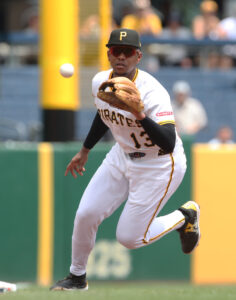
Hayes, 28, is a former first-round pick and top prospect who looked to be on the cusp of stardom early in his career. He graded as an elite defensive third baseman throughout his time in the minors and hit well as he climbed the minor league ladder. Hayes made an electric debut in the shortened 2020 season, showing off that plus-plus glove while hitting .376/.442/682 in his first 95 big league plate appearances.
Hayes didn’t replicate that output in his first full big league season in 2021, but he held his own with a .257/.316/.373 batting line in 396 plate appearances despite missing significant time due to a wrist injury. He hit just six homers but played outstanding defense and swiped nine bags. The following April, Pittsburgh signed him to an eight-year, $70MM deal which, at the time, was the largest in franchise history.
Unfortunately for Hayes and the Pirates, back injuries have become a recurring problem in Hayes’ still-young career. He’s spent significant time on the injured list due to back troubles in 2022, 2023 and 2024 — totaling five IL stints due to his back in that period of three years. Hayes still managed a league-average season at the plate in 2023 (.271/.309/.453, 100 wRC+, 15 homers, 10 steals) but he’s been a well below-average hitter since. In 788 plate appearances dating back to Opening Day 2024, he’s mustered only a .234/.281/.290 batting line (58 wRC+).
The Pirates frontloaded Hayes’ extension, paying him $10MM in each of the contract’s first two seasons and then cutting the salary back to $7-8MM per year thereafter. He’s making $7MM in 2025, with about $2.26MM of that sum yet to be paid out. He’ll then be owed $36MM from 2026-29 ($30MM in salary plus at least a $6MM buyout on a $12MM club option for the 2030 season).
It’s a relatively hefty sum to take on, though Hayes remains such a premium defender that his glove alone is arguably worth the remaining $9MM annual value on the contract (including the 2026 buyout). Hayes has been credited with an astonishing 91 Defensive Runs Saved and 73 Outs Above Average in 4796 career innings at third base, including 16 DRS and 15 OAA in 861 innings this year already. Since Hayes debuted in 2020, he leads all of Major League Baseball (at all positions) in both DRS and OAA. Andres Gimenez‘s 63 DRS and Francisco Lindor‘s 68 OAA are the second-highest marks in each category.
On top of a legitimate claim to being the game’s top defensive player, Hayes does have some encouraging offensive trends. His 20.7% strikeout rate in 2025 matches his career mark and checks in lower than the league average. He also regularly posts strong batted-ball metrics. Hayes has averaged 90.7 mph off the bat in his career, and 46.3% of his batted balls have traveled 95 mph or faster. The downside, however, is that far too much of that hard contact comes in the form of ground-balls. A hefty 49.5% of Hayes’ career batted balls have been hit into the ground, and his lack of consistent elevation offsets his average power.
A move to Cincinnati’s Great American Ball Park could prove beneficial. Pittsburgh’s PNC Park is the toughest park in MLB on right-handed power over the past three years, per Statcast’s Park Factors. Great American, meanwhile, has been the second most conducive park to right-handed home runs in that time. It’s feasible that Hayes might at least eke out a few extra home runs just from the more favorable dimensions in his new home park.
The acquisition of Hayes could push infielder Noelvi Marte into the outfield on a more permanent basis. Marte is enjoying a nice rebound year at the plate, batting .276/.329/.500 with seven home runs and six steals in 146 plate appearances. Cincinnati has been having Marte go through outfield drills and has given him eight innings of actual right field (three games) over the past couple weeks.
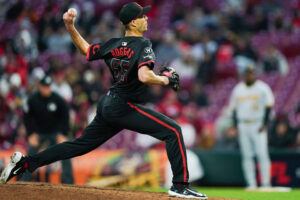
Rogers’ inclusion in the Hayes return is solely for financial purposes. The 34-year-old is an impending free agent earning $12MM in the final season of a three-year $33MM contract, though the Giants are paying half that salary under the terms of the offseason trade that shipped him to Cincinnati. The Pirates, in all likelihood, will turn around and try to trade Rogers before tomorrow afternoon’s deadline.
So far in 2025, Rogers has pitched to a 2.45 ERA with a 23.3% strikeout rate and 13% walk rate in 33 innings. Rogers has a track record as a closer and setup man but hasn’t been used frequently in high-leverage spots by the Reds this year. He should draw some interest, especially if Pittsburgh is willing to pay down some of the $1.94MM he’s still owed through season’s end.
Beyond shedding the entirety of an unwanted contract, the Pirates’ return in the trade is the 20-year-old Stafura. He’s just two years removed from being the No. 43 overall pick in the draft and receiving an over-slot bonus of nearly $2.5MM. Stafura was regarded as a potential first-round pick in 2023. He’s spent the 2025 season in Class-A, hitting .262/.393/.411 (131 wRC+) with four home runs, 18 doubles, nine triples and 28 stolen bases (in 33 attempts).
Stafura possesses well above-average speed and has walked in more than 15% of his plate appearances in his professional career. His 23.9% strikeout rate is a bit high and there have been some concerns about Stafura’s hit tool. He’s played 170 of his 172 games in the field at shortstop (plus two at second base). Baseball America, in ranking Stafura ninth among Reds farmhands, noted that while Stafura has a roughly average arm, it’s quite accurate and he has the other defensive skills needed to stick at shortstop. It’s always possible Stafura will eventually slide to second or move into a utility role, but for now, the Pirates figure to keep him at shortstop.
Cincinnati has spent much of the past few weeks looking for offensive upgrades. Hayes is quite possibly an offensive downgrade, but he’ll be a massive boost to the team’s defense. The Reds, presumably, will remain in the market for a hitter who can more meaningfully upgrade their lineup.
Mark Feinsand, Mark Sheldon and Alex Stumpf of MLB.com first reported that Hayes had been traded to the Reds. Ken Rosenthal of The Athletic first reported the return. Noah Hiles of the Pittsburgh Post-Gazette reported that the Reds were taking on Hayes’ entire contract.
Poll: Will The Pirates Be Able To Trade Ke’Bryan Hayes?
The Pirates have been one of the league’s most obvious sellers for quite some time now. Most of the attention has been on pieces like Mitch Keller and David Bednar, both of whom could bring back substantial returns as quality pitchers with multiple years of team control. With that being said, third baseman Ke’Bryan Hayes has found his name in the rumor mill on occasion this summer. Noah Hiles of the Pittsburgh Post-Gazette noted earlier this week that the Pirates have a “notable desire” to move on from Hayes, who will have $36MM left on his deal after this season, in addition to the balance of this year’s $7MM salary.
It’s not hard to see why Pittsburgh might like to part ways with their former top prospect. Hayes’s salary isn’t exactly pricey, but for a small market club like the Pirates, even a relatively cheap contract that’s underwater relative to the player’s production can be an issue. The 28-year-old has rarely been healthy throughout his big league career, and even when healthy has struggled on offense. This year, he’s slashing a paltry .234/.288/.300 with a wRC+ of 61. He’s striking out at a 20.9% clip, walking just 4.8% of the time, and offers virtually no power with the lowest ISO among all qualified hitters this year. He hits the ball hard but into the ground far too often.
While the Pirates wanting to move on from Hayes as they look to build a more potent offense around a strong rotation led by Paul Skenes makes plenty of sense, it’s an open question whether or not the club will be able to find a taker on his services. A player with virtually no offensive value and a long-term guaranteed contract isn’t exactly an attractive trade asset, after all. Hayes’s glove at third base is elite, with an incredible +14 Outs Above Average this year, but a glove-only player at a corner position is still a questionable fit on most contenders.
The Cubs, Yankees, and Tigers have all been connected to Hayes in at least some capacity, but it’s a somewhat open question as to how serious that interest may actually be. The Cubs have rookie Matt Shaw currently installed at the hot corner, and while his 79 wRC+ has been disappointing, Hayes would actually be a downgrade for Chicago offensively. Colt Keith and Zach McKinstry have been handling third base for Detroit and have both been above-average offensive contributors this year, meaning Hayes would hardly be a clear upgrade for them either. Hayes would actually be a clear upgrade for the Yankees, as both Jorbit Vivas and Oswald Peraza are less valuable than him on both defense and offense. That said, the Yankees are known to have eyes on a number of other possible third base options like Eugenio Suarez and Ryan McMahon who are likely more attractive than Hayes.
That all makes it difficult to imagine the Pirates swinging a trade involving Hayes, but one thing working in the club’s favor is that Hiles suggesting that they’re “likely” to prioritize simply getting Hayes’s contract off their books in any deal. Perhaps a club that isn’t interested in parting with precious prospect capital that has some money to spare in the budget could then see Hayes as a viable option to improve their infield or bench mix who won’t cost them much of anything. With that said, Hayes’s contract would be quite expensive for a bench player, meaning it could be difficult to convince a club to take him on without the Pirates absorbing some salary unless the acquiring team believes in Hayes as a starter.
One possible solution could be attaching Hayes to a more attractive trade asset like Keller or Bednar, but doing so would likely force them to lower their asking price for that asset considerably. Even for a team with as low of a budget as Pittsburgh, lowering the trade value of a major piece just to save money in a salary dump would be a difficult pill to swallow for fans. And it may not even be an attractive proposition for a front office that clearly hopes to contend while Skenes is still in town and will need to acquire as much offensive talent as possible in order to make that happen. On the other hand, perhaps the $36MM guaranteed Hayes is due in 2026 and beyond could be reallocated to upgrading the offense via free agency. Just for an example, Paul Goldschmidt, Gleyber Torres, Austin Hays, and Mike Tauchman signed one-year deals for a combined $34MM in free agency this past winter and each would’ve represented a substantial upgrade to the Pirates’ offense.
What do MLBTR readers think is next for Hayes and the Pirates? Will Pittsburgh manage to trade Hayes? If so, will they be able to do so without eating significant salary or attaching him to another more valuable player? Or will Hayes still be in town on August 1? Have your say in the poll below:
Will The Pirates Find A Taker On Ke'Bryan Hayes?
-
No, Hayes will remain in Pittsburgh on August 1. 45% (1,584)
-
The Pirates will trade Hayes, but they'll have to retain a portion of his salary or attach him to a more valuable player in order to get it done. 34% (1,214)
-
The Pirates will trade Hayes and won't need to eat salary or attach his contract to another player in order to do so. 21% (757)
Total votes: 3,555
Cubs, Tigers Among Teams Interested In Ke’Bryan Hayes
Pirates third baseman Ke’Bryan Hayes is drawing interest from multiple teams, with reporter Francys Romero listing last week that the Cubs, Tigers, and Yankees were all “potential suitors.” Jon Heyman of the New York Post wrote a few days ago that Hayes was indeed “on the Yankees’ radar,” and Noah Hiles of the Pittsburgh Post-Gazette writes that Chicago and Detroit have also checked in with the Pirates about Hayes’ status.
Hayes remains one of the sport’s best defenders at any position, as he is again posting fantastic numbers (+13 Outs Above Average, +11 Defensive Runs Saved) over 710 1/3 innings at the hot corner. The 28-year-old has also played in 83 games this season and thus far stayed off the injured list, which is noteworthy given how recurring back problems have plagued Hayes for multiple years, and limited him to just 96 games in 2024.
On the down side, Hayes is still producing next to nothing at the plate. It seemed as though Hayes was turning a corner with his .762 OPS season in 2023, as even producing league-average offense along with his superb glove would’ve made Hayes a great all-around boost to Pittsburgh’s lineup. However, his bat has cratered over the last two years, as his .238/.288/.295 slash line over 721 plate appearances has resulted in a dismal 62 wRC+. Since Opening Day, Hayes has the lowest wRC+ of any player in baseball with at least 700 PA.
Another possible obstacle to a trade is the eight-year, $70MM extension Hayes signed with the Pirates in April 2022. He is still owed the remainder of his $7MM salary for 2025, $30MM over the 2026-29 seasons, and then a $6MM buyout of a $12MM club option for the 2030 campaign. As great as Hayes’ glovework is, a trade partner would be taking a risk in absorbing over $39MM for a player with a history of both back problems and lackluster offense.
Third base has been a problem area for the Cubs all season, as the team’s hope that top prospect Matt Shaw was ready for prime time hasn’t yet paid off. A month-long demotion to Triple-A resulted in a brief surge at the plate once Shaw was recalled to the majors in May, but his bat tapered off again, and Shaw is hitting only .207/.288/.293 over 222 PA. Backup options like Vidal Brujan or Jon Berti also haven’t contributed much, leaving the hot corner as a clear weak link in an otherwise very strong Chicago lineup.
Hayes’ lack of pop would be less of an issue amidst so many other strong hitters, yet Shaw is no slouch with the glove himself — he has +6 DRS, though the OAA metric has him only league-average over 487 2/3 innings at third base. Acquiring Hayes would also block Shaw at third base over an extended period of time, whereas just picking up a rental third baseman at the deadline would help the Cubs’ chances of winning in 2025 while still keeping Shaw in line as the third baseman of the future.
It can be argued that third base isn’t even a need position for the Tigers at all, as the position has become Zach McKinstry‘s most common pathway into the lineup. McKinstry is hitting an impressive .285/.356/.456 over 307 PA, and he has gone from being a utility option to a near-everyday option for manager A.J. Hinch. The advanced metrics indicate that McKinstry is due for regression, however, and the fact that he hasn’t hit anywhere near this level in his previous five Major League seasons could leave Detroit looking for more stability at third base.
Javier Baez, Colt Keith, Jace Jung, and Andy Ibanez have all also seen time at third base for the Tigers this year, with the latter two currently in Triple-A. Baez looks to have re-established himself at shortstop and Detroit would love to see Keith find a regular spot for himself in the lineup, as his past positions of first and second base have been filled by Spencer Torkelson and Gleyber Torres. Relying on Keith for a pennant run is risky, however, so the Tigers may prefer exploring veteran third base options at the deadline.
From the Pirates’ perspective, it isn’t surprising that the club is already open to moving a player that so recently seemed like a building block. With the Buccos now approaching their seventh straight losing season, it isn’t clear if their rebuild is bearing much fruit, even with Paul Skenes‘ rise to superstardom and so many other promising young arms on the way. The struggling Pirates are reportedly open to moving basically anyone besides Skenes and Andrew McCutchen, and dealing Hayes has the side benefit of moving a long-term financial commitment from the team’s books.
Yankees Have Shown Interest In Ryan McMahon
As the Yankees search for infield upgrades to address their need for either a second baseman or third baseman — Jazz Chisholm Jr. can play either spot — they’ve reached out to the Rockies regarding the potential availability of Ryan McMahon, reports Jon Heyman of the New York Post. While the Rockies have been unwilling to entertain offers for McMahon in the past, Heyman suggests that they’re willing to listen this time around as they barrel toward a potentially historic loss total in 2025. He adds that New York has yet to contact the D-backs about Eugenio Suarez, though that has more to do with Arizona being within arm’s reach of a Wild Card spot (three games back) than a lack of interest.
McMahon would bring a major upgrade to a Yankees infield that has felt one player short all season. Chisholm has split his time almost evenly between second base (251 innings) and third base (214 innings), performing well with the bat at both spots. He’s hitting .240/.339/.490 on the season and has swatted 14 homers to go along with 10 steals. His 28.2% strikeout rate is up nearly four percentage points over his 2024 levels, but Chisholm’s 11.5% walk rate is far and away a career-high mark.
Chisholm told The Athletic’s Chris Kirschner earlier this week that he knows he’s a better defender at second base and that he’d prefer to be playing there if all else were equal, but he’s happy to do “whatever it takes to help the team win.” A trade for McMahon (or another third baseman) could kill two birds with one stone: solidify the hot corner and get Chisholm back to the position at which he’s most comfortable and best-suited to play.
Earlier this year, it looked as though the Rockies may have missed the boat on trading McMahon. He drew considerable interest in the weeks and months leading into last summer’s trade deadline, but McMahon is reportedly a favorite of Rox owner Dick Monfort, who wasn’t keen on shipping out an All-Star infielder who’s signed affordably through 2027. McMahon wound up falling into a deep slump over the season’s final two months and started the 2025 campaign with the least-productive month of his big league tenure. He entered the month of May hitting just .147/.273/.235 with a sky-high 35.5% strikeout rate.
McMahon homered on May 1, however, and it’s been business as usual for him since. He’s largely back into All-Star form, hitting at a .253/.343/.468 clip with 10 homers, nine doubles and a triple in his past 216 turns at the plate. It should be noted that he’s currently in a bit of a cold spell, with just two hits and 11 strikeouts in his past 23 plate appearances, but nothing so drastic or prolonged as his swoon from August through April (.179/.272/.275, 320 plate appearances). He’s still hitting only .216/.318/.387 on the season because of that disastrous first month, but the trend lines in May and most of June were quite favorable.
On top of his resurgent bat, McMahon has maintained his status as a premium defensive player. Both Defensive Runs Saved (3) and Statcast’s Outs Above Average (3) grade him as a positive in 2025. He’s not on quite the same pace as he was in 4434 innings from 2021-24 (50 DRS, 38 OAA), but McMahon is an unequivocal plus defender at the hot corner who also has ample experience and strong defensive grades at second base.
McMahon’s contract is surely appealing to the Yankees as well. He’s not necessarily a raucous bargain, but the former No. 42 overall draft pick is being paid $12MM this season and is owed $16MM in both 2026 and 2027. The Yankees would pay a 110% tax on his contract’s annual value, given their status as a third-time offender in the top tier of luxury penalization, but McMahon’s six-year, $70MM extension is still well shy of the market rate for a plus defensive third baseman with 25-homer pop.
Heyman also suggests that Pirates third baseman Ke’Bryan Hayes is at least “on the Yankees’ radar” as a change of scenery candidate, though he’d be a pure project. Hayes is an elite defender whose offensive output has cratered after recurring back troubles have popped up in recent years. He’s playing out an eight-year, $70MM contract signed with Pittsburgh prior to those back troubles surfacing. The Pirates owe him a $7MM salary this season and are on the hook for an additional $36MM over the contract’s final four guaranteed seasons (2026-29).
Hayes is hitting well over the past three weeks (.324/.342/.405 in 76 plate appearances), but it’d be a pretty big leap of faith to expect that to continue, considering the 28-year-old’s composite .239/.289/.297 slash in 714 plate appearances dating back to Opening Day 2024. Still, given the strength of his glove, his above-average speed and solid contact skills, Hayes at least makes sense for infield-needy clubs to track as a long-shot trade candidate.