
Reds To Pursue Trading Players On Expiring Contracts
The Reds are looking to move their rental pieces, reports C. Trent Rosecrans and Ken Rosenthal of The Athletic. Cincinnati fell to 44-53 with a blowout loss to the Rockies this afternoon. The club is seven games out of the final NL Wild Card spot.
The report notes the Reds are intent on trading players with expiring contracts. It doesn’t mention whether the organization would be willing to part with players who still have team control. Sources also tell Rosecrans and Rosenthal that Cincinnati would consider bringing in big-league talent that would help the club in the near future. Here’s a rundown of the rental players up for grabs…
The 29-year-old righty is one of the most expensive players on the roster. He is making $12.75MM in his last year of arbitration. Singer has not covered himself in glory heading into free agency. He has a 4.56 ERA supported by a 4.41 xFIP and a 4.37 SIERA across 19 starts. Singer’s 19.2% strikeout rate is the second-lowest mark of his career.
Home runs have been a major issue for Singer this season. He’s been taken deep 21 times, tied for the fifth-most in the league. One might assume getting him out of hitter-friendly Great American Ball Park would help, but that actually hasn’t been the problem. Singer has a sub-3.00 ERA at home. His homers have been split almost evenly between GABP and road venues. Singer has been a workhorse, so his durability could intrigue teams in need of reliable innings.
[Related: Reds Trade Deadline Outlook]
The follow-up to Suarez’s 49-homer season has not gone as planned. He’d posted an 85 wRC+ through 271 plate appearances heading into Saturday. Suarez’s strikeout rate, which has always been elevated, has exploded to a career-worst 35.8%. He’s been a subpar defender at third base (-5 Defensive Runs Saved). An oblique injury cost the veteran a month of action.
Suarez returned to Cincinnati on a $15MM deal with a mutual $16MM option for next season. He’s almost certainly heading back to the free agent market this offseason. Trading for him would be blind faith that his power stroke returns over the final two months of the year.
The Reds added Lowe on a minor league deal. It looked like a huge win for a couple of months. The veteran first baseman carried an .895 OPS into June. He’s fallen back to earth since then, but his wRC+ still sits at a solid 114 before Saturday’s game. Lowe has been an above-average bat every season except last year, when he struggled in stints with the Nationals and Red Sox. He’d fit nicely as a platoon bat/bench option for a contender.
The longtime backstop has also stumbled ahead of his first foray into free agency. Stephenson is slashing .238/.318/.359 across 74 games. He’s posted -6 DRS behind the plate. Stephenson has shown some power in his time with the Reds, and he has a strong 21.6% pulled air rate this year. The home runs could be coming. Stephenson might be a nice fallback for teams who miss out on Ryan Jeffers.
The Relievers (Pierce Johnson, Caleb Ferguson, Brock Burke)
This seems like the most likely group to be moved. They’re all pitching reasonably well and should find themselves on playoff teams after the deadline. Johnson joined the club on a $6.5MM deal. He has a 4.23 ERA, though a 6.24 xERA is cause for concern. Johnson has picked up five holds and a save as a member of Cincinnati’s high-leverage mix.
Ferguson and Burke are likely to have the attention of teams looking for lefty help. The former shook off an early-season oblique strain to deliver a 1.76 ERA through June. Ferguson has been scored upon a few times in July, but he’s generally been reliable, despite a dip in velocity. Burke has been one of the most-used relievers in the league. Only Mason Fluharty of the Blue Jays has more appearances than Burke’s 48. The veteran has chipped in nine holds and a save. He has a sub-3.00 ERA, though it comes with a 4.48 xERA and a 5.07 xFIP.
Photo courtesy of Isaiah J. Downing, Imagn Images
Reds Activate Eugenio Suarez, Place Ke’Bryan Hayes On 10-Day IL
The Reds placed third baseman Ke’Bryan Hayes on the 10-day injured list yesterday, while also activating third baseman Eugenio Suarez from the 10-day IL. Suarez returns after missing a month due to an oblique strain, while Hayes (whose placement is retroactive to May 21) is dealing with a lumbar bulging disc.
Back problems have been a recurring issue for Hayes over the years, and Cincinnati manager Terry Francona told The Athletic’s C. Trent Rosecrans and other reporters that Hayes has been bothered by a bad back at various points this season. “I think the spasming has gotten to the point where it’s kind of getting in the way,” Francona said, so the decision was made to let Hayes fully recover during an IL stint.
Beyond just getting healthy, Francona suggested that Hayes’ rehab process will include a stint working on his offensive mechanics at the Reds’ Spring Training facility in Arizona. The Reds were hoping that Hayes might find some untapped hitting potential after he was acquired from the Pirates at last year’s trade deadline, but whatever changes Hayes has made with his new team haven’t worked. Never known for his offense even at the best of times, Hayes’ bat has completely cratered this year, as he has hit only .142/.195/.225 over 128 plate appearances.
While Hayes remains one of baseball’s top defensive third basemen, excellent glovework only goes so far when a player has a 12 wRC+ — the lowest of any player in baseball with at least 120 PA. Sal Stewart had already started to receive some starts at third base even before Hayes went on the IL, and Stewart will likely get the majority of time at the hot corner while Suarez may make the odd start but is more likely to again factor heavily in the DH mix.
Cincinnati’s struggling offense will naturally get a boost from inserting Suarez in Hayes’ place, even if Suarez himself has yet to get going in 2026. After signing a one-year, $15MM free agent deal this past winter, Suarez’s encore in a Reds uniform has thus far resulted in three homers and a .231/.300/.363 slash line over an even 100 PA before the oblique strain sent the veteran to the injured list.
2026-27 Club Options: NL Central
In recent weeks, MLBTR has looked forward to next winter’s option classes. We’ll move now to the NL Central, where the Cubs have a number of low-cost options to weigh.
Previous: AL East, AL Central, AL West, NL East
Chicago Cubs
- Matthew Boyd, LHP: $15MM mutual option ($2MM buyout)
Mutual options are essentially never exercised, so Boyd will be paid the $2MM buyout and return to free agency next winter. That’ll conclude a two-year, $29MM free agent deal that worked out well. Boyd’s 3.21 ERA over 31 starts a year ago essentially paid for the contract on its own.
The second season isn’t going as planned. Boyd missed a couple weeks in April with a biceps strain and suffered a more significant meniscus injury in his left knee earlier this month. He underwent surgery that’ll keep him out into late June at the earliest. The Cubs probably aren’t keen on their end of the option.
- Hunter Harvey, RHP: $8MM mutual option ($1MM buyout)
Chicago added Harvey on a one-year, $6MM deal in December. The talented but oft-injured reliever only pitched four times before landing on the injured list with triceps inflammation. Further testing this month revealed a stress reaction that’ll keep him down for a while. This will be an easy pass for the team.
- Carson Kelly, C: $7.5MM mutual option ($1.5MM buyout)
Kelly has outperformed his two-year, $11.5MM deal signed in December 2024. Initially brought in as a veteran complement to Miguel Amaya, the 31-year-old Kelly has earned the majority of the playing time. He’s a .261/.344/.421 hitter with 19 homers over his season-plus in Chicago. He’s fourth among primary catchers this season with a .381 on-base percentage. Kelly has a strong case for another two-year contract at a better annual rate than the option price, so his camp should have an easy time passing.
- Colin Rea, RHP: $7.5MM club option ($1MM buyout)
Rea, a 35-year-old swingman, is in the second season of his second stint with the Cubs. He’s clearly a favorite of skipper Craig Counsell, who also managed him in Milwaukee in 2021 and ’23. Rea pitched pretty well last season, managing a sub-4.00 ERA while starting 27 of 32 games. The Cubs had a $6MM team option for 2026, but the sides agreed to a restructured extension that guaranteed Rea $6.5MM in exchange for the righty tacking on a similarly priced club option for 2027.
Injuries again quickly pushed Rea from long relief into a back-end rotation spot. He hasn’t performed as well as he did last season, allowing nearly five earned per nine across 47 frames. Rea had consecutive quality starts against the Phillies in mid-April but has surrendered a 7.04 ERA over his past five times out.
Rea’s strikeout, walk and home run rates are all virtually identical to last season’s. There haven’t been any meaningful changes to his pitch mix or velocity. He’s essentially the same pitcher, with this year’s ERA spike mostly due to a higher average on balls in play. That’s always a risk for a pitcher like Rea who pounds the strike zone but doesn’t have overpowering stuff.
The Cubs will presumably look for a rotation upgrade or two in July that can push him back into a relief role. A buyout seems likelier than them picking up the option, though it wouldn’t be a surprise if they try to bring him back a slightly lower price given his flexibility in usage.
- Caleb Thielbar, LHP: $6MM mutual option ($500K buyout)
Chicago brought back Thilebar on a $4.5MM deal after he worked 58 innings of 2.64 ERA ball in 2025. The southpaw is making $4MM this year and will earn a $500K buyout at season’s end. He missed just under a month with a left hamstring strain and has been limited to 12 appearances. Thilebar has recorded 11 punchouts while allowing four runs (three earned) across 9 2/3 innings. The Cubs will probably pass on their end but could have interest in keeping Thielbar around for his age-40 season at slightly less money.
- Jacob Webb, RHP: $2.5MM club option (no buyout)
The Rangers surprisingly non-tendered Webb after he turned in 66 innings with an even 3.00 earned run average. Chicago signed him to a $1.5MM free agent deal that includes a $2.5MM team option for 2027. The righty has been a nice addition to Counsell’s middle relief corps, striking out a quarter of opponents with a 3.05 ERA over 20 2/3 innings. He’s getting swinging strikes and chases off the plate at career-best rates.
Webb has allowed right around three earned runs per nine in three straight seasons. His market has never really materialized, but a $2.5MM option is cheap enough that the Cubs would very likely bring him back if he keeps this pace all year.
The Cubs hold a $3.3MM club option on RHP Javier Assad. He’ll remain eligible for arbitration through at least 2028 even if the option is declined.
Cincinnati Reds
- Pierce Johnson, RHP: $8MM mutual option ($1.5MM buyout)
Cincinnati picked up Johnson on a one-year, $6.5MM deal after the Braves bought him out. The veteran righty has allowed eight runs over 19 1/3 innings with league average strikeout and walk numbers. His 9.3% swinging strike rate is a career low. Johnson is an MLB-caliber arm but more of a middle reliever than a setup man at age 35. An $8MM option price is too rich on the Reds’ end.
- Eugenio Suárez, DH/3B: $16MM mutual option
Cincinnati brought Suárez back on a one-year, $15MM deal late in the winter. It looked like a nice bargain pickup for a team that needed offense. Suárez’s age evidently tamped down long-term interest, but he hit 49 home runs a year ago. The return has started slowly, as he hit .231/.300/.363 through 100 plate appearances before sustaining a left oblique strain that sent him to the injured list. He began a rehab assignment with Triple-A Louisville yesterday.
The Reds will also pay a $3MM buyout to released infielder Jeimer Candelario.
Milwaukee Brewers
- Luis Rengifo, 3B: $10MM mutual option ($1.5MM buyout)
Milwaukee bought low on Rengifo with a $3.5MM deal in Spring Training. He’s making a $2MM salary and due a $1.5MM buyout on a $10MM mutual option. They haven’t gotten anything close to the desired bounce back. The switch-hitting utilityman carries a .199/.262/.257 line without a home run over 150 plate appearances. Third base feels like a priority for the Brewers at the deadline, at which point they could move on from Rengifo entirely.
- Gary Sánchez, C: Mutual option
The terms of Sánchez’s mutual option were never reported. He signed a $1.75MM guarantee to return to Milwaukee as a backup catcher/part-time DH. Although Sánchez is only hitting .198, he has walked 20 times and hit five home runs in 108 plate appearances. The Brewers will eventually want a look at prospect Jeferson Quero, but William Contreras will be an offseason trade candidate with free agency looming after 2027. They could look to keep Sánchez around as a cheap #2 catcher.
Milwaukee holds a $14.5MM club option on C William Contreras for his final season of arbitration. He’ll remain under team control if Milwaukee declines.
Pittsburgh Pirates
- Marcell Ozuna, DH: $16MM mutual option ($1.5MM buyout)
Pittsburgh added Ozuna late in the offseason on a $12MM deal. It didn’t make much sense at the time since it locked all of Ryan O’Hearn, Brandon Lowe and Spencer Horwitz into defensive spots without a fallback at designated hitter. Ozuna was also coming off a mediocre second half and playing in one of the toughest home parks for right-handed power.
Ozuna had an atrocious April. He’s at least drawing a lot of walks in May, but his season .179/.275/.305 line isn’t cutting it. It goes without saying that the Pirates aren’t exercising a $16MM option. The bigger question is whether they’ll keep Ozuna on the roster all year.
St. Louis Cardinals
- Dustin May, RHP: $20MM mutual option ($500K buyout)
May commanded a surprisingly strong $12.5MM guarantee despite coming off a 4.96 ERA season between the Dodgers and Red Sox. He’s making a $12MM salary and will collect a $500K buyout on the $20MM mutual option at season’s end. May has stayed healthy and taken all nine turns through the rotation, but he’ll take a 4.81 ERA into today’s start against the Pirates. His strikeout and whiff rates are well below average despite his 97 mph fastball. While May’s power stuff and early-career success have continued to intrigue teams, the recent performance has been that of a fifth starter. The Cardinals aren’t signing up for a $20MM option.
- Ryne Stanek, RHP: $6MM club option (no buyout)
St. Louis added the hard-throwing Stanek on a $3.5MM deal in January. They wanted an experienced leverage arm who could compete for the closing role and potentially be a midseason trade asset. Riley O’Brien seized the ninth inning, leaving Stanek alongside JoJo Romero and George Soriano in the setup group.
Stanek continues to sit around 98 mph and generate above-average strikeout and whiff rates. His already problematic control has pushed even further, though, and he’s walking nearly 18% of opposing hitters. It’s the third-highest mark among pitchers with at least 20 innings. The free passes have resulted in a 6.30 ERA over 23 appearances. Teams are inclined to bet on pitchers with this kind of stuff, but Stanek will need a better second half to convince the Cardinals (or a potential midseason trade partner) to bring him back for $6MM.
- Ramón Urías, 3B: $4MM mutual option ($500K buyout)
St. Louis added Urías on a $2MM free agent deal during Spring Training. He’s making $1.5MM in salary and will be paid a $500K buyout. Urías limped to a .158/.279/.316 start over 25 games before landing on the injured list with tennis elbow.
NL Central Notes: Woodruff, Lockridge, Suarez, Lowder
Brewers right-hander Brandon Woodruff was back with the club for a series against the Yankees after having fluid removed from his shoulder. He’ll play catch this weekend as he nears a return to the mound, relays Adam McCalvy of MLB.com.
Woodruff’s progression is encouraging, considering how he looked in his most recent outing. The veteran was removed after just six batters during an April 30 start against the Diamondbacks. His fastball was down more than 7 mph. Woodruff was soon placed on the injured list with shoulder inflammation.
The 33-year-old Woodruff has dealt with shoulder and lat injuries for the past three years. He missed all of 2024 due to shoulder surgery. Even before the outing against Arizona, Woodruff’s velocity was down slightly from last season. He’s several years removed from averaging mid-90s with the heater.
Despite operating at a lower velocity, Woodruff has been effective. He’s working with three fastballs these days, adding a cutter to his four-seamer and sinker. The veteran is throwing his changeup more than ever. Woodruff delivered a 3.20 ERA with a career-best 32.3% strikeout rate in a dozen starts last year. The strikeouts are down this season, but he has a solid 3.60 ERA through 30 innings.
Here’s more from around the division…
- Brewers outfielder Brandon Lockridge seems to have escaped serious injury after crashing into the wall on Friday against the Yankees. He was carted off the field and needed nine stitches to address a deep cut near his knee. Lockridge was back in the clubhouse on Saturday and hopes to return after close to a minimum stint on the IL, per McCalvy. Manager Pat Murphy was less optimistic, expecting the outfielder to miss at least a month. Blake Perkins was recalled to take Lockridge’s spot on the roster.
- Reds third baseman Eugenio Suarez took 50 swings on Thursday as he works his way back from a strained oblique, relays FOX 19’s Charlie Goldsmith. The veteran infielder hasn’t played since April 22. Suarez was off to a difficult start in his second stint with Cincinnati, slashing .231/.300/.363 across 100 plate appearances. After matching a career high with 49 home runs in 2025, he’s left the yard just three times this year.
- Also from Goldsmith, Reds right-hander Rhett Lowder isn’t dealing with any structural damage in his shoulder. He received an injection and could throw a bullpen on Sunday. Lowder left after three innings on Thursday against the Cubs. He hasn’t been placed on the IL yet. Cincinnati got lefty Nick Lodolo back on Friday. He took the spot of right-hander Chase Petty, who is scheduled to start at Triple-A on Sunday.
Photo courtesy of Benny Sieu, Imagn Images
Reds Place Eugenio Suárez On 10-Day Injured List
TODAY: Cincinnati officially announced Suarez’s IL placement, retroactive to April 24. Right-hander Kyle Nicolas was also optioned to Triple-A, and Bleday and right-hander Jose Franco were called up from Triple-A in corresponding moves.
APRIL 24: The Reds will place Eugenio Suárez on the 10-day injured list with a low-grade oblique strain, manager Terry Francona told reporters (including Charlie Goldsmith). He was scratched from tonight’s game with what the team initially called mid-back discomfort.
Although oblique strains can linger for hitters, this one doesn’t appear to be particularly serious. Goldsmith writes that the team is hopeful Suárez can resume baseball activities after a brief shutdown and reevaluation. The Reds can backdate the placement to April 23, meaning the earliest he could return is May 3.
Outfielder JJ Bleday was removed from tonight’s Triple-A game after two plate appearances. That seemingly points to him being recalled tomorrow as the corresponding move. It would be Bleday’s first look at the MLB level with Cincinnati. He has been on optional assignment all year but is on a tear in the minors, batting .345 with six homers through his first 23 games.
Bleday isn’t a direct positional replacement for Suárez, but the Reds have used the latter mostly as a designated hitter. He has only made six starts at the hot corner compared to 18 appearances as the DH. They’re a much better defensive team with Ke’Bryan Hayes at third base, but the two-time Gold Glove winner is out to a terrible start at the plate.
Hayes is hitting .081 with one home run in his first 68 trips to the dish. Cincinnati has managed to keep winning despite getting nothing offensively from Hayes, catcher Tyler Stephenson, or any of their outfielders. Suárez hasn’t been particularly productive either, batting .231/.300/.363 with just three home runs through his first 100 plate appearances.
The Reds nevertheless pulled out another improbable win on Friday. Nathaniel Lowe, who drew into the lineup at DH with Suárez out, hit a walk-off two-run homer off Kenley Jansen with two outs in the ninth. That was Lowe’s second of the night, his first two longballs in a Cincinnati uniform. They’re up to 17-9 despite entering the night ranked 24th in MLB in scoring.
Lowe figures to pick up most of the extra at-bats while Suárez is sidelined. The bench skews left-handed and will lean even more in that direction if Bleday is the corresponding move. Lowe has a decent career track record against pitchers of either handedness and got the DH assignment tonight against Detroit southpaw Framber Valdez. Hayes seems assured of continued run at third base for the time being.
MLBTR Podcast: Twins Front Office Shake-Up, The Brendan Donovan Trade, Eugenio Suarez, And More!
The latest episode of the MLB Trade Rumors Podcast is now live on Spotify, Apple Podcasts, and wherever you get your podcasts! Make sure you subscribe as well! You can also use the player at this link to listen, if you don’t use Spotify or Apple for podcasts.
This week, host Darragh McDonald is joined by Steve Adams of MLB Trade Rumors to discuss…
- The Twins parting ways with president of baseball operations Derek Falvey (2:10)
- The Mariners getting Brendan Donovan in a three-team trade with the Cardinals and Rays (18:15)
- The Reds signing Eugenio Suárez (35:50)
- The Pirates reportedly just missing on Suárez and what they could still do at this late stage of the offseason (39:20)
- The Giants having an agreement Luis Arráez and also Harrison Bader (49:20)
- The White Sox acquiring Jordan Hicks from the Red Sox (58:35)
- The Athletics signing Jacob Wilson to an extension (1:12:20)
- Several players not being allowed to participate in the World Baseball Classic due to insurance issues (1:16:05)
Check out our past episodes!
- Examining MLB’s Parity Situation – Also, Bellinger, Peralta, Robert, And Gore – listen here
- What The Tucker And Bichette Contracts Mean For Baseball – Also, Nolan Arenado And Ranger Suarez – listen here
- The Cubs Land Cabrera And Bregman, Remaining Free Agents, And Skubal’s Arbitration Filing – listen here
The podcast intro and outro song “So Long” is provided courtesy of the band Showoff. Check out their Facebook page here!
Photo courtesy of Joe Puetz, Imagn Images
Reds Sign Eugenio Suarez
February 3rd: The Reds made the Suarez deal official today. Catcher Ben Rortvedt was designated for assignment as the corresponding move.
February 1st: Eugenio Suarez is returning to Cincinnati, as ESPN’s Jeff Passan reports that the slugger has signed a one-year, $15MM deal with the Reds that includes a mutual option for the 2027 season. Jon Heyman of the New York Post reports that the option is worth $16MM, though mutual options are rarely triggered by both sides. The deal will become official once the Reds clear a spot on their 40-man roster, and presumably when Suarez passes a physical. Suarez is represented by Octagon.
Reports emerged last week that the Reds had interest in a reunion with the third baseman, who hit .253/.335/.476 with 189 homers over 3730 plate appearances during the 2015-21 seasons. The continued uncertainty over the Reds’ broadcast deal with Main Street Sports was said to be a holdup for the team in how much money they had available to pursue Suarez or other targets like Austin Hays (who signed with the White Sox yesterday).
With an agreement now in place with Suarez, it could be that the Reds have gotten some clarity about how they’ll proceed with MSS or perhaps a new broadcasting agreement with Major League Baseball itself. Alternatively, Suarez’s acceptance of just a one-year deal and arguably a discount price may be another reason why the two sides were able to line up on a contract.
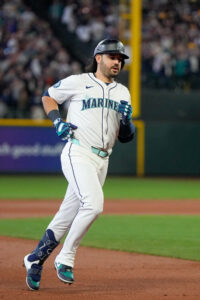 MLB Trade Rumors ranked Suarez 20th on our list of the winter’s top 50 free agents, and projected him for a three-year, $63MM deal. The one-year, $15MM pact falls well short of that prediction in both years and average annual value, as it could be teams were wary of making a larger commitment to a strikeout-prone player who turns 35 in July. Suarez’s third base glovework also dropped in 2025, as he posted -6 Defensive Runs Saved and -3 Outs Above Average.
With the bat, however, Suarez hit 49 home runs in 2025, matching his career high set with the Reds in 2019. Suarez’s overall slash line of .228/.298/.526 reflects his power-heavy output, as he delivered a below-average walk rate for the second consecutive season. Though Suarez’s 29.8% strikeout rate put him in the fifth percentile of all batters, he maxed out when he did make contact, with strong hard-contact and barrel rates.
It has been a strange two-season run for Suarez, who sandwiched a superstar-level campaign in between two mediocre half-seasons. Suarez had only a .591 OPS over his first 315 PA of the 2024 season with the Diamondbacks, before he caught fire and hit .276/.336/.593 with 60 homers over 766 PA from July 1, 2024 to July 31, 2025. Unfortunately, Suarez then drastically cooled off after he was dealt to the Mariners at the trade deadline, but he somewhat rebounded to get some key hits during Seattle’s postseason run to Game 7 of the ALCS.
This rather extreme streakiness could be another reason Suarez’s market never really took off this winter, as teams were justifiably not sure exactly which version of Suarez they’d get in his 13th big league season. The Mariners had some interest in a reunion, and other teams like the Cubs, Red Sox, and Pirates were also linked to the slugger.
Pittsburgh was the other finalist for Suarez’s services, according to MassLive.com’s Chris Cotillo. As per MLB.com’s Alex Stumpf and Jason Mackey of the Pittsburgh Post-Gazette, the Pirates were willing to offer a $15MM average annual salary to Suarez and also offered him a second guaranteed year. In taking just a one-year contract, Suarez seems to be hoping to fully re-establish his market by having a big season in 2026 and then re-entering free agency next winter. It was also very likely to Cincinnati’s benefit that Suarez is already very familiar with the organization from his previous seven-year run in the Queen City.
While the Pirates are on the way up, Suarez may have been more interested in joining a Reds team that actually did make the playoffs in 2025. Cincinnati reached the postseason on the strength of its rotation, as the lineup was average at best in most offensive categories, and 21st of 30 teams in home runs. Elly De La Cruz and Spencer Steer combined for 43 homers as the Reds’ top two home-run hitters in 2025, so Suarez alone tops that total.
Suarez steps right into an everyday role in the Reds’ lineup, though it will be interesting to see where exactly Suarez is deployed. Ke’Bryan Hayes is arguably the best defensive third baseman in the game, so Suarez is more likely to see a lot of action as a DH and possibly at first base. Suarez’s MLB history as a first baseman consists of just three late-game appearances, all of which came last year. The Reds will surely give Suarez plenty of time at the position this spring to see how Suarez fares at the cold corner, and Steer and Sal Stewart will also receive at-bats in the first base/DH mix. Stewart can also play some second base and Steer could play left field, with Steer’s right-handed bat complementing the left-handed hitting JJ Bleday on the grass.
Bleday and Dane Myers were the only notable offensive adds the Reds made prior to today, with the two outfielders more or less replacing Hays and Gavin Lux (who was dealt to the Rays as part of the three-team deal with the Angels that brought reliever Brock Burke to Cincinnati). Suarez now represents a major boost to the Reds’ lineup, and a source of stability on a team that is still waiting to see what it has in players like Steer, Stewart, Matt McLain, or Noelvi Marte. Even De La Cruz was more good than great in 2025, but EDLC figures to benefit with Suarez providing protection behind him in the lineup.
RosterResource estimates a $126.1MM payroll for the Reds at the moment, which is a minor increase over their $118.7MM figure from the 2025 season. President of baseball operations Nick Krall said in early November that the Reds would be spending at “around the same” levels as 2025, so it could be that the team is essentially done with significant offseason moves unless they can unload some salary.
This could again change depending on what happens with the Reds’ broadcast deal, or ownership might potentially green-light some more spending either now or during the season (perhaps once some ticket revenue starts rolling in). The Reds seem to be well-positioned to make another run at a postseason berth in 2026, even though within the NL Central alone, the Pirates will be better and the Brewers and Cubs each figure to keep battling for the division crown.
Inset photo courtesy of Stephen Brashear — Imagn Images
Latest On Reds’ Payroll
The Reds roster appears to be in a holding pattern due to off-field reasons. Ken Rosenthal and Will Sammon of The Athletic report that the club has interest in players like infielder Eugenio Suárez and outfielder Austin Hays but the club is waiting for more clarity on their broadcast situation before proceeding.
Cincinnati was one of nine teams who terminated a contract with Main Street Sports earlier this month. The company has been flailing for years and was in bankruptcy for most of 2023 and 2024, back when it was known as Diamond Sports Group. The company previously ran broadcasts under the Bally Sports moniker. After emerging from bankruptcy, they changed the company name and also signed a new naming rights deal, so the channel has had the FanDuel Sports Network label more recently.
Though the company did emerge from bankruptcy, they haven’t escaped trouble. They recently missed payments to a few clubs, which is what prompted the terminations. The regional sports network (RSN) model has been eroding for years due to cord cutting and streaming.
This puts some clubs in an awkward spot. The RSN model has been a good source of revenue in the past but it has been declining. Some teams have pivoted to having MLB running their broadcasts. This allows them to offer customers a direct-to-customer streaming option with no blackouts, increasing viewership. However, that model generally leads to revenues which are not only lesser but also not guaranteed, as they are contingent on how many people sign up.
Going back to Diamond/Main Street is another option but that usually involves the club taking in less money from rights fees than before. Going into 2025, the Reds looked around for different options but ended up working out a new deal with the company in mid-January.
At the start of the current offseason, president of baseball operations Nick Krall said that the Reds would likely have a similar payroll in 2026 to what they had in 2025, though that was before the Main Street situation cropped up.
Their winter has been fairly quiet, all things considered. They re-signed Emilio Pagán to a two-year, $20MM deal, a small raise over the two-year, $16MM deal which had just expired. They also gave one-year deals worth less than $7MM each to Pierce Johnson, Caleb Ferguson, JJ Bleday and Keegan Thompson, though Thompson was lost to the Rockies via waivers.
The Bleday signing perhaps made Gavin Lux expendable, as the Reds including him in a three-team trade a few weeks later to get lefty Brock Burke. That deal saved Cincinnati a few million, as Lux is going to make $5.525MM this year compared to Burke’s $2.325MM.
RosterResource currently projects the club for a payroll of $112MM. Cot’s Baseball Contracts put them at that same number at the start of 2025. It appears nudging this year’s number up a bit won’t happen without more clarity on the TV situation. Trading Brady Singer would free up some space, as he will make $12.75MM this year, but he has stayed on the roster despite trade rumors this winter.
Suárez would appear to be the less likely of the two potential pursuits. He is coming off a 49-homer campaign and MLBTR predicted him for a three-year, $63MM contract at the beginning of the offseason. Since he has lingered unsigned this long, perhaps it’s more like he ends up with a two-year deal, but it would still be with a decent average annual value.
The Reds have Ke’Bryan Hayes at third base but Suárez is not a great defender and is 34 years old, so he could be slotted into the first base and designated hitter mix, where the Reds have Sal Stewart and Spencer Steer. Stewart had a nice debut in 2025 but only has 58 big league plate appearances under his belt. Steer is coming off a couple of average seasons with the bat and could move into the outfield mix.
Hays should be more viable. The Reds signed him last year with a $5MM guarantee on a one-year deal. He had a solid season but his earning power shouldn’t be too much higher than it was then. He made for a nice complement to their outfield with his righty bat, pairing with lefties TJ Friedl and Lux. He could serve a similar role in 2026, but with Bleday swapped in for Lux.
That would be contingent on him staying unsigned while the Reds sort out their broadcast situation. Hays has also received reported interest from the Royals, Yankees, Mets and Cardinals this winter, though most of those clubs have made other outfield moves since those reports came out.
Photo courtesy of Ron Chenoy, Imagn Images
Poll: Who Will Sign Eugenio Suarez?
With Cody Bellinger now off the market, just one impact bat remains available in free agency: third baseman Eugenio Suarez. Coming off a 49-homer campaign in 2025, the 34-year-old seemed to be one of the premier mid-tier free agents available in free agency this winter. His market has been rather quiet for most of the winter, however. Some of that can surely be attributed to age, as teams are often hesitant about how strikeout-heavy sluggers like Suarez will age as they enter their mid-thirties. A tough stretch run in Seattle where Suarez hit just .189/.255/.428 across 53 games following a midseason trade might also raise some eyebrows. Even so, the upside Suarez demonstrated last year is tremendous and could be a game changer for a lineup in need of a boost. The question is: which team will step up to land him? A look at some of the options:
Boston Red Sox
The Red Sox are a somewhat obvious fit for Suarez’s services after the club missed out on reuniting with Alex Bregman earlier this month. That leaves a clear hole in the team’s infield, and Suarez is by far the best option to plug that hole remaining on the free agent market. The slugger would also offer home run power that the team lacked throughout 2025, a deficiency that led them to get involved in the markets for Kyle Schwarber and Pete Alonso earlier this winter. With that said, however, the team’s pivot towards signing Ranger Suarez after missing on Bregman has been coupled with a focus on pitching and run prevention. Suarez is a lackluster defender at third base already and those skills only figure to decline as he ages, so the Red Sox might prefer to pursue the trade market, where younger players like Nico Hoerner, Isaac Paredes, and Brendan Donovan could be available.
Pittsburgh Pirates
The Pirates stand out as an excellent fit for Suarez on paper. After trading Ke’Bryan Hayes to the Reds last summer, they have a gaping hole at third base that Suarez could fill. Adding Suarez to the lineup would also lend credibility to the Pirates’ effort to contend this year. Brandon Lowe, Ryan O’Hearn, Bryan Reynolds, and Oneil Cruz are a solid group of bats in the heart of Pittsburgh’s order, but a big righty bat to help balance those lefties out a bit more would go a long way to adding some credibility to the club’s lineup. The biggest question for Pittsburgh might be whether the sides can find common ground at all; the Pirates have already spent quite a bit more than usual this winter, and it’s unclear where exactly their limit for spending is. From Suarez’s perspective, meanwhile, he might prefer to sign with a more surefire contender if Pittsburgh isn’t the clear best offer available to him.
Seattle Mariners
Early in the offseason, it seemed likely that Suarez would be headed elsewhere after the 2025 season. That’s sensible enough, as he had just wrapped up his second stint in Seattle and struggled with elevated strikeout rates relative to his career norms both times thanks to the difficult hitting environment at T-Mobile Park. Once Jorge Polanco signed elsewhere, however, reporting suggested an openness on the part of Seattle to reuniting with Suarez, as he could serve as a bridge to the team’s up-and-coming young infielders in Cole Young and Colt Emerson. While Suarez’s past struggles in Seattle create some cause for concern, it’s nonetheless not hard to see him putting together another solid season like the one he delivered for the Mariners in 2022, when he swatted 31 homers with a 132 wRC+ despite a strikeout rate north of 30%.
Other Options
While the above three teams are the most obvious fits for Suarez’s services, they aren’t the only plausible options. The Cubs were connected to Suarez earlier this winter. The Reds are very familiar with the slugger and spent the early part of the offseason looking to add a power-hitting bat to the middle of their lineup. The Phillies tried to sign Bo Bichette early this month but came up empty in those efforts. The Padres could use a big bat for first base or DH, particularly one that bats righty to complement Gavin Sheets. The Marlins have an affinity for high-powered, strikeout-heavy sluggers (Kyle Stowers, Owen Caissie) and a hole at third base that Suarez could credibly fill. The A’s recently tried to land Nolan Arenado to fill their hole at third base, and Suarez would be a great fit at the team’s homer-friendly ballpark.
All of those potential suitors come with caveats, however. The Cubs seem far less likely to be interested in Suarez after adding Bregman, and would need to push top prospect Moises Ballesteros out of the lineup to make room for him. The Reds have seemed reluctant to spend big this winter after missing out on Schwarber. The Phillies pivoted from Bichette to J.T. Realmuto and might not have room in the budget to pursue Suarez, especially if they can’t trade Alec Bohm. It’s unclear if the Padres have the budget space to mount a credible pursuit of Suarez, either. The same goes for the Marlins and the A’s, with both teams also suffering from the same flaw as Pittsburgh as teams that could be unappealing to free agents due to their struggles to contend in recent years.
Where do MLBTR readers think Suarez will ultimately land? Will he replace Bregman in Boston, transform the Pirates’ lineup, or return to Seattle? Is there another team out there that could sneak into the sweepstakes as a dark horse and come out on top? Have your say in the poll below:
Who Will Sign Eugenio Suarez?
-
Mariners 23% (3,247)
-
Pirates 22% (3,061)
-
Red Sox 21% (3,016)
-
Reds 10% (1,363)
-
Other (Specify in Comments) 8% (1,065)
-
Phillies 5% (771)
-
Athletics 5% (722)
-
Padres 3% (448)
-
Cubs 2% (228)
-
Marlins 2% (216)
Total votes: 14,137
Latest On Red Sox’ Infield Pursuits
The Red Sox pivoted quickly after losing out on third baseman Alex Bregman, bringing lefty Ranger Suárez in to join an already deep rotation. They’re still in the market for help on the infield, and comments from chief baseball officer Craig Breslow at Suárez’s introductory press conference perhaps shed some light on the potential moves they could yet have in store (links (via Chris Cotillo of MassLive.com, Rob Bradford of WEEI and Jen McCaffrey of The Athletic).
“I don’t think there’s a question anymore that the identity of our team and the strength of our team is going to be our pitching and our ability to prevent runs,” Breslow said .
Breslow, unsurprisingly, wouldn’t comment directly on whether any subsequent additions are on the horizon. The third-year baseball ops leader acknowledged (via Bradford) that “teams call about some of our depth” but added that it’s “hard to tell” whether anything will come together in the near future, just given the sudden nature with which offseason negotiations can either accelerate or crumble at any given point.
Regarding the team’s in-house options, McCaffrey reports that the organization prefers Marcelo Mayer at third base rather than at second base. That’s not necessarily set in stone, and the Sox would presumably be open to Mayer at second base if an unexpected opportunity arose at the hot corner, but it’s nevertheless notable that that’s where they’d lean, all else being equal. Breslow emphasized that the Red Sox “will be very mindful of the defensive skill set” of any addition to the infield. McCaffrey suggests that the ideal target for the Red Sox would be a plus defensive second baseman.
That’s not great news for Eugenio Suárez, who has drawn some level of interest from Boston, Pittsburgh and the incumbent Seattle. (Surely, others are also in the mix to varying extents.) The 34-year-old is fresh off a 49-homer campaign and would absolutely give the Sox the power bat they said they were targeting early in free agency, but Breslow’s comments following the Bregman pivot seem more focused on defense, and Suárez was dinged for negative grades by both Defensive Runs Saved (-6) and Outs Above Average (-3) between the D-backs and Mariners this past season.
On the flip side, it only further strengthens the idea of Boston taking a genuine run at Cubs second baseman Nico Hoerner or, to a lesser extent, Cardinals second baseman Brendan Donovan. Hoerner is the premier second base defender in MLB and is earning $12MM in the final season of his contract. He hit .297/.345/.394 with a microscopic 7.6% strikeout rate and 29 steals this past season. The Cubs have at least heard out interested teams on Hoerner, particularly after signing Bregman, but they’d need immediate MLB-ready help on the pitching side of things to even consider moving him. It’s also feasible that they could listen on young infielder Matt Shaw, but he’d also come with a lofty ask given his six years of remaining club control.
Circling back for a third separate trade with the Cardinals, where Breslow’s predecessor Chaim Bloom is running baseball operations, would be highly unusual — but the fit is sensible. Bloom obviously is quite familiar with many of Boston’s farmhands, and the Cardinals are looking to max out Donovan’s trade value while he still has two seasons of club control left. Donovan is a left-handed hitter and isn’t as strong defensively as Hoerner, making him a lesser fit, but the multiple seasons of control and ability to pretty seamlessly slide to third base or left field — depending on team health/needs — is certainly appealing.
Payroll-wise, there shouldn’t be much off the table for the Sox. RosterResource pegs them at about $197MM in actual cash payroll, which is down from 2025’s mark and not close to the franchise-record $236MM Opening Day mark. Their $265MM luxury tax ledger is far heftier, thanks in large part to backloaded deals for Suárez, Roman Anthony, Brayan Bello, Kristian Campbell and Ceddanne Rafaela. They’re second-time payors who are currently in the second penalty tier, thus subjecting them to a 42% tax on the the next $19MM or so that they spend.
If the Red Sox were to add another $20MM or more to the CBT ledger, that’d bump the tax rate to 75% for subsequent additions and, more notably, drop their top pick in the 2026 draft by ten spots. That’s probably the primary deterrent to spending beyond that point, though with the possible exception of Eugenio Suárez, none of the potential infield targets in question would thrust Boston into the third tier of penalization anyhow.
Readers — Red Sox fans in particular — are encouraged to check out the three linked pieces in full, as each has more extensive quotes from Breslow on the team’s offseason goals and the team’s pursuit of (Ranger) Suárez.