
Twins Release Matt Guerrier
The Twins announced today they have granted reliever Matt Guerrier his unconditional release. The move comes one day prior to the retention bonus deadline. The Twins would have had to pay Guerrier $100K to retain him and send him to Triple-A.
Guerrier, 35, signed a minor league deal with the Twins in January. A Twins waiver claim of Guerrier in 2003 paid off, as he made his big league debut with the team the following year and logged 472 innings with them over seven seasons. His solid relief work with Minnesota led to a three-year, $12MM deal with the Dodgers after the 2010 campaign. This spring, Guerrier gave up three runs in four innings.
Following a series of other moves, the Twins now have 29 players in camp.
Scouting Odrisamer Despaigne
Cuban righty Odrisamer Despaigne joined infielder Aledmys Diaz in a 90-minute February 13th showcase in front of more than 50 scouts at the Peoria Sports Complex in Arizona, according to MLB.com's Jesse Sanchez. At the time, agent Jaime Torres told Sanchez, "We'll field offers shortly on Despaigne."
Diaz, an infielder, was expected to sign before Despaigne. He inked a four-year, $8MM deal with the Cardinals on March 9th. Despaigne remains unsigned, and hasn't shown up on the pages of MLBTR since the showcase.
I talked to a high-ranking international scouting official to get a scouting report on Despaigne, to perhaps shed some light on why he hasn't signed. The official has seen Despaigne three or four times in person and has seen him dating back to 2010.
The picture painted by the official was not particularly exciting. "I would say his stuff is average across the board. He's got feel and he's got deception, and he knows how to pitch. The biggest thing going for him is his ability to mix and match and change slots and change arm angles. He probably throws four different pitches from different slots and different angles. He never gives guys the same look, and he throws a lot of strikes. But he doesn't have anything plus." The official considers Despaigne's pitches to be fringe-average or slightly above-average, depending on the day.
The official went on to explain where Despaigne might fit in with a Major League team. "I see him as a middle inning type of guy. He's going to have to really throw a ton of strikes to have success. He's really no different than a lot of six-year free agents and non-roster invitees that are out there right now. I think he fits in well to a bullpen probably as a middle inning reliever and potentially a long guy or a No. 5 starter." I asked how Despaigne compares to the Phillies' Miguel Alfredo Gonzalez, a Cuban pitcher who signed a three-year, $12MM deal in August. That deal was drastically reduced due to injury concerns, which have carried into spring training. The official has always projected Gonzalez as a reliever as well, but feels the Phillies pitcher has "much bigger stuff" than Despaigne.
Despaigne is no different than a lot of pitchers currently on the roster bubble in spring training, opined the official, which could explain why he remains unsigned. An eight-figure contract for Despaigne appears unlikely, but it does seem that he'll pitch in the big leagues in some capacity.
Ranking Agencies By 2013 WAR
Which agency's players have the most MLB talent? One way of answering that question is to rank the agencies by 2013 wins above replacement (from FanGraphs). Here are the results for total 2013 WAR. Please note that players with negative WAR were omitted, and cutoffs of 50 plate appearances for hitters and 20 innings for pitchers were used to remove smaller sample cases.
- Boras Corporation: 132.9
- Relativity Baseball: 107.4
- Excel Sports Management: 72.0
- CAA Sports: 70.8
- ACES: 68.9
- Wasserman Media Group: 62.6
- Octagon: 44.8
- The Legacy Agency: 43.6
- MVP Sports Group: 41.8
- Jet Sports Management: 25.5
- Beverly Hills Sports Council: 23.5
- Frontline: 22.8
- TWC Sports: 21.2
- LSW Baseball: 20.3
- Kinzer Management Group: 19.7
Let's take a look at WAR per big league player, filtering to agencies with at least ten players. WAR per player:
- Boras Corporation: 2.42
- Excel Sports Management: 2.18
- Relativity Baseball: 2.03
- Wasserman Media Group: 2.02
- Jet Sports Management: 1.96
- Frontline: 1.90
- Kinzer Management Group: 1.79
- MVP Sports Group: 1.74
- Octagon: 1.72
- LSW Baseball: 1.69
- CAA Sports: 1.54
- ACES: 1.47
- The Legacy Agency: 1.36
- All Bases Covered: 1.28
- Beverly Hills Sports Council: 1.12
In some cases WAR per player is deceiving, because a large agency like Boras gets dinged for having small 2013 contributions from players like Xander Bogaerts or Jake Arrieta. So, here's a listing of the number of four-win players by agency:
- Boras Corporation: 11 (Carlos Gomez, Chris Davis, Max Scherzer, Matt Harvey, Jacoby Ellsbury, Shin-Soo Choo, Adrian Beltre, Carlos Gonzalez, Jayson Werth, Matt Holliday, Jose Fernandez)
- Relativity Baseball: 5 (Miguel Cabrera, Paul Goldschmidt, Justin Verlander, Andrelton Simmons, Gerardo Parra)
- ACES, Excel Sports Management, Wasserman Media Group: tied at 4
MVP Sports Group and Octagon had three each.
A look at three-win players by agency:
- Boras Corporation: 20
- Relativity Baseball: 14
- Excel Sports Management: 11
- Wasserman Media Group: 8
- CAA Sports: 7
- ACES: 6
- Octagon: 5
- Jet Sports Management, Kinzer Management Group, MVP Sports Group: tied at 3
Comparing these numbers to 2012, the Boras Corporation increased its total WAR by over 27% and came out on top in every category. The agency continues to represent the most and best MLB talent. The top ten from last year remains mostly the same, though Relativity (formerly SFX) is on the rise with star power and depth. Jet Sports Management is a new entrant in the top ten, led by Chris Sale, new addition Mike Minor, Kyle Seager, and Brian McCann.
MLBTR's agency database was used for this post; please email me at mlbtrdatabase@gmail.com with any corrections or omissions. Also, feel free to drop me a line if you'd just like to see your agency's entire list of players used for this post.
Mike Minor Joins Jet Sports Management
One of the game's top southpaws has changed representation. Braves lefty Mike Minor has joined Jet Sports Management, MLBTR has learned. Minor was previously with Bo McKinnis. Jet Sports has strong Braves ties, representing Chipper Jones, Brian McCann, and Jonny Venters.
Minor, 26, posted a 3.21 ERA in 32 starts in a breakout 2013 campaign. He signed for $3.85MM this year, as he was arbitration eligible for the first time as a Super Two player. Minor is under the Braves' control through 2017, and he'll have three more cracks at arbitration unless he signs a long-term extension. The Braves went on an extension spree in February, locking up Freddie Freeman, Andrelton Simmons, Craig Kimbrel, Julio Teheran, and Jason Heyward to multiyear deals totaling $280.7MM.
Jet Sports Management, which is headed by B.B. Abbott, had a big addition last summer when agent Andrew Lowenthal joined the company. With him, Lowenthal brought clients such as Charlie Morton, Steve Cishek, Kyle Seager, Daniel Hudson, Joe Panik, David Goforth, and Justin Marks. In addition to the aforementioned players, the agency counts Chris Sale, Rex Brothers, Jonathan Broxton, Wade Davis, Corey Kluber, Devin Mesoraco, Byron Buxton, Zack Wheeler, and Mike Zunino among its clients. For all the latest on MLB player representation, check out our agency database.
Out Of Options 2014
The following 40-man roster players have less than five years service time and are out of minor league options. That means they must clear waivers before being sent to the minors. I've included players on multiyear deals. This list was compiled through MLBTR's sources. For context on each team's situation, please check out my six-part series.
Angels
Ernesto Frieri, Kevin Jepsen, Andrew Romine
Astros
Chris Carter, Lucas Harrell, Raul Valdes
Athletics
Daric Barton, Josh Donaldson, Brandon Moss, Fernando Abad, Jesse Chavez, Chris Gimenez, Michael Taylor
Blue Jays
Brett Cecil, Jeremy Jeffress, Luis Perez, Esmil Rogers, Sergio Santos, Todd Redmond, Moises Sierra
Braves
Cory Gearrin, David Carpenter, Ramiro Pena, Jordan Schafer, Anthony Varvaro
Brewers
Cubs
George Kottaras, Wesley Wright, Justin Ruggiano, James McDonald, Pedro Strop, Welington Castillo, Jeff Samardzija, Luis Valbuena, Travis Wood, Donnie Murphy, Alberto Cabrera
Diamondbacks
Randall Delgado, Matt Tuiasosopo
Dodgers
Scott Elbert, Javy Guerra, Drew Butera
Giants
David Huff, Joaquin Arias, Gregor Blanco, Yusmeiro Petit, Jean Machi, Ehire Adrianza, Tony Abreu
Indians
Mariners
Marlins
Garrett Jones, Brian Bogusevic, Brad Hand, Jacob Turner
Mets
Eric Young Jr., Ruben Tejada, Carlos Torres
Nationals
Jose Lobaton, Jerry Blevins, Tyler Clippard, Ross Detwiler
Orioles
Edgmer Escalona, Chris Davis, Tommy Hunter, Troy Patton, Nolan Reimold, Chris Tillman, Zach Britton, Kelvin De La Cruz, David Lough, Brian Matusz, Steve Pearce, Francisco Peguero, Josh Stinson
Padres
Cameron Maybin, Eric Stults, Dale Thayer, Yonder Alonso, Rene Rivera, Alex Torres
Phillies
John Mayberry Jr., Kevin Frandsen, Brad Lincoln
Pirates
Chris Stewart, Jeanmar Gomez, Mark Melancon, Travis Snider, Jose Tabata, Bryan Morris, Andy Oliver, Stolmy Pimentel, Pedro Alvarez, Vin Mazzaro
Rangers
Engel Beltre, Pedro Figueroa, Adam Rosales, Michael Kirkman
Rays
Jake McGee, Cesar Ramos, Matt Joyce, Chris Archer, Josh Lueke, Brandon Guyer
Red Sox
Reds
Rockies
Jordan Pacheco, Tyler Chatwood
Royals
Brett Hayes, Jarrod Dyson, Justin Maxwell, Pedro Ciriaco, Francisley Bueno, Carlos Peguero, Danny Valencia
Tigers
Don Kelly, Evan Reed, Jose Iglesias
Twins
Trevor Plouffe, Anthony Swarzak, Scott Diamond, Sam Deduno, Vance Worley, Eduardo Escobar, Alex Presley, Chris Parmelee
White Sox
Conor Gillaspie, Ronald Belisario, Mitchell Boggs, Maikel Cleto, Donnie Veal, Alejandro De Aza, Dayan Viciedo
Yankees
Out Of Options Players: AL West
The following 40-man roster players have less than five years service time and are out of minor league options. That means they must clear waivers before being sent to the minors, so the team would be at risk of losing them in attempting to do so. I've included players on multiyear deals. This list was compiled through MLBTR's sources. Our series concludes with the AL West.
Angels: Ernesto Frieri, Kevin Jepsen, Andrew Romine
Frieri is the team's closer, and Jepsen has a spot in the pen as well. About a week ago, Mike DiGiovanna of the L.A. Times noted that Angels manager Mike Scioscia said the team could open the season with an eight-man bullpen. DiGiovanna further explained, "Carrying an extra reliever and a five-man rotation would limit the Angels to a three-man bench consisting of a backup catcher, utility infielder and outfielder."
Romine is battling non-roster invitee John McDonald for that utility infielder job, though as MLB.com's Alden Gonzalez noted earlier this month, Grant Green appears to have joined the mix.
Astros: Chris Carter, Lucas Harrell, Raul Valdes
Carter will serve as the team's designated hitter. Harrell is looking to reclaim a spot in the Astros' rotation, which is something of an open competition behind Scott Feldman. Valdes, a lefty reliever, is the oldest player in Astros camp at age 36, according to Evan Drellich of the Houston Chronicle. He's competing for a lefty relief spot with Darin Downs and Kevin Chapman, wrote Drellich a week ago.
Athletics: Daric Barton, Josh Donaldson, Brandon Moss, Fernando Abad, Jesse Chavez, Chris Gimenez, Michael Taylor
Susan Slusser of the San Francisco Chronicle wrote about Taylor on Monday and Tuesday, noting that a scout told her a change of scenery might do some good for the 28-year-old outfielder. Slusser says non-roster invitee Sam Fuld is ahead of Taylor to potentially fill in for Craig Gentry if Gentry needs to start the season on the DL. Slusser wrote Monday that Barton will need at least a few more days to recover from a hamstring strain. Barton doesn't fit well at first base in a potential platoon with Moss, wrote John Hickey of the Mercury News in February, so it could be difficult for him to find a roster spot. Moss seems assured of semi-regular first base duty after hitting 51 home runs for the A's over the past two years. Donaldson is the team's starting third baseman after a breakout 2013.
Gimenez is seemingly fourth on the A's depth chart at catcher, so he has an uphill battle for a roster spot out of camp.
MLB.com's Chris Gabel wrote about Abad yesterday, noting that he's competing with Drew Pomeranz and Joe Savery to become the second lefty in Oakland's bullpen. Though Abad has surrendered a few runs in his six innings of spring work to date, Gabel quotes A's manager Bob Melvin as praising the 28-year-old, leading the writer to speculate that "he might already have secured a spot in the A's bullpen." Last week, MLB.com's Jane Lee wrote that Chavez "appears to be a lock" for the team's pen.
Mariners: Hector Noesi
The Mariners have an open rotation competition after Felix Hernandez in the wake of injuries to Hisashi Iwakuma and Taijuan Walker, wrote MLB.com's John Schlegel on Tuesday. James Paxton, Scott Baker, and Erasmo Ramirez might be the favorites, though, meaning Noesi is really competing for one spot. Noesi could instead be a long reliever out of the bullpen, Bob Dutton of the News Tribune suggested a week ago.
Rangers: Engel Beltre, Pedro Figueroa, Adam Rosales, Michael Kirkman
In a roster projection from Evan Grant of the Dallas Morning News today, he included both Beltre and Michael Choice, noting that the team doesn't want to lose Beltre. Keeping both Beltre and Choice might mean sending catcher Robinson Chirinos to Triple-A despite an impressive spring. Grant sees Rosales as the team's best backup infield option over Brent Lillibridge and Kevin Kouzmanoff, because Rosales can play second base, shortstop, and third base.
Kirkman is part of Grant's projected seven-man bullpen, while Figueroa is not. As a lefty who throws 95 miles per hour, Figueroa was intriguing enough to the Rangers for the club to claim him off waivers from the Rays in late January. It seems the Rangers will be forced to choose one of the two, barring a trade or injury.
Offseason In Review: Chicago White Sox
The White Sox made an early splash by signing a powerful 27-year-old Cuban first baseman, acquired a new center fielder, swapped their closer for a third base prospect, and tinkered with small-scale free agent signings.
Major League Signings
- Jose Abreu, 1B: six years, $68MM (may opt into arbitration once eligible)
- Scott Downs, RP: one year, $4MM (includes $4.25MM club option for 2015 with $250K buyout)
- Matt Lindstrom, RP: one year, $4MM (club option exercised)
- Ronald Belisario, RP: one year, $3MM (can be controlled through 2016 as arbitration eligible player)
- Paul Konerko, 1B/DH: one year, $2.5MM ($1MM deferred until 2021)
- Felipe Paulino, SP: one year, $1.75MM ($4MM club option for 2015 with a $250K buyout)
- Mitchell Boggs, RP: one year, $1.1MM (can be controlled through 2015 as arbitration eligible player)
- Total spend: $84.35MM
Notable Minor League Signings
- Dylan Axelrod, David Purcey, Brian Omogrosso, Zach Putnam, Mauricio Robles, Hector Gimenez, Alex Liddi, Eric Patterson
Trades and Claims
- Acquired 1B Jackson Laumann from Braves for cash considerations
- Acquired OF Adam Eaton from Diamondbacks, gave up P Hector Santiago and OF Brandon Jacobs
- Acquired 3B Matt Davidson from Diamondbacks for RP Addison Reed
- Claimed C Adrian Nieto from Nationals in Rule 5 draft
- Claimed SP Eric Surkamp from Giants
- Claimed RP Maikel Cleto from Royals
- Acquired a player to be named later or cash considerations from Athletics for IF Jake Elmore
- Acquired cash considerations from Braves for SP Zach Stewart
Notable Losses
- Hector Santiago, Brandon Jacobs, Addison Reed, Gavin Floyd, Santos Rodriguez, Brent Morel
Needs Addressed
White Sox GM Rick Hahn explained his plan to Paul Sullivan of the Chicago Tribune in late October: "Obviously getting better quickly is the goal, but the final determining factor is whether it's going to make us better for an extended period of time. I'm not going to keep churning this thing every two years with short-term fixes. Eventually you have to pay the piper for that and we want to set up something that's sustainable over an extended period." Hahn also made it clear in various offseason interviews that he felt good about the team's pitching depth and aimed to add position players.
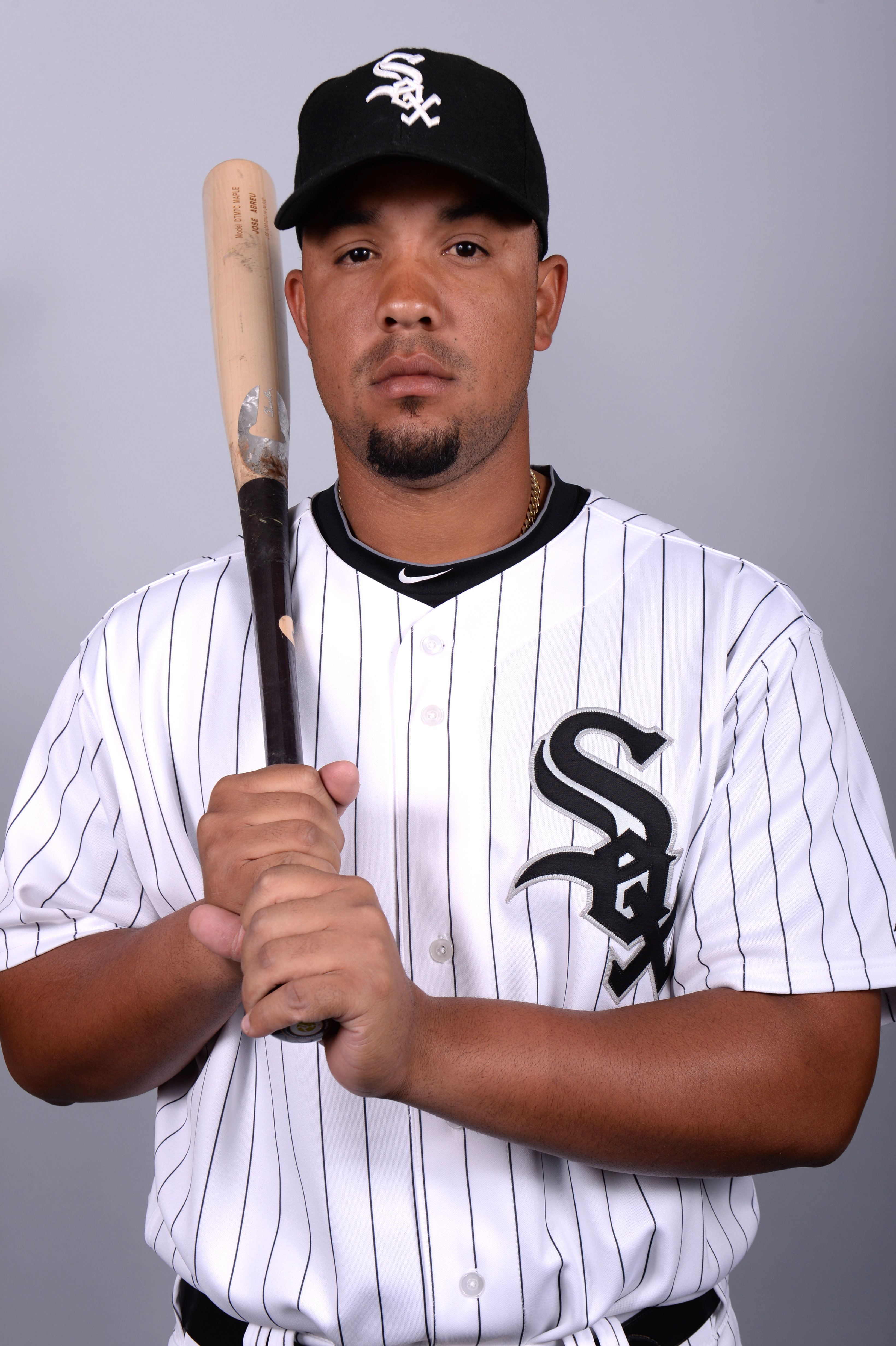
It's no surprise, then, that the key moves of Hahn's offseason involved acquiring three position players. Jose Abreu (pictured), Adam Eaton, and Matt Davidson are all in their 20s, with Abreu the oldest at 27. Abreu is controlled through 2019, Eaton through '18, and Davidson through '19 or later. The newly-acquired trio is Major League ready or close to it, as is summer acquisition Avisail Garcia.
As I explained shortly before the October signing, Abreu checks all the boxes for the White Sox: long-term value, a contract that isn't monstrous by typical free agent standards, and no loss of a draft pick to sign him. Five teams offered $60MM+ for the Cuban slugger, but the White Sox prevailed with a six-year, $68MM deal that stands as the largest ever for an international free agent and the largest in team history. The White Sox hope Abreu can provide 30+ home runs annually as their first baseman for the next six years.
The Eaton trade was struck during baseball's Winter Meetings, in a collaboration with the Diamondbacks and Angels. The main piece the Sox had to surrender was 26-year-old southpaw Hector Santiago, who compiled a 3.51 ERA, 8.4 K/9, 4.3 BB/9, and 1.10 HR/9 in 130 2/3 innings as a starter in 2013 and remains under team control through 2017. With Erik Johnson and Andre Rienzo coming on, the White Sox had the depth to spare Santiago, who still has to figure out command and home run issues.
Eaton, often described as a "dirtbag" type of ballplayer, comes with questions of his own. The former 19th round draft pick exceeded expectations in the minor leagues, earning a cup of coffee with Arizona in 2012 and becoming a popular Rookie of the Year candidate for 2013. However, that spring he sprained the UCL in his left elbow, and didn't return to the big leagues until July. Eaton is 25 with only one healthy month in the Majors to his name. The White Sox are gambling that he can be the scrappy consistent on-base threat with good defense that he appeared to be one year ago.
The third major pickup was Davidson, who was also acquired from Arizona. The Sox snagged Davidson straight-up for closer Addison Reed, a 25-year-old with four years of team control remaining. As MLBTR's Jeff Todd noted in his D'Backs Offseason In Review, Reed is not without his flaws, and the cost of saves in arbitration may cut down his years of team control. Davidson, 23 this month, hit .280/.350/.481 with 17 home runs in 500 Triple-A plate appearances and picked up 87 late-season plate appearances with the big club. Ranked 88th among all prospects by ESPN's Keith Law, Davidson "should be an above-average regular at third base given a season or two there to continue to progress." If that is the eventual outcome, the White Sox did very well in acquiring Davidson for perhaps three years of a good (and increasingly expensive) closer.
The White Sox traded Jesse Crain and Matt Thornton during the season and Reed in the offseason, so the bullpen demanded fresh arms. Hahn kept the commitments relatively light, exercising Lindstrom's option, and signing Belisario, Downs, and Boggs for a total of $12.1MM. Belisario and Boggs were non-tendered by their previous teams in December, and the Sox can control them beyond 2014 if it makes sense.
Belisario and Boggs will be projects for renowned pitching coach Don Cooper, as will scrap heap rotation hopeful Felipe Paulino. The 30-year-old last had significant time in the Majors in 2011, undergoing Tommy John surgery in July 2012 and shoulder surgery in September 2013. When he was right, Paulino whiffed about a batter per inning and consistently worked at 95 miles per hour, and the White Sox could have the bargain of the offseason if they can get 25+ starts out of him. The White Sox did at least look into a bigger addition for the rotation, Japanese righty Masahiro Tanaka. After an exploratory meeting with the pitcher in January, the Sox made an offer that one GM guessed was around $100MM. It doesn't seem that the Sox came close to signing Tanaka. As with their crosstown rivals, potentially paying him $108MM over the next four years did not make sense, even if his ability and youth were worth a bid.
In a process that dragged into December, White Sox all-time great Paul Konerko signed on for one more year at a meager $2.5MM. It was a sentimental signing of a limited player who fits poorly onto the team's roster. As explained by Jim Margalus of South Side Sox in an excellent reflection on the move, "Even the most ardent Konerko supporters acknowledge that he's significantly compromising the roster, but they're writing it off as a fair sacrifice because of the alleged effect he has on others." The signing reminds me of the Mariners bringing Ken Griffey Jr. back for the 2010 season, which didn't end well.
On the coaching front, the White Sox added hitting coach Todd Steverson in October, and extended manager Robin Ventura in January to avoid him entering 2014 in lame-duck status.
Questions Remaining
Despite the positive vibes from Rick Hahn's offseason, the White Sox still have a below-average collection of 25-and-under players and a farm system that Baseball America ranks 24th and Keith Law ranks 27th in the game. The 2014 draft will continue pushing things in the right direction, as the Sox have the third overall pick and a bonus pool near $10MM. Still, Hahn and company want to get back to contention quickly, and the team needs a good amount of work in the short-term.
The Sox never did address their catching situation this offseason, instead deciding to give the Tyler Flowers/Josh Phegley tandem another shot. I've heard they had significant interest in free agent Jarrod Saltalamacchia, particularly if he could have been had on a two-year deal, but Salty wound up with the Marlins on a three-year pact. The Sox picked up Adrian Nieto in the Rule 5 draft, but keeping a Double-A type backstop on the Major League roster all season would be challenging.
The acquisition of Eaton seemingly pushed Alejandro De Aza into a fourth outfielder role, for which he may be best suited anyway. With a $4.25MM salary, De Aza might have more value to another team, and it's likely the Sox will continue to explore trades. Then there's 25-year-old Dayan Viciedo, who hit 25 home runs in 2012 but slumped last year. He's controlled through 2017 and could still be a long-term piece, but I imagine the Sox will be open-minded to trade proposals.
Chicago's middle infield tandem of Gordon Beckham and Alexei Ramirez has come up in trade rumors in the last year. The disappointing Beckham has two years of team control remaining, while Ramirez is signed through 2015 with a club option for '16. Ramirez is guaranteed $20.5MM over the next two years, his age 32-33 seasons. His trade value could be limited by the continued availability of free agent shortstop Stephen Drew. Both Beckham and Ramirez figure to frequent the pages of MLBTR this summer.
The White Sox have uncertainty at the back of their bullpen after the Reed trade, with Nate Jones the current favorite to close games in 2014. The franchise hasn't put together a particularly strong bullpen since their 2005 World Championship season.
Deal of Note
If an MLB team wants to throw a large, unrestricted sum of money at a player in his mid-20s, players coming over from Cuba and Japan are basically the only options. The White Sox took advantage of the opportunity by signing Abreu. At $68MM, his contract defied my expectations by a good 25%, but it still leaves room for upside. Accounting for the cost of a draft pick, the Mets paid a similar amount for Curtis Granderson's age 33-36 seasons, a deal that strikes me as mostly downside risk. If Abreu can provide the White Sox with 25+ home runs per year, a .340 OBP, and average defense, he'll easily be worth $11.3MM per year compared to continually rising market prices. And certainly, there's some chance of Abreu's power translating to a few 35-40 home run seasons in the bigs.
It should be noted that given the standard clause allowing Abreu to opt for arbitration once eligible, he might end up being paid more than $68MM over the next six years. In particular, given good production he'll prefer arbitration over the sixth year of the contract, and possibly even the fifth. If he's good enough to justify that, it will be worth the extra money for Chicago.
Overview
This is rebuilding, White Sox style. Like any team trying to improve its young talent base, they've recently taken a few steps back in the name of the greater good. But unlike the Cubs or Mets, the White Sox aren't on a four or five-year plan. Hahn has been acquiring Major League ready talent, and while the White Sox are a long shot for 2014, don't count them out for '15.
Photo courtesy of USA Today Sports Images.
Out Of Options Players: NL East
The following 40-man roster players have less than five years service time and are out of minor league options. That means they must clear waivers before being sent to the minors, so the team would be at risk of losing them in attempting to do so. I've included players on multiyear deals. This list was compiled through MLBTR's sources. Next, we'll take a look at the NL East.
Braves: Cory Gearrin, David Carpenter, Ramiro Pena, Jordan Schafer, Anthony Varvaro
Carpenter is a lock for a bullpen spot. On Friday, Braves manager Fredi Gonzalez said of Varvaro, "Who knows? It's so early. If we had to break Spring Training today or tomorrow to start the season, I'd count on him. He'd be one of the guys in the bullpen," talking to MLB.com's Spencer Fordin. Gearrin is among a host of pitchers competing for two other spots in the pen; he told Mark Wiedmer of the Chattanooga Times Free Press in February his shoulder was 100% after being shut down for the final two months of the 2013 season.
Pena will serve as the Braves' primary utility infielder, and Schafer will be the fourth outfielder.
Marlins: Mike Dunn, Garrett Jones, Brian Bogusevic, Brad Hand, Jacob Turner
Beyond Steve Cishek, A.J. Ramos, and Dunn, the Marlins' bullpen picture is "extremely muddled," wrote Clark Spencer of the Miami Herald recently. As for the rotation, Turner looks like the team's fourth starter, with Hand, Tom Koehler, Kevin Slowey, and Brian Flynn in the mix for the last spot, according to MLB.com's Joe Frisaro. Spencer noted that Hand could land in the bullpen if he doesn't crack the rotation.
Jones was signed to be the team's primary first baseman. Bogusevic, acquired from the Cubs for Justin Ruggiano in the offseason, seems to have a leg up to become the team's fourth outfielder.
Mets: Eric Young Jr., Ruben Tejada, Carlos Torres
Young's spot on the team is secure. Tejada is the starting shortstop, though the Mets seem to be considering upgrades such as Stephen Drew or Nick Franklin. In the event they acquire someone, the Mets could entertain trading Tejada or just put him in a reserve role.
Torres is a lock for the Mets' bullpen, wrote Adam Rubin of ESPNNewYork.com a week ago.
Nationals: Jose Lobaton, Jerry Blevins, Tyler Clippard, Ross Detwiler
Detwiler will be on the Nationals' pitching staff in some capacity, either as the fifth starter or a member of the bullpen. Lobaton, Blevins, and Clippard are secure.
Phillies: John Mayberry Jr., Kevin Frandsen, Brad Lincoln
Mayberry and Frandsen were given guaranteed arbitration contracts, noted Matt Gelb of the Philadelphia Inquirer in February, giving them a leg up on bench jobs. Yesterday, Gelb wrote that Phillies GM Ruben Amaro Jr. "continues to dangle Mayberry this spring in trade talks." Mayberry is competing with Darin Ruf for a bench spot. A week ago, Chris Branch of The News Journal took a look at the Phillies' backup infield situation. Freddy Galvis is a near lock to make the team, with Frandsen battling Ronny Cedeno, Andres Blanco, Cesar Hernandez, and Reid Brignac for the one remaining spot.
Five days ago, Ryan Lawrence of the Philadelphia Daily News termed Lincoln to be "likely a favorite" for a bullpen spot, because of his option situation as well as past big league success.
Out Of Options Players: AL East
The following 40-man roster players have less than five years service time and are out of minor league options. That means they must clear waivers before being sent to the minors, so the team would be at risk of losing them in attempting to do so. I've included players on multiyear deals. This list was compiled through MLBTR's sources. Today, we'll take a look at the AL East.
Blue Jays: Brett Cecil, Jeremy Jeffress, Luis Perez, Esmil Rogers, Sergio Santos, Todd Redmond, Moises Sierra
Back on February 20th, Blue Jays GM Alex Anthopoulos spoke about beginning the season with an eight-man bullpen, as they did in 2013, partially because of the desire not to lose a player, according to MLB.com's Gregor Chisholm. Cecil, Santos, Casey Janssen, Steve Delabar, and Aaron Loup are the locks.
Perez has already been sent to minor league camp, with the Jays expected to buy some time by putting him on the DL to start the season. Dustin McGowan is under contract on a multiyear deal, and was not listed above because he has over seven years of big league service. Still, the Jays will have to find a spot if they wish to retain him, and they probably will. McGowan, Rogers, Redmond, and Jeffress are part of the fifth starter competition, as outlined by Rosie DiManno of the Toronto Star on Friday. In theory, all four could be retained: one in the rotation, the other three filling out the bullpen. That scenario would involve sending Neil Wagner and other solid pitchers to Triple-A, establishing strong depth but perhaps not putting the team's best 13 pitchers on the Opening Day roster. A trade would be another way to find some breathing room. The Jays are known to be in the mix for Ervin Santana, who would take a rotation spot and have a ripple effect on the above-named players.
Sierra seems to have a good shot at the team's last bench spot partially because of his lack of minor league options. It's another case where making the decision to retain the player might be less than ideal, as Sierra would have to be the team's fourth outfielder over the defensively superior Anthony Gose. Sierra would also platoon at DH with Adam Lind and could pitch in at first base, however.
Orioles: Edgmer Escalona, Chris Davis, Tommy Hunter, Troy Patton, Nolan Reimold, Chris Tillman, Zach Britton, Kelvin De La Cruz, David Lough, Brian Matusz, Steve Pearce, Francisco Peguero, Josh Stinson
The Orioles' list includes a staggering 13 players. Let's start with the team's rotation. We can project three members with certainty: Ubaldo Jimenez, Chris Tillman, and Wei-Yin Chen. At this moment, Miguel Gonzalez and Bud Norris would grab the two remaining spots. Two of the above-named pitchers, Britton and Matusz, had been among those competing for the fifth starter job before Jimenez was signed. Further muddying the picture, as explained by Dan Connolly of the Baltimore Sun today, is the pursuit of Ervin Santana. Additionally, Suk-min Yoon and Johan Santana will come into play later in the season.
Connolly notes that Norris or Gonzalez could move to the bullpen if necessary. Hunter, Darren O'Day, Ryan Webb, and Matusz seem to be locks for the pen. A 25-game amphetamine suspension for Patton takes him out of the picture for most of April. That leaves Escalona, De La Cruz, Britton, and Stinson as out of options pitchers competing for three likely spots, with Steve Johnson, Alfredo Aceves, T.J. McFarland, and Evan Meek also in the mix. You may recall the Orioles were loose with 40-man roster spots in the offseason, giving them to Escalona, De La Cruz, and Peguero despite scant big league experience. Retaining them now requires putting them on the 25-man roster. This situation seems to call for a trade or two.
As the backup center fielder, Lough is assured a spot on the roster. The Cruz signing takes away at-bats from Reimold, but he still seems likely to make the team. Peguero or Pearce could take the final roster spot, but only by beating out the other candidates in camp, such as Delmon Young, Xavier Paul, Julio Borbon, Quintin Berry, and Henry Urrutia. There seems a good chance Peguero or Pearce is exposed to waivers; perhaps both. Again, a minor trade could make sense in the coming weeks.
Rays: Jake McGee, Cesar Ramos, Matt Joyce, Chris Archer, Josh Lueke, Brandon Guyer
Archer is a lock for the Rays' rotation, while Ramos is battling pitchers such as Erik Bedard, Jake Odorizzi, Nate Karns, and Alex Colome for the fifth starter job until Jeremy Hellickson's projected late May return. If he doesn't win the job, Ramos would go back to the Rays' bullpen.
McGee is a lock for a bullpen job, as are Grant Balfour, Heath Bell, and Joel Peralta. Juan Carlos Oviedo has yet to report to camp due to visa issues, but he's expected to take a spot as well. If Ramos doesn't win the rotation job, that leaves one potential opening for Lueke. Late last month, Marc Topkin of the Tampa Bay Times named Brad Boxberger, Brandon Gomes, and Mark Lowe as other candidates, choosing Lueke as the favorite given his option situation.
Joyce is a lock for a roster spot. If the Rays go with a traditional fifth outfielder, Guyer could snag the job, as Roger Mooney of The Tampa Tribune explained late last month. The team could also use Sean Rodriguez or Ben Zobrist as the fifth outfielder.
Red Sox: Mike Carp, Felix Doubront
Doubront is penciled into Boston's rotation. Carp has a bench spot locked down, though he did pop up in recent trade rumors.
Yankees: Francisco Cervelli, Ivan Nova
Nova is a key piece of the Yankees' rotation, while Cervelli is highly likely to break camp as the backup catcher.
Out Of Options Players: NL West
The following 40-man roster players have less than five years service time and are out of minor league options. That means they must clear waivers before being sent to the minors, so the team would be at risk of losing them in attempting to do so. I've included players on multiyear deals. This list was compiled through MLBTR's sources. Next, we'll take a look at the NL West.
Diamondbacks: Randall Delgado, Matt Tuiasosopo, Marcos Mateo (Rule 5)
With the Diamondbacks beginning their season on March 22nd in Australia against the Dodgers, both teams will deal with a unique set of roster rules, as outlined by MLB.com's Steve Gilbert last month.
Delgado seems slated for Arizona's bullpen, unless perhaps Bronson Arroyo's bulging disk lands him on the DL. Regarding Tuiasosopo, D'Backs manager Kirk Gibson told Bob McManaman of the Arizona Republic yesterday, "He definitely could be a guy that comes into play for us because of his versatility."
The D'Backs took Mateo from the Cubs in December's Rule 5 draft, but with Brad Ziegler, J.J. Putz, David Hernandez, Addison Reed, Josh Collmenter, and Joe Thatcher seemingly locked in, there won't be room for Mateo if Delgado joins the pen. A trade or injury could create a spot. A trade with the Cubs to retain Mateo's rights wouldn't make much sense, as the D'Backs would still have to pass him through waivers to get him to Triple-A.
Dodgers: Scott Elbert, Javy Guerra, Drew Butera
Elbert is on the 60-day DL currently, so he won't be occupying a roster spot. Guerra is "up against it" in trying to make a Dodgers bullpen stacked with veterans, as explained by MLB.com's Ken Gurnick last month. Tim Federowicz is set to back up A.J. Ellis behind the plate, so the Dodgers will probably have to try to pass Butera through waivers.
Giants: David Huff, Joaquin Arias, Gregor Blanco, Yusmeiro Petit, Jean Machi, Ehire Adrianza, Tony Abreu
Yesterday, Matt Kawahara of The Sacramento Bee suggested there are two openings in the Giants' bullpen, assuming Petit makes the group as a long man. Machi will probably take one, but it could be tough for Huff to make the team in a similar role to Petit. Heath Hembree, Derek Law, and Jose De Paula are just a few of the other names in the mix.
There won't be room for both Adrianza and Abreu, as explained by Grant Brisbee of McCovey Chronicles. It seems likely one of them will be traded.
Padres: Cameron Maybin, Eric Stults, Dale Thayer, Yonder Alonso, Rene Rivera, Alex Torres
Unless the Padres decide to carry three catchers, Rivera's shot at making the team depends on Yasmani Grandal's recovery from July knee surgery.
Rockies: Jordan Pacheco, Tyler Chatwood
Pacheco is slated to serve as the backup catcher behind Wilin Rosario, though he had an issue with his shoulder earlier this week. Michael McKenry is in camp to provide some competition for Pacheco.