Out Of Options Players: AL Central
The following 40-man roster players have less than five years service time and are out of minor league options. That means they must clear waivers before being sent to the minors, so the team would be at risk of losing them in attempting to do so. I've included players on multiyear deals. This list was compiled through MLBTR's sources. Next, we'll take a look at the AL Central.
Indians: Carlos Carrasco, Josh Outman
Both Carrasco and Outman will be on the Indians' pitching staff, noted Tony Lastoria of FOX Sports Ohio on Monday. Carrasco is battling a few others for the fifth starter job, but if he doesn't earn it he'll go to the pen.
Royals: Brett Hayes, Jarrod Dyson, Justin Maxwell, Pedro Ciriaco, Francisley Bueno, Carlos Peguero, Danny Valencia
Hayes seems to be the favorite to back up Salvador Perez at catcher, as 24-year-old Francisco Pena can get more seasoning at Triple-A. Veteran Ramon Hernandez, signed to a minor league deal, is also in the mix for the Royals' backup catcher job.
Dyson is expected to make the team as the center field backup for Lorenzo Cain, wrote Andy McCullough of the Kansas City Star last week. That leaves Maxwell and Peguero battling for the fifth outfield spot. Maxwell would seem to have a leg up, having played well upon joining the team in a trade last July. His right-handed bat might be of more use to the Royals, who avoided arbitration with Maxwell in a January agreement about a week before acquiring Peguero.
The Royals seem to have room for five infielders, and Blair Kerkhoff of the Kansas City Star wrote last week that Valencia is likely to make the team. That would leave the team without a reserve middle infielder behind Omar Infante and Alcides Escobar. If the Royals do surprise and find a way to include a reserve middle infielder, it would be a competition of Ciriaco, Christian Colon, and Johnny Giavotella.
Bueno is competing with Donnie Joseph and Everett Teaford to become the Royals' second bullpen lefty behind Tim Collins.
Tigers: Don Kelly, Evan Reed, Jose Iglesias
Kelly is in good standing as a super-utility man. There appears to be one bullpen job up for grabs, with pitchers such as Luke Putkonen, Justin Miller, Blaine Hardy, and Casey Crosby (if healthy) among those battling with Reed. The Tigers claimed Reed off waivers from the Marlins about a year ago, and will probably need to put him in their bullpen to start the season to retain him.
Twins: Trevor Plouffe, Anthony Swarzak, Scott Diamond, Sam Deduno, Vance Worley, Eduardo Escobar, Alex Presley, Chris Parmelee
Plouffe and Swarzak are locks to make the club. Plouffe figures to man third base on an everyday basis now that Miguel Sano is out for the season, and Swarzak was among the league's best swingmen in 2013.
Diamond, Deduno and Worley are in the mix for the fifth spot in the rotation, and each can make their case based on historical context. Diamond was the club's best starter in 2012, Deduno has outperformed him since, and Worley was a key component of the Ben Revere trade just one offseason ago before a disastrous 2013 dropped his stock. The trio also has deal with top prospect Kyle Gibson, who is fully recovered from Tommy John surgery. Any of the three could end up in the bullpen, but at least one seems likely to go.
Presley has the inside track to make the club either as the Opening Day center fielder — should Aaron Hicks struggle in Spring Training — or as a fourth outfielder.
Escobar's versatility is appealing to the Twins, and his case for the Opening Day roster has been strengthened now that starter Pedro Florimon had his appendix removed two weeks ago. Florimon is fielding grounders pain-free as of yesterday, per MLB.com's Rhett Bollinger, but his Opening Day status is up in the air. Former Twin Jason Bartlett is in camp as a non-roster invitee and could serve as competition.
Parmelee is a former first-rounder that hasn't hit since a 2011 September call-up. The now-26-year-old demolished Triple-A pitching in 2012 but has batted just .228/.302/.364 over his past 543 PAs in the Majors. He didn't fare much better at Triple-A in 2013. With Oswaldo Arcia and Josh Willingham at the outfield corners, Joe Mauer at first base and Jason Kubel likely to make the club as a DH/corner outfielder, Parmelee's best hope is to lock down a bench role. His experience at first base could give him an edge for that spot.
White Sox: Conor Gillaspie, Ronald Belisario, Mitchell Boggs, Maikel Cleto, Donnie Veal, Alejandro De Aza, Dayan Viciedo
The Sox seem to only have one spot open for a third baseman at this time, though that could change if they trade an outfielder like Dayan Viciedo or Alejandro De Aza. As it stands, Gillaspie is competing for third base with Jeff Keppinger and rookie Matt Davidson. It would be sensible to start Davidson at Triple-A, and it's possible lingering effects of Keppinger's September shoulder surgery could cause him to start the year on the DL.
Boggs and Belisario seem locks for the bullpen after signing as free agents, though Belisario has yet to arrive in camp due to visa issues. A few of the team's relievers are dealing with nagging injuries, but if everyone is healthy and Belisario is in camp as Opening Day approaches, there would seem to be one spot for either Veal (a lefty) or Cleto. Veal is the favorite over Cleto, who joined the team in a waiver claim just last week.
Steve Adams contributed to this post.
Out Of Options Players: NL Central
The following 40-man roster players have less than five years service time and are out of minor league options. That means they must clear waivers before being sent to the minors, so the team would be at risk of losing them in attempting to do so. I've included players on multiyear deals. This list was compiled through MLBTR's sources. Today, we'll take a look at the NL Central.
Brewers: Juan Francisco, Jeff Bianchi
Francisco is competing with Mark Reynolds and Lyle Overbay for the Brewers' first base job. It's hard to imagine a scenario where all three make the team, wrote Tom Haudricourt of the Milwaukee Journal-Sentinel last week. Reynolds and Overbay signed minor league deals, but it seems likely at least one of them will make the team. When Reynolds signed in January, it was said the Brewers told him he'll almost certainly make the team, so Overbay might have to beat out Francisco, who has the advantage of already being on the 40-man roster.
Back in February, Curt Hogg of Disciples of Uecker dissected the Brewers' reserve infielder situation, explaining that while they may need to carry seven infielders, Bianchi still seems needed as the only one capable of backing up Jean Segura at shortstop.
Cardinals: None
Cubs: George Kottaras, Wesley Wright, Justin Ruggiano, James McDonald, Pedro Strop, Welington Castillo, Jeff Samardzija, Luis Valbuena, Travis Wood, Donnie Murphy, Alberto Cabrera
McDonald is competing with Chris Rusin for the Cubs' fifth starter job, at least until Jake Arrieta's shoulder is deemed ready. Meanwhile, Cabrera is battling for the final bullpen spot with about a half-dozen others.
Pirates: Chris Stewart, Jeanmar Gomez, Mark Melancon, Travis Snider, Jose Tabata, Bryan Morris, Andy Oliver, Stolmy Pimentel, Pedro Alvarez, Vin Mazzaro
The Bucs' seven primary relievers last year were Jason Grilli, Melancon, Justin Wilson, Tony Watson, Gomez, Mazzaro, and Morris, and indeed, that was their bullpen for the NLDS. It would be difficult for Oliver to break into that group, but surely the Pirates don't want to lose the hard-throwing Pimentel. Tim Williams of Pirates Prospects thinks they'll find a place for him. Some kind of trade makes sense to clear the logjam, barring injury.
Reds: Alfredo Simon
Simon is in good standing as a member of the Reds' pen.
Offseason In Review: Chicago Cubs
The Cubs added flippable veteran arms, assembled a center field platoon, and brought in a new backup catcher.
Major League Signings
- Jason Hammel, SP: one year, $6MM.
- Jose Veras, RP: one year, $4MM. $5.5MM club option for 2015 with a $150K buyout.
- Ryan Sweeney, OF: two years, $3.5MM. $2.5MM club option for 2016 with a $500K buyout.
- Wesley Wright, RP: one year, $1.425MM. Under team control for 2015 as an arbitration eligible player.
- James McDonald, SP: one year, $1MM. Under team control for 2015 as an arbitration eligible player.
- Total spend: $15.925MM.
Notable Minor League Signings
- Emilio Bonifacio, Chris Coghlan, Darnell McDonald, Ryan Roberts, Chris Valaika, Tsuyoshi Wada, Casper Wells, Tommy Hottovy, Jonathan Sanchez, John Baker, Eli Whiteside, Aaron Cunningham, Ryan Kalish, Mitch Maier, Lars Anderson
Trades and Claims
- Acquired C George Kottaras from Royals for cash.
- Acquired OF Justin Ruggiano from Marlins for OF Brian Bogusevic.
Notable Losses
- Dioner Navarro, Brian Bogusevic, Dave Sappelt, Kevin Gregg, Scott Baker, Marcos Mateo, Daniel Bard, Brooks Raley
Needs Addressed
In an alternate universe, the Cubs' 2013-14 offseason could have been very exciting. They fired manager Dale Sveum in late September, and for about a week there was talk of a big-money run at Joe Girardi, who would have marked a return to the team's "name" managers. Instead, Girardi re-upped with the Yankees. The Cubs interviewed A.J. Hinch, Manny Acta, Dave Martinez, Eric Wedge, and Brad Ausmus for their managerial position but ended up hiring someone less famous than any of them in former big league infielder Rick Renteria. Renteria has no MLB managing experience, but did manage eight seasons in the Marlins' and Padres' farm systems before becoming a Padres bench coach. The Cubs would probably admit they missed the mark on Sveum, making Renteria the fourth Cubs manager in the last five years. He signed a three-year deal with two options, and hopefully the Cubs will be satisfied with his handling of young players and find managerial stability.
Having traded Matt Garza and Scott Feldman during the 2013 season, the Cubs were in need of veteran rotation depth for 2014. They decided not to revisit the Scott Baker idea, letting him walk as a free agent. Though last summer's Feldman trade netted a rotation candidate in the form of Arrieta, he encountered shoulder tightness in the offseason.
Cubs president Theo Epstein and GM Jed Hoyer have been on the job for three offseasons now, and Hammel is their fourth potential sign-and-flip starting pitcher. The key return in the Paul Maholm deal, Arodys Vizcaino, is still trying to come back from the Tommy John procedure he had two full years ago. He could still become an impact reliever, according to Baseball America, which ranked him tenth among Cubs prospects. Feldman brought Arrieta and reliever Pedro Strop from the Orioles last summer, as well as international bonus pool slots 3 and 4. The Cubs ultimately went nearly 50% over their international bonus pool, so the slots acquired from Baltimore can be considered nothing more than $58K in overage tax savings.
Having gotten nothing in return for Baker, the Cubs spent close than $12MM in salary on the three flipped starters. Vizcaino, Arrieta, and Strop are all under team control through 2017, and if the Cubs walk away with multiple seasons of solid cheap relief work, the whole thing was worthwhile, if not spectacular.
When McDonald posted a 3.56 ERA in his first 331 innings with the Pirates, it looked as though they had found something in their 2010 trade with the Dodgers. The wheels fell off in July 2012, however, and he posted a 6.28 ERA in 104 2/3 frames thereafter, plus time spent in the minors on 2013. A shoulder injury surfaced in May last year, and by September, McDonald was a free agent. There's no telling whether the Cubs can get him back to usefulness, but they didn't risk much to try.
The Cubs stumbled into a reunion with Kevin Gregg last year, and although they didn't manage to flip the closer in a trade, he did provide a few months of stability at the back end of their bullpen. Veras, 33, was signed in December 2012 to be the Astros' closer and was quite good at the job in 43 innings. The Astros flipped Veras to the Tigers for a pair of far-off prospects in Danry Vasquez and David Paulino, and it stands to reason the Cubs will consider doing the same with Veras if he succeeds in the first half. Veras apparently wasn't the Cubs' first or only choice in right-handed relief this offseason, as reports linked them to Edward Mujica, John Axford, Joba Chamberlain, and Jesse Crain.
The Cubs signed Wesley Wright to an affordable deal to bolster their left-handed relief. In a world where Boone Logan, Javier Lopez, and J.P. Howell garner eight-figure commitments and even a 38-year-old Scott Downs costs $4MM, the $1.425MM commitment to Wright has a chance to return profit. The Cubs also took some long shots in this area, signing Jonathan Sanchez, Tsuyoshi Wada, and Tommy Hottovy to minor league deals.
Catcher Dioner Navarro wound up signing a two-year, $8MM free agent deal with Toronto on the strength of 266 strong plate appearances with the 2013 Cubs. With Welington Castillo's solid play, the Cubs had no need to pony up to retain Navarro, who they had signed as a backup for $1.75MM. I am curious as to whether the Cubs received any decent offers on Navarro during the summer, however. Regardless, they acquired three reasonable options to back up Castillo this year in Kottaras, Baker, and Whiteside, the last two on minor league deals. The Cubs reportedly had looked into a more established backup in Kurt Suzuki. However, the walk-happy Kottaras, a former Epstein acquisition for the Red Sox, will caddy for Castillo to start the season.
Junior Lake, 24 later this month, hit a respectable .284/.332/.428 in 254 plate appearances for the Cubs last year while learning to play left field. While the Cubs might be happy to see Lake establish himself as a second-division regular, their entire current outfield seems comprised of placeholders for Albert Almora, Jorge Soler, and perhaps Kris Bryant if he moves off third base. Schierholtz endured some trade talk but is back as the Cubs' right fielder against right-handed pitching for his walk year. Ryan Sweeney could take a similar platoon role as the team's primary center fielder, though in last year's limited sample the left-handed hitter handled same-side pitching well. Kudos to the Cubs for re-signing Sweeney for just $3.5MM plus a club option in October, before the market for good fourth outfielder types was established at two years and $10-12MM by Rajai Davis, David DeJesus, Nate McLouth, and David Murphy.
The Cubs reached out to Chris Young early in the offseason, but he ended up signing a one-year, $7.25MM deal with the Mets. Plan B for a right-handed hitting outfielder in Young's mold appears to have been Justin Ruggiano, who Hoyer described as "a better fit for our roster" than Bogusevic. Ruggiano, a power/speed guy, has hit .270/.347/.544 in 305 plate appearances against southpaws over the last three years and will likely spell Schierholtz and Sweeney.
Questions Remaining
The Cubs' biggest question mark is the future of 29-year-old righty Jeff Samardzija, their nominal ace. With two years of team control remaining, the Cubs have tried to extend him but have found a gap between the valuations of each side. Rather than further reset the extension market and give Samardzija a $100MM deal, the Cubs explored trades this offseason. The Diamondbacks, Nationals, Blue Jays, Orioles, Yankees, and Braves were among the reported suitors, but by the Winter Meetings the trade barometer had gone from likely to unlikely. On December 11th, Bob Elliott of the Toronto Sun wrote that the Cubs wanted Aaron Sanchez, Marcus Stroman, and a third player from the Blue Jays. Prospect gurus suggest Sanchez is around the 30th best prospect in the game, and Stroman around the 60th.
Though teams are rightfully veering well away from ERA in decision-making, Samardzija's marks of 4.34 last year and 5.47 in the season's final three months certainly don't help his trade value. Though a third of Samardzija's team control will have evaporated by the trade deadline and the pitcher finds an extension with a new team unlikely, the Cubs are gambling he can raise his stock with a big first half in 2014 (barring a surprise trade this month).
The Cubs wound up adding Hammel and McDonald, though they were thinking much bigger with a pursuit of the offseason's top prize, Masahiro Tanaka. The Japanese ace signed a seven-year, $155MM deal with the Yankees with an opt-out clause after the fourth year, and required a $20MM release fee as well. If speculation as to the Cubs' six-year, $120MM offer with no opt-out clause is accurate, then the Yankees were offering nearly 11% more in AAV, an extra year, and the extremely valuable opt-out. That suggests the Cubs were not close on Tanaka. Of the ten MLB contracts signed with true opt-out clauses, only Tanaka's allows for the player to join a new team before age 30. The Cubs will compete in 2015 if we're being optimistic. Burning his first year on a rebuilding season could be acceptable as part of a six-year deal, but potentially paying Tanaka $108MM for the next four years didn't work for this team. The Cubs had also been an early offseason speculative suitor for David Price, whose two-year window of control and huge prospect cost also fit poorly for the Cubs unless they had reason to expect a below-market extension.
The Cubs' bid for Tanaka and speculative connection to Price stems from the question of who their future mound ace will be when all of their hitting prospects reach the Majors, especially if Samardzija is not extended or does not take the next step. Slender but well-regarded prospect C.J. Edwards could become that ace, and maybe the Cubs will take a close-to-the-Majors pitcher with their fourth overall pick in the June draft. Though Bryant projects as a future All-Star, perhaps Jonathan Gray would have been a better pick for the Cubs with their #2 overall choice in the last draft. There's a good chance the Cubs' next ace pitcher will have to come from outside the organization.
The Cubs also face questions at every infield position. First baseman Anthony Rizzo is signed through 2019, but hasn't hit lefties in his big league career and batted .217/.325/.374 from June onward last season. 27-year-old power righty Andrew Cashner, who the Cubs sent to the Padres for Rizzo, has developed into a more valuable pitcher than anyone in the Cubs' current rotation. Second baseman Darwin Barney didn't hit enough in 2013 to justify regular playing time, and figures to be challenged by prospects this year. Shortstop Starlin Castro, signed through 2019, was surprisingly below replacement level last season. A lawsuit with a baseball school in the Dominican may have affected his play, but he'll be pushed by top prospect Javier Baez in 2014. The Cubs' ragtag group of third basemen showed surprising pop last year, and they have good organizational depth beyond stopgap veterans Luis Valbuena and Donnie Murphy.
Deal of Note
The Cubs made a run at Roberto Hernandez during the Winter Meetings, but wound up reaching an agreement with Hammel in late January. The 31-year-old Hammel had surprised with a strong partial season in 2012 with the Orioles, bumping his average fastball velocity to almost 94 miles per hour and posting career-best strikeout and groundball rates. Hammel earned the Orioles' Opening Day nod but came back to Earth in 2013, posting a 4.97 ERA and hitting the DL with inflammation around the ulnar nerve in his elbow. If both Hammel and Samardzija are dealt this summer, it will mark the third consecutive season of the Cubs trading 40% of their rotation.
Overview
After a new front office came in and on punted on their first two seasons, the Cubs have assembled the fourth-best farm system in baseball, according to ESPN's Keith Law as well as Baseball America. Ideally, 2014 will be the team's final consolidation year before contending. If you think about it, three concession seasons in a market of this size is remarkable, the Mets notwithstanding. After this year, Epstein will have only two years left on his contract and even the Cubs' fanbase will start getting antsy.
The Cubs certainly tried to make some big statements this offseason. Imagine how the conversation would have changed had they hired Girardi, extended Samardzija, and signed Tanaka. The big moves didn't materialize, leaving Epstein and company with money kept in reserve for the first time. In the bigger picture, the Cubs seem to be holding off on embracing their status as a large market team until their $500MM Wrigley Field renovation project begins, potentially after this season if the dispute with rooftop owners can be resolved. Brighter times are ahead, but until then the world's most patient fanbase continues to be tested.
Photo courtesy of USA Today Sports Images.
The Draft Pick Each Team Would Have To Forfeit
The calendar will turn to March soon, but our #6, #14, and #28-ranked free agents remain unsigned. The primary factor in the delay for Ervin Santana, Stephen Drew, and Kendrys Morales is that signing any one of them requires the new team to forfeit its highest unprotected draft pick and its associated bonus pool money, because these players were among 13 to turn down a one-year, $14.1MM qualifying offer in November. Earlier draft picks are more valuable, of course, so let's take a look at the pick each team would have to forfeit to sign one of these three free agents. The 2013 slot value for each pick is also provided; those numbers will increase for 2014. 2014 draft order information comes courtesy of River Ave. Blues.
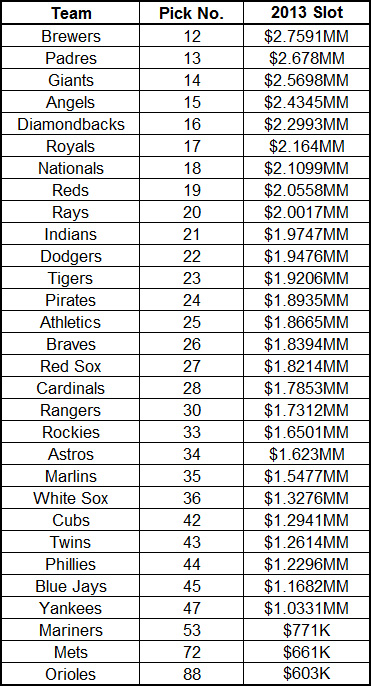
As many have pointed out, the current system provides a major incentive for teams to sign multiple compensation free agents. Now that the Orioles have surrendered their #17 pick for Ubaldo Jimenez and their #52 pick for Nelson Cruz, they could sign Santana, Drew, or Morales with the smallest draft pick cost of any team. In theory, teams at the bottom of this chart should be willing to offer at least several million more than a team near the top, assuming a desire and need for one of the three free agents. It's why Drew makes so much sense for the Mets.
These three free agents have a good reason not to sign a one-year deal right now, with the season less than a month away, even though Cruz did so recently. As Ken Rosenthal of FOX Sports recently pointed out, a player must be with his team for the entire season to receive a qualifying offer. Santana could sign a one-year worth $15MM or so and make it official on March 22nd, and not have to worry about being saddled with another qualifying offer after 2014. On the other hand, losing the ability to make a qualifying offer lowers his value to the signing team, to some degree.
If any of the three compensation free agents is willing to wait until June 5th to sign, the draft pick compensation issue goes away and the players can be signed without forfeiture of a pick. The old teams, the Royals, Red Sox, and Mariners, would not gain a supplemental round pick in that scenario. If those teams perceive that threat to be real, it provides an incentive for them to explore deals to bring back Santana, Drew, and Morales, respectively.
Analyzing The Five Players Who Opted Out
As I mentioned in my opt-out feature article last week, five players have used an opt-out to secure a new contract or extension: Alex Rodriguez, J.D. Drew, A.J. Burnett, C.C. Sabathia, and Rafael Soriano. A-Rod and Sabathia stayed with the Yankees, with Sabathia getting a year added to his contract just before the point of opting out. Drew, Burnett, and Soriano signed with new teams.
One negative often associated with opt-out clauses is that if a player has two or three good years, he'll just opt out and his former team will miss out. But what if the five players above had not opted out? Would their teams have come out ahead?
For this exercise, we'll use FanGraphs' dollar valuations, which were explained here by Dave Cameron. My definition of an opt-out clause is a provision where the player can become a free agent midway through a multiyear deal, at a point where he has multiple guaranteed years remaining.
- Alex Rodriguez: Opted out of 2008-10 seasons, for which the Yankees would have paid him $72MM. A-Rod produced 13.7 WAR during that time, which was worth $60.1MM. He was a very good player from 2008-10, averaging about 4.6 WAR per year, but he didn't provide great value for the price.
- J.D. Drew: Opted out of 2007-09 seasons, for which the Dodgers would have paid him $33MM. Drew produced 10.5 WAR during that time, which was worth $46.8MM. This opt out hurts in that regard, though the Dodgers paid $22MM for Drew's 6.8 WAR in 2005-06, which is valued at $24.2MM. While it would have been excellent value to have Drew for the duration of his five-year, $55MM contract, the Dodgers didn't do poorly in getting the first two years.
- A.J. Burnett: Opted out of 2009-10 seasons, for which the Blue Jays would have paid him $24MM. He was worth 4.3 WAR during that time, valued at $19.2MM. The Jays wound up paying $31MM for 10.7 WAR from 2006-08, which is valued at $45.2MM. As former Blue Jays GM J.P. Ricciardi put it in our interview, "We put the opt-out in there and in all honesty, it ended up working out great for us."
- C.C. Sabathia: Would have opted out of 2012-15 seasons, for which the Yankees owed him $92MM. Sabathia's 7.3 WAR from 2012-13 was worth $34.3MM, and it's difficult to picture him producing $57.7MM worth of value for his age 33-34 seasons. Had the Yankees allowed Sabathia to opt out and leave after 2011, they would have missed out on a strong 2012 season. Still, the case can be made that they should have let him go after paying $69MM for 17.5 WAR from 2009-11, which is valued at $76.8MM.
- Rafael Soriano: Opted out of 2013 season, for which the Yankees owed him $14MM. I'm not a big fan of using WAR to evaluate reliever salaries, but I am comfortable saying Soriano's 2013 season was nothing special and not worth his salary. I should note that Soriano's post-2012 opt-out doesn't fit neatly into our definition of the clause — with one year left at that point, it resembled a player option, which is more common.
Take a look at the following table, which shows each player's age in the season immediately following his opt-out:
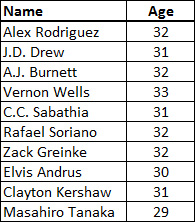
Of the ten opt-out clauses in baseball history, only Tanaka could opt out and sign a new contract that begins on the right side of 30. Even Kershaw could be mortal by his age 31 season. With an average age of 31 after the opt out, it's not surprising that with four of the five opt-outs that have been employed, the team was better off losing the player and the back end of his original contract.
Orioles Close To Deal With Nelson Cruz
9:11am: Cruz and the Orioles have mostly been discussing the possibility of a one-year deal, ESPN's Jayson Stark tweets.
7:02am: The Orioles are close to a deal with slugger Nelson Cruz, reports Jon Heyman of CBS Sports. Heyman adds, "There are still a couple issues to be resolved, according to sources, though a deal looks extremely likely."
Cruz was one of 13 players to receive and turn down a one-year, $14.1MM qualifying offer in November. Signing such a player requires the forfeiture of a draft pick, which contributed to slow markets for Cruz, Ubaldo Jimenez, and the still-unsigned Ervin Santana, Stephen Drew, and Kendrys Morales. The Orioles signed Jimenez on Monday to a four-year, $50MM contract, a franchise record for a pitcher. The O's sacrificed the 17th overall pick in the June draft to do so. At the trade deadline last year, the Orioles dealt their Competitive Balance Lottery Round A pick to the Astros in the Bud Norris deal, currently #33 overall. That means their next available pick to sacrifice for a qualifying offer free agent is #52, so the penalty to sign Cruz is less pronounced. The Rangers will receive a supplemental first round pick for their loss.
On Friday, Ken Rosenthal of FOX Sports tweeted that the Orioles were in talks with both Morales and Cruz, and a deal with one could happen soon. In Cruz, they'll get a 33-year-old right-handed bat who hit .266/.327/.506 with 27 home runs in 456 plate appearances in 2013. The overall line is reflective of Cruz's recent body of work: good power, not too many walks. His home run total ranked second among free agents, even though he was suspended 50 games for a connection to Biogenesis. Cruz explained in an August statement that a gastrointestinal infection led to "an error in judgment that I deeply regret" weeks before he was to report in spring training 2012. It appears that the draft pick attached to Cruz affected his market more than the 2013 suspension, with Jhonny Peralta scoring a $53MM contract in November after serving an in-season Biogenesis suspension.
For the Orioles, Cruz could play both left field and designated hitter, as they're not locked into an established or expensive player at either position. Cruz has played 384 2/3 innings in left in his career, though his defense is generally considered below-average.
Back in November, before the plight of certain qualifying offer free agents was fully established, MLBTR's Steve Adams predicted a three-year, $39MM contract for Cruz. He's represented by Adam Katz of Wasserman Media Group.
Clearly, the Orioles signing Cruz would remove a suitor for Morales. According to Heyman, Morales has been working out for a month at the Boras Sports Training Institute on the campus of St. Thomas University in Miami Gardens. Morales could still return to the Mariners, and Boras has pitched him as a potential first baseman for the Pirates.
Another Bite At The Apple: Opt-Out Clauses In MLB
An opt-out clause is the ultimate safety net for an MLB player. Typically employed with deals of least five guaranteed years, an opt-out clause is inserted in the middle of the term and allows the player to abandon the rest of his contract and become a free agent.
Alex Rodriguez started the opt-out trend with his monster free agent deal with the Rangers in December 2000, and in total, ten players have received opt-out clauses. Six of those clauses have come due, and only one of those players, Vernon Wells, didn't secure additional money at the time. C.C. Sabathia leveraged his ability to opt out to add one year and $30MM to an already record-setting deal. The others — A-Rod, J.D. Drew, A.J. Burnett, and Rafael Soriano — got to take another lucrative bite at the apple of free agency.
A Deal-Making Idea
On the night before the 2005 Winter Meetings in Las Vegas, agent Darek Braunecker had a client in A.J. Burnett who he felt was on an island in terms of being the best pitcher available. It was at that point Braunecker conceived of the idea of asking for an opt-out clause in Burnett's deal. "I wanted to create something that might add additional value to the deal as opposed to just the monetary component of it," explained Braunecker in a January conversation.
Burnett's five-year, $55MM deal with the Blue Jays came together quickly once the team agreed to include an opt-out clause after the third year. "Quite honestly, it was a deal-maker for us," said Braunecker. "I presented the idea to [Blue Jays GM] J.P. [Ricciardi] and told him that we had another club that had already agreed to that provision, and that if he was willing to do it that he would have a deal. So, really, no pushback to speak of. He obviously had to get approval from [club president] Paul Godfrey, and Paul gave his blessing on it almost immediately and that's essentially what concluded those negotiations." Braunecker added, "It really wasn't much of a challenge, to be honest with you."
Three years later, agent Greg Genske had the enjoyment of negotiating on behalf of the offseason's best available starting pitcher, C.C. Sabathia, and eventually landed a record-setting seven-year, $161MM deal with an opt-out clause after the third year. There seems to be some disagreement about who proposed the clause. Back in 2008, Matt Gagne of the New York Daily News quoted Yankees GM Brian Cashman saying, "I offered it. They never asked for it. They never said they were afraid of New York, I never heard that….Just in case it was an issue, I went to their house and I said, 'I think you're going to love it here. But let me just throw this out there.'" Genske disputed Cashman's account, telling me in January this year, "That's not true at all. That was a negotiated item that was difficult to get the Yankees to agree to. It was the last item agreed to."
The sheer rarity of opt-out clauses suggests they're not something teams are readily offering up. Only ten opt-out clauses have been given out in total, though two of them came in January this year for Excel Sports Management clients Clayton Kershaw and Masahiro Tanaka. According to Cot's Baseball Contracts, 52 MLB contracts have been worth $100MM or more. Only seven of those included opt-out clauses. Asked if he's surprised we've seen so many top of the market deals without opt-out clauses, Genske replied, "I don't think I'm surprised. It certainly is a big deal for a club. If a club's going to commit themselves to those kinds of dollars, then they don't get the benefit of the upside fully if the player has the right to opt out. I certainly understand clubs' resistance to do it."
How Much Would Kimbrel Have Earned In Arbitration?
Back in October, MLBTR contributor Matt Swartz explained that Braves closer Craig Kimbrel has been so good in his first three seasons, he broke our arbitration projection model. We eventually decided to create a special rule because of Kimbrel, which limits a player's raise to $1MM beyond the previous record for his player type. Since Jonathan Papelbon had set a $6.25MM first-time arbitration record for closers in 2009, we capped Kimbrel's 2014 projection at $7.25MM.
Without the rule, our system had assigned a $10.2MM projection to Kimbrel, so we lopped off about $3MM more for which he at least had a statistical argument, if not a precedent. With such a wide spread of possibilities, it was no surprise when Kimbrel and the Braves ended up exchanging arbitration figures. Kimbrel and his agent David Meter submitted a $9MM figure, a number reflective of the attitude, "We don't just deserve to beat Papelbon's record, we should crush it." The Braves went with $6.55MM, which would have thrown Kimbrel just $300K beyond Papelbon's record despite this potential hearing coming five years later and Kimbrel's far superior statistical record.
With a midpoint of $7.775MM, Meter would only have had to convince an arbitration panel his client deserved a dollar more than that, meaning that Kimbrel should get $1,525,001 more than Papelbon did. You always hear that arbitration hearings are a crapshoot, but if I were a betting man, I would have bet on Kimbrel's side. It's not just Meter putting together the argument; they would have had the knowledge of a motivated players' union behind them.
Once the two sides reached the point of exchanging figures, a one-year deal went off the board because of the Braves' file-to-go stance. But the two sides still discussed a multiyear deal and were able to get it done. Kimbrel signed a four-year, $42MM deal with a club option for 2018. The deal bought out all three of Kimbrel's arbitration years and one free agent year, with the option for a second free agent year.
For Meter and the Braves, one key question that had to be explored before agreeing to this deal was how much Kimbrel stood to earn in arbitration going year-to-year. I asked Matt Swartz to show me a few scenarios. Initially, Matt used what I considered to be fairly conservative stat projections for 2014 and 2015. He used Steamer's 65 innings, 28 saves, and 1.88 ERA for Kimbrel's 2014 season, and then regressed to the mean a bit on 2015 with 55 innings, 22 saves, and a 2.20 ERA.
Using these stats and assuming Kimbrel lost this month's arbitration hearing, he'd have salaries of $6.55MM, $9.9MM, and $12.9MM for a total of $29.35MM over his three arbitration years. In his actual multiyear deal, Kimbrel will earn $28MM over his three arbitration years. In this scenario, Kimbrel left just $1.35MM in arbitration money on the table. In his multiyear deal he still conceded up to two free agent years, and of course the younger a free agent is, the better he does.
Using the same stats and assuming Kimbrel won this month's arbitration hearing, he'd have salaries of $9MM, $12MM, and $14.7MM for a total of $35.7MM. It's interesting to note that there was a lot more at stake in the 2014 hearing than the $2.45MM spread — losing this one hearing would have lost Kimbrel a projected $6.35MM in total arbitration earnings. Comparing the $35.7MM projection to the $28MM his contract pays, Kimbrel gave a discount of more than 21% for his arbitration years.
As I mentioned above, I felt that Matt's statistical projections for Kimbrel were pretty conservative. The 50 saves Matt projected for 2014-15 is equal to his 2013 total. In three years as a closer, he's averaged 46 saves per year. Still, great closers fall short of the 40 save plateau all the time. I asked Matt to plug in 35 saves for each of the 2014 and '15 seasons and run the numbers. With the pair of 35-save seasons, Kimbrel projected to earn $33.65MM for 2014-16 if he lost his 2014 arbitration hearing and $40.1MM if he won it.
It's clear that the Braves feel Kimbrel has a good chance to reel off quality 35 save seasons in his next two years, with a reasonable chance of more than 70 overall. Let's say, then, that the team might estimate his arbitration earnings in the $34-42MM range. Compared to the actual contract, they might consider their arbitration savings anywhere from 18 to 33%. In the scenario where Kimbrel wins his 2014 arbitration hearing and then reels off a pair of 35 save seasons, which I find quite plausible, the Braves essentially secured his first free agent year for free, plus an option on a second.
Keeping with the 35 save scenario, Kimbrel's 2016 salary projected at $16.1MM if he won lost his 2014 hearing and $17.9MM if he won it. Since more than 35 saves a year is certainly possible, I'd widen that range and just say Kimbrel could have earned $16-20MM in 2016 alone. Whatever the exact number, even the free agent market is not paying that much for elite relievers. The Braves were likely picturing not being able to keep Kimbrel on the team in 2016, a point at which he'd have reduced trade value with an arbitration salary outstripping his potential free market salary. Furthermore, if you take a more aggressive 40 save projection for Kimbrel for 2014 and assume he would have won the upcoming hearing, a $14MM salary for 2015 appeared possible. Even that might have been untenable for Atlanta, reducing their Kimbrel window to one more year.
Since Kimbrel could have potentially earned all $42MM through arbitration and then gone to free agency as a 28-year-old, you might ask why he signed this multiyear deal. As with most multiyear deals, Kimbrel chose to leave some potential earnings on the table for guaranteed money now. Eric Gagne is a cautionary tale. The former Dodgers closer was invincible from 2002-04 and then pitched 15 1/3 innings from 2005-06 due to elbow issues. If something like that happens to Kimbrel, he's still got all $42MM coming to him, which is not the case if he had decided to go year-to-year through arbitration.
The arbitration pay scale for closers is just wacky, even more so in a time where teams are backing away from huge contracts for relievers. With this deal, the Braves subverted the arbitration system and found a way to keep an elite reliever for more than one or two additional years. If Kimbrel stays healthy and reasonably effective, they'll save significant money compared to arbitration, too. Kimbrel can rest easy, having secured his family for generations three years prior to when he would have reached free agency.
Scouting Masahiro Tanaka
Though he's yet to throw a pitch in the Major Leagues, the Yankees committed a massive $175MM to sign 25-year-old righty Masahiro Tanaka in January. $20MM of that went to his old team, the Rakuten Golden Eagles, with $155MM going to Tanaka. Tanaka's contract is the third-largest ever for a pitcher in MLB history, topped only by Clayton Kershaw's new extension with the Dodgers and C.C. Sabathia's 2008 free agent deal with the Yankees. Like those deals, Tanaka's includes an opt-out clause.

Tanaka comes to MLB for the 2014 season after posting what many scouts refer to as "video game numbers" in Japan last year: a 24-0 record and a 1.27 ERA in 212 innings. Last Friday, Yankees GM Brian Cashman did his best to temper expectations for Tanaka in a conversation with ESPN's Ian O'Connor. Cashman said he expects the pitcher to have growing pains in the States, and asked his ultimate upside two or three years down the road, the GM said Tanaka "has the potential to be a really solid consistent number three starter." Free agent salaries continue to rise, but I don't think the Yankees would spend that kind of money on a pitcher they thought might become a number three a year or two before his opt-out clause comes up.
Unbiased opinions were needed. To get a feel for Tanaka's repertoire and approach, injury risk, and overall ability, I spoke to high-ranking officials with scouting-related positions for four MLB teams (referred to simply as "scouts" later in this article). Each has seen the pitcher in person extensively, and none work for the Yankees.
Before we begin, here is a refresher on the 20-80 (or 2-8) scouting scale from Kevin Goldstein, formerly of Baseball Prospectus: "A score of 50 is major-league average, 60 is above-average (also referred to as "plus"), and 70 is among the best ("plus-plus"). 80 is top of the charts, and not a score that gets thrown around liberally." For more information on scouting pitchers from Goldstein, click here.
Scouting Report: Three Plus Pitches
Tanaka's fastball typically sits between 91-93 miles per hour, with the ability to touch 96 mph. Most of the scouts to whom I spoke graded his fastball as a 6, or plus, though one put a 70 on the heater. One scout praised his fastball in saying he throws a "heavy ball," though two others noted the pitch can get flat or straight at times. One of those two said Tanaka's fastball is "probably his most hittable pitch, in a way."
Scouts agreed Tanaka has a second or third gear for his fastball. In Japan he'd often be in "cruise control" for the first half of the game, ramping his fastball up into the mid-90s later if he needed to. Noted one scout who loves Tanaka, "When they're in Japan, they don't have to throw their best stuff because the league's not as good." That figures to change for Tanaka in MLB, given the deeper lineups.
Tanaka clearly had plus-plus control in Japan, with walk rates below two per nine innings in each of the last four seasons. Scouts feel that will translate to plus in the States. Grading Tanaka's command, one scout said "60 or 70," another went with 55, and one gave a 5. The most pessimistic scout elaborated, "I actually thought with the offspeed stuff, the splitter and the slider especially, I thought there was more command of those pitches. And I thought with the fastball he definitely threw strikes to an above average level but I thought the command, pinpointing it, was just average." When Tanaka does get into trouble in MLB, there's a good chance it will be the result of throwing hittable fastballs.
Next is Tanaka's splitter, by most accounts a nasty pitch. One scout put an 8 on it, suggesting if you don't put an 8 on this particular pitch, then you might be the type who never gives out 8s. He explained, "It's not a tumbling pitch. It's more of a disappearing fastball. It's not a Contreras splitter that comes out and kind of flutters." Two others put 7s on the splitter, though one dissented with a 6. That person admitted the split "could be plus-plus," but unlike his peers, he feels Tanaka's best pitch is his slider.
The lone scout who prefers the slider explained, "I think it's a true slider with a good tilt, he would get depth to it more than ones that are plus-plus." He feels the slider has a slight lead over the splitter, noting the slider has been Tanaka's pitch since his high school days. With the other scouts, Tanaka's slider received a 6 across the board.
It is generally agreed that Tanaka's fastball, splitter, and slider are plus pitches, and he'll get strikeouts with each. For a change of pace, he also throws a slow curveball, described by one scout as "useful." This pitch grades in the 45-50 range. Tanaka's ability to throw this pitch for strikes allows him to pitch backward if he chooses. Typically, though, Tanaka's approach is aggressive, as one scout explained: "He pitches inside, he doesn't pitch away from contact a lot. Some guys in Japan, they're not as aggressive. He has more of a Western style that he's not afraid to go up and in, he's not afraid to pitch inside. He pitches kind of with a little chip on his shoulder."
Reduced Strikeout Rate: Red Flag?
Though he posted a 1.27 ERA, Tanaka struck out only 7.8 batters per nine innings last year in Japan. That mark was his lowest since 2010. While one scout admitted, "It's certainly not a positive," all agreed the reduced strikeout rate is not a cause for concern. Explained another, "He's the type of guy that if he wants to, he can go out and strike out hitters. He's a brilliant, smart pitcher and he's not afraid to pitch to contact. I saw him doing that a lot that last couple years. That's one of the reasons he was able to stay efficient with his pitch counts." Throw in MLB lineups that are much more prone to swinging and missing, and there's good reason to believe Tanaka will whiff more than 7.8 per nine in 2014.
Heavy Workload: Cause For Concern?
In December, multiple MLB executives expressed concern to Yahoo's Jeff Passan regarding Tanaka's high pitch counts. The righty averaged about 110 pitches per regular season start in 2013, with seven outings in excess of 122 and a high of 136. Most famously, Tanaka threw 160 pitches in a Japan Series game and another 15 the next day in relief. In total, he threw 1,315 innings through his age-24 season, which hasn't happened in the Majors since the mid-70s, according to SI's Tom Verducci. Perhaps the GMs and owners calling the shots were worried about Tanaka's high pitch counts, but most of the scouts we talked to brushed it off.
"He's been trained for that his entire life," remarked one. Another noted his durable, solid body and suggested he's someone who might be able to handle throwing a lot of pitches. One scout noted that while it's obviously not a great idea to throw 160 pitches in a game, Japanese pitchers typically get six or seven days rest between starts, making the total mileage similar to MLB starters. None of the four feel that Tanaka's injury risk exceeds that of a typical MLB starter. Keep in mind, however, that the chance of going on the disabled list for the average MLB starter is around 39% for 2014, based on research from Jeff Zimmerman for FanGraphs.
Tanaka's Overall Projection
In a tweet last month, Joel Sherman of the New York Post said the comparables he's heard most often for Tanaka are Hiroki Kuroda and prime-age Dan Haren, plus reliever Bryan Harvey for his splitter. One scout agreed with the Haren comp, noting that Tanaka has more arm strength. Others cited Zack Greinke and Matt Cain.
In terms of placing an overall grade on Tanaka, opinions ranged, but all were quite positive. One scout, who admitted being "toward the higher end of the spectrum," described Tanaka as a number one starter, without hesitation. He expects Tanaka to contend for the Cy Young, and feels he'll be one of the ten best starting pitchers in MLB in 2014.
The other three scouts placed Tanaka in a slightly lower tier, ranking him in the #15-25 range among all MLB starters for 2014. Two of them described him as a number two starter.
The mystery of how Tanaka will perform in Major League Baseball should be resolved in short order. He'll face MLB hitters in Spring Training later this month, and could have a bit of a soft landing with the Yankees' first three regular season games coming in Houston in early April.
RELATED READING
Introducing ProFootballRumors.com
We are proud to announce our new NFL rumors site, Pro Football Rumors! Luke Adams and his team of NFL fanatics are covering rumors, transactions, and the draft 365 days a year with the style, timeliness, and analysis you've come to love on MLBTR and Hoops Rumors. The team has been quietly covering all the latest for the past several days, so there is plenty of reading material.
NFL free agency starts in March and we'll have the latest on big names like Jimmy Graham, Greg Hardy, and Eric Decker. We'll also keep you on top of the latest on Johnny Manziel, Teddy Bridgewater, and Jadeveon Clowney in advance of the May draft. If you like what you see at Pro Football Rumors, please bookmark the site, follow us on Twitter @PFRumors, and like our Facebook page.