
Help Wanted: MySQL, PHP, Custom CMS
MLB Trade Rumors is seeking a freelance developer with experience in MySQL and PHP. Currently, we are using MySQL for the database that powers MLBTR’s various features, such as the Transaction Tracker and Agency Database. The MLBTR staff inputs data daily into a custom content management system. We would like to expand this to power our new acquisition, Roster Resource.
I believe the best route will be to build upon our existing database and CMS to allow for the easy input of Roster Resource information, such as player numbers, birthdates, position, method of acquisition, birthplace, option status, etc. Then, Roster Resource website must be rebuilt to display the information from this database, with an eye on improving the load time. Furthermore, we’d like to customize the mobile versions of these pages to present this wealth of information on cell phones.
If you are interested in this project, please send an email to mlbtrhelp@gmail.com. In the email, please explain your qualifications and related experience and include your hourly rate.
Trade Rumors Acquires Roster Resource
Today, we’re proud to announce an acquisition of our own! Trade Rumors has purchased the Roster Resource website, which was formerly known as MLB Depth Charts before expanding into other sports. Additionally, we’ve hired the site’s creator, Jason Martinez. Jason will continue to obsessively update depth charts and roster information quickly and accurately for all MLB, NBA, and NFL teams, and he’ll also contribute articles here at MLBTR.
The depth charts and roster information will continue to live at Roster Resource for now, though it is officially under the Trade Rumors umbrella. You’ll see us begin linking more to the Roster Resource depth charts in our posts, as we feel this information is a perfect fit for readers of MLB Trade Rumors, Hoops Rumors, and Pro Football Rumors. We are striving to bring you the best possible coverage of transaction-related news as well as depth charts and roster information you can consult for further analysis.
We’d love your feedback on Roster Resource, whether through comments on this post, replies on Twitter, or messages through our contact form. We’ve already got a number of improvements planned. Below, I’ve linked to depth charts for each of the 30 teams, which is the heart of what the site offers.
- Arizona Diamondbacks
- Atlanta Braves
- Baltimore Orioles
- Boston Red Sox
- Chicago Cubs
- Chicago White Sox
- Cincinnati Reds
- Cleveland Indians
- Colorado Rockies
- Detroit Tigers
- Houston Astros
- Kansas City Royals
- Los Angeles Angels
- Los Angeles Dodgers
- Miami Marlins
- Milwaukee Brewers
- Minnesota Twins
- New York Mets
- New York Yankees
- Oakland Athletics
- Philadelphia Phillies
- Pittsburgh Pirates
- San Diego Padres
- San Francisco Giants
- Seattle Mariners
- St. Louis Cardinals
- Tampa Bay Rays
- Texas Rangers
- Toronto Blue Jays
- Washington Nationals
2017 MLB Free Agent Power Rankings
During the month of May, we saw a pair of key players decide to forgo free agency. Nationals starter Stephen Strasburg, by far the best projected free agent from the 2016-17 class, signed a seven-year, $175MM extension that includes heavy deferrals and two opt-out clauses. I believe Strasburg left at least $50MM on the table in making the surprising decision to sign. With Strasburg off the market, we’re unlikely to see any $100MM pitchers this winter after four hurlers reached that mark last offseason.
Francisco Cervelli, projected to be the best catcher on the 2016-17 free agent market, signed a three-year, $31MM extension with the Pirates. Cervelli may have left $20MM or more on the table in signing his new deal.
So, we’ve lost the #1 and #10 free agents on last month’s power rankings. Below, I’ve ranked the remaining projected free agents by earning power. You can view the full list of 2016-17 MLB free agents here.
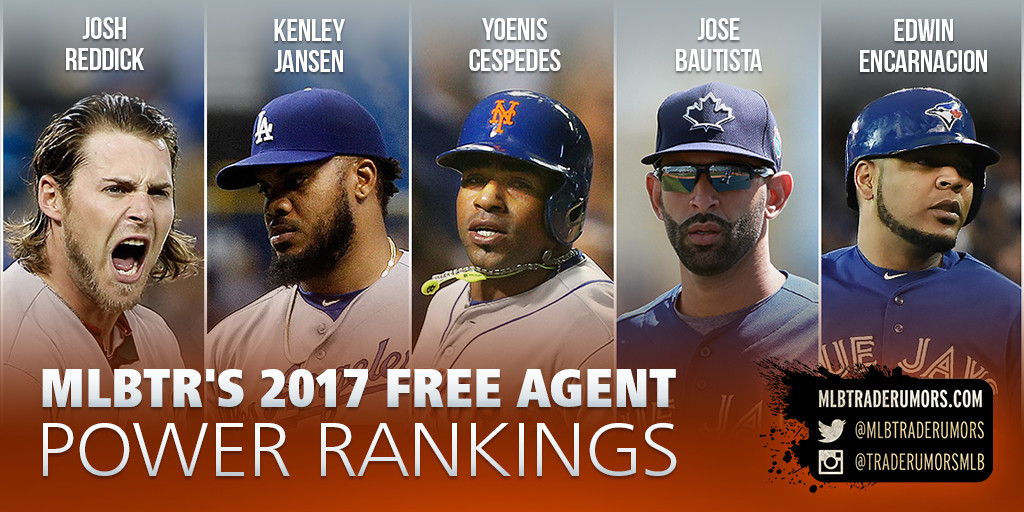
1. Yoenis Cespedes. With 15 home runs in his first 193 plate appearances, Cespedes has a good chance to reach 40 for the first time. He’s increasingly likely to opt out of the remaining two years and $47.5MM on his contract with the Mets. The 30-year-old slugger could be the only free agent to reach $100MM this offseason, underlining the lack of relatively young high-end players on the market.
2. Jose Bautista. The most noteworthy part of Bautista’s May was his run-in with Rougned Odor‘s fist. Bautista served a one-game suspension for his role in the ensuing brawl. At the moment, I’m projecting a four-year deal in the $100MM range for Bautista, who turns 36 in October.
3. Josh Reddick. Reddick fractured his left thumb during a headfirst slide on May 19th. While the injury will not require surgery, he’s expected to be out until late June. Reddick was swinging a hot bat leading up to the injury. Assuming he continues to produce upon his return, I don’t see the injury affecting his earning power. I can see a five-year deal approaching $100MM.
4. Kenley Jansen. Not much has changed with Jansen, who has a shot at a five-year deal. It seems likely that a reliever will end up with the largest pitching contract of the offseason.
5. Edwin Encarnacion. Encarnacion recovered from an ugly April to post a solid May. He could wind up with a three-year deal with a salary in excess of $20MM.
6. Dexter Fowler. Fowler continued to rake in the month of May, hitting .295/.403/.476. He currently ranks third among position players with 3.2 wins above replacement, after Mike Trout and Manny Machado. I’m projecting a four-year deal in excess of $60MM for Fowler, after he was left with a disappointing one-year deal last winter.
7. Aroldis Chapman. Chapman made his Yankees debut on May 9th after serving a 30-day suspension for a domestic violence incident. He’s looked as dominant as ever, and a large free agent payday is in the offing. The question is whether Chapman can get a five-year deal, in light of that October incident.
8. Neil Walker. Walker posted another solid month for the Mets. In a thin market, perhaps he could land a Chase Headley contract (four years, $52MM) if he keeps going strong.
9. Rich Hill. Hill now has 11 starts under his belt this year with a 2.25 ERA and 10.4 K/9. The southpaw, who turns 37 next March, has come a long way in the last year. He appears to have a good chance at a four-win season, which generally seemed impossible for most of the last decade. Despite Hill’s age, I think a three-year deal in excess of $40MM is within reach.
10. Mark Trumbo. After another big power month, Trumbo is now tied for third in the AL with 15 home runs. If he winds up near 40 home runs this year, a strong three-year deal becomes possible. However, his value is hurt by his defensive limitations.
Carlos Gomez, who was ranked fifth on this list last month, has dropped out of the top ten. The hope is that he’ll finally start hitting after serving a May DL stint for bruised ribs. However, at this point he’s a candidate to take a one-year deal to rebuild value.
Four players were very close to making the list: catchers Matt Wieters and Wilson Ramos, and outfielders Michael Saunders and Ian Desmond. Each of them appears to be setting up for a three-year deal at this point. If four years starts to seem likely for any of these players, they’ll have a spot in the top ten.
Seeking Writers For New Hockey Rumors Website
Our family of websites includes MLB Trade Rumors, Hoops Rumors, and Pro Football Rumors. Later this year, we plan to start covering NHL transaction-related news with a brand new website. We are now taking applicants for part-time writers at our upcoming hockey rumors site. The position pays hourly, and we will be hiring multiple people. The criteria:
- Availability to work at least ten hours per week covering NHL news.
- Exceptional knowledge of all 30 NHL teams, no discernible bias. Knowledge of transaction-related concepts.
- A high school degree is required, and further education is preferred. Please include your highest completed level of education in your application.
- Writing experience is necessary, and online writing experience is preferred.
- Attention to detail and ability to follow the MLBTR/Hoops Rumors/PFR style and tone.
- Ability to analyze articles and craft intelligent, well-written posts summing up the news quickly and concisely.
- Ability to use Twitter, Tweetdeck, and an RSS feed reader such as Feedly. In general, you must be able to multi-task.
- Experience with social media, especially Twitter.
- If you’re interested, email prohockeyrumorshelp@gmail.com and explain how you stand out and qualify in a couple of short paragraphs. Please attach your resume to the email. We often receive several hundred applications, so unfortunately we will not be able to reply to each one.
2017 MLB Free Agent Power Rankings
The first month of the 2016 MLB season is in the books, and we’ve got movement in our 2017 MLB Free Agent Power Rankings. These rankings apply to players projected to reach free agency after this season, and the players are ranked based on earning power. In the middle of April, the Rangers unsurprisingly extended Adrian Beltre, so he’s off the list. To see the full list of 2016-17 MLB Free Agents, click here.
1. Stephen Strasburg. Strasburg was dominant in the season’s first month, carrying over his success from last year. By measure of wins above replacement, only Clayton Kershaw and Noah Syndergaard have been better. With a full season of good health, agent Scott Boras could look to push a seven-year deal for Strasburg past $240MM. An opt-out clause or two will surely figure in as well. Strasburg doesn’t turn 28 until July.
2. Yoenis Cespedes. Cespedes jumps up a spot after a huge April. In addition to seven home runs, he even managed to draw a few extra walks. A less streaky campaign than 2015, perhaps ending with around 35 home runs again, could net Cespedes the six-year deal that eluded him last winter. To take a shot at it, he’ll have to opt out of the remaining two years and $47.5MM on his current contract with the Mets.
3. Jose Bautista. Bautista continues to do his thing, hitting for power and drawing lots of walks. Last week, Jon Heyman tweeted that he believes Bautista will take less than his five-year, $150MM asking price but not less than $100MM. Something a bit north of $100MM on a four-year deal does seem plausible for Bautista, who told Nick Cafardo of the Boston Globe last month that he is willing to negotiate in-season with the Blue Jays.
4. Josh Reddick. Nothing out of the ordinary from Reddick in April. As a solid player who doesn’t turn 30 until February, Reddick could be a sneaky candidate for a five-year deal this winter. He told MLB.com’s Jon Paul Morosi that he’s not aware of any substantive extension talks with the A’s. In that column, Morosi had some interesting speculation about whether the Cubs could trade for Reddick this summer.
5. Carlos Gomez. Gomez is hitting .245/.303/.364 since June of last year, and I’ve dropped him three spots since our last rankings. The Astros’ center fielder is currently battling rib cage soreness and is trying to avoid the DL. For the Astros, Gomez just hasn’t looked like the player he was with the Brewers. Even if he performs to projections from here on out, which is a total unknown, Gomez could be limited to a four-year deal in the range of Alex Gordon‘s $72MM. He carries further downside risk if this becomes a lost season.
6. Kenley Jansen. Business as usual for Jansen, who has allowed one run in his first ten appearances. If the save opportunities continue coming as they did in April, perhaps the Dodgers’ closer can top his career high of 44 saves. It would be interesting to see a reliever earn the second-largest pitching contract of the offseason. Jansen could make that happen with a precedent-shattering five-year deal.
7. Edwin Encarnacion. Like last year, it was a rough April for Encarnacion. The Blue Jays’ designated hitter has shown many times he’s capable of going on a tear. Still, my confidence in a four-year deal for Encarnacion is wavering a bit. He’ll turn 34 in January.
8. Aroldis Chapman. Chapman’s 30-game suspension for a domestic violence incident ends a week from today, and he’ll presumably jump right into the Yankees’ closer role. He’s been working out at the Yankees’ minor league complex, taking some time last week to become a U.S. citizen. I expect Jansen to do better than Chapman in free agency, but Chapman should still land a huge contract if he stays incident-free until free agency.
9. Francisco Cervelli. Cervelli makes his first appearance in our top ten. The Pirates’ backstop has stepped it up a notch after a stellar 2015, and ranks fifth in the NL with a .438 on-base percentage. As it stands now I could see a four-year deal worth $60MM, and I think he could have a shot at five years if his offensive success continues. Quite the transformation for Cervelli, who will turn 31 shortly before the 2017 season.
10. Dexter Fowler. Like Cespedes, Fowler could find the contract that eluded him after another year back with his old team. So far in 2016, Fowler has been the best player in baseball. The Cubs’ center fielder boasts an MLB-best .470 OBP. Though he’s never approached four wins above replacement, Fowler already has two in the books after one month. If he stays healthy and productive, Fowler should be able to get a four-year deal in free agency.
Neil Walker and Michael Saunders are both pushing for a spot in our top ten after stellar starts to their seasons. Walker has already crushed nine home runs, and could reach 30 this year. Saunders is healthy and hitting after a lost 2015. Typically weaker against left-handed pitching, Saunders smacked three home runs off southpaws in April, including two off Drew Smyly. Colby Rasmus, Mark Trumbo, Martin Prado, and Rich Hill are a few others off to hot starts in 2016. Andrew Cashner drops out of our top ten after a lackluster April.
Seeking Producer For MLB Trade Rumors Podcast
The MLB Trade Rumors Podcast has been going strong for over a year now. You can check out our Soundcloud page to listen to past episodes. Unfortunately, our podcast producer has to step down, which means we are in the market for a replacement.
We are seeking a new producer to put together each week’s episode and ensure the best possible sound quality. If you’re interested and have relevant experience, please email mlbtrhelp@gmail.com explaining your qualifications and technical setup/process. Please also include links to sample shows that you have produced, and don’t hesitate to let us know if you have any ideas about how to improve the current show.
Offseason In Review Series
Check out all of our Offseason In Review posts at the links below. We’ll update this post as more are published.
AL East
AL Central
AL West
NL East
NL Central
NL West
Orioles Sign Zach Phillips, Designate Chris Jones
The Orioles have signed lefty Zach Phillips to a one-year deal, announced the team. To clear a spot on the 40-man roster, they designated southpaw Chris Jones for assignment. MLBTR has learned that Phillips received a Major League deal worth $510K. Phillips is represented by Matt Colleran.
Phillips, 29, elected free agency last week after the White Sox removed him from their 40-man roster. He has just 15 2/3 innings of big league experience, which came from 2011-13. Last year at Triple-A Charlotte, Phillips posted a 3.13 ERA, 10.5 K/9 and 3.3 BB/9 in 54 2/3 innings, allowing just one home run. He spent 2014 with the Hiroshima Carp. The Rangers took Phillips as a draft-and-follow out of Sacramento City College in 2004, trading him to the Orioles in July 2011 for Nick Green. Phillips told reporters including Roch Kubatko of MASNsports.com this morning, “I’ve always wanted to come back here and I thought it was a great time to. Just being familiar with Baltimore and them giving me a chance. I’ve always liked it here and thought it would be good to come back.”
Phillips “has a good chance to make the Orioles,” writes Rich Dubroff of CSN Mid-Atlantic. As noted by MLB.com’s Brittany Ghiroli on Twitter, the Orioles have a potential bullpen opening because of an injury to Brian Matusz. According to Eduardo A. Encina of the Baltimore Sun, Matusz has been dealing with a lower back strain and just received a cortisone injection, putting Opening Day in jeopardy. The Orioles kick off their season at home against the Twins on April 4th. Their bullpen should otherwise include Zach Britton, Darren O’Day, Brad Brach, Mychal Givens, Dylan Bundy, and one more reliever from a handful of options.
Jones, 27, put up a 2.94 ERA, 6.3 K/9, 1.7 BB/9, and 0.90 HR/9 in 150 Triple-A innings last year. That represented his third career stint at Triple-A. Jones was drafted by the Indians in the 15th round in 2007. He was traded to the Braves in October 2011 for Derek Lowe, and was later shipped to Baltimore for Luis Ayala in April 2013. The O’s released Jones in February 2014 upon signing Nelson Cruz, re-signing the lefty to a minor league deal shortly thereafter. He rejoined Baltimore’s 40-man roster last November, and had been reassigned to minor league camp early last week.
Sign Up For The MLB Trade Rumors Newsletter
Is MLBTR’s newsletter landing in your inbox each week? The premise is simple: an exclusive weekly hot stove article, written by me. There are no strings attached. The newsletter is completely free, and we won’t give out your email address or use it for marketing. This week, I’ll take a look at the 2017 MLB Free Agents who fell short of the top ten in my power rankings. Those of you viewing this post in our app can use this link.
2017 MLB Free Agent Power Rankings
The 2015-16 MLB free agent class is winding down, and it’s time to turn our attention to the 2016-17 group. These players project to become free agents after the 2016 season, unless they sign contract extensions first. Extensions seem unlikely for the top names. Players may be reluctant to sign now, as the 2016-17 class appears weak. MLBTR’s full list of 2016-17 free agents can be found here.
What exactly are we ranking here? The simplest explanation would be earning power. These rankings represent expected contract size, assuming each player reaches the open market and goes to the highest bidder. Of course, nothing affects a free agent’s earning power more than his most recent season, so I’ll be updating these rankings monthly.
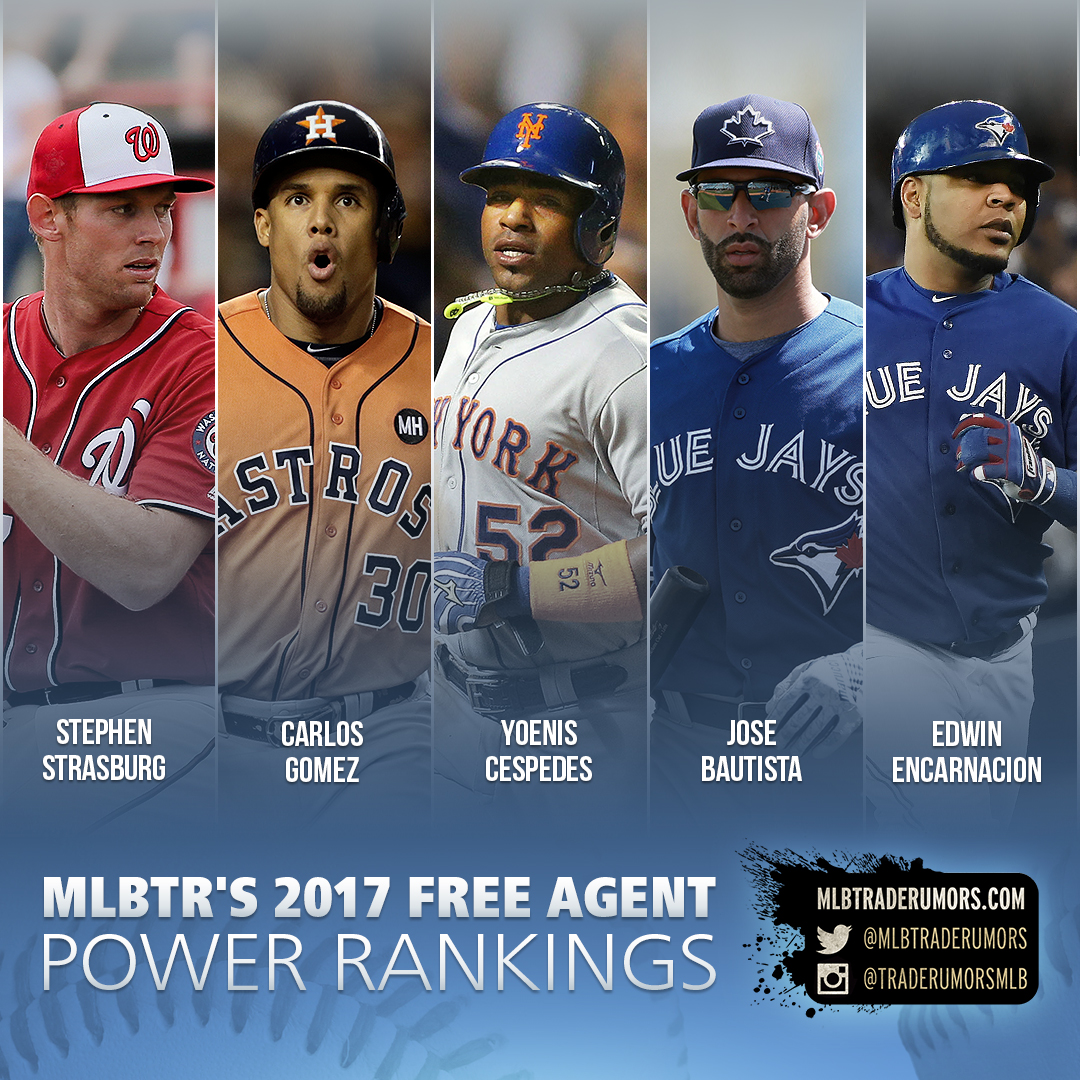
1. Stephen Strasburg. The first overall pick in the 2009 draft, Strasburg has been very good in his Nationals career but hasn’t quite lived up to expectations. One could draw a parallel with one of last winter’s top free agents, Justin Upton. Of course, it’s different with pitchers, and over the years Strasburg’s only limitation has been health. After tying for the NL lead in strikeouts in 2014, shoulder, neck, back, and oblique issues limited Strasburg to 23 big league starts in 2015. After the season, he had a “small, non-cancerous growth removed from his back,” wrote James Wagner of the Washington Post. Strasburg also has Tommy John surgery in his health history, with the procedure performed in September 2010. Strasburg’s agent, Scott Boras, enjoys a well-known cozy relationship with the Nationals. The team generated controversy in 2012 when Strasburg was shut down at 159 1/3 innings with the team headed to the playoffs, a decision unsurprisingly supported by Boras. Now, if Strasburg can muster up his second career 200-inning season along with his typical dominance, Boras will seek to shatter David Price‘s record contract for starting pitchers, which was for seven years and $217MM with the Red Sox. As with Price, opt-out clauses will factor heavily into the discussion. Strasburg doesn’t turn 28 until July, so he’ll be about two years younger than Price was.
2. Carlos Gomez. Gomez took big steps forward after being traded to the Brewers in November 2009, and posted a career-best 19 home runs in 2012. In the spring of 2013, with free agency looming after the season, Gomez signed a surprising three-year extension with Milwaukee. He went on to put up monster seasons in 2013 and ’14, but was derailed in 2015 with hamstring and hip issues. A near-trade to the Mets fell apart in July when New York backed out for various reasons, but he was successfully traded to the Astros the following day. Similar to Strasburg, a healthy season will go a long way for Gomez, who is also represented by Boras. The center fielder could land a deal north of $150MM if he returns to his 2014 level of health and production.
3. Yoenis Cespedes. I predicted a six-year, $140MM deal for Cespedes, who reached free agency after the 2015 season. Instead, the 30-year-old slugger turned down multiple five-year offers and returned to the Mets in late January on an interesting high-AAV contract. Cespedes signed a three-year, $75MM deal, with an opt out after 2016. If exercised, Cespedes will have earned a hefty $27.5MM for the ’16 season. If he does opt out, perhaps Cespedes will be coming off a season good enough to ease whatever concerns plagued him this winter, and he can snag that six-year deal in the end. It’s a weaker market for sluggers, as Bautista and Encarnacion are considerably older.
4. Jose Bautista. Bautista, 36 in October, crushed 75 home runs over the last two seasons for the Blue Jays. He’s a late bloomer, having broken out with the Jays in 2010 at age 29 with 54 home runs. While extension talks with Toronto have occurred, Bautista stated in February that he’s “not willing to negotiate” from his asking price, which reports suggest could be five or six years at around $30MM per season. Right now I’m penciling him in for four years and $120MM. Some teams will draw a hard line because of Bautista’s age, but it’s certainly possible for one to throw caution out the window.
5. Edwin Encarnacion. Bautista’s teammate has been prolific in his own right, with 151 bombs over the last four years. He’ll turn 34 prior to the 2017 season, so age is a big factor here as well. Talks with the Jays have stalled over contract length, and you have to think Encarnacion expects at least four years. I could see something like four years and $100MM, though he’d have a good argument for five years if Bautista gets that many first. Encarnacion is more limited in the field, as a DH/first baseman.
6. Josh Reddick. Reddick doesn’t carry the same health or age concerns as the other outfielders on this list. He recently turned 29, and he played in 149 games last year. Reddick has evolved as a hitter, dropping his strikeout rate to 11.2% last year. He’s got 20 home run pop and a good defensive reputation, if not the numbers to back up the latter in recent years. He could be a candidate for a surprising five-year deal approaching $100MM. The A’s are at least exploring an extension.
7. Andrew Cashner. You might be surprised to see Cashner this high on the list. Indeed, his position is tenuous. But in a free agent market starved for starting pitching, Cashner is the type you can dream on. A former 2008 first rounder, Cashner averaged a blazing 94.8 miles per hour on his fastball last year. That ranked sixth in baseball among those with 180 innings. On the other hand, it was Cashner’s first time reaching that innings plateau, and he served up a 4.34 ERA for San Diego. The team chose to hold onto him over the winter, perhaps sensing his value could rise in his contract year. If Ian Kennedy can get five years and $70MM plus an opt-out clause, Cashner could do well in a free agent market for starting pitching that looks much, much worse.
8. Kenley Jansen. Jansen, 29 in September, may be the game’s best reliever. The Dodgers’ closer boasts massive strikeout rates, and he added a career-best walk rate last year. Jansen is practically unhittable, and he doesn’t come with the off-field baggage Chapman does. Jonathan Papelbon‘s record four-year, $50MM contract for relievers could fall, as it’s possible Jansen could land a five-year deal.
9. Adrian Beltre. Though he’s represented by Boras, Beltre stands a fair chance of reaching an extension with the Rangers. The third baseman will turn 37 soon, but a three-year deal would be a fair request. I could see three years and $60MM or more. Though Beltre is winding down a potential Hall of Fame career, he remains a potent hitter and strong defender.
10. Aroldis Chapman. Chapman is right there with Jansen in terms of relief dominance, regularly punching out at least 42% of batters faced. The 28-year-old is the hardest-throwing pitcher alive, averaging 99.5 miles per hour on his fastball last year and over 100 the year before. However, his upcoming free agency is clouded by an incident that occurred at his home last October. In a police report uncovered by Tim Brown and Jeff Passan of Yahoo, Chapman reportedly pushed and choked his girlfriend and fired a gun repeatedly in his garage. Chapman denies harming his girlfriend, but chose not to appeal the 30-game suspension handed down by MLB as part of its domestic violence policy. Even if Chapman avoids further incidents as a member of the Yankees, this one will affect his free agency after the season. Every interested team will conduct due diligence, and perhaps several will emerge with enough comfort to offer Chapman a large four-year deal. At this point, it’s difficult to say.
In the 2015-16 offseason, ten free agents signed for at least $80MM, seven of whom were pitchers. This year, only Strasburg seems likely to reach $80MM, highlighting the lack of depth in starting pitching in the 2016-17 market. After Cashner, there’s names like Jesse Chavez, Jorge de la Rosa, Ivan Nova, Edinson Volquez, Kris Medlen, and Brett Anderson. James Shields and Scott Kazmir each have the ability to opt out of their current contracts and join the market, though it’s unclear whether either will find that worthwhile. On the relief side, Mark Melancon is a high quality arm likely to land in our top 20.
There are a few interesting position players who did not make my initial top ten: Justin Turner, Francisco Cervelli, Matt Wieters, and Neil Walker. Ian Desmond and Colby Rasmus will find themselves back on the market again, barring extensions.
It doesn’t seem likely that the Nippon Ham Fighters will post 21-year-old phenom pitcher Shohei Otani after this season, but if they do it would shake up the MLB free agent market.