
Red Sox, Padres Reportedly Still Negotiating Wil Myers Swap
FEBRUARY 19: The Pads are indeed interested in both Lindor and Senzel, Dennis Lin of The Athletic reports (subscription link). It’s even possible that the Myers talks with the Red Sox could morph into a three-team arrangement involving the Reds, Lin adds.
FEBRUARY 18: Spring Training is now upon us. Prior talks failed to result in a deal. And yet the Red Sox are still holding talks with the Padres about a potential deal that would send first baseman/outfielder Wil Myers to Boston, according to Kevin Acee of the San Diego Union-Tribune.
Details are about as firm as you could ever hope to see them in a rumor of a potential swap. As before, the Friars want the Sox to take over about half of Myers’s salary (total guarantee of $61MM) over the next three years. Young talent would go to Boston to sweeten the pot. Players that have been discussed include Cal Quantrill, Luis Campusano, and Gabriel Arias, though it’s not clear which would be included and the Sox wouldn’t be able to obtain all of them just to take on half of what’s owed Myers.
That leaves out one major component of the as-yet-uncompleted trade talks: what would come back from the Red Sox? The original chatter between these teams involved Mookie Betts, who is no longer in the Boston stable. There’s no real indication just yet as to what current Red Sox might pique the interest of Padres GM A.J. Preller.
Yet more intriguing? The real goal, per Acee, is to swing a blockbuster for a high-level talent. He notes Nick Senzel of the Reds and Francisco Lindor of the Indians as longstanding targets, but it’s not really clear whether either is realistically available at this point. There aren’t many other conceivable candidates to be acquired who’d meet the description of a “difference-making” performer.
It’s fair to hold some skepticism here, especially as to the possible second prong of this scenario. Then again, Preller once pulled off a trade for Craig Kimbrel just before the start of a season, so it’s tough to rule out any mid-spring fireworks.
Red Sox Ownership Downplays Role Of Luxury Tax In Mookie Betts Trade
Apparently not content to let Jim Crane draw all the headlines for ownership comments worthy of skepticism, Red Sox principal owner John Henry, chairman Tom Werner and president/CEO Sam Kennedy on Monday all denied that the trade of Mookie Betts and David Price to the Dodgers was driven by a desire to dip south of the luxury tax barrier.
In a lengthy prepared statement released on Twitter, Henry appealed directly to Red Sox fans, speaking of the “extraordinary challenges” with which the team was faced this winter and praising the work of chief baseball officer Chaim Bloom, general manager Brian O’Halloran and the rest of the team’s baseball operations department.
Henry attempted to connect to the fan base by reminding that everyone in the ownership group was first a fan, thus making them empathetic toward the pain and frustration fans have voiced in the days since the trade. “I grew up a fan of the St. Louis Cardinals,” said Henry. “My favorite player was Stan Musial. My heart would have been broken if Stan the Man had ever been traded — for any reason.”
Sticking with the Musial thread, Henry went on to lament the unfair system that prevented Musial and other players from generations past from being paid at their market rate and present the decision to part with Betts as the type of choice all clubs are forced to make “in this economic system.” To quote Henry at greater length:
“We were faced with a difficult choice. You can talk about dollars. You can talk about metrics and value. But in the end, even though we are consistently among the highest-spending clubs in baseball — with this year being no exception — we have to make hard judgments about competing for the future as well as the present. … In today’s game there is a cost to losing a great player to free agency — one that cannot nearly be made up by the draft pick given. We’ve seen other examples of this recently. … We felt we could not sit on our hands and lose [Betts] next offseason without getting value in return to help us on our path forward. We carefully considered the alternative over the last year and made a decision when this opportunity presented itself to acquire substantial, young talent for the years ahead.”
Werner suggested that the team had other ways to shed salary if that had been the main goal, noting that they could “hypothetically” have traded Price without moving Betts as well (Twitter link via WEEI’s John Tomase). Kennedy at least appeared to acknowledge that the financial element of the trade played a role, noting that the trade wasn’t “exclusively” about resetting the team’s penalty level (Twitter link, with video, via NBC Sports Boston):
“There are clearly certain advantages by resetting and getting under [the luxury tax], but we’ve tried to be clear that this was not exclusively about the CBT and getting under that CBT threshold. There would’ve been other ways to have done that. You don’t trade Mookie Betts to get under the CBT. We traded Mookie Betts and David Price and got back significant value in return.”
Of course, all of this comes fewer than five months after Henry said unequivocally that the Red Sox “need to be under” the $208MM luxury tax threshold for the upcoming 2020 season (link via the Boston Globe’s Alex Speier). “We’ve known for some time now we needed to reset [the penalties by staying under the threshold], as other clubs have done,” Henry said as recently Sept. 27.
Months later, Henry tried to walk that statement back, emphasizing that the team was more focused on “competitiveness” than resetting its luxury penalty in 2020. Red Sox brass will surely argue that the team is indeed better-poised to compete over the next half decade with Alex Verdugo, Jeter Downs and Connor Wong now in the organization, but there’s no doubt that the Boston club is a demonstrably worse team in 2020 without Betts in right field and without Price in the rotation. Perhaps the Red Sox could chase a Wild Card spot if things break right, but they look to be squarely behind the Yankees and Rays, at the very least, and the competition for the Wild Card spots in the AL will be steeper after active offseasons from the White Sox, Blue Jays, Rangers and Angels.
It seems particularly important to point out that Red Sox brass has sought to paint this as an either-or scenario: either trade Betts (and, ahem, $48MM of the $96MM owed to Price) now or risk losing Betts as a free agent this winter. That seems to ignore the possibility of taking aim at a rebound effort in 2020 with Betts and Price in the mix, then trading Betts at the deadline if the division looks out of hand. The return, of course, would be diminished, but the Sox would surely have been able to extract some long-term pieces while endeavoring for a competitive 2020 season.
It would be inaccurate to call the Betts/Price trade a pure salary dump. Henry, Werner, Kennedy and other Red Sox officials have a legitimate point when highlighting the long-term value they received in dealing away that pair of highly paid stars. But it also feels disingenuous not to acknowledge that dropping below the CBT threshold was a key — perhaps even the key — in making this deal. After all, Boston has previously let key players walk as free agents for minimal or no compensation — Craig Kimbrel and Jacoby Ellsbury come to mind — and they traded Jon Lester midseason in 2014 after spring extension talks didn’t come to fruition.
As for where they stand in the 2020 season, Henry didn’t want to concede that the Sox might be taking a step back, instead rhetorically asking reporters (Twitter link via the Boston Herald’s Jason Mastrodonato: “Don’t you think this would be a record payroll for a bridge year?” That’s not exactly a declaration that the team is all-in on winning in 2020, but it’s also less than an acknowledgment that this diminished version of the Red Sox is clearly something less than a division contender.
Rob Manfred Addresses Astros Scandal
In an interview with ESPN’s Karl Ravech and during a press conference at the Braves’ Spring Training camp earlier today, commissioner Rob Manfred discussed a number of topics surrounding the game, but the bulk of attention was directly on the ongoing fallout from the Astros’ sign-stealing scandal.
Asked by Ravech why no Astros players were suspended or fined as part of the league’s investigation, Manfred said that “in a perfect world it would have happened. We ended up where we ended up in pursuit of really, I think, the most important goal of getting the facts and getting them out there for people to know it.”
Players were given immunity so that the league could freely acquire information on the details of the now-infamous sign-stealing process, which involved Astros players alerting (using signals ranging from whistling to banging a trash can) teammates at the plate as to what pitches were coming, after the Astros used real-time video technology to observe rival catchers’ signs. Such use of available video was forbade in a memo sent from the Commissioner’s Office to teams in 2017, but Manfred said Astros players weren’t made aware of the seriousness of the offense.
“The memorandum went to the general manager, and then nothing was done from the GM down,” Manfred said. “So we knew if we had disciplined the players in all likelihood we were going to have grievances and grievances that we were going to lose on the basis that we never properly informed them of the rules. Given those two things, No. 1, I knew where, or I’m certain where the responsibilities should lay in the first instance and given the fact we didn’t think we could make discipline stick with the players, we made the decision we made.”
Since the league’s ruling on the Astros’ punishment last month, Major League Baseball has faced widespread criticism from both fans and rival players about not only a seeming lack of discipline directed towards Houston players, but also at the franchise itself. While the Astros were fined $5MM and lost four draft picks, the fact that the organization wasn’t formally stripped of its 2017 World Series title has not sat well with many around the sport.
As Manfred told the Associated Press and other journalists, the league considered such a singular measure but decided against taking the championship away from the Astros.
“First of all, it had never happened in baseball,” Manfred said. “I am a precedent guy. The 2017 World Series will always be looked at as different, whether not you put an asterisk or ask for the trophy back. Once you go down that road as for changing the result on the field, I just don’t know where you stop.”
In regards to Astros players, Manfred told Ravech that the outrage directed at the team has served as a measure of additional punishment unto itself. “I think if you watch the players, watch their faces when they have to deal with this issue publicly, they have paid a price,” Manfred said. “To think they’re skipping down the road into spring training, happy, that’s just a mischaracterization of where we are.”
The early response to Manfred’s comments have not been positive, with particular criticism directed towards his rather flippant description of the Commissioner’s Trophy (as Manfred told Ravech, “The idea of an asterisk or asking for a piece of metal back seems like a futile act“). As much as the league and the Astros would like to put the incident behind them, that outcome doesn’t seem possible in the near future given the amount of attention that several of the game’s biggest stars continue to focus on the situation. It also doesn’t help that Astros management and players continue to dig themselves into deeper public relations holes on a near-daily basis, whether it’s giving non-specific apologies during awkward press conferences, being unduly outraged at being accused of different methods of cheating during the 2017-19 span, and all the while insisting that the 2017 World Series was legitimately won.
The heated comments between the Astros and rival players has troubled Manfred, particularly statements from such pitchers as Ross Stripling and Mike Clevinger that Astros players might be hit by pitches as retaliation. Manfred met with several MLB managers today, and told reporters at Sunday’s press event that, “I hope that I made it extremely clear to them that retaliation in-game by throwing at a batter intentionally will not be tolerated, whether it’s Houston or anybody else. It’s dangerous and it is not helpful to the current situation.”
In addition, Manfred told Ravech that the league is preparing “a memorandum about intentionally throwing at batters. It’s really dangerous. Completely independent from the Astros investigation, we’ll be issuing a memorandum on hit by pitches which will increase the disciplinary ramifications of that type of behavior. I think that will be a tool for dealing with whatever flows from the Houston situation.”
If the Astros controversy wasn’t enough, there’s also the other ongoing league investigation into another championship team’s alleged improper use of video equipment, namely the 2018 Red Sox. Manfred said that he hopes that investigation will be concluded within two weeks’ time. It isn’t known what punishment could await the Boston organization, though as with the Astros case, Red Sox players were also given immunity in exchange for their insight on the matter.
Latest On Chris Sale
Chris Sale’s 2019 season came to an end in August when he hit the shelf with left elbow inflammation. Fortunately, he was able to treat the injury with a PRP injection and rest. The Red Sox ace began a throwing program in December, and he told reporters today (including Pete Abraham of the Boston Globe) his elbow is now fine. Tommy John surgery was never on the table, Sale said (via Chris Cotillo of MassLive).
More recently, though, the 30-year-old (31 in March) came down with a mild case of pneumonia, reports Christopher Smith of MassLive. Boston won’t ramp him up too hard during spring training, manager Ron Roenicke told Smith, preferring to cautiously monitor as he rebuilds strength. Roenicke acknowledged that conservative build-up leaves open the possibility Sale could miss Opening Day. Nevertheless, the left-hander expressed hope (via Cotillo) he will indeed be ready for the start of the season.
A return to form for Sale is critical if the Red Sox are to compete for a playoff spot. He posted only a 4.40 ERA in 2019, nearly a full run higher than his previous career-worst mark. Of course, Sale’s peripherals tell a different story. His 35.6% strikeout rate trailed only Gerrit Cole’s 39.9% mark (minimum 100 innings). Sale’s 6.1% walk rate, too, was much better than average. Even with an uptick in home runs to a career-worst 1.47/9, Sale’s 3.39 FIP was among the top 20 in the league.
He, Eduardo Rodríguez, and Nathan Eovaldi will lead a rotation with a fair bit of upside but ample uncertainty. A healthy, productive season from Sale is all the more important in the wake of the recent Mookie Betts/David Price trade.
Health Notes: Verdugo, Mikolas, Buxton, Buttrey
As spring training gets rolling in earnest, news continues to trickle out about various players’ health situations. We’ll collect the latest here.
- Red Sox outfielder Alex Verdugo has a stress fracture in his lower back, the team told reporters (including Chris Cotillo of MassLive). The organization is comfortable with Verdugo’s progression but unsurprisingly plans to take things slowly in the early going, Cotillo notes. Interim manager Ron Roenicke acknowledged to reporters (including Cotillo) that “if everything goes right, he still might not be ready for Opening Day.” That’ll surely raise some eyebrows among Sox fans, but the organization was fully aware of the issue at the time they made the Mookie Betts trade, reiterates Pete Abraham of the Boston Globe (on Twitter). Surgery won’t be necessary, tweets Mike DiGiovanna of the Los Angeles Times, but this is the firmest indication we’ve heard yet that Verdugo is likely to start the season on the shelf. Of course, Boston finalized a deal with Kevin Pillar yesterday. He figures to take on a significant role if Verdugo ends up sidelined.
- The prognosis seems to be better for Twins center fielder Byron Buxton. Buxton hit off a tee today and hopes to progress to soft toss by next week, per various reports (including from Do-Hyoung Park of MLB.com and Aaron Gleeman of the Athletic). Per Gleeman, manager Rocco Baldelli expressed optimism earlier this week that Buxton could return from the shoulder surgery that ended his 2019 season by Opening Day.
- Cardinals right-hander Miles Mikolas is working back from a flexor injury and could be delayed in spring training, the team told reporters (including Derrick Goold of the St. Louis Post-Dispatch). Mikolas had some recurring flexor soreness last season, Goold adds, although the hope was that a postseason PRP injection and rest would alleviate the issue. With the soreness having cropped back up, Mikolas is likely ticketed for an MRI, Goold reports. Notably, manager Mike Shildt stressed to Goold that the injury is likely not indicative of any damage to the UCL, which would obviously have been quite problematic. It doesn’t seem there’s overwhelming cause for concern just yet. Of course, it’s not ideal for a key member of the St. Louis rotation to be dealing with arm soreness this early in the season. (UPDATE: Mikolas underwent an MRI this morning, Goold tweets. The exam did not reveal any ligament damage, tweets Anne Rogers of MLB.com).
- Angels reliever Ty Buttrey suffered an intercostal strain and will be out for one or two weeks, manager Joe Maddon told reporters (including Rhett Bollinger of MLB.com). The club still anticipates he’ll be a full-go by Opening Day. The 26-year-old posted a 3.98 ERA with a strong combination of strikeouts (27.2%) and walks (7.4%) in 2019. The former Red Sox prospect figures to be a key bullpen piece for Maddon in the latter’s first year at the helm in Anaheim.
Red Sox Sign Kevin Pillar
7:37pm: This one’s in the books, with the Sox announcing the signing.
5:25am: The Red Sox are reportedly in agreement on a one-year, $4.25MM deal with free-agent outfielder Kevin Pillar. The All Bases Covered Sports Management client is said to be set for a physical this weekend, after which the deal will be officially announced by the club (assuming all goes well).
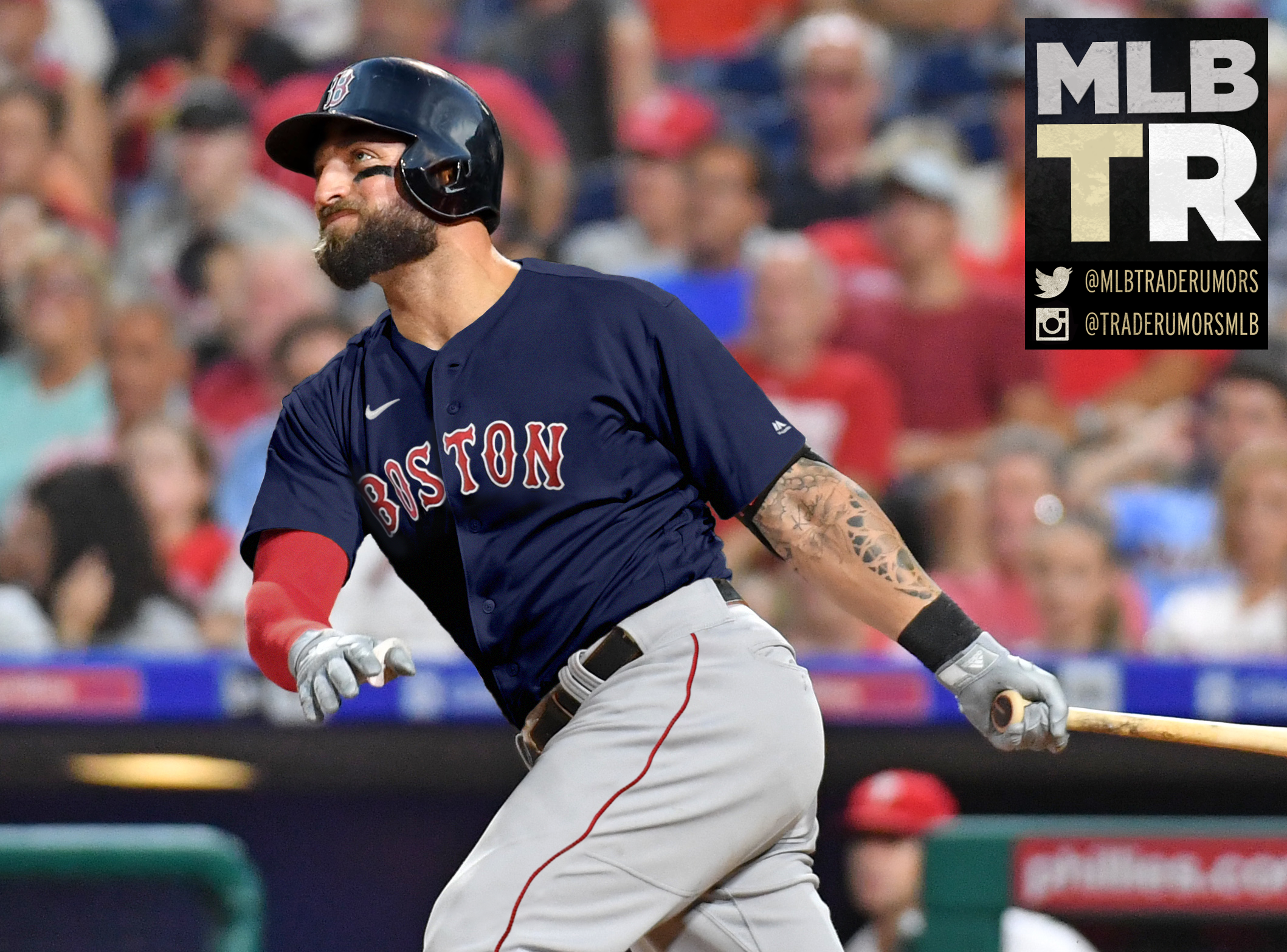
Pillar, 31, was non-tendered by the Giants earlier in the winter after hitting .259/.287/.432 with a career-high 21 home runs in 2019. He’d been projected by MLBTR contributor Matt Swartz to earn $9.7MM in arbitration. Pillar also swiped 14 bags — his fifth straight season with at least that many — and struck out in just 13.8 percent of his plate appearances. However, the longtime Blue Jays center fielder also only walked at a 2.8 percent clip — a career low — and the resulting .287 on-base percentage was one of the worst marks of any qualified MLB hitter.
Defensively, he played a roughly average center field by measure of metrics like Defensive Runs Saved, Ultimate Zone Rating and Outs Above Average. That’s a step back from the days when he graded out as one of MLB’s premier defensive players, but Pillar is still at least a serviceable option in center and likely an above-average glove in the corners.
Following the trade of Mookie Betts, the Red Sox had an all-left-handed-hitting outfield comprised of Andrew Benintendi, Jackie Bradley Jr. and newly acquired Alex Verdugo. Pillar will give them a right-handed hitting complement to that bunch as well as insurance against an injury (or perhaps an eventual trade of Bradley) at any of the three positions. He’s a career .281/.313/.453 hitter against southpaws, so while he’s not exactly a lefty masher, he’s still a bit above average in those situations.
Dumping the salaries of Betts and David Price (well, half of his deal) in the Dodgers trade dropped the Red Sox south of the $208MM luxury tax threshold by a bit less than $10MM. They should be able to bring Pillar aboard while maintaining ownership’s preference to remain south of that cutoff.
MLB Network’s Jon Heyman reported that the two sides were close to a deal. The Athletic’s Ken Rosenthal added that a Major League pact was in the works. Alex Speier of the Boston Globe reported that a deal had been reached, and Heyman tweeted the final guarantee.
Red Sox/Dodgers Notes: Betts, Friedman, Verdugo
The latest news from two coasts, as the Dodgers and Red Sox continue to adjust to new realities after the blockbuster trade that sent Mookie Betts and David Price to Chavez Ravine…
- Talks between the Dodgers and Red Sox about Betts began to develop in late December, Dodgers president of baseball operations Andrew Friedman told Jorge Castillo of the L.A. Times and other reporters, though Los Angeles first looked into acquiring Betts prior to last July’s trade deadline. A late surge for the Sox (who had an 8-3 run during an 11-game between July 17 and 27) convinced them to keep Betts and make a push for the postseason. Pondering about what a deadline Sox/Dodgers trade would’ve looked like is an interesting what-if, especially since Friedman would’ve been negotiating with a different person — Dave Dombrowski was still Boston’s president of baseball operations at the time, before being replaced by chief baseball officer Chaim Bloom (who used to work with Friedman in the Rays’ front office).
- Unsurprisingly, the Dodgers don’t see Betts as just a one-year rental, as team president Stan Kasten told The Athletic’s Andy McCullough that pursuing a long-term extension with the outfielder was “certainly was part of our thinking [with the trade] — that that’s what we would like the outcome to be.” Friedman concurred, saying “from our standpoint, I think he’s going to fall in love with the city, the fan support, the teammates, the facilities. And we’re just trying to do everything we can to continue that and have our own guys want to stay.” Keeping Betts would require a financial commitment that would far surpass anything Friedman has made since he joined the organization in 2015, though surely the baseball ops head and Dodgers ownership are aware of what it will cost the team to lock Betts up — in all likelihood a $400MM+ deal. However, as McCullough notes, the Dodgers have seemingly laid the groundwork for big future expenditures with less than $45MM in guaranteed payroll commitments on the books following the 2021 season. It remains a question as to whether Betts would be open to an extension, of course, given how he has so steadfastly expressed his desire to test the open market as a free agent. Future contracts weren’t on Betts’ mind as he spoke with reporters, saying “I’m still trying to find a house and all those types of things. I’m not even really thinking about that. I’m just focused on staying with 2020 and going from there.”
- As to Betts’ projected replacement in the Red Sox outfield, Alex Verdugo might not be ready for Boston’s Opening Day lineup, Alex Speier of the Boston Globe reports. Back and oblique problems sent Verdugo to the injured list on August 6 of last season, and he only appeared in one minor league game after that placement. Speier writes that Verdugo’s back is still bothering him, though the Sox don’t see the injury as a long-term problem. If Verdugo does miss time at the start of the season, it could be for precautionary reasons, as “a small number of games missed early in the year is better than a substantial stretch on the sideline if he is rushed into the lineup.“
Red Sox Win Arbitration Hearing Against Eduardo Rodriguez
Red Sox left-hander Eduardo Rodriguez has lost his arbitration hearing against the team, The Athletic’s Ken Rosenthal reports (Twitter link). Rodriguez will now receive an $8.3MM salary for the 2020 season, as opposed to his sought-after figure of $8.975MM.
Amidst an overall disappointing year for the Sox, Rodriguez was a major bright spot, delivering a performance that earned him a sixth-place finish in AL Cy Young Award voting. The southpaw posted a 3.81 ERA, 2.84 K/BB rate, 9.4 K/9, and 48.5% grounder rate in 2019, and perhaps the most important statistic for Rodriguez is that those numbers came over 203 1/3 innings. After multiple injury-plagued years, Rodriguez stayed healthy and became a workhorse out of Boston’s rotation, as only ten pitchers topped Rodriguez’s innings total last season.
Originally acquired for Andrew Miller in 2014 trade deadline deal, the man they call E-Rod has been a solid (if inconsistent) pitcher over his 699 career Major League innings, and the Red Sox now hope that he can match or surpass his 2019 numbers going forward. As a Super Two player, Rodriguez has a fourth year of arbitration eligibility remaining next season before hitting free agency after the 2021 season. There hadn’t been any extension talks between Rodriguez and the Red Sox as of last September, though it wouldn’t be surprising if new chief baseball officer Chaim Bloom and Rodriguez’s reps at Octagon have a few discussions this spring now that this hearing is out of the way (and now that the Sox have cleared a lot of future salary off their books by trading David Price to the Dodgers).
Dodgers reliever Pedro Baez remains the only player to emerge victorious in an arbitration hearing this year, as Rodriguez joins Jose Berrios, Shane Greene, Joc Pederson, and Tony Wolters in coming up on the down side of the arbiter’s decision. You can follow along with all of the arbitration results with the MLBTR Arbitration Tracker.
Closer Role Notes: Red Sox, Pirates, Marlins
The notion of a closer’s role has evolved over the years, but there’s never been any doubt of the importance of a reliable late-inning relief strategy. While some organizations prefer more flexible arrangements, quite a few still utilize dedicated ninth-inning men. Settling on a closer isn’t just important to a team and to fantasy baseball gurus. It’s also a factor in a player’s trade and free agent status and — especially — to his potential arbitration earnings.
Here are some early notes on spring closer situations from around the game …
- Red Sox manager Ron Roenicke made rather clear that he views Brandon Workman as the top closing option entering camp, as Chris Cotillo of MassLive.com tweets. The club isn’t making anything official just yet, but the comments from the just-minted skipper give him a strong presumption. That’s not too surprising: the 31-year-old Workman emerged as a premium pen arm last year, when he racked up 71 2/3 innings of 1.88 ERA ball with 13.1 K/9 and 5.7 BB/9. He does have some experience closing out games, having finished 16 Boston wins as part of a committee approach last year.
- For the Pirates, there’ll be no waiting: new skipper Derek Shelton says Keone Kela will handle the ninth, as Adam Berry of MLB.com reports on Twitter. Kela’s time in Pittsburgh hasn’t exactly been smooth, but he’s undeniably talented enough to do the job and will now be challenged with added responsibility as the organization seeks to turn the page on a brutal 2019 season. There were numerous problems on and off the field for the Bucs. By far the most important was the arrest of closer Felipe Vazquez on charges so awful that it’s hard even to think of the matter from a baseball perspective. But the organization has obviously had to make decisions to account for that departure. There is plenty of incentive for Kela, who will be a free agent at season’s end. If things go better for the 26-year-old than for the remainder of the Pirates team, he could also feature as a significant mid-season trade piece.
- The Marlins have set about compiling a new-look bullpen this winter. It seems it’ll be anchored by one of the club’s recent veteran additions. Manager Don Mattingly strongly suggested that Brandon Kintzler is the top choice to function as closer, Craig Mish of FNTSY Sports Radio tweets. The 35-year-old isn’t exactly a prototypical swing-and-miss, capital-C closer type. But he did turn in 57 frames of 2.68 ERA ball last year with a typically strong 54.7% groundball rate. And Kintzler has saved 49 games in his career.
Details On Mets’ Pursuit Of Mookie Betts
Mookie Metts? It didn’t come to fruition, but the Mets did make an effort in December to acquire superstar outfielder Mookie Betts from Boston. The Red Sox ended up trading him to the Dodgers earlier this week.
One reason talks between the Mets and Red Sox broke down? The Mets weren’t open to moving infielder/outfielder Jeff McNeil for just a year of control over Betts, Joel Sherman of the New York Post reports (they also wouldn’t give him to the Indians for shortstop Francisco Lindor). However, the Red Sox regarded McNeil as “integral” to a potential trade package, according to Sherman. Understandably, the Mets weren’t going to part with the versatile, inexpensive 27-year-old after he was one of the majors’ most effective offensive players from 2018-19.
While the Mets weren’t willing to surrender McNeil for Betts, they did offer packages centered on outfielder Brandon Nimmo and infielder/outfielder J.D. Davis (quality, affordable players in their own right), per Sherman. Those deals also would have included one of the Mets’ infield prospects in either Andres Gimenez or Ronny Mauricio, two top-100 farmhands. It seems the Mets, reluctant to absorb all of Betts’ $27MM salary, also would have tried to include one of their highly paid, unwanted veterans in outfielder Yoenis Cespedes or infielder Jed Lowrie in order to somewhat offset the money they’d have taken on had a deal with Boston gone through.
Considering that getting under the $208MM luxury-tax threshold was one of the main causes for the Red Sox’s decision to unload Betts (and left-hander David Price with him), adding Cespedes or Lowrie wouldn’t have been palatable for them. They wound up accepting the Dodgers’ offer of outfielder Alex Verdugo and two prospects – infielder Jeter Downs and catcher Connor Wong – saving a total of $75MM in the process.
Meanwhile, although the Mets went big-game hunting for Betts, their outfield appears as if it’ll enter 2020 with mostly the same cast. That’s not necessarily a bad thing, even though none of the team’s current options can rival Betts. However, to their credit, McNeil, Nimmo, Davis, Michael Conforto and Dominic Smith all had good seasons a year ago. It’s anyone’s guess what the Mets will get from Cespedes after injuries shelved him for the vast majority of the prior three seasons, but he’s back on a reduced salary and has always produced when healthy.