
Theo Epstein On Trading Samardzija, Hammel
Yesterday, the Cubs set off fireworks in the baseball world when they agreed to send Jeff Samardzija and Jason Hammel to the Athletics for top prospect Addison Russell, outfield prospect Billy McKinney, and pitcher Dan Straily. In a conference call earlier today, Cubs President Theo Epstein spoke fondly of both starters and thanked them profusely for their effort while in Chicago. Samardzija will be under contract with Oakland through 2015 but Hammel will hit the open market after the 2014 season. I asked Epstein if he might circle back to the 31-year-old whom he signed to a reasonable one-year, $6MM deal earlier this year.
“You know, Jason left a great impression while he was here, but he’s an Oakland A now,” Epstein said. “We just wish him well with Oakland all the way through October.”
While word of the trade leaked out late last night, the deal between Chicago and Oakland was actually agreed to mid-afternoon yesterday. A’s GM Billy Beane first reached out to Epstein “about a month ago” to let him know that they wanted to be aggressive this year, particularly in acquiring pitching, and asked him to keep the A’s in mind when it came to Samardzija and Hammel. Epstein quickly realized the two clubs didn’t match up “one-for-one” in a deal involving Samardzija and Russell, but they managed to expand the deal in yesterday’s talks to something that worked for both sides.
Russell is one of the top prospects in baseball and gives the Cubs a nice return for their pitchers, but Epstein is hopeful this will be the last time they find themselves on this side of a summer deal.
“We thought a lot internally as we went through this process that we hope that this is the last year that we’ll be obvious sellers at the deadline. And, nothing would make us happier than aggressively adding to the big league team and enhancing chances for a World Series,” Epstein said. “We repeated to ourselves that this type of move is not something that we want to do.”
Of course, the addition of Russell gives the Cubs something of a glut at shortstop on the surface. However, even with Starlin Castro at the big league level and two top-100 prospects in Javier Baez and Arismendy Alcantara waiting in the wings, Epstein says no one will be changing positions right away.
“The nice thing about having impact players who are athletic, can play in the middle of the field, and can hit is that it gives you options. You can never have too many shortstops and you look around baseball and you see some of the best outfielders in the game came up as shortstops and the same for the best third basemen and second basemen. We feel that Baez is a shortstop but we’re also comfortable that he can play second base or third base or outfield if he has to. Addison Russell has versatility to play all over the infield, Bryant can also go out to right field with a relatively smooth transition, Alcantara can play shortstop or second base or be one heck of an outfielder…They can all fit on the field together,” said the Cubs president, who went on to say the acquisition of Russell had “nothing to do” with Castro.
Ultimately, the Cubs feel you can never have too much of a good thing and they have a plan in place to make sure everyone is utilized. Of course, as Epstein himself said, there also figures to be plenty of trades in the club’s future.
Trade Market For Catchers
Last summer, catchers Steve Clevenger and Drew Butera were traded in July, while Kurt Suzuki and John Buck were dealt in August. The Orioles, Blue Jays, and Dodgers could consider adding a starting catcher, while clubs such as the Royals and Giants could seek a backup. Here’s a look at this summer’s trade market for catchers. The roles listed below could differ based on the acquiring team.
Starters
Miguel Montero (Diamondbacks), Carlos Ruiz (Phillies), Kurt Suzuki (Twins), Jason Castro (Astros), Welington Castillo (Cubs), Wilin Rosario (Rockies), Yasmani Grandal (Padres), A.J. Pierzynski (Red Sox)
- Montero, 30, has been the most productive of the group. He’s having a resurgent campaign after a lost 2013, and at the trade deadline he’ll have roughly $43MM left on his contract through 2017. However, the D’Backs are not looking to dump salary, and aim to contend in 2015. To that end, trading Montero doesn’t make sense, but GM Kevin Towers is known as the Gunslinger for a reason.
- The Phillies made a three-year commitment to Ruiz last offseason, so he’s not the most likely candidate to be dealt. Plus, he’s currently on the seven-day concussion DL.
- Suzuki, a free agent after the season, seems a reasonable trade candidate. He’s having his best season in years and will be owed less than a million bucks by the deadline. The Twins could look to extend him instead, though.
- Castro’s performance has taken a tumble since his breakout 2013 season. Certainly the Astros would consider trading the 27-year-old, who is under team control through 2016 as an arbitration eligible player. However, the club will probably be disinclined to sell low.
- Castillo is a speculative name here, in that the Cubs would likely at least listen. He’s 27 years old and under team control through 2017, and the Cubs don’t have much catching in their farm system. But if they manage to acquire a better “Catcher of the Future” candidate in another trade, moving Castillo becomes more palatable.
- Would the Rockies trade Rosario? They made an offer to Ruiz in the offseason, suggesting they weren’t thrilled with Rosario’s defensive chops. Rosario, just 25, is under team control through 2017. He hit 49 home runs from 2012-13.
- Grandal is a player who could be considered more by a non-contending team, if the Padres decide to cut bait with the former top prospect.
- At 6.5 games out, the Red Sox are currently on the bubble of contention. The meager return they could get for Pierzynski may not be worth shaking up their catching situation, with the veteran having the worst offensive season of his career.
Backups
Robinson Chirinos (Rangers), Ryan Hanigan (Rays), Rene Rivera (Padres), Carlos Corporan (Astros), Chris Gimenez (Rangers), John Ryan Murphy (Yankees), Austin Romine (Yankees), Tony Sanchez (Pirates), David Ross (Red Sox), J.P. Arencibia (Rangers), John Baker (Cubs), Jose Molina (Rays), Geovany Soto (Rangers), Gerald Laird (Braves)
It should be noted that Soto is currently on the 60-day DL, recovering from March knee surgery. This group presents a wide range of options, with a few players who are able to play regularly as well as some young players who have yet to establish themselves. Hanigan would be the most complicated one to move, with nearly $12MM coming to him through 2016.
Rays Claim Cory Burns Off Waivers From Rangers
The Rays have claimed Cory Burns off waivers from the Rangers, according to MLBTR’s Tim Dierkes (via Twitter). The right-hander has spent parts of the last two seasons in the majors but has been with Texas’ Triple-A affiliate for 2014.
Burns, 26, owns a 7.44 ERA with 8.0 K/9 and 2.8 BB/9 in 19 relief appearances and one start this season. In a combined 27 appearances for the Padres and Rangers between 2012 and 2013, Burns posted a 4.60 ERA with 7.1 K/9 and 5.2 BB/9.
MLBTR Originals
A look back at the original reporting and analysis found on MLBTR the last seven days:
- Steve Adams sees the value of a four-year contract extension for Mets second baseman Daniel Murphy being dependent on whether it’s reached before or after setting his final arbitration salary: $45-48MM before or $48-52MM after.
- Tim Dierkes was the first to report the Padres were adding Cuban right-hander Odrisamer Despaigne to their 25-man-roster.
- Brad Johnson asked MLBTR readers who will be the first starting pitcher traded. Nearly 31% of you see the Cubs dealing Jason Hammel before his teammate Jeff Samardzija (17%) and before the Rays part with David Price (24%).
- Steve hosted this week’s chat.
- Zach Links compiled the latest edition of Baseball Blogs Weigh In.
Examining A Potential Daniel Murphy Extension
It’s been reported that the Mets, who have shown a reluctance to move veteran pieces under GM Sandy Alderson, could work out an extension with second baseman Daniel Murphy rather than trade him for prospects at this year’s deadline. The natural reaction to that news, particularly for Mets fans, is to wonder what an extension would cost the team.
Murphy entered the year with four years, 109 days of service time and a $5.7MM salary in his back pocket after avoiding arbitration with the team for the second time this past winter. He’s under control through next season and is due one more raise in arbitration before being scheduled to hit the open market for the first time in his career.
Using MLBTR’s Extension Tracker to look at extensions for second basemen with between four and six years of service time, Martin Prado jumps out as a strong comparable for Murphy both in terms of service time and in terms of production. Here’s a look at Murphy’s career to date alongside Prado’s career through the time he signed his four-year, $40MM deal with the D’Backs:
From an offensive standpoint, the two are very similar. Even when adjusting for ball park, Murphy has a 110 OPS+, where Prado’s was at 109 heading into the 2013 season. The big difference between the two, of course, is defense. Murphy, drafted as a third baseman, learned to play second base on the job and was a liability there early in his career. Defensive metrics have come around on his glovework at the keystone, but Defensive Runs Saved still pegs him as below-average, and Ultimate Zone Rating feels he’s average at best.
Prado, meanwhile, was considered a standout defender at third base and in left field at the time of his extension, and he was also capable of sliding over to second base or shortstop if needed. That’s versatility that Murphy simply doesn’t have to offer, and it’s a large reason for the fact that Fangraphs valued Prado’s career at 14.2 WAR when he signed his deal, while Murphy’s career to date is pegged at 11.1 fWAR.
However, Prado’s contract was signed 18 months ago, and his $4.75MM salary in 2012 was lower than Murphy’s current $5.7MM mark. It stands to reason that Murphy would earn more next season in arbitration than Prado would have in his final arb year, and we’ve seen the price of extensions grow over the past few seasons. Additionally, if the Mets feel that Murphy has progressed to the point where he’s at least an adequate defender at second base, they’ll likely be willing to pay for his future defensive value rather than ding him for his past struggles.
Murphy himself mentioned the possibility of a four-year deal multiple times in the report from Andy Martino of the New York Daily News, and if that’s the target window for an extension, something in the neighborhood of $9MM in 2015 and $12-13MM annually for his first three free agent seasons could work for both sides. That’d put his deal in the $45-48MM range over four years, beginning in 2015.
Murphy could also follow the route of Brett Gardner — another above-average player who was never seen as a star prior to his offseason contract extension. Gardner agreed to his final arbitration salary and then signed a four-year deal that began in 2015 and covered only free agent years. Were Murphy to go that route, an additional year at $12-14MM could be added to Murphy’s deal (which would then begin in 2016), meaning he would earn roughly $9MM in 2015 and earn something in the $48-52MM range for his age-31 through age-34 seasons (2016-19).
Baseball Blogs Weigh In: Sabean, Buehrle, Duffy
On this date in 2012, Jim Thome set a major league mark with his 13th career walk-off home run, a solo shot over the left-field wall in the bottom of the ninth inning, giving the Phillies a dramatic 7-6 victory over Tampa Bay. Before that, the 41-year-old shared the record with Hall of Famers Jimmie Foxx, Mickey Mantle, Babe Ruth, Stan Musial, and Frank Robinson. Here’s this week’s look around the baseball blogosphere..
- National League Theory talks Giants GM Brian Sabean.
- Birds of BABIP sees Mark Buehrle as the Blue Jays’ biggest surprise this season.
- Pine Tar Press discusses Royals extension candidate Danny Duffy.
- FanDuel remembers some of Tony Gwynn‘s greatest career achievements.
- Baseball Hot Corner looks at Ben Zobrist as a fit for the Giants.
- Blue Jays Plus talks Zobrist in Toronto.
- Inside The Zona wants to know where the D’Backs go from here.
- The Giants Cove isn’t surprised by the SF’s recent skid.
- Call To The Pen wonders if Coco Crisp will ever hit 20 homers again.
- Camden Depot appreciates Steve Pearce.
- Beisbol’s Blog examines Jimmy Rollins‘ Hall of Fame credentials.
Please send submissions to Zach at ZachBBWI@gmail.com.
MLBTR Originals
A look back at the original reporting and analysis found on MLBTR this past week:
- Tim Dierkes revised MLBTR’s 2015 Free Agent Power Rankings and Hanley Ramirez has regained the top spot over Max Scherzer. There are also five new players in this month’s edition (Nelson Cruz, Victor Martinez, Mike Morse, Asdrubal Cabrera, and Russell Martin).
- Charlie Wilmoth outlined several possible reforms to the Super Two designation (untethering free agency and arbitration eligibility from service time, allowing an arbitrator to determine a prospect’s MLB readiness, eliminating the Super Two and redistributing those salaries, and prorating first-year arbitration salaries), but opines a few cases every season like the Pirates’ Gregory Polanco do not justify sweeping changes to the existing system.
- Jeff Todd examined the Jon Singleton extension and noted the ground-breaking contract should have relatively minimal impact on players who have the means and desire to bear the inherent risk of transitioning from top prospect to an established Major Leaguer.
- Tim was the first to report the details of the 2015 vesting option for White Sox lefty reliever Scott Downs: 55 appearances and not ending the season on the disabled list.
- Speaking of vesting options, Steve Adams is tracking the progress players with a 2015 vesting option are making toward exercising those options.
- MLBTR was the first to learn right-hander Dustin Moseley, who has hasn’t pitched since 2012 because of a shoulder injury, will throw a full bullpen session for interested teams on Tuesday.
- Zach Links revisited the notable transactions which have occurred on June 19th.
- Steve hosted this week’s live chat.
Should The Super Two Designation Be Changed?
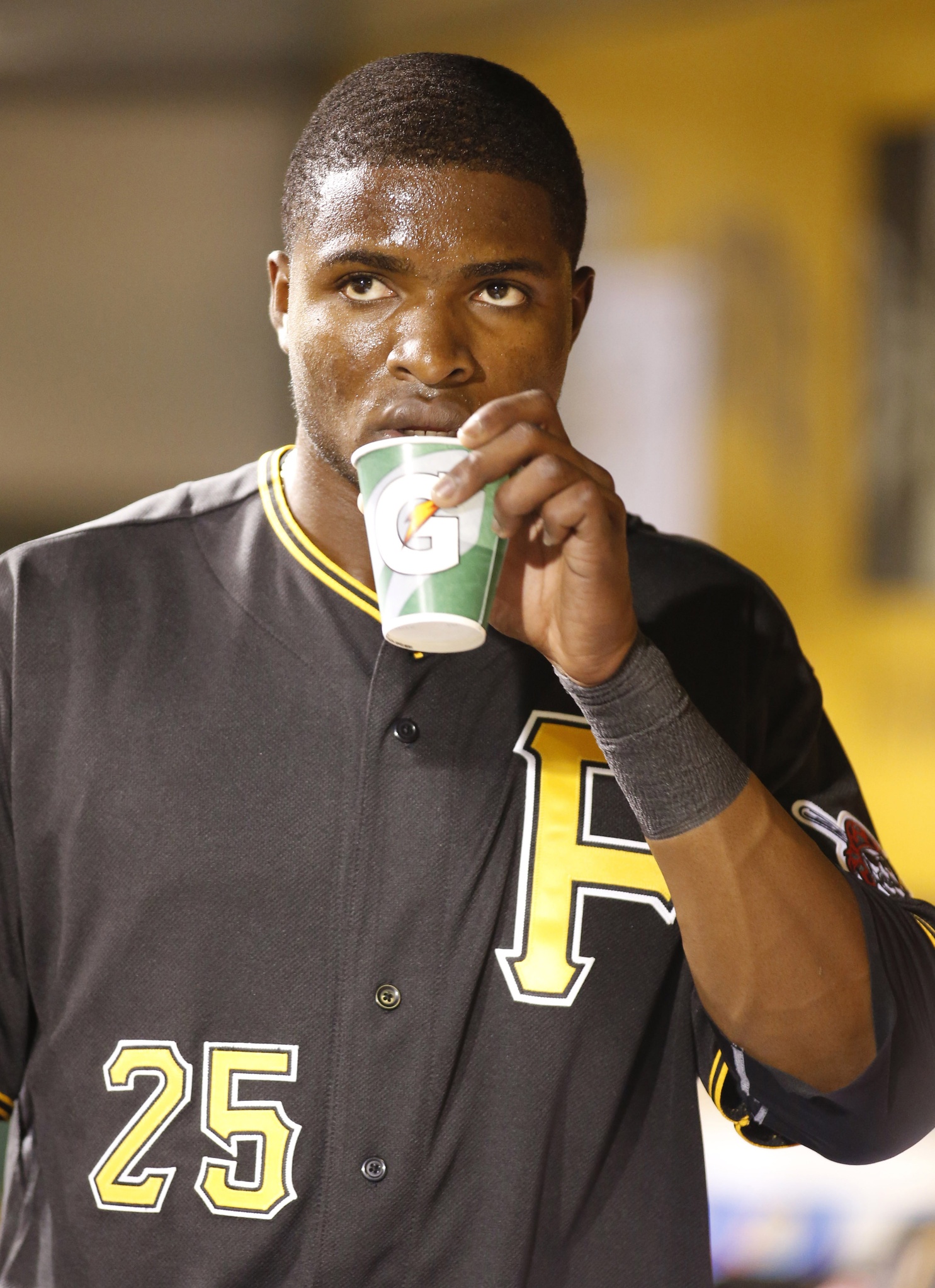 The Pirates’ decision to wait until June 10 to promote top outfield prospect Gregory Polanco set off a new round of debate, both in Pittsburgh and nationally, about the Super Two designation in particular and top prospect promotion timelines in general. The Pirates have said that their decision to wait to promote Polanco was due to developmental reasons, but whatever their motivations, the current system incentivizes waiting to promote top prospects even if they seem to be ready for the big leagues. That’s unfortunate, and MLB perhaps ought to consider reforming the Super Two designation. It’s probably impossible, however, to completely disincentivize manipulation of players’ promotion dates.
Overview
Teams must consider two thresholds when promoting a top prospect. A player is eligible for an extra arbitration season as a Super Two player if he has between 2.086 and three years of service time and he ranks in the top 22 percent in service time among players with between two and three years. The 22 percent clause means that the Super Two threshold is a moving target, but teams can usually feel safe about promoting a player in early to mid-June with the idea that he won’t be a Super Two player three offseasons later. A Super Two player can be eligible for arbitration four times rather than three, which means that a Super Two star player can make millions more in his arbitration seasons than a similar player who does not have that designation.
Teams must also consider a player’s free agency threshold. A player becomes eligible for free agency after six full years of service time, which means teams must consider a separate date in mid-April before which a player can become a free agent a year early.
We’ll leave aside, for now, the question of whether it’s wise for teams to delay promotion of top prospects in order to avoid Super Two status or free agency, and simply observe that the current system provides them at least some incentive to do so. The Pirates promoted Polanco on June 11, after months of criticism from analysts and fans who watched Polanco post great numbers at Triple-A while Jose Tabata and Travis Snider struggled in right field for the Pirates. (Josh Harrison handled the position for about a month before Polanco arrived and played much better.) Major League Baseball received some criticism, too, for creating the rules that made the Pirates’ decision rational (or arguably rational. Few commentators offered viable alternatives to the Super Two system, however, with Baseball Prospectus’ R.J. Anderson (subscription-only) being among the few to make a strong attempt.
If the Pirates held Polanco in the minors for two months longer than they would have without the Super Two system in place, that’s not nearly the tragedy many fans and commentators made it out to be. ESPN’s Dan Szymborski, the creator of the ZiPS projection system, tells MLBTR that based on information available in mid-April, promoting Polanco on June 10 rather than April 15 projected to cost the Pirates about one win. (And the Pirates might well have waited to promote Polanco even without the Super Two rule, given their longstanding record of allowing players time to develop in Triple-A before promoting them.) That’s unfortunate for the Pirates and their fans, but it’s hardly a travesty. A few cases like Polanco’s each year likely do not justify sweeping changes to the existing system.
Many large-scale rules involve thresholds that can be less than ideal on the micro level while producing good results on the macro level. For example, it isn’t ideal, or fair, for an irresponsible 16-year-old to be legally allowed to drive (if he or she can pass a driving test), while a responsible 15-year-old with excellent hand-eye coordination cannot. But the 15-year-old will soon be 16, and so that unfairness will soon be rectified. Meanwhile, the existence of a threshold that permits small-scale unfairness keeps the rules simple and helps prevent charges of arbitrariness.
Preventing teams from manipulating players’ service time is not a simple matter. As long as arbitration eligibility and/or free agency eligibility are tied to service time, and as long as teams control when their players’ service time clocks begin, teams will be able to use players’ promotion dates to manipulate their salaries and/or years of control.
So, for example, even if MLB were to eliminate the Super Two designation while maintaining current rules regarding free agency eligibility, teams could delay the promotion of top prospects who appeared to be ready in August or September and wait instead to promote them in mid-April. We would see fewer mid-June promotions for top prospects, but we would also see fewer mid-August promotions and more mid-April promotions, and the criticism of MLB’s rules would simply take place in August and September rather than April or May. If the goal is to prevent teams from delaying the promotion of top prospects who appear to be ready, simply changing the thresholds of arbitration or free agency eligibility will not work.
Untethering Free Agency, Arbitration Eligibility From Service Time
One solution to eliminate thresholds that can prevent teams from promoting players when they’re ready might be to untether free agency eligibility and arbitration eligibility from MLB service time. If a team were not worried about the number of years it could control a player, or about his salary during his arbitration seasons, it would be free to promote him whenever it deemed him ready.
This would, however, be a radical change with far-reaching consequences. With enormous payroll disparities between teams, MLB depends heavily on young players’ cost-controlled salaries to maintain competitive balance. Without cost control, it would be nearly impossible for smaller-payroll teams like the Athletics, Rays and Pirates to compete. The current rules regarding free agency and arbitration eligibility are the mechanism that allows player salaries to remain cost controlled. So if MLB and the players’ union were to agree to untether free agency and arbitration eligibility from service time, they would need some other mechanism to allow cost control.
One possibility would be to base free agency and arbitration eligibility not on service time, but on when a player was drafted or signed as an amateur, similar to the way Rule 5 Draft eligibility is determined. A player’s eligibility for the Rule 5 Draft in a given year depends upon his age on the June 5 before he signs and the number of Rule 5 Drafts that have passed since then. A similar system could be devised to determine free agency and arbitration eligibility. For example, a player under 19 by the June 5 before he signs might become eligible for arbitration after nine full years and eligible for free agency after 12 full years. A player who is at least 19 by the June 5 before he signs might become arbitration-eligible after eight full years and eligible for free agency after 11 years. (Players posted from Japan would continue to be exempt from these rules.) This system would enable the Pirates, for example, to promote Polanco whenever they deemed him ready, without concern for arbitration or free agency timelines.
Unfortunately, this rule would produce plenty of unintended consequences, and the cure would likely be worse than the disease. This system would be tremendously unfair to players who move quickly through the minors.
For example, the Expos drafted Chad Cordero in 2003 with the idea that he could make it to the big leagues quickly. He did exactly that and was a successful closer for several years before succumbing to injury. Because he was eligible for arbitration after his third full season, he was able to make over $11MM in his career, a total that seems reasonable, given the quality of his pitching. Under a system that connected arbitration eligibility to signing date rather than service time, he likely would have made only about a third that much, since he would have been close to the MLB minimum for his entire career. Meanwhile, a player who struggled in the minors and arrived in the big leagues after many years in Triple-A might become arbitration eligible after just one or two years. Also, such a system would dramatically limit the long-term earning capabilities of top players like Mike Trout who reach the Majors at young ages.
Allowing Neutral Parties To Determine Readiness
Another possibility might be to maintain the basic outline of the current arbitration and free agency timelines but to allow arbitrators to determine when those timelines might begin. So, for example, an arbitrator might have ruled that Polanco was ready May 1, forcing the Pirates to begin his big-league service clock then even if they did not promote him. Clearly, though, this is perverse and heavy-handed, putting the determination of the player’s readiness in the hands of an outside party who would have had far less information about the player’s development than his team did. Such a system would surely also create even more complaints of unfairness than the current one.
The problem here, of course, is the existence of thresholds. When there are thresholds that determine how long a team controls a player and how much they’ll have to pay him, there will be incentives to manipulate those thresholds. One of those thresholds, the one that determines free agency eligibility, probably isn’t going anywhere, since it helps prevent star players from becoming free agents while seasons are in progress. (That is, there could be a system in which a player who is promoted for the first time in August also could become a free agent in August six years later. But that would be chaotic, and the current threshold of six-plus years before free agency eligibility helps prevent that.)
The free agency threshold is probably here to stay, and as long as there’s a threshold, there will be occasional cases like Polanco’s where teams delay promotions of top prospects even when they’re dominating at Triple-A. It’s unfair on the small scale, but reasonable on the larger scale, and that might be as much as MLB can do.
Eliminating The Super Two, Redistributing Super Two Salaries
There are, however, some more modest reforms that MLB might consider to change the Super Two threshold, leaving teams with only one threshold to consider, rather than two. One possibility might be to eliminate the Super Two completely, as Pirates president Frank Coonelly recently suggested in an interview with USA Today’s Bob Nightengale.
The players’ union would, of course, be reluctant to make such a change, given that the existence of Super Two status means more money for them. But MLBTR’s Tim Dierkes suggests that MLB could, instead, calculate the approximate percentage of overall player income Super Two status typically produces and redistribute it as a modest, across-the-board raise for players making the MLB minimum salary. (Dierkes points out, however, that it’s possible the union would still dislike the idea, given that Super Two arbitration salaries for players like David Price help set arbitration salaries for other players.)
Prorating First Year Arbitration Salaries
MLBTR’s Jeff Todd suggests making all players with between two and three years of service time Super Two players, but prorating their first year of arbitration salary based on their service time. So a player with two years and 50 days of service time would receive an arbitration-year salary prorated for those 50 days of MLB service (combined with an MLB minimum salary prorated for the rest of the year), whereas a player with two years and 100 days would receive an arbitration-year salary prorated for 100 days. Players with three or more years of service time would then go through arbitration as they do now.
Either of the last two proposals would effectively eliminate the Super Two threshold. The free agent threshold probably can’t be eliminated, and its existence should continue to provide teams with incentive to manipulate players’ service time. But at least there would only be one threshold, rather than two. Also, either proposal to change the Super Two would eliminate the uncertainty involved in Super Two status, given that there’s currently no way for teams interested in promoting a player to know where exactly the Super Two threshold will fall two and a half years later.
Photo courtesy of USA Today Sports Images.
Contextualizing The Jon Singleton Extension
Eyebrows were raised recently when the Astros agreed to an extension with first base prospect Jon Singleton that was reported simultaneously with his first promotion to the big leagues. Extensions have broken new ground in different ways of late, and this deal represented a heretofore unseen foray into long-term guarantees for young players who are completely untested at the MLB level. Let’s take a look …
Framing the Contract
The deal pays Singleton $1.5MM for this season and $2MM annually from 2015 to 2018. It also includes three club option years over 2019-2021, progressing as follows: $2.5MM ($500K buyout), $5MM ($250K buyout), $13MM ($250K buyout). Singleton is assured of earning $10MM for the next five years, would earn up to $30.5MM in base salary if the options are exercised, and could max out the deal with an additional $5MM in incentives.
Since Singleton had zero days of MLB service at the point the contract was agreed upon and was highly unlikely to reach Super Two status, the standard means of describing the contract would be as follows: it pays him an above-minimum MLB salary for his partial first season, guarantees his three pre-arbitration and first arb-eligible campaign, and gives the club options over his final two years of arbitration and first year of free agent eligibility.
But the notion that the deal gives the Astros control over Singleton through to his first free agent year is heavily dependent on a key assumption — namely, that Singleton will stay in the big leagues over the life of the deal. In actuality, it is far from a certainty that Singleton’s play (and/or the team’s impossible-to-predict circumstances) will actually warrant his continued presence on the team’s active roster through to 2021.
Testing the Criticism
Of course, it remains obvious that Singleton has cut off a good chunk of the upside he might have realized through arbitration, and has potentially even delayed his entry to the free agent market by a season. That is the major complaint that has been logged against the deal. Defenders, meanwhile, have generally focused on Singleton’s off-field issues, noting that he may have had valid non-pecuniary motivations for signing.
It strikes me, however, that something basic is being overlooked here. Singleton — a $200K bonus signee out of high school — not only got his cash up front, but has completely avoided the downside scenario. And it is not as if the contract is completely without upside. At worst, Singleton is a bust who walks away with $10MM. At best, he is a top-rate big leaguer who earns over $35MM through his age-22 through age-29 seasons and hits the open market as an attractive commodity at the reasonably youthful age of 30. (That is, if he has not already agreed to a new extension in the meantime.)
Likewise, it has largely been overlooked that the contract is significantly front-loaded. Singleton will earn $7.5MM before reaching arbitration eligibility, which is much greater than he’d expect to bring in at the league minimum rate (this year, $500K). That certainly increases its value.
The real issue, I think, relates to that simple, timeless maxim of which Baseball Prospectus is fond of reminding us: prospects will break your heart. Singleton is every bit a prospect, as he entered the year facing questions about his maturity and ability to hit left-handed pitching. He rose to 27th on Baseball America’s top-100 list last year, only to slide to 82nd before this season. He is a first baseman who will need to hit — a lot — to keep his place in the big leagues.
His situation, in other words, is highly variable — perhaps more so than many have acknowledged. Some observers have touched on the implications of this fact. BP’s Zachary Levine tackled the Singleton extension from an economics perspective, applying marginal value concepts and game theory to the deal, explaining how Singleton’s individual value-maximization strategy may not have aligned with that of the collective (i.e., other union members). Likewise, looking at it from a labor perspective, the Economist recently noted that the Astros “acquired all of Mr. Singleton’s upside without taking on any of his downside risk.”
I am not sure I agree with the Economist’s notion that the team has not added downside; if anything, it has done just that, albeit at a manageable level ($10MM and a relatively firm commitment of a roster spot for some time.) To my thinking, the team agreed to take on some risk from Singleton in exchange for some of Singleton’s upside. He can still achieve significant earnings above his guarantee, and Houston could ultimately be enticed to pay more through the options than it would have through arbitration if Singleton has injury or performance questions but still carries enough promise that the team wishes to retain him.
But that still leaves unanswered whether, based on the reasonably possible outcomes that a player in Singleton’s situation might look forward to, the deal represents a fair exchange of risk and upside. To help answer this, I think it worthwhile to look at some actual, real-world scenarios that have played out in the recent past.Read more
MLBTR Originals
A look back at the original reporting and analysis found on MLBTR the last seven days:
- Steve Adams, in the latest Free Agent Stock Watch, is bullish about the prospects of Adam LaRoche envisioning a two-year deal worth $10MM+ annually for the Nationals first baseman.
- Zach Links was the first to report Jason Kubel cleared waivers and will refuse his outright assignment by Twins, which will likely result in his release.
- Steve hosted the MLBTR live chat this week.
- Zach gathered the best the baseball corner of the web had to offer in Baseball Blogs Weigh In.