
Orioles Designate Chris Tillman
2:49pm: Baltimore has given Tillman an opportunity to continue pitching in its minor league system, but he’s undecided as of now, general manager Dan Duquette told Eduardo A. Encina of the Baltimore Sun and other reporters.
2:24pm: The Orioles announced that they’ve designated right-hander Chris Tillman for assignment. His roster spot will go to infielder/outfielder Renato Nunez, whom they’ve selected from Triple-A Norfolk.
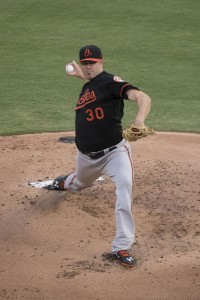
Tillman’s designation continues an abrupt fall from grace for a pitcher who was a solid mid-rotation starter earlier in his career. Acquired from the Mariners in a 2008 heist, Tillman broke out in 2012 with 86 innings of 2.93 ERA ball and then threw between 172 and 206 1/3 frames in each of the ensuing four seasons. During that 844 2/3-inning span, Tillman logged a 3.81 ERA with 6.98 K/9 and 3.07 BB/9.
Unfortunately for Tillman and the Orioles, his career took a major turn for the worse in 2017. Tillman missed the first month-plus of the season with a shoulder injury and then struggled mightily across 93 innings, recording a 7.84 ERA with 6.1 K/9 and 4.94 BB/9. In the process, he dealt with a decline in velocity and even lost his place in Baltimore’s rotation.
Despite Tillman’s nightmarish 2017, the starter-needy Orioles brought him back in the offseason on a one-year, $3MM guarantee with the hope he’d revive his career. The Orioles also hoped at the time that they’d push for a playoff berth, but they’re now among the worst teams in the league, and Tillman hasn’t helped matters. The 30-year-old made seven starts prior to his designation and combined for just 26 2/3 innings of 10.46 ERA ball, also issuing more walks (17) than strikeouts (13).
Tillman hasn’t pitched in the majors since May 10, after which he went on the disabled list with a lower back strain, and his velocity once again tumbled when he did take the hill. Further, Tillman has been ineffective across multiple minor league levels, including Triple-A Norfolk, where he has registered a 6.60 ERA with 3.0 K/9 and 3.6 BB/9 in 15 innings.
With Baltimore now beginning a full rebuild, there are multiple eras coming to an end on its roster. Not only is Tillman on his way out, but the team just traded its best player, shortstop Manny Machado, to the Dodgers this week. There will be more longtime franchise staples headed out via trade in the next week-plus, too, with center fielder Adam Jones (who came over from Seattle with Tillman) and closer Zach Britton perhaps among them.
Given that the Orioles are turning over their roster, they’re in position to evaluate young players, including Nunez. The 24-year-old joined the Orioles off waivers from the Rangers in mid-May and has since batted .289/.361/.443 with five home runs in 228 plate appearances at Norfolk. Nunez is a lifetime .249/.311/.457 hitter in 1,341 Triple-A PAs and has seen a bit of big league action in each season since 2016, having combined for 72 PAs and a .167/.222/.273 line with the A’s and Rangers.
Photo courtesy of USA Today Sports Images.
Mariners Extend Scott Servais
The Mariners announced that they’ve agreed to a multiyear contract extension with manager Scott Servais. The length of the deal isn’t yet known.
“Scott has created a culture here in Seattle that allows players to be successful,” general manager Jerry Dipoto said of Servais. “They are encouraged to be themselves, which has resulted in a loose environment, while still maintaining the focus on team above self. His leadership has also been evident through the ongoing growth and impact of one of the best coaching staffs in Major League Baseball. He has been the right leader at the right time for the right team and I look forward to many more years together.”
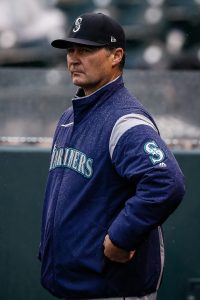
The extension for Servais comes two weeks after the Mariners locked up Dipoto, who, like Seattle’s manager, had been in the final year of his contract. The Dipoto-Servais duo has been together since 2015, and the Mariners have posted a solid 222-199 record with them at the helm.
While the Mariners have also extended their major league-worst playoff drought to 16 years under their current leadership, the team may finally break that ignominious streak this season. The M’s will begin the second half of the campaign on Friday with a 58-39 record, which gives them a three-game edge over the American League West rival Athletics for the AL’s last wild-card spot.
Given how difficult it is to quantify the performance of a manager, it’s debatable whether Servais – an ex-major league catcher – has had a significant impact on the Mariners. Thanks in some part to Servais, though, the Mariners have exceeded preseason expectations in 2018 and have done so without one of their best players, second baseman Robinson Cano, who’s simultaneously recovering from a fractured right hand and serving an 80-game suspension. Cano has appeared in just 39 games this year, making Seattle’s success all the more impressive.
With Cano slated to return in mid-August, Servais & Co. will work in the meantime to stay in playoff position. The club entered the All-Star break in an awful skid, as it followed an eight-game winning streak by losing eight of 11. But regardless of whether Seattle recovers and finally returns to the postseason this year, it appears Servais will be atop its dugout for the foreseeable future.
Photo courtesy of USA Today Sports Images.
Cubs Acquire Jesse Chavez
The Cubs have acquired right-hander Jesse Chavez from the Rangers, as Ken Rosenthal of The Athletic first reported (via Twitter). Lefty Tyler Thomas is heading to the Rangers in return.
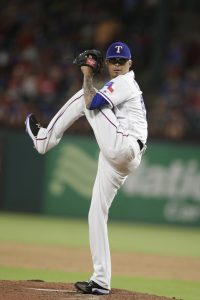
Chavez, 34, is owed $1.5MM on the season under his one-year deal. (That includes an additional $500K over the base $1MM guarantee that was tacked on when he made the active roster to open the season.) While he has flown under the radar on a Rangers club that’s mired in last place, Chavez earned a reasonably lofty placement (#38) on MLBTR’s recent ranking of the 75 top summer trade candidates.
Much of the appeal in Chavez lies in his ability to function as a swingman. He has alternated between relief and rotation work over the past several seasons, generally providing useful innings in either capacity. While he’ll surely be asked to join the relief corps in Chicago, Chavez will also help pad the club’s rotation depth.
On the heels of a tough 2017 campaign in which he worked mostly as a starter, Chavez has settled into a role as a multi-inning reliever in Texas. He carries a 3.51 ERA through 56 1/3 innings over thirty appearances, with 8.0 K/9 and 1.9 BB/9.
Notably, Chavez’s velocity has trended up by over a full tick (to 93.1 mph with his average fastball) after fading somewhat last year. He’s also generating an 11.0% swinging-strike rate that’s near his personal best. Chavez has, however, allowed a few too many home runs for three years running.
For their minimal investment in Chavez, the Rangers seem to have done reasonably well to pick up Thomas. The 22-year-old was a 2017 seventh-round pick out of Fresno State. He has thrown well this year at the Class A level, turning in 75 innings of 2.88 ERA ball with 9.7 K/9 against 1.7 BB/9.
Photo courtesy of USA Today Sports Images.
Shohei Ohtani Cleared To Begin Throwing Progression
Angels starter/DH Shohei Ohtani has been cleared medically to resume throwing, per a club announcement. The news came on the heels of his examination after six weeks of rest following stem cell and platelet-rich plasma treatment.
Ohtani, who took MLB by storm in his first season after coming over from Japan, hit the shelf in early June after being diagnosed with a grade 2 sprain of his ulnar collateral ligament. The two-way star has since returned to the active roster to continue working as a hitter, but has not yet begun moving back toward the mound.
It obviously seems to be promising news that Ohtani will be able to attempt to return to the hill as soon as the present season. The announcement states that Ohtani’s UCL “continues to show improved healing.” He’ll doubtlessly be watched closely as he ramps back up and will certainly need some time to get back to full speed. It’ll also be interesting to see how the Halos balance the need to get Ohtani rehab outings with the fact that he’s already an active part of the MLB roster.
Of course, skeptics will note that this club has pursued this route before, with at most a mixed record. While Garrett Richards was able to stave off Tommy John surgery for a while after electing not to undergo the procedure in May of 2016, he experienced some intervening setbacks and only made it back for 22 total starts before ultimately requiring a UCL replacement. Teammate Andrew Heaney initially charted a similar course at nearly the exact same time, but ultimately did not return to competitive action before needing a TJ procedure. Interestingly, though, to this point Heaney has 22 MLB outings of his own since both he and Richards faced the same choice.
It’s worth noting that Ohtani has been cleared to begin ramping up after just six weeks of rest. That’s the same hope that was expressed at the time that Richards underwent his initial treatment, but he ultimately did not begin his own throwing program until mid-August of 2016 — about three months later. Whether that suggests greater cause for optimism in Ohtani’s case isn’t really clear.
Of course, even if Ohtani is able to make it back later this year, it’s far from clear that he’ll have any impact on the team’s 2018 prospects for reaching the postseason. Since he left the rotation, the club has plummeted in the standings and now sits nine games out of a Wild Card spot.
That’s not to say that there isn’t anything to be gained by avoiding the surgery. At this stage of the year, TJ would likely prevent Ohtani from pitching for most or all of the 2019 season. That essential outlook would remain the same if, say, Ohtani ends up undergoing a procedure this fall. The Richards example shows that there are risks in the rehab approach, too, but it’s also far from guaranteed that a pitcher who undertakes such a serious surgery will end up back at full strength.
Fortunately, Ohtani has impressed nearly as much with his bat as with his arm, though it’s the combination of the two areas that makes him utterly unique at the game’s highest level. Through 157 plate appearances, he carries a .283/.365/.522 slash line with seven home runs. In nine starts, he posted a 3.10 ERA with 11.1 K/9 and 3.6 BB/9. The Angels are clearly much better, and the overall game of baseball much richer, with Ohtani functioning in both a hitting and a pitching capacity
Indians Acquire Brad Hand, Adam Cimber For Francisco Mejia
In a sudden and abrupt development, the Indians and Padres announced a blockbuster trade Thursday that will send one of baseball’s best relievers, Brad Hand, and emerging setup man Adam Cimber from San Diego to Cleveland in exchange for catcher/outfielder Francisco Mejia — one of the top-regarded prospects in all of baseball.
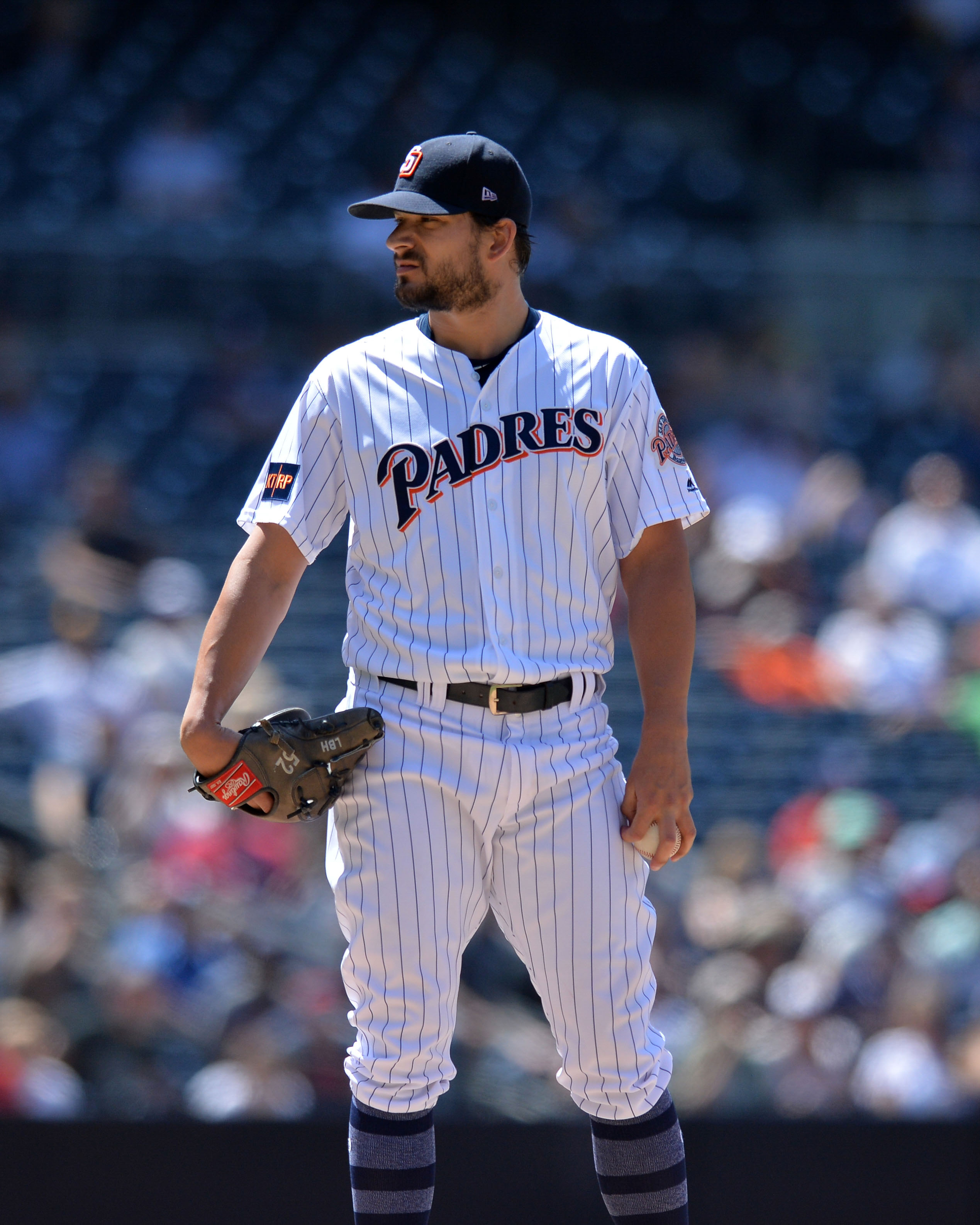
The Indians’ desire to augment what has surprisingly been one of the worst bullpens in all of baseball has been no secret, and Hand, in particular, was reported by ESPN’s Jerry Crasnick to be a target of theirs earlier this week. That said, there’d been little to no suggestion that Cleveland’s interest was anything more than preliminary in nature to this point.
Cleveland’s acquisition of Hand harkens back to the team’s 2016 pickup of fellow southpaw Andrew Miller. While Hand isn’t quite the ultra-dominant weapon that Miller was at the time, he’s nonetheless established himself as one of the top relievers in all of baseball over the past three seasons and, like Miller in 2016, is controllable for years beyond the current campaign. Hand signed a surprising three-year, $19.75MM extension with San Diego this offseason despite already being well into his arbitration years and being within striking distance of free agency.
Hand recently voiced a desire to remain with the Padres as the team pushes back toward contention but candidly acknowledged his cognizance of the fact that the extension also markedly upped his trade value. Today’s agreement underscores the veracity of those comments, as he’ll now head to Cleveland through at least the 2020 season. Hand is earning $3.5MM in 2018 and will be paid $6.5MM in 2019 and $7.5MM in 2020. The Indians will also have a $10MM club option on Hand for the 2021 season, which comes with a $1MM buyout.
Originally a waiver claim from the Marlins organization, Hand landed in San Diego with little fanfare. However, over the course of the past three seasons, he’s gone from long reliever to setup man to elite closer, as evidenced by his 2.66 ERA, 11.8 K/9, 3.0 BB/9, 0.9 HR/9, 46.5 percent ground-ball rate in 213 innings dating back to Opening Day 2016. For an Indians club that has seen its collective bullpen struggle to a ghastly 5.28 ERA (second-worst in the Majors), Hand alone would represent a massive and much-needed upgrade.
Of course, Hand isn’t the only upgrade Cleveland is acquiring in this case — far from it. The 27-year-old Cimber represents an entirely different type of success story for the Padres. A former ninth-round pick, the sidearming Cimber wasn’t even in consideration to break camp with the Padres heading into Spring Training this season, but a dominant performance earned him a spot on the Opening Day roster. Though he was late to arrive on the Major League scene, Cimber quickly emerged as a reliever who looks like he may never have to return to the minors.
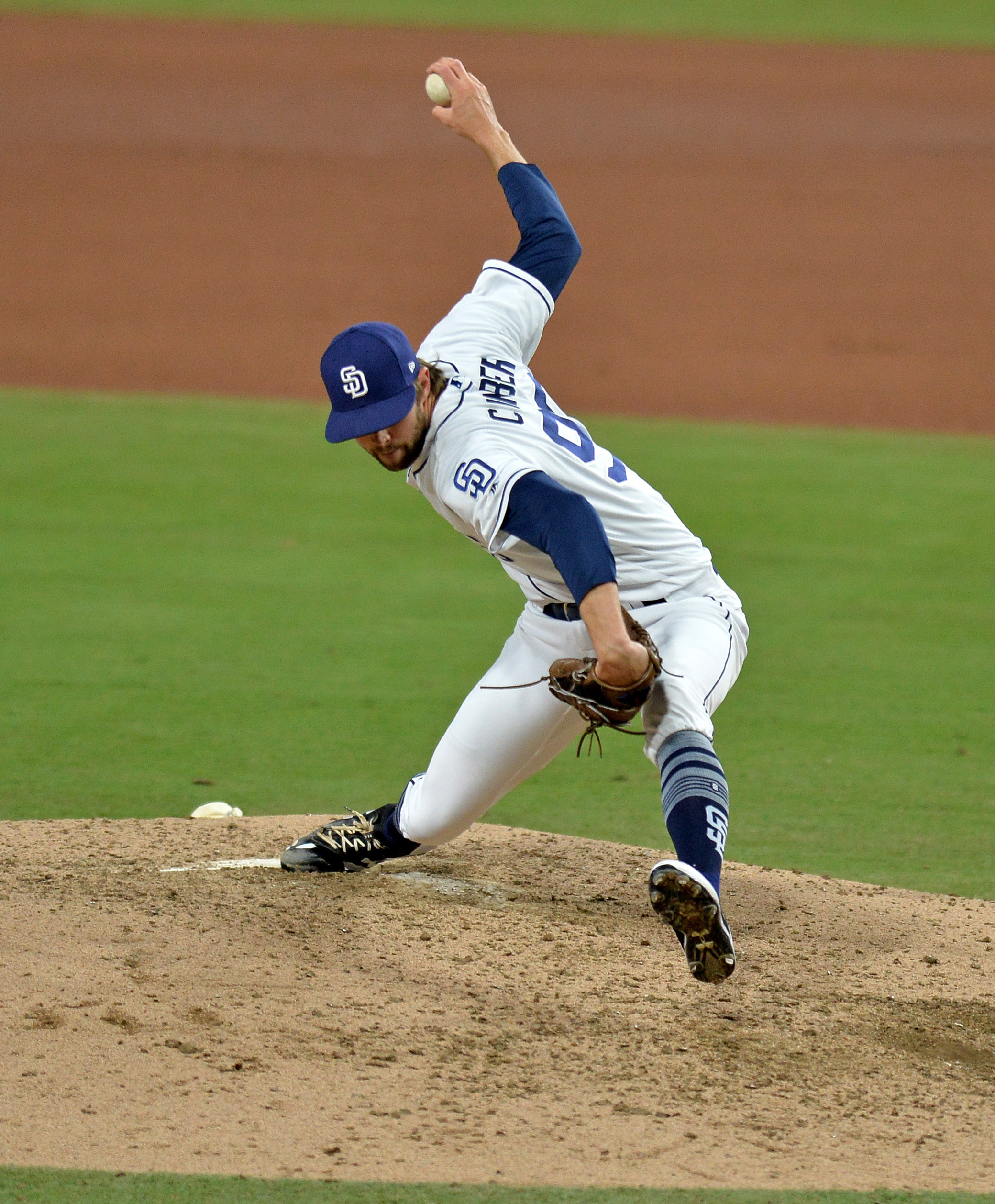
In 48 1/3 innings out of the Padres’ bullpen this season, Cimber has turned in a 3.17 earned run average, though secondary numbers paint an even more optimistic picture. Cimber has averaged 9.5 K/9 against just 1.9 BB/9 with a 52.3 percent ground-ball rate. ERA alternatives such as FIP (2.32), xFIP (2.79) and SIERA (2.68) all feel he’s outperformed an already strong ERA mark.
Cimber has allowed only two home runs on the season thus far and has rendered opposing right-handed hitters utterly useless; righties are slashing a comically bad .207/.221/.261 against Cimber through 123 plate appearances. He does come with some platoon concerns, as lefties have clobbered him for a .288/.391/.569 slash through 69 PAs, but he comes to the Indians organization with five and a half years of club control and won’t even be eligible for arbitration until the completion of the 2020 season.
It’s not clear exactly how the Indians will utilize their new pair of relievers. While Hand could surely be viewed as an upgrade over struggling incumbent closer Cody Allen, the Indians may also relish the idea of having both Hand and Miller available as high-leverage, multi-inning weapons to use during any game situation (once Miller is healthy, of course). Manager Terry Francona could also simply choose to utilize a variety of ninth-inning options depending on matchups, rather than deploying one true closer.
While the Padres surely found it difficult to part with a pair of quality relievers who could have affordably helped to anchor their bullpen for the next several seasons, they’re also assuredly thrilled to add yet another elite prospect to what was already regarded as one of the game’s top farm systems. Baseball America ranked Mejia as the game’s No. 24 overall prospect on yesterday’s updated Top 100 list, while ESPN’s Keith Law just this morning ranked Mejia as baseball’s No. 5 overall prospect.
In Mejia, the Padres are adding a 22-year-old switch-hitting catcher who also comes with experience at both third base and in the outfield corners. But Mejia’s future with the Padres is likely behind the plate, and he could even see significant time there this season. Mejia got off to a slow start but went on an otherworldly hot streak to open the month of June and hasn’t looked back since. The author of a historically excellent 50-game hitting streak in the minor leagues last season, Mejia hit .297/.346/.490 in Double-A in 2017 and is hitting .279/.328/.426 so far in Triple-A despite facing older competition. Since the start of June, he’s notched an obscene .391/.421/.594 slash with four homers and 15 doubles through 141 plate appearances.
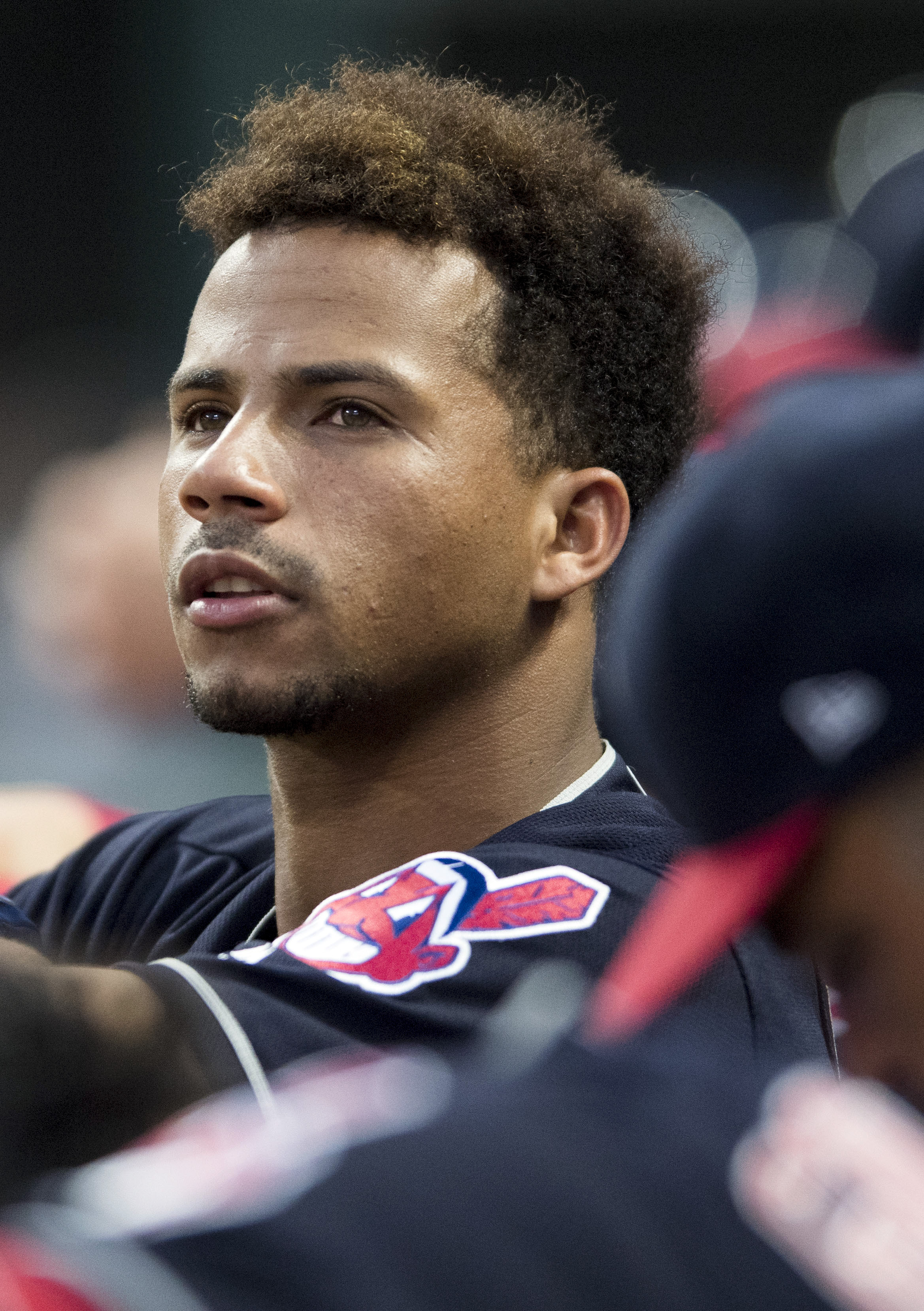
The acquisition of Mejia clouds the future of once-vaunted catching prospect Austin Hedges in San Diego. While Hedges’ defense behind the plate has been every bit as strong as advertised, the questions about his hitting ability have proved valid. Though he’s hit for plenty of power in the Major Leagues (.250 ISO), Hedges’ overall batting line through 730 trips to the plate sits at .205/.253/.355. He’s a superior defensive option to Mejia, but his bat looks decidedly unlikely to ever stack up to that of today’s newly acquired backstop.
As such, Mejia and Hedges could form a strong catching tandem behind the plate. Mejia will bring a more offensive-minded focus, but the Padres will feel comfortable in knowing they have a plus defender to utilize behind the dish on days when Mejia isn’t there — either for a full day off or perhaps in an outfield corner or at third base. Mejia’s versatility would at least allow the Friars to consider rostering three catching options at a time, though most clubs prefer not to do so (the division-rival D-backs being one notable exception).
For the Indians, today’s trade isn’t so much about winning the American League Central as it is about strengthening a relief corps that was already widely expected to be pitching in October baseball. Cleveland, after all, holds a 7.5 game lead over the Twins in the division. The move is also one of long-term import, however, as bullpen anchors Allen and Miller are both slated to hit free agency at season’s end. With the possibility of both departing, the Indians have now added some long-term insurance while also creating a potentially dominant relief corps for the 2018 postseason, assuming Miller can fully heal and Allen can return to form.
As for the Padres, the addition of Mejia could well be one of the final pieces in an ongoing rebuild that has seen GM A.J. Preller and his staff compile one of the most impressive farms in recent memory. Mejia’s path to the Majors will largely coincide with that of top prospects Fernando Tatis Jr., Luis Urias and others, giving the Padres a young core of position players on which they can dream — in addition to a deep reservoir of pitchers that has already begun to emerge at the big league level.
Photos courtesy of USA Today Sports Images.
Ken Rosenthal and Robert Murray of The Athletic were the first to report all of the notable components of this trade (all links to Twitter).
Angels Ownership Responds To Manfred’s Comments About Mike Trout; Trout Adds Own Statement
10:04pm: Trout himself has added a statement regarding the commissioner’s comments. Here’s the full text of his response.
“I have received lots of questions about Commissioner Manfred’s recent statement. I am not a petty guy and would really encourage everyone to just move forward. Everything is cool between the commissioner and myself. End of story. I am ready to just play some baseball!”
While most of the statement seems lighthearded and passive, perhaps the most interesting part is the inclusion of the phrase “End of story”, which rhetorically serves to completely shut down any invitation of further questions on the subject. It’s of course a crystal clear sign that Trout wants to stay as far away from any controversy as possible, and certainly doesn’t wish to perpetuate any conflict between Manfred and the Angels.
8:59pm: The Angels issued a statement today regarding outfielder Mike Trout. Out of context, the statement offers praise for the two-time AL MVP (both for his on-field accomplishments and his off-field character), while simultaneously congratulating him for another excellent performance in the All-Star game. While you can read the statement in its entirety at the above link, the excerpt below helps to capture its essence succinctly.
“Mike Trout is an exceptional ambassador for the game. Combined with his talent, his solid character creates a perfect role model for young people everywhere. Each year, Mike devotes a tremendous amount of his time and effort contributing to our Organization, and marketing Major League Baseball… In addition, Mike spends quality time as a husband, son, brother, uncle and friend. We applaud him for prioritizing his personal values over commercial self-promotion. That is rare in today’s society and stands out as much as his extraordinary talent.”
There is, however, important additional context to consider in this situation. As Ronald Blum laid out in a piece for AP News, commissioner Rob Manfred recently criticized Trout for lack of engagement in actively marketing himself. Manfred at one point went so far as to comment on how Trout spends his free time. Below are some of Manfred’s most interesting words on the subject.
“Player marketing requires one thing for sure — the player. You cannot market a player passively. You can’t market anything passively. You need people to engage with those to whom you are trying to market in order to have effective marketing. We are very interested in having our players more engaged and having higher profile players and helping our players develop their individual brand. But that involves the player being actively engaged.
Mike’s a great, great player and a really nice person, but he’s made certain decisions about what he wants to do and what he doesn’t want to do, and how he wants to spend his free time and how he doesn’t want to spend his free time. That’s up to him. If he wants to engage and be more active in that area, I think we could help him make his brand really, really big. But he has to make a decision that he’s prepared to engage in that area. It takes time and effort.”
While the comments seem mostly harmless, it’s hard to recall a time in recent memory when the commissioner offered such a direct criticism of a player’s effort to build his brand. The fact that Trout’s shown such exceptional talent while never accruing so much as a blemish on his reputation makes this criticism all the more peculiar. That Trout’s not a bigger name outside of baseball circles probably speaks as much to the league’s efforts to market their players (and overall popularity) as it does to Trout’s own individual endeavors.
Although the subject of marketing Trout has never taken this much spotlight before, this is far from the first time it’s been broached- Fangraphs’ Effectively Wild podcast is just one outlet to have examined it in detail. It’s often been suggested that while Trout’s baseball talent is extraordinary, his personality doesn’t particularly invite the same fascination. The Angels outfielder’s most widely-known hobbies include fishing, crabbing, with an interest in meteorology perhaps being his most unusual one. Some reporters have actually tried to exploit that latter item; Ken Rosenthal in particular put a weather map in front of Trout at one point during the All-Star Game and asked him to tell his audience whether they might see any rain during the course of the exhibition. Nonetheless, there’s been little success in eliciting the same kind of extroverted passion seen in players like Francisco Lindor, humor shown by players like Brandon McCarthy, or any of the bizarre and noteworthy comments given by players like Bryce Harper.
That said, it’s not as though Trout has stayed entirely out of the spotlight. As Angels ownership noted in the aforementioned statement, he’s been involved in plenty of community outreach. The seven-time All-Star has visited schools, hospitals and plenty of other charities, signing autographs for children and other fans while exhibiting class and humility. That Trout’s been a great husband, brother and friend to many while accomplishing such unimaginable feats in the game of baseball does plenty to establish a brand in its own right.
One could argue that Trout’s somewhat simple personality has allowed for plenty of humor by of contrast. Comedy is created by opposition, after all, and Trout delivering lines somewhat dryly with a monochromatic expression has created some brilliant humor in commercials for products like BodyArmor Sports Drink, Subway, and even MLB itself. While successful deadpan humor amidst heightened situations is far from the only ingredient in the recipe for a strong brand, it certainly isn’t nothing, and it’s proof in and of itself of how knowing the personality you’re working with is a key component of a successful marketing campaign.
Then again, it’s important to examine whether it’s any sort of obligation for Trout to actively market himself if he doesn’t want to. Certainly the league would benefit greatly if its consensus best player were as prominent of a celebrity as LeBron James or Tom Brady, but it would be hard to argue that Trout “owes” the league anything additional in that regard. After all, he’s fulfilled all his contractual obligations with the Angels since the moment he set foot in The Show, and his level of play certainly suggests he puts 110% effort into his game. Manfred’s comments seem to imply that it’s Trout’s responsibility as a top MLB talent to put more free into building his brand, when in reality the very use of the phrase “free time” illustrates that such a suggestion is at most up for debate. Trout certainly has significant obligations to his family, and there’s of course significant drawbacks to being more recognizable in public.
All that said, there’s no denying that it would benefit Trout’s legacy if he were to devote more time and resources to promoting himself and building his brand. Even considering only his accomplishments to date, Trout is a surefire bet to land in the Hall of Fame, and he’s not even to the age that most would consider to be a player’s “prime”. If he stays healthy and ages at least gracefully, he stands a reasonable chance to break Babe Ruth‘s records for fWAR and bWAR and go down as the greatest baseball player of all time. A bigger brand could mean more public notoriety, a greater estate for his descendants, and a greater impact on the community he devotes so much time to helping.
Though it’s fair to assume that Manfred’s comments were made largely in his own self-interest, noteworthy is the fact that the Angels themselves would be among the most lavish beneficiaries of a greater Trout presence, considering they directly benefit from the increased sales they’d likely draw from ticket sales and player merchandise (though one would hope the products would be better than this shirt). That Angels ownership stood in such obvious opposition to Manfred’s comments perhaps speaks to their relationship with Trout, and perhaps even a contrasting assessment to that of the commissioner. For their part, many players, including former teammate Huston Street, certainly seem to believe that Trout is exactly what a player ought to be.
It will be interesting to see how Trout and his agent, Craig Landis, respond to this drama, or indeed whether they choose to at all. Furthermore, it’s easy to wonder if this will lead to a further exchange between the commissioner’s office and Angels ownership. And of course it’s also possible that Tony Clark of the MLBPA could even get involved. Speculation aside, though, one thing is certain… the subject is unlikely to simply disappear over the long remainder of Trout’s career. Perhaps the most intriguing concern is whether this controversy will reach a point at which it causes unnecessary tension between the league and its best player… for the sake of the game, I hope that seemingly far fetched outcome doesn’t come to fruition.
Dodgers Acquire Manny Machado
8:07pm: Both the Dodgers and the Orioles have officially announced the deal. Valera has been optioned to Triple-A Norfolk, while the other four prospects involved will report to Double-A Bowie (h/t Rich Dubroff of BaltimoreBaseball.com).
6:17pm: After a small medical holdup involving one of the prospects coming back, the Dodgers have acquired All-Star shortstop Manny Machado from the Orioles. Outfielder Yusniel Diaz is the key piece headed back to Baltimore in the deal. They’ll also receive minor-league right-handers Dean Kremer and Zach Pop, along with infielders Rylan Bannon and Breyvic Valera. The Dodgers will take on the entirety of Machado’s remaining 2018 salary, which checks in at about $6.3MM.
Since starting out the year with an 8-20 record, it’s been all but certain that the Orioles would deal the impending free agent in exchange for more controllable talent ahead of the July 31st non-waiver trade deadline. But the question of where he would go would prove to be one of baseball’s most intriguing storylines for months. At different points in time, the Yankees, Brewers, Phillies, Diamondbacks, Dodgers and Indians were all strongly connected to the four-time All-Star and two-time Gold Glove Award-winner, with the Braves and Red Sox more loosely associated in trade rumors.
The trade will, of course, close the book on Machado’s tenure with the Orioles organization, who drafted him with the third overall pick back in 2010 and watched him blossom into one of the best players in franchise history. With his new team, Machado will step in as the club’s everyday shortstop — a void that was created earlier this year when Corey Seager incurred a torn ulnar collateral ligament that required Tommy John surgery.
 Though Machado, 26, broke into the league as a third baseman, he was drafted and developed as a shortstop and only moved to the hot corner due to the presence of J.J. Hardy at shortstop early in his Baltimore career. Machado voiced a strong preference to move to shortstop this season, and the Orioles accommodated that desire this winter, although defensive metrics have painted him in a dismal light (-19 Defensive Runs Saved, -7.7 Ultimate Zone Rating). It’s also possible, of course, that Machado’s glovework at short will continue to sharpen as he continues to re-acclimate to his natural position after spending years as one of the game’s premier defenders at third base.
Regardless of his defensive skills, there’s little denying the type of offensive upgrade he’ll bring to an already potent Dodgers lineup. Machado posted a .280/.338/.502 slash and 105 homers from 2015-17, and he’s in the midst of his finest offensive campaign yet; through 413 trips to the plate, he’s raked at a .315/.387/.575 clip with 24 homers, putting him well on his way to a new career best.
As was made abundantly clear at the time of this offseason’s Matt Kemp swap with the Braves, the Dodgers have a strong desire to remain south of the $197MM luxury tax threshold this year. Doing so would reset their penalty level from 50 percent to 20 percent the next time they cross that line (not coincidentally in advance of a stacked free-agent class). The Dodgers were roughly $15MM south of that line prior to acquiring Machado and the roughly $6.45MM remaining on this year’s $16MM salary. Earlier on Tuesday there were reports that Los Angeles could attempt to send a veteran player such as Logan Forsythe back to the Orioles as a means of offsetting some of that salary, but Rosenthal since reported that the Dodgers were sending only minor leaguers to Baltimore in the deal.
The 21-year-old Diaz immediately becomes Baltimore’s top prospect. MLB Pipeline’s most recent ranking pegged him as baseball’s #84 overall prospect, praising the potential of all his tools outside of power. In fact, he earns 55 grades across the board with his hitting, speed, arm and defense. Though he’s played center field in the minors, MLB Pipeline suggests he’s more likely to play right field at the MLB level. Thus far in Double-A this season, Diaz has hit at an impressive .314/.428/.477 clip with more walks than strikeouts to go along with six homers and eight steals.
Bannon, 22, is largely regarded as the second-best player headed back to Baltimore in the deal. Checking in as the Dodgers’ 27th-best prospect prior to the trade, Bannon profiles as a third baseman and has earned praise for his great defensive capabilities. That’s not to say that his bat doesn’t hold some potential, however, as he’s managed an impressive .296/.402/.559 so far with the Dodgers’ High-A affiliate. Though he’s compiled a gaudy strikeout total, his 14.6% walk rate is nonetheless impressive. Bannon game to the Dodgers by way of the number 250 overall pick in the 2017 draft.
Kremer checked in right behind Bannon at #28 on MLB Pipeline’s list of Dodgers prospects before being shipped to Baltimore. It’s said that his best pitch is his fastball, which sits around 91-94 MPH with some good horizontal movement. He also features an impressive curveball, and has recently found some success with a slider and changeup. Though he struggled as a swingman at the High-A level last year, the success he’s enjoyed thus far in 2018 (3.30 ERA, 12.99 K/9 at High-A Rancho Cucamonga) has convinced scouts that he has a good chance to stick as a starter.
Pop, however, does indeed profile more as a reliever. Despite a mediocre 7.67 K/9, he’s managed to post a 0.33 ERA through 27 innings in High-A this season. A 95% strand rate suggests he may have been a bit lucky so far, but a dirty 94-97 MPH sinker has impressed scouts and annihilated opposing hitters to such an extent that there’s optimism as to the right-hander’s upside.
Valera is the only player in the deal who’s spent any time in the majors. He spent seven years in the Cardinals’ minor-league system, eventually earning a promotion to St. Louis and making 11 plate appearances before ultimately being traded to the Dodgers in exchange for minor-league outfielder Johan Mieses. Valera’s made 34 plate appearances with the Dodgers this year, amassing just five hits but walking as many times as he struck out (four). That patience is a skill he’s shown in the minors this year, as evidenced by his 9.4% walk rate and 9.0% strikeout rate at Triple-A Oklahoma City. That’s in tandem with a .284/.350/.433 batting line at that level.
Eduardo A. Encina of the Baltimore Sun first reported that the agreement was in place, moments after Roch Kubatko of MASNsports tweeted that it looked like a deal would go through pending some final points to review. Jeff Passan of Yahoo Sports was the first to report that the deal was finalized and that players were being notified. J.P. Hoornstra of the Southern California News Group had the first report on the inclusion of Diaz, Kremer, Pop and Bannon in the deal. Ken Rosenthal of The Athletic was the first to report that Valera was headed back to Baltimore, and was also first to mention that the Dodgers were taking on all of Machado’s remaining salary.
Wilson Ramos Placed On DL, Expected To Be Sidelined Beyond Non-Waiver Trade Deadline
The Rays placed catcher Wilson Ramos on the disabled list due to a hamstring strain today, as has been expected. However, while some might’ve hoped that Ramos would be able to return to action prior to the non-waiver trade deadline on July 31, that won’t be the case, it seems. Marc Topkin of the Tampa Bay Times tweets that Ramos is likely to miss “extended time” and is expected to be on the disabled list beyond July 31.
Clearly, the injury is a significant blow for the Rays. Ramos, 30, had seemingly made a full recovery from the ACL tear that he suffered in September 2016 — an injury that likely robbed him of a quite lucrative multi-year pact. Instead of landing a four- or five-year deal in free agency that offseason, Ramos settled for a modest two-year deal with Tampa Bay that was loaded with incentives. While he missed about half of the 2017 season, he’d come back as a force in 2018.
Through 315 plate appearances this season, Ramos has posted a terrific .297/.346/.488 slash with 14 home runs and 14 doubles. He’s struggled a bit in terms of preventing the running game (22 percent caught-stealing rate) and has posted roughly average framing marks, per Baseball Prospectus. But while he may not be a premium defender, he’s been an elite bat relative to other catchers throughout the league and is playing the 2018 campaign on a reasonable $10.75MM salary.
With teams like the Nationals and Astros at least exploring the market for catching upgrades, the Rays were a near-certainty to cash in on Ramos and land a new prospect or two to add to their minor league ranks. That now looks unlikely — at least in the month of July. It’s possible that Ramos could return at some point in August, though it’s doubtful that he’d clear waivers. Still, that doesn’t necessarily preclude the possibility of a deal coming together.
The Rays can pass Ramos through revocable waivers so long as he’s spent at least the minimum time required on the disabled list (which will be the case by default) and so long as he is healthy and able to play at his accustomed level. In other words, he’d be eligible to run through waivers around the time he’s able to go on a minor league rehab assignment.
While a division rival would quite likely block the Astros from a chance to acquire Ramos via revocable trade waivers next month, it’s not impossible that a fringe contender in need of catching help could take a chance on Ramos. Specifically (and, to be clear, quite speculatively), if the Twins manage to pull within four to five games in the AL Central and opt not to sell off major assets, they’d be a natural landing spot for Ramos in an August swap. The Mariners, too, could be a fit given Mike Zunino’s struggles to get on base so far.
That’s just a pair of speculative scenarios, of course. Alternatively, other clubs who don’t especially need Ramos may be wary of placing a blocking-style claim on an impending Rays free agent with a fairly notable salary, as the possibility exists that the ever-cost-conscious Rays could simply opt to let him go.
Agent: Mets Should “Consider Trade Opportunities” If They Do Not Plan To Pursue deGrom Extension
Over the past few seasons, there’s been occasional talk of a potential long-term deal between the Mets and ace Jacob deGrom, though clearly nothing between the two sides has ever come together. With that in mind, deGrom’s agent, Brodie Van Wagenen of CAA Baseball, offered a candid take on his client’s future to Ken Rosenthal of The Athletic today (Twitter links).
“We have discussed Jacob’s future with the Mets at length,” said Van Wagenen. “Jacob has expressed interest in exploring a long-term partnership that would keep him in a Mets uniform for years to come. If the Mets don’t share same interest, we believe their best course of action is to seriously consider trade opportunities now. The inertia of [the] current situation could complicate Jacob’s relationship with the club and creates an atmosphere of indecision.”
Van Wagenen adds in a followup to Joel Sherman of the New York Post that his statement is “not a demand for a trade” and is in fact more an expression on his client’s behalf that he’d like to remain with the organization for the long term (Twitter link). Nonetheless, the public nature of those comments only puts further pressure on the current iteration of the Mets’ front office to act in a more decisive manner. And it only furthers the already strong likelihood that if deGrom is not traded in the next couple of weeks that he’ll be a prominent trade target for teams in the 2018-19 offseason — adding another layer of complexity to a winter that will feature one of the more impressive free-agent classes in recent memory.
However, while Van Wagenen’s comments are fairly straightforward and aggressive in tone, deGrom himself unsurprisingly struck a softer tone at today’s All-Star festivities (Twitter links via Anthony DiComo of MLB.com). Asked about Van Wagenen’s statements, deGrom replied:
“We’ve been open to discussing long-term deals with the Mets. There’s been no numbers discussed, and I’ve enjoyed my time here. … I would love it to be here with the Mets. We’ll just have to see what happens. … I would love to play here for my whole career. I think it’s just kind of deciding what we see as the future. It’s something that’s in the Mets’ control, and kind of out of mine.”
It’s certainly telling to hear deGrom himself flatly state that the two sides have never even progressed to the point where they’ve talked about even loose parameters of a contract. Certainly, it’s not likely that the Mets and deGrom will hammer out what would assuredly be a nine-figure extension in the next couple of weeks. Such negotiations would be complex, and the Mets’ front-office trio of John Ricco, J.P. Ricciardi and Omar Minaya will be dedicating a considerable amount of time and energy to trading other players even if the plan is to eventually talk long-term deal with deGrom.
It should be noted, of course, that these types of comments from agents don’t always serve as a catalyst to facilitate a deal. While Christian Yelich was moved this offseason not long after agent Joe Longo made comments similar in tone to those of Van Wagenen today, that wasn’t the case for J.T. Realmuto. In fact, Realmuto is also repped by CAA, and agent Jeff Berry told the Miami Herald back in February that Realmuto preferred to be moved. Realmuto, of course, is still in Miami and enjoying the best season of his career.
The 30-year-old deGrom is under club control, via the arbitration process, through 2020. He’s already earning $7.4MM, and with one of the strongest arb cases in quite some time taking shape, he could find his salary to be pushing $20MM by the end of those remaining arbitration years. It stands to reason that any extension talks would have to be of at least five years in length, though presumably deGrom’s camp would push for a lengthier pact, given the six- and even seven-year deals landed by some of the game’s top pitchers in recent seasons. Locking up deGrom could quite likely push the Mets into a new franchise-record contract; David Wright currently holds that distinction at $138MM (over an eight-year term).
Phillies, Dodgers, Brewers Reportedly In Lead For Manny Machado
JULY 15, 2:59pm: The Phillies, Dodgers and Brewers are indeed in the lead for Machado, according to Eduardo A. Encina of the Baltimore Sun, but a source tells him “it’s too close to call” whose offer is the best. The Braves are still alive, adds Encina, who writes that “the strength of the Yankees’ offer appears to have been exaggerated.”
2:32pm: The Yankees are still “serious” about acquiring Machado, Nick Cafardo of the Boston Globe hears.
1:37pm: The Orioles continue progressing toward a deal, tweets Olney, who echoes Heyman in suggesting the Phillies, Brewers and Dodgers are the three most likely clubs to acquire Machado. Olney omits the Yankees and Indians, however.
9:06am: The Brewers have made a “good offer” for Machado, Heyman tweets, adding that they “appear” to join the Phillies and Dodgers as the most likely landing spots for the shortstop. The Yankees and Indians are also still alive, Heyman suggests.
JULY 14, 5:44pm: The Orioles are “definitely motivated” to get a deal done as soon as possible, Olney adds, citing an evaluator who is familiar with trade discussions.
5:14pm: The Orioles are “making progress and narrowing their focus” in Machado trade talks, Buster Olney of ESPN tweets. The Phillies and Brewers are said to be among the finalists; it isn’t clear who the other finalist(s) might be at this time.
1:19pm: The Phillies are “thought to be” ahead of the Yankees “and maybe most others” in the Machado derby, Heyman tweets. The Brewers, Dodgers, Diamondbacks and Indians remain in the mix, though, per Heyman.
JULY 13, 6:30pm: Rosenthal adds on Twitter that the O’s are taking a closer look at the Philadelphia farm. And Jon Heyman of Fancred tweets that there has been “some progress” between the sides
That said, there’s some uncertainty among teams pursuing Machado as to when the O’s intend to make a decision, according to ESPN.com’s Jerry Crasnick (Twitter links). While the club is said to “have a pretty good idea what [Machado] can bring” back in a trade, it seems that some suitors are wondering if the Orioles won’t wait to act until the deadline gets closer.
12:55pm: The Phillies have improved their offer to the Orioles for star infielder Manny Machado, reports Ken Rosenthal of The Athletic (Twitter links). In recent days, the Brewers, Dodgers and Yankees have been categorized as the favorites to land Machado. However, Rosenthal suggests that while the Dodgers and Yankees have the strongest offers on the table, the Brewers are beginning to fade from the mix, while the Diamondbacks are, at this point, “on [the] periphery” of the market.
Regarding the Yankees’ interest in Machado, some have considered it a questionable fit given the presence of Miguel Andujar and Didi Gregorius on the roster. Rosenthal, though, echoes recent suggestions from MLB.com’s Jon Morosi that it’s at least possible that Andujar could be utilized as the centerpiece of a trade to acquire a controllable piece in the rotation, thus opening a spot for Machado. There are questions about Andujar’s defense, Rosenthal notes, which is borne out in defensive ratings (-12 Defensive Runs Saved, -7 Ultimate Zone Rating).
Suffice it to say, there are plenty of moving parts on the Machado front. Baltimore has been said to be keen on acquiring controllable starting pitching, and the Phillies have plenty of options in that regard, as do the Brewers, Yankees and Dodgers.
It’s not yet clear what, precisely, the Phillies (or any team) is willing to offer up, though the Phils have intriguing young rotation pieces in the form of Zach Eflin and Enyel De Los Santos, each of whom has already pitched in the Majors this season (extensively so, in Eflin’s case). Right-handers Sixto Sanchez and Adonis Medina are each considered to be among the game’s top 75 or so prospects, and the Phils have a number of MLB-ready back-of-the-rotation options on the 40-man roster who could be secondary pieces (e.g. Ben Lively, Jake Thompson, Drew Anderson, Mark Leiter Jr.)
Regarding the Yankees’ scenario, while some fans would undoubtedly bristle at the very notion of moving Andujar, third base is a position of depth for the Yanks, who still have Brandon Drury as an option who could step onto the big league roster following the season, should that scenario ultimately play out. Of course, the Yankees also figure to be prominent players in the offseason market to acquire Machado this winter, and if they’re successful in that regard, Andujar would’ve potentially been viewed as an expendable piece anyhow. As ever, it’s worth emphasizing that that’s one of numerous scenarios that’s likely being kicked around at this juncture.
As for the Brewers, they’ve previously been said to be among the most aggressive suitors, but right-hander Corbin Burnes, one of the Orioles’ targets, could prove to be a sticking point in those talks. Tom Haudircourt of the Milwaukee Journal-Sentinel took a lengthy look at the fit between the Brewers and Machado earlier today, calling him an “absolutely perfect” fit given the team’s deficiencies in the lineup — particularly at shortstop. Milwaukee, according to Haudricourt, still views struggling Orlando Arcia as its shortstop in 2019 and beyond, but Machado would give them a potentially overpowering top of the order, joining Lorenzo Cain, Christian Yelich, Jesus Aguilar, Travis Shaw and Eric Thames/Ryan Braun.