
Taijuan Walker Diagnosed With “UCL Injury”
Diamondbacks starter Taijuan Walker has been diagnosed with a “UCL injury,” skipper Torey Lovullo told reporters including MLB.com’s Steve Gilbert (Twitter links). The severity of the issue — including whether there’s a tear to the ligament — is not yet known.
For the time being, all that’s really known is that Walker will head out for a second opinion before deciding on a course of treatment. The options on the table at the moment are not clear, but it seems reasonable to hope there is still a possibility he’ll avoid the worst-case outcome.
In certain situations, damage to the ulnar collateral ligament requires Tommy John surgery, which comes with a rehabilitation protocol of a year or more. In some cases, though, UCL problems can be approached with rehab, stem cell and/or platelet-rich plasma treatment, and/or less-invasive surgical approaches.
The news comes as a major shock to a D-Backs club that has paced the NL West in the early going. Even if Walker is able to avoid surgery, he’ll quite likely require a substantial DL stint before he’s able to return to the hill.
Any missed time will be problematic, to say the least, though the Arizona organization does have some options to fill in. Former top prospect Braden Shipley, recent waiver claimee Troy Scribner, and fellow righty Matt Koch are the top possibilities on the 40-man roster. Kris Medlen, Jake Buchanan, and Tyler Pill represent the slate of pitchers with MLB experience that are also in the organization (though the latter two have been knocked around in their first outings at Triple-A).
It’s even more concerning news from Walker’s perspective. The long-hyped 25-year-old finally turned in a full and productive season in 2017, when he pitched to a 3.49 ERA with 8.4 K/9 and 3.5 BB/9 along with a 48.9% groundball rate over 157 1/3 innings. He had seemed in typical form to open the current season, though he was getting less swings and misses than usual (in a limited, 13-inning sample).
Walker is earning $4.825MM this year, his second season of arbitration eligibility after qualifying as a Super Two player in 2017. The Diamondbacks control him for two additional seasons beyond the present one.
2018-19 MLB Free Agent Power Rankings
All of our top 50 free agents from the 2017-18 offseason have signed, concluding a free agent freeze the likes of which we’ve never seen in MLBTR’s 12-year history. With Masahiro Tanaka choosing not to opt out and the Indians picking up their option on Michael Brantley, here are the grisly numbers on the 48 free agents from our list.
- Predicted total dollars: $1,650,000,000. Actual total dollars: $1,275,000,000. These 48 free agents received 77.3% of what was predicted for them.
- 37.5% of players received fewer years than expected, 54.2% received exactly as many years as expected, and 8.3% received more years than expected. Mike Moustakas, Lance Lynn, Greg Holland, Logan Morrison, and Addison Reed received at least two fewer years than expected.
- 64.6% of players received fewer total dollars than expected, 6.3% received exactly as many dollars as expected, and 29.2% received more dollars than expected. Tyler Chatwood, Carlos Santana, Eric Hosmer, and Lorenzo Cain exceeded their projections by $10MM or more. 14 players fell at least $10MM short of projections, led by Moustakas ($78.5MM short), Lynn ($44MM short), and J.D. Martinez ($40MM short).
- These seven players had to settle for one-year deals in the $3-6.5MM range despite projections of at least $12MM: Moustakas, Morrison, Jonathan Lucroy, Carlos Gonzalez, Carlos Gomez, Neil Walker, and Jon Jay.
For a laugh, check out the image I had made up on March 14th, 2017 of my top projected free agents. Masahiro Tanaka and Johnny Cueto wisely chose not to opt out after questionable seasons, Lucroy signed for peanuts, and top pitchers Yu Darvish and Jake Arrieta fell short of expectations. At least we had J.D. Martinez and Eric Hosmer at #6-7.
The 2018-19 free agent market will be different. I do think there is an unfortunate new reality for most good-but-not-great veteran free agents. Rockies center fielder Charlie Blackmon, 32 in July, recognized the downside risk and accepted an extension worth five years and $94MM in new money. But this class still looks legendary because of the talent at the top.
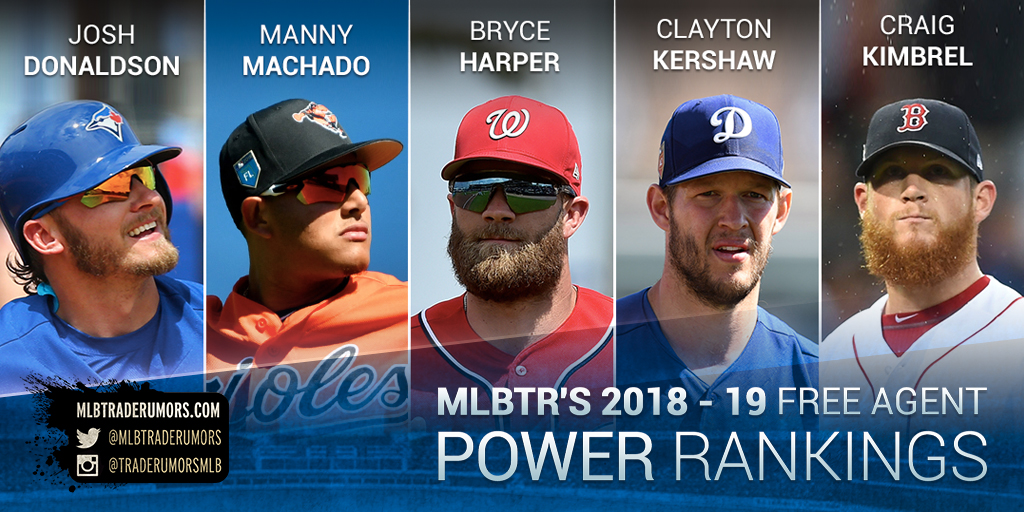
1. Bryce Harper. Before his 2012 Rookie of the Year season, Baseball America called Harper “the most hyped position player prospect in baseball history.” Seemingly groomed for MLB stardom from birth, Harper graduated high school early and fast-tracked himself to make his debut with the Nationals at age 19. He’s only missed the All-Star team once in his career, and won the NL MVP in 2015. Harper stands alongside Mike Trout and Joey Votto as one of the best hitters in baseball, combining power and patience from the left side of the plate. Due to his early debut and avoidance of contract extensions, Harper stands to reach free agency as a 26-year-old.
Aside from the sky-high price tag, only Harper’s injury history could give teams pause. Harper has gone on the disabled list three times in his career, missing anywhere from 35-65 days with each injury. He suffered knee and thumb injuries in 2013 and ’14, respectively, that resulted from his all-out style of play. Both ultimately required surgery. Harper rebounded to play in 300 games from 2015-16, but suffered a bone bruise in his left knee last August that kept him out for a month and a half. Harper is healthy and raking early in 2018, and something close to 150 games played should quiet injury concerns.
Though he understandably refuses to discuss his free agency with reporters this year, MLB fans expect an epic experience with the Winter Meetings taking place in Harper’s hometown Las Vegas. 18 years after opinionated agent Scott Boras brokered Alex Rodriguez‘s precedent-shattering 10-year, $252MM free agent contract with the Rangers, he’ll attempt to raise the bar with Harper. Harper figures to easily surpass the current record contract, Giancarlo Stanton‘s 13-year, $325MM deal from November 2014. Aside from beating that total by more than $100MM, Boras will also aim to destroy the current average annual value record, the $34.4MM Zack Greinke is earning. A half billion dollars could be in play. Harper could land anywhere from $400-500MM over 10-14 years. Opt-out clauses will likely be scattered throughout, allowing Harper the opportunity to later break his own record.
2. Manny Machado. About three months after Harper debuted in 2012, Machado reached the Majors as the Orioles’ third baseman. Just a few months older than Harper, Machado was also a first-round prodigy. Machado’s bat took longer to blossom, with a power surge in his fourth season. Machado is well-known for his defense on the left side of the infield. He came up as a shortstop, but began his big league career at third base to accommodate J.J. Hardy. Machado became an elite defender at the hot corner, winning three Gold Gloves. His ascent was interrupted when he tore the medial patellar ligament in his left knee in September 2013, pushing his 2014 debut into May. Several months later, Machado sprained a ligament in the other knee, also necessitating surgery. The knee injuries are behind him, as Machado averaged 158 games from 2015-17. He played a couple months of shortstop in the summer of 2016 when Hardy got hurt, and convinced the Orioles to shift him back to his natural position for the 2018 season. In addition to establishing himself as an above-average defensive shortstop, Machado must shake off mediocre offensive output from 2017, when he posted a .310 OBP.
Machado endured trade rumors throughout the offseason, and could be dealt this summer if the Orioles fall out of contention. Though he’ll fall short of Harper’s contract, some teams may consider Machado a more balanced player with lower health risk. Since he doesn’t turn 26 until July, Machado is also set up for a monster contract that could top $300MM.
3. Clayton Kershaw. Already an all-time great at age 30, Kershaw has been slowed only by his balky back. He lost 74 days to a back injury in 2016 and another 39 last summer. Kershaw otherwise remains at the top of his game. He’s got three Cy Young awards (and an MVP) under his belt and even finished fifth in the Cy voting in 2016 (149 innings) and second last year (175 innings). By measure of Wins Above Replacement, Kershaw ranks fourth in baseball among pitchers from 2016-17 despite pitching about 100 innings fewer than the three hurlers ranked ahead of him. Logically, barring an in-season extension with the Dodgers, Kershaw will opt out of the remaining two years and $65MM left on his contract and explore free agency for the first time. For teams formulating an offer, the primary forecasting question will be more about Kershaw’s health than his abilities. How much time will the future Hall of Famer miss within the next seven or eight seasons? Will he require back surgery at some point? If Kershaw makes it through this season mostly unscathed, he’ll be primed to sign the largest contract ever for a starting pitcher, topping David Price‘s seven-year, $217MM pact and Greinke’s $34.4MM average annual value.
4. Josh Donaldson. The Cubs drafted Donaldson 48th overall in 2007 as compensation for the loss of free agent Juan Pierre. Donaldson had switched from third base to catcher during college, and Baseball America said he projected “as a .280 hitter with 15-20 homers a season.” He was soon shipped to Oakland in the Rich Harden trade, and before the ’08 season BA noted that “some scouts question if he’ll hit enough to be a big league regular.” Donaldson got a big league look in 2010, but he was still buried on the Athletics’ catching depth chart in 2011 at age 25. His opportunity finally came in 2012 with a preseason injury to A’s third baseman Scott Sizemore. Donaldson bounced up and down that year but started to emerge in the season’s final two months. Finally, in 2013 at age 27, Donaldson established himself as one of the best third basemen in baseball. He combined strong defense with increasing power to become a perennial MVP candidate. The A’s traded him to Toronto in the 2014-15 offseason, and Donaldson won the MVP in his first season with his new team. Last year marked his first appearance on the DL, as he lost more than a month to a calf injury. Currently, he’s on the DL for right shoulder inflammation. As a late bloomer, Donaldson will play his first season on his next contract as a 33-year-old. In discussing his free agency with my MLBTR colleagues, I was the low man on his contract, not fully convinced a player with this profile can secure a four-year deal. At the least, he’s a candidate for an AAV in the $25MM range.
5. Craig Kimbrel. A third round pick of the Braves in 2008, Kimbrel emerged as the best closer in baseball beginning in 2011. Kimbrel racked up 185 saves for the Braves from 2011-14, inking an extension along the way that bought out his first two free agent years. The Padres acquired him in 2015 in a rare April trade, capping off their ill-fated push for contention under A.J. Preller. Seven months later Preller turned around and dealt Kimbrel to the Red Sox. Kimbrel made his fifth All-Star game in his first season with Boston, though his walk rate spiked up to a dangerous level. He more than corrected that problem in a dominant 2017, finishing sixth in the Cy Young voting. Another vintage Kimbrel season may result in the largest reliever contract in baseball history. Aroldis Chapman‘s five-year, $86MM deal is the record, while Wade Davis set the high water mark for AAV at $17.3MM in December winter. Kimbrel will likely be striving for a five-year deal, though he’ll pitch most of 2019 at age 31 (as opposed to Chapman and Kenley Jansen beginning their recent free agent deals at age 29).
6. Patrick Corbin. Corbin, a 28-year-old lefty, was a second-round pick of the Angels in 2009. Near the trade deadline in 2010, he became the third piece headed to the Diamondbacks in the Dan Haren trade. Corbin bounced up and down with Arizona in 2012 and won the team’s fifth starter job out of camp in 2013. At age 23, Corbin authored an excellent All-Star campaign over 208 1/3 innings. In line to start Opening Day 2014, Corbin instead wound up getting Tommy John surgery in March that year. About 15 months later, he was back on a Major League mound and acquitted himself well in 16 starts. Corbin had a surprisingly rough 2016, losing his rotation job in mid-August after seeing his walk and home run rates spike. He bounced back with a healthy 3.0 WAR season in 2017 and is off to a nice start this year. Since that 2016 bottoming out, Corbin has increased his slider usage to the current 46.8%, throwing the pitch more often than any starter other than Chris Archer. Corbin has youth on his side and will compete with Dallas Keuchel to be considered the best free agent starting pitcher, Non-Kershaw Division. At nearly 19 months younger than Keuchel, age is on Corbin’s side. After the 2015-16 free agent starting pitcher bonanza, in which seven pitchers signed for at least five years (excluding Kenta Maeda), only one starting pitcher, Yu Darvish, has reached five years in the past two offseasons. That will likely be Corbin’s goal.
7. Dallas Keuchel. Compared to Corbin, Keuchel has age working against him, but the Astros lefty also has a Cy Young Award on his shelf from 2015. Keuchel is a ground-ball machine when he’s on, including a 66.8% rate last year that was tops among starters with at least 140 innings. Neck injuries caused Keuchel to miss more than two months in 2017, and a healthy season would increase his chances at a strong multi-year deal in free agency. Keuchel’s profile as a soft-tossing southpaw who relies heavily on ground-balls could be spun either way — it’s not as exciting as a power arm with a more strikeout-oriented approach, but it could also be seen as a skill set that will age better than his peers who rely more on premium velocity.
8. Brian Dozier. The Twins drafted Dozier in the eighth round in 2009. In his first Baseball America profile in 2011, they wrote, “His biggest weakness is his lack of power, as he doesn’t project to hit more than 5-10 homers annually.” BA didn’t rate any of Dozier’s tools as above-average at the time, so he was even more of an underdog than Donaldson. Dozier became the Twins’ Minor League Player of the Year that season, and was upgraded to a future Jamey Carroll type. Twins manager Ron Gardenhire championed Dozier as more than a utility man, however, and indeed he took over for Carroll as the team’s starting shortstop in May 2012. The 25-year-old rookie was demoted in August but bounced back to win the Twins’ starting second base job out of camp in 2013. Dozier never looked back, hitting 17 home runs in his final 108 games that year. The second baseman continued ramping up his power output over the years, peaking with 42 bombs in 2016. By WAR, he was the 11th-best position player in baseball from 2016-17, exceeding the output of players like Nolan Arenado and Paul Goldschmidt. Dozier will play most of 2019 at 32, so like Donaldson, his age will work against him in free agency. Alex Gordon‘s four-year, $72MM deal could be a target.
9. A.J. Pollock. Pollock, 30, was taken 17th overall by the Diamondbacks as part of their productive 2009 draft. He made his Major League debut in 2012 upon an injury to Chris Young. A spring 2013 injury to Adam Eaton opened up a door for Pollock, who logged most of the team’s innings in center field that year. Eaton was traded that winter, further cementing Pollock’s position until a Johnny Cueto pitch broke his hand in late May, costing him three months. Health was not a problem in Pollock’s incredible 2015 season, a .315/.367/.498 effort worth 6.8 WAR and MVP votes. In 2016, an elbow injury derailed Pollock’s ascent to stardom. The elbow fracture required surgery, as did a similar injury suffered by Pollock when he was in the minors in 2010. Pollock appeared in just 12 games in 2016, and then lost 50 days in 2017 with a groin injury. A healthy contract year is crucial as Pollock looks to achieve the five-year, $80MM center fielder standard set by Dexter Fowler and Lorenzo Cain.
10. Elvis Andrus. Though Andrus is in his ninth season with the Rangers, he still hasn’t reached his 30th birthday. Signed as an amateur free agent out of Venezuela by the Braves, the Rangers acquired Andrus in the legendary Mark Teixeira trade near the July 2007 deadline. Andrus became the Rangers’ starting shortstop as a 20-year-old in 2009, with Michael Young moving to third base to accommodate the rookie. Renowned for his defense, speed, and makeup, Andrus settled in as a 2-3 WAR shortstop. In April 2013, the Rangers signed Andrus to what GM Jon Daniels called “an unusual deal,” a record extension worth $120MM over eight years. The contract allows Andrus to opt out after the 2018 or ’19 seasons. He’s guaranteed $58MM over the next four years, so opting out this winter isn’t a slam dunk. After serving as an iron man for nine seasons, Andrus will miss 6-8 weeks with a broken elbow that will not require surgery. It’s the first DL trip of his career. Further complicating Andrus’ value is his newfound power. Though Andrus jumped up to a career-high 20 home runs last year, that plateau isn’t as special when 116 other players also accomplished it. The result was a 110 wRC+, which contributed to a career-best 4.3 WAR. Andrus’ safest move might be to avoid free agency, and instead convince the Rangers to guarantee his club/vesting option for 2023.
In addition to these ten players, another eight have a good shot at exceeding a $40MM free agent contract: Garrett Richards, Yasmani Grandal, Daniel Murphy, Cody Allen, Andrew McCutchen, Gio Gonzalez, Drew Pomeranz, and Andrew Miller. Others may very well join that mix as the season progresses. I’ll update these power rankings monthly, and I’m sure they’ll look very different by the time free agency actually begins.
Kevin Kiermaier To Undergo Thumb Surgery
2:05pm: Topkin now adds that he hears that Kiermaier’s absence will likely be closer to 12 to 13 weeks than to eight weeks (Twitter link).
11:50am: The Rays announced that Kiermaier has been placed on the 10-day DL and confirmed the ligament tear as well as the requirement for surgery. Right-hander Chih-Wei Hu has been recalled from Triple-A Durham to take Kiermaier’s spot on the active roster for now.
11:24am: Rays center fielder Kevin Kiermaier suffered a torn ligament in his right thumb when sliding into second base yesterday and will require surgery that could sideline him for the next eight to 12 weeks, Marc Topkin of the Tampa Bay Times reports.
Manager Kevin Cash had already suggested after yesterday’s game that Kiermaier could miss some significant time with the injury. He underwent an MRI this morning that revealed the tear, and a formal announcement is expected from the team later this afternoon, according to Topkin.
Though Kiermaier was off to a dreadful .163/.250/.233 start to his season, the loss of one of the game’s premier defenders is a significant blow to the Rays. Tampa Bay is off to just a 3-12 start to the 2018 season, and Kiermaier’s absence possibly into the month of July won’t do them any favors. This’ll now be three straight seasons in which Kiermaier has missed multiple months due to injury, having previously been shelved by a fractured wrist and a fractured hip.
[Related: Tampa Bay Rays depth chart]
The Rays have a pair of center-field capable outfielders on the active roster already in the form of Mallex Smith and Carlos Gomez. Presumably, one of the two will step into the considerable void left by Kiermaier. The injury will also likely push Denard Span into the outfield with more regularity, and it could clear a spot on the big league roster for recent waiver pickup Jeremy Hazelbaker.
Given the Rays’ miserable start to the 2018 campaign and now the lost of perhaps their best all-around player, trade rumblings surrounding their more established players figure to crop up earlier in the year than usual. Chris Archer and Alex Colome are a perennial fixtures on the rumor mill, though each struggled to a dismal start of his own. Gomez, Wilson Ramos, Adeiny Hechavarria, Sergio Romo and Span are among the other logical trade candidates on the Rays, should the team ultimately show an openness to moving some pieces. For now, of course, the focus for the Rays will remain on rebounding from an ugly start to the season.
Dinelson Lamet To Undergo Tommy John Surgery
Padres righty Dinelson Lamet will undergo Tommy John surgery, MLB.com’s AJ Cassavell reports on Twitter. He’ll miss the remainder of the 2018 season and, likely, some of the 2019 campaign as well.
When Lamet hit the DL to open the year, the expectation was that it was only to allow him a brief rest after some elbow pain cropped up. Instead, a closer look evidently revealed damage to his ulnar collateral ligament. As Cassavell notes, the young righty hoped at first to rehab rather than undergoing surgery, but ultimately elected to bite the bullet and have the procedure.
It came as something of a surprise when Lamet was brought up to the majors early in the 2017 campaign. But he quickly proved he belonged, showing a strong fastball-slider combo that played in the rotation despite the fact that he only went to his third pitch (a change) in less than one of every twenty deliveries. The 25-year-old Lamet ended the year with a 4.57 ERA over 114 1/3 innings. He recorded 10.9 K/9 on an 11.8% swinging strike rate while permitting a few too many walks and dingers (4.3 and 1.42 per nine, respectively).
Though there are obviously still some elements of Lamet’s game in need of being smoothed out, the hope was that he would continue to advance while providing solid innings at the MLB level. Now, he’ll be staring down a lengthy rehab process. When the 2019 season gets underway, Lamet will already have accrued 1.130 days of MLB service, so he’ll be primed for potential Super Two status if he goes straight back to the majors once he finishes his rehab.
Travis d’Arnaud To Undergo Tommy John Surgery; Kevin Plawecki Placed On Disabled List
Mets catcher Travis d’Arnaud, who’d previously been diagnosed with a partial tear of the ulnar collateral ligament in his right elbow, will undergo Tommy John surgery next week, the team announced on Friday.
Additionally, the Mets placed Kevin Plawecki on the 10-day DL due to a hairline fracture in his left hand, selected the contract of Jose Lobaton from Triple-A Las Vegas and optioned out righty Jacob Rhame in place of outfielder Brandon Nimmo.
To make room on the 40-man roster for Lobaton, d’Arnaud was placed on the 60-day DL. Plawecki is expected to be out three to four weeks, the team told reporters (Twitter link via Mike Puma of the New York Post).
Suffice it to say, it’s been a devastating 48 hours for the Mets, who just days ago were counting on d’Arnaud and Plawecki to shoulder the entirety of their catching work in 2018. Now, they’ll be without Plawecki for perhaps a month’s time, while d’Arnaud will be lost for the whole season. In their stead, the Mets will turn to Lobaton and Double-A backstop Tomas Nido to handle immediate catching duties. Lobaton is in tonight’s lineup.
However, for a club that started 10-1, the Mets understandably aren’t keen on merely relying on depth pieces and journeyman stopgaps as they await the return of Plawecki, who, while he has shown promise in the past, is no sure bet for a productive campaign.
To that end, the Mets are already on the lookout for catching help, per multiple reports. Anthony DiComo of MLB.com tweets that a small-scale move — something along the lines of a pickup of recently designated veteran Miguel Montero — could be in play for the Mets. FanRag’s Jon Heyman, meanwhile, tweets that the Mets are “seriously” looking at adding a catcher, though GM Sandy Alderson, at least publicly, spoke to the contrary (Twitter links via DiComo and Puma).
Alderson indicated that his club will “be aware” of what is available on the catching market but is not actively pursuing a Major League catching addition. Puma notes that Alderson did suggest that trades are more plausible early this season than in other years because of the number of teams that “aren’t trying that hard.”
One move that seems decidedly unlikely is a swap for J.T. Realmuto. DiComo and Newsday’s Tim Healey have both thrown significant cold water on the possibility, downplaying the notion that the Mets would be able to put together a sufficient package and also downplaying the Marlins’ willingness to move him. Healey notes that the Mets and Marlins haven’t spoken about Realmuto at all this week, noting that offseason talks for the star catcher failed to gain any traction.
More emphatically, Joe Frisaro of MLB.com tweets that the Marlins don’t have any intention of dealing Realmuto while he’s rehabbing from injury and, in the grander scope of things, don’t even plan on making him available at all this season. It seems that the Fish would prefer to hold Realmuto through the end of the 2018 season and market him again next winter when a wider base of clubs could likely inquire about his services. Of course, such plans can always change at the deadline if a few contenders find themselves with an acute need, thus creating the basis for a bidding war, but for the time being it doesn’t sound as if a Realmuto trade is even worth speculating upon.
As far as depth options go, the Mets have already acted quickly to pursue one such addition. Former Mets backstop Johnny Monell announced today on Instagram that he’s signed a new minor league deal with the team and will return to the club. The 32-year-old logged 57 plate appearances for the 2015 Mets and is a lifetime .278/.350/.460 hitter in parts of five seasons in Triple-A, which is where he’ll be headed.
Elvis Andrus Diagnosed With Elbow Fracture
TODAY: Andrus will not need surgery but will miss approximately six to eight weeks of time, the club announced. It is not fully clear whether that estimate includes any anticipated time spent on a rehab assignment, though it seems the organization can anticipate that its regular shortstop will be back in the majors at some point in the month of June.
YESTERDAY, 11:35pm: The Rangers issued a press release on Andrus’ injury, indicating that initial X-rays “indicate the probability of a fracture in the elbow.” He’s set to undergo additional X-rays and a CT scan tomorrow, and his elbow has been placed in a splint for the time being.
10:57pm: Rangers shortstop Elvis Andrus has been diagnosed with a fracture in his right elbow, tweets Evan Grant of the Dallas Morning News. Andrus was hit by a pitch late in Wednesday’s contest, and post-game X-rays revealed the break. The extent of the fracture hasn’t been revealed, though it seems clear that a DL stint for Andrus is likely on the horizon. Jeff Wilson of the Fort Worth Star-Telegram tweets that Andrus will have more tests performed tomorrow and notes that a DL trip would, remarkably, be the first of the shortstop’s career.
Obviously, the news comes as a blow to a Rangers club that has gotten off to a dreadful 4-10 start to the 2018 season and is currently sporting baseball’s second-worst run differential at -33. The 29-year-old Andrus was off to a torrid, hitting .327/.426/.500 with a pair of homers and three doubles through his first 61 plate appearancesÃÂ as he looked to recreate last season’s career year at the plate.
Andrus is the latest in a recent string of DL placements for a Rangers club that has also lost Delino DeShields, Rougned Odor and Doug Fister to the disabled list since Opening Day. With both Odor and Andrus on the sidelines, former No. 1 overall prospect Jurickson Profar seems likely to at last be ticketed for regular at-bats with the Rangers for the foreseeable future. Catcher/infielder Isiah Kiner-Falefa is already with the big league club and has experience at second base, and the Rangers also have March trade pickup Eliezer Alvarez on the 40-man roster, though he has only limited experience above A-ball. Versatile Hanser Alberto in Triple-A Round Rock, but he’ll need to be re-added to the 40-man roster after previously being non-tendered and re-signed to a minor league deal.
One other scenario that could play out would be a move of Drew Robinson from the outfield to the infield, as he comes with experience in both regards at the minor league level. Shifting Profar to shortstop and Robinson to second base could then open the door for top prospect Willie Calhoun to return as a left fielder, although that alignment would likely force Ryan Rua into center field, where he’s played just 14 big league innings. Carlos Tocci remains an option in center as well, though as a Rule 5 pick, asking him to take on regular center field work would be a lot.
Certainly, the timing of the injury is brutal for Andrus from a personal standpoint as well. The shortstop’s eight-year, $120MM deal was viewed for several seasons as a misstep by the front office, but Andrus’ sensational 2017 season and strong start to the 2018 campaign suddenly made the possibility of him exercising an opt-out clause after the season look entirely possible.
Andrus has $58MM guaranteed to him over the next four seasons, but with a repeat of his 2017 season he’d almost certainly elect to test the open market in search of a lengthier, more lucrative contract. If he’s able to return in the near future, that may still be the case, but the length of his absence and the degree to which he is able to bounce back from the injury will now carry added significance with the possibility of free agency looming.
Alex Gordon Placed On DL With Labral Tear In Left Hip
The Royals announced that they’ve placed left fielder Alex Gordon on the 10-day disabled list with a labral tear in his left hip. Recently claimed outfielder Abraham Almonte has been recalled from Triple-A Omaha to take his place. Kansas City didn’t provide an immediate timeline within its announcement, though manager Ned Yost suggests that the injury may not be as bad as it sounds (Twitter link via Rustin Dodd of The Athletic). Yost said that Gordon will be re-evaluated in five days and could return as soon as two weeks down the road in a best-case scenario.
Gordon, 34, inked a franchise record four-year, $72MM contract with the Royals in the 2015-16 offseason. At the time, the left fielder had made three consecutive All-Star teams and been one of the key factors in the Royals’ return to prominence in the American League Central. From 2011-15, Gordon slashed .281/.359/.450 (121 OPS+) and took home four Gold Glove Awards. Baseball-Reference pegged his efforts at 27.2 wins above replacement in that five-year peak, while Fangraphs credited him with 24 WAR.
However, Gordon’s production immediately went south in the first season of a four-year contract that has transformed from a cause for celebration among Royals fans to an albatross deal for the franchise. Since Opening Day 2016, Gordon has posted a woeful .213/.300/.343 slash in 1071 plate appearances, missing time along the way with a fractured right wrist (in May 2016). He’s still owed $20MM in 2018 and 2019, plus a $4MM buyout of a mutual option for the 2020 season.
Orioles To Activate Alex Cobb On Saturday
Right-hander Alex Cobb will make his Orioles debut against the Red Sox in Boston this coming Saturday, the team told reporters (Twitter link via Roch Kubatko of MASNsports.com). The right-hander had opened the season in extended Spring Training as he built up strength after waiting until late in Spring Training to sign with the O’s. Baltimore also announced that former top prospect Hunter Harvey has been recalled for tonight’s game and added to the bullpen, with lefty Tanner Scott heading to Triple-A in a corresponding move.
Cobb inked a four-year, $57MM pact that came as somewhat of a surprise after the market for him, Lance Lynn and Jake Arrieta looked to have largely collapsed. Rather than taking a short-term deal, as Lynn did, Cobb and his reps at Beverly Hills Sports Council instead found a contract that was largely commensurate with a number of November projections (and topped our $48MM estimate here at MLBTR).
Prior to revealing that Cobb would start on Saturday, the O’s announced that Cobb worked a six-inning outing in extended Spring Training today, allowing two runs (one earned) on six hits and a walk with eight strikeouts in six innings against Twins farmhands. Cobb tossed 93 pitches in that game, so it seems he should be stretched out enough to eclipse the 100-pitch mark if necessary.
Cobb will join Dylan Bundy, Kevin Gausman, Andrew Cashner and Chris Tillman in a revamped Orioles rotation, pushing right-hander Mike Wright Jr. out of the starting mix — presumably into the bullpen. The 30-year-old’s big league deal means he’s already on the 40-man roster, but the Orioles will still need to clear a spot on the 25-man roster for him.
As for Harvey, the former No. 22 overall pick in the draft (2013) rated as one of the best prospects in the game before arm injuries, including Tommy John surgery, severely hampered his development. It’s an aggressive promotion for Harvey, who’d never pitched above A-ball prior to this season, though it’s also quite likely to be short-term in nature, as the O’s presumably still want to see him stretch out as a starter in hopes that the 23-year-old can eventually be an option for them in the rotation. Harvey had been slated to start tonight in Bowie prior to his promotion to the big leagues.
Nationals Extend Mike Rizzo Through 2020
10:39am: Rizzo will earn $4MM in each of the two years of the contract, Janes tweets.
9:42am: While salary terms remain unknown, Rizzo intimated that — much like some recent free-agent players — he was able to achieve an appealing salary despite settling for a shorter commitment. “The years are important to me, but the AAV of the deal is right where I wanted it to be,”on Twitter said Rizzo (via Mark Zuckerman of MASNsports.com, ).
7:26am: The Nationals have agreed to a new contract with president of baseball operations and GM Mike Rizzo, as the club announced and Chelsea Janes of the Washington Post reports. Rizzo’s contract will now run through 2020.
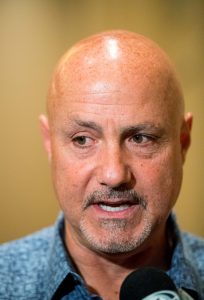
Rizzo, who took over the organization’s baseball operations department in advance of the 2009 season, had been working on a deal that expired at the end of the current campaign. Though both he and the club’s ownership had expressed confidence that a new arrangement would be reached, it took somewhat longer than expected — and, perhaps, will not be for as lengthy a term as might have been anticipated. (Salary terms are not yet known.)
Compared to his peers, the 57-year-old Rizzo will continue to operate with relatively little job security. Numerous other top operations officials with similarly impressive track records have achieved much lengthier terms on their most recent contracts. Most recently, Pirates GM Neal Huntington signed on for another four campaigns while Yankees GM Brian Cashman secured a five-year deal that’s reportedly worth more than $25MM.
Of course, the lack of long-term arrangements has not prevented Rizzo from securing a long run at the helm in D.C. already. As Janes notes, he has run the baseball ops department for longer than all but four of his peers. Rizzo originally joined the Nationals as an assistant GM after running the Diamondbacks’ scouting department.
It also does not seem to bother Rizzo. In an appearance today with 106.7 The Fan’s The Sports Junkies, via Janes on Twitter, Rizzo cited his longstanding relationship with an ownership group that is led by the Lerner family. “The trust level I’ve built up with the Lerners has been great,” he said. “There’ s a bond between us [that] I think is stronger than anything else.”
There have obviously been some disappointments for the Nationals, who have somehow not yet managed to advance past the divisional round of the postseason in four recent attempts. But it’s difficult to lay those failures — which have come in one tightly-contested series after the next — entirely at the feet of the front office. After all, Rizzo has consistently put competitive rosters on the field over a tenure that has otherwise been a resounding success.
In the first season following Rizzo’s ascension to the GM seat — initially, on an interim basis — the club won just 59 games, matching its ugly total from the prior campaign. But the Nats added ten and then eleven wins in each of the next two seasons, setting the stage for a breakout 2012 unit.
Nationals fans will not soon forget that season, when the Nationals shocked the baseball world by posting 98 wins and claiming their first NL East crown and postseason berth. The core of the team was developed from within, with major contributions from then-recent top draft picks Stephen Strasburg and Bryce Harper.
While there were hiccups along the way — specifically, second-place finishes in 2013 and 2015, the latter in humiliating fashion — the Nats have been perennial contenders ever since, winning more total games than any team but the Dodgers. A payroll that now ranks among the highest in the game has certainly helped, but Rizzo’s shrewd dealings have kept the roster stocked with high-end talent.
As with any executive, Rizzo has had his hits and misses. The regrettable but unforgettable acquisition of Jonathan Papelbon certainly rates among the most notable in the latter category. Foibles with managers are by now a worn joke with regard to the Nationals, though perhaps only Rizzo’s hand-picked hiring of Matt Williams is his responsibility moreso than ownership’s. Many would rate the decision to shut down Strasburg in 2012 as a blemish, though the critics have always seemed to ignore that the organization had arrived at its decision before the start of the season and declined to waver from it, despite obvious temptation, to protect a young player who had shown signs of wearing down.
By and large, though he has been remarkably successful at structuring trades and overseeing a drafting and development effort that has consistently produced quality young players. To be sure, Strasburg and Harper largely fell into the Nats’ lap, both carrying unquestionable 1-1 talent in the drafts where the club was choosing first. But Rizzo also scored value in later drafts — especially in nabbing Anthony Rendon in 2011. Over the years, Rizzo brought in key contributors such as Wilson Ramos, Tanner Roark, Felipe Rivero, and Trea Turner in high-value trades.
Even as the Nationals face a future that may not include Harper, they seems primed to continue competing with a core group that could soon include Victor Robles, Juan Soto, and Carter Kieboom. Accomplishing that transition — or, instead, finding a way to keep Harper around without crippling the team’s ability to spend on other talent — may be the biggest challenge yet for Rizzo.
Photo courtesy of USA Today Sports Images.
Rockies Extend Charlie Blackmon
The Rockies have announced an extension with outfielder Charlie Blackmon. In addition to re-working his already agreed-upon 2018 salary, the new deal covers five additional seasons, giving the Rockies control over three would-be free agent campaigns and providing the ACES client with a pair of player options for two further years.
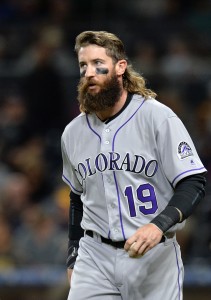
Blackmon will be guaranteed $94MM in new money, $63MM of which comes over the three seasons that are locked in before the player options, according to Craig Calcaterra of NBC Sports (Twitter link). He will also receive the same amount ($14MM) he was already promised for 2018, though $2MM of that figure will now come by way of signing bonus. He’ll then earn $21MM annually from 2019 through 2021.
In the final two potential seasons, Blackmon will consider a $21MM player option for 2022 and, if he’s still playing under the contract, a $10MM option for 2023. That final option number could escalate by up to $8MM. As Ken Rosenthal of The Athletic tweets, it will move north by $5MM so long as Blackmon takes 400 plate appearances. He can boost the figure by $2MM with a first, second, or third-place finish in the MVP voting or by $1MM if he lands fourth or fifth. The contract also includes limited no-trade protection.
Blackmon, who’ll turn 32 in July, has ramped up his productivity over the past two seasons to become one of the game’s best all-around outfielders. He has won consecutive Silver Sluggers and placed fifth in the National League MVP voting in 2017.
More importantly, the numbers suggest that Blackmon is primed to continue his success. Blackmon has racked up 400 hits over the past two seasons, carrying an eye-popping .327/.390/.578 cumulative slash line that impresses even after accounting for the fact that he plays half of his games at Coors Field. He no longer swipes many bags, but made up for that lag in the counting-stat department by hitting a career-high 37 long balls last season. Notably, he also boosted his walk rate to a career-high 9.0% in 2017. While that’s hardly a premium figure, it’s promising that it is moving northward at this stage. And Blackmon has also fared rather well historically against left-handed pitching.
Though he grades mostly as an average performer in center, and may ultimately move out to a corner spot before this deal is up, Blackmon is a solid defender and good baserunner as well. He has also stayed on the field consistently since emerging as a full-time player in 2014.
The move will keep one of the Rockies’ biggest stars on hand through at least his age-34 season while committing the team financially through his age-36 effort. Whether the Colorado organization can similarly lock up its other top player, third baseman Nolan Arenado (a free agent after 2019), remains to be seen.
This contract also removes a significant player from the much-anticipated 2018-19 free agent class. While Blackmon never was going to carry quite the earning power of some of the other intriguing names who’ll soon reach the open market, he had certainly profiled as one of several players that could have pushed for nine-figure contracts.
As it turns out, Blackmon’s new contract topped nine figures only nominally. Of course, he’s locking that figure in now rather than rolling the dice on how things turn out in the season to come — not to mention how the next free agent period will go after a long, strange 2017-18 offseason. And he’ll get to stay with the only organization he has played for. There’s also value in controlling the outcome of the final two seasons of the deal, though perhaps not all that much given how long in the tooth Blackmon will be when it comes time to make a call on those years.
Blackmon also had to contend with anticipated market unease over his age as well as the fact that he has rather significant home/road splits (131 wRC+ vs. 100 wRC+ for his career). It was fairly unlikely that he’d have received a much lengthier commitment upon entering the market at 32 years of age. The Coors factor is harder to gauge, but could certainly also have been a factor in limiting interest.
All told, there’s certainly a case to be made that Blackmon could have earned a fair bit more had he waited. Way back in the 2012-13 offseason, Josh Hamilton secured a five-year, $125MM pact entering his age-32 season. Then again, the amply accomplished Lorenzo Cain — nowhere near the hitter Blackmon is, but a better performer in other areas — is only months older than Blackmon and secured just $80MM for his own five-year term. Another monster season might, in the right market circumstances, have allowed Blackmon to drive up a bidding war and earned a decent bit more than he will. Odds are, though, that he will not have left an enormous pile of cash on the table when all is said and done.
Photo courtesy of USA Today Sports Images.