
2024-25 Free Agent Power Rankings: Late August
Since Opening Day, MLBTR has taken periodic looks at the upcoming free agent class. This is our third (and likely final) installment of our in-season power rankings. Players still have a month and potential postseason play to move things around, yet the class is coming into focus.
There’s no suspense at the top of the list. The 1-2 have remained unchanged from start to finish (although the gap between 2 and 3 has closed in the past few weeks). This is our attempt to capture a player’s earning power, so age is big factor. This is not strictly a list of the best players in the class, though talent is obviously the starting point.
Our power rankings are compiled collaboratively. We worked with Darragh McDonald — with input from MLBTR founder and owner Tim Dierkes — for this installment. Players with opt-out clauses and player options are eligible for the list. Stats are through play on August 29.
- Juan Soto, OF, Yankees
Soto has been the clear top free agent in the class for years. He has been on track for a record-setting deal (in terms of total guarantee, AAV or both) for a while. To top it off, Soto is amidst arguably his best season during his platform year. He has already established a new career mark in home runs. He’s going to hit 40 for the first time and could top 45 by year’s end. Soto is hitting .291/.421/.590 on the season. This will be his fifth consecutive season with more walks than strikeouts.
Approaching his 26th birthday, Soto is ostensibly at the beginning of his prime. There’s not much room for him to get better, but a signing team could realistically expect another seven to 10 years of elite offensive production. Soto’s league-best strike zone awareness should age gracefully. It’s essentially unheard of for teams to be able to sign a player who is on an inner circle Hall of Fame trajectory with another four full seasons before he turns 30. Every high-payroll organization should be involved.
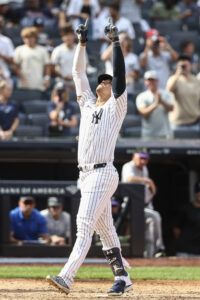
While Soto generally doesn’t provide a ton of defensive value, he’s having a decent season in that regard. He has a career-high five defensive runs saved in nearly 1100 innings. Statcast has him right around average. Soto could move to designated hitter in the latter half of a deal that exceeds a decade but shouldn’t have any issue sticking in right field for the foreseeable future.
Soto turned down a reported $440MM extension offer from the Nationals a few years ago. His camp subsequently rebuffed overtures from the Padres and Soto shut down any chatter about a potential midseason deal with the Yankees in June. He’ll be three years younger than Shohei Ohtani was during his free agency. Soto isn’t likely to accept a deal with the kind of deferrals that Ohtani took, but he should handily beat the approximate $461MM net present value of the Ohtani contract. He should top half a billion dollars and it wouldn’t be surprising if his camp at the Boras Corporation were aiming for something close to or north of $600MM and/or multiple opt-out chances.
2. Corbin Burnes, SP, Orioles
Burnes has been the #1 pitcher in the class throughout the summer. He has finished in the top 10 in Cy Young balloting in four straight years, highlighted by his ERA-leading 2021 season in Milwaukee. Burnes is having a good year, working to a 3.23 earned run average across 164 1/3 innings. His production has slipped coming out of the All-Star Break though. He carried a 2.43 ERA into the Break but is allowing more than five earned runs per nine in 45 2/3 innings in the second half.
The recent results are the continuation of a slightly alarming trend. Burnes was among the game’s top two or three strikeout artists a couple seasons ago. That has gone in the wrong direction over the last two years. After fanning north of 30% of opponents in each season from 2020-22, his strikeout rate dipped to 25.5% last year. It is down three more percentage points during his first (and potentially only) season in Baltimore. Burnes had a 23.3% strikeout rate before the Break and is fanning a slightly below-average 20% of batters faced within the past six weeks.
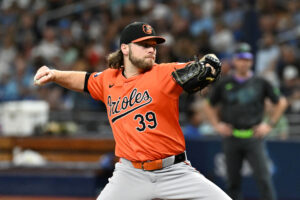
There hasn’t been an obvious corresponding downturn in his stuff. Burnes is averaging a personal-high 95.5 MPH on the cutter that serves as his primary pitch. The speed on his breaking pitches is in line with his career marks. Yet as his velocity has picked up throughout the season, the whiffs have dropped. Opponents have jumped all over his cutter and curveball in uncharacteristic fashion this month.
None of this means Burnes is no longer a good pitcher. He’s in the top 30 among pitchers (minimum 100 innings) in both ERA and swinging strike rate. Burnes is averaging over six innings per start. He hasn’t had a non-illness related stint on the injured list in four years. There’s some amount of concern with every pitcher in the class and Burnes provides the best combination of durability track record and ace upside. Still, teams will need to determine how concerned they are about his two-year dip in swinging strikes when considering whether to meet an asking price that’ll very likely remain north of $200MM.
3. Alex Bregman, 3B, Astros
Early this season, Bregman looked headed for a lost year. The former No. 2 overall pick was hitting .201/.270/.264 as deep into the season as May 12 — a span of 160 plate appearances. At that point, it was fair to wonder whether he’d be able to turn his season around.
Bregman has done that in spades. Over his past 388 plate appearances, he’s hitting .284/.335/.518 with 20 homers, 20 doubles, two triples and his typical above-average glovework at the hot corner. His overall season batting line is still skewed by that ugly start, but for the past 87 games, Bregman’s 3.6 wins above replacement (per FanGraphs) rank 15th in all of baseball.
It’s worth emphasizing that even throughout this turnaround, however, Bregman isn’t quite the same superstar-level hitter he once was. He’s been 42% better than average during this run, by measure of wRC+. That’s still great, but it’s a ways shy of the elite levels of offensive output he delivered in 2018-19, when he finished fifth and second in AL MVP voting, respectively. Bregman’s once outstanding plate discipline has faded this season as well. After walking in 13.8% of his plate appearances from 2018-23, he’s down to 6.8% in 2024. It’s the first time he’s had a below-average walk rate since his 49-game rookie season back in 2016.

Some teams might be turned off by Bregman’s batted-ball data as well — an issue that harmed Cody Bellinger’s free agency last offseason. Though Bregman has long been a plus hitter, he’s never made loads of hard contact. He’s sitting on an 89.4 mph average exit velocity and 41.4% hard-hit rate this year. Both marks are only a bit higher than the league average, but they’re higher than Bregman’s career 88.8 mph and 37.8% marks in those respective categories.
Some might think Bregman to be a product of Minute Maid Park’s friendly dimensions. The short left field porch, the Crawford Boxes, sits only 315 feet down the line. That’s surely benefited Bregman throughout his career and perhaps even informed his swing mechanics and approach at the plate. However, Bregman also flat-out hits wherever he is. The difference between his rate stats at home (.271/.371/.475) and on the road (.275/.363/.489) are negligible. If anything, he’s hit for slightly more power on the road than at home.
Even setting aside his ’18-’19 peak, Bregman has been a consistently standout player in the five seasons since. He’s batted .261/.352/.443 during that time, shown elite contact skills (12.6% strikeout rate) and played above-average defense at an important position. Bregman never settled in as a perennial MVP candidate, but he’s averaged 25 homers and better than four wins above replacement (4.4 bWAR, 4.8 fWAR) per 162 games since 2020. Teams are going to covet his hard-nosed personality as well; one general manager who’d like to sign Bregman told ESPN’s Jeff Passan that he would “completely change our clubhouse for the better.”
The MLBTR team is perhaps more divided on Bregman’s earning power than any other player on this list, but we generally agree there’s a clear nine-figure deal to be had here. Heading into his age-31 season significantly limits him, however. The question is whether the market views him with some trepidation and tries to stick in the low $100MMs or whether interest is bullish enough to push Bregman close to the $200MM range — despite minimal precedent for such a contract at his age. How he finishes the season will be a key factor.
4. Willy Adames, SS, Brewers
Adames has rebounded from his worst offensive showing in Milwaukee. He slumped to a .217 average with a .310 on-base mark a year ago, but he’s up to a .252/.337/.451 slash over 572 plate appearances this season. Adames has already matched last year’s total of 24 homers and has a shot to get to 30 longballs for the second time in his career. That’s not easy to find at the infield’s toughest positions. Among primary shortstops, only Corey Seager and Francisco Lindor have more homers than Adames’ 79 over the past three seasons.
He pairs that above-average power with a patient approach. Adames has walked in more than 11% of his plate appearances in consecutive seasons. He doesn’t have great pure contact skills and his strikeout rate has spiked over the past couple months. While the whiffs keep Adames a tier below the game’s elite infielders, he’s an above-average regular who routinely draws praise from teammates and coaches for his leadership and clubhouse presence.
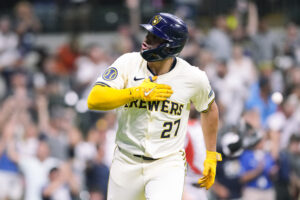
Traditionally, Adames’ glove is one of his calling cards. He has been a plus defender for the bulk of his career. This year’s defensive performance has been erratic. Statcast has graded him as an average defender, while Defensive Runs Saved has been very down on his work (12 runs below average). It’ll be his first season with a subpar DRS since his 2018 rookie year.
Adames has committed 17 errors this year, fourth-most among shortstops. Statcast still credits him with plus range and arm strength. He’s not showing signs of physical decline. The walk year isn’t an ideal time for Adames’ defensive performance to crater, but this season’s poor numbers seem like more of an aberrant spike in errors than an indication that he’s losing athleticism that’ll force him off the position.
As he approaches his 29th birthday, Adames has pulled away from Ha-Seong Kim as the top shortstop in the class. He’s far better than anyone who was available in last winter’s group of shortstops. Adames should beat nine figures and has an argument for a six- or seven-year deal that puts him in the $150MM+ range. Javier Baez, Trevor Story and Dansby Swanson all leveraged this general profile into strong contracts. None of those deals have worked out well, so perhaps teams will round down on Adames, but the market has thus far placed a lot of value in shortstops with power.
5. Blake Snell, SP, Giants *
Two months ago, Snell had fallen off this list. How things have changed. The two-time Cy Young winner is back. As MLBTR’s Steve Adams explored at greater length in a piece for MLBTR Front Office subscribers, Snell has been the best pitcher in baseball for two months. Since the start of July, he carries a 1.30 ERA with an MLB-best 37.1% strikeout rate through 55 2/3 innings. His 18% swinging strike rate over that stretch easily leads all pitchers with 40+ innings. He has reached 10 strikeouts in four of his last six starts. He followed up a career-high 15 punchouts against the Rockies on July 27 with an 11-strikeout no-hitter of the Reds in his first appearance of August.
Snell’s disastrous start to the year feels like a distant memory. He signed late and allowed more than a run per inning through his first 23 2/3 frames. He had two stints on the injured list related to left groin issues. Snell’s sheer dominance since returning from his second IL stay makes it seem like he simply wasn’t healthy for the first couple months.

While Snell has been famously streaky throughout his career, few pitchers can match his highs. Over the last three seasons, he owns a 2.93 earned run average with a 32% strikeout rate over 387 innings. Even Burnes probably doesn’t have Snell’s ceiling at this point, though the left-hander has not been as consistent as the Baltimore ace.
Unless he suffers an injury in the next few weeks, Snell is a virtual lock to decline his $30MM player option for next season. He’ll return to free agency at age 32 and likely take another swing at the kind of deal that alluded him a year ago. Snell recently refuted (X link via Foul Territory) a report that the Yankees had offered him a six-year, $150MM deal last winter. It’s not clear what kind of money was on the table, but it wasn’t sufficient for Snell and his camp at the Boras Corporation to consider it preferable to the two-year guarantee that he ultimately signed with the Giants. He’ll try again without being tied to draft compensation and could take aim at a deal in the $150-200MM range.
6. Matt Chapman, 3B, Giants *
As with Snell, Chapman signed with the Giants late in the winter upon not finding a long-term deal to his liking. He started the year slowly, running a .266 on-base percentage through the season’s first month. Chapman has been fantastic since then, slashing .251/.349/.458 since the start of May. He’s up to a .244/.331/.440 mark with 21 homers across 562 plate appearances — offense that checks in 17 percentage points above league average, as measured by wRC+.
That’s par for the course for Chapman. While he’s been prone to significant swings in performance within seasons, his results at the end of the year tend to be consistent. He’ll hit around 25 homers with enough walks to offset a higher than average strikeout rate and middling batting average.
Chapman pairs that solid offense with some of the best third base defense in the majors. He’s a four-time Gold Glove winner who still rates as one of the game’s top glovemen. Chapman will play next season at 32, so his athleticism and defensive metrics might drop off within the next few seasons, but he’s one of the better all-around infielders in the majors right now.
The Giants have already opened extension talks with Chapman’s camp at the Boras Corp. He’s a Fullerton product who has a strong relationship with San Francisco manager Bob Melvin. Chapman looks likelier than anyone else on this list to sign an extension before free agency opens as a result. If he makes it to the open market, he could seek a five-year deal that exceeds $100MM.
7. Max Fried, SP, Braves
Fried established himself in the Atlanta rotation by 2019. He has been a consistent top-of-the-rotation presence since then. Over the past five-plus years, the 30-year-old southpaw has a 3.09 ERA over 139 starts. Fried hasn’t been quite as effective in the postseason, but he’s one of the biggest reasons for the Braves’ recent run of success.
The former seventh overall pick doesn’t miss bats at the level of a typical ace. He has a career 23.8% strikeout rate and has fanned 22.8% of batters faced this season. His 10.1% swinging strike rate is a hair below average. Fried excels in contact management. His 58.1% ground-ball rate is fourth among pitchers with 100+ innings. He has a five-year track record of suppressing hard contact. While Fried’s 93-94 MPH fastball isn’t overpowering, his secondary stuff (especially his curveball) is excellent.
The biggest concern with Fried is his recent injury history. A forearm strain cost him three months between May and August last summer. Fried spent a couple weeks on the injured list with ulnar neuritis coming out of the All-Star Break this season. He hasn’t pitched especially well since coming back, allowing a 5.26 ERA (albeit with a strong 27.7% strikeout rate) over his last 25 2/3 innings. It’s possible teams will have some trepidation about his arm health, but Fried has an argument for a deal in the Patrick Corbin ($140MM) or Carlos Rodón ($162MM) range if he finishes strong.
8. Jack Flaherty, SP, Dodgers *
If Fried offers consistency despite pedestrian strikeout totals, Flaherty is a more volatile upside play. The 28-year-old righty has some of the best bat-missing stuff in the majors. He has punched out 31.1% of batters faced behind a 13.6% swinging strike rate over 23 starts. He’s fifth in strikeout rate and 11th in whiffs among pitchers with 100+ innings. Flaherty has paired that with a career-low 4.8% walk rate, firing 135 frames of 3.07 ERA ball.
Excellent as his production has been this season, Flaherty is a year removed from posting a 4.99 earned run average between the Cardinals and Orioles. He has looked like a Game 1 starter at his best and a back-of-the-rotation arm at his worst.
Flaherty battled oblique and shoulder injuries between 2020-22, limiting him to 154 2/3 innings over that stretch. He has not been on the injured list in the last two years, yet that hasn’t silenced questions about his health. The Yankees reportedly pulled out of a preliminary deadline deal with the Tigers after identifying an undisclosed concern in his medical review. The Dodgers apparently didn’t share such concerns, as they sent prospects Thayron Liranzo and Trey Sweeney to Detroit thereafter.
Entering his age-29 season, Flaherty is one of the younger pitchers in the class. He doesn’t have the consistency of a $200MM arm but could land in the lower nine figures on a deal similar to Robbie Ray’s five-year, $115MM contract with Seattle.
9. Pete Alonso, 1B, Mets
The personification of the prototypical slugger, Alonso has been the second most consistent power hitter in the game since his 2019 debut. In that time, only Aaron Judge’s 225 home runs top Alonso’s 220 for the MLB lead. The Polar Bear simply mashes. He’s never hit fewer than 37 homers in a full 162-game season. He’s as durable as they come, never missing more than 10 games in a season since debuting, and the only two players with more plate appearances than Alonso since 2019 are Marcus Semien and Freddie Freeman. Teams know Alonso is likelier than most to be out there every day, and he’s assuredly going to hit for more power than nearly any of his peers.
On the other hand, Alonso will turn 30 in the offseason. He’ll receive and reject a qualifying offer in search of a multi-year deal. His defense at first base is not considered to be strong. Alonso walks at an above-average but not-elite clip. Paired with his low batting averages, that typically limits his on-base percentage to the .330 to .340 range.
None of those are glaring flaws on their own, but bundled together they could make for a concerning profile among today’s front offices. A 30-year-old slugger without defensive value who sports pedestrian OBP marks and is tied to draft pick compensation — that’s not a recipe for a mega-contract. Modern teams have been increasingly wary of paying a first-base-only profile late into their 30s — or even signing such players to truly long-term deals as well.
Freeman (six years, $162MM) and Paul Goldschmidt (five years, $130MM) both inked long-term deals beginning with their age-32 seasons. Alonso is younger but also not considered as complete a hitter as those two were when they signed. It’s easy to imagine Alonso and Scott Boras wanting to top Freeman, but Alonso could have a hard time climbing to such heights.
10. Anthony Santander, OF, Orioles
Santander’s been a quality power hitter for the Orioles for years now, but he picked the right time to take his game to another level. The 29-year-old switch-hitter popped 33 home runs back in 2022 but surpassed that mark weeks ago. He’s currently sitting on a career-high 38 home runs. A 40-homer campaign seems like a lock, and Santander could finish with 45 to 50 homers if he enjoys a hot September.
Even if this is a career year in terms of power output, Santander has proven himself a perennial 30-homer threat. He does damage from both sides of the plate, though he’s a more pure lefty hitter. Santander draws more walks, strikes out less often and is a generally well-rounded hitter from the left side. From the right side, he morphs into more of a three-true-outcomes slugger. It all balances out for steady production that any club would be happy to plug into the middle of its lineup.
As is usually the case, the impressive power profile isn’t without its flaws. Santander is limited to the outfield corners (plus some briefer cameos at first base) and doesn’t grade out as a plus defender anywhere. He’s a passable enough right fielder, showing above-average arm strength to go along with plodding range, but no one’s ever going to claim Santander is an elite defender. He’s a bat-first player who figures to slow down as he enters his 30s. It’s reasonable to think that by the second half of a contract, he’ll be a clearly below-average defender in the outfield.
Even at the plate, Santander is a free-swinger who doesn’t walk like the quintessential slugger. He has a slightly above-average walk rate from the right side of the dish but is below-average from the left side. Overall, he’s walked in just 7.1% of his career plate appearances, including a below-average 8% in 2024. Santander doesn’t strike out much (20.7% career, 19.4% in 2024), but he’s still prone to low OBPs because he broadly lacks patience.
Much of what was said regarding Alonso applies here, too. Santander has more defensive value as a currently playable outfielder but a less consistent track record of 40-homer power. But like Alonso, he’ll reject a qualifying offer and head into free agency as a 30-year-old slugger with OBP questions and middling defensive contributions. While Alonso’s regular display of 40-homer pop makes him feel like a lock to reach five years, Santander could be hard-pressed to find that length. A high-AAV three- or four-year contract will likely be in play as one of the best non-Soto power bats on the market.
* Denotes ineligible for qualifying offer
Honorable Mentions (listed alphabetically): Cody Bellinger *, Gerrit Cole *^, Paul Goldschmidt, Teoscar Hernández, Clay Holmes, Ha-Seong Kim, Sean Manaea, Tyler O’Neill, Nick Pivetta, Jurickson Profar, Max Scherzer *, Luis Severino, Justin Verlander *, Christian Walker
^ Cole has the ability to opt out of the final four years and $144MM remaining on his deal at season’s end. If he triggers the opt-out, the Yankees can void it by exercising a $36MM option covering the 2029 season — bringing their commitment to five years and $180MM. MLBTR explored the Cole situation in detail in a post for Front Office subscribers this week.
Pirates Remove David Bednar From Closer Role
The Pirates are pulling star closer David Bednar out of the ninth inning, manager Derek Shelton told the Pittsburgh beat before tonight’s loss to Cleveland. The team will go with a committee approach for now (X link via Alex Stumpf of MLB.com).
Bednar was one of the best relievers in the majors each season between 2021-23. He posted a sub-3.00 ERA with plus strikeout rates in all three years. Bednar worked as a setup option in 2021 before assuming the closing role in ’22. He made the All-Star Game in both 2022 and ’23 and topped the National League with 39 saves just last season. That’s particularly impressive on a team that finished 10 games below .500.
This year has been far less consistent. Bednar was torched for more than 11 earned runs per nine through the end of April. He turned in an excellent 2.01 earned run average in 23 appearances from the start of May through the All-Star Break, though his modest 20.7% strikeout rate suggested he still wasn’t back to peak form.
The wheels have come back off since the Midsummer Classic. Bednar has given up 16 runs (15 earned) in his last 14 2/3 innings. Opponents have teed off at a .328/.434/.531 slash in 77 plate appearances. Bednar’s strikeouts are still down (20.8%) while his walk rate has spiked to an untenable 14.3% clip. His season hit its nadir on Wednesday. Shelton called upon Bednar to protect a two-run lead against the Cubs. He allowed three hits and two walks (one of which was intentional) while recording two outs. Chicago tagged Bednar for five runs — two of which were inherited runners who scored after he was replaced by Jalen Beeks — and went on to a 14-10 win.
For the season, Bednar now carries a 6.32 ERA through 47 innings. His 22.9% strikeout percentage is six points lower than last season’s mark, which had been the lowest of his career. He’s giving up home runs at an elevated rate of 1.53 per nine innings. Bednar’s 97.2 MPH average fastball velocity is still as strong as ever. Opponents have nevertheless feasted on the pitch, connecting for six homers with a .286 average and .527 slugging mark.
Aside from Bednar, Aroldis Chapman and Colin Holderman have been Pittsburgh’s primary high-leverage arms. Holderman has been out for a few weeks with a sprained wrist, leaving Chapman as the favorite for most of the closing work. Dennis Santana and Carmen Mlodzinski are potential options to pick up save chances if Shelton wants to turn to a right-hander.
How the Pirates handle the ninth inning for the next few weeks isn’t as significant as determining whether Bednar can recapture his lockdown form. A disastrous August has tanked their playoff hopes. As the focus turns toward the offseason, the front office could face questions about Bednar’s future with the organization. Pittsburgh rebuffed trade interest when the big righty was at his peak form. They had an extended control window and probably had some designs on agreeing to an extension with the Pittsburgh native. That’s a tougher call to make coming off the worst season of Bednar’s career.
The 29-year-old is playing on a $4.15MM arbitration salary. The process is designed to escalate salaries even amidst down years, so Bednar’s price tag next year should top $5MM. His track record makes a non-tender difficult to envision, but the Pirates could entertain trading his final two seasons of arbitration eligibility.
Cubs Release Tomas Nido
The Cubs released catcher Tomás Nido, tweets Meghan Montemurro of the Chicago Tribune. Nido had been on the 10-day injured list but was occupying a 40-man roster spot. Chicago needed to create a 40-man vacancy to finalize their claim of reliever Shawn Armstrong from St. Louis.
Nido has been on the IL since July 25 with a meniscus injury that required right knee surgery. The Cubs sent him on a rehab stint with Triple-A Iowa last night. That suggests he’s nearing a return, but the Cubs no longer felt they needed him in the catching corps. Chicago called up Christian Bethancourt once Nido landed on the shelf. He has mashed over 11 games in the backup role. Starter Miguel Amaya, meanwhile, has a huge .337/.375/.554 slash since the All-Star Break. It’s a huge turnaround after the 25-year-old hit .201/.266/.288 in the first half.
Since Nido’s injury, Cubs’ catchers own an MLB-leading .327/.358/.634 batting line. Chicago’s catchers almost instantaneously flipped from one of the league’s worst groups to being among the best for the last month. There’s not much of a reason to make a change. The Cubs could have carried three catchers for September but probably would not have had many at-bats available for Nido.
Chicago has put the 30-year-old on waivers. He’d be a free agent if he goes unclaimed, though there may not be enough time for him to catch on elsewhere while still remaining eligible for postseason play with his new club. If another team claimed him or signed him to a big league contract, they’d only be responsible for the prorated portion of the league minimum. The Mets are otherwise paying his $2.1MM salary in the second season of a two-year contract.
Nido is a career .210/.245/.309 hitter over parts of eight seasons. He’s obviously not going to bring much to the table offensively but has a strong defensive reputation. Statcast grades him highly for his pitch framing acumen and arm strength.
Anthony Gose Elects Free Agency
August 30: Cleveland announced Friday that Gose cleared waivers and again elected free agency in lieu of an outright assignment.
August 28: The Guardians announced Wednesday that they’ve designated left-hander Anthony Gose for assignment. It’s rather incredibly the third DFA of the month for Gose, who has twice cleared waivers and returned to the organization (the second time after very briefly electing free agency). His spot on the roster will go to fellow left-hander Erik Sabrowski, whose contract has been selected from Triple-A Columbus. Sabrowski is now in line to make his major league debut the first time he takes the mound for Cleveland.
Gose, 34, pitched two innings in last night’s loss to the Royals, allowing a run four hits with one strikeout. The outfielder-turned-reliever has pitched 3 1/3 big league frames this season and allowed three runs. He’s spent the bulk of the season pitching for Cleveland’s Triple-A affiliate in Columbus, where he’s logged 39 innings with a solid 3.46 ERA, a huge 32.9% strikeout rate and a problematic 15% walk rate.
The 2024 season is Gose’s first year back from a Tommy John procedure that wiped out his entire 2023 campaign. A former second-round pick who ranked as one of the top prospects in the game during his days as a center fielder, he’s still looking to establish himself as a viable big league option in the bullpen. Gose has pitched 31 innings in the majors since making the switch to the mound and recorded a 4.35 ERA with big strikeout numbers (29.5%) and also big walk issues (12.9%).
A two-way star in high school who had some draft interest as a pitcher, Gose was brandishing a fastball that averaged 99.3 mph when he made his mound debut in 2021. He’s since undergone elbow surgery and seen that average heater dip to 95.2 mph — still a well above-average mark (particularly for a lefty), but not the same type of overpowering offering it was a few years back. Gose is still piling up strikeouts in Triple-A, but the command of his fastball/slider combination is a work in progress.
Gose will once again head to the waiver wire now that he’s been designated for assignment. He has the right to reject an outright in favor of free agency, but at this point of the season there’s a good chance he’d just re-sign with Cleveland and head back to Columbus anyhow, as he did following his previous DFA.
As for Sabrowski, this is his first call to the big leagues. The 6’4″, 230-pound southpaw was a 14th-round pick by the Padres in 2018 who came to the Guardians organization by way of the Rule 5 Draft’s minor league phase in 2021. Although he’s a 2018 draftee, he’s only pitched in parts of three professional seasons, thanks to the canceled 2020 minor league campaign and a pair of Tommy John surgeries that both cost him at least a full season. He has just 99 1/3 professional innings under his belt at this point.
Even with that minimal workload, Sabrowski has been impressive with the Guardians since returning from his most recent elbow surgery. Like Gose, he’s posted huge strikeout numbers but also bloated walk rates. His 2023 season saw Sabrowski log 21 2/3 frames with a 2.49 ERA in Double-A. He punched out 30.4% of his opponents but also walked 19.6% of the batters he faced.
Sabrowski opened the 2024 season back at Double-A and notched a pristine 0.77 ERA in 11 2/3 innings there, fanning a comical 54.2% of his opponents against a vastly improved 4.2% walk rate. Since being promoted to Triple-A, he’s logged a 4.38 ERA in 37 innings while recording a 31.2% strikeout rate against a once-again troublesome 17.6% walk rate. He’ll need to improve that command in order to find sustained success in the majors, but there’s little doubting Sabrowski’s ability to miss bats in droves. For now, he gives Cleveland skipper Stephen Vogt a fresh arm as the Guards look to fend off a surging Royals club in the AL Central, with the Twins only 2.5 games behind as well.
Rockies Select Seth Halvorsen
The Rockies announced they’ve selected reliever Seth Halvorsen onto the MLB roster. He joins the bullpen in place of Noah Davis, who was optioned to Triple-A Albuquerque. The Rox had an opening on the 40-man roster after passing left-hander Antoine Kelly through outright waivers yesterday.
Halvorsen, 24, will be making his big league debut. The 6’2″ righty spent two years at the University of Missouri before transferring to Tennessee for his junior season. He turned in a 3.81 ERA over 52 innings for the Vols. The Rockies selected him in the seventh round of last year’s draft.
Colorado got Halvorsen to Double-A by the end of his draft year. He has split this season between Double-A Hartford and Albuquerque. Halvorsen turned in a 4.84 ERA in 35 1/3 Double-A frames, striking out nearly 26% of opponents while walking 12% of batters faced. While he only has nine Triple-A appearances under his belt, he has already punched out 15 at the top minor league level.
In April, Eric Longenhagen of FanGraphs ranked Halvorsen the #14 prospect in the Colorado system. Longenhagen credited him with an upper-90s fastball, as well as an above-average slider and splitter duo. He doesn’t have great control, potentially pushing him into a middle relief role. The Rox are desperate for reliable contributors in the bullpen. There’s plenty of room for Halvorsen to establish himself quickly.
Giants Outright Thairo Estrada, Release Tyler Matzek
Thairo Estrada and Tyler Matzek both went unclaimed on waivers. The Giants announced they’ve assigned Estrada outright to Triple-A Sacramento while recalling Brett Wisely (X link via Alex Pavlovic of NBC Sports Bay Area). Matzek, who’d been on the 60-day injured list, was placed on unconditional release waivers. Estrada drops off the 40-man roster, which now carries 38 players.
San Francisco reportedly placed Estrada, Matzek and lefty reliever Taylor Rogers on waivers earlier in the week. The Giants did not announce what happened with Rogers’ waiver process. It’s possible that they didn’t officially place Rogers on waivers until a day later than the Estrada and Matzek moves (and are therefore still waiting on a resolution). However, it seems likely that Rogers went unclaimed and the Giants simply elected to hold onto him.
A team is not required to send a player to the minors after he clears waivers. The Giants would have no reason to do so with Rogers. If the Giants tried to demote him, the former All-Star could elect free agency while retaining his $12MM salary for next season. That’d simply amount to cutting Rogers, a productive reliever, without any financial benefit for doing so.
Estrada does not have that luxury. The glove-first second baseman has between three and five years of service. That gives him the right to decline an outright assignment but would require him to forfeit the remainder of his salary to do so. Estrada is playing on a $4.7MM arbitration deal and isn’t likely to give up the more than $800K remaining on that contract. He’ll almost certainly report to Sacramento, while Wisely could get a look as the everyday second baseman at Oracle Park.
The 28-year-old Estrada was an average or better hitter during his first three seasons with the Giants, combining for a .266/.320/.416 slash. He topped 20 stolen bases and drilled 14 homers apiece in 2022 and ’23. He hasn’t been anywhere near that effective this season. He’s hitting .217/.247/.343 across 381 trips to the plate. Among hitters with 300+ plate appearances, only Eddie Rosario and Adam Duvall have a lower on-base percentage.
San Francisco can reselect Estrada onto the 40-man roster through season’s end. He’d technically remain eligible for arbitration if they called him back up, but the waiver process makes clear that the Giants don’t plan to tender him a contract in either case. Whether he returns to the MLB club next month, he’s very likely to be on the open market (either through minor league free agency or a non-tender) during the upcoming offseason.
The Giants acquired Matzek from the Braves as a salary offset in the Jorge Soler deadline deal. He’s playing on a $1.9MM salary that no team was willing to assume. Matzek was on the injured list at the time of the trade and never threw a pitch as a Giant. He missed all of last year recovering from Tommy John surgery. Matzek returned this season before landing back on the IL in May with elbow inflammation.
The 33-year-old southpaw had a tough first month in Atlanta, giving up 11 runs over 10 frames. The Giants sent him to Triple-A on a rehab stint a couple weeks ago. He made five appearances, allowing four runs through 4 2/3 innings. Matzek could be healthy enough to sign elsewhere, though he’d need to do so within the next day to be eligible for postseason play.
Angels Designate Johnny Cueto For Assignment
The Angels announced they’ve designated Johnny Cueto for assignment. Los Angeles also placed reliever Carson Fulmer on the 15-day injured list (retroactive to August 27) with elbow inflammation. The moves create active roster spots for the previously reported promotions of Caden Dana and Samuel Aldegheri. The Halos transferred José Marte to the 60-day IL to clear the second 40-man spot.
Los Angeles called Cueto up last week. They gave him two starts, in which he surrendered nine runs over 11 1/3 innings. Cueto struck out six, walked three and gave up four home runs. He managed a quality start against the Royals in his team debut (three ER in 6 1/3 frames) before the Tigers tagged him for six runs on Tuesday.
The Angels then decided to take their first look at Dana and Aldegheri, two of the top pitching prospects in the organization. That’s a better use of the final month of a lost season than continuing to turn to a 38-year-old impending free agent. Cueto’s tenure with the Halos certainly wasn’t the most memorable, but it did mark his 17th straight year logging some amount of MLB action. Los Angeles will place Cueto on waivers in the next few days. He’ll almost certainly clear and become a free agent.
As for the injured players, Fulmer told the Halos beat that he’s headed for an MRI (X link via Rhett Bollinger of MLB.com). The 30-year-old righty expressed confidence there’s nothing structurally awry. Marte has been on the injured list for a few weeks with a viral infection. Manager Ron Washington told reporters earlier in the week that the righty experienced shoulder soreness once he resumed a throwing program (link via Jeff Fletcher of the Orange County Register). The severity of the injury isn’t clear, but his season is over.
Cubs Claim Shawn Armstrong
The Cubs have claimed reliever Shawn Armstrong from the Cardinals, reports Jeff Passan of ESPN (X link). St. Louis had designated the righty for assignment on Tuesday.
Armstrong’s DFA ended a brief run in St. Louis. The Cards acquired him from the Rays at the trade deadline in a swap sending former top prospect Dylan Carlson to Tampa Bay. Armstrong pitched well in St. Louis, running a 12:2 strikeout-to-walk ratio while allowing only four runs in 12 2/3 innings. That was quite a bit better than the 5.40 earned run average he’d posted across 46 2/3 frames with Tampa Bay earlier in the year.
While Armstrong held up his end of the bargain, the Cardinals have had a tough month. They’ve dropped six games back of the last Wild Card spot. The front office has conceded the unlikelihood of a playoff run by waiving Armstrong and Tommy Pham, the two impending free agents they’d acquired at the deadline. Doing so allows them to offload what remains of Armstrong’s $2.05MM arbitration salary; they’d save the prorated portion of Pham’s $3MM deal if another team were to claim him.
The Cardinals lose Armstrong to their rivals, who are only one game closer to a postseason spot. Chicago enters play on Friday five games back of the Braves in the Wild Card mix. As with St. Louis, they’re long shots to get to the playoffs. The Cubs are riding a three-game win streak and kicking off a stretch of winnable games against the Nationals and Pirates. The front office isn’t completely throwing in the towel, adding to a bullpen that has pitched well over the past six weeks.
At 68-66, the Cubs had a higher waiver priority than any team that currently occupies a playoff spot (plus the Mariners, Red Sox and Mets). They’ll assume roughly $330K in salary commitments, plus another $66K in estimated luxury tax payments, to plug Armstrong into the bullpen for the season’s final month. Assuming the claim is officially processed tomorrow, he’d be eligible for Chicago’s playoff roster if they made a furious push to snag a spot.
Dodgers Release Jesse Hahn
Right-hander Jesse Hahn has been released by Triple-A Oklahoma City, according to his transactions tracker at MLB.com. He had been pitching for that club after signing a minor league deal with the Dodgers in the offseason.
Hahn, now 35, had his 2021 season ended by a shoulder injury and then didn’t pitch in any official capacity in the following two years. With OKC here in 2024, he tossed 41 2/3 innings over 35 appearances, allowing 4.54 earned runs per nine. His 24.2% strikeout rate and 58% ground ball rate were both strong, but his 18.1% walk rate was abysmal. For reference, the major league average in 2024 is currently 8.2%.
It’s perhaps not surprising that Hahn has had some rust after such a long layoff, but it was also a trend prior to his absence. With the Royals from 2019 to 2021, he tossed 25 1/3 innings with a 26.1% strikeout rate but a 16.2% walk rate.
Hahn will now head to the open market and see if any club is interested in his services, presumably one that has a plan for reining in that control somehow. In 311 1/3 career innings from 2014 to 2021, he posted a 4.22 ERA with an 18% strikeout rate, 9% walk rate and 49.5% ground ball rate.
Vinnie Pasquantino To Miss Six To Eight Weeks With Broken Thumb
3:30pm: The Royals announced that Pasquantino has been placed on the 10-day injured list with Loftin recalled as the corresponding move.
10:30am: The Royals announced that first baseman Vinnie Pasquantino has a broken right thumb. He is scheduled for further testing today but the club says he won’t be able to return for six to eight weeks. Given that timeline, he’ll miss the remainder of the regular season and would need the club to put together a deep postseason run to be a factor late in October.
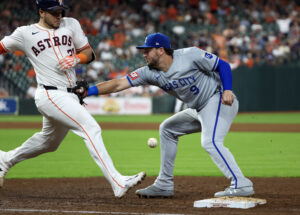
During last night’s game against the Astros, Yainer Diaz hit a comebacker to right-hander Lucas Erceg, who attempted to field the ball with his bare hand. Erceg knocked the ball down, picked it up and fired to first. The ball arrived at the bag around the same time as Diaz, who made contact with Pasquantino as the first baseman attempted to field the throw (Video link from MLB.com). Both Erceg and Pasquantino were visibly injured and removed from the game after the play. Manager Matt Quatraro told reporters after the game that both players would undergo X-rays, per broadcaster Joel Goldberg on X.
The Royals haven’t yet provided an update on Erceg, but the news on Pasquantino is devastating. He’s been a key bat for the club this year, hitting 19 home runs while limiting his strikeout rate to 12.8%. His .262/.315/.446 batting line translates to a wRC+ of 106.
That’s only six percent better than league average but the Royals have had a fairly top-heavy offense this year. Bobby Witt Jr. has been elite and Salvador Perez has been great, but there’s a big drop-off without Pasquantino in the mix. The only others players on the team with an above-average wRC+ this year are Freddy Fermin, Michael Massey and Paul DeJong. Fermin’s output is fuelled by a .344 batting average on balls in play that he will struggle to maintain while DeJong has been a boom-and-bust players for years, alternating between home run surges and big strikeout woes.
The lineup looks a lot less imposing without Pasquantino in it and the Royals will now have to proceed in his absence. Despite that fairly middling offense, the club has been able to ride Witt’s amazing season and a strong rotation to a record of 75-60. They are in the middle of a three-way battle for the Central division, currently 1.5 games back of the Guardians but two ahead of the Twins. Both the Royals and Twins currently hold Wild Card spots, with Boston 3.5 games back of Minnesota for the final slot.
The club will now have to navigate the remainder of the regular season and at least the beginning of the playoffs while figuring out a solution at first base. Perez has gotten into 35 games there, including 31 starts, usually with Pasquantino slotting in as the designated hitter. Perhaps Perez will play first more often but Fermin won’t be able to catch every day, so Perez will have to be behind the plate from time to time.
Perhaps the club will turn to one of Nick Loftin or CJ Alexander, as both are multi-positional guys capable of playing first and each is having a good season in Triple-A. Loftin is slashing .331/.422/.509 for the Storm Chasers while Alexander is hitting .303/.352/.554. But neither player has hit in the majors yet, as Loftin has a line of .236/.316/.305 in 232 big league plate appearances while Alexander slashed .125/.125/.125 through his eight trips to the major league plate.
The Royals could look outside the organization for more offense, though their options will be limited now that the trade deadline has passed. Players like Tommy Pham and Robbie Grossman have reportedly been put on waivers this week. Neither is a real first base solution but they could conceivably help with the DH spot. It’s likely there are other names on the wire that haven’t been reported. Any player claimed prior to September 1 is playoff-eligible with his new team.
The next few days should shed some light on how the Royals respond. For Pasquantino, it’ll be a second consecutive season marked by injury. His 2023 campaign was ended in June by shoulder surgery, limiting him to just 61 games. He got into 131 contests this year but he won’t be able to increase that number now. He is slated to qualify for arbitration after 2025 and free agency after 2028.