
Giants Promote Heliot Ramos
12:03PM: The Giants have officially announced the move. Right-hander John Brebbia has been placed on the bereavement list to create a 40-man roster space.
8:12AM: The Giants are promoting outfield prospect Heliot Ramos to the big leagues, as initially reported by Munger English Sports Management (Ramos’ agency). Ramos is expected to make his debut today for the Giants’ game against the Marlins.
With southpaw Trevor Rogers scheduled to start for Miami, the right-handed hitting Ramos is a logical fit for tonight’s lineup, and perhaps for throughout the season given the left-handed tilt of the Giants outfield. Mike Yastrzemski, Joc Pederson, Steven Duggar, and the currently-injured LaMonte Wade Jr. all swing from the left side, though San Francisco also has Darin Ruf, Austin Slater, Mauricio Dubon, and Luke Williams as available right-handed bats. Utilityman Williams might end up being the odd man out to make room for Ramos, as Williams still has three minor league options.
The 22-year-old Ramos has long been seen as one of the Giants’ best prospects, and he has been a regular on top-100 rankings since he was selected 19th overall in the 2017 draft. His stock has somewhat dropped as a result of not playing in 2020, and then a 2021 campaign that saw Ramos hit a modest .254/.323/.417 over 495 combined plate appearances at the Double-A and Triple-A levels. Still, The Athletic’s Keith Law rated Ramos 70th on his preseason top-100 list, Baseball America had Ramos in the 94th spot, and Fangraphs has Ramos ranked 101st.
Ramos only just turned 22 in September, and BA’s scouting report notes that Ramos has made his way up the minor league ladder “usually as one of the younger players at every stop.” Along the way, Ramos has shown glimpses of his potential, if there is some master-of-none aspect to his performance. As Fangraphs’ report puts it, “while it’s easy to call him a five-tool player since he’s competent in every aspect of the game, scouts struggle to figure out what Ramos’ one carrying tool is.”
At the plate, Ramos has hit .270/.340/.448 over 1625 PA in the minors, with 47 homers and 41 steals (out of 64 attempts). He has also struck out in 440 of those at-bats, and evaluators note that his swing lacks some loft, and that Ramos has looked a little susceptible to off-speed pitches. Ramos is expected to eventually move to right field due to his relative lack of top-tier speed and his good throwing arm, but Ramos has mostly played as a center fielder throughout his career and has looked decent up the middle. The Giants are probably likely to use Ramos primarily in center, though he has the flexibility to play at any of the three outfield positions based on situations.
Ramos hit well in the small sample sizes of Spring Training (10 PA) and the early stages of the Triple-A season (13 PA). While he didn’t break camp with the team, his quick promotion means that Ramos should still clock a full year of service time should he remain on San Francisco’s active roster for the remainder of the season. The newly-instituted Prospect Promotion Incentive could also somewhat mitigate the Giants’ service-time concerns, though Ramos may technically not qualify. As per The Athletic’s Evan Drellich, prospects are PPI eligible if they “are included in two or more of the preseason top-100 prospect lists put out by Baseball America, MLB.com or ESPN,” and of those three specific outlets, Ramos only cracked BA’s list.
Red Sox Extend Garrett Whitlock
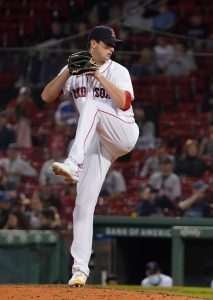
The Red Sox have announced a four-year extension with right-hander Garrett Whitlock, with club options also covering the 2027 and 2028 seasons. Whitlock will earn $18.75M over the four guaranteed years (2023-26) of the deal, according to MassLive.com’s Chris Cotillo, and the 2027 option is worth $8.25MM with a $1MM buyout. The 2028 option would pay Whitlock $10.5MM, with a $500K buyout. With escalators, the option years can be worth up to $4MM more in extra money per season.
Whitlock was already controlled via arbitration through the 2026 season, so the extension gives the Red Sox some cost certainty and also some extra control over his first two free agent years. Sean McAdam of The Boston Sports Journal (Twitter link) has the annual breakdown, starting with a $1MM signing bonus. Whitlock earns $1MM in 2023, $3.25MM in 2024, $5.25MM in 2025, and $7.25MM in 2026.
 If the escalators both max out, Whitlock will land a total of $44MM over the six-year term of the extension. Cotillo adds that Whitlock is also still eligible for the league’s bonus pool for pre-arbitration players both this season and in 2023, so the righty has the opportunity to land even more money.
It’s not a bad payday for a pitcher who is barely a year removed from his MLB debut, and who has still never pitched at the Triple-A level. An 18th-round pick for the Yankees in the 2017 draft, Whitlock had some strong numbers in his first three pro seasons but underwent Tommy John surgery in July 2019. Without any sort of 2020 season, Whitlock was seen as something of an under-the-radar choice when the Red Sox selected him away from New York in the December 2020 Rule 5 Draft.
As it turned out, Whitlock now stands as one of the best Rule 5 success stories in recent memory. The rookie posted a 1.96 ERA, 49.7% grounder rate, 27.2% strikeout rate, and 5.7% walk rate over 73 1/3 innings, acting as a lockdown multi-inning reliever out of the Red Sox bullpen. Whitlock’s surprise emergence was a major factor in Boston’s run to the ALCS, and the team has now locked him up as a contributor for the better part of the decade.
The contract escalators are tied in part to innings totals, which reflects the possibility that Whitlock might eventually go from the bullpen to the rotation. There was some consideration given to deploying Whitlock as a starter this year, but the Sox are opting to be as flexible as possible with the righty’s usage. Whitlock will be teamed with Rich Hill in piggyback fashion to begin the year, which also frees Whitlock up to pitch in other games in high-leverage situations.
This is the third extension of Chaim Bloom’s tenure as Boston’s chief baseball officer, and the second involving a relief pitcher, following the two-year, $18.75MM pact finalized with Matt Barnes last summer. Despite the similar guaranteed salaries, there isn’t much of a comp between the two contracts, as Barnes was just a few months away from entering the free agent market. Whitlock, on the other hand, turns 26 in June, and thus wouldn’t have been hitting the open market until he was on the verge of his age-31 season.
While his $247.5K draft bonus was larger than usual for an 18th-rounder, and the new pre-arbitration pool provides an extra avenue for more earnings for pre-arb players, it isn’t hard to see why Whitlock (with a TJ surgery already on his resume) would be eager to guarantee himself a life-changing fortune so early in his career. There was obvious appeal from Boston’s side as well, since the extension is a good deal for the team even if Whitlock remains “only” a shutdown reliever. Should Whitlock eventually emerge as a starter, the Red Sox stand to benefit from this early investment in the right-hander.
Photo courtesy of USA Today Sports Images
Latest On Nationals’ Extension Talks
It doesn’t appear as though the Nationals have had any in-depth talks with Josh Bell about a long-term contract, as president of baseball operations Mike Rizzo told The Washington Post’s Jesse Dougherty (Twitter links) that Juan Soto is still the top focus for an extension. There have been more “discussions” with Soto, but until that situation is settled, any negotiations with Bell will seemingly have to wait.
Bell avoided arbitration by agreeing to a $10MM salary for 2022, his final season of arb eligibility. Since most players prefer to not talk contract during the season, the Nats might be left with a pretty limited window of time to work out a new deal with Bell, possibly just from the end of Washington’s season to the official start date of free agency. Furthermore, Bell is represented by the Boras Corporation, and it is rare to see Scott Boras clients agree to extensions so close to a trip to the open market.
Since Soto is under team control through 2024, Bell is technically the more pressing concern, and yet it is easy to understand why the Nationals are prioritizing a new Soto deal. It’s fair to guess that a Soto extension would be the single largest contract in baseball history, as Soto (also a Boras client) has already turned down a 13-year, $350MM offer from the Nats earlier this winter. Soto is still only 23 years old and already has a phenomenal track record of success, so it isn’t hard to imagine Boras wanting to set new contractual benchmarks for both total value and average annual value.
Bell, meanwhile, had a strong performance in his own right during his first season in D.C. The first baseman was one of many Nationals players sidelined by a COVID-19 outbreak in April, but after a slow start, Bell caught fire over the last four months and finished with 27 home runs and a .261/.347/.476 slash line over 568 plate appearances.
Should Bell repeat this performance in 2022, it’ll line him up for a nice multi-year pact in free agency. Bell turns 30 in August and he is somewhat limited as a primary first baseman, though he did line up in both corner outfield positions on occasion last season. With the universal DH now in place, Boras can now fully market Bell to National League teams that might have previously been unsure about his fielding future — as well, defensive metrics indicated that Bell’s 2021 glovework was the best of his career.
Whether Bell’s future is in Washington or not remains to be seen, depending on the state of the Nats’ minor rebuild. There is obvious benefit to retaining Soto as the face of the franchise, but locking Bell up to an extension or re-signing him in free agency would be a clear sign that the Nationals plan to contend again sooner rather than later. Such a move would also undoubtedly factor into Soto’s decision process, as Soto has been clear that he wants to play for a winning team. Plus, if an extension with Soto doesn’t become a reality, the Nats might adopt a win-now approach to capitalize on Soto’s prime years while they still have him.
Considering that D.C. has topped the $200MM payroll mark as recently as 2019, the team does have the resources to extend both Soto and Bell. Stephen Strasburg and Patrick Corbin take up an outsized chunk of future payroll, but they are also the only Nationals players guaranteed money beyond the 2022 season.
Yankees, Aaron Judge Fail To Reach Contract Extension Prior To Season
TODAY: According to The Athletic’s Ken Rosenthal, Judge didn’t ask for an extension longer than eight years (or nine years, counting the 2022 season). The Yankees’ offer to Judge also didn’t include any deferred money.
APRIL 8, 3:23pm: Jon Heyman of the New York Post hears from multiple sources that Judge had sought an offer of nine to ten years with an average annual value of $36MM. Heyman cautions that a person close to Judge contested those numbers. Max Scherzer ($43.333MM AAV over three years with the Mets) is the only player in history with an AAV north of $36MM, with Mike Trout‘s $36MM annual salary the largest for a position player.
Over a ten-year span, a $36MM AAV would match Trout’s $360MM guarantee. Trout’s deal has the largest present day value in MLB history, although Mookie Betts (who received $365MM in total guarantees but with deferrals that reduced its present value) topped that mark in raw dollars. The Yankees never seemed likely to go to that kind of offer, particularly since a deal buying out nine free agent seasons would take Judge through his age-39 campaign. Heyman adds that the Yankees were willing to include one or more opt-out possibilities for the star outfielder.
10:17am: Yankees GM Brian Cashman told reporters there will be no extension with Aaron Judge today, hours before the slugger’s self-imposed Opening Day deadline. In a rare disclosure, Cashman detailed that the Yankees offered a seven-year, $213.5MM extension beginning in 2023, representing a $30.5MM average annual value.

That AAV would have ranked 17th in baseball history. Notably, the Yankees were willing to extend Judge through age 37, the same as recent contracts for Corey Seager, Freddie Freeman, Marcus Semien, and Francisco Lindor, despite Judge’s injury history.
Cashman sounds like he’d like to avoid an arbitration hearing for Judge’s 2022 salary, which Lindsey Adler of The Athletic believes would happen in June. Beyond that, the two sides will engage after the season. Of the 24 arbitration eligible players currently headed toward a midseason hearing to determine their 2022 salary, Judge’s $5MM gap with the Yankees ($17MM vs. $22MM) represents the largest.
Cashman’s comments come less than two hours before the Yankees open their season against the Red Sox, Judge’s deadline for a a contract extension as he enters his walk year.
Judge has missed significant portions of three of the last five seasons due to injury. Seager, at least, had a notable injury history of his own, but his deal was struck on the open market in advance of his age-28 season. Judge will play in 2023 at age 31. Offering to sign Judge through age 37 is a significant gesture by the Yankees. The AAV, while perhaps not elite, isn’t unreasonably light and could be considered a tradeoff for the club including a seventh year.
If Judge reaches the open market, he could be joined in a 2022-23 free agent class again strong at the shortstop position. The outfield market doesn’t project to be too impressive beyond Judge, with other names including Joey Gallo, Mitch Haniger, Brandon Nimmo, and Kiké Hernandez.
Judge is set to bat second in the Yankees’ Opening Day lineup in today’s game against Nathan Eovaldi and the Red Sox, which begins at 12:05pm central time.
Guardians, Myles Straw Agree To Five-Year Extension
The Guardians and Myles Straw have agreed to a five-year contract extension, with club options covering the 2027 and 2028 seasons, per Zack Meisel of The Athletic. The deal is worth $25MM, per Mandy Bell of MLB.com, with the options valued at $8MM in 2027 and $8.5MM in 2028. This is the third extension for the club in recent days, following the deals for Emmanuel Clase and Jose Ramirez.
Straw was drafted by the Astros in the 12th round in 2015 and earned attention in the minors for his speed and defense. He stole at least 20 bags in the minors in his first three season in 2015-2017, before swiping 70 bags between Double-A and Triple-A in 2018. He was ranked by Baseball America as one of Houston’s top 20 prospects in 2018 and 2019. That latter season, he saw his first extended stretch of MLB action, hitting .269/.378/.343 in 56 games, along with eight steals.
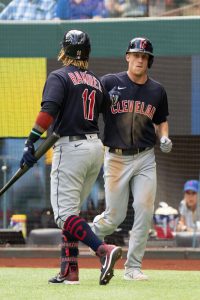
At last year’s deadline, he was acquired by a Cleveland team that was looking to fill an outfield that had been mired in uncertainty for quite some time. Between the two teams, he hit .271/.349/.348. That production was just barely below league average (98 wRC+), though Straw was better after the trade than before. He also stole 30 bases on the year and provided excellent defense, coming in seventh among center fielders in the 2021 Fielding Bible Award voting. Desperate that average-ish batting line, he was still worth 3.7 wins above replacement, in the estimation of FanGraphs, due to his athleticism in the field and on the bases. He should now give the team a stable presence in the middle of the outfield for years to come.
Straw finished last year with two years and 112 days of service time, just four days shy of the 2.116 Super Two cutoff for the most recent offseason. That means he wasn’t going to qualify for arbitration until after this year. This deal will cover his four remaining years of team control and at least one free agent year, with the options potentially accounting for two more. The 27-year-old Straw will be 31 in the final guaranteed year, with the options covering his age-32 and age-33 campaigns.
Prior to this extension, and the deals for Clase and Ramirez, the Guardians had a clean slate on their payroll beyond this year. Now all three of them could potentially form a core for the club to build around, with each player under control through 2028. (Ramirez’s deal is guaranteed, while Clase and Straw are each guaranteed through 2026 with the two club options.) The majority of the rest of the roster is young players who have either not yet reached or just recently qualified for arbitration.
With the White Sox still looking like division favorites, the Twins aggressively reloading after a down year and the Tigers and Royals both coming out of rebuilds, the division looks like it is on the cusp of becoming stronger in the years to come. Even with these deals, the Guardians still have plenty of payroll flexibility, even for a typically low-spending club like them, with Ramirez still earning the only significant salary in the years to come.
Photo courtesy of USA Today Sports Images.
NL Central Notes: Happ, Cardinals, Sims, Solano, Castillo, Minor
Cubs left fielder Ian Happ was removed from today’s 9-0 win over the Brewers after being hit in the left kneecap by a Trevor Gott pitch during the seventh inning. X-rays were negative, as Happ told NBC Sports Chicago’s Tim Stebbins and other reporters after the game. “It’s going to be pretty stiff [Sunday], I’m sure, but right now it’s not too bad,” Happ said. It would seem as if Happ is questionable for tomorrow’s lineup, and since the Cubs don’t play on Monday, Happ has some more time to heal up and receive further treatment to determine if an IL trip could be necessary.
The Cubs/Brewers series has thus far seen seven batters hit by pitches over two games, which has some a frequent occurrence in recent meetings between the two division rivals. The result was a skirmish that saw both benches and bullpens empty after Andrew McCutchen was hit by a Keegan Thompson pitch in the eighth inning, but ultimately nothing but harsh words were exchanged.
More from the NL Central…
- Busch Stadium is known as a pitcher-friendly ballpark, and the Cardinals have added to this built-in run suppression by creating a tremendous defensive roster. As Derrick Goold of the St. Louis Post-Dispatch examines, the club has embraced this to the point of deciding against moving in the walls at their ballpark, even after commissioning a study to examine the possible impact. “We started to think we may have an edge here with this particular configuration,” chairman Bill DeWitt III said. “In theory, a bigger ballpark, more balls in play, a defense that catches anything — why don’t we put this on ice and see how things develop? We have an elite defense and we’re contemplating doing something that might minimize the impact of that defense. Let’s not.” Goold’s piece breaks down some of the findings of the study, with the Cards looking at how potential alterations to any of the dimensions would affect everything from fan experience to on-field performance.
- Reds manager David Bell provided reporters (including MLB.com’s Mark Sheldon) with several updates on injured players over the last two days. Lucas Sims is on pace to head to Triple-A this week after throwing a live BP session at the team’s extended Spring Training camp, and Bell set April 20 or 22 as the target dates for Sims’ likely return. Donovan Solano is out with a left hamstring injury, but Boone said Solano has been doing some running drills and even took some swings during some simulated game sessions.
- Mike Minor and Luis Castillo both began the season on the IL due to shoulder soreness, and while Castillo was initially thought to have the quicker return of the two, Minor has now seemingly moved ahead after throwing a 35-pitch simulated game on Friday. Minor could now be ready for Triple-A work or at least another sim game, while Castillo still has to get a second bullpen session under his belt. In terms of projections, the Reds are now aiming for Castillo to be back by late April, while Minor could make his debut closer to the middle of the month.
MLBTR Chat Transcript
Click this link to read the transcript of tonight’s live baseball chat
Dodgers Didn’t Make Extension Offer To Trea Turner
Trea Turner and the Dodgers avoided an arbitration hearing by agreeing to a one-year, $21MM salary for the 2022 season, but those were seemingly the only contract talks between the two sides this winter. Turner told The Athletic’s Fabian Ardaya and other reporters that the team told him that no extension offer would be coming prior to the start of the season. Earlier this offseason prior to the lockout, Turner said that the Dodgers had engaged in some light but nonspecific negotiations about a possible long-term deal, without any offers or numbers exchanged.
Turner didn’t sound upset about the lack of talks, saying “the money will take care of itself. It’s why you have agents and whatnot….I just asked them to be honest with me. They were honest with me, a few days ago, a week ago, whatever it was. It’s time to play, and time to try to win a World Series.”
It doesn’t seem likely that any negotiating will take place during the season, with Turner now focused on baseball and simply because it’s rare for such major impending free agents to agree to extensions as they get closer and closer to the open market. Assuming he delivers his usual numbers in 2022, the shortstop projects as arguably the top free agent of the 2022-23 class.
Despite the lack of talks to date with the Dodgers, a return to Los Angeles can’t be ruled out. For one, the free-spending Dodgers are one of the teams best suited to pay the mega-contract that Turner will demand on the open market. L.A. has also been willing to let major names (such as Justin Turner, Kenley Jansen, and Clayton Kershaw) all test in the market in the past before eventually re-signing them.
The Dodgers have quite a bit of money coming off the books next winter, though a lot of that space could be taken up by extensions, options being exercised, and escalating arbitration costs. Furthermore, with the Dodgers approaching the top $290MM penalty threshold of the luxury tax, it’s possible the front office could slightly dial things back by “only” spending at the next tier down.
If Turner did leave, the Dodgers might look to replace him with Gavin Lux, should Lux establish himself as a quality big leaguer this season. Utilityman Chris Taylor is another in-house option, but since this is the Dodgers we’re talking about, the club could explore bringing in another star name via trade (like how Turner himself was acquired essentially as Corey Seager‘s replacement) or via free agency — Carlos Correa and Xander Bogaerts are two of the shortstops expected to opt out of their contracts after the season.
Injury Notes: Pollock, La Stella, Sanchez, Borucki, Pearson
A.J. Pollock left today’s game with what the White Sox announced as right hamstring tightness. Pollock had just singled, but seemed to tweak his hamstring while making the turn around first base, and had to be replaced for a pinch-runner. While Pollock’s lengthy injury history (including a right hamstring strain that sidelined him for over two weeks last September) gives particular concern to any new issues, Pollock told The Athletic’s James Fegan and other reporters after the game that today’s injury wasn’t nearly as severe as last season’s hamstring problem.
As it happens, Pollock was already set to miss some time. The outfielder and his wife are expecting their second child, and Pollock was scheduled to go on paternity leave tomorrow. He’ll use the absence to rest his hamstring and hopefully avoid become the latest White Sox player to hit the injured list. Garrett Crochet has been lost for the season due to Tommy John surgery, while the 10-day IL features Lance Lynn, Yoan Moncada, Joe Kelly, Yermin Mercedes, and Ryan Burr, plus Lucas Giolito is now also set to miss at least his next two starts.
More injury updates from around baseball…
- There is “no set in stone timeline at this point” for when Tommy La Stella might return from the injured list, Giants manager Gabe Kapler told MLB.com’s Maria Guardado and other reporters. La Stella underwent Achilles surgery in October and is still feeling some soreness, though he told media that doctors have said this isn’t unusual. Despite the lack of clarity, the Giants did consider using La Stella as a DH to begin the season, so it would seem like he is relatively close to playing. “It was just one of those things where we wanted to make sure that we weren’t sacrificing the long-term success in this process for short-term gains now and make sure I’m set up to be good to go for the rest of the season,” La Stella said.
- Anibal Sanchez could miss his scheduled start Monday, as the Nationals right-hander has been dealing with neck soreness. The Nats already pushed Sanchez’s start back to give him time to heal, but as MASNsports.com’s Mark Zuckerman writes, the club now may need to turn to either the bullpen, or possibly a minor league call-up like Josh Rogers or Aaron Sanchez to take the start. In Aaron Sanchez’s case, the Nationals would have to first clear a 40-man roster spot to select his minor league contract.
- Blue Jays manager Charlie Montoyo updated reporters (including TSN’s Scott Mitchell) about sidelined pitchers Ryan Borucki and Nate Pearson. Borucki is on the 10-day IL with a right hamstring strain, but came out of a two-inning simulated game feeling well. Pearson is set to start light throwing after missing time due to mononucleosis, but because Pearson missed a significant portion of Spring Training, Mitchell writes that the right-hander is “essentially starting from scratch” from a preparation standpoint. As such, it might not be until at least mid-May that Pearson is fully ramped up.
Rockies Hire Todd Helton As Special Assistant
The Rockies announced that franchise legend Todd Helton has been hired as a special assistant to GM Bill Schmidt. According to Danielle Allentuck of The Denver Gazette (Twitter links), Helton’s primary responsibility will be working with minor league players, and Allentuck notes that Helton has already been working with prospect Michael Toglia (Colorado’s first-round pick from 2019) during Spring Training.
Helton spent all 17 of his Major League seasons with the Rockies, and is the team’s all-time leader in multiple major categories, including games, plate appearances, home runs, runs, hits, doubles, RBI, walks, total bases, and bWAR. The first baseman hit .316/.414/.539 with 369 homers over his 9453 big league PA, with a resume that includes five All-Star appearances, four Silver Slugger awards, and three Gold Gloves. It seems as though Helton will one day be wearing a Colorado cap into Cooperstown, as his vote total has been steadily climbing through four years on the writers’ ballot — Helton received 52% of the vote this past winter, up from 44.9% in 2021, 29.2% in 2020, and 16.5% in 2019.
Special assistant duties tend to vary greatly from person to person and from team to team, with the duties generally tailored towards the specialties of the individual. In Helton’s case, he “will essentially be a roaming coach,” Allentuck writes, as Helton had expressed an interest in taking on more of a role with his old organization.