
Nats Notes: Cabrera, Zimmermann, Extensions
Ninety years and one day ago, the Washington Senators defeated the New York Giants in Game Seven of the 1924 World Series. Newsreel footage (YouTube link) of the Senators’ 12-inning walkoff win was recently uncovered by the Library of Congress, giving us a very cool glimpse into how baseball has both changed and stayed the same over nine decades. (The blunt “President is there” title card is also pretty funny; poor Calvin Coolidge didn’t even merit being named?) The Senators franchise won two more championships after they moved to Minnesota and became the Twins, but 1924 was the only time Washington D.C. celebrated a World Series title.
It’ll be at least one more year of waiting for D.C. in the wake of the Nationals’ loss in the NLDS but in the meantime, here are some Nats-related links…
- Asdrubal Cabrera would prefer play shortstop but said he is open to playing second base on a contending team, he tells MASNsports.com’s Dan Kolko. “It depends. A team like this team, a good team that want me to play second, I would love to stay here. I just want to win. I’ve got eight seasons already. I want to be in the World Series one day,” Cabrera said. With a fairly thin crop of free agent shortstops, Cabrera could draw a lot of interest this winter, and his market will be further widened if he is willing to play second as well. It would seem that the Nationals are Cabrera’s first choice given how he stressed how much he enjoyed his brief stint with the club.
- The Nationals offered Jordan Zimmermann a five-year, $85MM extension last winter, MLB.com’s Bill Ladson reports. Zimmermann mentioned that the two sides had discussed a lengthier deal than his eventual two-year, $24MM agreement, though the term and dollar figure of the larger offer weren’t known at the time. The right-hander will be a free agent after the 2015 season and, if he continues his current form, he’ll be looking at deals in the $130-$140MM range on the open market.
- Beyond Zimmermann, the Nationals also have to consider extensions for Ian Desmond and Doug Fister this offseason, CSN Washington’s Mark Zuckerman writes. All three players will be free agents after 2015. The Nationals could look to lock up Fister since he’ll command less money than Zimmermann, Zuckerman opines, and he also wonders if a seven-year, $105MM deal would be enough to keep Desmond in the fold. That would represent a bump from the seven-year, $85-98MM deal that Desmond reportedly rejected last winter.
AL Central Links: Royals, Aviles, Twins
After sharing some White Sox-centric notes, let’s take a look around the rest of the AL Central…
- The December 2010 trade of Zack Greinke to the Brewers was a major moment in Royals history, and Tyler Kepner of the New York Times revisits that blockbuster deal to see the impact it had on Kansas City’s current ALCS run. Alcides Escobar and Lorenzo Cain are playing big roles for the Royals, while Jake Odorizzi was flipped to the Rays as part of the package that brought James Shields and Wade Davis to K.C. two years later.
- Mike Aviles‘ $3.5MM club option for 2015 could be a key part of the Indians‘ offseason plans, Zack Meisel of the Cleveland Plain Dealer writes. If the Tribe keeps the veteran utilityman, it could make Jose Ramirez expendable and create a clear path for Francisco Lindor to win the starting shortstop job in Spring Training. Lindor seems likely to debut in the majors in 2015 and, if he and Ramirez are both around, then $3.5MM might be a bit much for the Indians to pay for a backup like Aviles, despite the depth he provides all over the field.
- Jack Goin, the Twins‘ manager of baseball research, talks to Parker Hageman of Twins Daily about how the club’s use of analytics has evolved over the years.
White Sox Notes: Payroll, Second Base, Montas
Here’s the latest from the South Side of Chicago…
- Jose Abreu, Chris Sale and Jose Quintana will combine for (at most) $16.445MM in salary in 2015, a huge bargain for three star players that has left the White Sox with plenty of payroll space, CSN Chicago’s Dan Hayes writes. Quintana and Sale’s contracts, in particular, looks like very shrewd investments for the Sox at this point. Sale, for his part, has no regrets about signing his extension in March 2013 since it allows the team to acquire more talent. “With them being able to do that and have pieces of the puzzle and still a little money in the bank, they can kind of assemble guys around us to do the same things,” Sale said.
- Marcus Semien, Carlos Sanchez and Micah Johnson will be competing for second base job in the spring, and ESPN’s Doug Padilla doubts all three players will still be with the team by Opening Day. Padilla figures one of the trio could be dealt for a reliever, or could be part of a package in a larger trade.
- In a look at notable Arizona Fall League prospects, ESPN’s Keith Law (Insider subscription required) praised White Sox righty Francellis Montas, who joined the organization as part of the Jake Peavy trade in July 2013. Montas, 21, posted a 1.44 ERA, 8.9 K/9 and 3.64 K/BB rate over a combined 81 innings at rookie ball, high-A ball and Double-A in 2014, and Law said Montas’ fastball touched 102 mph in a recent instructional league game.
- Law also had good things to say about the White Sox farm system in general, saying this is the strongest Chicago’s system has been in the six years he’s been working for ESPN. Law hinted that four White Sox minor leaguers are slated for his next top-100 prospect list.
Brewers Retain Ron Roenicke For 2015 Season
Brewers manager Ron Roenicke will remain in his position with the team for 2015, the team announced in a press release. This puts an end to speculation that Roenicke could be fired in the wake of the team’s late-season collapse.
Roenicke led the Crew to the 2011 NL Central title and a berth in the NLCS in his first year as manager in 2011, and he has a 335-313 overall record in four seasons running the club. The Brewers have yet to return to the postseason since 2011, however, and went 9-17 last September to fall out of playoff contention despite leading the NL Central for much of the year.
Back in March, the Brewers exercised their team option on Roenicke’s services for 2015 while also adding another option year for the 2016 campaign. With no job security beyond next season, it’s fair to speculate that Roenicke could be on the hot seat if the Brewers get off to a slow start next season.
The team also announced that hitting coach Johnny Narron and first base/infield coach Garth Iorg will not be offered contracts for 2015. The Brewers have posted a collective 93 wRC+ over the last two seasons (ranking 17th in baseball), and posted only an 85 wRC+ (fifth-worst in baseball) after the All-Star break last season, which likely led to Narron’s departure. The rest of Milwaukee’s coaching staff will remain intact.
“Over the course of the last few weeks, we have evaluated the work of Ron and his coaches and believe that this is the best course of action to take,” general manager Doug Melvin said in the press release. “We appreciate the work that Johnny and Garth did for us through the years, and moves like these are never easy to make. We have already started reviewing our player personnel and will continue to address the factors that led to our disappointing finish to the season.”
AL East Notes: Shields, Melky, Jays, MacPhail
Several executives around baseball are starting to think James Shields will receive some five-year offers in free agency this winter, Scott Lauber of the Boston Herald reports. This would be a sizable commitment in a pitcher who will be 33 years old on Opening Day, and since the Red Sox don’t like guaranteeing that many years to pitchers in their 30’s, the team could offer Shields a four-year deal with a higher ($20MM) average annual value. If this isn’t enough to land Shields, however, Lauber feels by that point the Sox should just increase their offer to Jon Lester.
Here’s some more from around the AL East…
- In a radio interview on The Jeff Blair Show (Sportsnet.ca’s Ben Nicholson-Smith has the audio link and partial transcript) Blue Jays GM Alex Anthopoulos said the team had had “some conversations” with Melky Cabrera about a new contract though seemingly little progress has been made. “Clearly both sides right now can’t seem to get together for various reasons,” Anthopoulos said. “I don’t think it’s fair for anyone to assume that there hasn’t been dialogue. I wouldn’t assume that there haven’t been proposals exchanged.”
- Beyond just on-the-field upgrades, the Blue Jays also need to re-establish trust between the clubhouse and upper management, Sportsnet.ca’s Shi Davidi opines. Some Jays players were openly upset with the front office’s lack of major spending or acquisitions over the last year, and while Davidi doesn’t cite this lack of trust as the key reason why the Jays missed the playoffs, it obviously helps to have everyone in the organization on the same page.
- The Orioles‘ success over the last three seasons wouldn’t have been possible without former president of baseball operations Andy MacPhail, Paul Sullivan of the Chicago Tribune writes. While MacPhail’s departure following the 2011 season coincided with Baltimore’s return to contention, manager Buck Showalter and several of the O’s best players joined the organization on MacPhail’s watch.
- J.J. Hardy‘s extension with the Orioles only enhances Xander Bogaerts‘ value to the Red Sox, Brian MacPherson of the Providence Journal writes. A young, controllable star at shortstop who can contribute both offensive and defensively is a major commodity, though Bogaerts obviously still work to do to establish himself on that level. “How much of a step forward Bogaerts can take at shortstop will have quite a bit to do with how much of a step forward the Red Sox can take in the American League East,” MacPherson writes.
- In other AL East news from earlier today on MLBTR, I collected a set of Yankees Notes and Jeff Todd featured Blue Jays center fielder Colby Rasmus in a Free Agent Profile.
Yankees Notes: Hardy, Robertson, Cashman
The Yankees wouldn’t have been willing to offer J.J. Hardy more than two guaranteed years in free agency, Bill Madden of the New York Daily News reports. The Bronx Bombers had “mild interest” in Hardy had he reached the open market but their recent underwhelming returns on veteran free agents left the team hesitant about a longer-term deal. Hardy received three years and a vesting option for a fourth in his extension with the Orioles. Madden predicts the Yankees will look to sign Stephen Drew or Asdrubal Cabrera to a one-year pillow contract as both players look to rebuild their value.
Here’s some more from the 27-time World Series champs…
- David Robertson could be the first player to accept a qualifying offer, as Joel Sherman of the New York Post feels the closer will remain with the Yankees for at least the 2015 season. The team figures to issue the $15.3MM, one-year qualifying offer to Robertson as the attached draft pick compensation could hurt his free agent market and make him easier to sign to a long-term deal. From Robertson’s perspective, accepting the QO would ensure he gets at least one big payday in an uncertain free agent closer market and he’d still be in position to land another big deal in an extension with the Yankees or perhaps even another qualifying offer next winter. MLBTR’s Steve Adams recently examined Robertson in a free agent profile and predicted he could receive a four-year, $52MM deal this offseason.
- Now that Brian Cashman has been extended for three years, the general manager will be able to “create a Yankees team in his own image, with his own vision and his own players, and to finally build his own legacy,” ESPN New York’s Wallace Matthews writes. This may seem odd given that Cashman has already been the team’s GM since 1998, though Matthews argues that Cashman has never had to truly build a team since the Yankees always had the “Core Four” backbone in place since the Gene Michael/Bob Watson management era.
- In a conference call with reporters (including MLB.com’s Bryan Hoch), Cashman said that “I think it’s best to assume that we should have contingencies in place” should Alex Rodriguez no longer be able to handle regular third base duties. “Until we get to see it on a daily basis, I think it’s just hard to assume anything,” Cashman said. Joe Girardi recently spoke with Rodriguez about working out at first base, and A-Rod could provide some valuable depth at the position given Mark Teixeira‘s injury history.
Free Agent Profile: Colby Rasmus
Colby Rasmus entered the year as one of the more intriguing pending free agents. Coming off of a big 2013 campaign, he rated eighth among all expected free agents in MLBTR’s first Free Agent Power Rankings installment back in March.
While his upside remains tantalizing, however, the Excel Sports Management client has yet to establish himself as a consistent presence. And the 2014 season magnified some of his weaknesses, serving as a poor platform for free agency.
Strengths/Pros
Power from a capable center fielder is a rare commodity, and Rasmus is certainly the only free agent-to-be who offers that package. Despite seeing only 376 plate appearances in 2014, Rasmus managed to swat 18 long balls and post an excellent .223 ISO (slightly better than players like Justin Upton, Matt Kemp, and Miguel Cabrera). That is rare air, indeed, for an up-the-middle outfielder: in terms of ISO, only Mike Trout and Andrew McCutchen posted higher marks among center fielders.
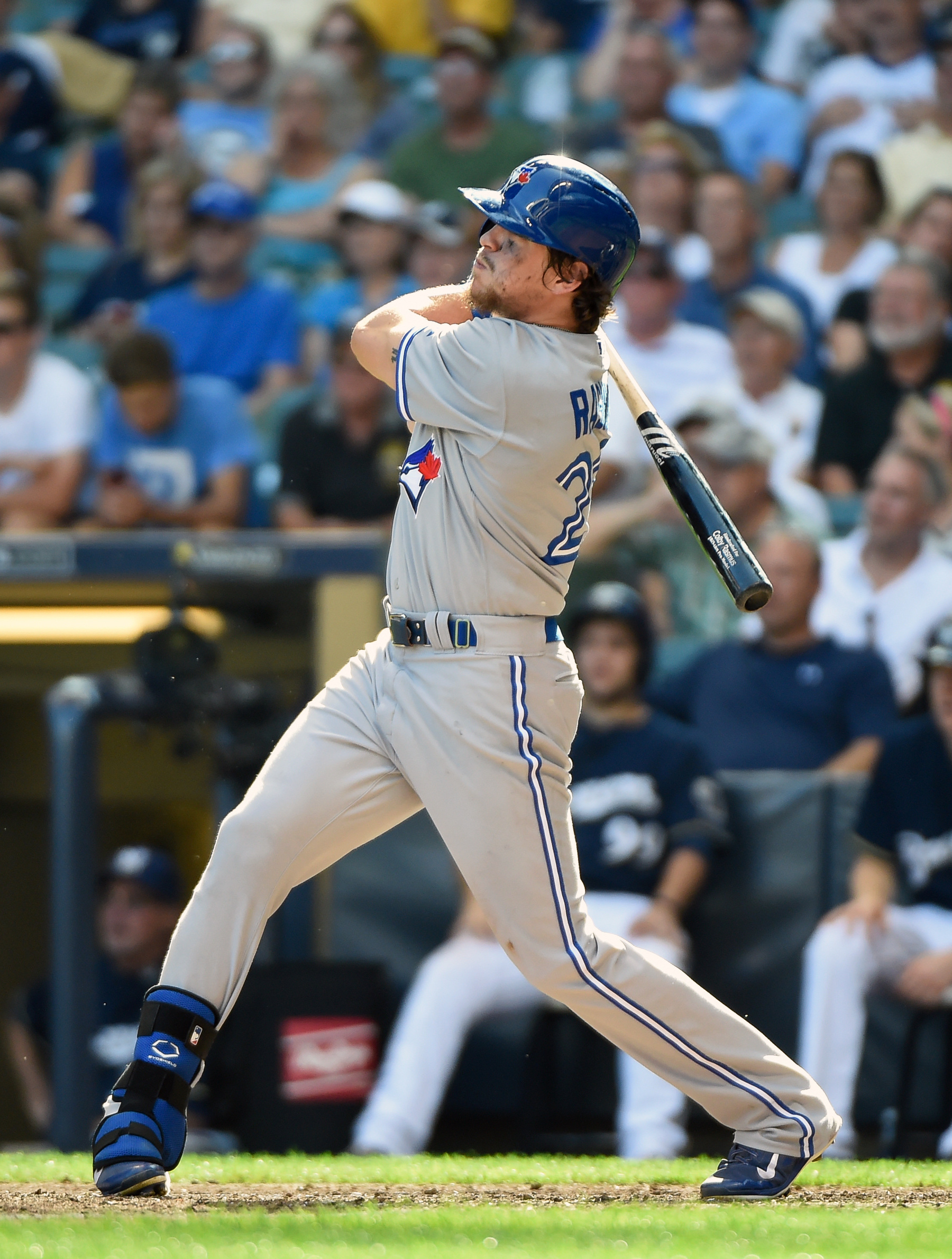 If there were any doubts whether Rasmus could remain a consistent source of power, he answered them. Indeed, Rasmus’s 2014 campaign landed right alongside his two excellent overall seasons of 2010 and 2013 in terms of ISO. Likewise, his line drive rate (23.3%) and home run to flyball ratio (19.4%) reached new career highs, while his infield fly ball ratio declined for the fourth consecutive year.
Generally, then, when Rasmus makes contact, it has been good contact. (More on that below.) To an extent, his variations in batting average and on-base numbers over the years can be attributed to BABIP. Last year, for instance, he hit .276 and reached base at a .338 clip on the back of a .356 BABIP. When his average on balls in play dropped to .294 this year, his average fell to .225 and his OBP dropped to .287.
As Rasmus noted in a fascinating interview with Scott MacArthur of TSN.ca, he believes that he sent a lot of hard-hit balls into newly-aggressive shifts, accounting for some of the decline. Shi Davidi of Sportsnet.ca explored that idea, and other possible explanations for Rasmus’s enigmatic bat, in a late-season piece. As Davidi notes, Rasmus suffered significant BABIP drops on both line drives and ground balls. Another oft-noted change was the departure of Jays hitting coach Chad Mottola, with whom Rasmus thrived. Though Rasmus has good things to say about replacement Kevin Seitzer, he has not seemed to mesh in working to counteract the league’s adjustments.
Despite struggling in some other ways at the plate, Rasmus still managed to produce at a better than league average clip this year (103 wRC+) thanks to his pop. He has been a consistently solid baserunner, though he is not much of a threat to steal. And while his defensive ratings have had their ups and downs, the total package is appealing. At his best, Rasmus has logged two seasons as one of the better center fielders in baseball: 2010 (4.0 fWAR, 3.6 rWAR) and 2013 (4.8 fWAR, 4.6 rWAR). And even in the rough campaigns of late — 2012 (1.0 fWAR, 1.8 rWAR over 625 plate appearances) and 2014 (0.6 fWAR, 0.9 rWAR over 376 plate appearances) – he has been at least serviceable, if not the kind of player that first-division club would hope to field.
Of course, it is critical to bear in mind that Rasmus only just turned 28 in August. That is an unusually young age to reach free agency, and could be enough to keep hopes alive for a return to the fairly impressive ceiling that he has shown in the past. Needless to say, youth, athleticism, and power are excellent attributes in any free agent.
Another key factor is that Rasmus is all but certain not to come with draft compensation attached. Teams will be much more inclined to take a chance on his talent without the need to sacrifice future assets.
Weaknesses/Cons
Defensively, advanced metrics were less kind to Rasmus this year than in the past. One year after being credited with saving his team 11 runs by Defensive Runs Saved, Rasmus checked in at a negative 7 tally in 2014. And his UZR/150 figures likewise reversed course, going from +15.2 to -15.3.
This is not the first time that those measures viewed Rasmus as a hindrance in the field, though he has tended to bounce up and down over the years and remains an average to slightly above average contributor over his career. Rasmus has explained that he was also slowed by cumulative injuries – he mentioned his hips and hamstrings – that could have had an impact.
Most worryingly, perhaps, are the changes in Rasmus’s strikeout figures. He has set career highs in each of the last two years, moving from a 29.5% strikeout ratio last year to a 33.0% clip this time around. Of course, he did succeed at that level last year, and posted his third-highest career K rate in his excellent 2010 season. As Drew Fairservice of Fangraphs wrote in exploring the “enigma” of Rasmus, he has a fairly unusual skillset with few obvious comps. Though B.J. Upton and Chris Young offer warning signs, Fairservice notes some routes to upside scenarios, even if they are arguably less likely.
Also up for debate is whether Rasmus would be better served in a platoon situation. As a left-handed bat, he generally has performed better against righties. For his career, Rasmus owns a 112 wRC+ against righties, which drops to a score of 77 against same-handed pitchers. In spite of his struggles in 2014, he actually reduced his splits to a more manageable 14-point gap.
It is also worth pointing out that Rasmus has a not-unblemished injury history. In fairness, most of the issues are not much more than typical bumps and bruises, but he has missed time over recent years with wrist, oblique, and hamstring injuries. This could, of course, be spun in either of two ways: on the one hand, some have suggested that Rasmus is injury-prone; on the other, he could be said to play the game hard and his nicks could explain some of his inconsistency.
Then, there is the fact that Rasmus sat a good bit at the tail end of 2014. Though that was obviously a reflection of a complicated situation — involving his performance, that of the Blue Jays, and the presence of younger players who had a future with the organization — it certainly did not help. If nothing else, the benching held down his stats, prevented him from showing much late in the year, and may not have sent the best signal to prospective new employers.
Personal
Rasmus grew up in Alabama and still lives there in the offseason. He is married with one child. Rasmus grew up in a very baseball-focused family, and appeared in the 1999 Little League World Series along with brother Cory, who now pitches for the Angels, on a team coached by his father.
In the above-linked interview, Rasmus intimated that he has struggled at points in his career with maintaining his love for the game. Saying that he is by nature relaxed but hard-working, Rasmus says that over-aggressive coaching has at times had the opposite of the intended effect on him. On the whole, Rasmus leaves the impression that his production on the field and enjoyment of the game tend to go hand-in-hand, and that he hopes to find an environment in which both can thrive.
Market
Rasmus is in a unique position in the market. On the one hand, he occupies the always-enviable status of being the best player available at his position, center field. In fact, it’s not even close: players like Emilio Bonifacio, Grady Sizemore, and Chris Young fall next in the pecking order.
In spite of that, it is questionable whether a club with expectations to contend would pursue the up-and-down Rasmus as an everyday option. As MLBTR’s Tim Dierkes has suggested (via Twitter), teams like the Tigers and Braves are in need of added production up the middle. But they might prefer to explore a trade market that could include options such as Drew Stubbs, Dexter Fowler, Jon Jay or Peter Bourjos, and perhaps Desmond Jennings. That figures to be the real competition for Rasmus.
On the other hand, there are still plenty of landing spots that might make sense. Dierkes also suggested the Cubs, and the Twins are also unsettled in center. Though Rasmus has little experience in the corners — less than 100 big league innings, in fact, all coming in his rookie year — a host of other teams might like the idea of deploying him there. It is possible to imagine interest from the Mets, Reds, Rays, White Sox, Royals, Giants, Padres, Pirates, Rangers, and Athletics. Depending on what shakes out with their current options, the Orioles, Astros, and Phillies are certainly plausible bidders as well. (Of course, unlike the center field market, there are more viable alternatives to contend with as well.)
All said, Rasmus should have a fairly broad market given his upside and defensive flexibility. Things will really open up if, as I suspect, he prioritizes fit with the clubhouse and coaching staff over contract particulars and position (if, in other words, he is amenable to taking a corner job).
Expected Contract
Ultimately, Rasmus is one of the most difficult free agents to pick a price tag for. His upside – given his age, center field capability, and power – is perhaps unmatched among this year’s crop of outfielders. Indeed, it was not long ago that it seemed likely, as MLB.com’s Gregor Chisholm wrote in late 2013, that Rasmus would top the B.J. Upton contract (five years, $75MM) when he hit the market. Yet it is not plausible now, with another year of information in the books. to put him in that range.
There would appear to be two approaches that Rasmus – and interested teams – could take. First is the traditional pillow contract. In that case, Rasmus would surely look to prioritize fit, hoping to find both regular playing time and a situation that would lead to a good platform season. Position player comps are somewhat wanting: Young signed for one year and $7.25MM last year in a somewhat similar situation, though that deal emerged out of a much more crowded outfield market, and Young was both somewhat older and coming off of a rougher offensive year. And Kevin Youkilis went for $12MM over one year, though he had a significantly longer track record of consistent production but was a much older player. With market inflation and a lack of competition, I believe Rasmus would be able to reach eight figures on a one-year deal.
On the other hand, the following year’s market includes increased competition in the form of players like Fowler and Austin Jackson. And it is not hard to imagine a team that believes in Rasmus looking to take advantage of his depressed value to lock in an attractive contract, much as the Twins did last year with Phil Hughes. For a club that can tolerate his strikeout tendencies, and believes in him as an at least average defender up the middle, a three-year offer cannot be ruled out, especially given Rasmus’s age. (Remember, the Red Sox just committed $72MM to unproven 27-year-old Rusney Castillo.) Clubs could be tempted to take the risk for a chance at his upside since he is a reasonably flexible roster piece, given his left-handed bat and center field capabilities.
It is hard to gauge just how high the price could go in that scenario, but it should be noted that Rasmus can wait to re-enter the market at a young 29 and has already earned something like $17MM in his career. Given that, it is somewhat difficult to imagine him seriously considering a deal that falls shy of a $10MM AAV over a term of three years. (And it might well take more to convince him to go that route; remember, he can look to rebuild his value and hit the market again at a still-youthful 29. Two years seems undesirable from Rasmus’s perspective, though he could field such offers.) One other factor to bear in mind is that Rasmus should be able to take his time seeing how interest develops in a multi-year scenario, fairly confident that a solid one-year option will be around at the end of the day.
Ultimately, I believe Rasmus will prioritize finding the right fit over maxing his earnings, whether on a one-year or multi-year deal. I do find a make-good contract to be the likelier outcome, and think that Rasmus will be able to reach $12MM on a one-year deal. But I would not be surprised if he ultimately scores a three-year pact.
Quick Hits: MASN, Cubs, Mariners, Cruz, Minniti, Santana
The arbitration order regarding Mid-Atlantic Sports Network television rights fees that is now the subject of litigation between the Nationals and Orioles would deliver about $300MM in payments to the Nationals over the five years, as James Wagner of the Washington Post writes. Documents filed in court show the structure of the award, which spanned the 2012-16 seasons and therefore would have both retroactive and going-forward impact. Beginning with an approximately $53MM payout for 2012, the award escalated to $66MM in 2016.
While that matter goes through the court process, let’s round up the news of the day:
- In other television money news, the Cubs are sending signals that the team could be lining up for an earlier-than-expected cash boost, as Patrick Mooney of CSNChicago.com reports. The club has an unusual split of its TV rights, the more important part of which is not up for negotiation for some time, but seemingly could be lining up a means of unlocking some revenue ahead of schedule. (Of course, the now-underway Wrigley Field renovations have long been pitched as the key to the team’s anticipated return to big spending.) “We haven’t reached that next level yet where the payroll’s going to significantly increase,” said president of baseball operations Theo Epstein. “The TV deal is really the magic bullet, the paradigm-shifter that’s going to put us in a whole new level.”
- The Mariners had a deal in place with Nelson Cruz last winter before ownership nixed the idea, Bob Dutton of the Tacoma News Tribune reports. Cruz was set to sign for a relatively meager $7.5MM or so, while giving the team an attractive option in the $9MM range. Though the magnitude of Cruz’s production this year is surprising, that deal — and, especially, the upside conveyed via the option — sure look good in retrospect, especially for a Seattle club that fell one win out of a postseason slot. It is strange that Seattle did not follow through with the contract for several reasons. With a protected first round pick, the Mariners gave up their second pick to sign Robinson Cano, meaning that Cruz wouldn’t have hurt much in that area. And the team ultimately committed $7MM to Corey Hart.
- Nationals assistant GM Bryan Minniti has left the team, as Ken Rosenthal of FOX Sports reported on Twitter. Minniti said he felt it was time for a change, as James Wagner of the Washington Post reports. Indeed, he could be preparing to enter another field of work entirely. GM Mike Rizzo made clear in a statement that Minniti was an integral part of the organization’s rise over the last five years.
- The Twins could use Danny Santana at short or in center next year, GM Terry Ryan tells Darren Woolfson of 1500 ESPN (Twitter link). That flexibility will presumably open up some additional possibilities for Minnesota. The 23-year-old had a stunning debut, putting up a .824 OPS that dwarfed anything he had done across seven minor league seasons.
Minor Moves: Jordany Valdespin, Tony Gwynn Jr.
Here are the day’s outrights and minor moves:
- The Marlins have outrighted utilityman Jordany Valdespin, according to the MLB.com transactions page. Valdespin, 26, slashed .214/.280/.347 last year after joining Miami on a minor league pact. He had been non-tendered by the Mets before reaching arbitration eligibility. Over parts of three seasons in the big leagues, Valdespin has spent time all over the outfield as well as at second base, in addition to a handful of appearances at short.
- The Phillies announced that outfielder Tony Gwynn Jr. has elected free agency after refusing an outright assignment. The 32-year-old slashed a meager .152/.264/.190 over 127 plate appearances on the year. He has seen big league action in parts of eight seasons, and at his best added value through stellar defensive ratings in the outfield.
Russell Martin Declined Pirates’ Mid-Season Extension Offer
Pirates catcher Russell Martin rejected an extension offer made by the team at some point during the season, Jon Heyman of CBSSports.com reports. Terms of the offer (or its precise timing) are not known. There are no indications that the sides are close on a late-breaking deal to keep Martin off the market, Heyman adds.
Pittsburgh reportedly has continued interest in bringing back Martin, and this reported mid-season effort lends credence to the idea that they will be serious in pursuit. On the other hand, of course, Martin stands alone among free agent backstops, and plenty of other clubs figure to make a run at him.
The Bucs had preliminary discussions with Martin in the spring, but held off on making an offer. That may have cost the team its window to reach a deal. Martin has delivered plenty of value on the two-year, $17MM deal he signed with Pittsburgh before the 2013 season, and his .290/.402/.430 line in 2014 brought him into a new performance tier. MLBTR’s Charlie Wilmoth profiled Martin’s rising standing in August.