
MLB Draft Signings: 6/7/19
Keeping up with the latest MLB draft signings…
- The Marlins have agreed to an over-slot bonus with second-rounder Nasim Nunez (pick 46), Craig Mish of FNTSY Sports Radio tweets. The high school infielder from Georgia will receive $2.2MM, a fair amount more than the recommended value of his pick ($1,617,400). Nunez had previously committed to Clemson. Jim Callis and Jonathan Mayo of MLB.com ranked the 19-year-old Nunez as the 51st-best player entering the draft, writing he may be the top defensive shortstop in his class. But whether the 5-foot-9, 155-pound switch hitter will complement his irreproachable glove work with big league-caliber offense is in question.
- Thirty-eighth overall pick T.J. Sikkema has agreed to a deal with the Yankees worth full slot value ($1.95MM), per Mark Feinsand of MLB.com. Sikkema, a left-hander from Missouri, checked in at No. 57 on MLB.com’s pre-draft list. While Sikkema doesn’t seem to come with a ton of upside, he has a high enough floor to potentially make it as a major league reliever or a back-end starter, Callis and Mayo suggest.
- Brewers second-rounder Antoine Kelly, the 65th pick, has signed for full slot value ($1,025,100), Callis reports. The development of the 19-year-old Kelly – a lefty from Wabash Valley College in Illinois – “will require a ton of patience and he ultimately may be more of a reliever than a starter, but he has a rare arm,” Callis and Mayo write. They ranked Kelly 90th overall going into the draft.
Marlins Sign Yangervis Solarte
The Marlins have signed infielder/outfielder Yangervis Solarte to a minor league contract, Roster Roundup reports.
Miami’s the second team of 2019 for Solarte, who cracked the Giants’ season-opening roster after signing a minors pact with them over the winter. However, the switch-hitting Solarte didn’t prove to be part of the solution for San Francisco’s dreadful offense, slashing .205/.247/.315 (48 wRC+) with one home run in 78 plate appearances. As a result, the Giants released him in early May.
While the 31-year-old Solarte was a solid contributor with the Yankees and Padres from 2014-17, those days appear long gone. His struggles in San Francisco came on the heels of a difficult 2018 campaign spent in Toronto, with which he batted .226/.277/.378 (77 wRC+) with 17 homers in 506 trips to the plate. Solarte has continued to show defensive versatility even as his offense has tanked, though. Dating back to last season, he has logged double-digit appearances at second base, third and shortstop. He also picked up nine appearances in left field with the Giants.
Braves Sign Dallas Keuchel
FRIDAY, 9:07pm: The Braves have announced the agreement. To make room for Keuchel on their 40-man roster, they transferred reliever Darren O’Day to the 60-day injured list. Atlanta plans to activate Keuchel after he makes two starts in the minors, Mark Bowman of MLB.com tweets.
6:32pm: Keuchel has passed a physical, per Gabe Burns of the Atlanta Journal-Constitution (via Twitter). The signing is expected to be announced tonight.
THURSDAY, 9:02pm: Keuchel’s contract is indeed for one year, reports Yahoo’s Tim Brown (Twitter link). He’ll be paid $13MM between now and season’s end, which is a bit more than the $11.16MM he’d have made on a prorated deal worth the same amount as the $17.9MM qualifying offer. (ESPN’s Jeff Passan adds that his base salary is technically around $20MM, and the $13MM represents the prorated version of that sum.) Keuchel will take a physical tomorrow, and he’ll jump right into the fray with Triple-A Gwinnett when he makes a start there on Saturday.
8:18pm: The Braves have agreed to terms with left-hander Dallas Keuchel, reports David O’Brien of The Athletic (Twitter link). It’s “likely” a one-year deal, O’Brien adds. Keuchel is represented by the Boras Corporation.

As was the case with Craig Kimbrel, Keuchel will see his prolonged free-agent saga come to a close just days after the draft-pick compensation that has hung over his head was lifted. The terms of the contract will surely be only a fraction of what the former Cy Young winner had eyed when rejecting a $17.9MM qualifying offer from the Astros back in November, but but a short-term arrangement will allow Keuchel the opportunity to once again test free agency — this time without the burden of a qualifying offer and likely with some lower expectations; Keuchel and Boras reportedly sought a contract of five years and more than $100MM in the early stages of free agency.
Keuchel, 31, has seen his results tail off since his brilliant Cy Young campaign back in 2015, but he’s still a quality arm who should provide some much-needed stability to a Braves rotation that hasn’t functioned according to plan (or anywhere close) in 2019. Top starter Mike Foltynewicz missed several weeks to open the season and has struggled considerably in his return from the injured list, while Sean Newcomb has been moved to the bullpen and Kevin Gausman is lugging around a 6.15 ERA. Julio Teheran has posted solid bottom-line results, but fielding-independent pitching metrics forecast him as a regression candidate.
Mike Soroka has been far and away the team’s best starter, putting himself not only in the Rookie of the Year race but in the Cy Young race early in the season. Soroka, however pitched just 56 1/3 innings between the Majors and minors last season and figures to have some degree of workload restriction facing him down the line. Lefty Max Fried has also emerged as a largely solid option, but he tossed only 111 innings last year and could see his own innings monitored a bit late in the year.
Last season, Keuchel racked up 204 2/3 innings while working to a 3.74 ERA with 6.7 K/9, 2.6 BB/9, 0.79 HR/9 and a 53.7 percent ground-ball rate. Keuchel’s strikeout and ground-ball rates have dipped in recent seasons, particularly in 2018, and he also saw both his 2016-17 seasons shortened a bit by injuries. All of that has taken some of the shine of the lefty, but it’s also a fact that he’s posted a sub-3.00 ERA in three of the past five seasons. Even when throwing out his Cy Young campaign, Keuchel has a 3.77 ERA with a premium ground-ball rate and above-average control through his past 518 1/3 innings.
Based on that track record, there’s little doubt that he’ll be an upgrade for the Braves — especially when considering who he’ll likely replace. Gausman would appear to be the odd man out in this situation, as he’s struggled through the worst season of his career and could very well be bullpen-bound. If he can manage to find success in that admittedly presumptive new role, the benefit to the Braves would be twofold; not only would they get another quality arm in the ‘pen, they’d have a starter working deeper into games (Keuchel) and thus not forcing the bullpen into action as frequently.
Keuchel drew interest elsewhere around the league, with the Yankees in particular being mentioned as an aggressive pursuer. However, Joel Sherman of the New York Post reports that the Yankees had a very clear cutoff with their offer and were not willing to budge beyond paying Keuchel the prorated portion of the $17.9MM qualifying offer (Twitter link). That base salary would’ve paid Keuchel about $11.16MM through season’s end — assuming a deal is completed tomorrow. The Cardinals, Twins and Rays were all mentioned as interested parties, to varying extents, although Juan Toribio of MLB.com tweets that Tampa Bay was never strongly after the lefty. Those teams will instead have to turn to the trade market in order to find rotation upgrades, as Keuchel was the open market’s lone realistic difference-maker.
The Braves, too, still figure to be active on the trade market moving forward. Even after adding Keuchel to the rotation, the Atlanta bullpen has been shaky and could stand to be improved upon. The team has been relying on Luke Jackson in the ninth inning as well as a host of converted starters and a series of low-cost fliers on veterans (e.g. Jerry Blevins, Anthony Swarzak). Newcomb has shown well in that role, as has Touki Toussaint, which makes the situation a bit less dire, but it’d nevertheless be a surprise if the Braves didn’t add at least one more reliable arm to the relief corps. Keuchel may very well be the highest-profile addition made by Atlanta between now and July 31, but he’s unlikely to be the only one.
Phillies To Sign Fernando Salas
The Phillies have agreed to a minors pact with righty reliever Fernando Salas, MLBTR’s Steve Adams reports on Twitter. Salas is expected to report to the club’s top affiliate.
Salas has thrown nearly five hundred MLB frames over nine seasons, but has bounced around a bit in recent years. He threw forty innings for the Diamondbacks last year before he was cut loose, then was dropped by the Braves after a brief stint at Triple-A. He ended up landing in the Mexican League for the current season.
Pitching for the Acereros de Monclova this year, Salas has precisely matched his lifetime 3.90 MLB ERA through 27 2/3 innings in his homeland. He has coughed up four long balls, which helps explain the results, but is carrying a strong 28:4 K/BB ratio.
Whether or not Salas will end up getting a shot at the MLB level with the Phils remains to be seen, but it wouldn’t be surprising to see him come up in the near future. The Philadelphia organization is weathering an ongoing run of poor health fortune in its relief corps.
Cubs Sign Craig Kimbrel
June 7, 6:44pm: The team has formally announced the contract.
Jon Heyman of MLB Network has further details. (Links to Twitter.) Games-finished escalators can boost the option buyout value from the $1MM base; Kimbrel can add another $1MM apiece by reach 53 games finished in 2020 and 2021. The option vests if Kimbrel finishes 110 total games between 2020 and 2021, at least 55 of which come in the latter season, and a doctor determines that he does not have a “non-temporary” injury (the details of which are surely defined in the contract).
Kimbrel also picks up no-trade protection. He can’t be dealt this season without his approval. He’ll have an eight-team no-trade list for the 2020 season. The deal does not provide any limitations thereafter.
9:11am: Kimbrel has passed his physical, per Heyman (Twitter links), and an introductory press conference is set to take place prior to today’s game.
June 5, 9:06PM: The deal pays Kimbrel $10MM this season, and $16MM in both 2020 and 2021, ESPN.com’s Jeff Passan reports (Twitter link). There is a vesting option for 2022 that pays Kimbrel $16MM if it vests, Heyman reports (via Twitter), while it becomes a club option if it doesn’t vest. The buyout of the option year is $1MM.
Also from Passan, Kimbrel could potentially join the Cubs before June 20. The closer “has been electric” in workouts in front of scouts.
8:21PM: Craig Kimbrel‘s long wait in the free agent market is over. The closer has agreed to a multi-year deal with the Cubs that will become official once Kimbrel passes a physical, The Athletic’s Ken Rosenthal reports (links to Twitter). Rosenthal originally reported the dollar figure as close to $45MM, and MLB Network’s Jon Heyman reports that Kimbrel will be paid $43MM (via Twitter) through the 2021 season. Kimbrel is represented by SportsMeter.
Unsurprisingly, Kimbrel’s protracted time on the open market wrapped up shortly after the amateur draft. Since Kimbrel turned down a one-year, $17.9MM qualifying offer from the Red Sox, any team that signed the veteran closer had to give up some type of compensation in the form of at least one draft pick, plus potentially international signing bonus money and even another pick depending on the identity of the team who landed Kimbrel. However, this draft pick compensation no longer applied to Kimbrel (or fellow free agent holdout Dallas Keuchel) once draft day hit, removing one of the key hangups any interested team might have had about a signing.
As well, Kimbrel and his representatives aimed very high in their initial contract demands, reportedly looking for a nine-figure deal that would’ve set a new record for a free agent closer. That said, it’s very common for free agents to hit the market with a big asking price as a starting point, yet Kimbrel’s market never seemed to really develop even as the offseason continued and his contract demands fell into the three-year range.
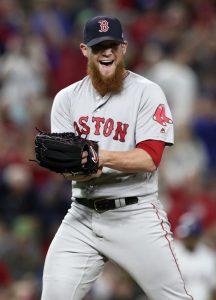 It could be that the market has simply shifted, and front offices are no willing to commit the type of long-term financial commitments (especially with draft and international market penalties involved) for free agent stoppers that were available to the likes of Aroldis Chapman, Kenley Jansen, or Mark Melancon just as recently as the 2016-17 offseason. That said, it’s still a surprise to realize that over a third of the season elapsed before any club was willing to ink a player with as sterling a track record of ninth-inning success as Kimbrel.
With a career 1.91 ERA, 14.7 K/9, and 4.23 K/BB rate over nine seasons and 532 2/3 career innings, Kimbrel’s resume could very well eventually land him in Cooperstown down the road. While 2018 wasn’t as dominant as some of his past years, Kimbrel still seemed to have a viable platform year with a 2.74 ERA, 13.86 K/9, and 3.10 K/BB over 62 1/3 frames for the World Series-champion Red Sox.
Beyond the surface numbers, however, there were some red flags. It was hard to ignore Kimbrel’s increased struggles in the second half of last season, and then through Boston’s playoff run (a 5.91 ERA over 10 2/3 postseason innings). Kimbrel has also had some control issues in two of the last three seasons, with a 4.48 BB/9 last year and a 5.09 BB/9 in 2016. These issues could have been enough for teams to hesitate about guaranteeing five or six years to a pitcher in his 30’s (Kimbrel turned 31 in late May) when he was perhaps already showing some signs of slowing down.
Multiple teams were linked to Kimbrel’s market at various points over the last seven months, including several showing increased interest in the last couple of weeks as the draft (or, the qualifying offer expiration date) approached on June 3. The Rays, Phillies, Braves, Brewers, Twins, Nationals, and Red Sox all had some degree of interest while Kimbrel was available.
While the Cubs always seemed like a good on-paper fit, they seemingly only emerged late in the game due to some unexpected luxury tax room opening up. Ben Zobrist‘s placement on the restricted list on May 8 means that his salary no longer counted towards Chicago’s luxury tax calculations, and if Zobrist misses the entire season (which seems increasingly likely at this juncture), the Cubs would have around $9MM to work with, money has seems to have fueled their push for Kimbrel.
Theo Epstein and company headed into the offseason with a need for bullpen help, with closer Brandon Morrow undergoing elbow surgery in November and still without a clear timetable to return. Despite needs in the pen and elsewhere on the roster, however, the Cubs were very circumspect about their winter spending, due to a desire to stay under the maximum luxury tax threshold and team chairman Tom Ricketts’ controversial claim that “we don’t have any more” to spend.
Prior to the Kimbrel signing, Roster Resource projected the Cubs at just over $227.7MM in luxury tax payroll, putting the team in line for a 20% tax on every dollar spent above the $206MM luxury tax line, and then an additional 12% surtax for going more than $20MM over the line. The average annual value of Kimbrel’s deal works out to $14.333MM per season, thus keeping the Cubs from exceeding the $246MM maximum penalty threshold. Spending more than $246MM would cost the Cubs 62.5% surcharge on the overage, and their top draft pick in 2020 would be dropped by ten slots.
So it could be a win-win situation for Chicago, as the team looks to both avoid the top tax threshold while also getting a closer to bolster a bullpen that has generally been around the middle of the pack this season. With Pedro Strop returning from the injured list and now Kimbrel’s addition, the Cubs suddenly have a much deeper pen to help them in their fight to win the NL Central. Signing Kimbrel prior to June 3 would’ve cost the Cubs not only more money in salary, but also $500K in international bonus pool money and their second-highest pick in the 2019 draft (which ended up being the 64th overall selection).
For Kimbrel and his representatives, landing a multi-year contract represents some measure of a victory after the long wait, as several suitors were only interested in inking Kimbrel to a one-year deal for the remainder of the 2019 campaign. While three years and $43MM is considerably less than Kimbrel expected at the start of the winter, the term isn’t far from four years/$70MM predicted by MLB Trade Rumors’ Top 50 Free Agents list back at the start of November, though nobody could’ve expected the wild path Kimbrel could take to eventually land his next contract. If Kimbrel ends up pitching up to expectations, one suspects several teams will be kicking themselves over not signing Kimbrel when they had the chance.
The stopper is undoubtedly relieved to simply get his focus back on baseball, as he’ll now join a contender in pursuit of another World Series ring. The question now is when Kimbrel will actually join the Cubs, as while he has been training on his own in preparation for the season, it remains to be seen how long it will take for him to ramp up to be ready for MLB hitters. The other looming question could concern Kimbrel’s effectiveness, as other players whose qualifying offer-induced long waits in free agency (Stephen Drew and Kendrys Morales in 2014) both struggled badly after sitting out months of the season.
Photo courtesy of USA Today Sports Images
Angels Reinstate Kevan Smith, Designate Dustin Garneau
The Angels have announced that backstop Kevan Smith is back from the concussion injured list. To create space on the active roster, the team designated catcher Dustin Garneau for assignment.
That move also freed up a 40-man spot to make way for the team to bring up infielder Wilfredo Tovar. The final active roster space was created by optioning righty Jaime Barria.
Garneau, 31, will either end up landing elsewhere or back at Sale Lake City. He got on base at a healthy clip over his seven-game showing and was slashing .247/.368/.589 in 87 Triple-A plate appearances before his promotion. He has at times posted strong offensive numbers in the upper minors, but carries only a .198/.282/.321 slash in 302 trips to the dish over five seasons of action at the game’s highest level.
Angels To Select Wilfredo Tovar
The Angels are preparing to select the contract of middle infielder Wilfredo Tovar. The Halos Prospects Twitter feed reported that the move was anticipated, with Maria Torres of the Los Angeles Times tweeting that he was indeed coming onto the MLB roster.
Tovar made it up to the bigs briefly with the Mets in 2013 and 2014, but hasn’t been back since. He has played exclusively at Triple-A in the intervening seasons. This year, Tovar carries a .285/.329/.404 slash with three home runs over 210 plate appearances.
Corresponding roster moves aren’t yet known. The Halos have eight relievers on the active roster at present, leaving them with just three bench players. Adding another player capable of handling shortstop is particularly important given that the team is still going without Andrelton Simmons.
Mariners To Sign First-Rounder George Kirby
JUNE 7: It’s an at-slot deal, per MLB.com’s Jonathan Mayo (via Twitter).
JUNE 5: The Mariners have agreed to a bonus with first-round pick George Kirby, team director of amateur scouting Scott Hunter told Ryan Divish of the Seattle Times (Twitter links). The deal is set pending a physical. Terms weren’t revealed, though the 20th overall selection has a recommended bonus value of $3,242,900.
Kirby is a 6’4″, 201-pound right-hander out of Elon University and a consensus top-25 prospect according to pre-draft rankings. MLB.com had Kirby highest as the 18th-best prospect in this year’s class, with Fangraphs placing him 19th, Baseball America 20th, and ESPN’s Keith Law 24th. Kirby has a fastball that usually sits in the 94-95mph range and is considered a plus pitch as per BA’s scouting report, and his repertoire also includes a changeup, slider, and curveball, though the latter two pitches “might be average pitches, at best, in a starting role.”
The Mariners put a big focus on young arms in this year’s draft, as the club took college pitchers in each of the first five rounds, and drafted eight pitchers overall within its first ten picks. The M’s also took some prominent high schoolers outside of the top ten, including right-handers Anthony Tomczak (15th round) and Dutch Landis (17th round). Any bonus given to a player from rounds 11-40 that is in excess of $125K counts against the team’s bonus pool, though Hunter said the Mariners are prepared to go over slot to sign the two youngsters. Since clubs usually have something of a negotiating advantage with college seniors, Seattle should have some extra funds within their first ten picks to help their efforts in getting Tomczak and/or Landis signed.
Mariners Place Mitch Haniger On IL, Select Tayler Scott
The Mariners announced today that outfielder Mitch Haniger has been placed on the 10-day injured list. He has been diagnosed with a ruptured testicle, Ryan Divish of the Seattle Times tweets.
That’s obviously not a run-of-the-mill injury for a ballplayer, though unfortunately it’s also not unheard of. There is no indication at this point how long Haniger will be sidelined.
In happier news, the M’s have selected the contract of righty Tayler Scott, as Ken Rosenthal of The Athletic reported earlier on Twitter. Scott, 27, carries a 5.88 ERA with a 44:19 K/BB ratio in 33 2/3 innings over 19 appearances at Triple-A this year. He’ll make his MLB debut after signing a minors deal with the Seattle organization over the winter.
Scott was a 2011 fifth-round draft pick who spent time in high school in the states, but he’s a born-and-bred South African. He’ll become the first player from an African nation to pitch in the big leagues; infielder Gift Ngoepe previously became the first such player to appear in the majors.
Rockies Activate Blackmon & Davis, Designate Chris Rusin For Assignment
The Rockies have activated outfielder Charlie Blackmon and closer Wade Davis from the injured list, the club announced. Lefty Chris Rusin was designated for assignment to create one roster opening, with utilityman Garrett Hampson optioned for another.
The Colorado club will obviously be glad to welcome back two of its most-established veteran players. Neither required a lengthy absence, but any time away is more than the Rockies can afford. A recent run has the team three games over .500, but it’s still staring at a yawning ten-game chasm with the division-leading Dodgers on the other side.
Rusin only just returned to the majors after opening the year on the IL with back issues. He has not looked great. He was bombed in his first two outings, surrendering four earned runs on five hits while recording only three outs. And he’s already coming off of a messy 2018 effort in which he was torched for a 6.09 ERA.
Still, the peripherals suggested better last year. And Rusin was a strong performer in 2017, when he threw 85 innings of 2.65 ERA ball. Of course, he not only managed a typically strong 58.5% groundball rate that year but also produced a career-best 12.7% swinging-strike rate. He hasn’t come close before or since. Thus far in 2019, Rusin’s velocity is down and he hasn’t generated grounders (in the majors and during his rehab assignment).
The timing may feel a bit rushed at first glance, particularly for a player who is earning $1,687,500 (with one more year of arbitration control remaining). It makes more sense when you tabulate Rusin’s service time. He entered the season with 4.092 years on the ticker; with 71 more accrued to this point, he’s sitting just nine days shy of reaching five full years of service. At that point, he’d be able to reject an outright assignment without sacrificing the remainder of his salary. By making the move now, the Rockies can either shed the remaining obligation (if he’s claimed or rejects an assignment) or stash Rusin at Triple-A and try to work out the kinks.