
Minor MLB Transactions: 2/14/19
Here are Thursday’s minor moves from around the league…
- The Athletics announced that they’ve signed lefty Tyler Alexander to a minor league deal and invited him to Major League Spring Training. He’s been out of affiliated ball since the 2014 season, pitching on the independent circuit and in the Mexican League. Manager Bob Melvin spoke to Jane Lee of MLB.com and touted Alexander as someone who the A’s have kept an eye on for the past few years, specifically citing this winter’s strong showing in the Dominican Winter League — 2.68 ERA, 48-to-10 K/BB ratio in 50 1/3 innings — as a source of intrigue.
- The Orioles announced that infielder Jack Reinheimer cleared waivers and has been assigned outright to Triple-A Norfolk. He’ll be in camp as a non-roster invitee, where he’ll compete with a variety of other players for a shot at some time in the Baltimore infield mix. The light-hitting 26-year-old hasn’t seen much MLB time but bounced around the waiver wire a bit this winter, indicating that teams see him at least as a plausible big-league depth piece.
- Catcher Adam Moore has agreed to a minor league contract with the Rangers, tweets Jon Heyman of the MLB Network. He’d earn a $600K base salary at the Major League level. Moore, 34, has seen action in nine MLB seasons but played in double-digit games in only one of those. He spent most of 2018 at Triple-A, slashing .219/.260/.347 in 208 plate appearances.
- In somewhat of a blast-from-the-past move, the Blue Jays have added lefty Ryan Feierabend on a minor league deal, per Baseball Toronto’s Keegan Matheson (Twitter link). Now 33 years old, Feierabend has just 7 1/3 MLB innings under his belt since the close of the 2008 season. However, he’s had some success pitching in the Korea Baseball Organization in recent seasons and is now utilizing a knuckleball — a rare pitch in today’s game that is all the more anomalous given that Feierabend is left-handed.
Twins To Extend Max Kepler
3:40pm: Heyman tweets the full breakdown. Kepler earns successive salaries of $6MM, $6.25MM, $6.5MM, $6.75MM, and $8.5MM and will then receive either a $10MM salary or $1MM buyout. That 2024 option year salary can increase by up to $1MM based upon awards.
11:25am: It’s a five-year deal worth $35MM for Kepler, reports MLB Network’s Jon Heyman (via Twitter). The deal also contains a club option for a sixth season, which is valued at $10MM, according to ESPN’s Jeff Passan (Twitter link).
10:25am: The Twins are nearing the completion of a new contract with right fielder Max Kepler, Phil Miller of the Minneapolis Star Tribune reports. If and when the deal is completed, it’d be the second long-term deal hammered out by the Twins this week, as the team is also reported to be finalizing a five-year pact with shortstop Jorge Polanco. The Twins, notably, have scheduled a press conference for 10am tomorrow morning. Kepler is represented by Sosnick, Cobbe & Karon.
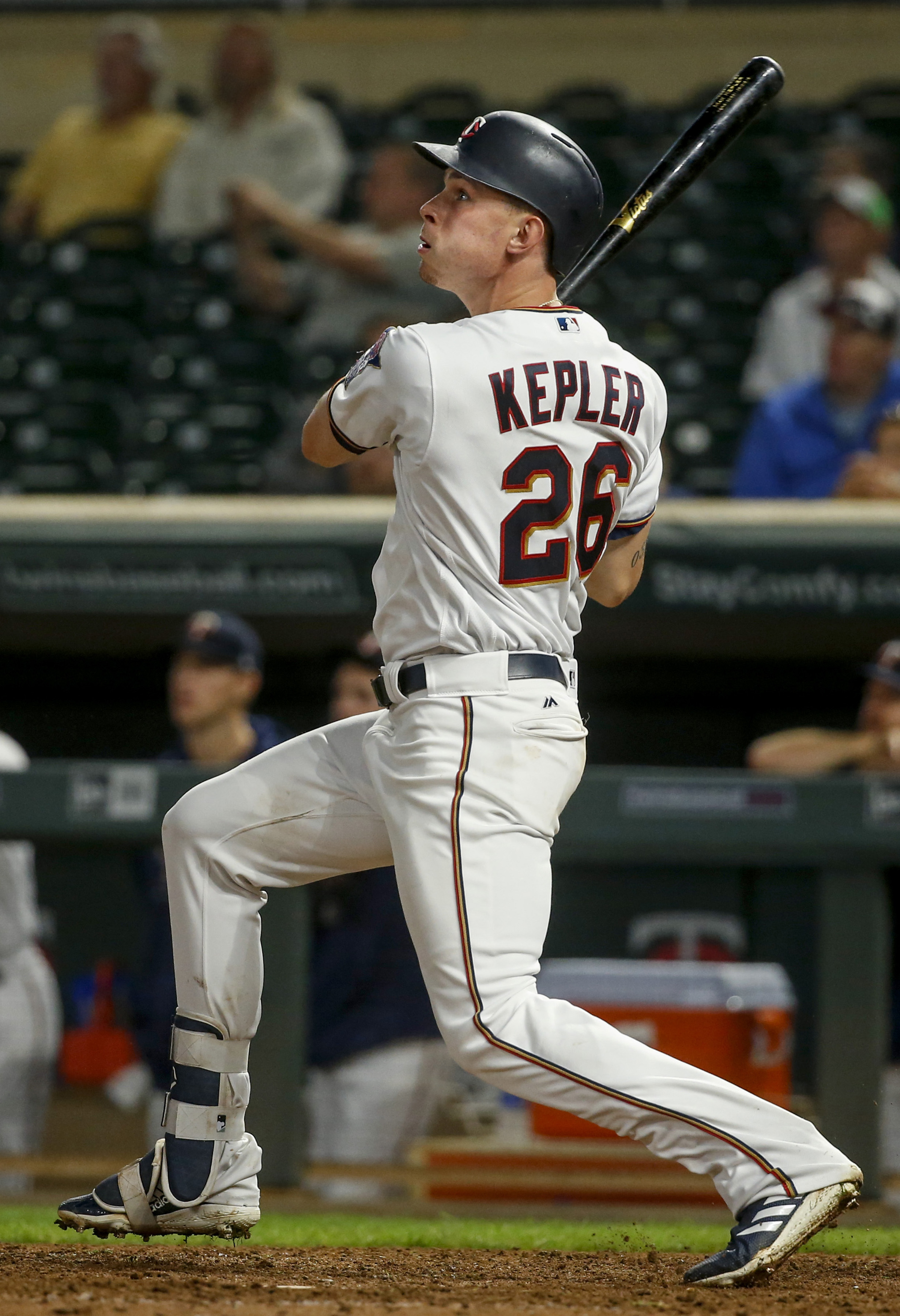
Kepler has already agreed to a $3.125MM deal for the 2019 season as a Super Two player, though a new long-term arrangement could potentially supersede that prior agreement. The German-born 26-year-old has spent the past three seasons as Minnesota’s primary right fielder, batting a combined .233/.314/.418 (96 OPS+) with 56 homers, 82 doubles, eight triples and 16 steals in 1626 plate appearances. He’s proven himself to be a strong defender in that time (+15 Defensive Runs Saved, +11 Ultimate Zone Rating, +32 Outs Above Average) and has drawn favorable reviews for his baserunning as well, even if his stolen-base totals are lacking (+8.1 BsR, per Fangraphs).
While Kepler’s overall production in his three years as an MLB regular doesn’t immediately stand out, there’s reason to believe that he could yet deliver a more impressive level of offensive output. For the first few seasons of his career, Kepler struggled mightily against left-handed pitching but turned in strong output against righties. From 2016-17, he hit .262/.336/.477 when holding the platoon advantage but mustered just a .177/.243/.280 slash against left-handers. This past season, though, Kepler delivered a much-improved .245/.323/.422 line against lefties and dramatically improved his strikeout and walk rates against them. Unfortunately, he saw his average on balls in play against right-handers crater, leading to diminished overall results.
If Kepler can bounce back in terms of BABIP against righties and maintain some of last year’s gains against lefties, there’s reason to expect the outfielder’s best season yet. Beyond that fairly rudimentary look at Kepler’s splits, he improved his walk rate to a career-high 11.6 percent in 2018 while slashing his strikeout rate to a career-low 15.7 percent. It’s also worth noting that the Berlin native also has less overall experience with baseball than most young players at his age, given baseball’s lack of popularity in his home country.
As things stand, Kepler will reprise his role as the everyday right fielder, with Eddie Rosario lining up in left and Minnesota once again hoping to see former No. 2 overall pick and top overall prospect Byron Buxton solidify himself at the Major League level. Buxton looked to be well on his way to breaking out as a star in 2017, but a series of injuries torpedoed his 2018 season and rendered him a question mark in 2019. He’ll get the first crack at regular work in center field, though the Twins also have Jake Cave on hand should Buxton struggle or be slowed by injuries once again. Both Kepler and Rosario can handle center field, as well.
A look at recent comparables in MLBTR’s Extension Tracker — specifically, Super Two outfielders with two to three years of service — Ender Inciarte stands out as a potentially relevant data point. The Braves’ center fielder signed an extension at the same age Kepler is now and with nearly identical service time, agreeing to a five-year pact worth $30.525MM prior to the 2017 campaign. Something in that range for Kepler could very well be plausible, though presumably his camp would like to top that mark in any negotiations.
As noted when looking at Polanco’s soon-to-be-finalized extension, the Twins don’t have a single guaranteed contract on the books beyond the 2019 season. Polanco and Kepler would change that fact and give the Minnesota organization additional cost certainty as it looks to supplement a roster that is largely comprised of young assets who are still years from reaching the open market. It’s possible that additional extensions could yet come to fruition, with Rosario and Jose Berrios standing out as prominent young Twins who the organization would surely like to retain for a longer period of time.
Twins To Extend Jorge Polanco
2:15pm: Polanco will earn $3.583MM in 2019, $3.833MM in 2020, $4.333MM in 2021, $5.5MM in 2022 and $7.5MM in 2023, according to MLB Network’s Jon Heyman (Twitter link).
His 2024 club option is valued at $10.5MM with a $1MM buyout, while the 2025 option is worth $12.5MM with a $750K buyout. The first of those two options is also a vesting option that would automatically trigger if Polanco tallies 550 plate appearances in 2023. His base salaries on the option years can increase based on All-Star nominations, Gold Gloves and Silver Sluggers.
9:45am: Polanco’s deal will pay him $25.75MM over the next five years, and it also includes club options for the 2024 and 2025 seasons, per Jim Bowden of The Athletic (Twitter link).
8:34am: ESPN’s Jeff Passan tweets that the contract will cover a total of seven seasons, at least five of which are guaranteed. The deal will indeed be in the range of Ramirez’s extension with Cleveland, though it’s expected to exceed that $26MM guarantee by a bit.
7:50am: The Twins and shortstop Jorge Polanco are nearing the finalization of a contract extension, reports Jesse Sanchez of MLB.com (via Twitter). La Velle E. Neal III of the Minneapolis Star Tribune reported earlier this week that Minnesota was optimistic about reaching perhaps multiple contract extensions in the near future. The 25-year-old Polanco is represented by Octagon.
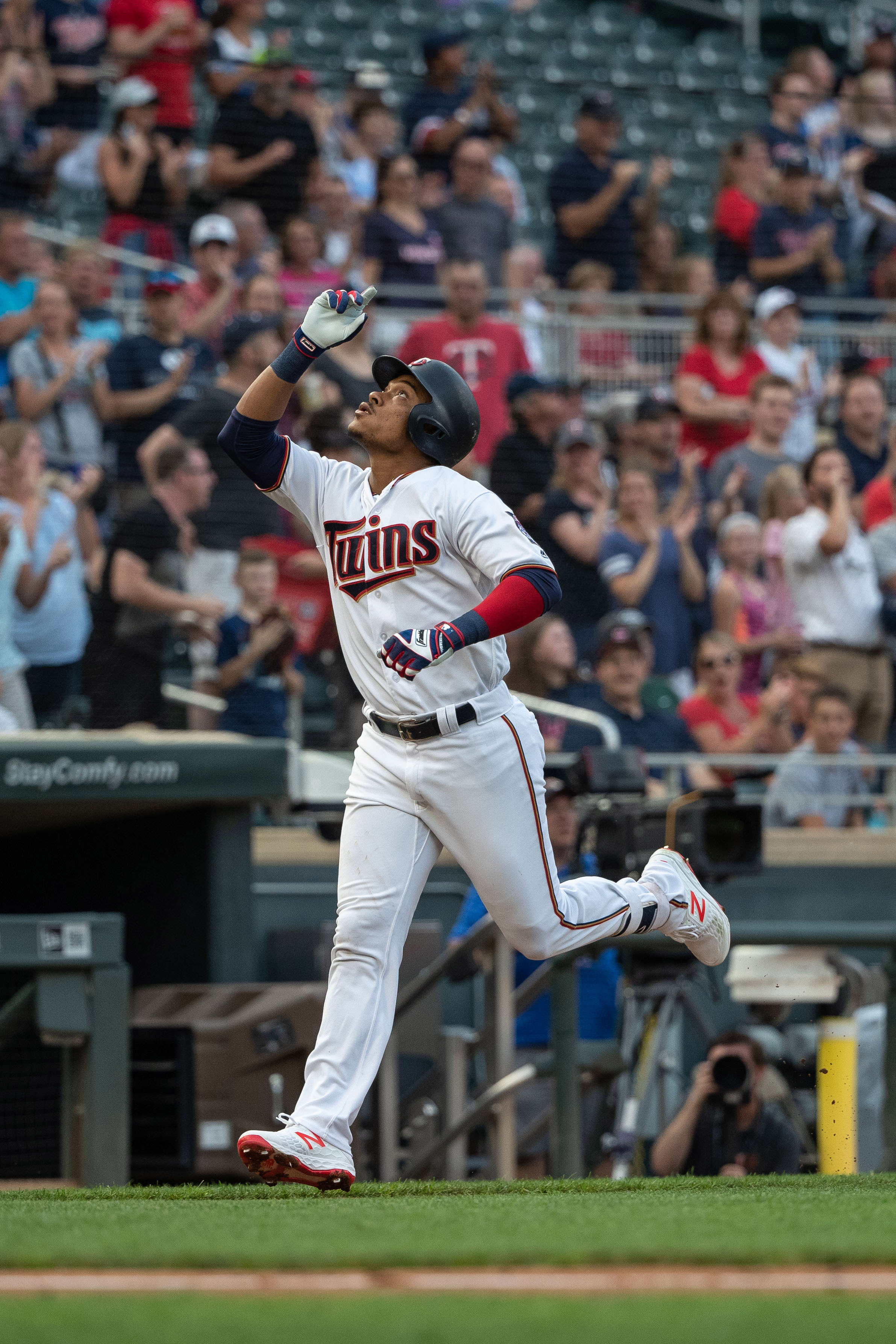
The switch-hitting Polanco was already under control for another four seasons and was not yet eligible for arbitration, but the new arrangement in question will presumably keep him in the fold longer than that. To this point in his career, the former top prospect has compiled a .272/.329/.420 slash line with 23 home runs, 64 doubles, 11 triples and 25 steals through 1167 plate appearances.
Polanco, long touted as a potential infield fixture for the Twins, got off to a dreadful start to his 2017 season, hitting just .213/.265/.305 through his first 310 plate appearances. He rebounded with a torrid final two months, hitting .316/.377/.553 to close out the year, though that production was met with some skepticism when Polanco was suspended for 80 games to open the 2018 season after testing positive for a banned substance (Stanozolol). Polanco hit well in his return from that suspension, though, slashing .288/.345/.427 with 27 extra-base hits in 333 plate appearances to close out the season.
While Polanco doesn’t post huge walk rates (7.5 percent in each of the past two seasons as well as in his overall career), he draws enough free passes and is a tough enough strikeout (16.2 percent) that there’s little doubt in his ability to consistently get on base. At the very least, he should be a useful source of batting average and on-base skills with modest pop and a bit of speed, though if he can tap into a bit more power, there’s perhaps room to take his game to another offensive level.
Defensively speaking, there was some question surrounding Polanco’s home on the diamond as he rose through the Twins’ system. While he was consistently given work at shortstop, some scouting reports felt he was best-suited for either second base or third base and would eventually have to move to either position. He hasn’t been a star defender at short thus far, but he’s held his own there over the past two seasons, with Defensive Runs Saved (-2) pegging him as below average but passable. Ultimate Zone Rating has been less kind (-8).
For the time being, with Jonathan Schoop at second base and Miguel Sano at the hot corner, Polanco will reprise his role as the team’s shortstop. It’s not difficult to envision a different alignment in the near future, however, with former No. 1 overall pick Royce Lewis soaring through the system and barreling toward the Majors with top 10 overall prospect fanfare. While Lewis is quite likely more than a year from reaching the game’s top level, he could usurp Polanco at shortstop when that happens, pushing him to either second base (depending on the status of former first-round pick Nick Gordon) or to third base (with Sano potentially slotting in at first base or DH).
Terms of the would-be extension aren’t yet known, but a look in MLBTR’s Extension Tracker could provide some useful context. Taking a look at other middle infielders with two to three years of service, Polanco has nearly the same service time that a pre-breakout Jose Ramirez had with the Indians when he signed a five-year deal worth a guaranteed $26MM (plus two options). Ramirez, to that point in his career, was a .275/.331/.404 hitter — numbers that closely resemble Polanco’s own .272/.329/.420 line.
From a payroll perspective, the Twins have zero issues fitting Polanco — or virtually any player in baseball — onto the long-term ledger. Minnesota is the only organization in MLB that doesn’t have a single guaranteed contract on the books for the 2020 season, with the only dollars they’re technically committed to beyond 2019 coming in the form of a $300K buyout on Nelson Cruz‘s one-year contract.
The Polanco extension and any others — Max Kepler, Eddie Rosario and Jose Berrios are among other candidates for multi-year deals — will change that outlook, though chief baseball officer Derek Falvey and general manager Thad Levine will nonetheless have ample payroll space to make any moves they wish in the near future given that largely blank slate. If anything, the cost certainty added from a Polanco deal and any other extensions will only make it easier for the team to look at adding pieces from outside the organization, as they’ll paint a clearer picture of exactly how much money is being spent over the next several years.
Blue Jays, John Axford Agree To Minor League Deal
Feb. 14: Axford and the Jays have reached an agreement on a minor league contract that would pay him $1.65MM if he makes the roster, Shi Davidi of Sportsnet reports (via Twitter). Axford is on his way to Blue Jays camp in Dunedin right now.
Feb. 13: The Blue Jays are close to a deal that’ll bring righty John Axford back to the organization, reports MLB Network’s Jon Heyman (Twitter link). Axford, 36 in April, spent most of the 2018 season with the Jays and had voiced a desire to return to his hometown organization earlier this offseason. Axford is represented by the Beverly Hills Sports Council.
Axford appeared in 45 games for the Blue Jays last season, pitching to a 4.41 ERA with a 50-to-20 K/BB ratio in 51 innings before being traded to the Dodgers prior to the July 31 non-waiver deadline. Unfortunately for both Axford and the Dodgers, the right-hander, he was clobbered for six runs in his first appearance with his new team. Before he had time for his numbers to recover, Axford was struck on the leg by a comebacker, sustaining a fractured fibula that shelved him for more than a month.
It’s been a rough couple of seasons for the veteran Axford, who has a 5.59 ERA in 75 2/3 innings dating back to Opening Day 2017. However, prior to that, Axford carried a 4.03 ERA with better than a strikeout per inning in four seasons split between the Brewers, Cardinals Indians, Rockies and A’s. The right-hander still throws hard, averaging 95.5 mph on his heater in ’18, though his swinging-strike and opponents’ chase rate both continued to trend in the wrong direction.
Given his recent struggles, it seems likely that Axford would have to earn his way onto the roster on a minor league contract, as he did a year ago with the Jays. If that is indeed the case, he’ll head to Spring Training and compete for a spot behind Ken Giles and Ryan Tepera at the back of the Toronto ‘pen. Righties Joe Biagini, Sam Gaviglio, David Paulino and Trent Thornton are among the current 40-man options against whom he’d be competing for those spots. All have minor league options remaining, which could help to work in Axford’s favor, as there’s no reliever who needs to be carried on the 25-man roster with the exception of Rule 5 pick Elvis Luciano — who is already an extreme long shot to stick on the roster given that he is just 19 years of age.
Indians Sign Asher Wojciechowski, Tim Federowicz To Minor League Deals
The Indians announced Thursday that they’ve signed right-hander Asher Wojciechowski and catcher Tim Federowicz to minor league contracts with invites to Major League Spring Training.
Wojciechowski, 30, will give Cleveland some depth in both the rotation and the bullpen. He’s struggled to a 6.64 ERA with 9.2 K/9 against 3.0 BB/9 in 78 2/3 MLB innings, most of which came with the 2017 Reds, but he has plenty of experience at the Triple-A level. In 550 1/3 innings at the top minor league level, Wojciechowski has a 4.37 ERA with 7.6 K/9, 3.1 BB/9 and 1.2 HR/9, with all but 15 of his 108 appearances there coming as a starter. He split last season between the Triple-A affiliates for the White Sox and Orioles, working to a combined 4.53 ERA in 119 1/3 frames but with a 126-to-37 K/BB ratio. Wojciechowski’s ability to miss bats has jumped considerably in the past two seasons, and his walk rate has dropped along with that spike, which likely piqued Cleveland’s interest.
As for Federowicz, the 31-year-old has appeared in parts of seven MLB seasons split between the Dodgers, Giants, Reds, Cubs and Astros. He’s never hit much as a big leaguer, managing just a .199/.247/.323 line in 360 plate appearances. That said, he’s an accomplished (and then some) hitter in Triple-A, where he owns a terrific .303/.374/.501 line in nearly 1900 plate appearances.
With Yan Gomes traded to the Nationals, Cleveland is relying on some combination of Roberto Perez, Eric Haase and trade acquisition Kevin Plawecki to shoulder the bulk of the workload behing the plate in 2019. Federowicz will add another depth option to the equation, though it’s unlikely that he’ll emerge as a viable candidate to crack the Opening Day roster with his new organization.
Royals Sign Jake Diekman
The Royals announced Wednesday evening that they’ve signed left-handed reliever Jake Diekman to a one-year contract with a mutual option for the 2020 season. Right-hander Jesse Hahn has been transferred to the 60-day injured list in a corresponding move. MLB.com’s Jeffrey Flanagan reports that Diekman, a client of the Beverly Hills Sports Council, will earn a $2.25MM base salary in 2019, and there’s a $500K buyout on next year’s option, making for a $2.75MM guarantee (Twitter link).
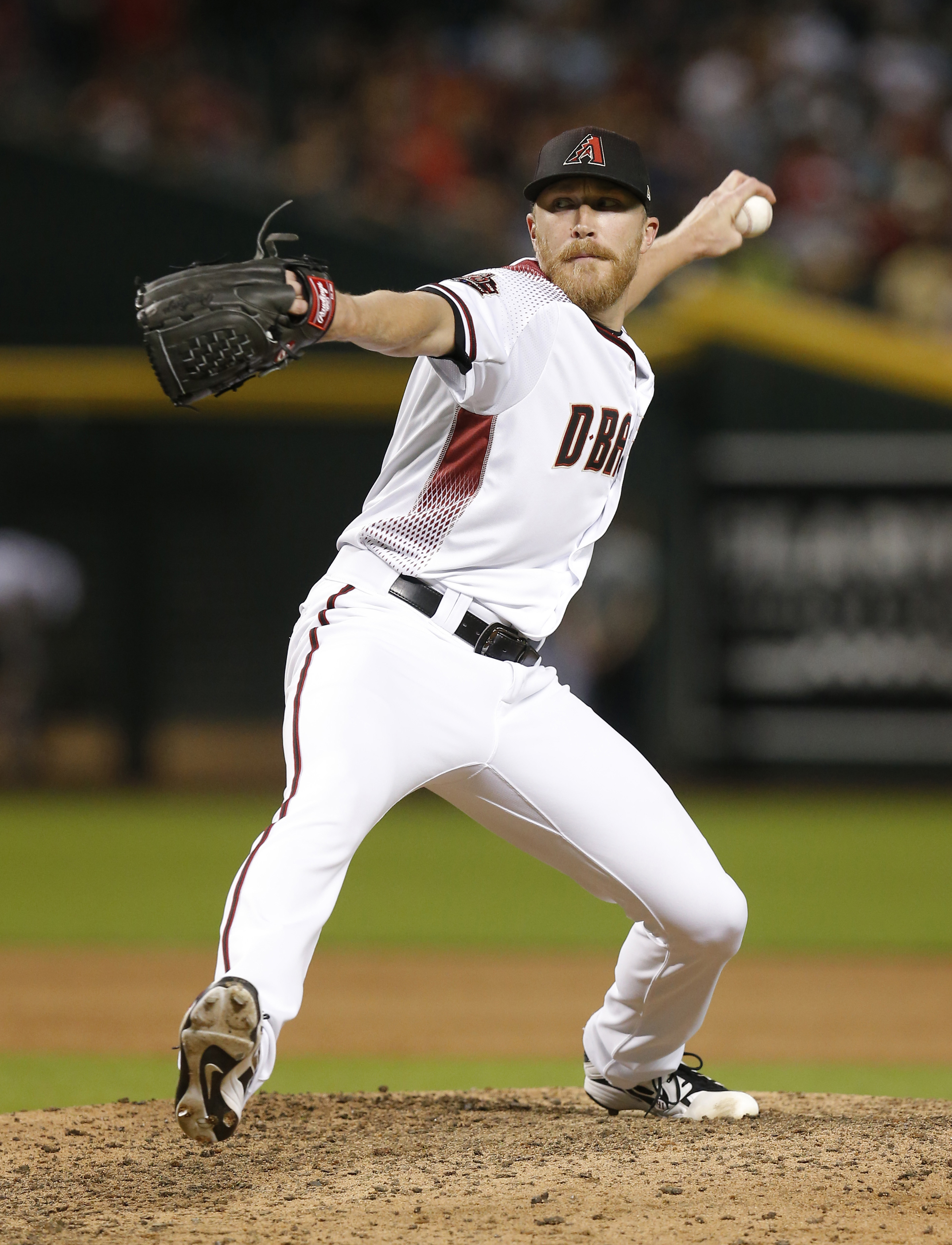
Diekman, 32, has long shown a penchant for missing bats at a lofty rate but also issuing far too many free passes. Dating back to the 2014 season, he’s averaged an impressive 11.2 strikeouts against an unsightly 4.9 walks per nine innings pitched. In that time, Diekman owns a 3.91 ERA in 246 1/3 innings of relief between the Phillies, Rangers and Diamondbacks. He’s handled both lefties (.255/.346/.346) and righties (.204/.320/.337) reasonably well outside of the obvious proclivity for issuing walks.
Last season, Diekman split the year between Texas and Arizona, working to a combined 4.73 ERA with 11.1 K/9, 5.2 BB/9, 0.68 HR/9 and a 47.8 percent ground-ball rate in 53 1/3 innings. That marked the lefty’s first full season back after missing most of the 2017 campaign due to a colectomy procedure that stemmed from ulcerative colitis.
Diekman is the second veteran arm the Royals have added in the past week, joining right-hander Brad Boxberger (a teammate last year in Arizona) as a newcomer to manager Ned Yost’s bullpen. He’ll give Kansas City a much-needed, experienced lefty; prior to this addition, Brian Flynn and Tim Hill were the team’s only southpaw relievers on the 40-man roster.
Diekman and Boxberger will be joined by holdovers Wily Peralta and Kevin McCarthy, at the very least, although the remainder of the relief corps’ composition will be determined in Spring Training. There’s even been talk of utilizing veteran starter Ian Kennedy in relief this season, which underscores the point that Spring Training will be of particular importance in assigning bullpen roles.
While Kansas City technically can control Diekman for the 2020 season, it seems quite likely that this’ll be a pure one-year arrangement. Mutual options are exercised by both parties with the utmost rarity, and the Royals utilize that specific option type regularly as an accounting measure — effectively deferring a portion of free agents’ salaries by a year in doing so.
Beyond that, there’s a good chance that if Diekman pitches well in his new environs, he’ll emerge as a trade chip this summer. Kansas City is fresh off a 58-104 season and has only made some marginal additions as the continue along in a rebuilding process. Diekman netted the Rangers a pair of minor league pitchers last summer and could once again be dangled to contending clubs this June or July if the signing goes according to plan.
Bauer, Cole, Wood Win Arbitration Cases
The players may be suffering through a winter of discontent in the free agent market, but they have now scored some notable wins in arbitration. Trevor Bauer of the Indians, Gerrit Cole of the Astros, and Alex Wood of the Reds have all been awarded the contract values they sought by their respective arbitration panels, per ESPN.com’s Jeff Passan (Twitter link).
Bauer will take home $13MM, a full $2MM more than the Indians had sought to pay him. Cole’s $13.5MM salary was about the same amount higher than the Astros’ $11.425MM filing figure. And Wood secures a $9.65MM payday that tops the $8.7MM the Reds defended.
[RELATED: MLBTR Arbitration Tracker]
Those cases break what had been a tie in arb hearings. The players already had a solid edge in the more significant cases, with Blake Treinen ($6.4MM vs. $5.6MM), Carlos Correa ($5MM vs. $4.25MM), and Tommy Pham ($4.1MM vs. $3.5MM) all coming out ahead while Kyle Barraclough ($2MM vs. $1.725MM), Michael Taylor ($3.5MM vs. $3.25MM), and Ryan Tepera ($1.8MM vs. $1.525MM) lost smaller-value contests.
In coming away with wins, all three of the starters also managed to top their projected earning power from MLBTR and Matt Swartz. Bauer ($11.6MM), Cole ($13.0MM), and Wood ($9.0MM) had projected in range of what they ultimately earned, but took shots on securing bigger paydays by making their cases to panels.
Bauer’s situation is particularly noteworthy, since he won a previous arb hearing and remains eligible for one more trip through the process after the 2019 season. This time last year, Bauer emerged with a $6.525MM salary rather than the $5.3MM the team proposed. That made him $1.225MM richer this time around as well, since his raise was dropped on top of a greater starting point. The same will hold true next year.
That serves to illustrate how important these cases can be to an individual player. But there’s also a broader market significance. Each data point that trends north can be cited by another player in the future, either in seeking a bigger arb number or in negotiating out the terms of an extension.
Phillies Extend Aaron Nola
The Phillies have officially reached a long-term deal with star righty Aaron Nola. The contract, which forestalls an arbitration hearing and expands the team’s control rights over its best pitcher, is said to be a four-year, $45MM deal that includes a club option.

Nola, a client of Paragon Sports, will receive a $2MM signing bonus and $4MM salary for the coming season. He’ll then earn successive salaries of $8MM, $11.75MM, and $15MM. The 2023 option is valued at $16MM and includes a $4.25MM buyout. Nola’s 2022 salary and 2023 option value will reportedly each increase by $1MM for each Cy Young win he secures, by $500K for a second-place finish and by $250K for finishing third through fifth in Cy Young voting.
Ultimately, then, the Phillies can control five future seasons of Nola, including 2019, at a total outlay of just $56.75MM (or perhaps a bit more, depending on Cy Young finishes). Nola gives up two would-be free agent campaigns in the deal. He had been nearing a hearing to determine his first-year arbitration salary, with his side filing at $6.7MM and the club countering at $4.5MM.
Now 25, Nola originally came to the Phillies organization as the seventh overall pick of the 2014 draft. He has rewarded the club handsomely for that selection, having already thrown 569 innings of 3.35 ERA ball at the game’s highest level while maintaining 9.4 K/9 and 2.5 BB/9 along with a 50.9% groundball rate.
Those shiny peripherals have been there from the outset for Nola, who has been a darling of ERA estimators ever since he took a big league mound. For his career to date, Nola is credited with a 3.24 FIP, 3.29 xFIP, and 3.48 SIERA.
In a sense, then, Nola’s eye-popping 2018 season was more a continuation than a turning point. But his 212 1/3-inning effort was still clearly a coming-out party, as Nola showed he could sustain excellence over a big workload while pitching meaningful innings. His resulting 2.37 ERA would have made him a Cy Young winner in some campaigns, though he settled for a still-impressive third-place finish after Jacob deGrom and Max Scherzer both turned in monster seasons.
[RELATED: MLBTR Extension Tracker]
The obvious comp for this extension is the deal reached two years ago between the Cardinals and Carlos Martinez. That agreement included more money, but a lengthier term, for another high-quality, 25-year-old hurler who was nearing a first arbitration hearing. Martinez took home a $51MM guarantee over five years, while giving the Cards successive $17MM and $18MM options with a cumulative $1MM buyout, meaning his deal would top out at seven seasons and $85MM.
Nola’s camp probably prefers his deal to Martinez’s, which set a high-water mark for arb1 pitcher extensions but did give away two additional seasons of control. Still, it’s a bit of a surprise to see that Nola did not break new ground in earnings, particularly since he secured a significant initial draft bonus in addition to already having one season of arb salary (nearly) in hand. Even if he ended up losing the hearing and suffering a major injury this spring, he’d profile as an easy 2020 tender candidate. The recent experience of Garrett Richards — who has thrown just 138 2/3 innings over the past three seasons and is rehabbing from Tommy John surgery, yet earned over $20MM in his final three arb years and then signed for $15.5MM in free agency — shows that teams will pay big money to hang onto the upside of top arms. Nola’s downside was limited, even in the event of a catastrophic injury. In terms of upside scenarios, the tepid free agent market is perhaps a factor, but team squeamishness toward long-term deals did not prevent Patrick Corbin from landing six years and $140MM — due in no small part to the fact that he hit the open market at 29 years of age.
If the option is indeed picked up, Nola will stand to reach free agency in advance of his age-31 campaign. He’d certainly still have ample earning capacity at that point, though leaving two prospective free agent campaigns in the hands of the Phils unquestionably removes some of the highest-upside contract scenarios. Of course, chasing the biggest imaginable guarantee certainly isn’t the top priority for every player, and it’s not hard to see how this contract serves Nola’s own interests as well — particularly since he did deal with a worrying forearm strain not long ago.
Whatever one thinks of the deal from the player’s perspective, it seems to be an easy risk for the big-budget Phillies to take. The Martinez experience does show some of the downside risks at play, as his injuries would have tamped down his arb earnings and do cloud his future, though he’s still a talented and youthful pitcher with ample promise. Locking up Nola comes with its own risks, but loads of upside as well.
It’s notable in this case that the sides had such a wide spread in their arb filing numbers. That had set up an important hearing decision, with Nola seeking to step in not far below Dallas Keuchel‘s record $7.25MM salary and the Phils defending something closer to the longstanding ceiling for first-time eligible pitchers (the 2006 Dontrelle Willis salary of $4.35MM). MLBTR projected a $6.6MM salary for Nola, though the team obviously felt comfortable with its aggressively low stance and the panel would have been forced to pick one of the two filing numbers. That left plenty of risk for Nola; the $2.2MM gap, after all, would also have been reflected in his prospective arb2 and arb3 salaries.
On the team’s side, though, the deal forecloses the greater earning situation. Had Nola landed the $6.7MM he asked for, and then turned in two more seasons in range of his career norms, he easily could have cleared $30MM in arbitration earnings and might well have done quite a bit more than that. deGrom’s other-worldly campaign scored him a record-setting $9.6MM year-over-year raise; expecting anything on that order would be foolish, of course, but that number shows the magnitude of potential earnings.
Of greater importance than controlling Nola’s arbitration earnings is the acquisition of control rights over two more seasons, his age-29 and age-30 campaigns. Had Nola hit the open market after his arb time ran out, he might well have commanded a huge and lengthy deal — with any acquiring team interested especially in capturing his remaining prime years. Doing a contract now allows the Phillies to hang onto those seasons for a relatively low price and without any need to promise Nola money well into his thirties.
Ken Rosenthal and Matt Gelb of The Athletic first reported the deal (Twitter link). Jeff Passan of ESPN.com tweeted the contract breakdown. The Athletic’s Jayson Stark reported the contract’s escalator clauses.
Photo courtesy of USA Today Sports Images.
Athletics To Sign Robbie Grossman
The Athletics have agreed to a one-year contract with outfielder Robbie Grossman, per Ken Rosenthal of The Athletic (Twitter link). It’s a major-league deal that lands in the $2MM range and also comes with some incentives, per Susan Slusser of the San Francisco Chronicle.
Grossman, a 29-year-old switch-hitter, was non-tendered by the Twins last fall after projecting to earn $4.0MM. He has turned in above-average offensive numbers for the Twins, though hasn’t replicated his breakout 2016 effort in the ensuing two campaigns.
The calling card here is on-base ability. Through over two thousand plate appearances, Grossman carries a .355 OBP. He has boosted that mark up to .371 over the past three years. While he delivers little in the way of power (.122 ISO), Grossman has walked at a 12.8% lifetime clip.
Grossman doesn’t shine as an outfield defender, earning mostly slightly below-average grades from advanced metrics. He doesn’t add value on the bases; in fact, he was panned for his efforts on foot in 2018 (-4.8 BsR).
Clearly, then, the interest here for the A’s is in picking up Grossman’s ability to get aboard. He’ll presumably function mostly as a reserve outfielder, with Khris Davis taking up the DH slot. Grossman has been particularly effective against left-handed pitching in his career.
Giants Acquire Trevor Gott
The Giants have acquired righty Trevor Gott from the Nationals, per Ken Rosenthal of The Athletic (via Twitter). Cash considerations are headed to D.C. in return. The Giants placed injured righty Johnny Cueto on the 60-day injured list to make roster space.
Gott was designated for assignment recently by the Nationals. The hard-throwing sinkerballer becomes the latest relief arm to be targeted by the San Francisco organization.
Still just 26 years of age, Gott turned in a highly promising 2015 campaign but has stalled out since heading to the Nationals in the ensuing offseason. All told, he owns a 4.64 ERA with 6.1 K/9 and 3.8 BB/9 in 75 2/3 MLB frames. Gott’s standout pitch is a blistering two-seamer that has enabled him to carry a 54.3% groundball rate in the majors.