
Team Facebook/Twitter/RSS
If you prefer your MLBTR fix limited to only your favorite team, we've got you covered. Below are links to our team Facebook, Twitter, and RSS pages and feeds.
AL East
- Orioles: Facebook / Twitter / RSS
- Red Sox: Facebook / Twitter / RSS
- Yankees: Facebook / Twitter / RSS
- Rays: Facebook / Twitter / RSS
- Blue Jays: Facebook / Twitter / RSS
AL Central
- White Sox: Facebook / Twitter / RSS
- Indians: Facebook / Twitter / RSS
- Tigers: Facebook / Twitter / RSS
- Royals: Facebook / Twitter / RSS
- Twins: Facebook / Twitter / RSS
AL West
- Angels: Facebook / Twitter / RSS
- Athletics: Facebook / Twitter / RSS
- Mariners: Facebook / Twitter / RSS
- Rangers: Facebook / Twitter / RSS
NL East
- Braves: Facebook / Twitter / RSS
- Marlins: Facebook / Twitter / RSS
- Mets: Facebook / Twitter / RSS
- Phillies: Facebook / Twitter / RSS
- Nationals: Facebook / Twitter / RSS
NL Central
- Cubs: Facebook / Twitter / RSS
- Reds: Facebook / Twitter / RSS
- Astros: Facebook / Twitter / RSS
- Brewers: Facebook / Twitter / RSS
- Pirates: Facebook / Twitter / RSS
- Cardinals: Facebook / Twitter / RSS
NL West
How To Use MLBTR
An explanation of the many ways to enjoy MLB Trade Rumors:
- If the main site doesn't load perfectly on your cell phone, try the more mobile-friendly mlbtraderumors.mobi. It's a simple page that shows you just the headlines and lets you click through to what you want to read.
- If you're an iPhone user, be sure to pick up our app for the latest news and rumors.
- If you want only the hard news in the form of transactions, our transactions page is the ticket. You can also get only the transactions via Twitter or RSS.
- To return to the main page at any time, just click on the title or the Home button on the navigation bar below the title.
- The navigation bar will cover many of your needs. Use the About dropdown to learn about this site or any of its writers.
- The Contact button takes you to a page where you can write an email message to the MLBTR writers. If you have a link to a rumor we've missed, please send it in through the Contact page! Also use the Contact page to inquire about advertising on MLBTR.
- The Archives dropdown shows you 15 months worth. If you need to go back further, click on Site Map at the very bottom of the page. Site Map also lists out every MLBTR post category, including players, teams, and features.
- The Tools dropdown takes you to a number of different places. The MLBTR Widget allows website owners to easily add a constantly updated box with all of MLBTR's headlines to their sites.
- Also under the tools tab is our Transaction Tracker, which enables you to search about anything and everything to do with baseball trades, signings and extensions.
- Under the tools tab, you'll find a link to our Forums, a message board community of MLBTR readers with over 8,200 members. You can discuss any baseball-related topic on the Forums, and start your own thread too.
- MLBTR's Agency Database lets you know which agencies represent which players. It's searchable by team, agency or player, so be sure to check it out.
- Feeds By Team is a very useful dropdown. Hover over it to see all 30 teams. Click on the team name to bring up a page of every post containing information about that team, with the latest on top. These are the same pages you'll find if you go to the Rumors By Team section on the sidebar and select A's Rumors, Angels Rumors, etc.
- Also under the Feeds By Team dropdown, you'll find RSS and Twitter buttons. Those links allow you to follow a single team's rumors via RSS or Twitter. Did you know we have a separate Twitter account for each of the 30 teams? For example you can follow @mlbtrtigers, where you would get the latest Tigers updates.
- You can also follow Tim Dierkes and Ben Nicholson-Smith on Twitter for more MLBTR content.
- On the far right of the Navigation bar, you'll see buttons for Twitter, Facebook, and RSS. MLBTR has over 105,000 Twitter followers, over 43,000 Facebook fans, and over 53,000 RSS subscribers. Sign up for these and you'll be the first to receive all of our posts.
- Be sure to check out your favorite team's MLBTR page on Facebook so you can receive and comment on the latest rumors.
- On to the sidebar. It begins with a list of our Top Stories, which our writers update any time major hard news occurs. Go here for a quick update on the most important stories. Below that is the site's Search Box, where you can type in any player's name and get the latest on him.
- MLBTR Features has all kinds of goodies, including our free agent lists, 2011 draft order, list of Scott Boras clients, and GM-related stuff. Many of the MLBTR Features are constantly updated by our writers, so be assured that our free agent lists are always fresh.
- Below Features you've got headlines for all the Recent Posts, in case you'd rather not scroll to see all the headlines. Then there's a box for our Mailing List, where you can sign up to receive a daily email containing MLBTR's posts. Use this option if you don't need the news as soon as possible.
- Next we have Featured Posts, where you'll find original work from MLBTR writers we consider noteworthy. For example, read about MLBTR's GM candidates.
Regular MLBTR Features
If you're a regular MLBTR reader, you'll be familiar with our chats, our Week In Review posts and Mike Axisa's Baseball Blogs Weigh In feature. Here's some more detail on when you'll see our weekly features and exactly what to expect from them:
- MLBTR Chats – Come by every Wednesday at 2pm CDT to chat about the latest trades, signings and rumblings around the Major Leagues.
- Baseball Blogs Weigh In – Every Friday morning, Mike Axisa directs you to some of the best writing on baseball blogs around the web. Whether it's opinion, stats or something else entirely, you can connect to the best of the blogosphere once a week on MLBTR. If you want to send Mike a post of yours, reach him at: mike@riveraveblues.com.
- Week In Review – It's remarkable how much happens in seven days. Every Sunday night, we summarize the week's biggest stories in our Week In Review posts.
- MLBTR Originals – We gather all our original analysis and reporting in one place every Sunday night.
Free Agent Arbitration Primer
What does it mean when we say a free agent was offered arbitration? When a team offers arbitration to one of its own free agents, it is offering the player a 2012 contract at a to-be-determined salary. Last year, out of 35 such offers, only two players (Frank Francisco and Jason Frasor) accepted.
One reason "offering arbitration" to free agents is confusing is that the actual process of arbitration rarely comes into play. Even with Francisco and Frasor last year, the sides agreed on 2010 salaries without arbitration hearings. In an arbitration hearing, a third-party panel must choose between one salary figure submitted by the team and another submitted by the player. These hearings only take place if the sides cannot agree on a salary. Clearing up a common error: if a free agent accepts arbitration, the team and the player can submit any salary figure they want.
If most free agents turn down arbitration offers, why do we care? Turning down an arbitration offer makes draft pick compensation possible for the team losing the free agent. Free agents can be classified as Type A, B, or nothing. Check our list to see the current designations, and click here to see the stats the Elias Sports Bureau uses to assign them.
Prince Fielder will be our example of a Type A free agent. Say the Brewers offer him arbitration, and he turns it down, knowing that he can do better than a one-year contract if he hits the open market. Say also that the Dodgers sign Fielder, and do not sign any other Type A free agents. In this case, the Brewers are given Los Angeles' #18 pick in the June 2012 draft as well as a pick in a supplemental round that takes place after the first round. It's important to note that the supplemental pick is squeezed into the draft but it does not come from the Dodgers. Therefore, the Dodgers only surrendered one pick to sign Fielder, even though the Brewers receive two.
In the Fielder example, the Brewers were given the Dodgers' first-round draft pick. With Type A free agent draft pick compensation, only first-round picks outside of the top 15 (plus holdovers from the previous year) are eligible to be taken by another team. In cases where the first-round pick is protected, the team gives up its second-round pick. For example, if the Cubs sign Fielder, the Brewers get their second-round pick rather than their protected first-round (#6) pick.
Now, if one team signs multiple Type As from other teams, draft pick compensation gets muddier. Click here to read up on that.
We'll use left-hander Bruce Chen as our Type B example. Say the Royals offer him arbitration and he turns it down in search of a better contract. Say also that the Orioles sign Chen. The Orioles do not give a draft pick to the Royals. The Royals do gain a draft pick – it is squeezed into the supplemental round. Therefore, signing a Type A free agent who was offered and turned down arbitration costs one draft pick, but signing such a Type B does not. Players who were not offered arbitration do not have draft pick compensation. Same goes for players who were designated neither A nor B.
Another cause for confusion: we have a different concept that also uses the word "arbitration." When we say Clayton Kershaw is arbitration-eligible, we mean that he has between two-plus and five-plus years of service time, and therefore has some say in his salary. Kershaw is under the Dodgers' control. The only question is what they will pay him next year, and that's the one similarity with free agent compensation. Kershaw and the Dodgers each submit salary figures, and if they can't agree an arbitration panel must choose one.
Upcoming deadlines: on November 23rd (by 11pm CST), we'll learn whether teams offer arbitration to their free agents. By December 7th, those players must choose whether to accept. Expect only a handful to accept. Those who accept are no longer free agents.
The non-tender deadline is December 12th. That is when teams decide whether to tender a contract to arbitration-eligible players. These players have fewer than six years of service time, and are under team control for 2012 if the team wants them. If not, the players are non-tendered and become free agents. We'll be adding many names to the free agent list on December 12th.
This is a modified version of a post by Tim Dierkes from December, 2009.
Final Update On This Year’s Rule 5 Picks
It takes an entire season for Rule 5 draftees to become official property of their new teams. Nearly ten months after the most recent edition of the annual draft, much of the uncertainty has been resolved. Five teams have been rewarded for their patience and now have new players. Here are the details on this year's 19 Rule 5 picks…
Official Property Of Their Current Teams (5)
- Pedro Beato, 24, posted a 4.30 ERA with 5.2 K/9, 3.6 BB/9 and a 47.4% ground ball rate in 67 innings for the Mets.
- Aneury Rodriguez pitched 85 1/3 innings as a swingman this year. The 23-year-old, who is one of the most extreme fly ball pitchers in the game, posted a 5.27 ERA with 6.8 K/9 and 3.4 BB/9 for the Astros.
- Nathan Adcock averaged just one appearance per week for the Royals after making two starts in late May. Used mostly out of the bullpen, the 23-year-old right-hander posted a 4.62 ERA with 5.4 K/9 and 3.9 BB/9 in 60 1/3 total innings.
- Joe Paterson, 25, has a 2.91 ERA with 7.4 K/9 and 4.0 BB/9 in 34 innings spread over 62 appearances. D'Backs manager Kirk Gibson limited the left-hander's exposure to right-handed hitters all season (91 plate appearances vs. LHB, 59 plate appearances vs. RHB).
- Michael Martinez added value for the Phillies with his versatility. Though he didn't hit much (.196/.258/.282), he backed up at second, third, short, left and right and played in more than half of Philadelphia's games.
Traded (4)
The Mets returned Brad Emaus to the Blue Jays, who traded the infielder to Colorado; the Twins retained Scott Diamond in a trade with the Braves; the Red Sox sent Daniel Turpen to the Rockies; the Indians recently sent Josh Rodriguez to the Pirates. Rule 5 restrictions no longer apply to these four players.
Injured (2)
Elvin Ramirez (Nationals) and Mason Tobin (Rangers) have been on the 60-day DL for over four months. They have to spend 90 non-September days on the active roster to become official property of their new teams. Otherwise, their Rule 5 status carries forward until the players spend 90 non-September days on the active roster.
Returned (8)
Brian Broderick, Jose Flores, Adrian Rosario, Pat Egan, Lance Pendleton, George Kontos, Robert Fish and Cesar Cabral were returned to their original organizations at various points this year.
MLB’s First-Year Managers
After an offseason of heavy managerial turnover, the 2011 season featured 12 skippers in their first full seasons with their current clubs. We checked in on the managers midseason and, now that the regular season is over, it's time to take another look at how the leadership changes have gone.
Keep in mind that teams' won-loss records reflect their players, their health and their opponents, not just the managers' work.
American League
Buck Showalter’s Orioles finished 69-93 and there are rumblings that he could move upstairs to the front office. John Farrell’s Blue Jays finished with a .500 record – 81-81 – in his first season as a manager.
Ned Yost led the Royals to a 71-91 record as Kansas City surpassed the 70-win plateau for just the second time in eight seasons. More importantly, Yost oversaw the big league debuts for top prospects like Eric Hosmer and Mike Moustakas. Former Indians manager Eric Wedge had the punchless Mariners on the fringes of contention, until an extended slump dragged the team to the bottom of the AL West, where they finished with a 67-95 record.
National League
The Braves lost their grip on the NL Wild Card with a late-season slide and finished 89-73 under new manager Fredi Gonzalez. Terry Collins' Mets finished 77-85 and the club picked up Collins' 2013 option this week. Another NL East skipper, Edwin Rodriguez, resigned after the Marlins' record slipped to 32-39.
Ron Roenicke led the Brewers to a division title and a franchise record 96 wins. Mike Quade of the Cubs completed his first full season in Chicago with a 71-91 mark. Clint Hurdle's Pirates were in the playoff mix for four months and eventually finished under .500 again with a 72-90 record.
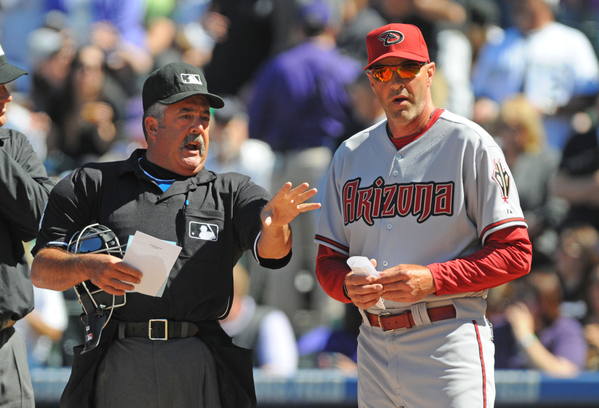
Kirk Gibson (pictured) is headed to the playoffs after leading the Diamondbacks to 94 wins and the NL West title. Another former big league star, Don Mattingly, led the Dodgers to an 82-79 mark after a slow start.
Photo courtesy Icon SMI.
Returns For Trading The Manager
So it appears that the Florida Marlins, a team not known for friendliness to Twitterers, have acquired Ozzie Guillen, one of the most outspoken Twitter users in MLB. It's going to cost the Marlins a pair of prospects: Osvaldo Martinez, an infielder, and Jhan Marinez, a relief pitcher. The two rated among Florida's top five prospects to begin 2011, though both have arguably taken steps back this year.
Still, to get a pair of young, cost-controlled players for a manager represents a pretty significant return. Martinez the infielder profiles as a plus glove at second base and shortstop; Marinez the pitcher struck out 11.5 batters per nine innings this season as a 22-year-old in Double-A.
Given the nature of a manager's contributions, it is hard to see any team swapping players for a manager and coming out ahead. Let's take a closer look at how this value measures up to the other manager-based swaps at the time they occured.
The most recent player/manager swap happened back in 2002, when the Mariners traded Lou Piniella to the Tampa Bay then-Devil Rays. However, this swap had players on both sides. Seattle also sent minor league infielder Antonio Perez to Tampa Bay, receiving outfielder Randy Winn in return. Winn, entering his age-29 season, was clearly a superior player at the time to either player in today's deal. But he was also a good deal more expensive, costing Seattle $3.3MM in salary in 2003, then a three-year, $11MM deal to retain him following the season.
Antonio Perez, incidentally, compares well with Osvaldo Martinez. Perez, at the time of the trade, had posted a .645 OPS in Double-A at the age of 22. Martinez just put up a .618 OPS in Triple-A at age 23. Both impressed with defensive ability, and both had suffered through their share of injuries. Perez appeared to have power Martinez doesn't have, but he'd yet to translate it into performance.
Ultimately, if you take Lou Piniella out of the equation, this sounds a bit like a modern-day Tampa trade, an about-to-be-expensive outfielder for an infielder with upside. That they received a manager as well – they paid Piniella more than Winn, giving him a four-year, $14MM contract - undoes the value completely. It is fair to say that Seattle won this swap, and received the best player in the deal. As for Tampa Bay, receiving Perez mitigates the deal overall, making the Devil Rays come out ahead of the Marlins on the manager end of the comparison.
The deal that saw Oakland send manager Chuck Tanner to the Pirates in November 1976 for catcher Manny Sanguillen and $100K is much easier to evaluate. Tanner was a fine manager; a 1976 Pirates team that won 92 games without him won 96 games with him. Oakland, however, received Manny Sanguillen and enough money that he effectively cost the Athletics $45K for the season. Though he only posted an OPS+ of 81, his versatility at that price was a substantial reward.
A year later, Oakland managed to deal Sanguillen back to the Pirates for three more players – outfield prospect Miguel Dilone, infielder Mike Edwards, and pitcher Elias Sosa, who led the Oakland bullpen with 2.2 wins above replacement in 1978. For his part, Oakland owner Charlie Finley thought the deal was entirely appropriate. "If I'm going to run a finishing school for managers, I want to be paid for it," Finley told the Associated Press. Clearly, Oakland got more for Tanner than Chicago got for Guillen. But the lesson with Tanner, just as with Piniella, is that dealing players for a manager almost never makes sense for the team obtaining the skipper.
There is that time, however, where it seemed to work out perfectly. Back in October 1967, the Mets traded pitching prospect Bill Denehy and $100K to Washington in exchange for manager Gil Hodges. Denehy had just struggled in both his Triple-A and Major League stints as a 21-year-old, but considering his youth and strikeout rates in the minor leagues, still held a good bit of promise. That he did so as a starter gave him more potential upside than Jhan Marinez of the Guillen deal. The $100K meant that in 1968, the Senators received Frank Howard's 170 OPS+ and Camilo Pascual's 109 ERA+ – the team's best hitter and pitcher – for free. Howard made $50K in 1968, Pascual made $42.5K.
Still, no one associated with the Mets at the time regrets the deal. Hodges lifted the Mets to ninth in 1968, then to the World Series in 1969. Many of his players, Tom Seaver included, credit Hodges with being a difference-maker at the helm. New York's talent in 1969 was undeniable, yet it would be a mistake to dismiss Hodges' impact. But a farm system producing players like Seaver, Nolan Ryan, Jerry Koosman and many others has to be considered the dominant factor. It even produced enough pitching that a prospect like Denehy could be dealt.
Ultimately, if Ozzie Guillen manages the Marlins to a World Series victory by 2013, no one in Florida will mind if both prospects they traded turn into stars. From a value perspective, however, it just isn't clear that making such a trade ever makes sense.
Free $400 Fantasy Football Contest (Sponsored Post)
Looking to show off your fantasy football genius this week? Try DraftStreet, where you can put together a new fantasy team each week and compete against other users for real money.
Right now DraftStreet has an NFL freeroll for MLB Trade Rumors readers, meaning you can take a shot at a chunk of the $400 prize pool for free, with no strings attached. Here's how it works.
The NFL freeroll begins Sunday at 1:00pm eastern time, so you have until then to create your team. You're given a $100K salary cap, and each player is assigned a price by DraftStreet. Your roster will cover these positions: 2 QBs, 2 RBs, 2 WRs, 1 TE, 2 FLEX, and 1 Defense. You get points based on how your team performs through Monday night's game. The teams with the most points get the prize money. Below is a screenshot of a sample roster:
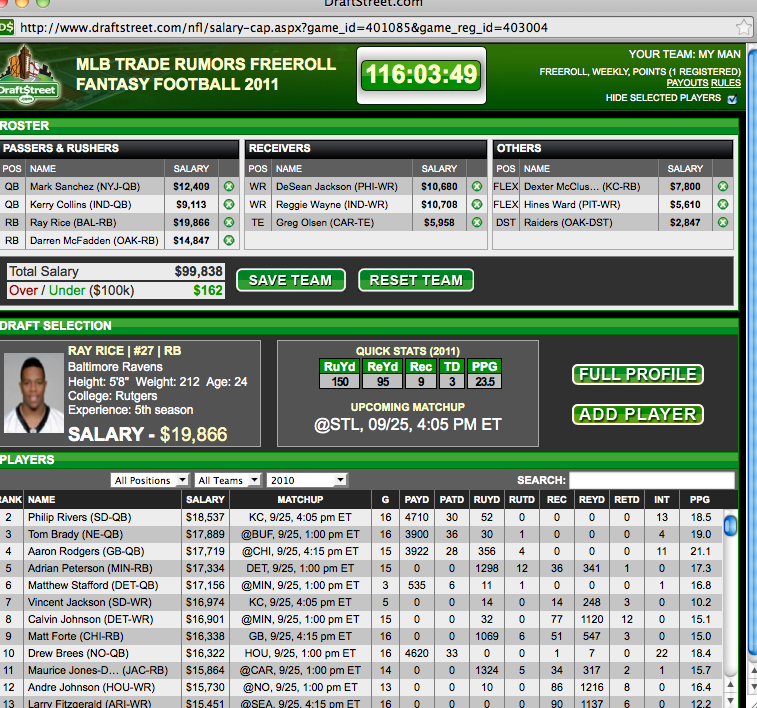
If you're interested, sign up and create a roster prior to Sunday's games (1:00pm eastern time). It's quick, easy, fun, and the MLBTR league gives you a free chance to win some of the $400 prize pool. If you enjoy the competition you can try other leagues for free and earn credits, or deposit real money.
Team Facebook/Twitter/RSS
If you prefer your MLBTR fix limited to only your favorite team, we've got you covered. Below are links to our team Facebook, Twitter, and RSS pages and feeds.
AL East
- Orioles: Facebook / Twitter / RSS
- Red Sox: Facebook / Twitter / RSS
- Yankees: Facebook / Twitter / RSS
- Rays: Facebook / Twitter / RSS
- Blue Jays: Facebook / Twitter / RSS
AL Central
- White Sox: Facebook / Twitter / RSS
- Indians: Facebook / Twitter / RSS
- Tigers: Facebook / Twitter / RSS
- Royals: Facebook / Twitter / RSS
- Twins: Facebook / Twitter / RSS
AL West
- Angels: Facebook / Twitter / RSS
- Athletics: Facebook / Twitter / RSS
- Mariners: Facebook / Twitter / RSS
- Rangers: Facebook / Twitter / RSS
NL East
- Braves: Facebook / Twitter / RSS
- Marlins: Facebook / Twitter / RSS
- Mets: Facebook / Twitter / RSS
- Phillies: Facebook / Twitter / RSS
- Nationals: Facebook / Twitter / RSS
NL Central
- Cubs: Facebook / Twitter / RSS
- Reds: Facebook / Twitter / RSS
- Astros: Facebook / Twitter / RSS
- Brewers: Facebook / Twitter / RSS
- Pirates: Facebook / Twitter / RSS
- Cardinals: Facebook / Twitter / RSS
NL West
Do Owners, GMs Learn From Bad Contracts?
Earlier this season, Mets owner Fred Wilpon explicitly compared the impending free agency of Jose Reyes to the contract that Carl Crawford signed last winter. That seven-year, $142MM deal was supposed to be beyond Reyes' reach.
But as the season has worn on, it has been Crawford who hasn't been worth "Carl Crawford money". The disappointing left fielder has tallied an OPS+ of 86 and just 18 stolen bases entering Monday's games, and so it has become fashionable to declare that general managers and owners will learn from Crawford, an admittedly similar player to Reyes, and avoid a similar payout in both length and worth of contract to Reyes this coming offseason.
This led me to wonder: had owners ever learned from a disastrous free agent deal before? Simply put, had any first-year collapses in performance by one player kept another, similar player from receiving a similar amount of money?
Take Darren Dreifort, for example. Through the 2000 season, the 28-year-old Dreifort had mediocre career totals – an ERA+ of 98 – but posted a 105 ERA+ just prior to hitting free agency. The Dodgers, intent on keeping him, signed Dreifort to a five-year, $55MM contract.
It didn't take long for the deal to look like a loser – Dreifort pitched to an ERA+ of 78 over half of 2001, then missed the rest of that season and the next one with an elbow injury. If the Crawford/Reyes thesis is to be believed, all of baseball shied away from such contracts for pitchers, particularly ones roughly Dreifort's age with a similar track record of success, right?
Not even if we narrow it to Los Angeles' own division. In the winter of 2001, the San Francisco Giants, who had a front row seat for Dreifort's failings, signed Jason Schmidt to a five-year, $41MM contract. Schmidt was 28, the same age as Dreifort, and his career ERA+ was 99 to Dreifort's 98. Even his breakout season was similar, with a 107 ERA+ to Dreifort's 105. That the Schmidt contract worked out far better than Dreifort's is beside the point; the Giants had no way to know that at the time. They simply had Dreifort's celebrated contract in their short-term memory, and did not hesitate to commit to Schmidt for the same duration anyway.
In reality, we can play a similar game with virtually every terrible free agent contract. Vince Coleman, for instance, signed a four-year, $11.95MM contract with the New York Mets prior to the 1991 season. He played in only 72 games during his first season in New York and saw his stolen base total drop from 77 to 37. Nevertheless, Otis Nixon, a speed-reliant player three years older than Coleman, signed with the Braves a year later for three years, $8.1MM.
That lesson didn't take a decade earlier, either. Speedy outfielder Dave Collins, fresh off of a 108 OPS+ age-28 season, signed a three-year, $2.475MM contract with the Yankees to help replace Reggie Jackson prior to the 1982 season. A year later, the Yankees dumped Collins (along with a package of players that included Fred McGriff) on the Blue Jays when he put up an OPS+ of 80 in New York. And yet, even as Collins was getting dumped, the Houston Astros signed Omar Moreno, an inferior player to Collins (also speed-reliant, and a year older than Collins when he signed) to a five-year, $3.5 million contract.
So forgive me if I don't believe that Jose Reyes will receive a lesser payday thanks to the struggles of Carl Crawford. As usual, Reyes' contract will be dictated by the market for players at his position and whether teams with money have a desire for Reyes, not owners and GMs mindful of recent comps that soured. If a team wants Reyes, that team will conclude this situation is different. It wouldn't particularly surprise me if that team even turned out to be the same one that signed Crawford.