
1993: The Year September Trades Mattered
My colleague Ben Nicholson-Smith pointed out, rightly, that September trades haven't amounted to much in the past decade. But there was a glorious summer-turned-fall for trades back in 1993. As Yasir Arafat and Yitzhak Rabin shook hands on the White House lawn, seemingly ending Middle Eastern conflict, Major League teams came together to help one another through the season's final month.
Sure, everyone knew that these relationships were as transitory as a momentary coupling with a beautiful stranger you meet on a cruise. But let's revisit the brief, sweet memories that resulted.
On September 1, the Chicago White Sox traded reliever Donn Pall to the Philadelphia Phillies for catcher Doug Lindsey. Though the Phillies held a 9.5 game lead over the Montreal Expos on September 1, a thin bullpen needed reinforcements. Pall certainly provided quality innings for Philadelphia, pitching to a 2.55 ERA over 17 2/3 innings. The hard-charging Expos managed to cut that lead to three games by season's end, foreshadowing further improvement the following season. Were Pall's innings the difference between winning and losing the division? Perhaps not, but they helped provide insurance for a closer-than-expected finish.
A week later, the Baltimore Orioles found themselves in a surprisingly strong position. Down six games in the AL East as September began, Baltimore had rallied to within a game of the first-place Blue Jays. Needing a hitter to help them with the stretch run, the Orioles sent minor leaguers Stanton Cameron and Terry Farrar to Pittsburgh for outfielder Lonnie Smith. For Smith, the chance to play left field and designated hitter on a contending team one last time helped spark him to a 139 OPS+ with Baltimore in 32 plate appearances. Though the Orioles faded, Lonnie Smith certainly didn't.
The significant dealing still wasn't finished, even when the month was more than half over. On September 17, the Texas Rangers trailed the AL West-leading White Sox by just 4.5 games. In an effort to bolster the team's offense, Texas traded minor leaguer Dave Gandolph to the Houston Astros for outfielder Chris James. The move paid dividends immediately, with James homering twice in his very first game with Texas. He went on to hit .355/.412/.677 in 34 plate appearances. Though Texas fell short of division title, James provided 0.7 WAR – an amazing total for someone on the active roster for a total of 15 days.
That same day, the Yankees, fading from the AL East race, decided to add another arm to a young, tiring starting rotation. Though the Phillies also had interest in Frank Tanana – after all, Donn Pall can't win pennants all by himself – the Yankees managed to snag Tanana from the crosstown Mets for reliever Kenny Greer. The once-great strikeout pitcher still knew how to get hitters out with junk at age 40. Though he failed to win his three starts with the Yankees, he pitched into the seventh inning all three times, posting a quality start in each outing. The Yankees failed to catch the Blue Jays, But Tanana's 19 2/3 innings of 3.20 ERA pitching certainly helped keep things close.
Will history repeat itself? Perhaps Chris Capuano will go across town to a contending Yankees team? Maybe the White Sox will send Jesse Crain to the Phillies? No matter how late it gets, don't assume the deals won't have an impact. After all, you'll never forget that night at sea, no matter how brief the interlude.
Players Traded In September
Let's face it – September trades are generally more complicated and less significant than the deals we see most months of the year. Players traded in September can help their teams reach the playoffs, but they can't play in postseason games. Here's a look at some current MLB players who have been involved in September trades since 2000:
- Octavio Dotel, 2010 - Dotel, a veteran of midseason trades, pitched 5 1/3 innings for Colorado after they acquired him from the Dodgers in September.
- Willie Bloomquist, 2010 - Bloomquist played three positions for the Reds last September, contributing five singles and a walk in 18 plate appearances.
- Micah Owings, 2008 - The Reds acquired Owings in the Adam Dunn deal, but he didn't pitch particularly well with Cincinnati. He does own an .808 OPS in 72 plate appearances for the Reds, though.
- Sean Rodriguez, 2009 - Rodriguez, the player to be named in the Scott Kazmir deal, has a .218/.311/.354 line with the Rays as a utility player this year.
- George Kottaras, 2006 - The Padres sent Kottaras to Boston for David Wells five years ago this month.
- Jason Frasor, 2002 - Frasor hadn't appeared in an MLB game when the Tigers sent him to the Dodgers in 2002.
The Closer Carousel
Teams pay a premium for saves; it's how Rafael Soriano was able to get a three-year, $35MM contract last offseason. Impending free agents who have picked up at least five saves this year: Jose Valverde (club option), Heath Bell, Francisco Cordero (club option), Jonathan Papelbon, Ryan Madson, Francisco Rodriguez, Kyle Farnsworth (club option), Matt Capps, Joe Nathan (club option), Jon Rauch (club option), Frank Francisco, Jason Isringhausen, and Jonathan Broxton. Brad Lidge is another consideration, though he has a ways to go. Options for Valverde and Farnsworth could be exercised and several more will likely be content to set up, but we're left with a minimum of five relievers who will expect to close next year. They won't get to choose their role, but trade candidates such as Brandon League, Leo Nunez, or Huston Street could enter the picture as well.
As many as 16 teams may be in the market for a closer in the offseason to varying degrees:
- Orioles: I'm not sure the team's new GM will want to throw good money after bad, but Kevin Gregg is the worst reliever holding a closer job currently.
- Red Sox: They could re-sign Papelbon, though Daniel Bard certainly appears ready.
- Blue Jays: Jason Frasor and Octavio Dotel are gone, while Shawn Camp, Rauch, and Francisco are eligible for free agency. Perhaps the Jays will bring several relievers in on one-year deals again, and/or pick up Rauch's option.
- Tigers: They could save $9MM by declining Valverde's option, allowing them to use Joaquin Benoit in the ninth or sign someone cheaper.
- Twins: With Capps and Nathan up for free agency, Glen Perkins could get the job. Or, Nathan could be re-signed at a much lower rate or they could see who else is out there.
- Mariners: David Aardsma figures to miss most of 2012, so League may be needed again. Otherwise, the Mariners could flip League at his peak value and bring in someone else.
- Marlins: The Marlins reportedly intend to retain Nunez as next year's closer, but they could change their mind and put him on the market.
- Mets: Bobby Parnell has the early line on the job, but they could bring in someone more seasoned to take on an Isringhausen-type role.
- Phillies: I expect a legitimate attempt to re-sign Madson. Antonio Bastardo might be capable of stepping in if that fails, but the Phillies figure to be in the market for a veteran closer.
- Reds: Cordero's option is certain to be declined, so the question becomes whether to use Aroldis Chapman as a closer or starter.
- Astros: I wouldn't expect them to sign Papelbon, but an experienced reliever would make sense even if Mark Melancon retains the job.
- Cardinals: They can make it work with Fernando Salas, Jason Motte, and others, and may need to skimp given the big names they have up for free agency.
- Rockies: They could save money by moving Street and using Rafael Betancourt or others.
- Dodgers: There's no reason not to stick with Javy Guerra, and Kenley Jansen has closer potential as well. Matt Guerrier is around to fill the veteran reliever role, so they might not be in the closer market.
- Padres: If they don't figure something out with Bell, I'd expect a cheap veteran signing or two. It'd be a dream opportunity for most relievers.
- Giants: Depending on how Brian Wilson's elbow soreness turns out, they could be in the market.
Certainly there are enough closer jobs to go around, though I don't see too many teams likely to join a high-end bidding war for Papelbon or Madson.
If you enjoy following all things closer-related for your fantasy team, check out CloserNews on Twitter as well as the website.
Reverse Standings
The Astros have a firm hold on the top spot, while the Orioles, Royals, Twins, Mariners, and Cubs are battling for second place. Is this Bizarro World Baseball? No, it's MLBTR's reverse standings!
Currently, fans for about 60% of MLB clubs are thinking about next year. Our reverse standings are the perfect way to follow the action, as teams vie for the for the best draft picks in June of 2012 by losing the most games in 2011. The standings will be updated every morning through the end of the season, and even calculate tiebreakers by looking at last year's standings. You will always be able to find the link under MLBTR Features in the righthand sidebar.
Limited Free Agent Market For Bats
Teams looking to add offense this offseason will face limited options. A look at the ten available middle-of-the-order type bats:
- Lance Berkman, 1B/OF: By most measures, Berkman has been one of the ten best offensive players in baseball this year at age 35. He's played in 87% of the Cardinals' games and has been consistently productive. He's got a list of three or four teams, headed by the Cards, and would consider retirement if he's "not thrilled with the opportunities." Though a multiyear deal would likely be available, Berkman is fine with another one-year contract. I have to imagine he'll get $12MM or more.
- David Ortiz, DH: Ortiz, who turns 36 in November, has been nearly as good as Berkman, and he's handled lefties well. Reportedly the Red Sox have yet to discuss a new deal with him. It's not clear how adamant each side will be about their stance on a multiyear contract. But the general expectation is that Ortiz returns to Boston.
- Prince Fielder, 1B: Most expect Fielder to look for Mark Teixeira money or beyond, though yesterday I was able to come up with reasons each of the 30 teams might balk at signing him. He'll land somewhere, but Scott Boras may need a team to bid against itself to reach Teixeira heights.
- Albert Pujols, 1B: Pujols now leads the National League with 31 home runs, so his off year is relative. His walk rate is down significantly though, which could give some teams pause before making one of the ten largest commitments in baseball history, if not one of the three biggest. The Cardinals have first crack at signing him, and there's a good chance they get something done.
- Carlos Beltran, RF: Beltran has been healthy and effective this year, outside of a DL stint for a strained hand shortly after his trade to the Giants. A strong finish could result in a three-year deal, though Beltran does turn 35 in April. He figures to get more than $10MM per year.
- Michael Cuddyer, RF/1B: Cuddyer has alternated good and mediocre seasons, a trend his agent will have to downplay since this is one of the good years. Cuddyer, 33 in March, should get a three-year deal with a salary similar to this year's $10.5MM.
- Aramis Ramirez, 3B: Ramirez should benefit from being the only viable starting option at third base on the market. He was headed toward a possible extension with the Cubs, but with Jim Hendry being fired he's going to take a step back and see what's out there. His $16MM option is mutual in nature. The 33-year-old should be able to secure a deal similar to my Cuddyer estimate, maybe better.
- Josh Willingham, LF: Willingham, 32, started out slow for the Athletics but has a .277/.374/.606 line with 12 home runs in 163 plate appearances since July 1st. Injuries have made him something of a 120 game guy, so a two-year deal for around $16MM seems feasible. Willingham projects as a Type A free agent, and seems like someone who might accept arbitration if the A's offer.
- Jason Kubel, RF/DH: At 29, Kubel has age on his side compared to most free agents. He missed almost two months with a foot injury this year but previously had been durable. He could be a popular free agent, with four years possible, but his stock will be hurt if he climbs to Type A status and turns down an arbitration offer from the Twins, thereby costing his new team a draft pick.
- Carlos Pena, 1B: Pena, 33, has been aided slightly by his first crack at the National League. He's a useful hitter, but a two-year deal at $10MM plus is a tough sell even for Scott Boras for a perennial .200 hitter.
There are other free agents – Jose Reyes and Jimmy Rollins are difference-makers and Casey Kotchman is having a nice year – but the middle-of-the-order bat market boils down to the ten I named above. Berkman, Ortiz, Fielder, and Pujols all have limited markets due to preference, price tag, or in Ortiz's case, the fact that he can't play the field. It's a good time to be Beltran, Cuddyer, Ramirez, Willingham, Kubel, Pena, or Kotchman. Surprises are possible, but the trade market offers little beyond perhaps Carlos Quentin.
Team Facebook/Twitter/RSS
If you prefer your MLBTR fix limited to only your favorite team, we've got you covered. Below are links to our team Facebook, Twitter, and RSS pages and feeds.
AL East
- Orioles: Facebook / Twitter / RSS
- Red Sox: Facebook / Twitter / RSS
- Yankees: Facebook / Twitter / RSS
- Rays: Facebook / Twitter / RSS
- Blue Jays: Facebook / Twitter / RSS
AL Central
- White Sox: Facebook / Twitter / RSS
- Indians: Facebook / Twitter / RSS
- Tigers: Facebook / Twitter / RSS
- Royals: Facebook / Twitter / RSS
- Twins: Facebook / Twitter / RSS
AL West
- Angels: Facebook / Twitter / RSS
- Athletics: Facebook / Twitter / RSS
- Mariners: Facebook / Twitter / RSS
- Rangers: Facebook / Twitter / RSS
NL East
- Braves: Facebook / Twitter / RSS
- Marlins: Facebook / Twitter / RSS
- Mets: Facebook / Twitter / RSS
- Phillies: Facebook / Twitter / RSS
- Nationals: Facebook / Twitter / RSS
NL Central
- Cubs: Facebook / Twitter / RSS
- Reds: Facebook / Twitter / RSS
- Astros: Facebook / Twitter / RSS
- Brewers: Facebook / Twitter / RSS
- Pirates: Facebook / Twitter / RSS
- Cardinals: Facebook / Twitter / RSS
NL West
Free $400 Fantasy Baseball Contest (Sponsored Post)
Looking to flex your fantasy baseball genius on a single night? Try DraftStreet, where you can put together a new fantasy team every night and compete against other users for real money.
Right now DraftStreet has a freeroll for MLB Trade Rumors readers, meaning you can take a shot at a chunk of the $400 prize pool for free, with no strings attached. Here's how it works.
The MLBTR freeroll is for Friday night's games (the Cubs-Cardinals game at 1:20 is not included), so you have until then to create your team. You're given a $100K salary cap, and each player is assigned a price by DraftStreet. For Friday, Felix Hernandez is considered the most valuable player since he starts against the Rays, but he'll cost you over $15K. Your roster will cover these positions: C, 1B, 2B, 3B, SS, 3 OF, 2 utility, 2 SP, 1 RP, 1 P and 2 Reserves (14 starters). You get points based on how your team performs Friday. For example, you'll get 0.75 points for each strikeout Felix racks up and 1.5 points if he gets the win. The teams with the most points get the prize money. You can apply all kinds of strategy in building your roster – for example, check out the chance of rain at Citi Field Friday before you decide to add Brewers and Mets players. Below I've taken a screenshot of my roster:
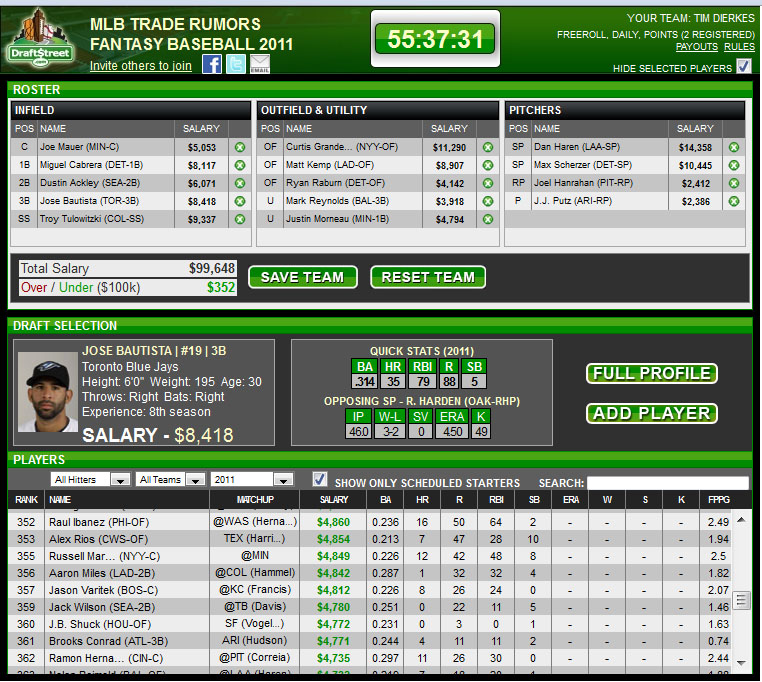
If you're interested, sign up and create a roster prior to Friday's night games (6:05pm central time). It's quick, easy, fun, and the MLBTR league gives you a free chance to win some of the $400 prize pool. If you enjoy the competition you can try other leagues for free and earn credits, or deposit real money.
Trade Targets Separated At Birth: Pence/White
Since the Philadelphia Phillies traded four prospects for Hunter Pence last month, things couldn't be going better – Pence is at .344/.408/.557 in his first 16 games. Still, the price was awfully steep for two years and two months of Pence, a 28-year-old corner outfielder with a career OPS+ of 118.
The four players Houston received – Jarred Cosart, Jonathan Singleton, Domingo Santana and Josh Zeid – represented three of the top nine Phillies prospects heading into the season, according to Baseball America, with Zeid checking in at 23rd. If the Phillies win another World Series or two, all that is likely to be forgotten. But when compared to Rondell White, a strikingly similar player in terms of value at the time he was traded, it is hard to feel as if the Phillies got a proper return.
When the Montreal Expos traded Rondell White in July 2000, he was 28 years old, just like Pence is now. His career OPS+ at the time was 113, lower than Pence's 118, though his offensive WAR was virtually identical: 12.4 in roughly 3,000 plate appearances, to Pence's 12.6 in roughly 3,000 plate appearances. Add defense into the equation, though, and White's overall WAR jumps to 17.7; Pence's falls to 11.0.
With both White and Pence a year and two months from free agency, it becomes clear that White was at least as valuable an asset at the time of the deal. So if the Astros got four prospects, including three elite ones, what did Montreal get from the Chicago Cubs for Rondell White?
Scott Downs. Just Scott Downs. Already 24 years old, having been traded from the Cubs to the Twins and then back, Downs was deemed the proper compensation for the Hunter Pence of his time, Rondell White. This is no knock on Downs, who has since enjoyed a strong career and become one of the best, most consistent left-handed relievers in the game.
But the Astros didn't deal for Cosart, Singleton or even Santana hoping for the value of a middle reliever. That's what they are probably hoping for from Zeid, the fourth-best player in the deal. Downs didn't help matters by pitching just three innings for the Expos, then having Tommy John surgery knock him out until 2002.
The deal worked out somewhat well for the Cubs, though White didn't become the stretch-run contributor the Cubs wanted. He played in 19 games, all starts, before injury ended his season on August 26. At that time, the Cubs were at the outer edges of the 2000 pennant chase, 8.5 games behind the Cardinals in the NL Central and 10 games behind the Mets for the Wild Card. But by the time White gave way to a September of Ross Gload and Roosevelt Brown in left field, the Cubs were all but eliminated.
White contributed greatly to a 2001 Cubs team that finished 88-74, a respectable third place in the NL Central. His OPS+ of 134 was second among all Cub regulars to Sammy Sosa's 203, and his WAR of 2.0 placed him in a tie for third on the team with Bill Mueller. Still, White's injury problems limited him to just 95 games and after the season, the Cubs saw him sign as a free agent with the New York Yankees.
Obviously, the major advantage Pence has over White is durability, with at least 156 games played in each of his full seasons. The extent to which White's defensive value evens that out is noteworthy, however. Had the Phillies merely dealt a 24-year-old Scott Downs – say, Kyle Kendrick – for a player of Pence/White's caliber, the trade would have been an outright heist. Seeing four prospects go in such a deal could be remembered very differently, however.
Early Non-Tender Candidates
We're more than three months away from the non-tender deadline, but many teams are certainly pondering the status of their arbitration eligible players. For example, it's possible that the Twins sent Delmon Young packing this week because they did not intend to tender him a contract in December. Let's take a look at a few prominent non-tender candidates, while acknowledging that the season is far from over.
- Luke Scott, Orioles: Scott's season, cut short by July shoulder surgery, wouldn't necessitate a big raise. But he'd probably get some kind of increase and he's already at $6.4MM, so it's likely he hits the free agent market.
- James Loney, Dodgers: He's likely to become a free agent at age 27, as the Dodgers will not want to pay him $5MM after the season he's had.
- Casey McGehee, Brewers: He's had a nice August and could still finish the season on a high note. My gut says he will be tendered a contract. However, his career body of work could lead to a $3MM arbitration salary, so the Brewers have to decide whether he'll be worth it.
- Ian Stewart, Rockies: Stewart will be earning at least $1.8MM next year if he's tendered a contract and not cut in Spring Training. His track record and work at Triple-A this year suggest some team would strike a deal for him and the Rockies won't have to non-tender him.
- Ryan Theriot, Cardinals: A non-tender candidate last offseason, Theriot received a $700K raise following a season pretty similar to this one. The Cards might not want him at a salary above his current $3.3MM.
- Andres Torres, Giants: He's had a couple of DL stints and has not approached his offensive production from 2010. He's operating from a $2.2MM salary and the Giants could let him go.
- Angel Pagan, Mets: Like Torres, Pagan has fallen off big-time this year. His current salary is $3.5MM.
- Tom Gorzelanny, Nationals: His strikeout and walk numbers are solid but the Nationals booted him from the rotation. With his $2.1MM salary on the rise they may not keep him around.
- Mike Pelfrey, Mets: His salary next year could be around $6MM, and the Mets have to decide whether that's good value for a back-end rotation type.
- Jonathan Sanchez, Giants: While it's hard to picture the Giants losing Sanchez for nothing, he took a step backward this year and would surely earn more than $6MM in 2012.
- Kevin Slowey, Twins: I doubt Slowey is in the Twins organization next year, but at a mild raise from this year's $2.7MM they should be able to find a taker.
- Luke Hochevar, Royals: Is it time to pull the plug? Hochevar is due a raise on this year's $1.76MM but has made little progress from last year.
- David Aardsma, Mariners: He had Tommy John surgery in July and would earn at least $3.6MM in arbitration, so he's probably headed for free agency.
- Tony Pena, White Sox: He appears headed for Tommy John and is a likely non-tender.
Unfortunate Type A Free Agents
Teams want their star free agents to be classified as Type As. For example, the Mets know there is no chance of Jose Reyes accepting an arbitration offer, nor will the loss of a draft pick have a big effect on his market. So, they can definitely expect two draft picks of some kind if he leaves. But for other, lesser free agents, Type A status is a problem for the team. For these guys it's understood by both sides that the loss of a pick will hurt their market, making the player more likely to accept an arbitration offer from their old team. If the team wants the picks but has no interest in retaining the player, offering arbitration is dangerous.
Looking at our latest Elias Rankings projections, the following non-star impending free agents are currently classified as Type A:
- Nick Swisher, Yankees: There's a pretty good chance the Yankees choose Swisher's $10.25MM option over his $1MM buyout. But if they decline the option in the name of moving on, Swisher could potentially accept an arbitration offer.
- Vladimir Guerrero, Orioles: If Vlad is a Type B, the Orioles have the chance of working out a handshake agreement for him to decline an arbitration offer, getting them a draft pick without hurting anyone. If he remains a Type A, the chance for a pick is gone.
- Josh Willingham, Athletics: If the A's offer arbitration, there's a good chance Willingham accepts.
- Jonathan Papelbon, Red Sox: If the Red Sox decide to go in a different direction at closer, perhaps to save some money, will they get draft picks from Papelbon? He'd probably prefer the security of a multiyear deal, but accepting arbitration and getting a raise from $12MM might have some appeal.
- Jose Valverde, Tigers: The Tigers will probably just pick up his $9MM option, but if not, they have to risk him accepting arbitration if they offer.
- Matt Capps, Twins: This situation resembles Vlad's.
- Darren Oliver, Rangers: Having Oliver around next year wouldn't be such a bad thing, so the Rangers could offer arbitration and be OK with either result.
- Ramon Hernandez, Reds: I think the Reds are safe here and Hernandez would decline an arbitration offer in search of multiyear security and a guaranteed deal.
- Brandon Phillips, Reds: If the Reds decide to decline Phillips' $12MM club option, snag some picks, and move on, they'd have to consider the possibility of Phillips accepting arbitration and actually getting more than $12MM. I think the risk of the Phillies' Jimmy Rollins accepting arbitration is lower.
- Chris Carpenter, Cardinals: He's a quality pitcher, but if the Cardinals decline his $15MM club option, they won't necessarily get draft picks if he leaves.
- Heath Bell, Padres: Bell has publicly stated he'll accept arbitration if the Padres offer. So much for the idea of hanging on to him at the trade deadline because the Padres preferred the value of two draft picks to the offers they received. Owner Jeff Moorad said Bell accepting arbitration is preferable for the Padres in some ways, a statement that invites skepticism.
- Francisco Rodriguez, Brewers: The Brewers worked out a deal to eliminate K-Rod's vesting option. But with his high salary an arbitration offer is not advised, so they probably won't get picks for him.
- Others who are not currently Type A but could get there include Jason Kubel, Marco Scutaro, Chris Snyder, Raul Ibanez, Lance Berkman, Kelly Johnson, Omar Infante, Francisco Cordero, Javier Lopez, and Octavio Dotel.