
How To Use MLBTR
An explanation of the many ways to enjoy MLB Trade Rumors:
- If the main site doesn't load perfectly on your cell phone, try the more mobile-friendly mlbtraderumors.mobi. It's a simple page that shows you just the headlines and lets you click through to what you want to read.
- If you're an iPhone user, be sure to pick up our app for the latest news and rumors.
- If you want only the hard news in the form of transactions, our transactions page is the ticket. You can also get only the transactions via Twitter or RSS.
- To return to the main page at any time, just click on the title or the Home button on the navigation bar below the title.
- The navigation bar will cover many of your needs. Use the About dropdown to learn about this site or any of its writers.
- The Contact button takes you to a page where you can write an email message to the MLBTR writers. If you have a link to a rumor we've missed, please send it in through the Contact page! Also use the Contact page to inquire about advertising on MLBTR.
- The Archives dropdown shows you 15 months worth. If you need to go back further, click on Site Map at the very bottom of the page. Site Map also lists out every MLBTR post category, including players, teams, and features.
- The Tools dropdown takes you to a number of different places. The MLBTR Widget allows website owners to easily add a constantly updated box with all of MLBTR's headlines to their sites.
- Also under the tools tab is our Transaction Tracker, which enables you to search about anything and everything to do with baseball trades, signings and extensions.
- Under the tools tab, you'll find a link to our Forums, a message board community of MLBTR readers with over 8,200 members. You can discuss any baseball-related topic on the Forums, and start your own thread too.
- MLBTR's Agency Database lets you know which agencies represent which players. It's searchable by team, agency or player, so be sure to check it out.
- Feeds By Team is a very useful dropdown. Hover over it to see all 30 teams. Click on the team name to bring up a page of every post containing information about that team, with the latest on top. These are the same pages you'll find if you go to the Rumors By Team section on the sidebar and select A's Rumors, Angels Rumors, etc.
- Also under the Feeds By Team dropdown, you'll find RSS and Twitter buttons. Those links allow you to follow a single team's rumors via RSS or Twitter. Did you know we have a separate Twitter account for each of the 30 teams? For example you can follow @mlbtrtigers, where you would get the latest Tigers updates.
- You can also follow Tim Dierkes and Ben Nicholson-Smith on Twitter for more MLBTR content.
- On the far right of the Navigation bar, you'll see buttons for Twitter, Facebook, and RSS. MLBTR has over 99,000 Twitter followers, over 41,000 Facebook fans, and over 53,000 RSS subscribers. Sign up for these and you'll be the first to receive all of our posts.
- Be sure to check out your favorite team's MLBTR page on Facebook so you can receive and comment on the latest rumors.
- On to the sidebar. It begins with a list of our Top Stories, which our writers update any time major hard news occurs. Go here for a quick update on the most important stories. Below that is the site's Search Box, where you can type in any player's name and get the latest on him.
- MLBTR Features has all kinds of goodies, including our free agent lists, 2011 draft order, list of Scott Boras clients, and GM-related stuff. Many of the MLBTR Features are constantly updated by our writers, so be assured that our free agent lists are always fresh.
- Below Features you've got headlines for all the Recent Posts, in case you'd rather not scroll to see all the headlines. Then there's a box for our Mailing List, where you can sign up to receive a daily email containing MLBTR's posts. Use this option if you don't need the news as soon as possible.
- Next we have Featured Posts, where you'll find original work from MLBTR writers we consider noteworthy. For example, read about MLBTR's GM candidates.
Explaining Major League Deals For Draft Picks
2011 draft pick Trevor Bauer already received a Major League deal from the Diamondbacks, and a few more players might receive one today. Via email, Baseball America's Jim Callis named Gerrit Cole (Pirates), Danny Hultzen (Mariners), Dylan Bundy (Orioles), and Anthony Rendon (Nationals) as candidates. Be sure to follow Jim on Twitter to get all of the latest draft pick signing scoops.
In a 2008 article, ESPN's Keith Law explained that "a typical minor league contract signed by an amateur player will fix his signing bonus and his salary for the first year of his minor league playing career." A Major League deal, meanwhile, benefits the player by placing him on the 40-man roster and therefore making it easier to promote him to the Majors later. The player also has the potential of seeing a domino effect on future salaries, as his salary cannot be less than 80 percent of his total compensation from the previous year. For example, the Tigers' Rick Porcello is earning $1.536MM even though he is not arbitration eligible until after the season, and that lifts up all his future salaries.
The team loses roster flexibility with a Major League deal for a draft pick, though it gains the advantage of lowering the average annual value by spreading it over multiple years. This advantage can be gained through two-sport deals without the sacrifice of a 40-man spot. Callis notes that Bubba Starling and Archie Bradley will get this type of contract.
Players have three or four years in which they can be optioned to the minors without clearing waivers, and with a Major League deal the first option is typically going to be used in the player's first year. This sometimes accelerates a player's timetable and forces the team's hand.
Nine teams currently have at least one opening on the 40-man roster, though as one baseball source noted, most teams have two or three guys they could easily remove this time of year.
Regular MLBTR Features
If you're a regular MLBTR reader, you'll be familiar with our chats, our Week In Review posts and Mike Axisa's Baseball Blogs Weigh In feature. Here's some more detail on when you'll see our weekly features and exactly what to expect from them:
- MLBTR Chats – Come by every Wednesday at 2pm CDT to chat about the latest trades, signings and rumblings around the Major Leagues.
- Baseball Blogs Weigh In – Every Friday morning, Mike Axisa directs you to some of the best writing on baseball blogs around the web. Whether it's opinion, stats or something else entirely, you can connect to the best of the blogosphere once a week on MLBTR. If you want to send Mike a post of yours, reach him at: mike@riveraveblues.com.
- Week In Review – It's amazing how much happens in seven days. Every Sunday night, we summarize the week's biggest stories in our Week In Review posts.
- MLBTR Originals – We gather all our original analysis and reporting in one place every Sunday night.
Haitian Prospects Stuck In Verification Limbo
This season, as during every season in recent memory, more Major League players come from the Caribbean island of Hispaniola than from any place outside of the United States. But for the time being, they come only from the eastern half of the island, the Dominican Republic. Prospects with origins in Haiti, Hispaniola’s western half, do exist, however. Most are first-generation Dominicans whose parents or grandparents emigrated from Haiti, as was the case with shortstop Miguel Sano, who signed with the Twins for $3.15MM in 2009 and is currently the team’s number three prospect, according to Baseball America. But as Neftali Ruiz at the Dominican newspaper El Caribe (link in Spanish) wrote in a highly recommended article this weekend, teams and scouts are showing decreasing willingness to sign or work with such prospects, due to what is perceived as a categorical opposition toward Haitian players from within the league itself.
The issue, as could be expected for a country with Haiti’s combination of poverty and ineffective governance, is reliable information. But even in the cases where the prospects have their paperwork seemingly in order, verifying the age or identity of Haitian players is a challenge the league can’t seem to master, explained Patrick Guerrero, the Latin American Scouting Director for the Mariners.
“The cases involving Haitians always get stalled in MLB. They usually get categorized as ‘indefinite’ and it takes three or four years for the player to receive a ‘yes’ or ‘no’ verdict,” Guerrero told Ruiz. “I don’t see them any more because I don’t want to waste so much time.”
Ruiz lays out the case of one such player, Cristian Pierret, who Guerrero calls “a player of great ability, but one of many players I’ve had to let go in order to avoid problems.” Pierret was born in the Dominican to a Haitian mother, and his father died when Pierret was two years old. As a player, Pierret began receiving offers upwards of $450K at age 15, and had an impressive tryout for then-Mets general manager Omar Minaya two years ago. However, the player, now 19, told Ruiz scouts have since stopped paying attention to him.
“Many people don’t believe my age. After July 2 [the start of the international signing period], two months went by without my lawyers presenting me to any teams, and I then I knew there was a problem,” Pierret recalled.
As Ruiz detailed in another article in El Caribe on Friday, there is a process for baseball prospects to seek Dominican citizenship and have their identity and age verified, even if they don’t have a birth certificate. However, Roberto Rosario, the president of the government office responsible for performing the research, told Ruiz that their work is limited to cases arising from specific requests by Major League Baseball—such as that of Sano, whose mother is Haitian. Over six months in 2009, Sano and his family were subjected to over six months of investigation, including DNA tests and a study of his bones, which placed his age as between 16 and 17.
The conclusion: He is who he says he is, but his age remains “indefinite.” Nevertheless, Sano signed with the Twins for what was, at the time, the second-largest signing bonus ever given to a non-Cuban Latin American player. This begs the question: is a matter of a year or two of age really worth all that trouble and lost time? After all, a process like Sano’s can seem particularly invasive and complicated when compared to high-profile Cuban players, for whom doubts about age persist as little more than joking asides in future columns. Mario Guerrero at the Dominican daily Listín Diario (link in Spanish) noted the discrepancy in an editorial on Sunday, writing:
"Just as Major League teams take the risk of recruiting Cuban players, having no idea of their age and true identity, they should give the same treatment to Haitians. The team’s directors will argue that these young men are high-risk goods, and most times this may be true, but if that's the case, then the matter could be resolved by offering a lower bonus, instead of rejecting them as a commodity without any value."
As for the tortuous verification process facing Haitian players, Guerrero said reading about them made him “feel like I was living in the time before 1947.”
“The pieces Ruiz published reveal that, although more than 60 years have passed since Jackie Robinson vindicated the rights of black players to play baseball in the Major Leagues, in many respects the exclusion of people based on their ethnicity is still in force in the sport.”
Dominican lawyer David Toribio suggested to Ruiz that the Dominican government could provide a more open and straightforward path to citizenship, perhaps utilizing existing Dominican players and their hundreds of millions of dollars in annual earnings as resources. The Mariners' Patrick Guerrero is less clear about a solution, emphasizing instead simply that the talent is there, and that many players are missing out on their small window of marketability.
"They are paying for other people's sins," he told Ruiz. "There are lots of players, and there's no need for them to spend years in such a painful situation."
Update On This Year’s Rule 5 Picks
Many Rule 5 picks ultimately return to their original organizations, because it's not easy to keep inexperienced players in the Major Leagues all season long. Only five of the 19 players selected in the Major League phase of last offseason's Rule 5 draft remain on active MLB rosters midway through the season. Here’s another update on the draftees:
On Active Rosters (5)
- Pedro Beato, 24, continues to impress for the Mets. He has a 3.38 ERA with 5.2 K/9, 3.8 BB/9 and a 48.1% ground ball rate in 45 1/3 innings this year. He may be the beneficiary of some luck (.228 opponents' batting average on balls in play, 4.1% home run/fly ball rate, 4.45 xFIP).
- Aneury Rodriguez of the Astros has a 4.79 ERA with 6.5 K/9 and 2.7 BB/9 in 67 2/3 innings. He started eight games for the Astros, but has been back in the bullpen for two months.
- Nathan Adcock of the Royals has a 5.36 ERA with 5.6 K/9 and 4.1 BB/9 in 42 innings this year, though he has appeared in just seven contests since May.
- Joe Paterson has a 3.33 ERA with 8.9 K/9 and 3.7 BB/9 in 24 1/3 innings this year. D'Backs manager Kirk Gibson mostly uses the southpaw against left-handed hitters (69 plate appearances vs. left-handed hitters, 37 plate appearances vs. right-handed hitters).
- Michael Martinez of the Phillies picked up some big hits for the Phillies last month and has appeared at second, short, third, left and center. His season batting line is improving, but sits at just .219/.264/.314.
Traded (4)
The Mets returned Brad Emaus to the Blue Jays, who traded the infielder to Colorado; the Twins retained Scott Diamond in a trade with the Braves; the Red Sox sent Daniel Turpen to the Rockies; the Indians recently sent Josh Rodriguez to the Pirates. Rule 5 restrictions no longer apply to these four players.
Injured (2)
Elvin Ramirez (Nationals) and Mason Tobin (Rangers) have been on the 60-day DL for over three months. They have to spend 90 non-September days on the active roster to become official property of their new teams. Otherwise, their Rule 5 status carries forward until the players spend 90 non-September days on the active roster.
Back Where They Started (8)
Brian Broderick, Jose Flores, Adrian Rosario, Pat Egan, Lance Pendleton, George Kontos, Robert Fish and Cesar Cabral are back with their original organizations.
When The 40/60/80 Arbitration Rule Doesn’t Work
If you’re interested in contracts between teams and players, there’s a good chance you’ve heard of the 40/60/80 rule (see below for explanation). It’s easy to remember and easy to use, but there’s a problem. It doesn’t work – at least not to the extent that some suggest it does. There’s a broad selection of arbitration eligible players – Michael Bourn, Brett Gardner (pictured) and Clayton Kershaw for example – for whom the approximation will not work this offseason.
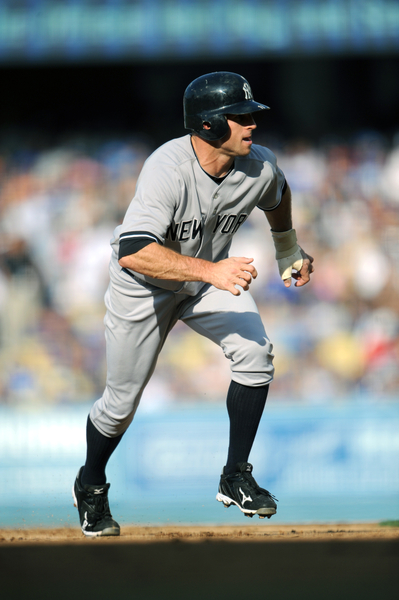
So why do we use it? First of all, the alternative’s a whole lot more complicated. To accurately project arbitration earnings for individual players, teams and agencies use comparable players and traditional stats instead of the 40/60/80 rule. Yes, 40/60/80 works as a guideline, but too many players and types of players are exceptions for it to provide consistently accurate projections. Though that’s probably not reassuring for saber-minded readers and writers, it’s all in the name of more accurate estimates for players’ salaries.
Before we go too much further, let’s briefly return to the origins of the 40/60/80 rule. David Studenmund showed in the 2007 Hardball Times Baseball Annual that, as a group, arbitration eligible players earn about 55% of what free agent players do (on a per win basis).
Tom Tango then built on Studenmund’s research and determined that, generally speaking, we can say first year arbitration eligible players earn about 40% of what free agents earn, second year arbitration eligible players earn about 60% of what free agents earn and third year arbitration eligible players earn about 80% of what free agents earn.
The points Studenmund and Tango make are convincing – the 40/60/80 rule works to describe what has happened to groups of players. “It’s a rule of thumb, and should be used generally speaking,” Tango explained in late July.
But when I asked Tango about the rule, he acknowledged that it has its limitations.
“If you look at specific players, you really should look at ‘comps,’” he said.
That’s what Major League teams and MLB agents do each winter. To prove that the player in question deserves the salary their side is proposing, executives and agents point to comparable players. If the player goes to arbitration, the arbitrators who hear the case and provide the verdict take into account salary and service time information and, according to baseball’s collective bargaining agreement, must consider “all comparable players.”
In other words, those in the baseball industry ensure that their comparisons are accurate by looking to the specifics. Generally speaking, the 40/60/80 rule works, but it doesn’t account for the nuances of baseball’s arbitration system.
“If you are trying to figure something more robust, I would not rely on the rule of thumb,” Tango wrote on his blog. “You’d have to come up with something not so linear,”
That could mean a sliding scale that would adjust for role players, superstars and award winners.
“Or, more likely, you can forget about WAR altogether,” Tango continued. Instead, we could do something similar to what teams and agents do – value players based on RBI, homers, saves, wins and other back of the baseball card stats.
Using WAR to project earnings can be deceptive for many types of players. Superstars don’t come close to earning 40% of their ‘market value’ as first time arbitration eligible players. Versatile utility types also pose problems. According to WAR, the Cardinals should have non-tendered Ryan Theriot after he posted negative WAR last year. Instead they traded Blake Hawksworth for Theriot and gave the infielder a $3.3MM contract. Since elite defenders aren’t particularly well-compensated in arbitration, you wouldn’t want to use WAR to project earnings for a player like Bourn or Ben Zobrist. The same goes for players with OBP-driven value; arbitrators don’t reward high on base percentages nearly as well as WAR does. Closers, on the other hand, can earn as much as position players through arbitration, even though WAR suggests they’re far less valuable. Super twos, the players who go to arbitration four times instead of three, complicate the 40/60/80 rule as well.
When there are this many exceptions to the rule, it's time to start questioning its effectiveness. Though it does work as a descriptor of the past, as Studenmund and Tango showed, it isn't a reliable predictor for individuals. The 40/60/80 rule starts with free agent value and works backward. But in reality, arbitration cases look back to performance, not forward to free agent value. As a result, significant discrepancies emerge when we use the 40/60/80 rule for individuals.
Wins above replacement is a more sophisticated and meaningful statistic than saves or runs batted in, yet WAR’s role in arbitration is limited at best. The 40/60/80 rule describes earnings for groups of players from the past, so using the rule to anticipate earnings for individuals in the future will not produce accurate results. It may seem old-fashioned, but the best way to establish a framework for a player’s earning potential is the same as it's ever been: comparing him to his peers with traditional stats.
What is the 40/60/80 rule?
The sabermetric principle suggests arbitration-eligible players earn roughly 40% of their free agent value as first-time arbitration eligible players, 60% of their free agent value their second time through arbitration and 80% of their free agent value while third-time arbitration eligible. Value, in this case, is determined by calculating the cost of obtaining wins above replacement on the free agent market (usually $4-5MM per win above replacement).
Photo courtesy Icon SMI.
CloserNews.com Is Looking For Writers
Last year, we created the @closernews Twitter feed, a must-follow for fantasy junkies who are looking for an edge in the saves and holds categories. Presently, it has 8,800 followers and is still growing. Then, in July, we officially launched CloserNews.com, a place where we could expound on all the information found in the Twitter feed.
After only a few few weeks, the early returns on CloserNews.com are promising, and now we're looking for a few motivated, strong writers to contribute to the site as we build it into a must-read for fantasy fans.
Ideal candidates will:
- have some college education
- be familiar with Twitter and RSS feeds
- be baseball and fantasy experts
- be strong writers whose copy requires minimal or no editing
This position is unpaid with the potential to become paid as the site grows. So, it's probably best for someone who is breaking into sportswriting — either as recent or soon-to-be grad, or someone changing careers.
If interested, please submit a writing sample to closernewshelp@gmail.com. The piece should be roughly 300 words and written in a style similar to the posts published at CloserNews.com. It can be a reaction to news or an original analysis piece. As well, tell us briefly about yourself and why you'd be a good fit.
Olney On Waiver Trade Candidates
ESPN's Buster Olney talks waivers in his latest blog post, and I can't help but join in.
- The Twins are currently seven games out in the AL Central. If they slip further from contention, Olney wonders what will happen if they place outfielder/designated hitter Jason Kubel on waivers later this month. He projects currently as a Type B free agent. I wonder if the draft pick alone would compel a non-contending AL team to make a claim, with less than a million bucks remaining on his contract after August.
- Olney sees such a scenario as possible for Rays reliever Kyle Farnsworth, who profiles as a Type A. He could see the Blue Jays jumping in for the draft picks, though I imagine the Rays would keep him for the same reason.
- Would Reds catcher Ramon Hernandez or Padres closer Heath Bell make it to an NL contender? Or would Type A status again factor in? Olney sees the A's pulling back Josh Willingham rather than dumping his contract, probably because he's a Type A currently. I wonder if Willingham would accept an arbitration offer though.
- Cubs first baseman Carlos Pena is a good candidate to be moved as a salary dump, with half of his $10MM due in January.
- Astros lefty Wandy Rodriguez is expected to clear waivers, with over $38MM left on his deal through 2014. Just to play devil's advocate: Wandy is a bargain this year with just $2.27MM remaining, so it's possible one contender could decide they can stomach three years and $36MM from 2012-14, and make a claim.
- Guys like Carlos Quentin and Jeremy Guthrie would be claimed, but dealing them in the offseason probably makes more sense.
August Trade Candidates
Last August, players such as Jim Edmonds, Mike Fontenot, Derrek Lee, Brian Fuentes, Manny Delcarmen, and Jeff Francoeur were traded, while Cody Ross, Rod Barajas, and Manny Ramirez were claimed off waivers. The previous year Carl Pavano, Aubrey Huff, Ivan Rodriguez, Billy Wagner, Jon Rauch, Scott Kazmir, Jose Contreras, Jon Garland, and Jim Thome were dealt, and Alex Rios was claimed off waivers. So while nothing compares to July, we'll still see some veterans change teams this month (though the White Sox should probably cool it on the waiver claims). Nearly everyone will be placed on waivers, but here's my speculation on some who could be dealt or claimed this month, or who might clear waivers at least.
- Rays: Johnny Damon, Kelly Shoppach, Kyle Farnsworth
- Blue Jays: Aaron Hill, Mark Teahen, Frank Francisco, Rajai Davis, Trever Miller, John McDonald, Jose Molina, Brian Tallet
- Orioles: Vladimir Guerrero, Mike Gonzalez, Kevin Gregg, Cesar Izturis, Mark Hendrickson
- White Sox: Jake Peavy, Alex Rios, Adam Dunn, Juan Pierre, Omar Vizquel, Will Ohman, Ramon Castro
- Twins: Joe Nathan, Carl Pavano, Matt Capps, Jason Kubel, Jim Thome, Kevin Slowey
- Royals: Kyle Davies, Bruce Chen, Jeff Francis, Matt Treanor
- Athletics: David DeJesus, Josh Willingham, Coco Crisp, Brian Fuentes, Hideki Matsui, Conor Jackson, Rich Harden
- Mariners: Chone Figgins, Jack Wilson, Chris Ray, Jamey Wright, Adam Kennedy
- Mets: Jason Bay, Ryota Igarashi, D.J. Carrasco, Scott Hairston, Tim Byrdak, Willie Harris, Jason Isringhausen
- Marlins: Mike Cameron, Javier Vazquez, Omar Infante, Wes Helms, Greg Dobbs, DeWayne Wise
- Nationals: Ivan Rodriguez, Jonny Gomes, Rick Ankiel, Todd Coffey, Livan Hernandez, Chien-Ming Wang, Laynce Nix
- Reds: Francisco Cordero, Ramon Hernandez, Edgar Renteria, Miguel Cairo, Dontrelle Willis, Jeremy Hermida, Fred Lewis
- Cubs: Alfonso Soriano, Carlos Zambrano, Aramis Ramirez, Carlos Pena, John Grabow, Rodrigo Lopez, Reed Johnson, Koyie Hill
- Astros: Carlos Lee, Wandy Rodriguez, Brett Myers, Jason Michaels
- Rockies: Aaron Cook, Huston Street, Mark Ellis, Rafael Betancourt, Ty Wigginton, Ian Stewart, Ryan Spilborghs, Jason Giambi
- Dodgers: Hiroki Kuroda, Ted Lilly, Jonathan Broxton, Casey Blake, Juan Rivera, Juan Uribe, James Loney, Rod Barajas, Matt Guerrier, Jamey Carroll, Dioner Navarro, Mike MacDougal, Aaron Miles
- Padres: Heath Bell, Aaron Harang, Chad Qualls
I left off a few players who would easily clear waivers but I can't fathom being dealt, such as the Mets' Johan Santana. Contenders also have movable parts such as Austin Kearns, Pat Burrell, Mark DeRosa, Xavier Nady, Arthur Rhodes, and Matt Diaz.
NL West Trades
Here are the trades that went down in the NL West in July..
Diamondbacks
- Acquired right-handed sidearmer Brad Ziegler from the Athletics for first baseman Brandon Allen and reliever Jordan Norberto.
- Acquired right-hander Jason Marquis from the Nationals for shortstop prospect Zach Walters.
- Acquired Ryan Langerhans from the Mariners for cash considerations.
Dodgers
- Acquired catcher Tim Federowicz, reliever Juan Rodriguez, and starter Stephen Fife from the Red Sox in a three-team deal that also involved the Mariners. The Dodgers sent outfielder Trayvon Robinson to the M's. Seattle also received outfielder Chih-Hsien Chiang from the BoSox while Boston received starter Erik Bedard and reliever Josh Fields from Seattle.
- Received outfielder Alex Castellanos and roughly $2.5MM from the Cardinals for Rafael Furcal.
- Acquired outfielder Juan Rivera from the Blue Jays for a player to be named later or cash considerations.
Giants
- Acquired Orlando Cabrera from Cleveland in exchange for outfield prospect Thomas Neal.
- Acquired right fielder Carlos Beltran and cash considerations from the Mets for pitching prospect Zack Wheeler.
- Acquired Jeff Keppinger from the Astros for right-handed pitchers Henry Sosa and Jason Stoffel.
Padres
- Will receive a player to be named later from the Pirates in exchange for right fielder Ryan Ludwick.
- Acquired pitching prospects Joe Wieland and Robbie Erlin from the Rangers for reliever Mike Adams.
Rockies
- Acquired Joe Gardner, Alex White, Matt McBride and a player to be named later from the Rockies for Ubaldo Jimenez. The deal is expected to include left-hander Drew Pomeranz once he's eligible to be traded in mid-August.