Check Out Pro Hockey Rumors For NHL Expansion Draft Coverage
MLBTR Seeking Team Facebook Page Managers
Are you an avid Facebook user and a diehard fan of the Yankees, Cardinals, Red Sox, Cubs, or Braves? Then MLBTR might have a job for you.
For many years, MLBTR has run a Facebook page for each of the 30 MLB teams. For example, here’s our Yankees page. From inception, these pages have been entirely automated, and thus, nothing special. We can do better. That’s why we’re launching an experiment in which actual human fans will curate our five most popular team Facebook pages.
You may notice that for these five teams, the names have been changed. For example, the Facebook page is now New York Yankees News & Rumors. We feel that MLBTR has the rumors, hot stove, and transaction information pretty well-covered for each club, and the team Facebook pages will continue to link to MLBTR for that. But there’s ample team-related news that would be of interest to fans, but would not fit on MLBTradeRumors.com. In this experiment, our curators will be posting news on those topics as well. For example, each game will have a game thread, postgame post, and links to highlight videos, for the purpose of discussion with fellow fans. Other types of news, like a lineup change, breakout performance by a top prospect, schedule and promotional information, interviews with current and former players, and All-Star voting updates will also be covered on these team Facebook pages. This will also be a space for the curator to share links to opinion and analysis articles from high-quality outlets. If you’re interested in applying to be one of our five curators for this experiment, read on…
- The Yankees, Cardinals, Red Sox, Cubs, and Braves are the teams in our initial experiment, simply because their MLBTR Facebook pages are our most popular. If the experiment is a success, we’ll add more teams. So, we’re looking for superfans of these five teams only right now. Please mention which team you support in the subject line of your email application.
- The pay for this is a flat $50 per month.
- This position requires prompt posting of MLBTR articles related to your team, as well as a minimum of five additional posts per day (whether an image, video, link, gif, meme, discussion thread, or poll). We also hope you’ll engage with your fellow fans in the comment section on the Facebook posts.
- These pages will be more laid-back than MLBTR itself, so humor is encouraged. Still, the pages will remain family friendly.
- You’ll need to know your way around Facebook, to ensure you are posting in the proper format. The position will require usage of our Trade Rumors app for notifications. We’re seeking strong writers, to ensure proper spelling and grammar. And of course, the gig requires deep knowledge of your team and a good understanding of hot stove concepts.
- If you’re interested in managing and curating MLBTR’s Facebook page for the Yankees, Cardinals, Red Sox, Cubs, or Braves, please email mlbtrhelp@gmail.com explaining your qualifications and why you’re the right person for the job.
New Features At Roster Resource!
Over at Roster Resource, we’ve been working hard to keep our readers updated on the state of each team from the Majors down to the low Minors. Not only do we provide up-to-the-minute depth charts with a ton of useful information, we have recently launched three new features that can give you an even better understanding of each roster.
- Our closer chart lists 3-5 relievers for each team with current role, recent bullpen usage and power ranking (overall and last 14 days).
- Notable closer workloads with likely replacement(s) for that day
- Injury updates
- Closers who are running out of chances and who is next in line to take their job.
- A look at each team’s starting rotation usage and effectiveness.
- View how many (and which) starters have been used by each team, which rotations are eating the most innings and which ones are providing their teams with the most quality starts.
- View which teams are getting the most starts out of homegrown pitchers.
- Our “Roster Effect Rating” shows which teams have been hit hardest by injuries using a formula that takes a player’s projected value and numbers of days on the DL into account.
- DL stint tally per team
- DL start and return dates.
- Number of days on the DL per player.
Please feel free to leave feedback or suggestions in the comment section or contact me @mlbdepthcharts.
Free Agent Stock Watch: Zack Cozart
Reds shortstop Zack Cozart has long been an interesting player, with outstanding glovework making him a regular at short despite an often-lagging bat. But he began to show signs of life at the plate in 2015, suggesting the possibility of more. Now, at 31 years of age — with free agency beckoning at season’s end — Cozart is playing like an All-Star.
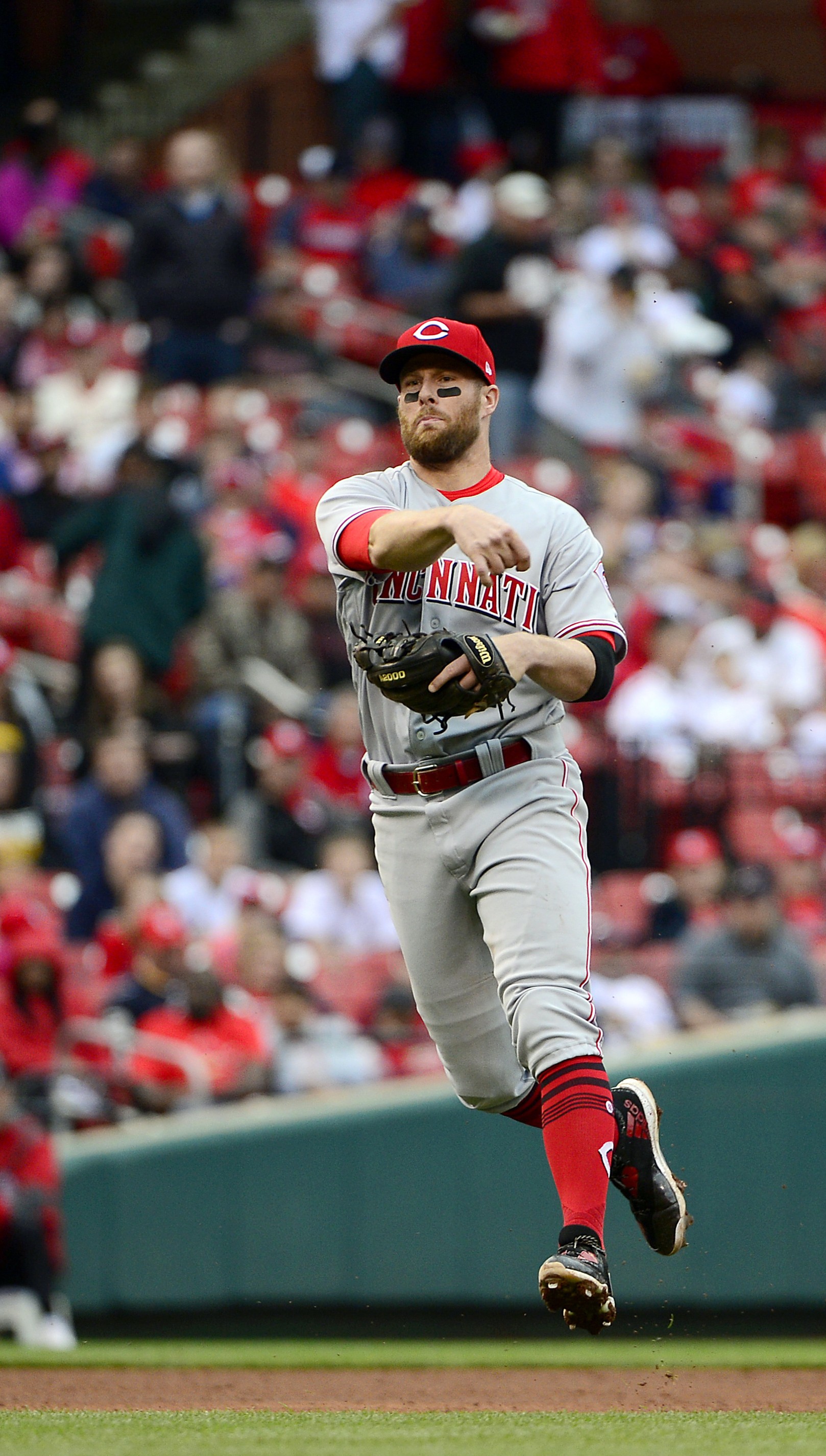
Perhaps this surge would now be less surprising had it not been for a devastating knee injury that disrupted Cozart’s ’15 campaign after just 53 games. At that point, he was slashing .258/.310/.459 and had swatted nine home runs. Upon returning last year, Cozart fell back a bit in overall productivity, but still managed 16 long balls and produced a 91 wRC+ — good enough to make him a 2.5 fWAR player.
Cozart has opened the 2017 season on a hot streak. It’s still early — he has only taken 97 plate appearances — so it’s best to temper expectations. But perhaps there’s more to it than just noting the surge and cautioning on the sample size. He’s hitting a BABIP-aided .329 and delivering an excellent isolated slugging mark (.220) despite just one home run. That’s all promising enough. But Cozart is also walking at heretofore-unseen levels. He entered the year with just a 5.6% career walk rate, but has nearly tripled that (to 14.4%) in the early going, leaving him with a robust .423 on-base percentage .
As ever, it’s fair to wonder whether that apparent improvement can be sustained. Cozart is approaching, but hasn’t quite reached, the stabilization point for walk rate, and even then you’d have to maintain a healthy degree of skepticism and bear in mind his longer track record. But this is the third straight year that Cozart has shown growth in his ability to take free passes. And there are other signs of a real change that shouldn’t be ignored. Cozart’s swing percentage sits at just under forty percent, well shy of his 46.5% career mark. And he’s not just watching more strikes go by: Cozart has offered at pitches out of the zone just 22.7% of the time, a significant reduction from his 29.4% career average. When he does swing, Cozart is missing just 5.6% of the time; again, that’s a significant change (7.3% career SwStr%).
While his strikeout rate is also up a bit, that’s an easy sacrifice to make when these are the results. It would be silly to expect Cozart to continue walking with quite this frequency, but even a bump up to league average (8.8%) would represent a major change in his profile. That might support a league-average on-base percentage. Combine that with the fact that Cozart has posted above-average isolated slugging marks over the past three seasons, and you’re suddenly looking at a real offensive threat.
Let’s not forget: the real calling card here is defense. Cozart doesn’t get talked about as one of the game’s best fielders, but metrics suggest he is. We’re not looking at a small sample here, either. Since he began receiving regular playing time in 2012, Cozart has been an elite defender. While he has traditionally rated as merely an average baserunner, the glove is good enough that Cozart doesn’t have to hit all that much to be an asset.
So, the arrow is pointing up right now, though there’s obviously a long season ahead. Cozart did miss time last year with ongoing issues relating to his 2015 knee surgery; while it seems he’s healthy now, he’ll need to stay that way. And teams will be watching closely to see just what portion of Cozart’s improvements at the plate can be maintained throughout the course of a long season.
As we watch to see how things progress — gauging not only Cozart’s open-market value but also his trade value this summer — there are some markers to bear in mind. Come August, Cozart will reach 32 years of age — just as J.J. Hardy did back in 2014 before signing a three-year, $40MM extension with the Orioles that kept him from reaching the open market. Hardy was an even more extreme version of Cozart at the plate, and was a similarly excellent defender, so seems a highly relevant comp. Though Hardy had a clearer record of success to that point, though, he also hadn’t shown anything like Cozart’s current changes at the plate.
If you see Cozart as a slightly above-average hitter, whose power is sometimes offset by questionable on-base numbers and patches of streakiness, then you’re looking at something like the profile of Ian Desmond, who just landed $70MM over five years. True, Cozart is a middling baserunner, while Desmond is one of the game’s best. But the situation is flipped on defense, where Cozart’s high-level play at short outeighs Desmond’s versatility. But the best aspirational comp is perhaps Brandon Crawford, whose blend of solid plate discipline and pop with otherworldly defense has made him a star (and earned him a six-year, $75MM extension).
Of course, it’s far from clear that Cozart will be able to score anything approaching those kinds of years and dollars, particularly given his age and the still-unknown level of demand. But he’s beginning to make out an argument that he’s just as valuable a player as some of his better-known peers.
Photo courtesy of USA Today Sports Images.
Rosenhaus Agency Expands Into Baseball
Rosenhaus Sports Representation, the powerhouse NFL player agency led by Drew Rosenhaus, is now expanding into baseball. According to a report from Liz Mullen of Sports Business Journal, agent Dennis Wyrick will run the new baseball division.
On the football side of things, Rosenhaus has long been considered one of the game’s major power brokers. He was recently listed among the fifty most influential people in the (domestic) sports world by the Sporting News — joining Scott Boras among player reps on that list.
The comparisons to Boras seem fairly apt. Here’s how Zach Links of MLBTR sister site Pro Football Rumors puts it: “Drew Rosenhaus, in many ways, is the NFL’s equivalent to Scott Boras. He’s the sport’s highest-profile agent with many of the game’s biggest stars in his stable. Drew has mellowed a bit in recent years, but he’s not afraid to get in front of a microphone and go to bat for his clients. And, like Jay-Z, his name value could help him quickly land big-time baseball players.”
Indeed, Rosenhaus’s NFL client list features many notable names, including Patriots tight end Rob Gronkowski, Steelers wide receiver Antonio Brown, Redskins wide receiver Terrelle Pryor, and Bills running back LeSean McCoy. In the past, stars like Terrell Owens, Warren Sapp, Plaxico Burress, and Chad Johnson/Ochocinco have entrusted their contracts and marketing to Rosenhaus’s team. Of course, Rosenhaus and co. will have their work cut out if they hope to build a similarly impressive group of clients on the baseball side.
NL Notes: D-backs, Mets, Phillies, Nats
The Diamondbacks could be in for bad news regarding right-hander Shelby Miller, who, as Barry M. Bloom of MLB.com tweets, exited his start Sunday with forearm tightness. Arizona is scheduling an MRI for Miller, who lasted four-plus innings and allowed three earned runs in a loss to the Dodgers. Manager Torey Lovullo is trying to be optimistic, notes Bloom, but Steve Gilbert of MLB.com observes (on Twitter) that the situation is “not good.” Forearm tightness often portends Tommy John surgery, which would be the biggest setback yet in Miller’s rocky tenure with the Diamondbacks. The club’s previous regime drew seemingly endless criticism for sending a Dansby Swanson– and Ender Inciarte-led package to the Braves for Miller two winters ago. General manager Dave Stewart and senior vice president of baseball operations De Jon Watson lost their jobs last fall after Miller struggled through a 2016 to forget, pitching to a 6.15 ERA in 101 major league innings and enduring a demotion to the minor leagues. Thanks in part to improved velocity, though, Miller has fared respectably this year with a 4.09 ERA and 3.29 FIP in 22 frames.
More from the National League:
- With an .095/.186/.127 batting line in 70 plate appearances, Mets infielder Jose Reyes has been among the majors’ worst players this year. Nevertheless, the Mets aren’t considering releasing the 33-year-old, according to Newsday’s Marc Carig, who casts doubt on the possibility of the team cutting him even if his performance doesn’t improve soon. Reyes makes a minimum salary and is a speedy switch-hitter who can play shortstop, all of which are facts that work in his favor, Carig writes. While the Mets have an elite shortstop prospect in Amed Rosario, who has slashed .355/.382/.353 in 55 PAs this season, a promotion for him isn’t imminent, sources told Carig. The Mets don’t want to rush either the 21-year-old Rosario or first base prospect Dominic Smith (also 21) to the majors.
- Phillies left fielder Howie Kendrick‘s previously reported abdominal strain is actually an oblique strain, one that’s likely to keep him out until “sometime in the early to mid part of May,” GM Matt Klentak informed Ryan Lawrence of PhillyVoice. With Kendrick unavailable for a while, Klentak acquired infielder/outfielder Ty Kelly from the Blue Jays on Saturday. It turns out the Klentak-led Phillies had Kelly on their radar in the past. “Kelly is a guy who was on waivers twice in the last few months, and both times that he was passing through waivers we were intrigued by him and would have liked to have placed a claim but our roster was in a position where he couldn’t do it,” Klentak said. “But now with the ability to transfer (Clay) Buchholz to the (60-day DL) and free up a spot, we were able to acquire him.” Aaron Altherr, not Kelly, will see the majority of time in left while Kendrick’s out, Lawrence notes.
- The Nationals will place righty Stephen Strasburg on the paternity leave list Monday, meaning he’ll miss his scheduled start Tuesday in Colorado, reports Mark Zuckerman of MASNsports.com. Washington is likely to recall Jacob Turner to fill Strasburg’s void for a start, while the latter will return in time to take the mound either Friday or Saturday.
Nationals To Select Contract Of Jeremy Guthrie
The Nationals are set to select the contract of veteran righty Jeremy Guthrie, manager Dusty Baker told reporters including Dan Kolko of MASNsports.com (via Twitter). As had been expected, he’ll make a start against the Phillies tomorrow, though it’s not yet clear what his role will be thereafter.
Entering camp, Guthrie seemed a longshot to make the talent-laden Nats roster. After all, he struggled badly in 2015 and did not suit up last season. But Guthrie reportedly showed up with a big fastball and turned in a nice spring stat line.
Over 18 2/3 innings, he allowed just five earned runs on a meager ten hits while racking up 15 punchouts to go with five walks. Whether or not he can carry that success into the regular season in his age-38 campaign remains to be seen, but it could be interesting to see how the longtime starter fares in a relief role. To this stage, over a dozen MLB seasons, Guthrie has entered from the pen only 33 times.
The Nats have long been expected to turn over the fifth starter’s role to Joe Ross, who owns a 3.52 ERA over the first 181 2/3 innings of his young career. But he was optioned to open the year, allowing the club to better utilize that roster spot to begin the season. That also meant Ross couldn’t be recalled for tomorrow’s outing, since he’s required to spend ten days on optional assignment.
A corresponding move has yet to be announced, but the obvious approach would be to option one of their reserves — infielder Wilmer Difo or outfielder Michael Taylor, most likely. Things get trickier after that, though. Washington could simply outright Guthrie after the start. It could move him to the pen and bump another reliever when it’s time to call upon Ross — though unless there’s a DL placement needed that’d likely mean placing the out-of-options Enny Romero on waivers. Or, that pen placement could be facilitated by optioning whichever reserve (Difo or Taylor) doesn’t lose his spot tomorrow. Perhaps there’s at least some possibility, too, that the club could hold Ross back in Triple-A and allow Guthrie to keep a rotation spot for some time.
It’s hard to know just how the team will proceed at this part; it could be dependent at least in part upon how Guthrie performs, and the plan could always change as circumstances dictate. The most likely course, it seems, would be for the optionable position players to head back to Triple-A for regular playing time to make room for Ross, leaving Guthrie to function in a swingman role. Baker could utilize him much as he did Yusmeiro Petit in 2016, when Petit threw 62 innings over 36 relief appearances and one start.
Offseason In Review: Philadelphia Phillies
This is the latest entry in MLBTR’s Offseason In Review series. The full index of Offseason In Review posts can be found here.
The Phillies’ front office, which continues to chart a steady rebuilding course, added short-term veterans to supplement a group of young talent that is steadily matriculating to the majors.
Major League Signings
- Jeremy Hellickson, SP: one year, $17.2MM (accepted qualifying offer)
- Michael Saunders, OF: one year, $9MM (includes $1MM buyout on $11MM club option)
- Joaquin Benoit, RP: one year, $7.5MM
- Andres Blanco, IF: one year, $3MM
- Total spend: $36.7MM.
Trades And Claims
- Acquired SP Clay Buchholz from Red Sox in exchange for 2B Josh Tobias
- Acquired 2B/OF Howie Kendrick from Dodgers in exchange for 1B/OF Darin Ruf, 2B/OF Darnell Sweeney
- Acquired RP Pat Neshek from Astros in exchange for cash/PTBNL (exercised $6MM club option)
- Acquired RP Pat Venditte from Mariners for OF Joey Curletta
- Acquired RP Mario Sanchez from Nationals as PTBNL in exchange for RP Jimmy Cordero
- Claimed RP David Rollins from Rangers (later lost via waiver claim)
- Claimed 3B Richie Shaffer from Mariners (later lost via waiver claim)
Notable Minor League Signings
- Pedro Beato, Sean Burnett (released), Chris Coghlan (released), Pedro Florimon, Hector Gomez, Ryan Hanigan (released), Bryan Holoday (released), Daniel Nava, Cesar Ramos
Extensions
- Odubel Herrera, OF: five years, $30.5MM (includes 2022 & 2023 club options)
Notable Losses
- Cody Asche (non-tendered), Peter Bourjos, A.J. Ellis, Matt Harrison (still owed $15MM), David Hernandez, Ryan Howard (declined club option), Charlie Morton (declined mutual option), Ruf
Phillies Roster; Phillies Payroll Information
Needs Addressed
With Ryan Howard’s departure, the Phillies have fully shed the stars that made up the organization’s most recent contending roster — with their salaries also now departing the payroll. Philadelphia is now building a new core, and just made the first long-term commitment to one of those pieces.
If you look at the Phillies’ future balance sheet, there’s just one name on it: Odubel Herrera, the former Rule 5 pick who is now controlled through 2023 after striking an extension over the winter. We’ll have more on that move below, in the “deal of note” section.
Interestingly, that was really the only significant forward-looking move the Phils made over the winter. There was some trade chatter, mostly surrounding second baseman Cesar Hernandez, but there was no urgency to deal him with three years of arbitration control remaining. And the Phils were never rumored to be chasing any controllable major leaguers.
Instead, the club seems content to nurture its existing group of young talent while continuing to build through the draft. But that’s not to say that GM Matt Klentak and company sat on their hands all winter. With massive spending capacity and a new TV contract, the plan called for some fairly significant investments in the 2017 roster — none of which, notably, will impact the future payroll.
That $36.7MM total spending figure listed above is a bit misleading. In addition to its free-agent commitments, Philadelphia struck three separate trades that essentially functioned the same way. The team gave up little in the way of players, but took on $30MM in salary. Combined with the open-market moves, two-thirds of Philly’s approximately $100MM Opening Day payroll comes from newly-added veterans.
So, what did they get for their money? There was no singular focus akin to the Braves’ and Padres’ rotation overhauls. Instead, the Phillies splashed veterans across the roster.
The rotation features some appealing young talent, though the Phillies obviously hoped to relieve the pressure on the arms that will be needed for the long haul. Jeremy Hellickson represented the first major addition when he somewhat surprisingly accepted the qualifying offer issued by the club. While the Phils surely would have been happy to recoup a draft pick, it’s hardly the worst result given the strategy. That said, if the club hopes to cash in on its thus-far worthwhile investment in Hellickson, it’ll need to deal him at the deadline; under the new rules, he’s not eligible for another QO.
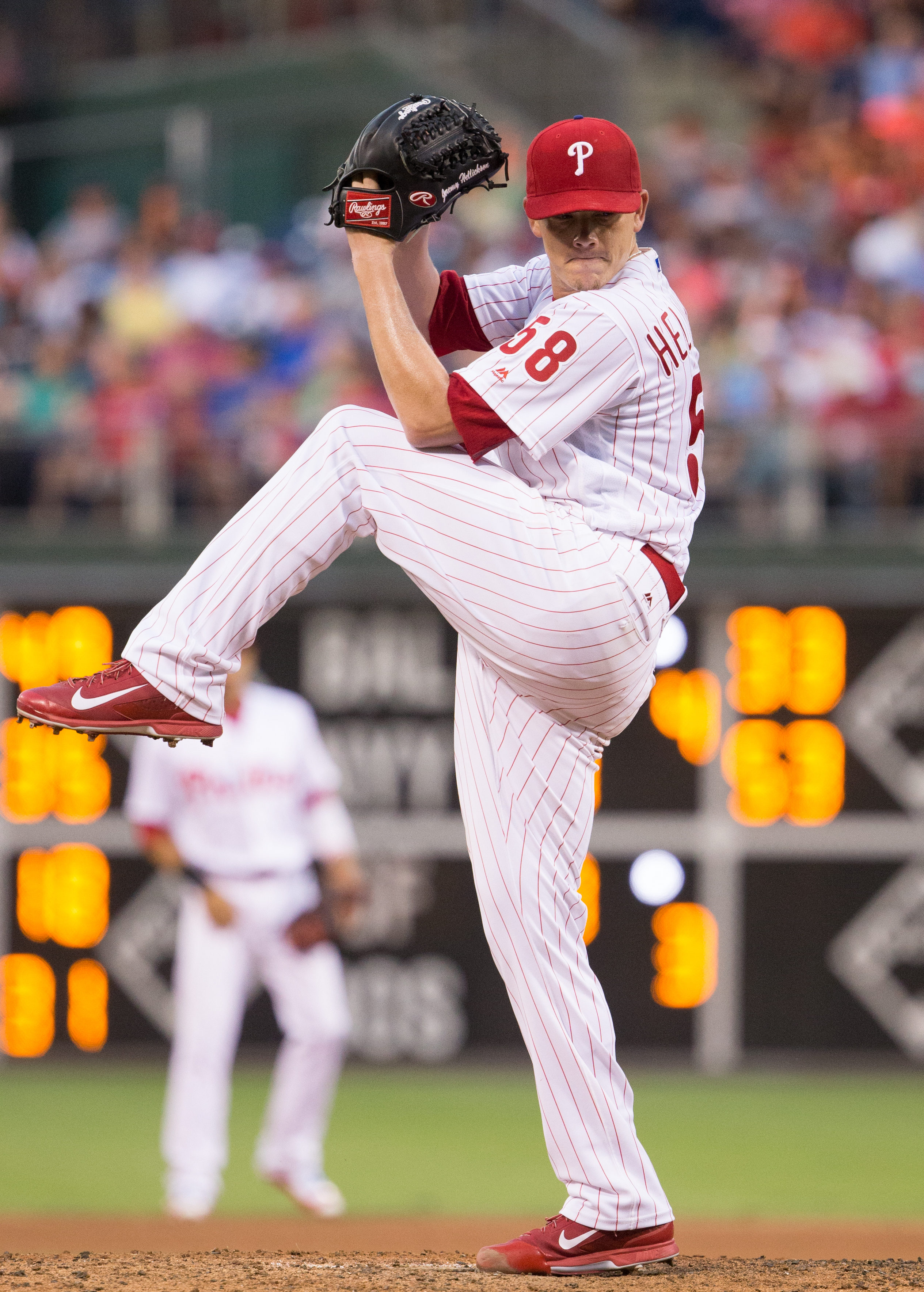
Despite the return of Hellickson, the Phillies elected to add Clay Buchholz to a staff that’ll also feature Aaron Nola, Vince Velasquez, and Jerad Eickhoff. There were alternatives to adding another veteran — Jake Thompson reached the majors last year and several 40-man members are throwing at Triple-A — but Philadelphia elected to take on Buchholz in hopes of a resurgence. If he can carry forward his strong work late in 2016 (2.86 ERA over his final 44 innings), then the Phillies can shop him over the summer or perhaps make a qualifying offer at season’s end.
The bullpen saw additions, too, with Pat Neshek coming via trade and Joaquin Benoit arriving from the open market. These elder statesmen both had promising results last year, but also come with questions. Neshek carried a 3.06 ERA while allowing less than one baserunner per inning through his typical blend of few walks and weak contact. But his success was driven by a BABIP-against mark (.216) that was even lower than usual (.236 career), and he was bombed when allowed to face lefties (.240/.321/.646 and ten home runs in just 55 plate appearances). Benoit, meanwhile, allowed just one earned run on 17 hits in his 23 2/3 innings with the Blue Jays, but had struggled with his control and long ball susceptibility over the first half of the season with the Mariners.
With the infield accounted for, Klentak and his charges turned to addressing an outfield that had received meager contributions from the corners in 2016. The first move, acquiring Howie Kendrick, may have been made in part to provide cover in the event that a deal was struck involving Hernandez. But the former second baseman was always penciled in to play left, and that’s where he’ll open the season. A paragon of consistency at the plate for the bulk of his career, Kendrick fell off last season and ended up hitting just .255/.326/.366 — though he did substantially increase his walk rate. While there’s not much upside to him as a left fielder, Kendrick at least represents a sturdy veteran who’ll plug a hole.
Next, the Phils staked a more interesting bet on Michael Saunders, whose deal includes an option for 2018. The 30-year-old was finally healthy and productive last year, though he faded badly after an outstanding start. Still, the overall results — .253/.338/.478 with 24 home runs over 558 plate appearances — were quite good, and Philadelphia would no doubt be pleased with a repeat performance.
That slate of moves was accompanied by the re-signing of veteran infielder Andres Blanco, who has been a handy member of the bench for the past two seasons.
Read more analysis below …
Carlos Rodon Out Five To Six Weeks
White Sox left-hander Carlos Rodon, who opened the season on the disabled list due to bursitis in his left biceps, is currently on a throwing program and could be back with the team within five to six weeks, barring setbacks, general manager Rick Hahn tells Scot Gregor of the Daily Herald (Twitter link). While it was known that Rodon would open the season on the shelf, there’s yet to be much of an indication as to how long of a recovery timeline Rodon would face.
Suffice it to say, an absence of five to six weeks representing a seemingly best-case scenario isn’t ideal news for the South Siders, though the 2017 season is a rebuilding year for the Sox anyhow. Nonetheless, Rodon’s injury shorts one of the White Sox’ most promising young arms of some development time, even if no further issues arise. That’s somewhat discouraging for Sox fans, especially when considering the strong second half that the former No. 3 overall draft pick posted last year.
After logging a 4.50 ERA with 8.9 K/9 and 3.1 BB/9 in the first half last season, Rodon reeled off a 3.45 ERA in the second half with 9.5 K/9 against 2.7 BB/9. Rodon enjoyed a superlative month of August, and while the month of September was more uneven, he flashed his upside with eight shutout innings and 11 strikeouts in his penultimate start of the season against the World Series-bound Indians.
With Rodon sidelined, a number of his would-be innings could go to rookie Dylan Covey and veteran swingman Anthony Swarzak. The rest of the Chicago rotation is rounded out by Jose Quintana, James Shields, Derek Holland and Miguel Gonzalez, though certainly the Sox hope that some of the vaunted arms they picked up in the offseason trades of Chris Sale and Adam Eaton could impact that starting group sooner rather than later; Michael Kopech, Lucas Giolito and Reynaldo Lopez — each of whom has been regarded recently as one of the game’s top overall pitching prospects — are all set to open the season in the upper minors for Chicago and could eventually knock on the door in 2017.
Offseason In Review: San Diego Padres
This is the latest entry in MLBTR’s Offseason In Review series. The full index of Offseason In Review posts can be found here.
While the rebuilding Padres still owe a ton of money to high-priced veterans Matt Kemp and James Shields, who were traded away last season, the players on the current team will make approximately $30MM in 2017. That’s less than the salary of Clayton Kershaw, who they’ll face off against on Opening Day and likely several more times during the season. It’s no surprise that they’re the favorite to land the No. 1 pick in the 2018 Amateur Draft, but that’s all part of the plan.
Major League Signings
- Trevor Cahill, SP: One year, $1.75MM
- Jhoulys Chacin, SP: One year, $1.75MM
- Clayton Richard, SP One year, $1.75MM (re-signed)
- Jered Weaver, SP: One year, $3MM
- Total spend: $8.25MM
Notable Minor League Signings
Trades And Claims
- Traded C Derek Norris to Nationals for P Pedro Avila
- Claimed P Tyrell Jenkins from Reds
- Claimed P Zach Lee from Mariners
- Lost RP Leonel Campos off waivers to Blue Jays
Rule 5 Draft
- Selected INF Allen Cordoba from Cardinals
- Selected P Justin Haley from Red Sox; traded to Brewers
- Acquired C Luis Torrens from Reds via Yankees
- Acquired RHP Miguel Diaz from Twins via Brewers
Extensions
- 1B Wil Myers: Six years, $83MM, plus $20MM club option in 2023 ($1MM buyout)
- 2B/3B Yangervis Solarte: Two years, $7.5MM, plus $5.5MM club option in 2019 ($750K buyout) and $8MM club option in 2020 ($750K buyout)
Notable Losses
- Alexi Amarista, Jon Jay, Derek Norris, Adam Rosales, Tyson Ross, Carlos Villanueva
Needs Addressed
Despite having one of the best farm systems in baseball, the Padres are light on pitching prospects who are ready to contribute at the Major League level in 2017. With a talented (if largely unproven) core of young position players, led by first baseman Wil Myers, and a strong bullpen, the top priority of this offseason was to fill out the starting rotation with inexpensive veterans who can eat innings and possibly pitch well enough to draw trade interest.
At a cost of just over $8MM, they were able to fill four rotation spots for the upcoming season by signing free agents Trevor Cahill, Jhoulys Chacin, Clayton Richard and Jered Weaver to one-year deals. This rotation won’t make them a contender or even a .500 team. But each has experienced a good level of Major League success and should be able to keep games from getting out of hand on a consistent basis. At least that’s what the Padres are hoping for.
Cahill was once on his way to being one of the better young pitchers in baseball—he finished 9th in the AL Cy Young race in 2010—but his career quickly went south. He bounced back in 2016 with a terrific season out of the ‘pen for the World Champion Cubs and now the Padres are giving the 29-year-old a chance to prove he can maintain that success while returning to a starting role. Chacin, also 29 years old and a once-promising pitching star for the Rockies, is trying to resurrect his career with a return to the NL West. He had a strong finish to the 2016 season (0.75 ERA over last four starts) and has a strong track record against the Padres’ division opponents. Richard signed with the Padres late last season after being released by the Cubs and impressed with a 2.52 ERA over 53.2 innings. He has not started more than nine games in a season since 2013, the last year of a four-season stint with the Padres. In Weaver, the Padres brought in a former ace who is trying to succeed with a low-80’s fastball.
Luis Perdomo, a Rule 5 success story in 2016, will be the No. 5 starter, although he’ll likely have an innings limit after logging less than 150 innings as a rookie. Former prospects Jarred Cosart, Tyrell Jenkins and Zach Lee could also work their way into the mix at some point, as will rookies Dinelson Lamet and Walker Lockett. The Padres’ pair of elite pitching prospects, Anderson Espinoza and Cal Quantril, are likely slated for High-A and won’t reach San Diego anytime soon.
The team’s highly suspect rotation will likely be one of, if not the worst, in baseball. But when they do hand a lead over to the bullpen, as rare as that might be, the Padres should be able to hold on for the win on most occasions. If Carter Capps can return to his pre-injury form—he had a 1.16 ERA, 2.0 BB/9 and 16.8 K/9 in 31 innings in 2015 before an elbow injury that required Tommy John surgery—the Padres could have themselves quite an effective group of late-inning arms. Along with Capps, who is expected to start the season on the DL, closer Brandon Maurer and lefty setup men Ryan Buchter and Brad Hand will all be highly-coveted by playoff contenders and could prove to be valuable trade chips in July. Veteran Craig Stammen, signed to a Minor League contract in the offseason, could also end up attracting trade interest if his spring performance (11.2 IP, ER, 12 K) is any indication of a return to form.
While the Padres are mostly sticking with their young position players, they did make one notable offseason addition in veteran Erick Aybar, who came to camp on a Minor League deal and ended up beating out Luis Sardiñas for the starting shortstop job. He’ll be yet another one-year stop-gap—Clint Barmes and Alexei Ramirez were the team’s Opening Day shortstops in 2015 and 2016, respectively—as Preller continues his search for the team’s shortstop of the future.
Aybar’s double-play partner will be Yangervis Solarte, who is shifting over from third base, while Ryan Schimpf (.533 slugging percentage in 330 MLB plate appearances) and former 1st Round draft pick Cory Spangenberg are competing for time at the hot corner. Top prospects and NL Rookie of the Year candidates Manuel Margot and Hunter Renfroe, who each had late-season MLB auditions in 2016, are expected to step into regular roles in the Padres’ outfield with Jabari Blash, Alex Dickerson—once he returns from the disabled list—and Travis Jankowski each getting plenty of opportunities to prove that they should be a part of the team’s future.
Behind the plate, Padres fans will finally get to see Austin Hedges, one of the most highly-touted defensive catching prospects in recent memory, on a regular basis. After spending 2015 as Derek Norris‘ backup and most of last season in the minors, he’ll get the bulk of playing time in 2017 with Norris out of the picture, Christian Bethancourt splitting time between the bench and the bullpen, and 20-year-old Rule 5 draftee Luis Torrens expected to mostly watch and learn, having never played a game above Low-A ball.
More analysis after the break …