
Free Agent Stock Watch: Closers
Over the winter, MLBTR’s Charlie Wilmoth took a look at the changing closer market, documenting the dwindling dollars and years available for 9th-inning relievers. As we approach now approach a new offseason, a different type of market change — related only in part to the broader trend — has taken hold. Namely, the actual group of soon-to-be free agents with closing experience has seen many individual stock drops.
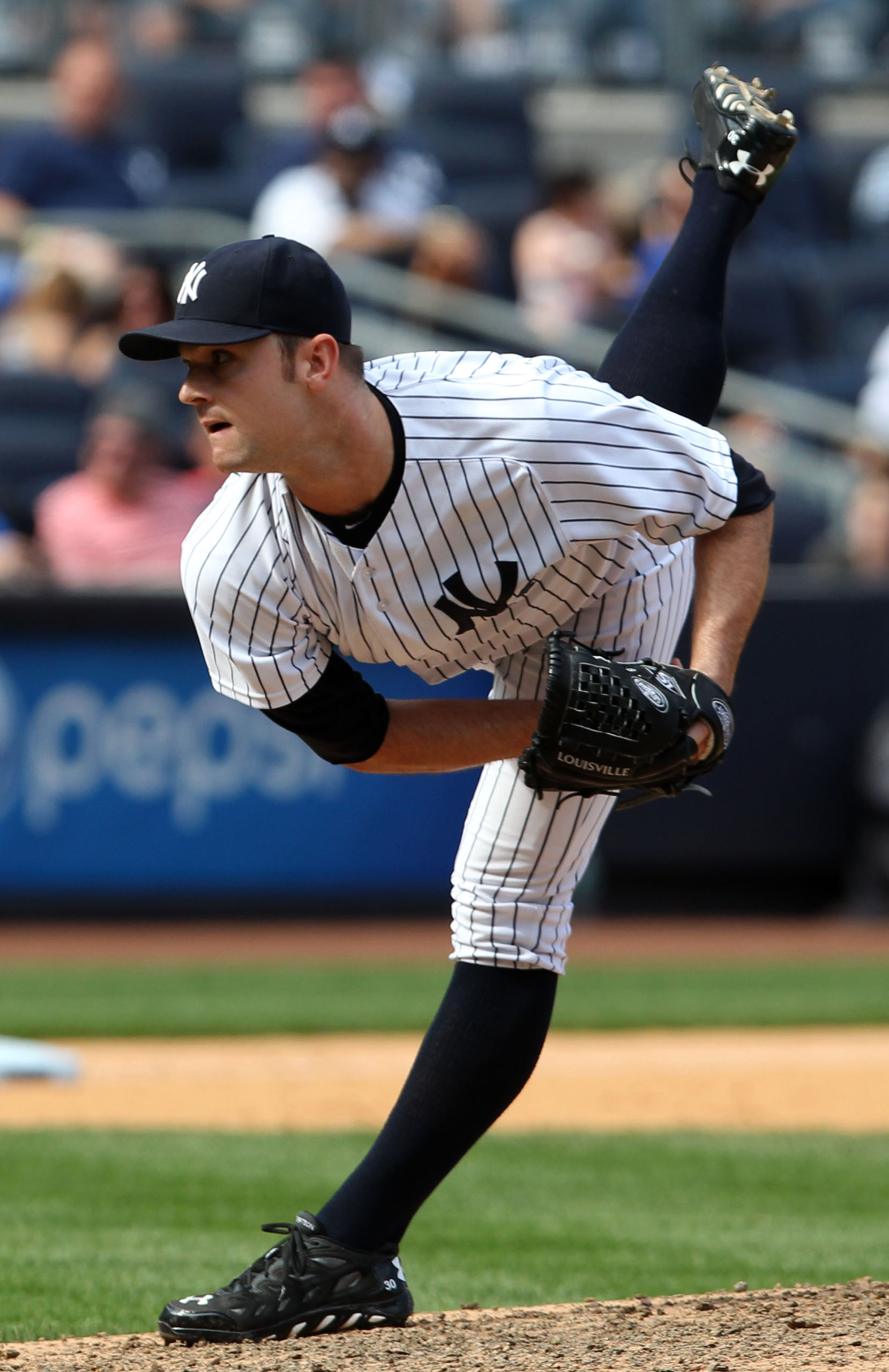
Let’s have a look at the “closer” portion of MLBTR’s 2015 MLB free agent list (including only those players who, in my opinion, are likely to become free agents): Jason Grilli, Casey Janssen, David Robertson, Francisco Rodriguez, Sergio Romo, Rafael Soriano, and Koji Uehara. Listed under right-handed relievers are a few other names with significant closing experience: Heath Bell, Jim Johnson, J.J. Putz, and Jose Veras.
Heading into the year, this looked like a pretty strong group of late-inning arms. Among them were some of the more established closers — and, indeed, better relief pitchers, role aside — in the game. But the group has seen some pretty significant shifts in value that make it look much less impactful on the whole.
Here are my assessments of the value movement on these players:
Trending Down
Grilli: coming off 2.70 ERA, 33-save year, lost Pirates closer job and was traded to Angels; has performed well since in set-up role
Janssen: missed significant portion of early year with injury, ended with 3.72 ERA and will cede time to younger players in September; has never really seemed to fit traditional closer model, and now features a plummeting strikeout rate (5.4 K/9)
Romo: after four-straight lights out years, was relieved of end-of-game duties and owns 3.98 ERA on season
Uehara: typically dominant year took dramatic, late-season downturn at inopportune time for 39-year-old
Bell, Johnson, Putz, Veras: look, there’s a reason that these guys fell off of the (admittedly subjective) “closer” list, which is that they all struggled mightily for lengthy stretches
Holding Steady
Robertson: on the one hand, Robertson has proven that he can handle closing in New York after taking over for a legend; on the other, his peripherals are in line with his career numbers but his ERA (2.92) is higher than in recent years
Soriano: there’s an argument to be made that he has raised his stock with his strikeouts back on the rise, but an offsetting jump in free passes has kept his K:BB ratio the same, and on the whole he has not done much to change the fact that he is a good-but-not-great reliever
Rising Up
Rodriguez: after surprisingly jumping into the closer’s role in the season’s early days, Rodriguez has locked down 39 saves and worked to a 3.00 ERA with 10.2 K/9 and 2.1 BB/9; since signing a minor league deal before 2013, K-Rod owns a 2.87 ERA
—
So what does this all mean? It seems to me that the major beneficiary of the market shake-out is Robertson, who is by far the youngest of these closers and is the only one who (as things stand) will enter free agency with both an impeccable recent track record and few real questions moving forward. Though Uehara has the most dominant recent record of this group, his well-documented recent struggles and advanced age should significantly dampen his market.
Those dynamics put the Yankees in an interesting spot. On the one hand, the club should now face greater competition to bring back its Mariano Rivera replacement. On the other, it might justifiably utilize the qualifying offer to buy back some leverage. The team has already shown a willingness to do just that with a closer (Soriano), and would up the ante for other teams that might consider a run at Robertson.
The possibility that Robertson’s market will itself be suppressed by a QO paints an even more sobering picture of the overall expectations. It is worth wondering whether any of the other above-listed players will be able to command a significant, multi-year guarantee. The one player who is clearly rising, Rodriguez, could certainly land a reasonable salary over two years (he is, somehow, still only 32), but it is hard to see a bidding war emerging there. No doubt some of the others will take smaller average annual values to get a second year, but pillow contracts could abound.
Remember, last year’s upper-middle closer market settled in the range of two years and between $9.5MM and $15.5MM. And that was for pitchers like Edward Mujica, Grant Balfour, Fernando Rodney, and Joaquin Benoit who had much stronger cases than this year’s crop. Notably, even those pitchers were not able to beat the earnings of high-performing non-closers. And, if anything, the high-profile struggles of players like Balfour and Johnson have further eroded the notion of paying big dollars for relievers whose primary calling card is 9th-inning experience.
This year’s market could have looked similar: a few strong performances from familiar players, a few emerging/rebounding names. Instead, we’ve seen mostly steps in the wrong direction from pitchers with closing time on their resume. And that is even before considering demand. Many of the clubs that could have open closing positions — for instance, the Orioles, White Sox, Rangers, Nationals, Brewers, Cubs, Giants, and Rockies — seem more likely to stick with veterans, elevate internal options, or avoid spending big dollars on an older reliever.
Now may be a good time to find out whether teams will place any significant premium at all on that experience going forward.
AL West Notes: Dunn, A’s, McDonald, Ackley
In an excellent piece at Fangraphs, August Fagerstrom looks at the Athletics‘ acquisition of Adam Dunn as the final piece of GM Billy Beane’s playoff roster. Fagerstrom notes that if the A’s play in a Wild Card game — which is very likely — they’ll likely face either Felix Hernandez, Hisashi Iwakuma, James Shields, Yordano Ventura, Max Scherzer or David Price. Five of the six are right-handed, making Dunn a formidable weapon in such a matchup. Beyond that, Fagerstrom looks at the Athletics’ bench versus a right-handed pitcher and versus a left-handed pitcher, noting that each group is composed of entirely different players (with the exception of Sam Fuld). However, each group will also feature two catchers that can hit reasonably well, an infielder that can play all four infield positions, and a pair of elite defensive outfielders. The balance of the roster is truly impressive, and Fagerstrom’s piece highlights the roster construction particularly well.
Here’s more from the AL West…
- In a lengthy piece for ESPN The Magazine, Tim Keown spoke with Beane at length about his team’s bold moves this season and the competition they’re facing in their quest for the World Series. Beane referred to division rival Mike Trout as “the best player who has ever walked on the planet” and said he doesn’t care for the narrative that the A’s are “all in” this season: “Just assume that every move we make in the front office means we’re all-in. We can’t afford a five-year plan, so every move means we’re trying to win every game we possibly can. All-in — I never liked that term. For one thing, I don’t have that many chips to throw into the middle of the table.” Keown also spoke with Jon Lester about his trade from the Red Sox to Oakland, and his piece also contains quotes from assistant GM Farhan Zaidi and Jeff Samardzija. The entire article is well worth the read not only for A’s fans, but for baseball fans in general.
- Angels infielder John McDonald tells Alden Gonzalez of MLB.com that he may end up retiring following the 2014 season. McDonald says he’s more than aware of his dwindling playing time — he’s received just 81 PA despite appearing in 81 games this season — and knows the market for 40-year-old infielders isn’t great. “I got more out of my career than I ever thought was possible,” said McDonald. “I didn’t think I’d get a day in the big leagues, let alone parts of 16 years.” For the time being, he’s trying not to even think about the offseason, however, as it’s “just too much fun” to go to the stadium every day in the midst of a pennant race.
- In a second Fangraphs piece pertaining to the AL West, Tony Blengino (former special assistant to the GM with the Mariners) looks at Dustin Ackley‘s batted ball data in an attempt to determine whether or not his second-half resurgence is legitimate. As Blengino notes, Ackley’s production has soared on pulled fly-balls, and his line-drive production has trended upward as well. The trade off has been some loss of authority on ground-balls, but as he notes, hitters will gladly make that swap. Blengino concludes that Ackley may never become a star, as his previously excellent walk rate now looks more pedestrian, but he’s capable of hitting .275-.280 with a .310-.310 OBP and a slugging percentage around .425 with solid-or-better defense in left field — an asset that seemed unlikely just a few months ago.
- Also of interest, Blengino discusses how those with the benefit of hindsight may wonder why Trout didn’t go at the top of the draft class when Ackley was selected, but most clubs felt he was too raw to select near the top of the draft despite being an obvious talent. The Mariners had Stephen Strasburg atop their board and Ackley second, and current Reds righty Mike Leake was “likely” their backup plan should anything go wrong with Ackley, whom he says was “considered a pretty obvious second selection back in 2009.”
NL East Links: Stanton, Harvey, MASN
While there have been indications that the Marlins won’t trade Giancarlo Stanton, many writers continue to speculate and discuss the possibility with league sources, and ESPN’s Buster Olney is the latest to talk Stanton with executives from around baseball (ESPN Insider required). Olney spoke to many executives about the potential NL MVP, with one telling him, “No team is going to give up the kind of prospects that is going to be required without knowing they’re going to be able to keep him.” The “kind of prospects” to which that official refers, according to Olney, is a Top 5 type of prospect that can serve as the anchor for the deal in front of many other well-regarded prospects. One executive half-joked that the Dodgers, for example, should open negotiations by simply offering all three of Corey Seager, Joc Pederson and Julio Urias, as the price will be astronomical. (Olney notes that Miami would ask for two of the three at the very least.) Olney names several teams that have the necessary prospects, including the Cubs (Kris Bryant), Cardinals (Oscar Taveras, presumably, as he doesn’t specify) and Astros (Carlos Correa, presumably) among others. And Stanton’s price tag on Stanton’s next major contract? Execs polled by Olney pegged him for a deal in the $250-300MM range, though it seems possible for that expectation to rise if he hits free agency after two more elite and healthy seasons.
Here’s more from the NL East…
- Stanton is the focus of the latest from Grantland’s Jonah Keri, who looks at the historic company with which Stanton has aligned himself early in his career. Keri’s excellent piece points out that Stanton is just the 11th player in history to have 150+ homers through his age-24 season. Additionally, when looking at players who have signed contracts for $180MM+, only two had amassed a higher WAR total than Stanton’s 20.9 (Alex Rodriguez and Albert Pujols). Keri and researcher Michael Bonzagni “scoured” history books to find a player with the same level of skill, youth and success that was traded at this juncture of his career, and the only comparison they could find came back in 1919 — a man by the name of George Herman Ruth.
- Rehabbing Mets starter Matt Harvey will throw a few more bullpen sessions and then be shut down until the spring, reports Kristie Ackert of the New York Daily News. He will reach the point of using all his pitches and throwing in a simulated inning setting, but will not face batters until ramping back up. Needless to say, Harvey’s recovery is a critical piece of the club’s plans both in the immediate and long term.
- James Wagner of the Washington Post reports that the legal battle between the Orioles and Nationals over the latter’s television rights with the Mid-Atlantic Sports Network (MASN) will drag on for at least three more months. The O’s have until Sept. 23 to file an amended petition to the New York Supreme Court, and the Nationals and MLB have until Oct. 20 to file a cross petition to dispute the other side’s claims. All parties involved will meet before a judge for a Dec. 15 hearing, Wagner adds.
Mariners Release Todd Coffey
The Mariners have released right-hander Todd Coffey so that he can search for an opportunity with a contender that can use his services, reports Jon Heyman of CBS Sports (on Twitter).
Coffey, who turns 34 next week, signed a minor league deal with the Mariners earlier this summer after missing the 2013 campaign following his second Tommy John surgery. Somewhat curiously, he didn’t crack Seattle’s big league roster despite fairly dominant numbers in the minors; the veteran righty pitched to a 1.93 ERA with 8.2 K/9 and 3.9 BB/9 in 37 1/3 at Triple-A Tacoma.
Coffey has a lifetime 4.10 ERA as a big leaguer, and that mark is accompanied by 6.8 K/9, 2.8 BB/9 and a solid 51.9 percent ground-ball rate. Among contending clubs, the Tigers have had the most glaring bullpen issues this season, although the Pirates, Dodgers and Yankees have all hunted for relief help at times. The Brewers, too, were in the market for relief upgrades, although they may feel set in that department following their acquisition of Jonathan Broxton on Aug. 31.
Of course, the Mariners themselves are contenders, but the club apparently feels content with its bullpen depth. Fernando Rodney has been excellent as the team’s ninth-inning man after signing a two-year, $14MM deal this offseason. Meanwhile, Danny Farquhar, Dominic Leone, Tom Wilhelmsen, Joe Beimel and Yoervis Medina all have ERAs south of 2.50 in at least 40 innings of work.
Outrighted: Gindl, Carp, Triunfel, Savery, Nelson
Here are today’s minor moves and outright assignments from around the league…
- Brewers outfielder Caleb Gindl has cleared waivers and been outrighted to Triple-A, according to the MLB.com transaction page. Gindl hit .242/.340/.439 last season in an extended look while Ryan Braun was serving his suspension but struggled in both the Majors and minors this season. Gindl, who turned 26 just four days ago, is a career .273/.345/.434 hitter in Triple-A.
- Mike Carp has cleared waivers and been outrighted to Triple-A by the Rangers, via the MLB.com transactions page. Carp, who had an excellent season for the World Series champion Red Sox in 2013, struggled in both Boston and Texas this season. He collected just five hits in 46 PA with the Rangers prior to his DFA.
- The Dodgers have outrighted shortstop Carlos Triunfel to Triple-A Albuquerque, according to MLB.com transactions page. The 24-year-old hit just .133/.188/.333 in 16 PA with the Dodgers this season and is a lifetime .160/.188/.235 hitter in 87 big league trips to the plate. The former top 100 prospect wasn’t able to deliver on his upside, as evidenced by his career .260/.301/.374 batting line at Triple-A.
- Also from the MLB.com transactions page, left-hander Joe Savery has been sent outright to Triple-A Sacramento by the Athletics. The 28-year-old fired four shutout innings for the A’s this season, allowing three hits and a walk without a strikeout. He was designated for assignment as the A’s made a series of September callups.
- Infielder Chris Nelson has cleared waivers and been outrighted to Triple-A El Paso by the Padres, reports Jeff Sanders of the San Diego Union-Tribune (on Twitter). The former first-round pick batted .233/.296/.274 in 81 plate appearances with the Padres this season and can become a free agent now or at season’s end if he wishes. Nelson, who has experience at both second and third base, is a lifetime .265/.311/.388 hitter in 901 PA between the Rockies, Angels, Yankees and Padres.
Red Sox Notes: Betts, Castillo, Offseason Plans
Boston’s recent flurry of moves — to say nothing of its seeming glut of outfielders and stockpile of young talent — have left the league waiting to see what strategic direction GM Ben Cherington takes, Andy Martino of the New York Daily News writes. The organization has given signals that it is lining up some further major transactions, with starting pitching an obvious possible focus, but possibilities abound.
Here are some notes that bear on the question of how Boston will proceed:
- The Red Sox are not presently concerned with sorting out playing time for next season, and will continue to play top prospect Mookie Betts in the outfield for the balance of the year, reports Gordon Edes of ESPNBoston.com. Cherington said that he hopes all three of the team’s unproven center field options — Betts, Jackie Bradley Jr., and the recently-signed Rusney Castillo — will pan out, indicating that decisions as to who plays (and where) will be sorted out in the future.
- Assistant GM Mike Hazen weighted in on the matter as well, telling Dennis & Callahan of WEEI.com (via WEEI.com’s Jerry Spar) that he envisions both Betts and Castillo being on the roster next year. Other changes, however, could be afoot. “We know we have some redundancies in some areas, we have some holes in other areas that need to be plugged,” he said. “And there’s two ways we’re going to plug those holes. We’re going to do it with money in the free agent market, and we’re going to be able to do it via trade, having good major league players, not just minor league players to trade.”
- Hazen specifically mentioned that the team has power bats that it could make available, noting that could represent a valuable commodity on the trade market. Of course, two of the main pieces of the overfilled outfield mix — recently-acquired corner bats Yoenis Cespedes and Allen Craig — would seem to be at least hypothetical trade candidates. The 2015 free agent crop does have some power options available, with players like Nelson Cruz, Michael Morse, and Josh Willingham set to hit the open market.
Homer Bailey To Undergo Forearm Surgery
Reds starter Homer Bailey will undergo surgery tomorrow on his right forearm to repair a flexor mass tendon tear, the club announced on Twitter. He is expected to be ready in time for the spring, according to a report from C. Trent Rosecrans of the Cincinnati Enquirer, who says the injury has been deemed a similar but less-severe version of that which afflicted what recently-dealt reliever Jonathan Broxton.
Needless to say, this is not how the 28-year-old — and, even less so, his team — hoped to see this season end. Bailey inked a six-year, $105MM extension before the 2014 campaign, a significant investment for a mid-market club that has already locked up several core players and had to choose carefully in making commitments to its best arms.
After a rough start to 2014, Bailey had settled in and begun to produce at the level that was expected when he inked his new deal. On the year, he owns a 3.71 ERA with 7.7 K/9 and 2.8 BB/9 to go with a career-best 50.6% groundball rate.
While any arm surgery is cause for concern for a pitcher, this particular injury and procedure do not appear to be as momentous as a UCL replacement. (If Bailey is expected to be prepared for the start of Spring Training, that would imply a recovery time of not more than six months.) Of course, forearm issues can be precursors to more serious injuries to the elbow and shoulder, so Cincinnati will surely handle its high-priced starter with care.
Yankees Intend To Bring Back GM Brian Cashman
The Yankees intend to offer GM Brian Cashman a new contract at season’s end, sources tell Jon Heyman of CBSSports.com. Cashman’s current deal — a three-year extension signed after the 2011 campaign — expires after this year.
It is hard to argue with the results that the Yankees have enjoyed under Cashman. 2014 marked his 17th year at the helm of New York’s baseball operations. During that run, the team has never finished with a winning percentage lower than .525 and has qualified for the postseason in all but two years.
That has not stopped at least some speculation that Cashman’s time in the Bronx could be coming to an end, particularly given some reports of tension with ownership over baseball decisionmaking. (Of course, as Heyman notes, that is nothing new.) As things stand, the club’s current iteration owns its worst record under Cashman’s watch and would fail to make the postseason for consecutive years for the first time since he took over. On the heels of some rather significant offseason spending, that could be seen as evidence that a fresh voice was needed.
According to Heyman, however, Yankees ownership does not blame Cashman for the fact that free agent signees like Brian McCann and Carlos Beltran have not performed to expectations. Moreover, the organization feels that he did well to once more scramble a contending roster — this year, by adding turnaround pieces like Brandon McCarthy, Martin Prado, and Chase Headley.
Of course, it remains to be seen whether Cashman himself will want to re-up with New York. But Heyman says that his personal circumstances and preferences seem to align with continuity, making it likely that Cashman will remain the game’s third-longest-tenured GM.
NL East Notes: Parnell, Nieuwenhuis, Nats, Phils
Mets reliever Bobby Parnell, who is rehabbing from Tommy John surgery, says he is making good progress and expects to be ready for the spring, as Mike Vorkunov of the Star-Ledger reports. Having suffered his injury early in 2014, it seems that Parnell has a good chance of returning early in the year, if not by Opening Day itself. That would create difficult but welcome decisions for New York, which has received encouraging production from some younger late-inning arms like Jenrry Mejia, Vic Black, and Jeurys Familia.
Here’s more from the NL East:
- The Mets are using the rest of this year to take a long look at outfielder Kirk Nieuwenhuis, tweets Mike Puma of the New York Post. The 27-year-old will be out of options next year. Though he has spent much of the year at Triple-A, Nieuwenhuis has posted a strong .259/.361/.506 slash with three home runs and four stolen bases over his 97 big league plate appearances to date.
- An underappreciated element of the Nationals‘ success is the team’s well-balanced lineup, writes Drew Fairservice of Fangraphs. The club’s current starting lineup is made up entirely of players who have produced better than league average offensively this year, and that is with Ryan Zimmerman still on the disabled list.
- Of course, that same well-balanced group of position players will also make for some tough decisions — both now and in the future — when Zimmerman returns to the mix. His torn hamstring is improving, making a mid to late-September return seem likely, according to a report from Adam Kilgore of the Washington Post. When he is activated, manager Matt Williams says, Zimmerman will play multiple defensive positions as he dials in his bat. “I would imagine he’ll play all three of those, on any given day,” said Williams. That creates some interesting possibilities for the Nats down the stretch, as they will be able to match up for the platoon advantage, give rest to regulars, and find a workable strategy for the postseason. It also could provide a look ahead at some of the possible arrangements for 2015 and beyond.
- Whereas the Nats have plenty of options, the Phillies have few, writes Mike Petriello of Fangraphs. The club will shed only minimal veteran obligations after this year (Kyle Kendrick and Mike Adams), and arbitration raises will absorb much of that cash. Philadelphia’s problems remain largely the same as those I predicted and Petriello documented earlier this year: despite solid enough production from older players, the team’s overall roster (and, especially, its younger side) has not been good enough to rise out of the cellar. As Petriello goes on to argue, GM Ruben Amaro Jr.’s stated intention to turn over the club’s roster will play out against the stark backdrop that there are limited apparent routes — shopping Cole Hamels, getting something for Marlon Byrd, perhaps convincing Chase Utley to accept a trade — to swapping present value for future talent.
NL West Notes: Hudson, Owings, Gregorius, Giants, Bell, Preller
Daniel Hudson pitched last night for the Diamondbacks for the first time since 2012, when he underwent his first of what ultimately became two Tommy John procedures. He tossed a scoreless frame and reportedly sat at 95 mph with his fastball. Jeff Passan of Yahoo Sports writes up the 27-year-old’s comeback, which surely provides some hope to other hurlers who have recently received their second new ulnar collateral ligament. Hudson signed a minor league deal to stay with Arizona, but earned MLB service time as he was added to the 40-man roster and DL’ed all year. He will have over four years of service heading into the offseason, but the club will have the chance to retain him through a $800K option. MLBTR congratulates Hudson on his return to action.
Here’s the latest out of the division …
- Diamondbacks GM Kevin Towers indicated that he may be ready to hand the reins over to a young middle infield combination next year, MLB.com’s Steve Gilbert reports. “In a perfect world, long term, I think hopefully it’s [Didi Gregorius] and [Chris Owings] with [Aaron Hill] kind of moving around from second to third,” said Towers. “My gut is that I think it will work. I love both of those guys. Didi is probably our best shortstop defensively. C.O. is probably the best offensive middle infielder we have. He seems to be comfortable at second.” In that scenario, Hill will function as a rather expensive ($12MM in each of the next two years) utility option. Towers also indicated that he may well retain Cliff Pennington, who is arb eligible for a final time. With top third base prospect Jake Lamb seemingly ready for a chance at the bigs, in spite of his difficulties in a brief call-up thus far, it will be interesting to see how Arizona proceeds with filling out the non-Paul Goldschmidt portion of its infield (even after clearing Martin Prado out of the picture).
- Though the Giants farm system generally does not draw rave reviews from outside, the club is higher internally on its slate of youngsters, writes Andrew Baggarly of CSNBayArea.com. “We always have what we need,” said club vice president Dick Tidrow. “We have turned down trades for all of these guys,” Tidrow added, referring to the current active roster players who came through the San Francisco system (including its recent call-ups).
- Former Padres closer Heath Bell says that he hopes to join the club next year after taking the latter portion of 2014 off, Barry Bloom of MLB.com reports (Twitter links). Bell said that he asked the Yankees to release him when they failed to bring him onto the MLB roster. The 36-year-old righty was highly productive in San Diego, where he pitched to a 2.53 ERA in 374 innings over five seasons.
- New Padres GM A.J. Preller will, of course, make the call whether to give Bell another run in San Diego. As MLB.com’s Corey Brock reports, Preller’s lengthy to-do list would appear to have a few higher priorities at the moment. After getting his arms around the organization, including most of its minor league affiliates, Preller is now turning his focus to the big league club for the end of the season. “Some of the newcomers, [see if] can they break in, be part of the club in the last month and set themselves up for net spring and get in a spot where they can compete to make the team,” Preller said of what he was watching for. “And for guys like Tyson Ross and Ian Kennedy, you want to see them finish strong.”