
NL West Notes: Rockies, Hudson, Rowland-Smith, Dodgers
Rockies owner Dick Monfort says that the organization is working on revamping its overall approach to roster development, Owen Perkins writes for MLB.com. One initiative relates to the draft. "We're still trying to draft players of character," said Monfort, "but the talent has to be there also." On the player development side, Colorado is upgrading facilities, tightening its relationships with its top affiliates, and expanding technology options for players and staff. And the club hopes to reap benefits from a variety of health initiatives. As for the current team, which is off to a rough start after dropping three of four to the Marlins, Monfort cites starting pitching as cause for hope. "I've never seen pitching like this in 10 years," Monfort said. "We got a seasoned, veteran pitcher [Brett Anderson] for $8 or $9 million that's the same kind of gamble the Broncos took with Peyton Manning."
Here's more out of the NL West…
- MLB.com's Barry M. Bloom reports that the Diamondbacks are planning to use Daniel Hudson as a reliever upon his return from his second Tommy John surgery. Manager Kirk Gibson tells Bloom that Hudson's days as a starter with the club could be over altogether. For the time being, he's throwing bullpen sessions on Tuesdays and Fridays, and long-tossing in the interim.
- Bloom also spoke with left-hander Ryan Rowland-Smith about his long road back to the Major Leagues. The Australian southpaw has struggled with injuries over the past three seasons, most recently undergoing an appendectomy while in the midst of a strong season with Boston's Triple-A affiliate (1.55 ERA in 52 1/3 innings). Rowland-Smith made the Diamondbacks' 25-man roster out of Spring Training, but the return of Cody Ross could push him out.
- Dodgers pitching coach Rick Honeycutt didn't specifically blame the injuries to Clayton Kershaw and Brian Wilson on the team's early games in Australia when speaking with ESPNLosAngeles.com's Mark Saxon, but he hinted that they could have contributed to the poor luck. "I don't think enough thought was put into the process," said Honeycutt. Kershaw said that he didn't think the long flights were a factor, but Wilson admitted that he would have liked to have gotten a longer Spring Training to ramp up for the season.
Jeff Todd contributed to this post.
Offseason In Review: Oakland Athletics
Fresh off their second straight AL West Division Championship, the Athletics spent a significant amount of money to invest in what is now a stacked bullpen.
Major League Signings
- Scott Kazmir, LHP: Two years, $22MM.
- Eric O'Flaherty, LHP: Two years, $7MM.
- Nick Punto, INF: One year, $2.75MM with a $2.75MM vesting option ($250K buyout).
- Total Spend: $31.75MM.
Notable Minor League Signings
Extensions
- Coco Crisp, OF: Two years, $22.75MM with a $13MM vesting option ($750K buyout).
Trades and Claims
- Acquired RHP Jim Johnson from the Orioles in exchange for 2B Jemile Weeks and C David Freitas.
- Acquired RHP Luke Gregerson from the Padres in exchange for OF Seth Smith.
- Acquired OF Craig Gentry and RHP Josh Lindblom from the Rangers in exchange for OF Michael Choice and 2B Chris Bostick.
- Acquired LHP Drew Pomeranz and RHP Chris Jensen in exchange for LHP Brett Anderson and $2MM cash.
- Acquired OF Billy Burns from the Nationals in exchange for LHP Jerry Blevins.
- Acquired LHP Fernando Abad from the Nationals in exchange for OF John Wooten.
- Acquired INF Jake Elmore from the White Sox in exchange for a player to be named later.
Notable Losses
- Bartolo Colon, Seth Smith, Brett Anderson, Grant Balfour, Jerry Blevins, Chris B. Young, Kurt Suzuki, Pat Neshek
Needs Addressed
After a disheartening defeat at the hands of Justin Verlander and the Tigers in the 2013 ALDS, the A's entered the offseason facing the reality that top starter Bartolo Colon and closer Grant Balfour would likely command more dollars than the team was comfortable committing. The always active Billy Beane sought to fill these gaps on the free agent and trade markets, and baseball's most famous GM had one of his most active offseasons to date.
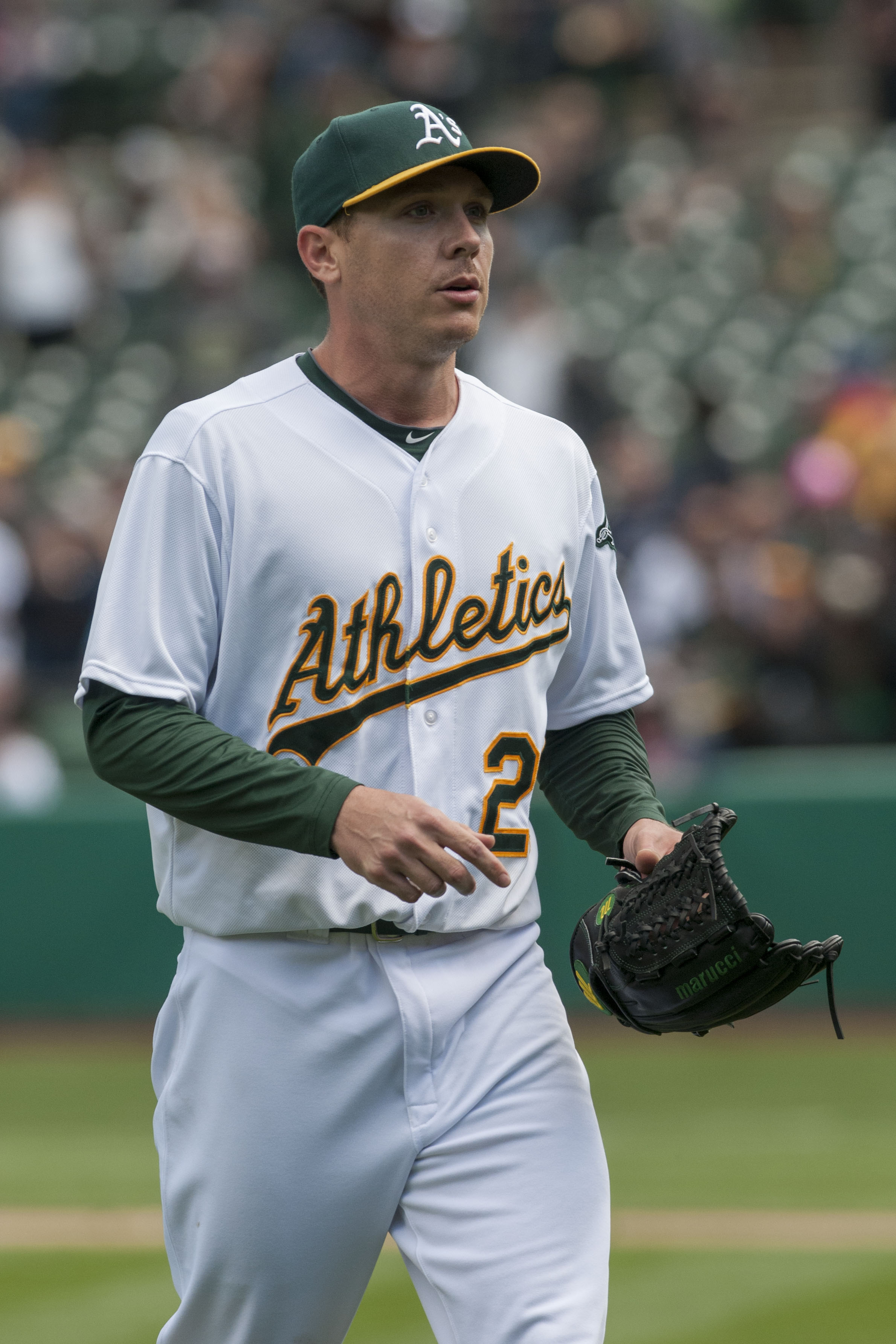
Scott Kazmir (pictured) was signed to a two-year deal that was actually $2MM more expensive than the two-year, $20MM deal that Colon inked with the Mets, but Beane and his staff appeared more amenable to the risk associated with Kazmir's injury history than Colon's age. Kazmir comes with significant upside, as ERA estimators FIP, xFIP and SIERA all feel that his performance was more indicative of a 3.35 to 3.50 ERA than the 4.04 mark he finished with. Kazmir's 10.1 percent swinging-strike rate and 92.5 mph average fastball velocity both ranked in the Top 25 in baseball among pitchers with 150 or more innings pitched. He was sidelined with a minor triceps issue this spring, but looked to be in good form in his first outing of the year (7 1/3 shutout innings with 5 strikeouts, no walks, and just three hits).
Many expected Balfour to sign a two- or three-year deal with a significant average annual value this offseason. The A's likely thought the same and deemed it too rich for the their taste, though apparently only in terms of contract length and not AAV. Oakland acquired Jim Johnson in exchange for Jemile Weeks and David Freitas in what amounted to a salary dump designed to free up payroll for the Orioles. It wasn't exactly a move that most would expect of Beane and his regime, as Oakland has long subscribed to the theory that closers are made, not born. (Balfour himself had just eight career saves prior to signing with Oakland.) When the A's have spent on a closer, it's been a more modest annual investment, such as their two-year, $10.5MM deal with Brian Fuentes prior to the 2011 season.
As if adding Johnson's $10MM salary wasn't enough, the A's doubled down on expensive relievers by flipping Seth Smith to San Diego in order to acquire one of the NL's best setup men — Luke Gregerson. Each player had one year left on his deal, though Gregerson will end up earning roughly $750K more than Smith after agreeing to a one-year, $5.065MM deal to avoid arbitration.
After seeing their acquisition of Chris B. Young result in a mere .200/.280/.379 batting line, the A's looked elsewhere for a lefty-mashing fourth outfielder and acquired Craig Gentry in an intradivision trade with the Rangers. In Gentry, Oakland secured one of baseball's best defenders and fastest runners — two skills that typically aren't rewarded through arbitration. That was unequivocally apparent when Gentry's first trip through arbitration resulted in a $1.145MM salary despite a healthy 6.2 fWAR over the past two seasons. That's nearly $10MM less than Young earned in 2013; suffice it to say, while Michael Choice was a reasonably steep price to pay, Oakland greatly improved its outfield depth for the next three years in a way that won't cost them financially. By acquiring Lindblom in the deal, they also gained another bullpen arm or potential rotation option, which has proven to be crucial this spring (more on that later).
Beane also acquired some future upside, though it doesn't come without risk; in Drew Pomeranz, he landed a former No. 5 overall draft pick (by the Indians) who has yet to flourish in the Major Leagues despite reasonable success at the Triple-A level. Pomeranz has opened the season in the Oakland bullpen after a strong Spring Training. Also acquired was the speedster Billy Burns, whose 10 steals in 26 Spring Training contests drew comparisons to another fleet-footed Billy — Billy Hamilton. Burns has averaged 76 steals per 162 games in the minors and has a career .420 OBP, and he's likely not too far from Major League ready.
Questions Remaining
Beane and his staff were able to make all of these moves without losing too many of the major pieces from last year's club. The loss of Colon, in theory, will be offset by the acquisition of Kazmir. Johnson and Gregerson are designed to replace Balfour at the back end of the bullpen, and while the loss of Anderson defintely sent some talent out the door, he pitched just 44 2/3 sub-par innings last season in a year when the A's won 96 games.
The question, then, becomes just how much — if at all — the A's improved. It's certainly curious to see Oakland spend this type of money on its bullpen, given the team's modest payroll. In Johnson, Gregerson and Eric O'Flaherty (who won't even pitch until midseason), the Athletics are spending more than $16MM. For a team that's in record-payroll territory despite an overall commitment of roughly $82MM, that's a significant amount of money to spend on late-inning relief.
Even before the benefit of hindsight regarding Jarrod Parker's Tommy John surgery, one could argue that some of those funds would have been better allocated to the starting rotation. Though Oakland starters finished ninth in the Majors in ERA last season, they finished 19th in FIP and 23rd in xFIP, and that was including the departed Colon. A full year of Sonny Gray will help those numbers, but a full season of Kazmir is far from a safe bet. Talented as Kazmir might be, he's topped 160 innings just twice in his career and logged 158 last season in his comeback with Cleveland. From a WAR standpoint, he may only need 250-300 innings to justify the value of his contract, but the A's are probably hoping for a higher total than that, which is no sure thing.
The question marks surrounding Kazmir's workload are magnified by the injuries to Parker and A.J. Griffin. Oakland has begun the season with Jesse Chavez in its rotation, and Lindblom has already been needed for a spot start. An early injury to Kazmir could push Lindblom into the rotation full-time and leave the club with little depth.
When everyone was healthy, adding two veteran starters might've seemed unnecessary, but perhaps they could have done so and moved a starter to address other needs. The team pursued a reunion with Tim Hudson this offseason and finished runner-up to the Giants; I wonder if foregoing the trade for Johnson could have left them with the financial wherewithal to add both Hudson and Kazmir.
That could've led to a trade to shore up their second base situation. For all of Eric Sogard's popularity — he nearly won the #FaceOfMLB contest this offseason due to his overwhelming popularity with the fans — the fact remains that he's a career .240/.295/.341 hitter. He and Punto provide strong defense at the keystone, and Sogard is a valuable member of the Oakland clubhouse, but a second base upgrade could have been beneficial. Had things shaken out differently, perhaps a second intra-division trade of the offseason could have been struck to add Nick Franklin to the fold. It won't be a surprise if the A's are in the market for a more potent bat up the middle this summer.
Deal of Note
While the Kazmir signing and the Johnson acquisition are both a bit out of character for the A's, perhaps the most interesting move the club made was its extension for Crisp. Beane and the A's are known for signing young, core players to long-term deals (and often trading them a few years into those deals), but an extension for a veteran player such as Crisp is of the utmost rarity for Oakland. The closest thing we've seen to a deal such as this one from Beane is Mark Ellis' two-year, $11MM signed following the 2008 season. Ellis was set to hit free agency following that season, while Crisp would've been a free agent following the 2014 season (Crisp's previous two-year deal with Oakland was signed in January 2012 as a free agent).
It's certainly a gamble, to an extent, on a 34-year-old whose game is largely based on speed, but Crisp has been worth at least two fWAR and 2.7 rWAR in each of his four seasons with Oakland. While he's not likely to play in 150 games per season, Crisp has been an underrated commodity in Oakland and should live up the value of his deal even when he faces some inevitable power regression (Crisp's average home run distance in 2013 was 353 feet, per BaseballHeatMaps.com, and Hit Tracker lumped eight of his 22 home runs from 2013 into the "Just Enough" category).
Overview
When coming off a 96-win season, it's difficult to find ways to definitively improve a club. Late injuries to Parker and Griffin have muddied the picture when looking at Oakland's roster, but heading into Spring Training, this looked to be a club that would challenge its record from 2013. Though the team could stand a few upgrades, Beane and his staff constructed a solid roster, top to bottom. It's possible that their spending spree on relievers was simply due to the fact that they had money to spend but so few glaring holes on the roster that they put the excess funds toward the only area that they felt needed a good deal of work.
The loss of Parker hurts, and Oakland has a lot of eggs in the fragile basket of Scott Kazmir's left arm. However, the club also has the depth to replace him, especially once Griffin returns to the mound. Injuries have ravaged the Rangers as well, somewhat lessening the blow of their own DL-related woes. While the Astros, Mariners and Angels all look to have improved, they're all still chasing the 2012-13 AL West Champions, and the A's figure to make a strong push for a divisional three-peat in 2014.
Photo courtesy of Ed Szczepanski/USA Today Sports Images.
Minor Moves: Rapada, Gimenez, Cabrera, Taylor
We'll keep track of the day's minor moves here:
- The Mariners have signed lefty Clay Rapada and added him to the roster at Triple-A Tacoma, according to Rainiers announce Mike Curto (on Twitter). Bob Dutton of the Tacoma News Tribune first reported (via Twitter) that Rapada was working out for the team. The left-hander has a 4.06 ERA in 94 big league innings but has never been able to hold down a consistent big league job despite dominant numbers against left-handed hitters; Rapada has held lefties to a minuscule .164/.255/.231 batting line in his career. However, righties have roughed him up at a .345/.464/.611 clip.
- Catcher Chris Gimenez has cleared waivers and been outrighted to Triple-A Round Rock, according to the Dallas Morning News' Evan Grant (Twitter link). Gimenez, who has been outrighted previously, has 72 hours to accept or reject the assignment. He was claimed off waivers by the Rangers last week but quickly designated for assignment when the club promoted Daniel McCutchen to the Majors.
- The Cubs have outrighted reliever Alberto Cabrera to Triple-A after he cleared waivers, reports Mark Gonzales of the Chicago Tribune (via Twitter). The 25-year-old righty was designated on Saturday.
- Outfielder Michael Taylor has cleared outright waivers and been assigned to Triple-A, tweets Chris Cotillo of MLBDailyDish.com. The 28-year-old will take up residence in Sacramento for the fifth straight year since joining the Oakland organization.
- Brian Bogusevic has accepted an outright assignment from the Marlins, reports Cotillo (via Twitter). Bogusevic, a 30-year-old outfielder who was acquired over the offseason for Justin Ruggiano, could have elected free agency since he has previously been outrighted.
- The Red Sox have released outfielder Scott Cousins, Cotillo also tweets. Cousins, 29, has seen bit action in parts of four MLB seasons. The news was first reported yesterday by Mike Andrews of SoxProspects (via Twitter). According to Andrews, longtime minor leaguer Juan Carlos Linares was also among the players cut loose from the Boston system.
- Pitcher Armando Galarraga is working on securing a visa after receiving an offer from the Taiwanese club Brother Elephants, his agent tells Jon Morosi of FOX Sports (Twitter link). Cotillo tweeted earlier this morning that the former big leaguer was close to a deal to move to Taiwan. In 542 career MLB innings, Galarraga has a 4.78 ERA with 5.7 K/9 against 3.8 BB/9.
- Outfielder Dave Sappelt has been released by the Phillies, tweets Cotillo. Sappelt himself said on Twitter that he appreciates the club carrying him while undergoing offseason surgery. The 27-year-old has seen limited action in three big league seasons.
- The Astros have outrighted reliever Raul Valdes to Triple-A, according to the PCL transactions page. Though he lacks an extensive MLB track record at age 36, Valdes still has an intriguing recent stat line and looks to be a good bet to see time in Houston at some point. His ERA was a ghastly 7.46 last year, but he put up 9.5 K/9 (against just 2.1 BB/9), good for a 3.10 SIERA. Valdes posted numbers more line with those peripherals in 2012 and even during limited action this spring.
- Likewise, Hiroyuki Nakajima has been outrighted to the top affiliate of the Athletics, also via the PCL transactions page. The move is not surprising, given that Nakajima had only been added to the 40-man in the first place to fill it up to allow for the team to designate Taylor for assignment, according to a report from John Hickey of the Bay Area News Group (via Twitter).
Steve Adams contributed to this post.
Freddy Garcia Receiving Minor League Offers
Following his release from the Braves, right-hander Freddy Garcia has received multiple minor league offers, including one from the Rangers, according to Jon Heyman of CBS Sport (on Twitter). However, Garcia is still holding out for a Major League opportunity at this time and is currently working out in Miami, per Heyman.
The Braves recently released Garcia, electing instead to go with fellow veteran Aaron Harang in their rotation early in the season (Harang had a stellar debut against the Brewers yesterday). Garcia was outstanding for the Braves down the stretch and into the playoffs in 2013, pitching to a 1.65 ERA with 20 punchouts against five walks in 27 1/3 regular-season innings before allowing two runs in six innings against the Dodgers in the NLDS.
However, prior to that resurgence in Atlanta, the veteran Garcia struggled in a 53-inning stint with the Orioles, posting an unsightly 5.77 ERA with just 26 strikeouts against 12 free passes. The 37-year-old Garcia said last month that he would prefer retirement to pitching in the minor leagues at this stage of his career. He has a 4.15 ERA in 2264 career innings with the Mariners, White Sox, Yankees, Braves, Phillies, Orioles and Tigers.
Rays Extend Chris Archer
THURSDAY: If Archer does not reach Super Two status, he is guaranteed $20MM, MLBTR has learned. In that instance, he would receive a $1MM signing bonus, $500K in 2014, $1MM in 2015, $1MM in 2016, $3MM in 2017, $4.75MM in 2018 and $7MM in 2019. The option years and buyouts would not change, regardless of his Super Two status. Either way, the guarantee is still the largest ever for a player with less than one year of service time.
WEDNESDAY: The Rays have established themselves as annual contenders by extending young players early in their Major League careers, and the next such case presented itself today as the team has announced a six-year contract for right-hander Chris Archer. Archer's deal buys out all of his pre-arbitration and arbitration years, and will be worth $25.5MM if he achieves Super Two status but less if he does not (Super Two seems highly likely for Archer, who entered the year with 156 days of service). The contract also also contains a pair of club options that can push the value of the deal to $43.75MM over eight years. The Relativity Baseball client also reportedly receives a $500K bonus if he is traded during this contract.
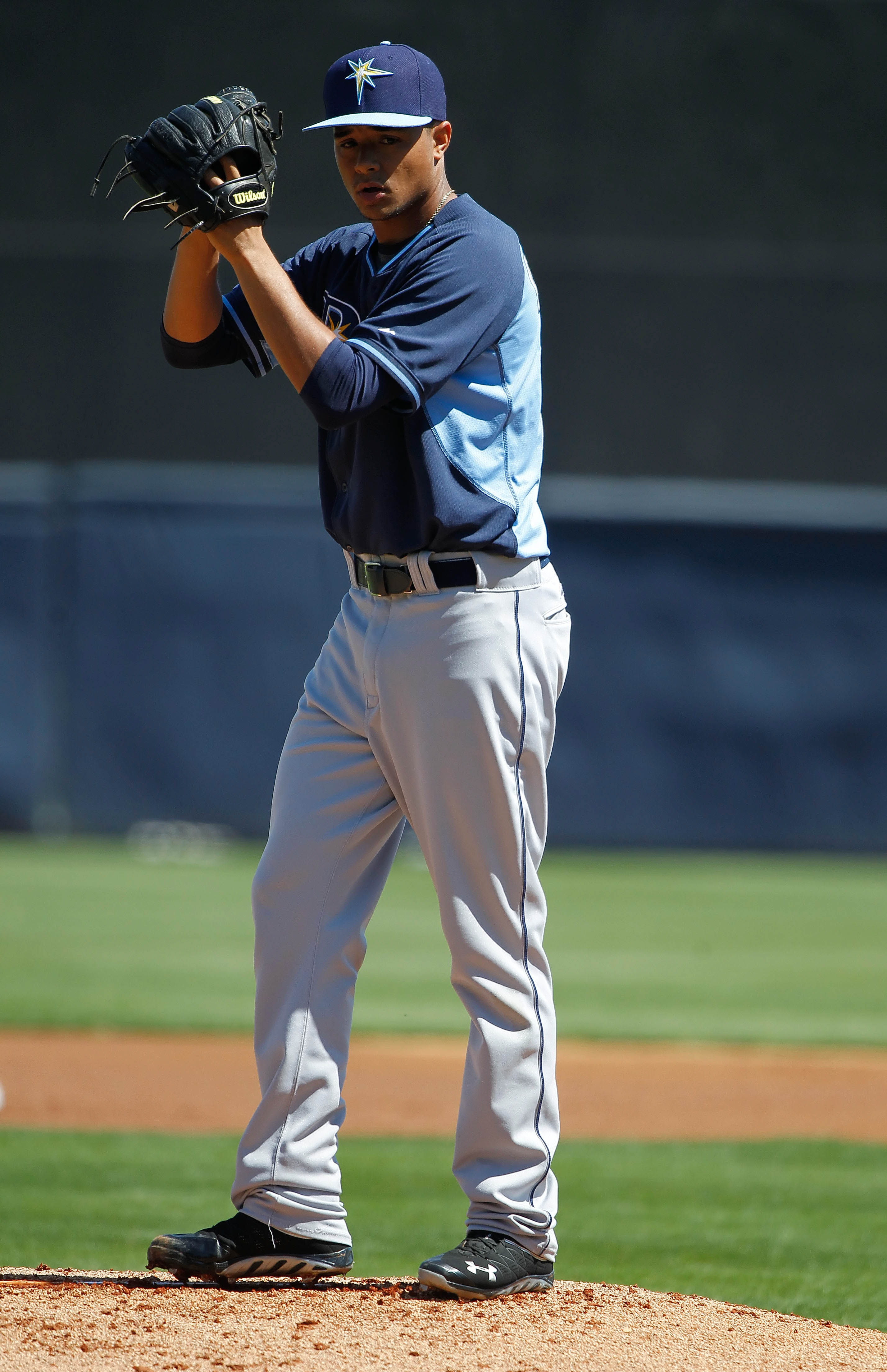
Assuming he reaches that Super Two status, Archer will receive a $1MM signing bonus and a $500K salary in 2014, $1MM in 2015, $2.75MM in 2016, $4.75MM in 2017, $6.25MM in 2018 and $7.5MM in 2019. The Rays can buy out Archer's 2020 option for $1.75MM.
Archer, 25, broke out with the Rays in 2013 with a strong performance that netted him a third-place finish in the American League Rookie of the Year voting. The North Carolina native posted a 3.22 ERA with 7.1 K/9, 2.7 BB/9 and a 46.8 percent ground-ball rate in 128 2/3 innings for the Rays, cementing himself as a member of the team's rotation. He averaged a blistering 95 mph on his fastball, which could eventually help him reach the his minor league levels of striking out a batter per inning. Perhaps most important for the Rays was Archer's improved command; he had averaged five walks per nine innings in his minor league career.
Archer's new deal is the largest ever for a player with less than one year of service time, eclipsing the six-year, $17.5MM extension and the five-year, $14MM extension signed by his own teammates Evan Longoria and Matt Moore, respectively.
The Rays originally acquired Archer from the Cubs along with Hak-Ju Lee, Sam Fuld, Brandon Guyer and Robinson Chirinos in exchange for Matt Garza, Fernando Perez and Zac Rosscup. That was actually the second trade of Archer's career though, as he was first drafted by the Indians and sent to Chicago along with John Gaub and Jeff Stevens to acquire Mark DeRosa back in 2008.
Archer was already under team control through the 2019 campaign, but this new contract will give the Rays options that run through the 2021 season, meaning the Rays haven't actually guaranteed any free-agent seasons with the deal. However, they will obtain cost certainty and two optional years of control, making it worthwhile risk for the team. From Archer's standpoint, he acquires financial security for a lifetime, sets a service time record and would hit the open market at age 33 if both options are eventually exercised.
For the 2014 season, Archer will join Moore, David Price, Alex Cobb and Jake Odorizzi/Jeremy Hellickson in the rotation (Hellickson is currently on the disabled list). While Price's long-term future with the club is in doubt, the Rays will now control Archer, Moore and Odorizzi through at least the 2019 season, with Cobb under control through 2017 via arbitration. Hellickson is controlled through 2016.
The Rays alerted the media that an announcement would be coming this morning, and Ken Rosenthal of FOX Sports was the first to report the six-year agreement, noting that it was in the $25MM range (via Twitter). Jon Heyman of CBS Sports pegged the exact value (via Twitter), while Yahoo's Jeff Passan added the trade bonus. Passan and ESPN's Jerry Crasnick added details approximating the value of the option years, and Passan noted the Super Two technicality as well. Marc Topkin of the Tampa Bay Times reported the year-to-year breakdown (via Twitter).
Photo courtesy of Kim Klement/USA Today Sports Images.
Mets Notes: Duda, Young, Abreu, Bullpen, Colon
Chris Young's tenure with the Mets isn't off to an ideal start, as the outfielder has already been placed on the disabled list with a quad injury sustained in the cold weather on Wednesday. Young called the situation a "bad dream" when talking with MLB.com's Anthony DiComo, who also spoke to manager Terry Collins about the $7.25MM man's early DL stint. More on the Amazin's as some teams wrap up their opening series…
- Manager Terry Collins told reporters earlier today that the Mets will give one first baseman a chance to prove himself beginning tomorrow, and Andy Martino of the New York Daily News reports that it will be Lucas Duda, not Ike Davis (Twitter links). Duda will be given a "real shot" to prove he can hold the job down, according to Martino.
Earlier Updates
- Bobby Abreu's minor league deal with the Mets is worth $800K, and he can opt out if not on the Major League roster by April 30, reports Joel Sherman of the New York Post (via Twitter). Abreu signed with the Mets after his release from the Phillies late last month.
- The Mets' bullpen woes only increased today, as a variety of arms struggled once again in action against the Nationals. The focal point of that general concern, of course, is injured closer Bobby Parnell, who figures to be out for at least six weeks and possibly much longer. As Ken Davidoff of the New York Post writes, replacing Parnell is a delicate balancing act. An outside addition is always possible, of course, but the options are limited. And while the team may well look to some young arms to bolster the MLB relief corps before long, it will need to be careful not to stunt the development of the team's key prospects.
- Martino also examined Bartolo Colon's importance to the Mets, and in doing so revealed that the Mets were the only club to offer Colon a multi-year deal. The Mets knew they needed to overpay after five losing seasons, according to Martino, who adds that Tim Hudson was willing to pitch for the Mets earlier in the offseason prior to signing a two-year, $23MM deal with the Giants.
Jeff Todd contributed to this post.
Tigers Claim Mike Belfiore From Orioles
The Tigers have claimed lefty Mike Belfiore off waivers from the Orioles, the club announced. Detroit optioned Belfiore to Triple-A.
Belfiore, 25, has no meaningful MLB experience but threw to a 3.18 ERA in 76 1/3 Triple-A innings (in just 37 appearances) last year. Lengthy relief outings are not a new thing for the Boston College product, who notably tossed 9 2/3 scoreless frames in a collegiate post-season tilt that proved to be the longest game in college baseball history. He came to Baltimore as the player to be named later in the trade that shipped Josh Bell to the Diamondbacks in early 2012.
Offseason In Review: Philadelphia Phillies
The Phillies brought in more veterans to supplement an already-aging core, and it is fair to wonder if the club is chasing good money after bad.
Major League Signings
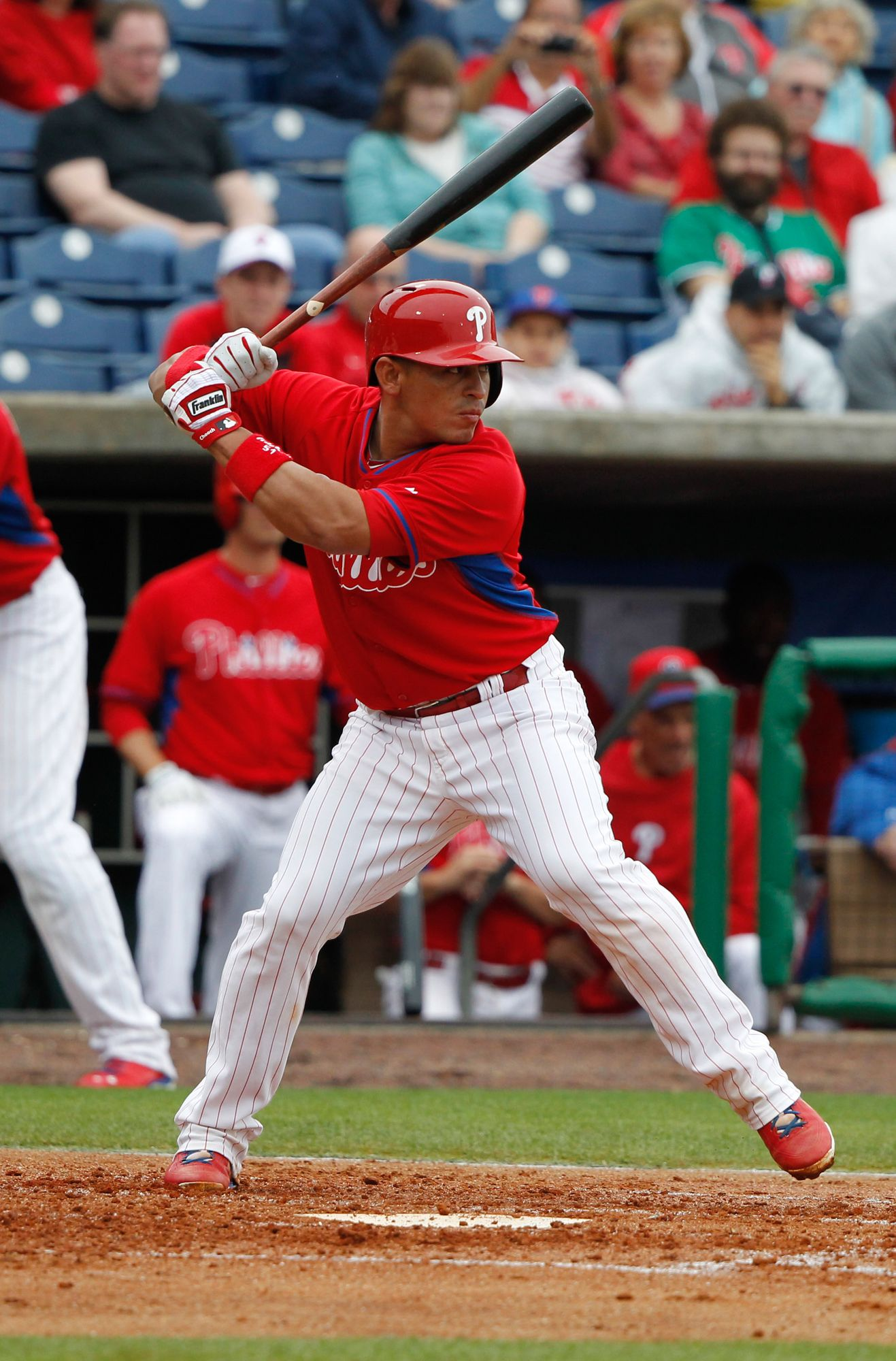
- Carlos Ruiz, C. Three years, $26MM.
- A.J. Burnett, RHP. One year, $16MM. Mutual/player option for 2015.
- Marlon Byrd, OF. Two years, $16MM.
- Roberto Hernandez, RHP. One year, $4.5MM.
- Wil Nieves, C. One year, $1.125MM.
- Total spend: $63.625MM
- Bobby Abreu (since released), Brian Bixler, Andres Blanco, Reid Brignac, Shawn Camp, Ronny Cedeno, Chad Gaudin (since released), Tony Gwynn, Jr., Cesar Jimenez, Jeff Manship, Lou Marson (since released), Sean O'Sullivan, Dave Sappelt, Clete Thomas
- Acquired RHP Brad Lincoln from Blue Jays in exchange for C Erik Kratz and LHP Rob Rasmussen.
- Acquired IF Jayson Nix from Rays for cash.
- Acquired C Koyie Hill from Nationals for PTBNL or cash.
- None
- Roger Bernadina, Roy Halladay (retired), John Lannan, Michael Martinez, J.C. Ramirez, Joe Savery, Casper Wells
Quick Hits: Pirates, Colvin, Free Agents, Dunand
The Pirates hold the top spot in Baseball America's ranking of every organization's minor league system (BA subscription required). This list has some updates from the original ranking in the 2014 BA Prospect Handbook, as while the top dozen teams remain the same, some clubs have moved up and down the list due to subsequent offseason moves. The Yankees, for instance, rise to the #13 spot due to their signing of Masahiro Tanaka, as he is technically a "prospect" as an MLB rookie.
Here are some items from around the baseball world…
- Tyler Colvin has accepted his assignment to the Giants' Triple-A affiliate and will report tomorrow, CSNBayArea.com's Andrew Baggarly reports (via Twitter). Colvin signed a minor league deal with San Francisco in February that contained an opt-out clause if he wasn't added to the team's Opening Day roster.
- While fans may worry that their teams will be hamstrung in the future by massive contracts, Sports Illustrated's Tom Verducci notes that the financial costs aren't as great as they seem given how much revenue Major League Baseball is generating and passing down to all 30 teams. These big deals also tend to create extra revenue for teams — Verducci cites how the Mariners' huge deal with Robinson Cano helped "a brand that needed polishing," and Cano's presence will help ticket sales and TV ratings.
- High schooler Joe Dunand's streak of eight home runs in as many at-bats has raised the youngster's profile, CBSSports.com's Jon Heyman writes. Dunand, 18, was considered by some scouting directors to be "a fringe pro prospect," but his homer streak attracted scouts from the Mariners, Angels, Royals, Orioles, Mets, Braves and Giants (among other teams) to his game on Wednesday. Dunand has committed to North Carolina State but could turn pro depending on his draft prospects. There's also the matter of Dunand's impressive bloodlines; his uncle is Alex Rodriguez.
- The Nationals announced that right-hander Erik Davis underwent Tommy John surgery today and will miss the entire 2014 season. Davis made his Major League debut last season and posted a 3.12 ERA and a 12.00 K/BB rate in 8 2/3 IP for Washington.
Pablo Sandoval Open To Midseason Negotiations
Pablo Sandoval has given the go-ahead to his agent, Gustavo Vasquez, to continue negotiations with the Giants about a possible contract extension should the club be willing to resume talking, CSNBayArea.com's Andrew Baggarly reports. San Francisco GM Brian Sabean traditionally eschews in-season negotiations, Baggarly notes, "so this could be a scenario where both sides say the ball is in the other’s court."
There was a considerable gap in offers when the two sides last met, with Sandoval demanding at least a five-year, $90MM deal and the Giants counting with a three-year, $40MM offer. That difference wasn't able to be bridged before Opening Day and Sandoval's team was reportedly deciding between continuing talks or waiting until after the season. It's possible the new deadline could be midseason, as Vasquez previously told CSNBayArea.com that Sandoval would test free agency if he didn't receive an acceptable offer from the Giants by the All-Star Break.
The Giants are known to want assurances about Sandoval's health and conditioning before extending the third baseman, and Sandoval has done his part in the early going by arriving at Spring Training in excellent shape. If the slugger is keeping up his fitness after a couple of months, it stands to reason that Sabean could have enough information to re-open talks. The Giants are no strangers to late extensions — they extended Hunter Pence in the last days of the 2013 season and similarly locked up Tim Lincecum in October, a couple of weeks before the right-hander hit the open market — though they might not get that chance this time if Vasquez's midseason deadline is a firm one.