
Mets Notes: Murphy, Wright, Trades, Seratelli
The Mets made Daniel Murphy available this past offseason but put a high price on the second baseman's services, Andy Martino of the New York Daily News reports, including asking the Orioles for top pitching prospect Dylan Bundy. Murphy has been working hard this spring to increase his value to the Mets, focusing on making more contact at the plate and reaching base more often (Murphy only had a .319 OBP last season). "On-base and slugging, this is what teams want," Murphy said. "This is what drives the offensive market now. They want you to be able to get on base, and when you do get base hits, they want them to be doubles. So I think that our game is heading in that direction. I think (the Mets are) probably a little bit farther, maybe out in front a little bit of the curve."
Here's some more from the Amazins' camp…
- "I'm not a mercenary," David Wright tells Bob Klapsich of the Bergen Record, as the Mets third baseman insisted that he has no regrets over staying with the team through their ongoing rebuilding process. "If my goal was to win right this second, then obviously, I would've been a free agent," Wright said. "To me, it was important to show loyalty to the Mets. I grew up rooting for them, they drafted me when I was 18, they're the only team I've ever played for." Klapisch, however, opines that the Mets haven't shown that same loyalty to Wright by not spending more to make the team competitive.
- The Mets' rebuild could be spurred by making trades rather than free agent signings, as Joel Sherman of the New York Post writes that if the Mets are willing to expand their payroll, they have the minor league depth to acquire expensive star players from teams who are themselves looking to rebuild or unload salaries.
- After eight seasons in the minors, 31-year-old Anthony Seratelli is still looking for his first taste of the majors, and now the New Jersey native has a chance close to home after he signed a minor league deal with the Mets earlier this offseason. MLB.com's Anthony DiComo profiles Seratelli's career, his video-editing talents and how he is inspired to keep playing by the tragic losses of his father and grandmother.
“If my goal was to win right this second, then obviously, I would’ve been a free agent,” Wright said. “To me, it was more important to show loyalty to the Mets. I grew up rooting for them, they drafted me when I was 18, they’re the only team I’ve ever played for.” – See more at: http://www.northjersey.com/sports/Klapisch_Mets_rebirth_vital_for_David_Wright.html?c=y&page=1#sthash.2fJKHX8T.dpu
AL Central Notes: Masterson, Santana, Tigers, Thome
Justin Masterson is only looking for a three- or four-year extension from the Indians, a short-term arrangement that speaks to comfort in Cleveland both on and off the field, MLB.com's Jordan Bastian writes. While Masterson said that contract talks are "a challenging situation, especially for me. [I'm] not doing this because we need to get the most money ever. We also think about others who may come behind us. There are a lot of different factors you try to work in. Are we being true to our value or are we skewing it?" Also, by staying with the Tribe, Masterson noted that he could further enhance the Indians' growing reputation as an attractive destination for people to play.
Here's some more from around the AL Central…
- A short-term deal may also have a strategic element to it, as MLB.com's Anthony Castrovince notes that a three-year deal would cover Masterson past the expiration of the current collective bargaining agreement. It's widely expected that the qualifying offer system will be modified (or even scrapped) in a new CBA, so Masterson could take the security of a short-term deal now and avoid having his market diminished as a free agent next winter if he has qualifying offer draft compensation attached to his services.
- Also from Castrovince, Masterson's love of playing for Terry Francona "is the only reason these extension conversations have had any traction."
- Twins assistant GM Rob Antony discussed his club's pursuit of Johan Santana with Mike Berardino of the St. Paul Pioneer Press. Minnesota only viewed Santana as a starting pitcher and would've been comfortable giving him a May 31 opt-out, Antony said, but the Twins simply weren't willing to sign Santana at the price he received from the Orioles. Santana will earn $3MM in base salary if he makes the Baltimore roster, plus potentially millions more in incentives.
- While Antony admitted that injuries could change the Twins' feelings about further additions, "right now I think what we’ve got in camp is what we’re working on.”
- Three months without the injured Andy Dirks as part of their left field platoon won't do much harm to the Tigers' playoff chances, Fangraphs' Jeff Sullivan writes. While Detroit is likely to replace Dirks with internal players, Sullivan notes that a more intriguing move would be to acquire an everyday outfielder who could then take over for Torii Hunter in 2015 and beyond.
- Jim Thome admits that he would "have to take that call" if another team contacted him about returning to the field, CBS Sports' Jon Heyman reports. Thome was hired as a special assistant to White Sox GM Rick Hahn last summer, though he never officially retired. While he would "always listen" about another playing opportunity, Thome enjoys his current position and has spoken of wanting to become a manager in the future.
Out Of Options Players: NL Central
The following 40-man roster players have less than five years service time and are out of minor league options. That means they must clear waivers before being sent to the minors, so the team would be at risk of losing them in attempting to do so. I've included players on multiyear deals. This list was compiled through MLBTR's sources. Today, we'll take a look at the NL Central.
Brewers: Juan Francisco, Jeff Bianchi
Francisco is competing with Mark Reynolds and Lyle Overbay for the Brewers' first base job. It's hard to imagine a scenario where all three make the team, wrote Tom Haudricourt of the Milwaukee Journal-Sentinel last week. Reynolds and Overbay signed minor league deals, but it seems likely at least one of them will make the team. When Reynolds signed in January, it was said the Brewers told him he'll almost certainly make the team, so Overbay might have to beat out Francisco, who has the advantage of already being on the 40-man roster.
Back in February, Curt Hogg of Disciples of Uecker dissected the Brewers' reserve infielder situation, explaining that while they may need to carry seven infielders, Bianchi still seems needed as the only one capable of backing up Jean Segura at shortstop.
Cardinals: None
Cubs: George Kottaras, Wesley Wright, Justin Ruggiano, James McDonald, Pedro Strop, Welington Castillo, Jeff Samardzija, Luis Valbuena, Travis Wood, Donnie Murphy, Alberto Cabrera
McDonald is competing with Chris Rusin for the Cubs' fifth starter job, at least until Jake Arrieta's shoulder is deemed ready. Meanwhile, Cabrera is battling for the final bullpen spot with about a half-dozen others.
Pirates: Chris Stewart, Jeanmar Gomez, Mark Melancon, Travis Snider, Jose Tabata, Bryan Morris, Andy Oliver, Stolmy Pimentel, Pedro Alvarez, Vin Mazzaro
The Bucs' seven primary relievers last year were Jason Grilli, Melancon, Justin Wilson, Tony Watson, Gomez, Mazzaro, and Morris, and indeed, that was their bullpen for the NLDS. It would be difficult for Oliver to break into that group, but surely the Pirates don't want to lose the hard-throwing Pimentel. Tim Williams of Pirates Prospects thinks they'll find a place for him. Some kind of trade makes sense to clear the logjam, barring injury.
Reds: Alfredo Simon
Simon is in good standing as a member of the Reds' pen.
Rick Ankiel To Retire
One of the most fascinating ballplayers of his generation, Rick Ankiel, has officially retired, Cardinals broadcaster Dan McLaughlin announced on the air today (story via MLB.com's AJ Cassavell). Ankiel is hoping to stay in the game by catching on in a front office.
Ankiel is a 34-year-old, power-hitting, free-agent outfielder who was cut loose by two different clubs last year. That seemed an unlikely ending when he cracked the league at age 19 as a big-armed pitcher, announcing himself with a 3.27 ERA in 33 innings for the Cardinals. He followed that up with an outstanding rookie year, throwing 175 innings of 3.50 ERA ball, notching 10.0 K/9 against 4.6 BB/9.
Then, of course, came Ankiel's sudden and stunning meltdown on the mound during the 2000 postseason. He never recovered to regain his former promise, and seemed destined to fade into obscurity.
Things took a second, almost equally startling turn when Ankiel re-emerged as an outfielder. Returning to the bigs in August of 2007, Ankiel swatted a home run in his debut and never looked back. He ultimately logged 2,019 plate appearances, notching 74 home runs and compiling a .242/.304/.427 line. And, of course, he put his powerful arm to good use, unleashing a number of memorable throws that cut down baserunners looking to stretch an extra base.
Though he was reportedly still interested in playing as recently as February, Ankiel had not received any interest at that point. He apparently decided to hang up his spikes now, rather than waiting for another opportunity.
After his time in St. Louis, Ankiel roamed the outfield for several clubs, starting with the Royals and Braves. He played for two seasons with the Nationals before finishing his career in 2013 with the Astros and Mets. Ankiel's overall stat line does not stand out, at least until one notices that it encapsulates two separate careers. Ultimately, his remarkable story, hard-nosed play, and incredible arm ensure that he'll long be remembered as a ballplayer.
Offseason In Review: Arizona Diamondbacks
One would be hard-pressed to offer a better description of this year’s Diamondbacks offseason than that written at the same time last year by MLBTR’s Steve Adams: “The Diamondbacks made a number of moves that raised eyebrows and invited skepticism this offseason, and they’ll have to improve on last year’s .500 record to silence those naysayers.”
Major League Signings
- Bronson Arroyo, RHP: Two years, $23.5MM. Club option for 2016.
- Eric Chavez, 3B: One year, $3.5MM.
- Total spend: $27MM.
- Henry Blanco, Daniel Hudson (non-tendered and re-signed), Mike Jacobs, Blake Lalli, Tommy Manzella, Andy Marte, Ryan Rowland-Smith, Adam Russell, Jess Todd
- Acquired RHP Justin Choate and OF Todd Glaesmann from the Rays in exchange for RHP Heath Bell (to Rays) and LHP David Holmberg (to Reds).
- Acquired OF Mark Trumbo and RHP A.J. Schugel from the Angels and OF Brandon Jacobs from the White Sox in exchange for LHP Tyler Skaggs (to Angels) and OF Adam Eaton (to White Sox).
- Acquired RHP Addison Reed from the White Sox in exchange for 3B Matt Davidson.
- Claimed Alex Sanabia, Matt Tuiasosopo, Santos Rodriguez, Marcos Mateo (Rule 5)
- Josh Collmenter, RHP: two years, $2.425MM. Club option for 2016 and mutual option for 2017.
- Brad Ziegler, RHP: two years, $10.5MM. Club option for 2016.
- Willie Bloomquist, Wil Nieves, Davidson, Bell, Holmberg, Skaggs, Eaton, Patrick Schuster (Rule 5), Kevin Munson (Rule 5)
Commenting Policy
MLBTR is increasing efforts to enforce our commenting policy. The goal is to raise the level of discourse in the comments, part of which involves eliminating inappropriate language and insults.
Comments of this nature are not allowed:
- Attacks or insults towards other commenters, the post author, journalists, teams, players, or agents.
- Inappropriate language, including swearing and related censor bypass attempts, lewdness, insults, and crude terms for body parts, bodily functions, and physical acts. Overall, we don’t want any language that a parent would not want their kid to see.
- Juvenile comments or extensive use of text message-type spelling.
- Comments written mostly or entirely in capital letters.
- Spam-type links or self-promotion. Please submit to our weekly Baseball Blogs Weigh In feature if you have a website or blog. Currently, permissible links in the comments are limited to MLB.com, Cot’s Baseball Contracts, FanGraphs, Baseball-Reference, Baseball Prospectus, Baseball America, and MLB Trade Rumors. Comments linking to other sites will be deleted.
- Comments about how you're sick of this topic or it's not newsworthy.
- Anything else we deem bad for business may be removed.
Also keep in mind the following general guidelines:
- No inappropriate avatars or images are allowed.
- Comments should be kept to approximately 200 words or less.
- Corrections for errors made in our posts are welcome and appreciated. We ask that you be cordial in doing so.
If you see comments that violate our policy, please flag them and/or contact us. Bans may be handed out liberally by our moderators, without second chances or warnings. Remaining civil is not that difficult, though, and most commenters have no problems doing so as well as helping rein each other in. We at MLBTR are grateful for long-time commenters and readers, though this policy applies equally regardless of tenure. This policy is always available at the bottom of the site, and will be re-posted monthly.
AL East Notes: Ervin, Johan, Salty, Lester, Bedard
Orioles manager Buck Showalter wouldn't rule out the possibility of his team adding Ervin Santana to the fold when asked by Roch Kubatko of MASNsports.com. Said Showalter: "I wouldn't say that and be completely sure that it's true." Kubatko has garnered that the Orioles were comfortable going into the three-year, $30MM range but weren't interested at Santana's asking price of four years, $50MM. More on the Orioles, who officially signed a different Santana (Johan) yesterday…
- Executive vice president Dan Duquette wouldn't commit to whether or not Johan Santana will be used as a starter or reliever if he's able to eventually take the mound, tweets Kubatko. Santana's contract contains incentives for games started, though reports yesterday indicated that they viewed him as a relief option as well. Duquette says Santana's ultimate role will be determined once the team sees how his velocity progresses. The two-time Cy Young winner topped out at 81 mph in his most recent workout, but he's very early in his throwing program at this point.
- The offer Jarrod Saltalamacchia received from the Red Sox this offseason was the lowest of the six or seven offers presented to him, the catcher told reporters, including the Boston Globe's Nick Cafardo (Twitter link). The Boston Herald's Scott Lauber tweets that despite signing for a much lower average annual value, Saltalamacchia said he wouldn't have accepted a qualifying offer from the Red Sox, as he preferred multiyear security. The Globe's Matt Pepin has full quotes from Saltalamacchia, who said Boston's best offer was for two years, but "not a straight two-year deal," adding that there "were other things involved."
- Jon Lester told reporters, including WEEI.com's Rob Bradford, that there have been no recent developments in his contract talks with the Red Sox. Lester, who has made his desire to stay in Boston well known, said he prefer to let agents Seth and Sam Levinson of ACES and GM Ben Cherington worry about those matters.
- Andrew Astleford of FOX Sports Florida spoke with Rays non-roster invitee Erik Bedard about how he is adjusting to the new clubhouse and what it's like to come into camp looking for a job each year. Bedard says he didn't think back to his days with the Orioles when he faced them in his first Spring Training outing, because he doesn't know many of the players or coaches anymore. "Every team turns around every year. It's never the same. Nobody keeps the same guys anymore. They'll switch, trade, get released. Back in the day, everybody stayed."
Rangers Designate Alex Castellanos For Assignment
The Rangers have designated outfielder Alex Castellanos for assignment in order to clear a 40-man roster spot for Joe Saunders, tweets Rangers executive VP of communications John Blake.
The Rangers claimed the 27-year-old Castellanos off waivers from the Red Sox back in December. Originally a 10th-round pick of the Cardinals in the 2008 draft, Castellanos was shipped to the Dodgers in the 2011 Rafael Furcal trade before being traded to the Red Sox this offseason. However, Boston designated him for assignment upon signing Mike Napoli, leading to his claim by the Rangers.
Though he's moved around quite a bit this offseason, Castellanos has an outstanding minor league track record. The Florida native is a career .291/.382/.525 hitter with 36 homers and 35 stolen bases in 848 Triple-A plate appearances. However, he's managed just a .171/.186/.390 batting line in an admittedly small sample size of 43 big league plate appearances.
NL East Notes: Nationals, Mets, Payrolls, Gonzalez
Adam Kilgore of the Washington Post examines the coming payroll crunch that will soon face the Nationals. While the division-rival Braves have locked up their young core on multi-year extensions that have delayed their free agency, only Ryan Zimmerman is in that situation in Washington. As Kilgore notes, Jordan Zimmermann, Ian Desmond, Doug Fister and Ross Detwiler are all free agents after the 2015 season, and extending any of those players becomes more difficult in light of the fact that they approach free agency at the same time that Bryce Harper, Wilson Ramos and Stephen Strasburg become more expensive via arbitration. Kilgore wonders if recent talk of a Mike Trout extension could lead to optimism about a Harper extension as well, but also notes the difference between agents; Craig Landis is likely more open to a long-term deal for Trout than Scott Boras would be for Harper. Here's more regarding the Nats and the NL East…
- In a piece for the Washington Times, Mark Zuckerman looks at the Nationals' options for their No. 5 starter in Spring Training. While Ross Detwiler, Taylor Jordan and Tanner Roark all have their merits, Zuckerman notes the strengths of each at adapting to different roles. He writes that the easiest decision is Detwiler in the rotation, Roark in the bullpen and Jordan at Triple-A, but stresses that GM Mike Rizzo and manager Matt Williams need to make the decision with the team's long-term interests in mind.
- MLBPA executive director Tony Clark wouldn't bite when asked if the Mets' payroll was drawing attention from the union, writes Andy Martino of the New York Daily News. Clark said that the MLBPA pays attention to payrolls "in general" and called the Mets a "marquee franchise" but wouldn't elaborate. Clark said he isn't aware of any payroll constraints on the Mets, who will have a roughly $87MM payroll that represents a slight decline from last year's mark.
- Ryan Lawrence of the Philadelphia News writes that while Miguel Alfredo Gonzalez's Spring Training debut didn't go particularly well this weekend, Phillies coaches and executives took away some positives from the outing. Gonzalez allowed a run on two hits and four walks with two strikeouts in 1 2/3 innings and is fighting with Roberto Hernandez for the fifth rotation spot. Pitching coach Bob McClure and GM Ruben Amaro Jr. offered some praise, especially since Gonzalez has scarcely pitched over the past two years due to injury and suspension. Lawrence writes that Roberto Hernandez is still the favorite for the fifth starter role.
What Might James Shields Earn In Free Agency?
We heard earlier today that the Royals have no intentions of making a run at extending ace hurler James Shields. That would seem to confirm what has long been expected: namely, barring a surprising change of circumstances, Shields will hit the market next year looking to sell his services for age-33 and beyond.
As Andy McCullough of the Kansas City Star noted earlier today, Shields and his camp have rejected rumors that he is seeking to land a deal in the realm of Zack Greinke's six-year, $147MM pact. (Note that Greinke did not require draft compensation to sign, as Shields almost certainly will unless he too is dealt mid-season.)
But, as McCullough notes, Shields compares well to Greinke — indeed, he compares well to just about anyone not named Clayton Kershaw — in terms of recent production. He has pitched at least 200 innings (and often quite a bit more) for each of the last seven seasons, and has logged ERA totals of between 2.82 and 3.52 over the last three. Shields has been among the 20 or so most valuable pitchers since he cracked the league, and has looked more like a top-ten guy more recently.
So, can Shields earn Greinke money? Though his numbers make that contract look like a solid comp, another major factor speaks firmly against it: namely, age. At the time Greinke inked with the Dodgers, he was just over 29 years old, and threw at that age for the entire season in the first year of his deal. Shields will be four years older when he faces the open market for the first time.
This series of observations led MLBTR's Tim Dierkes to suggest that, perhaps, it would be worthwhile to look at the historical results of top-level, slightly older hurlers. The results of that research, and my discussions on the topic with both Tim and fellow MLBTR writer Steve Adams, make up what you'll read below.
Unsurprisingly, it turns out that slightly older pitchers have not readily landed huge contracts. That makes sense, for at least two major reasons. First is simply the factor of selection bias. Most really good pitchers accrue service time early in their careers and thus hit the open market slightly earlier than will Shields, who did not crack the bigs until age 24 and then gave up two years of free agency in an early-career extension. Likewise, as age increases, the likelihood of significant injury goes up, further attriting the possibly worthy arms. The second reason is even easier: older pitchers have less near-peak years left to sell.
Let's take a look at all pitchers to have signed deals with at least a $60MM guarantee at a $15MM or greater average annual value — after having turned 31 years of age. (The last column represents the player's age at Opening Day of the first season of their deal).
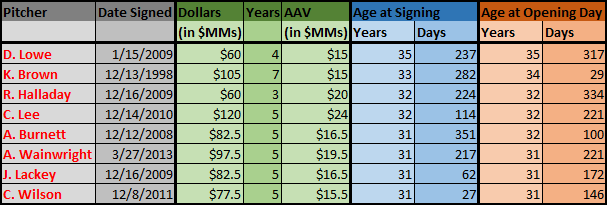
Among these potential comps, we can reject several out of hand. First, Brown and Lowe were both significantly older and signed deals in quite a different market. (Frankly, I only kept them on the chart to show how remarkable their contracts were.) Wainwright signed an under-market extension, while Halladay was also probably on a different performance/perception level and signed his own deal under somewhat odd circumstances.
That leaves us with four potential free agent comps, all of whom are near in age to where Shields will be when he hits the market. All signed five-year deals in early-to-mid-March of their free agent year. (If Shields signs before his birthday on December 20th, he'd be just shy of 33 years of age, making him slightly older than the other four were.)
How does Shields stack up to that quartet? Let's look at both three-year averages and walk-year performances to get an idea, and look at the salary numbers through the lens of inflation (present dollar value estimated via US Inflation Calculator). I have used ERA and fWAR not to suggest that those are the proper means by which to value pitchers, but to represent two sides of the overall picture: the former captures pure results, while the latter incorporates FIP as its baseline and thereby captures some of the underlying talent and rate-based results that teams surely examine closely when signing deals of this magnitude.
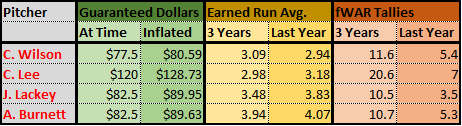
Needless to say, Lee paced the grouping — at least in the eyes of advanced metrics and in dollars achieved. He still fell well short of Greinke's guarantee, though of course he inked his deal a few years back and reportedly could have signed for seven years and $148MM.
As for Shields, his current three-year and last-year ERA both stand at 3.15. He has been worth 12.9 fWAR over the last three seasons, and earned 4.5 wins in 2013. Assuming he hits the market with approximately the same profile — i.e., he logs another 200+ innings of pitching in the low-to-mid-3.00 ERA range and has underlying metrics to support a 4-5 fWAR season — where might he land?
The answer, probably, is not in the realm of Greinke's contract (or the commensurate offer that Lee could have signed). Even accepting that baseball inflation has outpaced that of the general economy — or, at least, understanding that MLB salary levels are subject to wide variation due to the league's comparatively tiny player market, small sample of transactions, and range of non-market-based influences — the Wilson-Lackey-Burnett line of arms equate at most to a five-year, $100MM present-day value.
Importantly, Dierkes noted, those three were clearly the best available arms in their free agent years. While it is still conceivable that Shields will ultimately be the most attractive starter available when the market opens, odds are he will slot in behind Max Scherzer and possibly Jon Lester. (Of course, if Scherzer repeats his 2013 season, he might be on another plane altogether.) And if Justin Masterson hits the market, he might be more appealing to some clubs because of his significantly younger age. Regardless, unless each of those arms is extended off the market or takes a large value hit, Shields will not be the sole target for clubs looking to add an impact starter.
Moreover, as I recently noted in discussing extensions, teams have evinced an increasing willingness to value age. That attention to the aging curve probably also implies a corresponding unwillingness to roll the dice on continued production on its downside. Still-excellent pitchers Hiroki Kuroda (age 39) and A.J. Burnett (age 37) just signed one-year deals that will pay them $16MM. Can Shields really beat that AAV on a five-year pact that would buy out his age 33-37 campaigns, especially if there are alternative arms on the market? As Adams noted, Shields' slightly more advanced age means that a fifth year would push his guarantee into somewhat uncharted territory as compared with his most direct comps. It is worth wondering whether clubs would be willing to guarantee another year at such an elevated rate.
In the aggregate, it looks as though Shields could reasonably expect to top out at five years, with a $20MM AAV a seeming longshot at that term. On a four-year deal, Shields might land in the $75MM to $80MM range, perhaps with a vesting/club option of some kind attached on the end. But barring a massive jolt to the market that leaves Shields as the unquestioned prize with multiple suitors, it is somewhat difficult to imagine him reaching the $100MM threshold — if he is able to get a guaranteed fifth year at all.
One possible twist would be the inclusion of an opt-out clause. As Dierkes notes on Twitter, Lee actually had one offer that included an opt-out before he signed on with the Phillies. In his excellent piece on the use of opt-out clauses, Dierkes wrote that such provisions may not be that onerous to the team since, if exercised, the club is able to re-assess whether to take on further obligations (and, I would note, can do so with the advantage of insider knowledge on that pitcher). If clubs are unwilling to guarantee as much cash as Shields hopes for, he could potentially press instead for a deal that includes an opt-out, allowing him to re-enter the market if he carries his production into his mid-30's. And at that point, perhaps the Lowe contract would take on increasing relevance.