
Offseason Outlook: New York Yankees
MLBTR is publishing Offseason Outlooks for all 30 teams. Click here for the other entries in this series.
Despite a virtually unprecedented sell-off at the non-waiver trade deadline, the Yankees were in the thick of the Wild Card race through late September thanks to some significant strides from their young talent. With the path to playing time for a number of upstart players beginning to clear, they’ll look to supplement their increasingly youthful core in an effort to return to postseason play next year.
Guaranteed Contracts
- Jacoby Ellsbury, OF: $89.57MM through 2020 (including $5MM buyout of 2021 club option)
- Masahiro Tanaka, RHP: $89MM through 2020 (may opt out of contract after the 2017 season)
- Brian McCann, C: $34MM through 2018 (plus 2019 club option)
- Starlin Castro, 2B: $31MM through 2019 (including $1MM buyout of 2020 club option)
- Chase Headley, 3B: $26MM through 2018
- Brett Gardner, OF: $25MM through 2018 (including $2MM buyout of 2019 club option)
- CC Sabathia, LHP: $25MM through 2017
- Tyler Clippard, RHP: $4.15MM through 2017
Arbitration Eligible Players (service time in parentheses; projections by MLB Trade Rumors)
- Michael Pineda (5.099) – $7.8MM
- Dustin Ackley (5.087) – $3.2MM
- Nathan Eovaldi (5.013) – $7.5MM
- Adam Warren (4.031) – $2.3MM
- Didi Gregorius (3.159) – $5.1MM
- Dellin Betances (3.078) – $3.4MM
- Austin Romine (3.045) – $900K
- Aaron Hicks (3.041) – $1.4MM
- Tommy Layne (2.139) – $1.2MM
- Non-tender candidates: Ackley, Eovaldi
Other Financial Commitments
- Alex Rodriguez, DH: $21MM through 2017
Free Agents
- Mark Teixeira (retiring), Billy Butler
New York Yankees Depth Chart; Yankees Payroll Overview
Few would’ve pegged the Yankees as likely contenders after dealing Andrew Miller, Aroldis Chapman and Carlos Beltran prior to the non-waiver trade deadline, but the team hung around in the Wild Card race, buoyed largely by the superhuman performance of rookie Gary Sanchez and late flourishes from arms like CC Sabathia, Michael Pineda and Masahiro Tanaka — each of whom was excellent in September.
However, while Sabathia, Pineda and Tanaka each finished strong, that performance is potentially misleading. Each member of that trio entered the 2016 campaign with significant health questions — Sabathia’s knee, Pineda’s shoulder, Tanaka’s elbow — and it’d be unwise to expect that group to combine for 30 starts apiece once again in 2017. With the loss of Nathan Eovaldi to Tommy John/flexor repair surgery, the Yankees’ pitching depth took a further hit, leaving it unclear as to exactly who can shoulder the load for the rotation next season.
Certainly, Tanaka, Pineda and Sabathia are penciled into the mix, but the two additional spots beyond that group of veterans is up for grabs. Chad Green, Luis Severino, Bryan Mitchell and Luis Cessa are all candidates, and Adam Warren has done his share of starting for the Yankees in the past as well. But it’s not entirely clear that Severino’s future is in the rotation after a ghastly 8.50 ERA as a starter (47 2/3 innings) against a ridiculous 0.39 ERA as a reliever (23 1/3 innings). Obviously, those are small samples, but questions about Severino’s long-term ability to start date back to his days as a prospect, and the 2016 season certainly lends some credence to those who advocate for him to join Dellin Betances as a rotation prospect that instead thrives as a power arm in the bullpen. The 52 strikeouts that Green piled up in just 45 2/3 innings make him the next-most intriguing name of the bunch, but he finished the season on the shelf due to a flexor strain of his own, so there’s little certainty with regard to the 25-year-old.
The free-agent market is notoriously thin this offseason, though if GM Brian Cashman wants to utilize the financial flexibility he gained via the retirement of Mark Teixeira and the shedding of the Beltran, Chapman and Miller contracts to chase upside, the Yankees can certainly afford to beat the market for Rich Hill. The 36-year-old’s renaissance has been one of the most remarkable storylines of the past season, and Hill is unquestionably the only thing resembling a top-of-the-rotation pitcher on the free-agent market. He’d add his own laundry list of injury question marks to the Yankees’ ledger, of course, but Hill’s 2.21 ERA and 178-to-39 K/BB ratio across his past 146 1/3 big league innings (postseason included) are difficult to ignore.
The other top names on the market include Jeremy Hellickson, who figures to reject a qualifying offer (which curbed the Yankees’ free-agent pursuits last winter in an offseason in which they remarkably elected not to sign a single MLB free agent), and former Yankee Ivan Nova. Bounceback arms will be plentiful, with the likes of Charlie Morton, Brett Anderson, Bud Norris, Jake Peavy and Henderson Alvarez all available if they’re comfortable trying to reestablish themselves in the tight confines of Yankee Stadium.
The trade market represents Cashman’s other primary avenue to a big league rotation piece, but the GM has indicated that he doesn’t think he’s at the point where he’s ready to offload a newly acquired plethora of high-end minor league talent in order to procure a front-line starter. That could be a smokescreen and could change as opportunities arise throughout the offseason, but for now it sounds like Yankees fans should think more along the lines of Ervin Santana than Chris Sale or Chris Archer when it comes to trade targets. The subtraction of a number of a number of expensive commitments — Teixeira is already off the payroll, and both Alex Rodriguez and Sabathia will be next offseason — also allows Cashman to consider the possibility of taking on a burdensome contract from another club that would be more manageable for the Yankes. Whether it’s achieved through free agency or trades, adding an arm that’s controllable beyond the 2017 campaign seems imperative, as the Yanks could see Tanaka, Pineda and Sabathia all depart next offseason.
Cardinals Rumors: Center Field, Rotation, Bullpen, Moss, Wong
Derrick Goold of the St. Louis Post-Dispatch tackled questions from a number of fans earlier today and addressed a wide number of topics pertaining to the team’s offseason. First and foremost, Goold reports that he’s heard “more and more… how the Cardinals see trade opportunities as their preference” in their search for a center fielder. Specifically, he mentions Charlie Blackmon and Adam Eaton as speculative possibilities, though it personally strikes me unlikely that the Sox would deal Eaton. Blackmon has been an oft-rumored trade candidate over the past few seasons and will be again this winter with a projected arbitration salary of $9MM and a surplus of left-handed outfield bats in Colorado (Blackmon, David Dahl, Carlos Gonzalez, Gerardo Parra). Regarding Dexter Fowler, Goold notes that the Cardinals typically shy away from committing lengthy free-agent contracts to players on the wrong side of 30, downplaying the team’s potential interest.
More from Goold’s Cardinals rundown…
- Goold characterizes a significant investment into a starting pitcher as unlikely, noting that last winter’s pursuit of David Price was considered by the team to be a “special situation.” That type of opportunity isn’t present on this year’s free-agent market, though he does note that the Cardinals would consider Chris Sale a similarly “special” situation if he were to be made available on the trade market. That’s far from a guarantee, of course, as the White Sox could opt to take aim at contending once again in 2017.
- The Cardinals will be without left-hander Zach Duke for all of the 2017 season due to his recent Tommy John surgery, and Goold rattles off a number of internal replacements without making mention of the team potentially pursuing outside help. Among the candidates are Tyler Lyons, Marco Gonzales and “sleeper picks” Corey Littrell and Ryan Sherriff, each of whom is currently pitching in the Arizona Fall League.
- St. Louis will pursue other options early in the offseason as opposed to exploring a reunion with Brandon Moss, per Goold. If the team is unable to acquire a center field upgrade and Moss lingers on the free-agent market, a fallback would be signing Moss to play left field and keeping Randal Grichuk in center field.
- Despite a midseason demotion to Triple-A Memphis for Kolten Wong, the St. Louis front office remains “bullish” on the 26-year-old and would like to see him get a prolonged look at second base in 2017. According to Goold, there’s long been a separation between the front office and the manager when it comes to dividing playing time, but there was an agreement in place late in the season that Mike Matheny would give Grichuk an extended look in center field down the stretch. Wong could be the beneficiary of that same extended stint despite his disappointing April and May in 2016. For what it’s worth, Wong did hit .251/.341/.401 in 217 plate appearances following his recall from Triple-A.
Frank Wren Unlikely To Be Named Red Sox GM
While former Braves/Orioles general manager Frank Wren, currently the Red Sox’ senior vice president of baseball operations, had previously been tabbed as a leading candidate for the GM vacancy in Boston, Ken Rosenthal of FOX Sports reports that Wren is now “unlikely” to become the team’s next general manager (Twitter link). Wren, as WEEI’s Rob Bradford recently pointed out, resides in Atlanta and wasn’t a guarantee to accept a greater role with the Sox even if the team wanted to promote him. Per Rosenthal, Wren is happy with his current position within Boston’s front office. The Sox, of course, are in the market for a new GM after Mike Hazen was hired as the new GM of the Diamondbacks.
President of baseball operations Dave Dombrowski said yesterday that the ideal scenario for the Sox would be to fill the GM void internally. That leaves a fair number of options, but MLB Network’s Peter Gammons reported earlier today (via Twitter) that the question among GM circles is whether Red Sox vice president of amateur/international scouting Amiel Sawdaye would take the “diminished” GM role in Boston. Certainly, even though Sawdaye would be second in command as opposed to the top decision-maker, it would seem logical that Sawdaye would welcome the promotion. And indeed, the Boston Herald’s Evan Drellich tweets that the likely removal of Wren’s name from the running now places Sawdaye in the spotlight.
Also of note with regard to the Boston front office is Gammons’ report that analytics director Tom Tippett has left the team. Drellich reports that Tippett, who spent the 2008-13 seasons as the team’s director of information services before rising to the role of senior baseball analyst, was offered the opportunity to return but elected to pursue other avenues. Tippett told the Herald’s Michael Silverman that he could end up working for another club or within baseball in another capacity, adding: “…but I’m also interested in other spots and opportunities outside the sports world.” Peter Abraham of the Boston Globe tweets that Dombrowski said Tippett’s role will be filled, though he declined to specify if it’d be an external or internal hire and added that the position’s title is to be determined.
Those interested in the inner-workings of the Red Sox’ front office under current and prior leadership groups will want to check out Drellich’s above-linked column, as he quotes Tippett in discussing the leadership styles and strengths of Dombrowski as well as former Boston GMs Ben Cherington and Theo Epstein. Notably, Drellich reads between the lines a bit and wonders how heavily Tippett was leaned upon by Dombrowski, as Tippett said back in August when speaking at a seminar entitled Sabermetrics, Scouting and the Science of Baseball that Dombrowki has a “smaller inner circle that he works with when he’s making decisions” than either Epstein or Cherington did.
A Look Beyond The Tim Tebow Signing
Burke Badenhop made his Major League debut on April 9, 2008 when he tossed a scoreless inning of relief for the Marlins. In the eight years that followed, he pitched 512 1/3 innings of 3.74 ERA ball with the Marlins, Rays, Brewers, Red Sox and Reds. He’s been a part of four trades (most notably the Miguel Cabrera/Dontrelle Willis blockbuster), tested Major League free agency and been in more than a dozen Major League and minor league clubhouses. We are thrilled to have Burke bring some of that unique perspective to MLB Trade Rumors. This is his fifth offering; he has previously written about the long path to reaching free agency, importance of September roster expansion, the experience of playing the spoiler and how big leaguers separate themselves from the teams for which they grew up cheering.
Upon hearing that Tim Tebow had been training for the better part of a year to play baseball, I didn’t think much of it. I figured he would have a showcase, scouts would show up, and the baseball world would get to see what the Heisman great and former NFLer had to offer. If he were any good, he’d show promise in his workout. I completely assumed and understood that he would be given a bit more benefit of the doubt thanks to his name alone.
As you know, the reviews on Tebow were mixed after the workout. Most reports praised his power, were skeptical of his outfield work, and noted his arm was well below average. The critique that stuck with me most was a scout’s view that Tebow looked like “an actor trying to portray a baseball player.” Such a description summed up so many things in just one sentence. I pictured Bernie Mac hacking away in Mr. 3000 or Freddie Prinze Jr.’s rudimentary mechanics from Summer Catch. The average fan might not notice, but as a pro baseball player, you know the difference between a ballplayer and someone who’s just dressed as one for Halloween.
I checked out the video from the workout out of curiosity. Tebow’s swing looked fine to me. It was definitely long, but it was powerful and fell far short of looking as bad as a Charles Barkley golf swing. Tebow’s outfield work definitely left more to be desired, though. He shagged fly balls with an awkward ‘five step drop’ type of footwork. And I couldn’t stop looking at his glove. Not the type of glove or the color or anything, but how it was broken in. It was just wrong. It didn’t have a pocket, it was bent in a weird way and he had all five fingers in each finger hole, which I’ve never seen an outfielder do.
Despite all the red flags I saw and read about, I figured someone would still sign him. I had no problem with that. He had some pop from the left side. You can teach him how to break a glove in later. The problem for me arose when I heard he signed for $100,000, the equivalent of a bonus for a top ten round draft pick. For some reason, it hurt. It stung.
Big leaguers are found all over the draft. For every first-round superstar like Kris Bryant, you’ll find a Daniel Murphy in the 13th round. I was drafted in the 19th round as a college senior. I signed for $1,000. You could draft 100 of me for the price of one Tim Tebow. Such a thought only elicits feelings of disrespect.
I fully realize that Tebow will sell a lot of jerseys and will entice far more fans to come to the ballpark than I ever did. From a business standpoint, he will probably be profitable. But, as a former player, those ends don’t necessarily justify the means. Taking a roster spot on a minor league team is one thing, but also handing a guy $100,000 is another. This move comes in a day and age when minor leaguers are finally standing up and voicing their displeasure with how their salaries have drastically lagged behind the overall financial growth in our game. I immediately thought of all the struggles you have as a minor leaguer — all of the two-bedroom apartments you end up sharing with five guys. I would have killed for even a $5,000 bonus.
To see a team give a 29-year-old with no baseball experience a six-figure bonus because he was good at college football was confusing. The road to “The Show” isn’t a walk in the park. You don’t get to the big leagues as a 19th-rounder and stay without earning it. It was a badge of honor for me. This signing makes it seem that maybe teams don’t take the grind as seriously as the players do. It sends a very mixed message.
As a minor leaguer you have to believe that talent wins the day. That if you are talented enough, you’ll become a big leaguer. Without that basic belief, you’d be crazy to spend a summer riding a bus from small town to small town, making less than $7,500 per season.
Whether the Mets signed Tebow because they believe in his baseball ability or because they want to sell jerseys is a mystery. The whole nature of it, though, does nothing but cast doubt that talent will eventually win the day. As I said before, I was somewhat angry when I saw the details of the signing. I’m not angry with Tim Tebow. He didn’t force any team to sign him. As a player who defied the odds to carve out a career in the big leagues, my emotions were just another reminder that for guys like me, maybe our grind to the top isn’t as respected as we’d like to believe.
Chip Hale Returns To Athletics As Third Base Coach
The Athletics announced today that Chip Hale has been re-hired by the organization and will fill the role of third base coach that was vacated when Ron Washington took the same title with the Braves earlier this month. Hale, whose talks with the A’s were first reported by the San Francisco Chronicle’s Susan Slusser, has spent the past two seasons managing the D-backs but was dismissed from that post at season’s end. Prior to his time in Arizona, he served as Oakland’s bench coach under manager Bob Melvin from 2012-14.
“We’re thrilled to bring Chip back to the organization and to retain the rest of our coaching staff,” Athletics general manager David Forst said when announcing the hiring (Twitter link). Slusser tweets that Hale will take on Washington’s role of working with the team’s infielders as part of his duties as third base coach.
Hale, 51, had a seven-year playing career as a utility infielder with the Twins and Dodgers in the late 1980s and early-to-mid 1990s. His Diamondbacks exceeded the expectations of many pundits in 2015 by finishing 79-83 — good for a third-place finish in the NL West behind the Dodgers and Giants. However, Hale was one of many in the D-backs organization to pay the price for the team’s disastrous 2016 campaign, during which the Diamondbacks struggled to a 69-93 record and finished fourth in their division. His experience in a variety of coaching roles and as a big league manager, however, should make him a candidate for future managerial openings, even if he obviously won’t be in that type of role next season.
Minor MLB Transactions: 10/18/16
Here are the latest minor moves, via Baseball America’s Matt Eddy unless otherwise noted:
- The Braves re-signed catcher Blake Lalli after recently outrighting him. Lalli, 33, received a brief MLB cameo for the first time in quite a while, but hasn’t spend much time in the majors and figures to remain in the upper minors next year. He carries a .265/.316/.376 batting line over parts of five seasons at Triple-A.
- Meanwhile, the Braves outrighted 26-year-old lefties Matt Marksberry and Andrew McKirahan as well as shortstop Daniel Castro. Marksberry has made 35 appearances over the last two seasons, posting a composite 5.06 ERA, though he was effective in 42 2/2 frames in the upper minors last year, carrying a 2.32 ERA with 8.2 K/9 against 3.6 BB/9. McKirahan spent the year recovering from Tommy John surgery. As for Castro, 23, the last two years have come with a fair amount of major league opportunities, but his bat hasn’t been up to the task. Over 239 total plate appearances, he has hit just .217/.250/.265.
- The Pirates re-signed righty Casey Sadler to a minor league deal. Sadler, 26, made a nice spot start in 2016 but spent most of the year working at Triple-A. He wasn’t able to repeat his quality earned run numbers from the prior two seasons in the upper minors, pitching to a 4.22 ERA with 5.3 K/9 and 2.8 BB/9 over 81 frames in 13 starts.
- Young Mexican third baseman/catcher Victor Ruiz is heading to the Reds from the Tijuana Toros, Cincinnati announced. Reds director of international scouting Tony Arias says that Ruiz has been on Cinci’s radar for some time, praising the youngster’s hitting ability, his “very good hands and a good throwing arm,” and also his “leadership and competitive qualities.”
MLBTR Chat Transcript
Click here to read a transcript of today’s live chat with MLBTR’s Steve Adams.
Al Avila: “Changes Are Coming” To Tigers
Tigers GM Al Avila told team reporters in his end-of-year press conference today that the organization will be looking to shake up its approach to roster building this winter. While Avila was largely and understandably vague on specifics, he made clear that “changes are coming” to how Detroit does business, as Evan Woodberry of MLive.com reports on Twitter.
The central issue, Avila suggested, is to avoid the ongoing reliance on high-priced veterans, as Jason Beck of MLB.com reports (Twitter links). “We want to get younger,” he said. “We want to get leaner. We want to run the organization without having to go over our means. We want to stay competitive, but at the same time, this organization has been working way above its means for some time.”
The notion that the Detroit organization has been spending “above its means” is certainly notable. Unquestionably, the club — under the leadership of owner Mike Ilitch — has committed huge sums of money to acquire and retain numerous talented players at market prices. That includes not only large extensions for players like Justin Verlander and Miguel Cabrera, but also major free agent outlays for Prince Fielder (who was later traded for Ian Kinsler), Anibal Sanchez, Victor Martinez, and — most recently — Justin Upton and Jordan Zimmermann.
Many of those big contracts were handed out while the Tigers’ baseball operations were being run by Dave Dombrowski, who Avila replaced last summer. But he oversaw the signings of Upton and Zimmermann last offseason, along with acquisitions of veterans Mike Pelfrey, Francisco Rodriguez, Cameron Maybin, and Mark Lowe. And the front office reportedly talked down Ilitch from a budget-busting offer to slugger Chris Davis. While the club improved to an 86-75 record, it failed to make the postseason for the second consecutive season despite an Opening Day payroll of nearly $200MM.
Ultimately, Avila was not willing to label the team’s upcoming approach as a rebuilding effort, as Anthony Fenech of the Detroit Free Press reports (Twitter links). And he did not specifically chart a course for how the team will accomplish the stated aim of infusing youth and trimming costs. But he did suggest that some tweaks could be coming, and that they may require some changed expectations for a team that has fashioned itself a perennial contender. “It’s not going to be easy,” said Avila. “But it has to be done.”
The overall thrust of the comments appears to indicate that Detroit may look to reallocate resources as soon as the coming winter. Avila left the impression that the organization won’t be looking to add impact free agents, as Woodberry tweets. And the GM made clear that payroll won’t go up, as Fenech tweets. He also didn’t promise a decline, but seemingly suggested as much. “Usually it will be the opposite,” he said. It’s not immediately clear whether the Tigers could pursue trades of quality veterans in a bid to add younger, controllable talent, but that certainly seems to be a natural course to pursue given Avila’s statements.
Detroit may not pursue a dramatic tear-down, but the precise strategic direction remains to be seen. Avila did note that the Tigers will likely need to add a reserve catcher to pair with James McCann, suggesting his son — Alex Avila — could be considered for a return, as Fenech tweets. The organization has yet to decide on club options over Maybin ($9MM with a $1MM buyout) and Rodriguez ($6MM with a $2MM buyout), the veteran executive added and Fenech tweeted.
Ryan Spilborghs: Improving September Baseball
Recently, I outlined the problem that September roster expansion poses for many players, coaches and managers. Though the focus now is on the postseason, CBA talks are nearing finalization, so now’s the time to address the subject. I have several suggestions on how to “fix” the competitive integrity in the month of September — along with the other issues I have mentioned.
To begin, the added depth and flexibility of September rosters does have some lessons. I believe first and foremost that a Major League season is too long and that the league should return to the 154-game season. It’s a physical grind to try to play 162 games in 183 days. I understand the revenue involved with TV rights, ticket and concession sales for each game, but other factors need to be considered as well.
Because our sport has made a significant effort to clean up the game with the banning of “amphetamines,” we have seen a dramatic decrease in players playing more than 135 games per season. I am by no means condoning the use of “greenies” to help players play more games — MLB should be commended for its efforts — but the use of the illegal drug was, at one point, simply a necessity for players to physically meet the demands of the game.
The onus on players is to play each game and produce; performance has always been judged by results and the ability to compete in each game. Good nutrition, proper sleep and body maintenance still make it nearly impossible for players to stay on the field in a capacity that is healthy. There is too much travel and there are too many games for these players to maintain a healthy lifestyle. I have the same argument when I view what the NFL has done to their players by adding Thursday night football. The demands of the game, coupled with short windows of recovery, force players to find “means” in which to compete, and those means sometimes toe the line of legality.
For baseball, I firmly believe it’s time to scale back the regular season. There is a precedent dating back to 1961, when baseball played 154 games, and returning to this schedule is imperative for the safety of the players.
In addition to that change, rosters for each MLB team needs to expand as well, from a 25-man roster to a 28-man roster. The increase in three players is significant enough to lighten the burden on starting pitching rotations and bullpens while also giving teams an extra bench player.
I understand that adding three players comes at a cost to Major League owners by increasing payroll, insurance, and pension, while also allowing more players to reach arbitration. However, the current situation harms the product that the league sells. It has been increasingly popular for teams to carry 13 members of the pitching staff, limiting many teams to a four-man bench. The shorter bench becomes a disadvantage (especially for National League teams) when a starting player is nursing a “day-to-day” injury; it becomes only a three-man bench while the injured player recovers.
Without the needed flexibility, the 15-day minimum disabled list stint means that regulars can be pushed harder than they should — possibly leading to more significant injuries — or be kept out longer than they ought to if a DL stint is required. An increased roster size could help prevent starting players from hitting the disabled lists while recovering, because teams will not have to worry about playing with a shorter bench. That would increase competition, especially when the games matter most down the stretch, and allow owners to keep their best players on the field longer.
Having the extra bench player could also allow National League teams can carry a DH-type of player over the course of the season, creating more excitement and helping to even the playing field for NL clubs competing in AL parks during interleague contests. When baseball moved the Houston Astros back to the American League, the NL and the AL were balanced out to include 15 teams apiece, but the byproduct became season-long interleague play.
There are more direct ways in which the financial shift could be offset, too. In order to make up lost revenue from subtracting eight games during the season, the postseason can expand to include a seven-game series after the initial Wild Card play-in games. Currently the division series is a five-game series. Adding two games can help offset some of the lost revenue, and a shorter regular season would leave plenty of flexibility to accommodate them. With some give in the schedule, baseball can also consider starting opening day later in April, or it can start the playoffs sooner so that the postseason doesn’t leak into November, thereby avoiding some of the weather challenges that arise on either spectrum of when season starts or finishes.
My final suggestion deals directly with September roster expansion. Under my proposal, teams would be able to call upon any members of their 40 man roster, but in a way that respects the integrity of the game is at stake in the season’s final month. It’s simple: only 28 of those players should be eligible for each game. Managers and front offices can determine which players will be the active roster on a given day, without being forced to follow the typical optional assignment rules. Pace of play in the month of September should increase, or at least stay status quo with the pace of the regular season, as opposed to games in which we see teams deploy 10 or more pitchers. To be fair to players that aren’t activated for a given night, no player would lose service time if they are placed in the pool of possible active roster members, and they would be allowed participate in all pregame work. The only detriment would be that they would simply not be allowed to dress for that night’s game.
Although this seems like a trite reason, having that many players on the bench during the game disrupts many players in-game behaviors, from warming up to finding a seat on the bench. For the final stretch run of the season, even the smallest of disrupted routines can be very important to players competing during the game.
I love September — the drama of the season unfolding, the surprise of a new player making their first mark, players and teams chasing down goals. My goal isn’t to subtract from that by any means, but to serve the best interests of Major League Baseball, its players and its coaching staffs, now and in the future. The final month of the season should not take place with changed personnel rules when history is at stake. Without taking away from a player earning a chance to compete at the Major League level in September, it needs to be recognized that we also should not take away from how the game is played for the previous five months. As great as the drama of September baseball already is, I would love nothing more than to see baseball implement some changes in the final wave of CBA negotiations to improve this game I so deeply care about.
Hiroki Kuroda To Retire
Veteran right-hander Hiroki Kuroda has announced that he’ll retire at the end of the season, as Japan’s Kyodo News reports. The seven-year major league veteran has pitched in the Nippon Professional Baseball league for the last two seasons upon returning to his homeland.
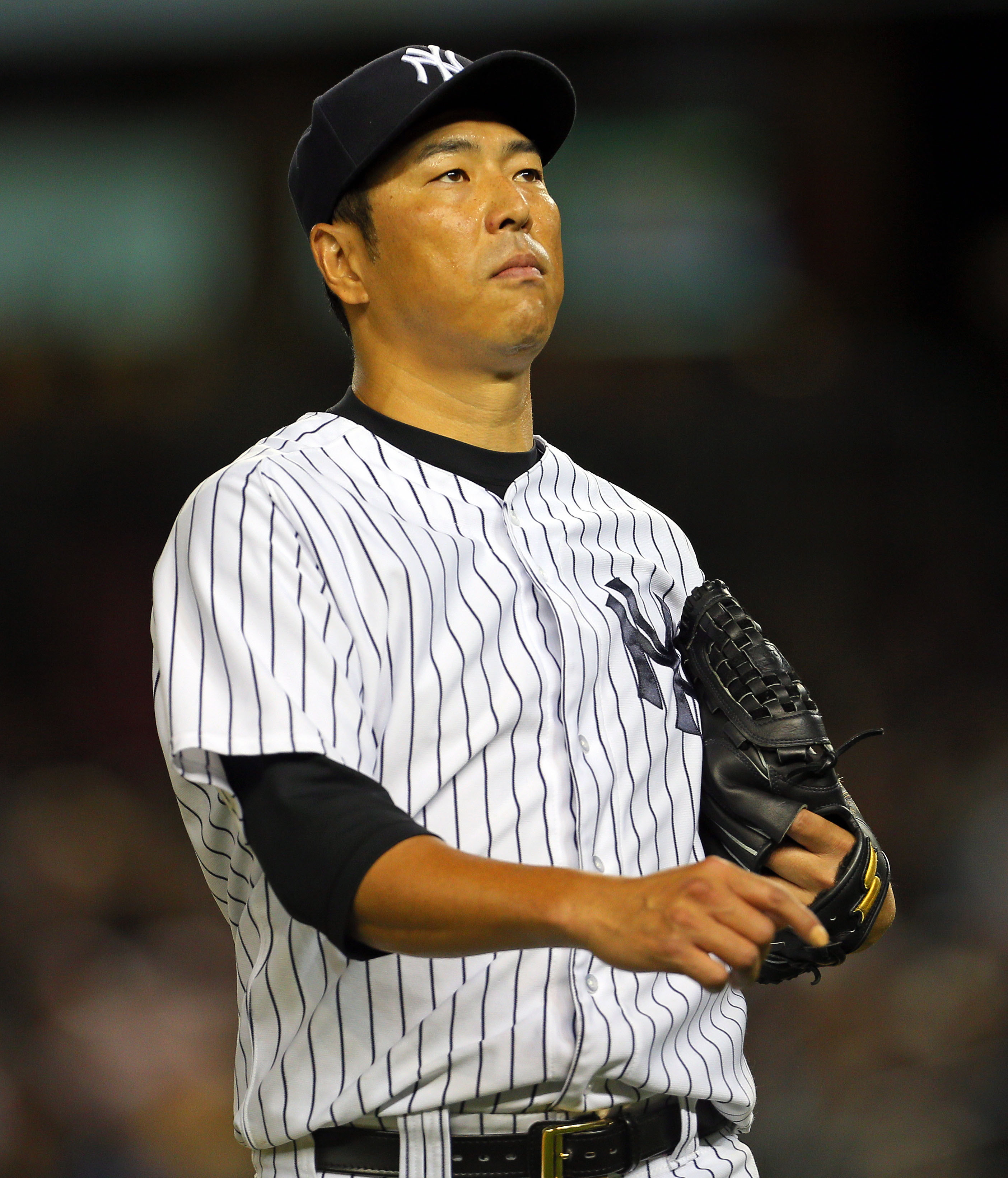
Kuroda, 41, is best known in these parts as a high-quality member of the Dodgers and then the Yankees. But in Japan, he is famed for his long run with the Hiroshima Carp — the organization he broke in with, excelled for, and returned to after his run in the majors (spurning the Padres’ reported efforts to keep him stateside).
Indeed, the Japanese star did not appear in the big leagues until his age-33 season. Of his twenty years of professional pitching, Kuroda spent 13 in the NPB — all for the Carp. All told, he provided that organization with over 2,000 innings of 3.55 ERA pitching. And he has been even better since his return, posting successive 2.55 and 3.09 ERA campaigns. He’ll hang up his spikes after the team’s run through the Japan Series comes to a close.
“The Japan Series will be the end. I’ve decided to hang it up,” Kuroda said. “I’ve been shown an excellent dream with an excellent team. And now I want to go out with a smile on my face, all of us celebrating a championship pouring beer on each other.”
In between his stints in Hiroshima, Kuroda excelled in the majors. He spurned several other suitors to join the Dodgers for the 2008 campaign, initially inking a three-year deal. From that point forward, Kuroda inked successive one-year pacts — first returning to Los Angeles, then switching coasts to join the Yankees on what turned out to be a trio of single-season deals (the final two of which came after he declined qualifying offers).
Through it all, Kuroda was a model of consistency. He only completed one campaign — his 2009 sophomore MLB season — with less than 31 starts. And he never completed a year with an earned run average of more than 3.76. Ultimately, Kuroda provided his two major league organizations with nearly identical production: 699 innings of 3.45 ERA pitching with 6.7 K/9 against 2.1 BB/9 for the Dodgers, and 620 frames of 3.44 ERA ball with 6.7 K/9 and 1.9 BB/9 for the Yanks. Even as his fastball velocity dwindled, Kuroda’s sinker/slider mix allowed him to steadily maintain his peripherals, and he ended with a 48.6% groundball rate and even 10.0% swinging strike rate in the majors.
In the aggregate, Kuroda earned just over $88MM as a major leaguer. And he is currently the highest-paid player in Japan. But it’s hard to dispute that he has delivered value at every stop along the way. MLBTR joins all those around the game in congratulating Kuroda on his outstanding two decades as a professional ballplayer, and in wishing him good fortune in his future endeavors.
Photo courtesy of USA Today Sports Images.