
This is the latest entry in MLBTR’s Offseason In Review series. The full index of Offseason In Review posts can be found here.
The Rockies obviously see an opportunity to contend in 2017, and made some hefty commitments over the winter to bolster that possibility. But ongoing pitching questions and a slate of spring injuries have clouded the outlook somewhat.
Major League Signings
- Ian Desmond, IF/OF: five years, $70MM (includes $2MM buyout of $15MM club option)
- Mike Dunn, RP: three years, $19MM (includes $1MM buyout of $6MM club/vesting option)
- Greg Holland, RP: one year, $7MM (includes $1MM buyout of mutual/vesting player option)
- Alexi Amarista, IF: one year, $1.25MM (includes $150K buyout of $2.5MM club option)
- Total spend: $97.25MM.
Trades And Claims
- Acquired RP James Farris from Cubs in exchange for SP Eddie Butler
Extensions
- Nolan Arenado, 3B: two years, $29.5MM (did not extend team control)
Notable Minor League Signings
- Domonic Brown, Matt Carasiti, Stephen Cardullo, Noel Cuevas, Chris Denorfia, Evan Grills, Ryan Hanigan, Mark Reynolds, Josh Rutledge (claimed in Rule 5 draft)
Notable Losses
- Butler, Jorge De La Rosa, Daniel Descalso, Nick Hundley, Ryan Raburn
Rockies Depth Chart; Rockies Payroll Information
Needs Addressed
After addressing the open managerial job with the hiring of Bud Black at the opening of the offseason, the Rockies had a wide-open slate of possibilities. The team could conceivably have pursued a variety of trade scenarios involving such established stars as Carlos Gonzalez and Charlie Blackmon. Instead, the club ended up keeping its core intact and adding the old-fashioned way: through some pretty big spending on the open market.
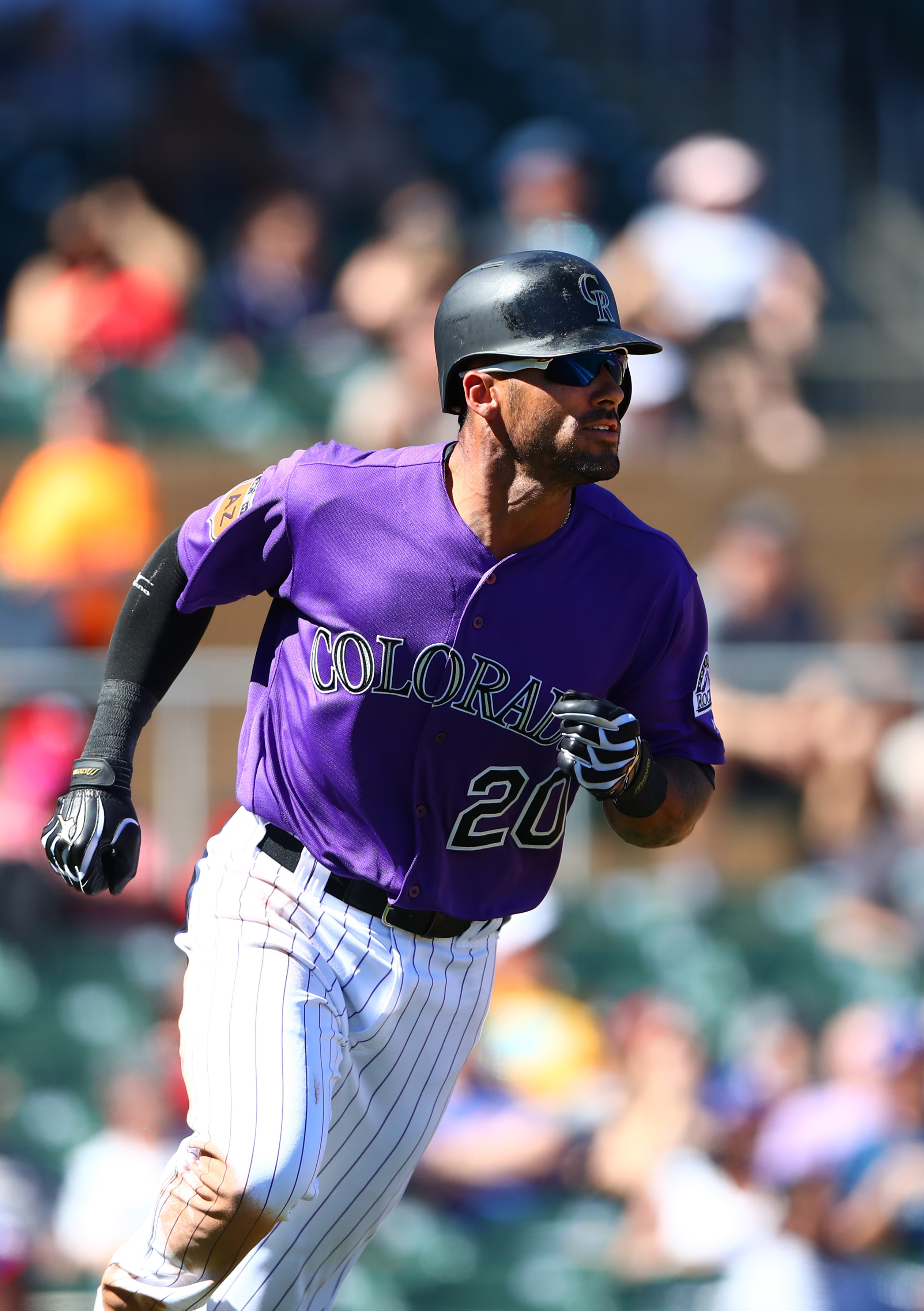
There were two major openings on the position-player side entering the winter: first base and catcher. Colorado elected to plunk down a lot of cash to add a productive veteran, but the player chosen came as quite some surprise. When the news broke that Ian Desmond was headed to the Rockies, it was generally assumed that he’d be playing in the outfield, with one of the team’s left-handed hitters — Gonzalez, Blackmon, Gerardo Parra, or perhaps even David Dahl — likely to be traded to address another need. Instead, the Rox stuck to their initial suggestion that Desmond would play first, though the organization notes that it values his versatility now and into the future. (More on that below.)
Behind the dish, the Rockies bypassed opportunities to pursue veterans via trade or free agency, where names like Matt Wieters, Jason Castro, Welington Castillo and (on the trade front) Brian McCann were available. Instead, the organization decided to rely on Tony Wolters, Tom Murphy, and Dustin Garneau. Murphy, who seems to have the greatest upside of the bunch, will be on the DL to open the year, so the Rockies made a late move to add veteran Ryan Hanigan.
Alexi Amarista was added to replace departing utilityman Daniel Descalso, but otherwise a bunch of friendly faces will be taking the field at Coors. In addition to the outfielders named above, high-power/high-strikeout shortstop Trevor Story is back from injury; Nolan Arenado and 2016 NL batting champion DJ LeMahieu will look to repeat their strong 2016 seasons at third and second base; and Mark Reynolds will return to first base (he re-signed on a minors deal) until Desmond, who suffered a fractured finger in Soring Training, is healthy. Rounding out the bench is Stephen Cardullo, an indy ball find who surprisingly spent time in the bigs last year.
Of course, the lineup was always seen as a strength for Colorado. Entering the winter, most expected the club to focus on pitching. Though the rotation finally had shown signs of life, it wasn’t exactly overloaded with established arms, and the bullpen had some clear holes.
The latter group got the attention that was expected, and then some. In addition to tendering a contract to Jake McGee despite his poor first year with the organization, Colorado gave Mike Dunn a surprising three-year deal and beat the market to roll the dice on Greg Holland, the once-elite reliever who’ll be returning from Tommy John surgery. That makes for one pricey relief corps. When you add the 2017 salaries of those three pitchers to what’s owed Adam Ottavino, Jordan Lyles, Chad Qualls, and the just-designated Jason Motte, the tab for this season alone lands just under $30MM.
But the rotation was another story. Content to keep its lefty-heavy outfield mix intact, and enamored of the relatively untested options on hand, the Rox did not add a single starter over the offseason.
Questions Remaining
The Rockies were arguably justified in staying their hand on adding another piece to the rotation. Entering camp, four spots were firmly accounted for (by Jon Gray, Tyler Anderson, Tyler Chatwood, and Chad Bettis). Beyond that quartet, there were quite a few contenders for the final job. Though adding a veteran to bolster the competition would have been nice, perhaps an appealing target couldn’t be enticed given the arms on hand and the prospect of pitching at Coors Field. And while the trade route surely was at least considered, either a lack of suitable matches or a differing strategy may simply have led the Rockies to a different approach.
Taking that course, though, always meant there’d be a lot of pressure on quite a few young pitchers. Teams know they’ll use more than five starters over the course of a season, so their depth charts must go at least eight or ten arms deep. In the case of the Rockies, outside of the top four arms listed above, the only potential starter in the organization who has more than eight MLB appearances under his belt is Chris Rusin, who thrived last year in a relief role. Prospects Jeff Hoffman and German Marquez are the only others who have seen any major league action at all, with each getting a taste of the bigs last year.
The situation worsened significantly with the terrible news that Bettis would require chemotherapy after his testicular cancer unexpectedly spread. Though he says it’s possible he could return this year, everyone’s first priority will remain Bettis’s well-being. Clearly, the team can’t count on a contribution from the steady performer in 2017.
Thus it was that the Rockies found it necessary to pluck two fresh arms from the farm to open the 2017 season. It seems that Antonio Senzatela (22) and Kyle Freeland (23) will get those jobs, with Marquez functioning as a swingman to open the season. The former was oustanding at Double-A in 2016, but he threw only 34 2/3 innings as the team exercised plenty of caution with a shoulder issue. While he had reached 154 frames in the prior season, asking for 32 starts would be a reach. Freeland, meanwhile, was the eighth overall pick in the 2014 draft. However, he only reached the upper minors last year and didn’t exactly dominate with a 3.89 ERA over 162 innings with 6.0 K/9 against 2.4 BB/9. Also of note: that innings tally represented a big jump after two consecutive partials seasons.
Whenever the next need opens up, the Rockies can turn to Rusin (once he’s healthy), Marquez, Hoffman, and perhaps Lyles. They’ll also be able to dip further into the farm, which includes pitchers such as 40-man members Shane Carle, Yency Almonte, and Zach Jemiola. That may well be sufficient depth, but the Rockies set to tap into an unusually youthful reservoir of starting pitching for an organization that has its sights set on contention.
The ‘pen faces its own questions, but they’re mostly of the typical kind. Overall, the unit has a fair bit of upside despite the recent health issues faced by pitchers such as Holland, McGee, Ottavino, and Qualls; those hurlers will be looking to return while others (Marquez, Carlos Estevez, and Miguel Castro, if he clears waivers) will try to convert impressive raw stuff into effectiveness.
You could say the same of the bulk of the lineup, which has a nice overall blend of stars, solid pieces, and role players. There may be minor quibbles about the lefty-heavy outfield mix — top prospect Raimel Tapia also hits from the left side — and the catching mix is as unestablished as any in baseball. The organization, though, seems to believe in the current catching options. And overall, the the collection of position players seems to be a good one.
Deal Of Note
That includes Desmond, the presumptive first baseman. He ought to be fine there, after all. If he’s a slightly above-average hitter and great baserunner, as he has been, and perhaps adds some value with the glove, he should be a solid-enough performer for the position.
But this is a club that enters the season with a record-setting $120MM payroll — prior to 2015, it had never even reached nine figures — and designs on more than competence. Desmond was the marquee addition, clearly. And teams generally accept that when they sign long-term deals with free agents — at least, those that aren’t abnormally youthful — they’re accepting that they’ll pay a premium later (in the post-prime years of the deal) in order to get a quality, established player on the MLB roster right away.
While we’ve heard plenty of explanations from the Rockies, and from observers, as to why Desmond will work at first base, it still seems an odd decision. Even granting that Desmond is a uniquely high-character player and that he could at least be an average hitter for the slugger’s position (though he’s only a league-average hitter for his career), the move represents a relatively enormous investment that just doesn’t come with much upside up front.
If the Rockies were so enamored of Desmond as a player and a person, perhaps the team ought to have lined up a trade for one of its left-handed-hitting outfielders. It’s reasonable to think that’d have had a reasonable chance of resulting in a pitching upgrade, at least. And it would have allowed the Rockies to take advantage of a free-agent market that was selling quality power bats for next to nothing.
While there’s admittedly some hindsight involved in that assessment, the awkward fit (barring trade) was apparent from the moment the deal was struck. And while Desmond’s future flexibility does carry value, but certainly not enough for that consideration alone to drive the signing. There’s still every chance that the contract will work out for Colorado. But every free-agent signing is a bet, and this one doesn’t seem particularly well-conceived.
Overview
This might all work out; even if not, it’s hard to criticize the Rockies too harshly for pushing some chips in. It’s always good to see a moribund franchise up its investment at an opportune time. And the unique circumstances of Coors Field certainly factor in, too, albeit in hard-to-discern ways. But from here, it doesn’t seem as if the organization got quite as much bang for its hundred-million bucks as perhaps it should have.
What’s your take on the Rockies’ winter? (Link to poll for mobile app users …)
How would you grade the Rockies' winter?
-
C 37% (643)
-
B 36% (624)
-
D 15% (265)
-
F 7% (122)
-
A 6% (103)
Total votes: 1,757
They been trying to trade cargo for 2 years let him try 1 st base and move Desmond to outfield. Then Dahl can slowly take over
Did not need Desmond, needed Rich Hill and/or Ivan Nova and a guy like Brandon Moss for 1B/OF depth.
I doubt rich hill would go to coors field unless they have him way more then the dodgers did.
It’s shaping up as quite a battle between Colorado and Arizona for third place in the NLW.
Not trying to be snarky here. It’s tough for mid-market teams to field division contenders faced with the spending ability of the Dodgers. The Giants ain’t exactly pikers either.
I think the difference is the DBacks will be selling midseason as to where the Rockies are about a year away from being absolutely scary.
It could play out that way, but I kind of doubt the D’backs will be in full sell mode in July. Unless they get even worse breaks than last season they will probably be at least on the edge of wildcard contention. But I agree the Rockies are poised to make a good run at contention in a year or so.
I didn’t mean they’d be in full sell mode. Full sell mode would occur in the offseason or it might even just be as simple as retool mode. I think they’d absolutely would try to move certain pieces at the deadline though. It’s just absolutely hard to buy that bullpen to believe they could compete with COL.
Rox send Hoffman, Dahl,
CarGo will take an extension the same day Aroldis Chapman takes one
Like alot of people I was a little confused about what the Rockies did in the offseason.
does anyone know if the angels have a review like this yet?