
The name of Marlins’ outfielder Christian Yelich is one that has popped up frequently in both trade rumors and trade speculation so far this offseason. The topic has certainly been covered at length (four links) here at MLBTR, and the frequency of Yelich mentions has continued to rise with each major trade Miami has made this winter. Save for maybe the Yankees, there isn’t a team in MLB who wouldn’t benefit from adding Yelich to their lineup and outfield. Therefore, the search for an ideal trade partner for the Marlins seems quite simple: any team with a farm system strong enough to pry him out of their grasp.
And yet, things are not nearly that simple in reality. Yelich is one of the top performers in baseball. Across the past four seasons combined, he ranks within MLB’s top 30 in batting average, on-base percentage and fWAR, and is within the top 50 in wOBA and wRC+. He’s a serviceable option in center field, as well, though DRS (-6 for 2017) and UZR/150 (-0.7 for 2017) don’t quite agree on his defensive value there. Regardless, Yelich ought to be considered a fantastic offensive talent at a premium defensive position. That makes his trade candidacy incredibly complicated when we factor in the team-friendly nature of his contract, which has four years and just $43.25MM remaining along with a $15MM option for 2023 ($1.25MM buyout).
Needless to say, Yelich would provide immense value to any club with the means to acquire him. After producing 15.9 fWAR over the past four seasons combined, he’s likely to be viewed as one of the most reliable outfielders in existence. The problem (which I’m sure you’ve inferred by now) is that the cost to trade for him would be absolutely enormous.
The best comp in my eyes for a potential Yelich deal is last offseason’s Adam Eaton trade. Eaton had produced 13.1 fWAR over the course of three full seasons with the White Sox while posting very similar batting averages and on-base percentages to those of Yelich. At the time, his contract had three years and just under $20MM remaining, plus two club options that could bring the total value of the deal to $38.4MM across five seasons. In order to swing a deal, the Nationals sent a deluge of minor-league talent to the White Sox. The headliner of the package was righty Lucas Giolito, who at the time was a consensus top-five prospect in baseball. Supplementing the return were fellow right-handed pitchers Reynaldo Lopez (then MLB.com’s #38 overall prospect) and Dane Dunning, whom the Nats had selected in the first round of the draft earlier that year.
On the surface, the return for Chicago appears to be one of the best prospect packages exchanged for a single player in recent memory. Were we to assume Yelich must warrant a similar return, at least half of the teams in MLB would be immediately eliminated from the Marlins’ pool of suitors simply because they don’t own that caliber of minor-league talent. Most of the others are rebuilding clubs who don’t have the kind of urgency that would motivate them to relinquish such a plethora of prospects.
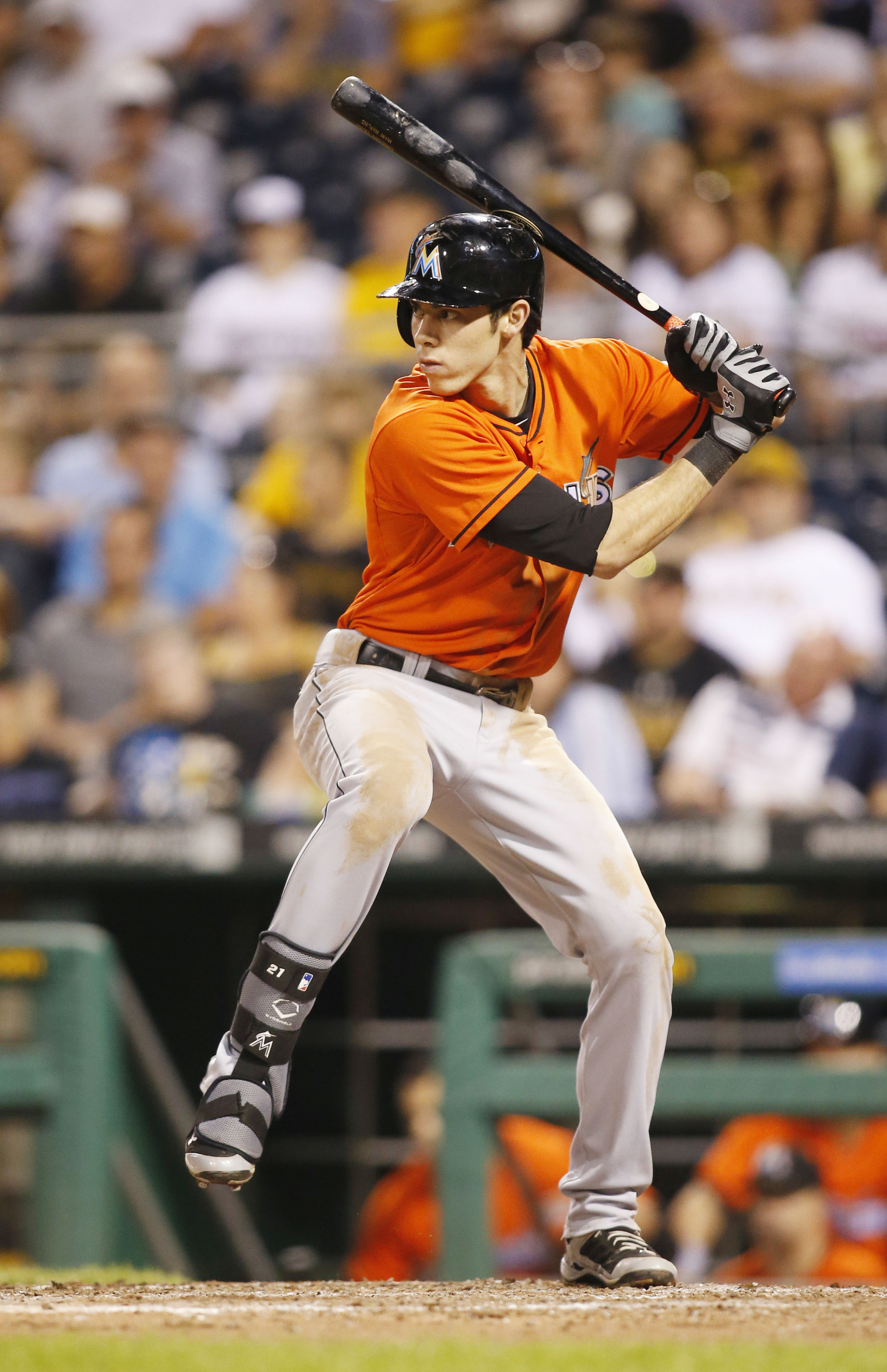 The caveat of all this is that Yelich may be an even more valuable trade asset than Eaton. At the time of his trade, Eaton was 28 years old, meaning he’ll be playing with the Nationals through his age-32 season. While that’s certainly not a prohibitive age, a large portion of Eaton’s value is tied up in his stolen base ability and his outfield defense. It’s not uncommon for those skills to begin a gradual decline at the age of 30. Yelich. on the other hand, will enter the 2018 season at the age of just 26, and he won’t even turn 31 until after the end of the 2022 season. Yelich’s on-base and power capabilities are far less likely to decline by that time. And the fact that he’s just now entering his prime implies that there could even be room for improvement on his career outputs. While I should caution that this is all just conjecture, it’s based on trends we’ve observed in baseball for some time. The overall point I’m trying to make is that there seems to be more upside in Yelich’s contract than there was in Eaton’s at the time he was traded.
Obviously, it’s difficult to imagine any team forking over a package better than the one the White Sox received for Eaton, but that’s likely the kind of return the Fish will be looking for, particularly in light of reports that they’d need to be blown away by an offer. Now, it’s not like legitimate trade partners don’t exist. Teams like the Indians, Astros, Blue Jays and Braves, for instance, have both the prospects to get a deal done and a role for Yelich available in their outfield. But the prospects those teams would probably need to part with (Kyle Tucker, Forrest Whitley and J.B. Bukauskas, as a purely hypothetical reference point) have plenty of upside themselves, and trading them for Yelich would prove the equivalent of putting an awful lot of eggs in one basket.
In the end, Yelich may simply be a player for whom no team would be willing to pay a fair price. And even if a team decides to step up and offer to obliterate their farm system, there’s still a chance the Marlins would hold onto Yelich for other reasons. For example, Atlanta and Miami were reportedly gaining some traction in trade talks during the winter meetings, but the Marlins pulled back following some PR backlash about the sale of other valuable assets. Additionally, with five years left on his contract, there’s a chance that Yelich could still be under team control during the next season in which the Marlins have a reasonable shot to contend.
A deal involving Yelich this offseason is surely not out of the question. But the complexities of his trade candidacy will, at the very least, mean that trade talks will require immense commitments of time and energy from front office personnel. Even if the barriers of the trade aren’t insurmountable, reaching an agreement to ship Yelich to another club will be a very difficult task for the Marlins to accomplish.
Photo Courtesy of USA Today Sports Images
I think you meant Kyle Tucker in your example. Preston is the older brother with considerably less value. I don’t even think he is on the team anymore.
I did mean Kyle Tucker haha. Thanks for helping out.
You are right, I believe Preston is with the braves now.
I would just go for gold. Forrest Whitley would be the only one not moving in any deal.
J.t.realmuto and Christian Yelich to the Astros
For
Derek Fisher, Kyle Tucker, Yordan Alvwraz, Francis Martes, J.D Davis, David Paulino and Garret Stubbs.
That’s about as far as you can get
Woah bud. Yelich isn’t like a Bryce Harper.
If I was the Marlins I would take that deal in a heartbeat, I don’t see what’s wrong with it lol
His comment means it’s too much for Yelich and so nothing is wrong with the deal from Marlins perspective, it is wrong from Astros perspective.
His Trade Suggestion is for ….
Realmuto AND Yelich…..So it’s not as bad as you guys make it out to be.
Definitely not. Yelich is far cheaper, controllable for five years instead of one, and has no injury history.
Lmao this is a definite no for the Astros
Fisher and McHugh will be dealt for a lf/dh split. Tucker, Whitley, Alvarez are off limits. Always will be.
Yea I bet if the dbacks have an awful year and Paul Goldschmidt becomes available all those guys will be totally off limits. Oh wait I bet Goldschmidt is so good that he is off limits and always will be.
Fisher and McHugh isn’t going to get you much
I think that one of Fisher or Tucker, and the rest of that package is actually a really solid starting point for those 2 players. Fisher and Tucker in the same deal is too much though
Arizona could benefit from him in left. A trade built around Pavin Smith or Jon Duplantier would certainly be tempting if I’m Miami. The latter could be up this year.
The only problem is a lot of team can beat both that you present to be offered. Both Smith and Duplantier are good players, but they have their warts.
Would love to see the Reds make an offer, but the Marlins probably start the conversation with Senzel or Greene and refuse to go any further without one of them.
I’d offer Billy Hamilton, one of Sal Romano/Robert Stephenson/Tyler Mahle, one of Adam Duvall or Scott Schebler, and two of Jose Siri, Aristides Aquino, and Shed Long
This is pretty lame.
Hamilton is a player with dwindling team control that Miami doesn’t need, Stephenson is looking like a bust, Duvall/Schebler are more or less one-dimensional players who also have dwindling control, and the last group of players are fringe prospects.
They’d have to include Senzel and/or Greene — which I agree would be too much for a team in their position, but they wouldn’t get Yelich otherwise.
Hamilton could have some value defensively in the larger Miami OF, but yeah, he is a very limited player who at this point in his career probably is who he is. Calling Stephenson a bust is definitely premature. He had a strong finish to 2017 and is only 25. Duvall is a gold glove finalist in LF and Schebler is better defensively than given credit (he can play CF although not as an everyday option), so both are hardly one-dimensional. Schebler has 4 more years of team control and Duvall 3, by my count. So to say they have “dwindling control” compared to Yelich’s 4 yr contract is pretty unreasonable. But you’re right, for it to work they’d need to include Senzel or Greene, and I’m just saying if I were the GM in their position that’s the package I’d be comfortable with offering (or something similar). Not my two draft horses
Still wold like to see the Braves land him and Realmulto. We have a GM who deals prospects for big leaguers, and we have the organizational depth. The team promised to field a winner in 2018 (now 2019), and the luster of the new ballpark -complete with an expensive game and food cost – will have the fans getting restless sooner than later.
The only hesitation I have with making a trade for Yelich, is that the braves need pitching and they would have to give up a lot of it to land him.
Don’t hesitate. Trade Allard, Muller, Pache and an A Ball lottery pick.
Still have Gohara, Newcomb, Fried, Sims, Soroka, Wright, Anderson, Weigel, Sanchez, Wentz, Davidson, Wilson, etc… Heck, upgrade Muller to Anderson. Point is, we’d still have over two rotations full of prospects.
Yes, vast overkill in the pitching department. Flipping three wouldn’t make a lick of difference – especially if the Braves took their favorite four or five off the table.
NO WAY! I’m a Braves fan who wants to see The Braves KEEP our high ceiling pitching prospects.
Sure, we have a PLETHORA of high ceiling arms in our System. However the one thing that so-called Braves fans like you seem to forget..is that our pitching staff is FAR from a finished product! We need to see WHICH ONES rise up/earn a rotation spot FIRST….only then does it make sense to start trading ‘the surplus’!
Until then, we keep our pitching prospects and give them time to develop/rise up/earn their spots in the rotation. The last thing I want to see The Braves do..is trade away the next Adam Wainwright in some ‘pipe dream’ push to make The Playoffs a year too early!
Let The Fish keep Yelich if they keep being too greedy! So far this offseason, NOT ONE TEAM has given up any of their top prospects in any trade for an established/young player. Why should The Braves partake in an overpay-like trade? It isnt like Yelich is going to be ‘the difference-maker’ this year!
Next offseason, The Braves will have approximately $100 mil to spend in The 2018 Free Agent Offseason. We WILL NOT have to give up ANY of our high ceiling pitching prospects in order to improve the offense. I’m ok with waiting one more year…..while The Rebuild plays itself out in 2018.
Your GM A.A. is the same guy who traded Thor for R.A. dickey
He’s got the philosophy of trading kids for vets.
Hope you don’t pull your hair out with some of the upcoming trades he’ll likely make
Would surprise me if he trades your entire AAA team for Yelich
I’d be after Castro too. I have Teheran, Swanson, Alex Jackson, Pache, two top 20 pitchers, Kakes, and Flowers going to Miami for Yelich, Realmuto, and Castro. Albies slides back to 2B.
Albies back to SS, sorry
Sean Reid Foley, Conner green, and Bichette for Yelich? I’d hate to add Alford, don’t think it would be worth it.
If you add Vlad Jr. into that offer you might be able to get Florida to listen. The game not prime player in your deal is Bichette (he’s going to be very good), but otherwise that offer is really weak.
Ah no. Vladdy and Bichette is way to much. Bichette actually had a higher OPS than Vladdy and flirted with .400 most of the year through multiple levels and plays a premium position. Jays already have multiple young out fielders in Hernandez, Alford and Pompey. I can’t see this trade happening anyways.
If I’m Marlin GM, I take an offer of Bichette and an OF prospect.
I live in Lansing and had an opportunity to watch both Vlad Jr. and Bichette play on numerous occasions. As of now, Bichette looks like a much more polished hitter at the plate. He’s much more patient and consistently hits the balls hard. Vlad, on the other hand, is undisciplined at the plate and swings at a lot of balls out of the zone.
With that said, did you see what the White Sox received for Eaton (a lesser player with less team control)? They received a top five prospect (Vlad’s value), the 38 overall prospect (Bichette is 26 according to MLB), and other pieces as well.
Why would Miami accept only Bichette and pieces for a younger and better player with more team control?
Now I can understand saying that you personally wouldn’t want to give that much up for Yelich, but that doesn’t change what his value is.
The Nats also knew what direction they were going in and were building a WS contender. They were willing to overpay to try to put themselves over the top. Teams always overpay to put themselves over the top which is why I keep saying that the return on a player with 1 year remaining isn’t far off the return on a rental at the deadline. Sorry a little off topic. However you are right I would definately not trade Vlad and Bichette. I would understand the deal if the traded Bichette and others though although I still wouldn’t like the deal. Easier to plug a OF hole in FA.
@ Cubman15
While we’re at it, we might as well list out the prospects that Eaton returned:
– Lucas Giolito
– Reynaldo Lopez
– Dane Dunning
Remember that Giolito was struggling at the time too.
“Giolito was struggling at that time too”
Huh?
Going into 2017, Giolito was unanimously listed as a top prospect by all the major publications:
#25 by BA
#12 by MLB.com
#10 by BP
If we’re comparing strictly based off rankings, it’s actually very fair to compare Giolito to Guerrero Jr. And likewise, it’s looking like Reynaldo Jr is looking like a good comparison for Bichette too (strictly based off rankings)
Cubman15 absolutely has a point here and I’m honestly not willing to pay that price.
Giolito was trending down at the time of the trade. The real prize in that package was Lopez
They’re both ‘prizes’. Both are (were?) consensus top 50 prospects.
Add vlad Jr to that package just to listen???
Vlad Jr would get Yelich strait up in my opinion.
Both of vlad and bichette better be blue jays in a few years or I’ll just stop going to games
2 untouchables
The problem with Foley and Green is that they are both big questions marks and are both approaching a crossroads in their development. They both had stinkers last year and Green almost had as many walks as strikeouts….. which never bodes well for a strikeout pitcher. I wouldn’t take that deal if I was the Marlins. Any deal not including vlad, IMO, would have to include Bichette,Alford,Jansen + something else. We are talking about a young, controllable, premier player here…. this isn’t a one year rental. It is going to cost alot.
Braves might be willing to take Prado, which is huge. Yelich and Prado for Allard, Fried and Pache should work for both teams.
I don’t know, that seems pretty light and I don’t think the Marlins actually are wanting to dump Prado for a lower prospect return.
Dumping Prado gets the payroll beneath $90M, the reported goal. I don’t see Allard and Fried as a light return.
It would only be huge if Miami hadn’t already dumped tons of salary.
Add Soroka and Anderson and I’m sure the Gish would bite us
Fish
Fish*
I’m a Braves fan wants NO PART of giving up Soroka, Anderson, Allard and Pache…for Yelich. The Fish can KEEP Yelich!
Come 2020, Soroka, Allard and Anderson will be 3/5ths of The Braves rotation FOR YEARS to come! Pache could very well replace Inciarte by 2021.
We’ll keep our best, young, cost controlled, high ceiling prospects! Let The Fish see what they can pry from other teams (who have shown this offseason that they ARE NOT willing to give up any of their top prospects in any trades so far)! Why should The Braves break that trend?
Here’s what I’d be willing to give up to get Yelich: Markakis, Lucas Sims, Richardo Sanchez, Matt Wisler, Aaron Blair and Dustin Peterson! Either take this package (similar to what The Pirates got from The Astros for Cole……or NO DICE!
The Braves will have approximately $100 mil to spend in The 2018 Free Agent Offseason…..we can improve the offense WITHOUT having to give up ANY of our pitching prospects!
I am with you on this, but I don’t think Anderson will be 3/5 of the rotation. Without any additions externally I’d see by 2021: Wentz, Wright, Soroka, Gohara, Allard. I could see him and Allard as headliners for a nice trade package.
How in the world does Coles package compare to Yelich who has 3 more years of control and isn’t arb eligible? Positional players also are a lot less likely for injury. Hilarious that you have 1 salary dump (Markakis) and 3 pitchers have exhausted their roster spot and should be available sometime this year when released if they haven’t made significant strides. Sanchez has some value, but if I were MIA I wouldn’t take a deal from ATL that didn’t include at least Pache, one of our top 4 SPs, etc.
I agree with Paullentz1972 tho. Marlins should also send money to pay off All of Yelichs contract and include Realmuto ONLY if the Braves send back Kasmir and McCarthy to the Fish. Helps both teams equally.
I dont expect The Marlins to accept that type of trade from The Braves, lol. I just dont want to give up any of our high ceiling pitching prospects for Yelich (that’s why I dont expect a trade to happen).
I just heard an interview that our GM, AA, did with MLB Network Radio earlier today…where he stated that now is not really the time to deal our young high ceiling pitching prospects…because, not only is he still ‘learning’ what it is that he exactly has…but that 2018 is all about giving these prospects time to develop/show him what he has.
I know that most fans ‘overrate’ their prospects. However this collection of pitching prospects that our previous GM, Coppy, collected….is simply amazing! The fact that he basically RAPED The Mariners GM out of Luiz Gohara last winter….is SICK, lol. He STOLE/CONNED them out of a CC Cybathia-type starting pitcher…for a couple of BUMS who are no longer with The Mariners, lol! Gohara is a TOR type starter…..and a lefty who has ‘swing and miss’ stuff!
Without Gohara….The Braves would still have A SICK system. But when you look at the fact that NOT ONLY did Gohara come cheaply…BUT ALSO Ronald Acuna only cost The Braves $100k in signing bonus money! You’re talking future Cy Young and MVP type players…for PEANUTS ON THE DOLLAR type acquisitions! SICK, lol!
I never stated that Yelich isnt a good player. I just dont want to see Atlanta blow through our prospects for him…not when we will have approximately $100 mil to spend after The 2018 Season is over…..during Free Agency! It’ll only cost us money to improve the offense!
If we keep our pitching prospects..we can build a rotation ON THE CHEAP…that will be cost controlled FOR YEARS TO COME! Yelich is only one player….while the likes of Soroka, Allard, Wright, Tousiant, Wentz, Wilson, Anderson, Davidson, Muller, Newcomb, Fried and Sanchez…..will be HELLA CHEAP/potentialy high ceiling FAR LONGER than the 5 years that Yelich’s relative team friendly contract is.
This does not assess his trade value, at all. Why not look at projections and figure out how much surplus value the contract has. Then you look at studies of how much prospects are worth and cone to a conclusion and how much you think he’ll cost.
This isn’t some big secret. Every team in baseball uses something like this. This whole post is just narrative driven.
Is that what the Marlins did when dealing All Star Ozuna to your team for a bunch of fading violets? Luke Weaver alone would have been a far more just return for Marcell.
Luke Weaver wasn’t in Deal. How about Yelich for Chavis,Travis,Swihart,Johnson,Wright and so on?
Corner IF is not a Miami priority.
Woooahh woah woah. Why we bringin my Sox prospects into this? Also Wright, Johnson, and Swihart have kind of fizzled. Travis is staying. Bryan Bentz could be had, but he has his own off field issues. Sox don’t need Yelich anyways. Benintendi is the same type of player and cheaper.
Absolutely. At arbitration prices Ozuna doesn’t have near the surplus value that Yelich does
Exactly how do Sierra, Alcantara, etc. have any value at all? Ozuna has proven ability and is improving. None of the Card prospects project at all.
Ozuna next two arb years are still cheaper han what he’d get had he been a free agent. Fish should’ve gotten better talent.
HA the full of some of these marlin fans thinking they can take 6 of a teams top 12 prospects for one player lmao sorry but no way is that happening he is a markakis 2.0 not worth 30 years of prospect control from a top farm that it would take to land him. That’s exactly why teams are bugging at the marlins initial cost
Are you actually aware of any specific trade packages the Marlins have requested? All I’ve seen is a bunch of undocumented hyperbole.
That’s what I’m talking about marlins fan banter thinks because we missed with the previous two that we are going all out this time I don’t buy it
Knuk2 and Yelich doesn’t have a no trade clause. Marlins have total control to trade him or not.
That’s not the issue. The question becomes do you WANT a guy in your clubhouse that doesn’t want to be there when it may affect his attitude/performance (as well as that of his team mates) thus diminishing his value whether to your team or another team. It’s just another factor for MIA to consider.
I see what you’re saying but you clearly havent followed Yelich/Marlins. Yelich isn’t the kind of professional to complain, your point holds absolutely no water. But nice try
*gull
*gall
Thanks lol
Tyler Naquin and Danny Salazar from Cleveland for Yelich
The Tribe should have targeted Ozuna. Mejia and a pitching prospect would have done it for this GM/
One factor that wasn’t mentioned is that Yelich apparently doesn’t want to be there and has asked to be traded.
That’s been speculated, certainly not reported. There has been no such quote from Yelich or the team..
Isn’t that every Marlins player?
The Pirates’ GM said “I’d trade him for a low level single A player if he was on my team.”
Actually that is not what he said or would do
I’d like to see the Padres go after Yelich.
So would I. Tatis Jr. and the return of Chris Paddack.
The Marlins will never get Tatis Jr. Preller got burned trading Trea Turner and had to pick up one year of Freddy Galvis to fill the SS hole. The Padres are light on position players on the farm, but they’re loaded with pitching.
There aren’t many pitchers close to the majors, and those who are will be relied on to fill the rotation in ’19 and ’20. There are quite a few lower level pitchers Preller’s evaluators rate highly, but other teams don’t. That’s a real problem of perception trading with the Padres.
Bottom line, the Padres have the talent package in the form of a string of pitching prospects who could dramatically improve the Marlins over several years, but the Marlins probably don’t realize it and would turn it down.
You traded Turner for a far lesser talent (Myers). Yelich brings far more to the table and he’s just entering his prime.
Oh yes the Trea Turner fiasco trade by Preller
Never get Tatis Jr.? Padres fans are so uneducated. Of course they would trade Tatis for Yelich! You think you get Yelich for garbage I bet
That package would never even be close to acceptable from the Marlins persoective
Your right, Yelich has the value to get Gore, Tatis and 2 lower level prospects.
I’m in agreement with you. DO IT PRELLER. You’ll probably disagree with the rest of my statement but: Then sign Hosmer. Then add RP Albers
It will take MORE then Tatis though
No on Tatis, or Gore. We have 5 other top 100 prospects, and probably 3 of those in top 60. We also have a former #41 prospect from last year who is Major league ready in Renfroe.
Renfroe, Spangenberg, Luchessi(top 80) and Quantrill (top 40) would be a nice haul for Yelich. Then sign Hosmer, move Myers to LF, and sign Kuechel next year.
Spangenberg is already in arb. Renfroe has so many warts. Quantrill and Luchessi are interesting, but they’d have to do better than Spangenburg and Renfroe.
You need one top 10 prospect, and another top 50 to start the ball rolling.
Lol. You guys crack me up. The story is about it taking 3 top 100 prospects and then some to acquire Yelich alone and everyone throws out offers thats half that at best or offers for both Realmuto and Yelich that would maybe only get one of them in real life.
I have Teheran, Swanson, Alex Jackson, Pache, two top 20 pitchers, Kakes, and Flowers going to Miami for Yelich, Realmuto, and Castro. Albies slides back to SS. Marlins get salary relief from trading Castro with Braves paying half of Kakes $11M. Braves pitching will look better with the upgraded defense and can afford to sign top flight SP next offseason.
LOL. Step away, take a breath and compose yourself. Teheran and Swanson both have trade value but it’s not nearly as high – let them rebuild it, if possible. MIA most likely wouldn’t be interested unless they’re secondary in any deal. And why would they deal 3 guys with arguably the most trade value on their team in 1 deal? Sell them each for parts and you will get more. And I’m a Braves fan.
correct. However, taking Prado’s contract along with Yelich would help limit the give, no question.
Teheran and Swanson would benefit from a change of scenery. If Miami dealt the three to Braves, Braves will be contenders THIS year and for possibly three more. Miami is five years away so it works out. BTW, that IS quite a haul for those three but both sides benefit.
Except MIA has already said they don’t need salary relief now and want the best possible packages.
But Castro made it clear he didn’t want to play for a rebuild…
That does not matter at all – he’s under contract and he has no trade value. Just because the player doesn’t want to play somewhere doesn’t mean the team has to move him. If he decides to not play then the team suspends him and stops paying him.
Not what the Fish need to do Nd have already said they won’t in including Prado in any deal involving either/or Yelich and J.T.
I dont see that being enough honestly. Any trade including BOTH Realmuto and Yelich will require anyones best prospect possibly best two prospects and then another 3-4 in their top 15 prospects. Realistically, Marlins wouldnt want Teheran in their current state. Looking for upside young guys with all 6 years of control left or near it. So, if you ask me, if for whatever reason a deal for JT, Yelich, and Starlin went down, it would take something like Acuna, Swanson, Allard, Anderson, Wentz, Pache, Jackson, and either Newcomb or Sims. You have to understand Castro isnt a “salary dump”. Marlins are cool keeping him, he is very affordable even at 11mm a year and any team needing an upgrade in the infield would take on full salary plus give up two prospects. Not big time guys but high upside players for sure. Gotta put yourself in the Marlins shoes. If they were on the braves, what would you want for them? Yelich is 3 top 100 prospects and another top 15 prospect. JT is 2 top 100 prospects and another top 15 and Castro Costs a teams top 10 prospect(NON top 100, like a Pache) and an additional piece of some sort. Makes more sense to trade them off separately as Marlins would get more doing that, no doubt. Hell Marlins may even REQUIRE Acuna, AND Albies AND Allard just to start talks. Very Complex deal, hard to know. Jeebus this post got long. My bad.
…and as soon as Acuna is mentioned, there is a “click”
And i agree ha. Which is why JT AND Yelich wont be traded together. If Yelich, expect something like a Allard, Anderson, Wentz and Jackson like combo. If JT expect two of those pitchers and probably still Jackson ha.
Which is a reasonable expectation. It’s also a reasonable expectation for Mia to ask seeing as Yelich and Realmulto were asked for in the same package. Mia would absolutely get more in separate packages.
You guys can keep Yelich! I’d rather see Atlanta keep their best pitching prospects…and use our $100 mil in payroll flexibility….to go after improving the offense via The 2018 Free Agent Offseason (where only Freddie Freeman at $21 mil and Ender Inciarte at $5 mil are on the books, not counting the couple of arbitration players we have, as well as the plethora of pre-arbitration players we have. This is also assuming that we trade Juiio Teheran and his $11 mil 2019 salary sometime before the trade deadline in July).
Yelich is a nice player..however giving up our Allard, Anderson and Wentz for him…is a no go for me! I’d rather spend money in free agency.
Would a trade for Yelich look that much different than the trade for Longoria? The Giants gave up 4 players……a mid-level starting OF and three prospects……but Longoria will make twice as much money as Yelich over the next 5 years. In my opinion, the Marlins could easily get several (at least 3) high level prospects and a decent position position player.
Agreed, Yelich should get the Marlins 2 top 100 players and 2 other pllayers. The Braves trade might look like Allard, Anderson, Riley, and Peterson, to the Padres, it would be Gore, Urias, Allen, and Paddock.
Thats pretty realistic. I’d love that haul from SD especially.
I agree, Yelich is a nice player. However as a Braves fan, I would rather that we keep Allard, Anderson, Riley (I could care less about Dustin Peterson)….while The Fish can either keep Yelich OR try and pry away at the reluctance of other teams to include any of their top prospects in any trades this offseason.
I didnt mind the losing of the past three years (and including another losing year in 2018)…because our last GM, Coppy, did AN AMAZING JOB of stockpiling a PLETHORA of talent (the 2015-2017 Drafts, when all is said and done, could go down as HISTORIC in nature).
Depending on how things go after 2018, our Starting Rotation from 2019 on could be HELLA YOUNG/cost controlled/cheap/high ceiling….for years to come! I’m excited to see how our young pitching talent develops.
Hypothetical 2019 Starting Rotation:
1. Mike Folty
2. Luiz Gohara
3. Mike Soroka
4. Kolby Allard
5. Kyle Wright
Hypothetical 2020 Starting Rotation
1. Luiz Gohara
2. Mike Soroka
3. Kyle Wright
4. Kolby Allard
5. Tooki Tousiant (or Mike Folty)
Hypothetical 2021 (and beyond) Starting Rotation:
1. Luiz Gohara
2. Mike Soroka
3. Kyle Wright
4. Joey Wentz
5. Bryce WIlson
We’ll still have Ian Anderson, Kyle Muller, Tucker Davidson and Richardo Sanchez all in the mix (assuming that we’ve moved on from Sean Newcomb, Max Fried, Mike Folty, Kolby Allard)! This depth is SICK, lol! In that 2021 hypothetical rotation…only Luiz Gohara would be eligible for salary arbitration (his 1st year…assuming we havent locked him up to a team friendly, long term contract by then).
If our GM, AA, plays it right, he’ll be able to pick and choose who he wants to offer long term deals to…but also who he wants to trade (whether to fill an offensive need OR for lower Minor League depth)….as well as who he wants to put in the bullpen (I feel that Max Fried, because of his past health issues, could be a candidate to eventually convert to an Andrew Miller-like role in The Braves bullpen….also, if Sean Newcomb cant develop a 3rd pitching to get hitters out as a starting pitcher, then perhaps he’ll be converted to a late inning/high leverage relief pitcher, given his nasty stuff).
Options galore!
You need balance to have a good rebuild, the Braves have the pitchers in hand, like the Mets a few years ago, but not the position players. AA is going to have to move at least 2 of these pitchers to get 2 good position players. I would look to the Yankees and trade with them for Frazier to start. That gives you your LF bat, maybe a Freid, Soroka, or Anderson.
Well Longoria is 6 years older than Yellich, and in the decline part of his career, so it’s not a great comparison. On top of that Yellich has been a significantly better hitter than Longoria over the last 3 years, and has averaged about 1 extra WAR per season. If you go off the $/WAR formula (which I don’t really believe in, but whatever) then you’d have to add about another $36M in value to a Yellich trade over the Longoria one.
So my thoughts on Yelich is he is a very good and interesting player. He is cost controlled and provides so much surplus value on his contract it’s not funny. He is going to give you 4.5 consistently throughout the contract(health permitting). He is not a true cf (he lacks the arm to play RF although in certain stadiums that might not matter ) and lacks somewhat in the power department. Teams should definitely be intrigued, but he’s more so a finishing piece. So when I see trade speculation from teams like the Jays and Padres it’s sort of head scratching. The Jays might be forced to tear it up mid season so depleting (Vlad Jr & Bichette seems) counter intuitive unless the FO is willing to spend elsewhere to clog the leaks. It’s the same somewhat as the Padres if you’re going to dig into the prospect cove is he really the game breaker to put them close to contention? If the intention is to compete seems like Tatis is someone you’d like hold. Idk to me it seems like getting ahead of yourself is unrealistic. I love Yelich, but he seems to fit a lot of teams because he’s cheap. Yet he truly fits teams in contention that are inherently strong up the middle or a team that had a ton of youth at the mlb level and is also strong up the middle. Regardless he’s going to cost an absolute ton as he should. Expectations should be managed though.
Yes, Yelich is an absolutely great piece for any MLB team. But, here is what the Marlins need to keep in mind. By not getting the best package this offseason, Yelich’s value will drop, because with no big bat in the lineup, Yelich’s stats will no doubt deteriorate as teams will pitch around him, knowing there is not treat behind him. They can still get a good package, just think his best package will come now with minimal negatives on Yelich.
Just a thought, anyone else agree, disagree? comments?
Im not so sure his numbers decrease. I see what you are saying, not as much protection but he isnt a power hitter, he’s a solid contact hitter so i think he hits just fine, if anything maybe we see more walks and a higher OBP, which is already high. But still a risk, no doubt. Gawd that would suck if he drops to a .270/.330/.420 type line.
Yelich for Alex Verdugo and yadier alvarez
It’s a nice start, but it’s still take more.
*It’d
Yankees have the prospects
why would the Yankees burn prospects when they have no room for Yelich?
Why wouldn’t the Yankees have interest in Yelich? He would be a cost-controlled leadoff hitter for the next decade and as a replacement for Gardner, it would open up ~6 million(?) in luxury tax space (not sure on the exact numbers). As much as I love Gardner and acknowledge the leadership role he has developed, the decline years are coming and he is an impending FA. He has trade value now, probably not a lot, but enough to ensure another team would accept his full salary. The savings would be used towards Darvish, or another player the Yankees are interested in but currently restricted from with the luxury tax reset plan.
It’s feasible Yelich could be acquired for a package which doesn’t include Gleyber. Use Frazier as the centerpiece and fill it out from there. Just because you have the #2 prospect in MLB doesn’t make him an absolute requirement, especially with the Yankee’s depth of talent.
So why would the Marlins want Frazier? He has 6 years of control remaining with a talent ceiling comparable to Yelich’s. I’m of the belief he did nothing to lower his “young asset/prospect” value last year, despite the drop off in production at the end. With inconsistent playing time and it being his first taste of the show, he showed the ability to make adjustments (back leg improvement) with flashes of extra-base power. He was not overmatched.
I am certainly not advocating the Yankees gut the farm for Yelich, but they should be able to beat any other reasonable offer out there with talent to spare. With what basically amounts to a public trade demand, the Marlin’s leverage has been lowered, it will be a recurring drama if they keep him, at least that’s what his agent’s actions today insinuate.
Frazier is an acceptable centerpiece, it’s been established the Pirates liked him better than any of the players received in the Cole trade, so that is some confirmation that his value isn’t just “Yankees Hype.” He was the centerpiece of a trade for Andrew Miller’s multiple years of control, in the same time-frame where Gleyber was a centerpiece for 1 year of Chapman.
Or the Yankees could just keep Frazier and hope he develops into a stable major league performer, that’s ok in my book as well. But Yelich is more of a sure thing, and that is why prospects are traded for established players.
You need balance to have a good rebuild, the Braves have the pitchers in hand, like the Mets a few years ago, but not the position players. AA is going to have to move at least 2 of these pitchers to get 2 good position players. I would look to the Yankees and trade with them for Frazier to start. That gives you your LF bat, maybe a Freid, Soroka, or Anderson.
The Pirates could prove they want to contend with a Meadows, Baz, Craig or Tucker and Martin package. Obviously the odds are slim to none……