
Nationals Win Draft Lottery
Major League Baseball conducted its third annual draft lottery this afternoon at the Winter Meetings. The Nationals won the lottery and will pick first overall. They’ll be followed by the Angels and Mariners. Washington had just above a 10% chance of securing the top pick, the fourth-highest odds.
Here’s the first round order:
- Nationals
- Angels
- Mariners
- Rockies
- Cardinals
- Pirates
- Marlins
- Blue Jays
- Reds
- White Sox
- Athletics
- Rangers
- Giants
- Rays
- Red Sox
- Twins
- Cubs
- Diamondbacks
- Astros
- Braves
- Orioles
- Brewers
- Royals
- Tigers
- Padres
- Phillies
- Mets
- Guardians
- Yankees
- Dodgers
As part of the Players Association’s efforts to reduce the incentive for non-competitive teams to lose games, the latest collective bargaining agreement introduced a lottery to determine the top six overall selections. A team’s odds of landing a higher pick are still weighted in favor of the clubs with the worst records, although the Rockies and Marlins had identical chances (22.5% apiece) of landing the top selection.
All non-playoff teams ostensibly have a chance to win the lottery. However, the CBA also prevents a team that is not a revenue sharing recipient from landing within the top six in consecutive seasons. No team can get a lottery pick more than two years in a row. That ruled out the White Sox and Athletics this year. Chicago is not a revenue sharing recipient and picked fifth last year, while the A’s were in the top six in both 2023 and ’24.
The Sox were not allowed to pick higher than 10th, while the A’s were capped at 11th. That’s despite the White Sox having the worst season of all time that would’ve placed them among the three likeliest teams to pick first. That increased the odds for every team but was especially beneficial to Colorado and Miami (from a probability perspective) by pushing their chances of the #1 pick north of 20%. Unfortunately for those teams, the balls didn’t bounce their way. The Angels and Nationals were the other teams with at least a 10% shot.
Seattle and St. Louis come away as big winners. The Mariners went 85-77 and had the second-best record of any non-playoff team. St. Louis had the fourth-best mark for clubs that didn’t get to the postseason. They nevertheless were fortunate to spring into the top five. It’s a particularly disappointing outcome for Miami, who didn’t land a lottery pick at all despite sharing the best shot at the first selection. The only silver lining is that they’ll remain eligible for lottery picks for at least 2026 and ’27 if they don’t make the playoffs.
Teams that exceeded the third tier of luxury penalization have their top picks dropped by 10 spots unless that selection lands within the top six. (In that instance, the club’s second-highest pick would move back.) MLB has yet to officially announce the 2024 tax data, but it is believed that the Mets, Dodgers and Yankees are the only clubs that surpassed the $277MM threshold for the pick to be dropped. All those teams made the playoffs and weren’t eligible for the lottery anyhow.
The lottery only comes into play for the first round of the draft. From the second round onwards, pick order is determined in inverse order of the prior season’s standings, aside from compensatory and competitive balance selections.
Baseball America published its most recent Top 100 draft prospects in September. As always, that’s worth a full read. Texas A&M outfielder Jace LaViolette topped BA’s list, though there’ll obviously be plenty of changes to the board as next spring’s amateur baseball season gets underway.
Marlins Fielding Interest In Jesus Luzardo
The Marlins are getting calls on starter Jesús Luzardo, reports Jon Morosi of the MLB Network (X link). Ken Rosenthal and Will Sammon of the Athletic write that the Fish are willing to entertain trade talks on the talented southpaw.
On the one hand, a team in a full rebuild like Miami is going to be open to discussing essentially every veteran player. Luzardo is a tough trade candidate, though, as the Marlins are shopping him while his value is at a low point. His ’24 campaign was more or less decimated by injury. Luzardo went on the injured list in the middle of April with elbow inflammation. He returned in May but was shelved again five weeks later by back issues. That not only took him off the table as a deadline trade candidate, it ended his season. Luzardo was diagnosed with a stress reaction in his lower back and couldn’t return to the mound.
Neither injury required surgery and Luzardo was able to begin non-throwing baseball activities by the end of the regular season. There’s no indication he won’t be full go for Spring Training. Still, there’s little doubt that acquiring teams are going to account for the injury risk as they weigh what to offer Miami.
Luzardo has spent a lot of time on the IL over his career. He fractured his throwing hand in 2021 and lost a good portion of the ’22 season to a forearm strain. He also has a Tommy John surgery on his medical chart dating back to high school in 2016. He has only topped 100 1/3 innings in an MLB season once.
That lone healthy campaign offered tantalizing upside. Luzardo took a full 32 turns through the rotation in 2023. He fired 178 2/3 frames of 3.58 ERA ball while punching out 28.1% of opposing hitters. He averaged nearly 97 MPH on his fastball, missed bats with both his slider and changeup, and limited his walks to a solid 7.4% clip.
That version of Luzardo was a #2 or high-end #3 starter, the kind of pitcher a team would happily plug into their playoff rotation. Luzardo didn’t show that form last year even when he was able to take the mound. He allowed five earned runs per nine with a diminished 21.2% strikeout rate in 66 2/3 frames. He still posted plus whiff rates on his secondary pitches, but his average fastball velocity dipped to 95.2 MPH and opponents teed off on it.
There’s obvious appeal for contenders to attempt to buy low. Luzardo is under arbitration control for two seasons. MLBTR contributor Matt Swartz projects him for a $6MM salary. That’s a bargain in comparison to a free agent market where a rebound candidate like Frankie Montas signed for $17MM annually and mid-rotation arms Yusei Kikuchi and Luis Severino landed more than $20MM per season on three-year deals.
Miami doesn’t have as much urgency to make a sell-low trade. Luzardo won’t make the difference between them contending for a postseason spot or not, but a strong first half could rehabilitate his value. If he demonstrates his 2023 form for three months, Luzardo would arguably be the biggest trade chip of the ’25 deadline. In the best case scenario, Miami could realistically seek multiple Top 100 type prospects next summer. If he struggles or suffers another significant injury, of course, whatever trade value he currently has would basically evaporate.
It’s largely a matter of risk tolerance for president of baseball operations Peter Bendix and his staff. The Fish have very little on the books for next season, so they’re not under any financial pressure to move Luzardo. He’ll be the highest-paid member of their otherwise modest arbitration class. They’re still on the hook for $17MM (including an option buyout) to released outfielder Avisaíl García. The only other player on a guaranteed deal is ace Sandy Alcantara, who’ll make $17MM next year. The Marlins reportedly informed Alcantara in August that they had no intention of trading him this offseason.
Yankees, Mets Among Top Suitors For Garrett Crochet
One day after the Mets and Yankees finished battling for the top free agent, they’re in the competition for arguably the winter’s #1 trade candidate. Ken Rosenthal and Will Sammon of the Athletic report that the New York teams are currently the most aggressive suitors for White Sox’s lefty Garrett Crochet.
The Athletic writes that the Red Sox and Phillies have also expressed interest, but they appear to be behind the New York teams for the moment. Jon Morosi of the MLB Network put the Brewers on Crochet this morning, though The Athletic report does not mention Milwaukee. Rosenthal and Sammon indicate that no team is close to pulling off a deal yet.
Crochet stayed healthy in his first full season as a starter. The Sox pulled back his workload after failing to line up a deadline trade. Chicago never shut him down or skipped his turns through the rotation, but they abbreviated his starts at the end of the year. Crochet finished the season with 146 innings across 32 appearances. He turned in dominant rate stats, striking out 35.1% of batters faced against an excellent 5.5% walk rate. His 3.58 earned run average didn’t quite align with those fantastic peripherals. That’s at least in part because he was pitching in front of one of the game’s worst defensive teams, contributing to an elevated .318 average on balls in play against him.
Going into 2025, Crochet projects as a top-of-the-rotation arm. He shouldn’t have as many concerns about his workload down the stretch. His deadline trade candidacy was also complicated by the late revelation that he was seeking a contract extension if he’d be asked to pitch into the postseason during his first season as a starter. That’s no longer an obstacle.
Chicago GM Chris Getz spoke in generalities about a potential Crochet trade. He repeated the organization’s preference to add young hitting talent but suggested they weren’t opposed to building around pitching if they felt it was the best offer (X link via Scott Merkin of MLB.com). Getz reiterated that he didn’t feel compelled to make a trade this offseason, though it’d be a major surprise if Crochet were still in a White Sox uniform by the end of March.
Of the New York teams, the Mets have more talent at the top of the farm system. Their system is headlined by shortstop Jett Williams. Baseball America ranks 19-year-old infielder Jesus Baez as the #3 prospect in the organization. Ronny Mauricio is a former top prospect who might’ve opened the season as New York’s third baseman had he not torn his ACL in winter ball last year. Third baseman Brett Baty has seen his stock dip as he’s underperformed against MLB pitching, but he’s drawing attention as a change of scenery candidate. While Baty no longer has the pull to headline a Crochet package, he could be of interest as a secondary piece. (The Sox built their deadline return for Erick Fedde and Michael Kopech around Miguel Vargas, another post-hype infielder.)
The Yankees’ system is headlined by Jasson Domínguez. There’s a sharp drop thereafter, however. It’d be a surprise if the Yanks were willing to put Domínguez in a Crochet package. The switch-hitter may well be New York’s starting center fielder next year, with Aaron Judge potentially kicking to right field after Juan Soto walked. Outfielder Spencer Jones and infielders George Lombard Jr. and Roderick Arias were once viewed as Top 100 type talents, but they’re all coming off somewhat alarming minor league seasons. Jones and Arias struck out at huge rates, while Lombard didn’t hit for much power in A-ball.
Crochet is controllable for two seasons. MLBTR contributor Matt Swartz projects him for a bargain $2.9MM salary. Even for the New York franchises, the affordability is appealing. The Yankees could prefer to attack the lineup in free agency rather than make a top-of-the-market splash for starting pitching. The Mets still need a top-of-the-rotation starter. They’ve thus far shied away from making that kind of move in free agency, instead building the rotation with upside plays for Clay Holmes and Frankie Montas.
Rangers Still Pursuing Reunion With Nathan Eovaldi
The Rangers continue to pursue a reunion with free agent starter Nathan Eovaldi, GM Chris Young confirmed today at the Winter Meetings. Evan Grant of the Dallas Morning News reports that Texas has a meeting scheduled with the right-hander’s representatives on Monday evening.
Eovaldi is one of the better unsigned pitchers in a quick-moving rotation market. Unlike Corbin Burnes and Max Fried, he’ll be limited to a relatively short-term deal. Eovaldi turns 35 in February. That’s an age at which very few free agent pitchers get three years. Using MLBTR’s Contract Tracker, we see that there are only three free agent starters 35 or older who signed for at least three years within the past decade: Jacob deGrom, Max Scherzer and Rich Hill.
MLBTR thus predicted two years at a hefty $22MM average annual value for Eovaldi. The rotation market has been quite strong early on, however, so it’s not out of the question that he gets to three years on a deal that pushes past $60MM total. Even if he’s limited to two years, it’ll very likely cost north of $20MM annually.
It’s not clear whether the Rangers would find that price palatable. They’ve scaled back spending in consecutive winters as they navigate an uncertain future with their in-market television deal. Grant reported in October that Texas was hoping to keep their luxury tax number below next year’s $241MM base threshold. RosterResource calculates the Rangers’ CBT number around $195MM. They’ve got a decent amount of flexibility, but something like $22MM annually for Eovaldi would account for nearly half the gap. Texas needs to acquire multiple relievers as well, and teams generally prefer to leave some payroll space for deadline acquisitions. A club’s luxury tax number isn’t calculated until the end of the season, so salary taken on midseason counts towards it on a prorated basis.
Eovaldi unsurprisingly has broad appeal on the market. He has gotten reported interest from the Orioles, Mets, Braves and Red Sox. He still has above-average velocity and is coming off a 3.80 ERA showing with good strikeout and walk numbers. Eovaldi also has a strong reputation for his performance in the postseason, including a 2.95 ERA over six starts during the Rangers’ 2023 World Series run.
White Sox Hire Joel McKeithan As Assistant Hitting Coach
The White Sox announced their finalized coaching staff on Monday afternoon. The only previously unreported addition was the hiring of Joel McKeithan as assistant hitting coach. The Sox also revealed that former interim manager Grady Sizemore is taking the title of offensive coordinator.
McKeithan, 32, spent two years as Cincinnati’s hitting coach. The Reds found more success in 2023 than they did this past season. Cincinnati battled some injuries to key players (i.e. Matt McLain and TJ Friedl) and navigated a PED suspension for infielder Noelvi Marte. The finished in the bottom third of MLB in overall offense. Incoming manager Terry Francona parted ways with McKeithan and assistant hitting instructors Terry Bradshaw and Tim LaMonte.
He and Sizemore will work on the offensive side along with returning hitting coach Marcus Thames. First-year skipper Will Venable tabbed Walker McKiven as his bench coach a few weeks ago. The Sox are otherwise retaining most of last year’s staff. Pitching coach Ethan Katz, first base coach Jason Bourgeois, third base coach Justin Jirschele, assistant pitching coach Matt Wise and catching coach Drew Butera are all back from last season.
Marlins Release Mike Baumann To Pursue NPB Opportunity
7:22pm: Baumann is actually headed to Japan. Kiley McDaniel of ESPN reports (on X) that the CAA client has agreed to a deal with the Yakult Swallows of Nippon Professional Baseball.
7:13pm: The Marlins released reliever Mike Baumann, as first reflected on the MLB.com transaction tracker. Miami’s 40-man roster count drops to 39.
Baumann landed with the Fish on a waiver claim in late August. They were rather incredibly his fifth team of the season. The out-of-options righty bounced around as the last man in the bullpen for each of the Orioles, Mariners, Giants and Angels as well. Baumann didn’t pitch especially well for any of those clubs. He finished the year with a 5.55 earned run average over 58 1/3 innings. His 22% strikeout percentage wasn’t far off the MLB average, but he walked an elevated 10.6% of opponents while giving up plenty of hard contact.
The 29-year-old was a capable middle reliever for the Orioles as recently as 2023. He worked to a 3.76 ERA in a career-high 64 2/3 innings with Baltimore two seasons ago. Assuming he clears release waivers, Baumann will become a free agent. He’s probably looking at minor league deals but won’t have any issue getting a non-roster invite to MLB camp.
As for Miami, the move appears to be related to Wednesday’s Rule 5 draft. The Fish could not have made a selection if they went into the draft with a full 40-man roster. Miami picks third behind the White Sox and Rockies. The Marlins could have a target of their own in mind or try to work out a draft-and-trade with a team that sits lower in the order.
Jace Jung Underwent Wrist Surgery, Expected To Be Ready For Spring Training
Tigers third baseman Jace Jung underwent an arthroscopic procedure on his right wrist in October, the team announced this evening. The talented infielder has already begun a hitting program and is expected to be full go for Spring Training.
Jung is the in-house favorite for Detroit’s third base job. The Tigers have been frequently connected to Alex Bregman, largely because of the history with manager A.J. Hinch, but there’s no indication they’re willing to make that level of long-term commitment. Jung’s minor surgery isn’t going to have any impact on a potential Bregman pursuit, of course. Assuming he recovers as expected, he’s on track to vie with Matt Vierling and Andy Ibáñez for playing time.
A former 12th overall pick, Jung made his MLB debut late in the season. He appeared in 34 games, hitting .241/.362/.304 without a home run through 94 trips to the plate. The lefty-hitting Jung had a strong year in Triple-A. Over 91 games, he hit .257/.377/.454 with 14 longballs and an excellent 16.1% walk rate.
In another development on the Detroit infield, Cody Stavenhagen of the Athletic tweets that Colt Keith and Justyn-Henry Malloy will take offseason reps at first base. Keith is expected to remain the team’s primary second baseman, as the measure is simply designed to increase his versatility on the right side of the infield.
It could be a more consequential development for Malloy, who has always been a promising hitter without a defensive home. Malloy worked in the corner outfield or at designated hitter as a rookie. He played third base in the minors through 2023 but was panned by scouts for his glove. Malloy logged a little bit of first base action in college but hasn’t played there professionally. Former first overall pick Spencer Torkelson could have a tenuous hold on the starting job. Detroit is reportedly among the teams that have been in contact with Paul Goldschmidt as they look for a right-handed bat this winter.
Astros Not Ruling Out Potential Trades of Kyle Tucker, Framber Valdez
6:35pm: In a full column at The Athletic, Rome writes that the Astros have unsurprisingly received calls on Tucker. He indicates that none of those discussions have become serious but reports that Brown is indeed willing to consider moving one of the two players if the right opportunity presents itself.
6:20pm: Astros general manager Dana Brown met with reporters this evening at the Winter Meetings. In addition to reiterating their longstanding desire to re-sign Alex Bregman, Brown left the door at least slightly open to trading one of his star players.
In response to a question about the team’s willingness to field interest in Kyle Tucker and Framber Valdez, Brown replied he “would listen on all the players” (X link with video via Brian McTaggart of MLB.com). It doesn’t seem they’re actively shopping either, however.
“We’ll listen on anybody. We’re not trying to aggressively move anybody out the door… If it doesn’t make sense, we wouldn’t do it,” Brown expanded (relayed on X by Matt Kawahara of the Houston Chronicle). “So it really would have to make sense. Because right now we’re a good team and we’re not motivated to move any of these guys.”
An open-mindedness to conversation isn’t a declaration that either player is on the block. It still seems likelier than not that both will begin next season in Houston. That said, there’s at least a little bit of chatter about the possibility of the Astros pulling off a blockbuster. Chandler Rome of the Athletic floated the idea last week, pointing out that it’d open a fair amount of immediate payroll space while helping to replenish a poor farm system. Jon Morosi of the MLB Network tweets that there’s “some buzz” around the Meetings regarding the potential for a Tucker trade, in particular.
Both players would net a strong return. They’re each down to their final year of arbitration but are among the best in baseball at their respective positions. Tucker, whom MLBTR contributor Matt Swartz projects for a $15.8MM salary, hit 23 home runs in only 78 games this year. He slashed .289/.408/.585 across 339 plate appearances. A nagging right leg injury cost him a few months, but Tucker’s rate production was the best of his career. He’s one of the game’s five to 10 best hitters and trending towards a free agent deal that could push near $400MM.
There’s little to suggest the Astros are going to make a push to sign Tucker to that kind of contract. Even if they expect him to walk in 12 months, a trade would be a tough sell. Houston is trying to win another AL West title. They wouldn’t come close to replacing Tucker’s production if they move him. They’re already thin in the outfield, where Chas McCormick and Jake Meyers are the other projected starters. Yordan Alvarez could see time in left field, but manager Joe Espada said today the Astros were hoping to scale back his outfield work to give him more reps at designated hitter (X link via Rome).
Valdez probably wouldn’t bring quite the same return as Tucker. He’d arguably be easier to replace, though the Astros would be placing a lot of faith in injury returnees Luis Garcia and Lance McCullers Jr. to do so. The southpaw is coming off a 2.91 ERA showing through 176 2/3 innings. Valdez has topped 175 frames in three straight years. He hasn’t allowed an ERA above 3.45 in any of those seasons. While his strikeout rates are more good than great, Valdez posts elite ground-ball numbers.
Swartz projects Valdez for a $17.8MM salary in his final arbitration year. That’s a notable sum but still well below what he’d make for one season if he were a free agent. (Frankie Montas just signed for $17MM annually over two seasons, for example.) Valdez is going into his age-31 season and could be limited to a five-year free agent contract, but he’s on track for a deal that lands well north of $100MM. The Astros have a better chance of re-signing him than they do of keeping Tucker, but neither player seems especially likely to remain in Houston after next season.
Giants Intend To Keep Jordan Hicks In Rotation
The Giants continue to view Jordan Hicks as a starting pitcher, baseball operations president Buster Posey said this afternoon (X link via Alex Pavlovic of NBC Sports Bay Area). The 28-year-old righty finished this past season in the bullpen.
San Francisco signed Hicks to a four-year, $44MM free agent contract last winter. They gave the hard-throwing sinkerballer a starting job. That was Hicks’ first extended rotation work. He had started eight games for the Cardinals in 2022 but moved back to the bullpen relatively early in that year. He was a full-time reliever in ’23 before getting the rotation spot with the Giants.
Hicks showed early promise as a starter. He posted a 2.70 earned run average over 12 starts through the end of May. It looked as if Hicks would be a reliever-to-rotation success story in the Seth Lugo or Michael King mold, but things went off the rails midway through the year. Hicks’ velocity trended down each month. While he averaged 95.6 MPH on his sinker in April, that was down to 93.4 MPH by July. The results sharply dropped with it, as he posted a 5.24 ERA in June and allowed nearly a run per inning in July.
San Francisco kicked Hicks to the bullpen by the end of that month. He pitched well in the more familiar one-inning role but battled shoulder inflammation late in the year. Hicks finished the season with a 4.10 ERA in a career-high 109 2/3 innings. The rate production was around average when all was said and done, but it was an up-and-down year.
Given the way Hicks wore down physically, it was fair to wonder if the Giants would move him back to relief for good. Posey also wasn’t responsible for signing him as a starter, a move that came under previous front office leader Farhan Zaidi. Nevertheless, it seems they’ll give Hicks another shot at a rotation spot.
Logan Webb, Robbie Ray and Kyle Harrison are locked into rotation roles going into camp. If Hicks takes the fourth spot, that’d leave one job up for grabs. That’ll probably be an external acquisition of some kind. The Giants have been linked to Corbin Burnes, though that reported interest predated their $182MM agreement with Willy Adames. It’s not clear if they’re still willing to play at the top of the rotation market. There are a number of more affordable possibilities in the middle tiers of free agency. Mason Black, Hayden Birdsong and Landen Roupp are the top internal candidates for the fifth starter role. They each have options and could open next season in Triple-A if San Francisco makes an addition.
In other pitching news, Posey downplayed the possibility of trading former closer Camilo Doval (relayed on X by Susan Slusser of the San Francisco Chronicle). The Giants have gotten interest in the one-time All-Star, who struggled to a 4.88 ERA as his command deteriorated this year. Trading Doval this winter would be selling low, though, and the Giants are already a bit thin at the back of the bullpen. Ryan Walker had a breakout season to take the ninth inning, while Taylor Rogers and Tyler Rogers are in potential leverage roles. Doval, whom MLBTR contributor Matt Swartz projects to make $4.6MM in his first season of arbitration eligibility, represents a volatile middle innings option.
Mets Sign Clay Holmes
The Mets officially announced the signing of Clay Holmes to a three-year deal that allows him to opt out after the second season. It’s a reported $38MM guarantee for the Wasserman client. Holmes will collect $13MM salaries in each of the next two years before deciding whether to opt out of the final year and $12MM. The deal comes with an approximate $12.67MM average annual value for luxury tax purposes. The Mets intend to use Holmes as a starting pitcher.
Holmes, who turns 32 on Opening Day, heads across town after three and a half seasons in the Bronx. He was an inconsistent pitcher for the Pirates between 2018-21. The Yankees, intrigued by his gaudy ground-ball rates, acquired him at the ’21 trade deadline. That move wasn’t met with a ton of fanfare, but Holmes broke out immediately after donning pinstripes.
Owner of a 4.93 earned run average at the time of the trade, Holmes fired 28 innings of 1.61 ERA ball to kick off his Yankees career. He took over as Aaron Boone’s closer by the following season. Holmes saved 20 games with a 2.54 ERA across 63 2/3 innings to earn his first All-Star nod in 2022. He followed up with 63 frames of 2.86 ERA ball while picking up 24 saves.
Holmes got out to another strong start this year. He didn’t allow an earned run over 13 1/3 innings through the end of April. He had a productive May as well, though he started to struggle with his command. That was a sign of a somewhat rocky summer. Holmes posted a 3.64 ERA in 30 appearances between the start of June and the end of August. While his rate production wasn’t terrible, he relinquished a lot of leads. By the start of September, the Yankees had replaced him in the ninth inning with Luke Weaver. Holmes finished the season in a setup role.
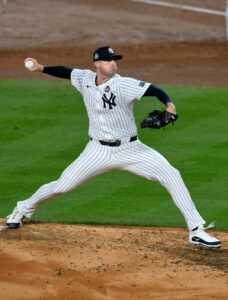
The 6’5″ righty concluded the regular season with a 3.14 ERA across 67 innings. He struck out around a quarter of batters faced against a league average 8.1% walk rate. Holmes got grounders at a characteristically excellent 65% clip. It’s far from a bad season, but he was bizarrely prone to blowing leads. While he recorded a career-high 30 saves, he was charged with an MLB-worst 13 blown saves. No other reliever gave up more than eight leads. He went into the postseason trending in the wrong direction after losing the closing job.
To his credit, Holmes rebounded when the lights were brightest. He only gave up three runs in 12 postseason innings. While he’d fallen behind Weaver in the bullpen hierarchy, he remained one of Boone’s most trusted setup options. Holmes picked up five holds without giving up the lead once in October.
That finish was a more fitting ending to his strong run in the Bronx. While the fanbase was divided at times on his reliability, Holmes posted good to elite numbers throughout his Yankee tenure. Of the 86 relievers with at least 150 innings over the past three years, Holmes ranks 17th in ERA. While his 25.7% strikeout percentage is middle of the pack, his 68.6% ground-ball rate is #1 among that group.
There’s no doubt that Holmes can be a productive reliever. The Mets believe he can be more than that. They’ll give him a chance at a full-time rotation role for the first time in his MLB career. Holmes has started four major league games, all of which came during his 2018 rookie season in Pittsburgh. Those didn’t go well — he allowed a 7.80 ERA with more walks than strikeouts in 15 innings — but that’s of little consequence. The Mets aren’t placing any stock in a minuscule sample that predated his breakout by three years.
Like many MLB relievers, Holmes was a starting pitcher in the minors. He’s not completely unfamiliar with working multiple innings, but it’ll be a tough test against big league hitters. He’ll probably need to make an adjustment to his pitch mix. Holmes has essentially abandoned his changeup since moving to the bullpen. His 96-97 MPH sinker is his go-to offering, the pitch most responsible for his huge grounder rates. Holmes has deployed two distinct breaking balls — an 87 MPH slider and an 83-84 MPH offering that Statcast classifies as a sweeper.
Having three pitches is an advantage as Holmes tries to navigate a lineup two or three times in an appearance. However, he hasn’t used a changeup or splitter that most starters have to handle opposite-handed hitters. Holmes has fared well against hitters of either handedness, but his strikeout and walk profile is far better when he holds the platoon advantage.
As a Yankee, Holmes held right-handed batters to a pitiful .203/.267/.284 batting line. He struck them out at a huge 31.7% clip against a tidy 6.2% walk rate. He fanned only 19.8% of left-handed opponents while issuing walks at a 9.8% rate. Holmes still held lefties to a mediocre .235/.318/.307 slash, but that’ll present more of a challenge as he works through a lineup multiple times.
There’s significant upside if Holmes can make that transition. Reliever to rotation success stories have gotten increasingly common. Seth Lugo, Reynaldo López, Garrett Crochet and Holmes’ former teammate Michael King have become top-of-the-rotation starters after spending most of their careers in relief. Jeffrey Springs, José Soriano and Zack Littell look like mid-rotation arms. It hasn’t been uniformly positive, though. Jordan Hicks wore down quickly when the Giants tried him as a starter last season. The Marlins experimented with A.J. Puk in the rotation. They pulled the plug by the end of April after he had four terrible starts.
Puk moved back to the bullpen with relative ease after the rotation experiment flopped. That’s a possibility for Holmes as well. The Mets surely believe he could return to a setup role in front of Edwin Díaz if he doesn’t take to the rotation. They’d be paying a high but not outlandish price for a leverage reliever in that case. Robert Stephenson, Rafael Montero and Taylor Rogers have signed three-year deals in the $33-35MM range in recent years. The Braves guaranteed López $30MM to give him a shot as a starter. Hicks, who is younger than the rest of that group, signed a four-year deal worth $44MM.
MLBTR predicted Holmes would land a three-year, $30MM contract that valued him as a setup arm. The Mets are going a little beyond that based on the perceived upside as a starter. The opt-out gives Holmes a chance to retest the market after two seasons. If he proves he’s capable of starting, he could do quite well in that return trip. There’s precedent for starters getting lucrative three-year deals at age 34. Lugo signed for $45MM, while Yusei Kikuchi and Chris Bassitt each inked $63MM contracts.
Holmes is the second rotation addition for the Mets in recent days. They finalized a two-year, $34MM deal with Frankie Montas on Wednesday. They’ve taken upside fliers in the middle of the market thus far — a strategy they employed to great success last offseason with Sean Manaea and Luis Severino. There should be more rotation moves on the way. New York already lost Severino and could see Manaea and Jose Quintana depart as free agents.
Kodai Senga and David Peterson likely have rotation spots secured, but there’s little certainty with a fifth spot that’d go to one of Tylor Megill or Paul Blackburn at the moment. Senga barely pitched this year, while Holmes could be on an innings limit. The Mets are still potential suitors for a top-of-the-market arm like Corbin Burnes or Max Fried, though president of baseball operations David Stearns has yet to make that kind of move. At the very least, they’ll continue to identify upside targets in the middle of free agency.
Joel Sherman of the New York Post first reported the Mets and Holmes were in agreement on a three-year deal worth $38MM. Jeff Passan of ESPN reported the opt-out clause and confirmed the Mets would use Holmes as a starter, which Sherman first suggested earlier this week. Will Sammon of the Athletic reported the salary breakdown.
Image courtesy of Imagn.