
Phillies, Jordan Luplow Agree To Minor League Contract
The Phillies have an agreement with free agent outfielder Jordan Luplow on a minor league deal, reports Robert Murray of FanSided (X link). He was released from a non-roster pact with the Braves last night. MassLive’s Chris Cotillo reported this afternoon (on X) that the Phils might have interest.
Luplow is a right-handed hitter who has hit for power against lefty pitching. The veteran has connected on 33 longballs in 565 big league plate appearances against southpaws. He’s only a .197/.287/.343 hitter versus right-handed pitching, so he’s best suited in a short side platoon capacity. He initially seemed as if he’d have a shot at playing that role in Atlanta as a complement to the lefty-swinging Jarred Kelenic. The Braves took that off the table when they reunited with Adam Duvall on a $3MM free agent pact instead.
Atlanta released Luplow within hours of the Duvall signing to allow him to explore other opportunities. He gets that look with Atlanta’s biggest threat in the NL East. The Phils already have a fairly right-handed bench group. Cristian Pache profiles as the fourth outfielder, while Whit Merrifield is a versatile option who could contribute throughout the infield or corner outfield. Philadelphia’s projected starter in left field, Brandon Marsh, has been delayed in camp after undergoing a minor procedure on his left knee at the beginning of February.
While the Phils anticipate Marsh being ready for Opening Day, there’s little harm in adding an experienced outfielder to camp. Luplow had been hitting well this spring, putting up a .276/.364/.621 slash with a trio of homers in 12 games.
Latest On Michael Lorenzen’s Market
With Opening Day less than two weeks off, Michael Lorenzen stands as arguably the #3 starting pitcher on the free agent market. The White Sox and Yankees have reportedly shown recent interest in the 32-year-old righty, but he evidently has yet to find a deal to his liking.
Jon Heyman of the New York Post reports that Lorenzen has declined contract offers in the $5-7MM range. It’s not clear which teams made those proposals or how recently Lorenzen’s camp passed. The Athletic’s Ken Rosenthal reported last week that the 6’3″ hurler had been holding out for a two-year pact.
It’s therefore not surprising that Lorenzen turned down what were presumably one-year offers at fairly modest salaries. He’s coming off his first All-Star nod and tallied a career-high 153 innings between the Tigers and Phillies last season. He looked on his way to a strong multi-year pact by the middle of August. After no-hitting the Nationals on August 9, he carried a 3.23 ERA in 20 starts. Lorenzen was never likely to maintain that kind of run prevention unless he improved upon a modest 19.4% strikeout rate, but few would have anticipated how badly his final six weeks would go.
Lorenzen allowed 30 runs (27 earned) in his final 30 1/3 frames. His already modest strikeout percentage dropped another seven points, while his previously strong walk rate jumped to 10.3%. The Phillies moved him to relief at the end of the regular season and didn’t lean heavily on him during the playoffs. That poor finish has seemingly led to a disconnect between how teams project Lorenzen and the kind of contract he expected to command heading into the winter.
Despite the rough conclusion, Lorenzen’s season ERA sat at a respectable 4.18 in 29 outings. His camp presumably viewed recent two-year guarantees inked by the likes of Ross Stripling ($25MM), Drew Smyly ($19MM), Jordan Lyles ($17MM) and KBO returnee Erick Fedde ($15MM) as comparison points. Innings eaters Kyle Gibson ($13MM) and Lance Lynn ($11MM) signed one-year pacts early this offseason that pushed past eight figures.
The offers which Lorenzen declined value him below those other pitchers. As shown on MLBTR’s Contract Tracker, five starting pitchers have signed one-year guarantees between $3MM and $9MM this offseason. Each of Wade Miley, Alex Wood, Martín Pérez, James Paxton and Jakob Junis landed in the $7MM – $8.5MM range.
Lorenzen himself has fallen in that category in each of his previous two free agent trips. He signed for $6.75MM with the Angels over the 2021-22 offseason. Last year, he inked an $8.5MM deal with the Tigers. Lorenzen has sought to move past that tier on the heels of a stronger platform season than the ones that preceded his last two free agent stints. It’s not known if that might’ve been achievable earlier in the offseason, but it seems he’s facing a tight market as many teams are at or near the payroll with which they’re willing to open the season.
Braves Release Jordan Luplow
The Braves announced they’ve released veteran outfielder Jordan Luplow to pursue other opportunities. He’d been in camp as a non-roster player after signing a minor league pact in January.
Luplow is a right-handed hitting outfielder who’d been competing for a bench job in camp. Atlanta signed Adam Duvall to a $3MM pact this afternoon to play that role instead. Carrying both Duvall and Luplow would have been a bit redundant, so the Braves decided to let the latter get an early jump on his next opportunity.
The Duvall signing wasn’t a reflection of Luplow underperforming in camp. To the contrary, the well-traveled outfielder has posted impressive numbers this spring. He was off to a .280/.379/.560 start through 29 plate appearances. Luplow had collected two homers and a double among his seven hits. He walked four times against only five strikeouts. Yet the organization has a long history with Duvall, who lingered in free agency deep into the offseason despite hitting 21 homers with a .247/.303/.531 slash for the Red Sox a year ago. Adding him to the bench at such a modest price tag was something the front office didn’t want to pass up.
Luplow shouldn’t have any issue finding another minor league opportunity elsewhere. He has tallied more than 1000 trips to the plate over the past seven seasons between six teams. Luplow got into 39 MLB contests a year ago, hitting .208/.322/.325 between the Blue Jays and Twins.
While he has posted below-average numbers over the past two seasons, Luplow has a decent track record in favorable platoon situations. He has popped 33 home runs in 565 career plate appearances against left-handed pitching. Luplow has reached base at a .338 clip with a very strong .495 slugging mark versus southpaws. He hasn’t had anywhere near the same level of success against righty pitching, posting a .197/.287/.343 slash when matched with same-handed hurlers.
Offseason In Review: Houston Astros
The Astros entered the offseason anticipating a few depth acquisitions. An injury to one of their anticipated setup relievers spurred them in another direction: a bold strike for one of the sport’s best late-game weapons.
Major League Signings
2024 spending: $25MM
Total spending: $107MM
Option Decisions
- RHP Héctor Neris declined $8.5MM player option in favor of $1MM buyout
Trades and Claims
- Claimed RHP Oliver Ortega off waivers from Twins
- Acquired RHP Dylan Coleman from Royals for minor league RHP Carlos Mateo
- Claimed RHP Declan Cronin off waivers from White Sox (later lost on waivers to Marlins)
- Acquired 1B Trey Cabbage from Angels for minor league RHP Carlos Espinosa
Notable Minor League Signings
Extensions
- Signed 2B Jose Altuve to five-year, $125MM deal covering 2025-29 seasons
Notable Losses
- Michael Brantley (retired), Martín Maldonado, Phil Maton, Neris, Ryne Stanek
The Astros very narrowly missed another trip to the World Series. They dropped two straight at home against the Rangers to lose a seven-game ALCS. Watching their in-state rivals secure the first championship in franchise history might add some fuel to the fire, but the Astros would’ve remained firmly in win-now mode no matter how things played in October.
That didn’t necessarily portend an active winter. Houston went into the offseason with a projected franchise-record payroll. They have one of the sport’s most complete rosters. They were set to lose a few contributors but no instrumental piece of the core. Michael Brantley (who eventually announced his retirement), Martín Maldonado and the relief trio of Héctor Neris, Phil Maton and Ryne Stanek were Houston’s only free agents of note.
As a result, general manager Dana Brown indicated early in the winter that the team didn’t expect to do anything drastic. He suggested their outside acquisitions were likely to be more of the depth variety, identifying backup catcher and middle relief as the target areas.
Before they could turn their attention fully to the roster, the Astros had to address the coaching staff. Dusty Baker stepped down at year’s end, concluding what’ll almost certainly be a Hall of Fame managerial career. Joe Espada, who had worked as bench coach under both A.J. Hinch and Baker, has long seemed to be a manager-in-waiting. The Astros tabbed Espada in mid-November, giving the 48-year-old his first managerial opportunity. Organizational stalwart Omar López moved up to bench coach.
Continuity was also a theme for much of the roster, although the Astros started the offseason with a few moves around the margins. During the Winter Meetings, they inked former Brewer Victor Caratini to a two-year, $12MM pact to serve as backup catcher. That marked the end of Maldonado’s run in Houston. The Astros declared before the winter that they’d turn the primary catching job to 25-year-old Yainer Díaz, who brings a lot more offensive upside than Maldonado offers. Given Maldonado’s stature in the clubhouse, it probably would have been tough to move him fully to a backup role in Houston. It made more sense to let him sign elsewhere — he eventually landed with the White Sox on a $4.25MM pact — and bring in a new #2 option.
Caratini wound up being Houston’s only MLB free agent position player pickup of the winter. It was their only major league signing at all well into January. That’s when the club revealed that Kendall Graveman required shoulder surgery that’d end his 2024 season before it got off the ground. Between Graveman’s injury and the aforementioned trio of free agent losses, the relief corps suddenly looked alarmingly thin behind the late-inning duo of Ryan Pressly and Bryan Abreu.
Brown initially played coy, saying the Graveman injury wouldn’t add any urgency to bring in relief help. Yet it clearly concerned both the front office and ownership, who signed off on a surprising strike at the top of the market. Within three days of announcing the Graveman news, the Astros inked Josh Hader to a five-year, $95MM pact. It’s the second-largest guarantee to a reliever in MLB history and the highest in terms of net present value after accounting for deferrals in Edwin Díaz’s $102MM deal with the Mets.
It was a completely out of character splurge for the organization. While owner Jim Crane has approved player payrolls in the upper third of the league, the organization has been averse to long-term free agent commitments. As shown on MLBTR’s Contract Tracker, the Hader deal was the first time the Astros stretched to five years on a free agent since Crane purchased the franchise in 2011. They’d only even gone to four years once before on the $52MM Josh Reddick pact. It was also the first time that Houston signed a player who had declined a qualifying offer.
Crane and Brown considered it worthwhile to deviate from typical procedure to add arguably the sport’s best reliever while the team’s path to a title remains clear. The five-time All-Star is coming off a 1.28 ERA showing while striking out almost 37% of batters faced for the Padres. Houston gave up their second-round pick and $500K in international signing bonus space to install him in the ninth inning. That bumps Pressly into setup work, where he’ll pair with Abreu in what should be an electric back of the bullpen.
Strong as that final trio is, the middle relief group does look like a relative weak point. The Hader signing meant the Astros eschewed a volume approach to addressing the middle innings. They claimed Oliver Ortega off waivers and took a flier on Dylan Coleman in a minor trade with the Royals. Beyond that, they’re counting on Rafael Montero to rebound from a poor season and hoping for steps forward from an internal option like Brandon Bielak or Seth Martinez. Brown acknowledged over the weekend the team is still looking to add middle relief help. That’d need to come via trade, waivers or potentially a minor league free agent pickup at this point.
As far as weaknesses go, middle relief is one of the easier problems to navigate. The Astros don’t have much concern throughout the rest of the roster. Caratini and first baseman Trey Cabbage, acquired from the Angels after a DFA, were the only position player pickups of the winter. Caratini and Díaz make for a strong catching tandem. José Abreu had a disappointing first year in Houston, but he perhaps found his power stroke in the final few weeks of the season. They’ll give him another shot at first base. Jose Altuve, Jeremy Peña and Alex Bregman round out an excellent infield.
Brantley’s departure puts a little more pressure on the in-house outfielders. Kyle Tucker should provide star production in right field. Chas McCormick has been an above-average regular and should get the bulk of playing time in left field. The Astros will turn center field to defensive stalwart Jake Meyers. McCormick can handle center on days when Yordan Alvarez trots out to left field. Mauricio Dubón remains on hand as a multi-positional option off the bench.
There wasn’t much turnover in the position player group. That could change next offseason, as Bregman is on track to hit free agency. That even led to speculation that the Astros could preemptively dangle him in trade talks this winter, although the organization quickly shot down that idea. Brown and Crane each said the team will make an extension offer to Bregman at some point, but that won’t be cheap. His camp could set out in search of a deal exceeding $200MM. The same is true for Tucker, who is controllable via arbitration through the 2025 season.
Like Bregman, Altuve had been on track to hit free agency at the end of the upcoming season. It was difficult to envision the franchise stalwart donning any other uniform. The Astros and his camp all but ensured that won’t happen. They locked in a five-year, $125MM extension covering the 2025-29 seasons. That runs through Altuve’s age-39 campaign, ensuring he’ll be the franchise second baseman through the end of this competitive cycle. Altuve’s defensive grades are declining, but he remains the sport’s best offensive second baseman. Keeping him in the leadoff spot maximizes their chances of staying atop the AL West in the middle third of the decade.
The extension discussion isn’t limited to the position player side. Framber Valdez is down to his final two seasons of arbitration control. He won’t hit free agency until age 32, so he doesn’t have the same earning power as Tucker or Bregman do. Yet he’s deep enough into arbitration that he’d surely cost more than the $64MM which Houston guaranteed Cristian Javier last spring. A Valdez deal would likely go into nine figures. He and the Astros haven’t found an agreeable price point yet. As with Bregman, this led to some early-offseason trade speculation that never seemed to get far.
For now, Valdez slots back in as Houston’s top starter. That might’ve been true even if Justin Verlander were healthy, but the latter will begin the season on the injured list as he cautiously builds up after experiencing shoulder soreness early in camp. Javier, José Urquidy and Hunter Brown will follow Valdez in the season-opening rotation. J.P. France will get the nod as the #5 starter so long as he’s fully recovered from a minor shoulder issue of his own. If France does need to miss time, Bielak, Ronel Blanco or prospect Spencer Arrighetti could find themselves in the mix.
It’s a thinner rotation than the ones which the Astros have rolled out in previous years. That could be a concern around the deadline, but Brown has stated a few times it’s not something they feel compelled to address before Opening Day. Verlander’s IL stay isn’t expected to be too long. Lance McCullers Jr. and Luis Garcia could each be back from arm surgeries in the middle of the season. The front office should have a clearer idea in the summer of the extent to which they can rely on McCullers and Garcia down the stretch.
The gap in the AL West isn’t as wide as it once was. The Rangers and Mariners both pushed last year’s division race into the final weekend of the regular season. Texas got the last laugh in October. Still, the Astros have taken the AL West crown in six of the last seven seasons (all aside from the shortened 2020 schedule). They’ve gotten as far as the ALCS every year since 2017. This probably won’t be the best Astro team of the last few years, but there’s certainly enough talent to put them in the conversation at the top of the American League yet again.
How would you grade the Astros' offseason?
-
B 44% (1,059)
-
C 33% (784)
-
A 12% (278)
-
D 7% (166)
-
F 5% (124)
Total votes: 2,411
Padres Acquire Dylan Cease
The Dylan Cease saga has come to an end. The Padres announced the acquisition of the right-hander from the White Sox for four players: prospects Drew Thorpe, Jairo Iriarte and Samuel Zavala and big league reliever Steven Wilson.
Cease has been a trade candidate at least as far back as last summer’s deadline. While Chicago took him off the market at that time, first-year general manager Chris Getz made clear that he was willing to consider offers on virtually everyone on the roster going into the offseason. That made Cease one of the top names of the winter.
Chicago fielded offers early in the offseason before pulling back. The Sox indicated they wanted to wait for the free agent rotation market to play out before aggressively shopping the star righty. Blake Snell and Jordan Montgomery have lingered in free agency longer than anyone anticipated. With Opening Day two weeks away, Chicago seemed to find more urgency to make a move. They’d reportedly talked with the Yankees and Rangers within the past few days, but it is San Diego that gets the deal done.
It’s a massive strike for them just a week before they’ll open the regular season with a two-game set against the Dodgers in South Korea. For much of the offseason, the Padres have gone in the opposite direction. They faced significant payroll constraints that led to the free agent departures of Josh Hader, Seth Lugo, Nick Martinez and Michael Wacha. Snell seems likely to follow.
The biggest loss, of course, came via trade. The Padres dealt Juan Soto to the Yankees before his final year of team control. That both offloaded his arbitration salary — which eventually checked in at $31MM — and brought back a number of controllable starting pitchers to compensate for the free agent departures. Michael King will step into the middle of the rotation. Jhony Brito and Randy Vásquez are candidates for a back-end role. Thorpe came over in that trade and would have been in the rotation mix as well, but he’s now headed to Chicago before throwing a regular season pitch for the Padres.
Despite targeting upper level pitching in the Soto return, San Diego had a largely unproven rotation. Joe Musgrove and Yu Darvish were locked into the top two spots. King was ensured of a job after a strong finish last season with the Yankees, but he’d been a reliever for most of his major league career. He only moved to the starting staff for his final eight appearances beginning at the end of August. The rest of the starting pitching options in the organization have limited MLB experience of any kind.
Cease addresses that lack of experience. The former sixth-round pick has been a fixture of the Sox’s rotation since 2020. Aside from a brief virus-related absence in ’21, he hasn’t missed any time as a major leaguer. Cease leads the majors with 109 starts over the last four seasons.
At his best, Cease has paired that pristine durability with a top-of-the-rotation ceiling. He was dominant two seasons ago, turning in a 2.20 ERA with an excellent 30.4% strikeout rate through 184 innings. He was runner-up behind Justin Verlander in that season’s Cy Young balloting and received some down-ballot MVP consideration.
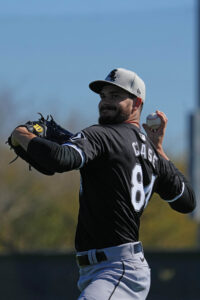
The 28-year-old didn’t replicate that ace-caliber production last season. He had a pedestrian 4.58 ERA across 177 frames. While some level of regression from a 2.20 mark always seemed likely, his earned run average more than doubling wasn’t expected. That’s partially a reflection of a dramatic swing in Cease’s batted ball fortune. Opponents hit only .260 on balls in play against him in 2022; that spiked 70 points a season ago.
Beyond the ball-in-play results, Cease was a little less overpowering in ’23 than he’d been the previous season. His swinging strike rate dipped from 15% to 13.6%. He lost three percentage points off his strikeout rate, which fell to 27.3%. The average velocity on both his fastball (95.6 MPH) and slider (86.3 MPH) dropped a tick. Those are all still better than average marks but not quite as impressive as his 2022 metrics.
As is often the case, Cease’s true talent ERA very likely falls somewhere in the middle. Going back to the start of 2020, he carries a 3.58 mark in just shy of 600 innings. That has come in a tough home ballpark for pitchers in front of generally lackluster defenses.
At the same time, Cease has never had pristine control of his high-octane stuff. He has walked more than 10% of batters faced in three of the past four seasons, including his Cy Young runner-up campaign. He issued free passes at a 10.1% clip last year. That inconsistent command has kept him from blossoming into a true ace and is part of the reason he’s “only” 16th in innings pitched over the last four seasons despite topping MLB in starts.
It’s debatable but largely immaterial where Cease slots alongside Darvish and Musgrove among San Diego’s top three starters. King moves to the #4 spot, while the Friars now have only one Opening Day rotation job up for grabs. Brito, Vásquez, knuckleballer Matt Waldron and the out-of-options Pedro Avila could each be in the mix for the role.
It’s a renewed push for contention by a San Diego front office that has never shied away from dealing for star talent. Cease becomes the defining addition of the Padre offseason, largely enabled by his affordability. He and the White Sox had agreed to an $8MM salary to avoid arbitration. He’s under control via that process through the 2025 campaign. The Padres can plug him into the rotation for the next two years for what’ll likely be between $20MM and $25MM overall.
RosterResource calculates San Diego’s 2024 player payroll around $167MM, including Cease’s salary. The trade pushes their luxury tax number around $224MM, roughly $13MM below this year’s lowest threshold. The Friars have worked to stay under the tax line after exceeding it in each of the past three seasons. They still have questions about the overall roster depth — particularly in the outfield — but they have some flexibility to continue adding either this spring or at the deadline without pushing into CBT territory.
Landing a pitcher of Cease’s caliber and affordability required parting with a few fairly well-regarded young players. San Diego was never going to trade Ethan Salas or Jackson Merrill and managed to keep young pitchers Dylan Lesko and Robby Snelling out of the deal. Thorpe, Zavala and Iriarte were all generally regarded in the next tier of Padres talents. Baseball America ranked all three between fifth and ninth in the San Diego system. The Athletic’s Keith Law had those players in the 6-9 range on his organizational prospect list.
As a key piece of the Soto return, Thorpe is probably the most well-known of the bunch. A second-round pick in 2022 out of Cal Poly San Luis Obispo, Thorpe had a breakout showing in his first full minor league season. The 6’4″ right-hander worked to a 2.52 ERA in 23 starts between High-A and Double-A last year. He fanned more than a third of opposing hitters against a modest 7.1% walk rate.

Thorpe doesn’t light up radar guns with a fastball that sits in the low-90s. Evaluators credit him with a plus or better changeup and an above-average breaking ball, though. He has shown advanced strike-throwing acumen, although Law writes that his precise command (the ability to spot pitches where he wants them) isn’t as impressive as his control (hitting the strike zone consistently). Baseball America, FanGraphs and ESPN’s Kiley McDaniel all placed Thorpe in the back half of the league’s Top 100 prospects this winter. He’s a potential mid-rotation arm who could impact the Sox as soon as this year.
Iriarte, a 6’2″ righty from Venezuela, could also be part of the major league pitching staff at some point in 2024. The 22-year-old worked 90 1/3 frames across 27 appearances between High-A and Double-A last season. He allowed 3.49 earned runs per nine behind a 33.2% strikeout percentage. He also walked almost 12% of opposing hitters, but there’s clear bat-missing potential.
Evaluators credit Iriarte with upper 90s velocity with a plus slider and a promising but inconsistent changeup. The chance for three above-average to plus offerings gives him significant upside, although evaluators are split on whether he’ll stick as a starting pitcher. He’ll need to refine his secondary stuff and continue to improve his control, but his athleticism gives him the opportunity to do so. FanGraphs slotted Iriarte in the back half of their Top 100 list. The Sox can take their time to afford him plenty of reps in the upper minors.
Zavala, 19, is a further away development flier. The lefty-hitting outfielder was one of the better prospects in the 2020-21 international signing period. He spent most of last season at Low-A Lake Elsinore. Zavala’s .267/.420/.451 batting line is impressive for a player his age, but prospect evaluators are divided on his long-term upside. Law suggests he’s unlikely to stick in center field, while most reports question his pure contact skills. Zavala took plenty of walks but also struck out at an alarming 27.2% clip in Low-A.
Wilson might be the fourth piece of the return, but he should step directly into the big league bullpen. The 29-year-old righty has been a quality reliever in each of the last two seasons. Wilson owns a 3.48 ERA across 106 career innings. He has fanned just over a quarter of opposing hitters against a 10.9% walk rate. Wilson leans heavily on a low-80s breaking ball and sits in the mid-90s with his fastball.

That profile has led to better strikeout and walk numbers versus right-handed batters, but Wilson has gotten decent results against hitters of either handedness. He could step into high-leverage work in a completely open Sox bullpen. The Santa Clara product has exactly two years of service. Chicago controls him through at least 2027, depending on whether they option him to the minors at any point. He won’t be eligible for arbitration until next offseason.
The White Sox had named Cease their Opening Day starter. That’s no longer on the table as they commit even further to a retool. KBO returnee Erick Fedde is perhaps the top pitcher in what might be the weakest rotation in the American League. Michael Soroka, Chris Flexen, Michael Kopech, Garrett Crochet and Jared Shuster are among the other possibilities. Thorpe figures to open the season in Triple-A but could pitch his way into the mix before long.
Chicago could go outside the organization to try to backfill some of their lost innings. Ken Rosenthal of the Athletic reported last night that the Sox had interest in Michael Lorenzen as a potential Cease replacement. Zack Greinke, Jake Odorizzi and old friend Johnny Cueto also remain unsigned.
Iriarte and Wilson are each on the 40-man roster. Thorpe and Zavala won’t be eligible for the Rule 5 draft until the 2025-26 offseason, although Thorpe seems likely to pitch his way onto the MLB roster well before that point. Chicago designated outfielder Peyton Burdick for assignment to open the necessary 40-man spot.
ESPN’s Jeff Passan first reported the Padres were finalizing a trade for Cease. Jon Heyman of the New York Post confirmed a Cease agreement was in place. Jon Morosi of MLB.com was first to report the White Sox were acquiring Thorpe and Iriarte. The Athletic’s Dennis Lin first reported Wilson’s inclusion. Bob Nightengale of USA Today was first with Zavala being in the deal.
Images courtesy of USA Today Sports.
Devin Williams To Miss Roughly Three Months With Back Fractures
Brewers star closer Devin Williams has been diagnosed with two stress fractures in his back, reports Jeff Passan of ESPN (X link). He’ll be shut down entirely for six weeks and is expected to be out of MLB action for around three months.
It’s a massive hit to the Milwaukee bullpen two weeks before Opening Day. Williams made two appearances this spring before pausing his work as he battled back soreness. He visited a spine specialist this afternoon. That examination revealed the fractures. Fortunately, Passan indicates that Williams is expected to make a full recovery.
That the injury shouldn’t affect Williams throughout his career is a positive, but there’s no question it’s a significant loss for the first half of the upcoming season. The two-time All-Star is among the best relievers in baseball. He has turned in a sub-2.00 ERA in consecutive years, including a sparkling 1.53 mark over 58 2/3 frames last season. Williams shut down 36 games in 40 attempts in his first full campaign as a closer. He rode his patented wiffle ball changeup, the so-called Airbender, to a massive 37.7% strikeout percentage. Williams was named the National League’s Reliever of the Year for the second time in his career.
As is the case with virtually every Milwaukee player approaching free agency, Williams found himself in trade rumors during the offseason. That speculation returned after they dealt Corbin Burnes to the Orioles, but Milwaukee didn’t find a deal to their liking. They elected to keep him at the back of the bullpen instead. Williams should eventually return to the ninth inning, but he’ll now begin the season on the 60-day injured list and will be out of action at least into the middle of June.
It’s unclear if Milwaukee skipper Pat Murphy will go with a committee approach to the ninth inning or pick a defined closer while Williams is on the shelf. If they go the latter route, any of Joel Payamps, Abner Uribe or Trevor Megill could be candidates. Payamps was somewhat quietly one of the more productive relievers in the NL last season. The secondary piece acquired in the William Contreras/Sean Murphy three-team trade, Payamps turned in a 2.55 ERA with plus strikeout, walk and ground-ball numbers across 70 1/3 innings.
Uribe has more traditional closing stuff. One of the hardest throwers in the sport, he averaged a blistering 99.4 MPH on his sinker as a rookie. Uribe turned in a 1.76 ERA behind a 53% grounder percentage and a 30.7% strikeout rate over his first 30 2/3 MLB innings. It’s eye-popping stuff, but his command could keep him out of the ninth inning. Uribe walked more than 15% of opponents last season.
Megill, acquired in a minor trade with the Twins last April, struck out nearly 36% of batters faced as a Brewer. He worked to a 3.31 ERA through 32 2/3 frames. Megill averaged 99.1 MPH on his heater, which he paired with a wipeout curveball in the mid-80s. Having that trio of power arms means Murphy should still have a good relief group with which to work, yet there’s no one who can be expected to replicate the production that Williams posts on an annual basis.
Milwaukee controls Williams via arbitration through the 2025 season. He’s making $7MM this season. Milwaukee has a $10MM option for next year but could retain him in arbitration even if they opt for a $250K buyout instead of the option value. If Williams progresses as expected, he should be back on the mound before the deadline. There’s a chance he’d be a midseason trade candidate if the Brewers unexpectedly fall out of contention in the NL Central, but the offers they receive could be complicated by other teams’ trepidation about the injury.
Bill Plummer Passes Away
Former major league catcher and manager Bill Plummer passed away this week, according to a report from The Associated Press. He was 76.
A Northern California native, Plummer entered the professional ranks in 1965 as an amateur signee of the Cardinals. He was plucked away by the Cubs in the Rule 5 draft three years later. Plummer made a brief big league debut with Chicago before being traded to the Reds as part of a deal for bullpen workhorse Ted Abernathy. Plummer spent eight years in Cincinnati, working behind Johnny Bench among the Big Red Machine teams of the 1970s.
The Reds won the National League pennant in 1970, ’72, ’75 and ’76. They were repeat World Series champions in the latter two of those seasons. Plummer didn’t appear in any of those series but was a respected defensive presence as the backup to one of the greatest catchers in league history. He finished his career with a 41-game stint for the Mariners in 1978. Plummer retired with a .188/.267/.279 line in a little more than 1000 plate appearances.
After collecting that pair of World Series rings as a player, Plummer moved into the coaching ranks. He managed in the Seattle farm system throughout the 1980s and was promoted to the big league staff in ’89. The Mariners hired him as their manager in 1992. Plummer led the team for one season but was dismissed after a disappointing 64-98 finish. Seattle hired Lou Piniella the following year. Plummer never got another big league managerial opportunity, but he continued coaching for various independent and minor league teams well into the 2010s.
MLBTR sends our condolences to Plummer’s family, loved ones, friends and former teammates.
White Sox Designate Peyton Burdick For Assignment
The White Sox announced they’ve designated outfielder Peyton Burdick for assignment. The move creates a spot on the 40-man roster to accommodate Steven Wilson and Jairo Iriarte, both of whom were acquired in the Dylan Cease trade.
Chicago claimed Burdick off waivers from the Orioles earlier in camp. The right-handed hitter has gone from the Marlins to Baltimore and the Sox within the last five weeks. He could find himself on the move yet again. Chicago will trade him or place him on outright waivers within the next seven days.
A third-round pick by Miami in 2019, Burdick has plus raw power but significant swing-and-miss concerns. The Wright State product has seen brief MLB action in each of the last two seasons. He combined for a .200/.281/.368 line over 46 games, striking out at a 38.1% clip. Burdick spent the bulk of last year in Triple-A. He connected on 24 homers and stole 12 bases in 492 trips to the plate, yet he went down on strikes nearly 37% of the time. Burdick finished the season with a .219/.327/.448 slash at the top minor league level.
The Sox gave him a brief look this spring. He started 1-15 before being optioned to minor league camp. He still has two minor league options remaining, so another team could stash him in Triple-A as a power-hitting depth player if they’re willing to carry him on the 40-man roster.
Rangers, White Sox Have Recently Discussed Dylan Cease
Significant trades halfway through Spring Training are rare, yet speculation about White Sox’s staff ace Dylan Cease hasn’t gone away. USA Today’s Bob Nightengale reported this morning that the Yankees put a new trade proposal on the table for Chicago’s expected Opening Day starter. Meanwhile, Evan Grant of the Dallas Morning News writes that the Rangers are still considering which players they might need to relinquish to try to pry Cease from the Sox.
Ken Rosenthal of the Athletic reports that the Sox and Rangers have had recent conversations regarding Cease. Rosenthal indicates that Chicago seems to be “getting more serious” about dealing the hard-throwing righty this spring.
Manager Pedro Grifol demurred this evening when asked whether he still expected Cease to start for the Sox on Opening Day. “I don’t know. I mean, how am I supposed to know that,” he asked rhetorically (via Scott Merkin of MLB.com). “I don’t know what’s going to happen out there. I don’t know where other teams are, what their urgency is. … I leave that to our major league scouts, our general manager, the front office.”
While the Yankees’ renewed interest in Cease is tied to Gerrit Cole’s MRI, Texas hasn’t dealt with any recent injuries to their rotation. Yet they went into camp knowing that three of their top starters — Jacob deGrom, Max Scherzer and Tyler Mahle — were going to begin the year on the shelf. Mahle and deGrom seem likely to be out past the All-Star Break as they work back from last year’s respective Tommy John procedures. Scherzer underwent back surgery in December and is expected to be sidelined into June.
That puts a lot of pressure on the rest of the pitching staff to hold the fort for the season’s first couple months. The Rangers have a front four of Nathan Eovaldi, Jon Gray, Dane Dunning and Andrew Heaney. Left-hander Cody Bradford is the favorite for the #5 job to open the season. Texas optioned Cole Winn over the weekend, taking him out of the mix for an Opening Day job. Owen White and Zak Kent are on the 40-man roster but have a combined two MLB appearances between them (both by White). José Ureña and Adrian Sampson are in camp on non-roster deals but should be behind Bradford on the depth chart.
If healthy, that’s still a solid front four. Yet there’s a fair amount of injury risk with much of that group. Eovaldi has twice undergone Tommy John surgery in his career. Gray has been on the injured list four times in his two seasons as a Ranger. Heaney was healthy last season but lost a good chunk of 2022 to shoulder problems. Even Dunning has a Tommy John surgery in his history, although he has been durable and quite effective for the last three seasons.
Even if that entire group stays healthy, Texas would benefit from another arm who can push Bradford to a long relief role. The southpaw turned in a 5.30 ERA in his first 56 big league frames a year ago. He has excellent control but struggled with home runs last season. That’s likely to be a recurring concern as a fly-ball pitcher without overpowering stuff. His fastball averaged 90.4 MPH.
To his credit, the Baylor product has pitched well this spring. Bradford has rattled off 11 innings of three-run ball, fanning nine against a pair of walks. Still, that’s unlikely to deter the front office from considering ways to upgrade the staff as they look to defend the first World Series in franchise history.
The Sox’s asking price on Cease has remained high, which is why he’s still in Chicago two weeks from Opening Day. The 2022 AL Cy Young runner-up is coming off a down year, turning in a 4.58 ERA over 177 innings. With mid-90s velocity and a strikeout rate that sat above 27% last season, he’s a clear rebound candidate. Cease is under arbitration control for two more years and will make $8MM in 2024. That affordability makes him an attractive alternative to top remaining free agents Blake Snell and Jordan Montgomery. The Rangers have had a fairly quiet offseason, thanks in part to trepidation about the long-term viability of their TV deal with Bally Sports.
White Sox Showing Interest In Michael Lorenzen
The White Sox have interest in free agent starter Michael Lorenzen, reports Ken Rosenthal of the Athletic. The right-hander is arguably the third-best pitcher still on the open market behind Blake Snell and Jordan Montgomery.
Chicago’s link to Lorenzen comes at a time when trade speculation around staff ace Dylan Cease has been rekindled. USA Today’s Bob Nightengale reported on Tuesday afternoon that the Yankees made a new offer for Cease. Not long after, Evan Grant of the Dallas Morning News and Rosenthal separately indicated the Rangers had interest.
It’s not clear if the Sox’s interest in Lorenzen is strictly contingent on a Cease trade. Yet dealing their projected Opening Day starter would leave Chicago looking for innings, if nothing else. Cease tallied a team-high 177 frames over 33 starts a year ago. He has taken a full series of turns through the rotation in each of the past four seasons. Moving a pitcher with that kind of reliability just weeks before Opening Day could leave the coaching staff struggling to piece together innings.
That’s particularly true given the rotation uncertainty behind Cease. KBO returnee Erick Fedde will occupy a spot in the rotation. The Sox will probably give a rebound opportunity to Michael Kopech, who allowed a 5.43 ERA over 30 appearances last season.
Michael Soroka hasn’t logged an MLB rotation workload in five years, largely on account of two Achilles tears. Chris Flexen allowed 6.86 earned runs per nine a year ago. Jared Shuster had an ERA approaching 6.00 over his first 11 big league starts. Touki Toussaint is better suited for a relief role. Rule 5 pick Shane Drohan will start the year on the injured list, while depth starter Jesse Scholtens underwent Tommy John surgery last month. Garrett Crochet is battling for a rotation spot but would be on an innings limit if he secures a starting job.
Even if the Sox held Cease and signed Lorenzen, they’d be unlikely to have an average rotation. Lorenzen would at least raise the floor and mitigate some concerns the Sox could have about getting through a full season, though. He tossed a career-high 153 frames between the Tigers and Phillies last year. His 4.18 ERA was right around league average but belies a season of extreme peaks and valleys.
Lorenzen earned an All-Star nod with Detroit. He pitched to a 3.58 ERA through 18 starts as a Tiger before being dealt to Philadelphia at the deadline. His first two outings as a Phillie were brilliant, highlighted by a no-hitter against the Nationals on August 9. After that point, he was among the least effective pitchers in the majors. Lorenzen allowed an 8.01 ERA over his last nine appearances. The Phils kicked him to relief and only called upon him twice in the postseason.
It’s possible he wore down as he neared the end of his first full, healthy season as a starting pitcher. That presumably played a role in the extent of his dismal finish, although he never looked likely to sustain the low-3.00s ERA he carried into the middle of August. During his successful run in Detroit, Lorenzen didn’t miss many bats or induce ground-balls at a particularly high clip.
The poor finish has apparently held up his market. Rosenthal reported last week that Lorenzen continued to hold out in search of a two-year contract. He has played the past two seasons on successive one-year guarantees valued at $6.75MM and $8.5MM, respectively. Cease is slated for an $8MM salary for the upcoming season. If signing Lorenzen were conditional on a Cease trade, it’d probably be around neutral from a financial perspective — particularly if Lorenzen does move off his ask for a two-year pact.