
Offseason In Review: San Diego Padres
It’s rare for the same team to be on opposite ends of blockbuster trades within one offseason. This Padres front office isn’t afraid to break convention. San Diego was the traditional “seller” in the winter’s biggest trade as they shed a lot of money. That didn’t stop them from dealing a trio of well-regarded prospects to upgrade their rotation in a late-spring strike.
Major League Signings
- LHP Yuki Matsui: Five years, $28MM (deal includes conditional opt-outs after 2026 and ’27 seasons)
- LHP Wandy Peralta: Four years, $16.5MM (deal includes opt-outs after 2024, ’25 and ’26 seasons)
- RHP Woo-Suk Go: Two years, $4.5MM (including buyout of 2026 mutual option)
- LF Jurickson Profar: One year, $1MM
2024 spending: $9.35MM
Total spending: $50MM
Option Decisions
- RHP Seth Lugo declined $7.5MM player option
- DH Matt Carpenter exercised $5.5MM player option
- Team, RHP Nick Martinez declined respective options covering 2024-25 seasons
- Team, RHP Michael Wacha declined respective options covering 2024-25 seasons
Trades and Claims
- Claimed SS Tucupita Marcano off waivers from Pirates
- Claimed RHP Jeremiah Estrada off waivers from Cubs
- Claimed RHP Logan Gillaspie off waivers from Red Sox
- Traded RHP Scott Barlow to Guardians for RHP Enyel De Los Santos
- Selected RHP Stephen Kolek from Mariners in Rule 5 draft
- Traded LF Juan Soto and CF Trent Grisham to Yankees for RHP Michael King, RHP Jhony Brito, RHP Randy Vásquez, minor league RHP Drew Thorpe, and C Kyle Higashioka
- Traded LHP Ray Kerr, DH Matt Carpenter and $1.5MM to Braves for minor league OF Drew Campbell
- Claimed RHP Luis Patiño off waivers from Rays
- Traded minor league LHP Blake Dickerson to Tigers for international bonus pool space
- Acquired RHP Dylan Cease from White Sox for RHP Jairo Iriarte, minor league RHP Drew Thorpe, minor league OF Samuel Zavala, and RHP Steven Wilson
Notable Minor League Signings
- Daniel Camarena, Drew Carlton, Ryan Carpenter, Austin Davis, Matt Festa, Bryce Johnson, Tim Locastro, Mason McCoy, Óscar Mercado, Brad Miller, Cal Mitchell, Nate Mondou, Tommy Nance, Kevin Plawecki, Zach Reks, Chandler Seagle, Tyler Wade
Extensions
- None
Notable Losses
- Barlow, Carpenter, Ji Man Choi, Garrett Cooper, Jose Espada (released to pursue NPB opportunity), Luis García, Grisham, Josh Hader, Rich Hill (still unsigned), Tim Hill (non-tendered), Iriarte, Kerr, Taylor Kohlwey (non-tendered), Lugo, Martinez, Austin Nola (non-tendered), Drew Pomeranz, Gary Sánchez, Blake Snell, Soto, Wacha, Wilson
Under A.J. Preller, it’s fair to presume the Padres are in for a headline-grabbing offseason. Yet while the past few years had been defined by major acquisitions, most of this winter was about departures. Late in the 2023 season, it emerged that the Padres were planning to cut spending. That came on the heels of Diamond Sports Group abandoning their local broadcasting contract midseason and amidst reports about the Padres falling out of compliance with MLB’s debt service ratio.
San Diego had key free agents Blake Snell, Josh Hader, and Seth Lugo; option decisions on Nick Martinez and Michael Wacha which they’d decline; and Juan Soto projected for the largest arbitration salary in league history. (Hader and Snell declined qualifying offers, so the Padres landed two draft choices after the fourth round for their departures.) It was clear there’d be a lot of roster turnover. Before they could even address that, the organization needed to settle on its leadership structure. Tension mounted between Preller and manager Bob Melvin towards the end of their underwhelming season. While they made some effort to smooth the relationship going into the winter, everyone decided a break was ultimately in the organization’s best interest.
The Padres allowed Melvin to interview for and accept the managerial role with the Giants without demanding any compensation from their division rivals. They reportedly considered former Angels skipper Phil Nevin and previous Cubs manager David Ross but ultimately stayed in-house. San Diego moved Mike Shildt from an advisory position in the front office back to the dugout, giving him his second managerial opportunity at the big league level. Bench coach Ryan Flaherty also interviewed for the position. When San Diego went with Shildt instead, they let Flaherty depart to serve as Craig Counsell’s top lieutenant with the Cubs. The Padres left the position vacant for 2024.
Of course, one would be remiss to discuss the Padres’ leadership structure without mentioning Peter Seidler. The San Diego owner passed away at age 63 in the middle of November after a battle with illness. Few owners were as widely respected around the league and by their fanbase as Seidler, who consistently approved star acquisitions and ran the organization’s player payroll as high as third in the majors entering last season. This was a franchise that ranked among the league’s bottom-five spenders throughout most of the 2010s. It didn’t always work, but there was little questioning Seidler’s commitment to giving the team a chance to win. Eric Kutsenda took over as the organization’s control person.
It surely wasn’t easy for the front office to step right back into daily operations after Seidler’s death, but the calendar unfortunately didn’t afford them much time. That week, they were faced with a handful of key arbitration decisions. The Padres made the easy call to non-tender Austin Nola after a disappointing tenure in San Diego. Whether they might’ve done the same with reliever Scott Barlow won’t be known, as the Friars found a taker for the righty just before the non-tender deadline.
San Diego flipped Barlow to the Guardians for Enyel De Los Santos. It was a one-for-one bullpen swap that saved the Friars around $6MM. De Los Santos doesn’t have the kind of swing-and-miss potential that Barlow offers and is probably better suited for middle relief, but he was a capable reliever for Cleveland over the past two seasons. Given their payroll restrictions, adding a more affordable reliever whom they control for three years was a tidy bit of business for San Diego.
Once the non-tender deadline passed, much of the league’s attention turned to two players: Shohei Ohtani and Soto. (The Padres were never serious threats for the former.) The chance for a second Soto blockbuster in less than 18 months was one of the offseason’s biggest storylines. It quickly became clear that the Yankees were the favorites. The sides pulled off the massive deal at the Winter Meetings.
San Diego packaged Soto and center fielder Trent Grisham to the Bronx for a pitching-heavy return. They added Michael King, who excelled in a limited stint out of the New York rotation late last season. He stepped into the staff behind Yu Darvish and Joe Musgrove. Righties Jhony Brito and Randy Vásquez have big league experience and could battle for spots at the back end of the rotation. At the time, it seemed that pitching prospect Drew Thorpe might soon join them at Petco Park. The Friars also landed Kyle Higashioka as a backup to young catcher Luis Campusano, allowing them to let Gary Sánchez depart in free agency.
Any Soto trade was unquestionably going to make the Padres worse. With so many gaps to plug on the roster, they weren’t prepared to carry him on an arbitration salary that eventually landed at $31MM. The volume approach allowed them to backfill some of the rotation depth they lost in free agency, but it subtracted two-thirds of their starting outfield. The Padres were never going to be able to replace Soto with a player of comparable quality. Yet they also opted against the traditional rebuilding return, pursuing a quantity-driven package of major league ready talent whom they control cheaply for multiple years.
Prioritizing pitching meant leaving massive questions in the outfield. The Padres never really answered them. They were linked to star KBO center fielder Jung Hoo Lee, but it quickly became clear his asking price was going to be well beyond their comfort level. He eventually ended up with the Giants on a $113MM pact. San Diego also showed reported interest in Adam Duvall and Michael A. Taylor but, thus far, their only major league outfield transaction was to bring back Jurickson Profar on a $1MM deal.
Profar will likely be the Opening Day starter in left field. Tommy Pham remains unsigned and has been linked to a San Diego reunion throughout the winter. His camp and the Padres are reportedly discussing a deal in the $3-4MM range. If Pham signs, he’d bump Profar down a peg on the depth chart. That obviously won’t happen before tomorrow’s regular season opener in South Korea, though.
Whoever is in left field will share time with Fernando Tatis Jr. and 20-year-old Jackson Merrill. San Diego is calling the latter directly from Double-A on the heels of a monster Spring Training. He’ll be the team’s starting center fielder despite never playing there in a minor league game. It’s a risky move borne partially out of necessity after the Padres missed on their other center field targets. At the same time, it’s not an uncharacteristic roll of the dice for an organization that hasn’t shied away from aggressively promoting its top prospects. José Azocar is likely to occupy the fourth outfield role, although minor league signee Tyler Wade could also see some time on the grass.
While San Diego’s pursuit of Lee didn’t get far, the Padres remained one of the league’s more active teams in Asia. After successfully pursuing players like Ha-Seong Kim, Robert Suarez and Martinez in previous offseasons, San Diego made another pair of acquisitions from the Asian pro leagues. They added one player apiece from Nippon Professional Baseball and the Korea Baseball Organization to their bullpen.
Left-hander Yuki Matsui was the bigger signing, as he landed a surprising five-year, $28MM guarantee that allows him to opt out after years three and four. Matsui is coming off three straight sub-2.00 ERA showings with plus strikeout rates in Japan. Evaluators are split on whether his stuff translates to a late-inning role in MLB, but the Padres clearly expect him to find success. While Matsui was a little behind in camp with back tightness, he should be on the Opening Day roster and could compete with Suarez for the closer role.
Woo Suk Go signed a two-year, $4.5MM pact after a seven-year run in the KBO. He’s young and throws hard, but the modest price tag reflects a general agreement that he projects more as a middle reliever than a high-leverage arm. Go was a closer in the KBO but had inconsistent command.
The bullpen overhaul didn’t stop there. The Padres added ground-ball specialist Wandy Peralta to the middle innings. They signed the former Yankee to a four-year, $16.5MM contract that allows him to opt out after each season. The contract length and overall guarantee were above expectations, but that’s a tradeoff San Diego made to keep his annual salaries low. Peralta has been particularly effective against same-handed hitters over the past couple years, providing a matchup option for Shildt in the middle to late innings.
San Diego also made a trio of waiver claims. They snagged Jeremiah Estrada from the Cubs, brought back former top prospect Luis Patiño from the White Sox, and grabbed righty Logan Gillaspie from the Red Sox. The Padres selected Stephen Kolek out of the Mariners system in the Rule 5 draft. They might not be able to keep everyone from that group. Patiño is out of minor league options and seems likely to be designated for assignment, as he wasn’t included on San Diego’s travel group to Seoul. Kolek can’t be sent down because of his Rule 5 status. Pedro Avila is out of options himself.
Even if the Padres move on from Patiño, they could have five or six new faces in the relief corps. Matsui, Go, De Los Santos, Peralta and Estrada all seem ticketed for key roles. In addition to the free agent departures of Hader, Martinez and Luis García, the Padres subtracted a couple relievers in trade. They flipped Ray Kerr to the Braves to get Atlanta to take on $4MM of Matt Carpenter’s underwater deal. Steven Wilson seemed ticketed for a middle relief spot as recently as last week, but he was an ancillary part of a late-offseason stunner.
Trade talk surrounding Dylan Cease had quieted going into Spring Training. That changed last week, as Chicago reengaged with teams like the Rangers and Yankees in an effort to move the righty before Opening Day. The Padres were initially viewed as more of a peripheral team in the Cease market, but Preller and his staff pushed back in for another star player.
Thorpe’s stay in the organization lasted all of a few months. The key prospect received in the Soto trade wound up headlining a Cease package that also included upper minors righty Jairo Iriarte, Low-A outfield prospect Samuel Zavala, and Wilson. Cease steps into the upper half of the rotation and adds a third established arm alongside Darvish and Musgrove. King slides into the fourth spot, leaving one season-opening role available for Brito, Vásquez, Avila or Matt Waldron.
San Diego dealt a trio of quality but not top-tier prospects and a decent reliever with four years of club control. Cease is making an $8MM salary that fit within their reduced budget. He’s eligible for arbitration once more. Even if he doesn’t recapture the form that made him Cy Young runner-up in 2022, Cease has been exceptionally durable over the past few seasons. He owns a 3.58 ERA going back to the start of 2020 and has a power arsenal that misses bats at an above-average rate. Cease should be a fixture in the San Diego rotation for the next two years, although it’d be foolish to count out San Diego pivoting and putting him back on the market this summer or next offseason if the team doesn’t perform up to expectations.
The one area of the roster that was not dramatically overhauled, at least in terms of personnel, was the infield. The Padres floated Jake Cronenworth in talks but didn’t find a trade partner. That’s no surprise, as he’s coming off a down season and entering the first year of the seven-year extension that he signed last spring. Kim was a much more in-demand trade target heading into the final season of his four-year deal.
The Padres decided not to move him, at least not to another team. San Diego is pushing Kim back up the defensive spectrum to shortstop, however. Xander Bogaerts is flipping to the other side of the bag, as he’ll become a second baseman for the first time in his career. It was always expected that Bogaerts would move off shortstop fairly early into his 11-year free agent deal, although few would’ve predicted that to happen after only one season. Manny Machado will eventually slot back in at third base. He’s likely to be limited to DH duty for the first couple weeks as he continues working back from last fall’s elbow surgery.
San Diego has Eguy Rosario and Matthew Batten as short-term options to cover third base, but they may turn to yet another prospect. Former 13th-round pick Graham Pauley has dramatically elevated his stock in pro ball. He’s coming off a .308/.393/.539 batting line between High-A and Double-A. The Duke product continued to rake this spring, turning in a .314/.400/.486 slash over 16 games. The Padres included Pauley in their travel group to Seoul, suggesting they’re considering jumping him directly from Double-A, just as they plan to do with Merrill.
The “offseason” work might not be 100% complete as they try to push a Pham deal across the finish line, but the Padres are a few hours from kicking off the regular season. They’ll do so with a team that looks a lot different than the one that finished 2023. Most outside expectations aren’t as high as they were at this time last year, but the late push for Cease shows that the organization still expects to compete for a playoff spot. Plenty of top-end talent remains. The question is whether the roster is deep enough to hold up over a 162-game stretch.
How would you grade the Padres' offseason?
-
B 44% (1,189)
-
C 30% (810)
-
D 11% (305)
-
A 9% (246)
-
F 5% (148)
Total votes: 2,698
Jackson Chourio To Make Brewers’ Opening Day Roster
The Brewers will carry top outfield prospect Jackson Chourio on their Opening Day roster, reports Curt Hogg of the Milwaukee Journal-Sentinel. He is already on the 40-man roster after signing an eight-year extension over the offseason.
Chourio, who was born in March 2004, will very likely be the youngest player in the majors. It’s nevertheless not all that surprising that he’s breaking camp after signing an $82MM extension in December. As shown on MLBTR’s Contract Tracker, that’s by far the largest guarantee for a player who had yet to make his MLB debut. Chourio only has six games of Triple-A experience but turned in above-average numbers in the Double-A Southern League a season ago.
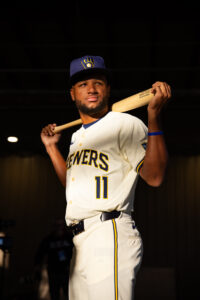
The right-handed hitter put together a .280/.336/.467 slash with 22 home runs and 43 steals over 559 plate appearances. That came against much older competition in a league where testing of the pre-tacked baseball led to increased break on pitches and proved a challenge for hitters. Chourio fared better in the second half after the league reverted to the traditional baseball, including a scorching .388/.447/.718 showing in July.
That firmly established him among the sport’s top handful of minor league talents. Chourio ranked second or third on Top 100 lists from Baseball America, FanGraphs, ESPN, The Athletic and MLB Pipeline this offseason. He’s a potential franchise center fielder with a rare combination of power and athleticism.
To the extent there’s risk with Chourio, it’s that he has shown an aggressive plate approach. He walked at a modest 7.3% clip in Double-A, although that’s hardly an overwhelming concern given his youth. Chourio kept his strikeouts to a solid 18.4% rate and showcased his physical gifts.
In 13 games this spring, he’s hitting .283/.313/.348. He has three doubles, no homers, and a 10:2 strikeout-to-walk ratio. They’re not overwhelming numbers, but it has been an impressive enough performance to reaffirm to the front office that he’s ready for an aggressive major league assignment. There’d be little reason to call him up if the club weren’t confident he can hold down the everyday center field job.
The Venezuela native will be at the center of a talented outfield at American Family Field. Christian Yelich should see the bulk of his time in left field with sporadic work at designated hitter. Former first-round pick Garrett Mitchell could slide to right field, where Milwaukee could also turn to Joey Wiemer or Sal Frelick. Their stockpile of outfield talent was enough that the Brewers have considered moving Frelick to third base, although the acquisition of Joey Ortiz in the Corbin Burnes trade gives them the flexibility to keep the Boston College product on the outfield grass if they like.
With a pair of club options tacked onto the end of his eight-year guarantee, Milwaukee already controls Chourio well beyond his six-year service window. The Brewers could still benefit from the Prospect Promotion Incentive if he performs well enough to merit award consideration.
Assuming Milwaukee keeps him in the majors for a full service year, Chourio would earn the Brewers an extra draft pick at the end of the first round if he wins Rookie of the Year or finishes in the top three in MVP balloting within his first three seasons. That’s certainly not an easy task. He faces an uphill battle in a Rookie of the Year race where Yoshinobu Yamamoto stands as the favorite and a top-three MVP finish is a tough ask of even the sport’s elite players.
Image courtesy of USA Today Sports.
A’s Release Angel Felipe
The Athletics released reliever Angel Felipe, according to the transaction log at MLB.com. He’d been designated for assignment over the weekend.
Once the A’s took Felipe off the 40-man roster, a release was all but inevitable. The 26-year-old righty underwent Tommy John surgery last week. Injured players cannot go on outright waivers. After the DFA, the only options were to trade Felipe or release him. They weren’t going to find a trade partner due to the injury.
Felipe lost his roster spot when Oakland announced the J.D. Davis signing. The A’s could have placed him on the 60-day injured list, but that would’ve required paying him a $740K salary for the upcoming season. They’d very likely have run him through waivers at the start of next winter anyhow — players can’t stay on the injured list during the offseason — so releasing him instead made sense.
Of course, that’s a tough blow for Felipe. Assuming he clears release waivers, he’ll become a free agent. The A’s could try to bring him back on a two-year minor league deal at that point, but he’d have the freedom to evaluate other opportunities. Oakland grabbed him off waivers from the Padres last June. Felipe debuted with 14 big league outings late last season, allowing seven runs with 19 strikeouts and 13 walks over 15 frames. He has a mid-90s fastball but hasn’t consistently thrown strikes in the minors. Felipe has a walk rate north of 15% over parts of eight minor league seasons, in which he owns a 4.65 ERA.
Offseason In Review: Colorado Rockies
The Rockies won 59 games last season and made almost no significant additions. They can expect some internal improvements, but this should be one of the worst teams in the National League.
Major League Signings
- C Jacob Stallings: One year, $2MM (including buyout of 2025 mutual option)
- RHP Dakota Hudson: One year, $1.5MM (eligible for arbitration through 2025)
2024 spending: $3MM
Total spending: $3.5MM
Option Decisions
- None
Trades and Claims
- Claimed LHP Jalen Beeks off waivers from Rays
- Acquired RHP Cal Quantrill from Guardians for minor league C Kody Huff
- Selected RHP Anthony Molina in Rule 5 draft from Rays
- Claimed CF Sam Hilliard off waivers from Orioles
Notable Minor League Signings
- Chance Adams, Ty Blach, Matt Carasiti, John Curtiss, Geoff Hartlieb, Matt Koch, Josh Rogers, Bradley Zimmer
Extensions
- Signed DH Charlie Blackmon to a one-year, $13MM extension
Notable Losses
- Chase Anderson, Harold Castro (non-tendered), Tommy Doyle (non-tendered), Chris Flexen, Connor Seabold (released to pursue KBO opportunity), Brent Suter, Austin Wynns (non-tendered)
The Rockies got a jump on their offseason just before it began. While the Rox were long since eliminated from playoff contention, the regular season wasn’t quite over when Colorado signed Charlie Blackmon to a one-year extension on September 29. That the Rox wanted to keep the career-long member of the organization for a 14th season wasn’t surprising. The price point, on the other hand, was unexpected. Colorado guaranteed Blackmon $13MM, an odd decision considering he’d been pushed mostly to designated hitter and has been a good, not great, offensive player over the past few years.
Paying an above-market price to prevent Blackmon from getting to free agency seemed a questionable move on day one. It looks even worse considering how the offseason transpired. Colorado’s front office can be forgiven for not anticipating the free agent market for hitters of Blackmon’s ilk would be down. Yet it’s tough to justify in the context of apparent organization payroll restrictions. Pending contract selections of players who are in camp on minor league deals, Blackmon’s salary accounts for more than half the financial commitments that Colorado made this winter.
No team did less in free agency. The Rox’s only major league signings were backup catcher Jacob Stallings and depth starter Dakota Hudson. Both players had been non-tendered by their previous teams. The Rockies announced the signings, which were worth $3.5MM combined, in tandem on January 5. Stallings is a fine backup catcher who had previous success when paired with Colorado’s current starter, Elías Díaz, in Pittsburgh. Hudson keeps the ball on the ground and had some early success with the Cardinals before falling off. He’s an alright rebound target, but his acquisition isn’t going to dramatically change the pitching staff.
The lack of free agent spending might be less notable had Colorado made significant moves on the trade market. They made one trade all winter. That was a buy-low flier on righty Cal Quantrill, who’ll get a spot in the season-opening rotation. Colorado took on a fairly significant $6.55MM arbitration salary in what was largely a financially motivated swap for the Guardians. The Rox sent former seventh-round pick Kody Huff, who projects as a depth catcher, back to Cleveland.
It’s a solid addition. Quantrill didn’t have much success in 2023, but that could be attributable to recurring shoulder issues. The former eighth overall pick is only a season removed from turning in a 3.38 ERA over a full set of 32 starts. Even at his best, Quantrill hasn’t missed many bats. He has plus command and has shown the ability to mostly stay off barrels, though. Colorado can control him through 2025 via arbitration. For little more than a willingness to tender him a contract, he’s a worthwhile flier for a team that entered the winter with almost no starting pitching.
The problem is that Quantrill and Hudson were the only rotation options whom Colorado added to the 40-man roster. It leaves them with arguably the worst group of starting pitchers in the majors. Kyle Freeland is reliable but has never come close to replicating his sterling 2018 season, when he turned in a 2.85 ERA over 33 starts. His stuff has regressed in recent seasons and he allowed more than five earned runs per nine a year ago. Freeland’s velocity has spiked this spring, which is promising, but he’s still miscast as a staff ace.
Beyond him, it’s a host of rebound candidates or development hopefuls. Quantrill will occupy a spot in the middle of the rotation. So will lefty Austin Gomber, who has been inconsistent but showed reasonably well in the second half of last season. Fourth starter Ryan Feltner has an ERA above 6.00 in 32 MLB appearances. Hudson and Peter Lambert (who owns a 6.47 career ERA) are competing for the fifth spot. It’s far from an inspiring group.
Things could look a bit better in 2025, when Germán Márquez and Antonio Senzatela should be back after Tommy John rehabs. For the upcoming season, skipper Bud Black could have a hard time getting enough innings out of this group. That’d put a lot of strain on a bullpen that, while similarly thin, has some promise towards the back end.
Colorado can hope for better out of Tyler Kinley after a healthy offseason. The righty was brilliant early in 2022 before elbow surgery knocked him out for more than a calendar year. While he struggled late last season, it’s understandable if he hadn’t shaken off the rust. He’s competing with hard-throwing righty Justin Lawrence for the ninth inning.
Colorado grabbed long man Jalen Beeks off waivers from the Rays. He posted an ERA near six last season but had a 2.80 ERA with an above-average 28% strikeout rate as recently as 2022. The Rox took righty Anthony Molina from the Tampa Bay system in the Rule 5 draft. Right-hander Jake Bird returns after tying for the MLB lead with 84 1/3 relief innings a year ago. He posted a solid 4.27 ERA behind a 54.2% ground-ball percentage. Colorado lost Brent Suter to the Reds in free agency, maybe opening a spot in the Opening Day bullpen for a minor league signee like John Curtiss or Geoff Hartlieb.
While the Rockies were surprisingly quiet in sitting out the pitching market, they did even less to address the position player group. Beyond Stallings, the only major league pickup was old friend Sam Hilliard, whom Colorado claimed off waivers in Spring Training. He’s probably competing with minor league signee Bradley Zimmer for a bench job. Hilliard and Zimmer each hit left-handed and are capable of playing center field.
Adding a player of that ilk was a goal for the front office. Starting center fielder Brenton Doyle hits from the right side. He’s an excellent defender but turned in a .203/.250/.353 batting line as a rookie. Right fielder Sean Bouchard is also a right-handed batter. While the UCLA product has posted excellent offensive numbers in a small big league sample, he soon turns 28 and has all of 48 MLB games under his belt. It’s no surprise the Rox wanted another option in case either Doyle or Bouchard stumbles. There’s not as much question in left field, where Nolan Jones had a strong campaign and looks like one of the organization’s most promising players.
Blackmon could occasionally see corner outfield work but will primarily DH. Kris Bryant is moving to first base for the most part as Colorado tries to keep their $182MM signee healthier. Other than that, the starting infield is unchanged. Brendan Rodgers will be back at second base, hopefully with better results than he managed late last summer after returning from shoulder surgery.
Ryan McMahon and Ezequiel Tovar are an excellent defensive tandem on the left side. The Rox will want to see more from the latter offensively. Tovar was a top prospect but had a middling rookie season as a hitter, largely thanks to a very aggressive approach. Still just 22, it’s possible he develops a bit more selectivity in his second extended look at big league pitching.
Stallings replaces Austin Wynns and Brian Serven as the backup catcher behind Díaz. The out-of-options Elehuris Montero should crack the MLB roster as a corner infielder and bench bat. The Rockies non-tendered utilityman Harold Castro, likely clearing a path for Alan Trejo to get back to the big leagues as a depth middle infielder. It’s a bit surprising that Colorado didn’t take a non-roster flier on a veteran who could back up Rodgers and Tovar. Perhaps that’s something they’ll look to address as players trigger opt-outs from minor league deals with other teams on the eve of Opening Day.
That may not be the team’s most pressing goal of the next couple weeks. MLB.com’s Thomas Harding reported over the weekend that the Rockies and Black were in discussions about another contract extension. The Rox have extended the veteran skipper on one-year deals in each of the past two offseasons. He’s signed through 2024, which will be his eighth season at the helm. Colorado is among the sport’s most loyal organizations and has stuck by Black, who certainly hasn’t been given the most talented rosters with which to work.
Aside from a possible managerial extension, it seems fair to presume any late-spring moves would be minor in nature. The Rockies were content to run back the vast majority of last year’s team, which lost a franchise-record 103 games. That’s a reflection of a payroll saddled with underwater investments in Bryant, Freeland and Senzatela (in addition to the $10MM which they still owe the Cardinals as part of the Nolan Arenado trade). The Rox were also hit by the broadcasting challenges facing a large portion of the league. AT&T Sports abandoned their local TV deal at the end of last season, cutting off a source of revenue that reportedly paid the team around $57MM last year. MLB is distributing the team’s games in-market for 2024.
Beyond the revenue challenges, the Rockies still haven’t shown a clear path to putting a competitive roster on the field. That might be easier to visualize later in the season if prospects like Adael Amador, Yanquiel Fernandez, Drew Romo and Zac Veen get to the big leagues. 2022 college draftee Sterlin Thompson might not be much further off. The Rockies took a flier on Chase Dollander with last year’s ninth overall selection to add the highest-ceiling pitching prospect they’ve had in the organization in some time. They’ll pick third in the upcoming draft and appear headed for high odds of another lottery pick in 2025.
That’s probably of diminishing solace for a fanbase that has seen the team finish in fourth or fifth in the NL West five years running. On paper, there’s a huge gap between Colorado and everyone else in their division yet again. Aside from Todd Helton’s Hall of Fame induction, this will probably be another tough summer for Rockies fans.
How would you grade the Rockies' offseason?
-
F 59% (1,530)
-
D 28% (721)
-
C 9% (242)
-
A 2% (50)
-
B 1% (38)
Total votes: 2,581
A’s Sign J.D. Davis
March 18: Davis would earn $750K for reaching 500 plate appearances and another $250K if he reaches 550 plate appearances, Susan Slusser of the San Francisco Chronicle reports.
March 16: The Athletics have now officially announced Davis’ one-year deal for the 2024 season.
March 15: The A’s have reportedly agreed to terms with third baseman J.D. Davis on a one-year, $2.5MM free agent contract. The deal, which is pending a physical and has not yet been announced by the team, contains an additional $1MM in performance bonuses. The infielder is represented by ALIGND Sports Management.
Davis stays in the Bay Area after being released by the Giants on Monday. His time in San Francisco ended on an acrimonious note. Pushed out of the starting lineup by the signings of Jorge Soler and Matt Chapman, he was arguably a redundant fit on the San Francisco roster. The Giants also carry Wilmer Flores as a righty-hitting corner infield/DH option.
That prompted San Francisco to shop Davis on the trade market. When no deal presented itself, the Giants placed him on outright waivers. The hope was that another team would claim him and assume the $6.9MM salary which his camp had won in an arbitration hearing in February. None of the other 29 teams took that on, leading the Giants to put Davis on release waivers.
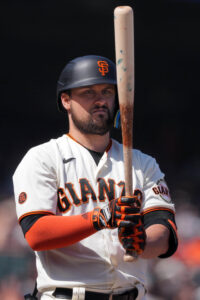
While he was no longer a great roster fit in San Francisco, the release was clearly motivated in large part by finances. Under the collective bargaining agreement, arbitration-eligible players who settle on a contract without going to a hearing are entitled to their full salary even if they’re released. Arbitration salaries determined in a hearing — whether in favor of the player or team — are not fully guaranteed until Opening Day. By releasing Davis more than 15 days before the start of the regular season, the Giants were only responsible for 30 days termination pay. That checked in a little above $1.1MM.
Davis’ deal with the A’s brings his guaranteed money for the upcoming season around $3.6MM. If he hits all of his incentives, he could get to around $4.6MM in earnings. The end of his Giants tenure will cost Davis a few million dollars, although he’ll at least have a clear path to everyday reps.
Oakland was likely to go into the year with either Abraham Toro or Darell Hernaiz logging the majority of their third base work. Toro is a career .211/.282/.354 hitter who spent most of last season in Triple-A with the Brewers. Hernaiz is a talented prospect, but he has yet to make his big league debut. Even if Hernaiz hits his way to the majors this year, he could push defensive specialist Nick Allen for playing time at shortstop. The A’s grabbed Miguel Andújar off waivers from the Pirates early in the offseason. He’s still on the roster but has played mostly in the corner outfield over the past few seasons.
Davis should be a clear upgrade over that group. The 30-year-old (31 in April) has been an above-average hitter in each of the last five seasons. Last year’s .248/.325/.413 batting line was his worst rate production since he emerged in 2019. Still, he played in a career-high 144 games and connected on 18 home runs. Davis has above-average power and draws a fair number of walks. He strikes out at a higher than average rate, yet his .268/.352/.443 slash of the last five years could earn him a spot in the middle third of Mark Kotsay’s lineup.
With between five and six years of major league service, Davis will head back to free agency next offseason. The opportunity to play on an everyday basis is surely appealing as he tries to establish himself as the #3 third base option in a free agent class that’ll include Alex Bregman and, if he opts out, Chapman. Improving his defensive grades would be a big boost to his market value. Davis has typically rated as a fringy defender. Public metrics were split on his value last season. Defensive Runs Saved had him among the least effective third basemen at 11 runs below average in 915 2/3 innings. Statcast was a lot more impressed, rating him four runs better than par.
Davis also drew interest from the Mets this week. Joel Sherman of the New York Post tweets that he chose the A’s in part because of the guarantee that he’ll play on a regular basis. He reunites with former Giants teammates Ross Stripling, Alex Wood and Scott Alexander as veteran additions to the A’s clubhouse. As with any veteran joining a rebuilding team on a one-year deal, he’d be a clear trade candidate this summer if he’s playing at his typical level.
Oakland’s player payroll now sits around $61MM, as calculated by RosterResource. That is a little above last season’s approximate $57MM Opening Day mark but still sits last in MLB by a country mile. The A’s have a full 40-man roster and will need to make a corresponding move once the contract is finalized.
Robert Murray of FanSided first reported the A’s and Davis were in agreement. MassLive’s Chris Cotillo had previously suggested the A’s were showing interest in Davis. Ken Rosenthal of the Athletic reported it was a one-year, $2.5MM guarantee with $1MM in performance bonuses.
Image courtesy of USA Today Sports.
Hitters Approaching Significant Career Milestones

This post is sponsored by Stathead. We use Stathead, powered by Baseball Reference, to find interesting stats in our articles. Stathead has easy-to-use discovery tools to take you inside the BR database. Try it for free today!
The 2024 season is just days away. It’s a time of renewed hope for at least the vast majority of teams. It also opens the opportunity for a few veteran players to continue building on what have already been very accomplished careers, some of which should happen early in the year.
Hits
- Freddie Freeman (2114; milestone: 2165 )
Among active players, Joey Votto leads the way with 2135 career hits. Votto is on a minor league deal with the Blue Jays and might start the season in Triple-A. Freeman will be back in the middle of a loaded Dodger lineup. While he won’t reach any notable round numbers this season — he has a shot to get to 2500 by the end of the ’25 season if he stays healthy — he’ll continue his ascent up the leaderboard in the next few months. Freeman needs only 51 more hits to surpass the original Billy Hamilton and climb into the top 200 on the all-time list. If he tops 200 hits for the second straight season, he’d pull alongside Eddie Mathews into the top 150 by year’s end.
- Paul Goldschmidt (1909; milestone: 2000)
Goldschmidt is 91 hits away from reaching the 2000 club. He’d almost certainly be the 297th player to get to that threshold, depending on whether Evan Longoria decides to continue playing. Longo is only 70 knocks away from that mark but was undecided on whether he’ll give things another go at last check. Even if Longoria does return, Goldschmidt could surpass him on the career leaderboard within a couple months. The 2022 NL MVP hasn’t had a stint on the injured list in almost a decade. If that continues, he should pick up hit #2000 sometime around the All-Star Break.
Notable players approaching 1500 hits: Mookie Betts (1485), Starling Marte (1470), Justin Turner (1461), Giancarlo Stanton (1454), Nick Castellanos (1451), Salvador Pérez (1411)
Home Runs
- Giancarlo Stanton (402; milestone: 432)
Stanton is the only active player with more than 400 career homers. There aren’t any traditional milestones upcoming but a 30-homer showing would put him in rare territory. Cal Ripken Jr. currently sits 50th all-time with 431 longballs. Stanton isn’t a lock to get there this year, as his overall production has plummeted over the past two seasons. Still, he topped 30 in both 2021 and ’22 and hit another 24 last year despite the worst numbers of his career.
- Mike Trout (368; milestone: 400)
Trout is the only player with a realistic shot to join Stanton in the 400-club this year, as he sits 32 away from that mark. After Votto and Longoria, Goldschmidt is next among active players at 60 homers away. Trout only hit 18 homers a year ago thanks to a hamate fracture in his left wrist. He’s only one season removed from popping 40, though. He’ll need to stay healthy, but he could get to 400 career homers in August or September.
- Paul Goldschmidt (340; milestone: 349)
Goldy will need to wait until 2025 to have a chance at the 400-homer plateau, but he’s nearing a notable spot on the leaderboard. With his ninth homer this year, he’d surpass George Foster and move into the top 100 in MLB history. As is the case with the hits milestone, Longoria could complicate this. Longo is at 342 career homers, although it’s unlikely he’ll hit seven more before Goldschmidt picks up his ninth of the season.
- Andrew McCutchen (299)/Anthony Rizzo (295; milestone: 300)
McCutchen and Rizzo should each join the 300-homer club early in the year. McCutchen almost certainly would’ve gotten there late last season were it not for a partially torn Achilles suffered in early September. The Pirates begin the season on a seven-game road trip before welcoming the Orioles to PNC Park in their home opener.
Rizzo also suffered an injury that kept him from the 300-homer plateau last year. After a torrid start, he suffered through a dismal slump related to what the Yankees believe was post-concussion syndrome arising out of a collision with Fernando Tatis Jr. on May 28. They shut him down in August. McCutchen and Rizzo should become the 12th and 13th active players (including Votto, Longoria and J.D. Martinez) to get to the 300-homer mark.
No one else is knocking on the doorstep of 300, although there could be one more late-season entrant to the group. Aaron Judge enters the year with 257 career longballs. A 43-homer showing is certainly within the range of outcomes if he stays healthy.
Notable players approaching 200 homers: Joey Gallo (198), Brandon Belt (194), Christian Yelich (193), Pete Alonso (192), Randal Grichuk (191), Justin Turner (187), Joc Pederson (186), Kris Bryant (182), Max Muncy (180), Cody Bellinger (178), Javier Báez (175), Xander Bogaerts (175)
RBI
- José Abreu (953)/Manny Machado (944)/Mike Trout (940)/Anthony Rizzo (930)/Bryce Harper (889; milestone: 1000)
There are nine active players who have driven in more than 1000 runs over the course of their careers: Longoria, Votto, Freeman, Goldschmidt, Nolan Arenado, McCutchen, Stanton, Carlos Santana and Martinez. The next five up all have a chance to join them, although it’d take a monster year from Harper to drive in 111. (Harper has topped that once, picking up 114 RBI for the Phillies in 2019.) Abreu, Machado and Trout should get there if they stay healthy. Rizzo could be a borderline case but drove in 70 as recently as two seasons ago.
Stolen Bases
- Jose Altuve (293)/Trea Turner (260; milestone: 300)
Among active players, Elvis Andrus leads the way with 347 career steals. He’s on a minor league deal with the D-Backs, though, so Starling Marte (338) is tops among players currently on a 40-man roster. Altuve and Turner are next in line and could each get to 300 this season. Altuve should do so with relative ease, even if he doesn’t run nearly as often as he did early in his career. Turner has an uphill battle. While he has twice topped 40 steals in a season, he hasn’t gotten past 32 in any of the last three years. To his credit, he went 30-30 last year, so there’s no questioning his efficiency.
Wins Above Replacement, bWAR
WAR doesn’t lend itself to milestone tracking with the same ease as the simpler counting stats. A player’s WAR total can go backwards, for one, and there’s no specific in-game moment when they’ll pass a certain threshold. Even if it’s not the easiest statistic to follow in real time, it’s one that teams and many Hall of Fame voters take into account, so it’s worth highlighting a few players.
- Mike Trout (85.2; milestone: 90)
The aforementioned hamate injury kept Trout to a modest 3-win season a year ago. B-Ref credited him with over six wins in 2022. Replicating that production would make him the only active player to surpass the 90-WAR threshold for his career, a mark topped by only 30 position players in league history. Trout currently sits 33rd on that list. He should pass Chipper Jones and George Brett this year, with an outside chance of tracking down Wade Boggs, Jimmie Foxx and Al Kaline.
- Mookie Betts (64.5; milestone: 70)
With another star-level season, Betts will surpass the 70-WAR threshold. Coincidentally, 70 position players in league history have gotten to that level. Of those players who are eligible for Hall of Fame consideration, only eight (Barry Bonds, Alex Rodriguez, Pete Rose, Bill Dahlen, Lou Whitaker, Rafael Palmeiro, Bobby Grich and Carlos Beltrán) aren’t enshrined in Cooperstown. There’s already no real doubt that Betts is en route to the Hall of Fame, but crossing the 70-WAR mark will further entrench him among the elite players in MLB history.
Notable players approaching 60 WAR: Freeman (55.7), Machado (54.9), Arenado (54.4)
Gerrit Cole Recommended For Non-Surgical Rehab On Elbow
March 16: Cole will be shut down for the next three to four weeks before re-evaluating his condition, the Yankees ace told reporters, including Bryan Hoch of MLB.com. He added that it is too soon to determine a date for his return (per Hoch). The reigning AL Cy Young winner is nursing some nerve inflammation and edema, which he is planning to treat with “rest and recovery.” He does not anticipate getting any PRP injections.
March 14: The Yankees and their fans can breathe a sigh of relief. Jon Heyman and Mark W. Sanchez of the New York Post report that defending AL Cy Young winner Gerrit Cole is expected to avoid surgery after further evaluation on his ailing elbow. The recommendation is for a treatment program of rest and non-surgical rehab.
Heyman and Sanchez report that Cole is expected to be out for roughly one to two months. Bob Nightengale of USA Today tweets that the timeline for a return to MLB action should be closer to 10-12 weeks. In either case, surgery isn’t on the table at present and the Yankees should get their ace back within the season’s first half.
That was the initial expectation. Team doctors reportedly identified the issue as elbow inflammation and concluded that Cole’s ulnar collateral ligament was intact. He nevertheless visited noted orthopedic surgeon Dr. Neal ElAttrache for additional testing today. It seems that in-person evaluation confirmed the initial indication that Cole has not sustained any UCL damage.
It’s a positive development given the concern any time a pitcher, especially one at Cole’s level, heads for an MRI on his throwing elbow. Still, the Yankees are going to have to navigate the early portion of the schedule without him. If the timeline checks in closer to 10-12 weeks, he probably wouldn’t make his season debut until June. There’s a chance he winds up on the 60-day injured list.
There’s obviously no way to replace a pitcher of Cole’s caliber, but his absence puts additional pressure on the rotation depth. Carlos Rodón, Marcus Stroman and Nestor Cortes project as the top three arms in the season-opening rotation. Clarke Schmidt is penciled into the fourth spot. There’s not a clear #5 starter at the moment. Prospect Clayton Beeter is on the 40-man roster, as are Yoendrys Gómez and Luis Gil. The latter two were optioned to minor league camp in the first week of March, suggesting they’re a bit further down the depth chart. Chase Hampton and Will Warren are not on the 40-man roster, but they’re upper level starting pitching prospects with more advanced control than Beeter has shown in the minors. Luke Weaver has plenty of starting experience and returned to the Yankees via $2MM free agent deal. He’s coming off a 6.40 ERA season.
The Yankees could benefit from adding veteran stability to the back end. They recently checked in with Michael Lorenzen, arguably the #3 starter still on the free agent market. Lorezen certainly doesn’t have the upside of either of the top two unsigned pitchers, Blake Snell and Jordan Montgomery, but he’d come at nowhere near the cost. That’s an obvious concern for a franchise that would pay a 110% tax on further spending.
If New York expected Cole to miss the entire season, perhaps that’d have increased their urgency to land one of Snell or Montgomery regardless of the money. That seems less likely with the Yankees anticipating Cole’s return in late May or early June, but a mid-tier arm like Lorenzen or Mike Clevinger could remain in play.
Royals Acquire Natanael Garabitos From Mariners
The Royals announced they’ve acquired minor league reliever Natanael Garabitos from the Mariners. He is the player to be named later to complete the January trade that sent infielder Samad Taylor to Seattle.
Garabitos, 23, signed with the Mariners as an amateur out of the Dominican Republic back in 2019. He has pitched in the lower levels of the minor leagues since entering pro ball. Garabitos has posted big strikeout numbers but walked far too many hitters. That continued at Low-A Modesto in 2023, where he issued free passes to 17.3% of opponents. The 6’0″ righty struck out 30.2% of batters faced while allowing 4.02 earned runs per nine through 40 1/3 innings.
Last spring, Eric Longenhagen of FanGraphs listed Garabitos as an honorable mention in his write-up of the Seattle farm system. Longenhagen noted that Garabitos averages around 96 MPH with his fastball but understandably panned his control. He’s a lottery ticket addition to the lower levels of the Kansas City system.
Taylor is trying to grab a utility spot with the Mariners. He has appeared in 11 Spring Training contests, hitting .269/.286/.500 over 28 plate appearances. He has hit two homers with six strikeouts and one walk.
Kole Calhoun Announces Retirement
Veteran outfielder Kole Calhoun announced his retirement this evening on Instagram. The 36-year-old hangs up his cleats after a 10-plus year run in the majors with four different teams.
“The day has come that I announce my retirement from Major League Baseball,” Calhoun wrote. “I know how extremely lucky I am to even be able to say that. Baseball was always my dream and to make that my reality fills me with gratitude. I have loved this game since I can remember, so making this announcement weighs heavy on my heart. This day comes for all players eventually and I can honestly say that I have given this game everything I have and I walk away with no regrets.” Calhoun goes on to thank his family, coaches, teammates, agents at PSI Sports Management, and the teams and fans for which he played as party of a lengthy statement.
That Calhoun reached the majors at all was far from a lock. The Angels selected him in the eighth round of the 2010 draft. A senior sign out of Arizona State, he entered pro ball without much fanfare as the recipient of a meager $36K signing bonus. The vast majority of players in that demographic never get to the highest level. Calhoun not only reached the big leagues within two years, he earned an everyday spot in the Halos outfield.
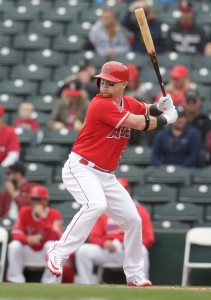
Calhoun was a part-time contributor over his first couple seasons. He secured the Opening Day right field job by 2014, a spot he’d hold for six straight years. Calhoun turned in a .272/.325/.450 slash line in his first full big league campaign. He had arguably the best year of his career in ’15, connecting on 26 homers while winning a Gold Glove. His relentless playing style made him an above-average defender for his first handful of seasons. He was also a durable lineup presence, surpassing 530 plate appearances in every year from 2014-19.
A lefty hitter with power, he hit a personal-high 33 homers in 2019. That total was surely aided by that season’s very lively ball, but he reached at least 17 homers in every season of that six-year stretch. Calhoun compiled a .249/.322/.424 batting line over parts of eight seasons as an Angel overall. In his first trip to free agency, he signed a two-year, $16MM deal with the Diamondbacks.
Calhoun went on a power barrage in his first season in Arizona. He popped 16 homers during the shortened schedule, tying for seventh in the majors. That was Calhoun’s last above-average MLB work. His numbers dipped over his final three years, which he split between the Diamondbacks, Rangers and Guardians. He concluded with a 43-game stint in Cleveland late last summer. As he noted in his retirement announcement, that brief run pushed him beyond the rare 10-year service threshold.
In just under 5000 career plate appearances, Calhoun put together a .242/.315/.417 slash. He knocked 179 homers, surpassed 1000 hits and drove in 582 runs. In addition to his Gold Glove, he helped the Angels to a postseason appearance in 2014. Baseball Reference calculates his career earnings just under $50MM. B-Ref and FanGraphs each credited him with around 14-15 wins above replacement, including a trio of solidly above-average seasons between 2014-16. MLBTR congratulates Calhoun on his strong career and wishes him the best in whatever comes next.
Image courtesy of USA Today Sports.
Pirates, Domingo German Agree To Minor League Deal
8:46pm: Germán’s base salary for the upcoming season would actually be $1.25MM if he secures an MLB roster spot, Mackey reports (X link). There’s also a 2025 club option with a base value of $2.25MM. Germán could earn additional performance bonuses in both seasons.
7:57pm: The Pirates are in agreement with Domingo Germán, as first reported by Mike Rodriguez (on X). Jason Mackey of the Pittsburgh Post-Gazette tweets that it’s a minor league pact. The New York Post’s Jon Heyman tweets that the righty will get an invite to major league camp.
Germán reached the market after being placed on outright waivers by the Yankees. That ended a six-year run in the Bronx that included a fair number of highlights but was also marked by off-field issues. Germán broke through as a big league starter in 2019 when he turned in a 4.03 ERA across 143 innings.
That September, MLB placed Germán on administrative leave after he reportedly assaulted his girlfriend at a charity event. MLB finished its investigation that offseason and suspended him for the first 81 games of the 2020 season. That year wound up being shortened by the pandemic, so MLB reinstated him after he missed the entire 60-game schedule.
Germán returned to the Yankees in 2021. He missed parts of the next two seasons battling shoulder issues, combining for a 4.17 ERA over 170 2/3 innings. He held a spot in the New York rotation for the early portion of last year. Germán’s start to the year was middling and he was suspended for 10 games in mid-May after failing a foreign substance inspection.
He carried a 5.10 ERA through his first 14 appearances into a late-June start in Oakland. Germán turned in a legendary performance at the Coliseum that night, throwing MLB’s 24th perfect game, the first since Félix Hernández’s outing in 2012. Germán followed that up with a 4.61 ERA over five starts in July.
On August 2, the Yankees announced they were placing him on the restricted list so he could report to an inpatient treatment facility for alcohol abuse. Lindsey Adler of the Wall Street Journal subsequently reported that an apparently intoxicated Germán had argued with teammates and coaches in the New York clubhouse and flipped a couch amidst those confrontations. New York placed him on the restricted list and moved on from him at the end of the season.
Pittsburgh will give the 31-year-old another opportunity to pitch his way back to the big leagues. The Pirates have an open rotation mix behind staff ace Mitch Keller. The Bucs added soft-tossing lefties Martín Pérez (via free agency) and Marco Gonzales (through trade) over the offseason. That duo will hold down rotation spots, with righty Luis Ortiz also likely to be in the mix. Bailey Falter, Josh Fleming and former top prospect Roansy Contreras are all competing for swing roles, but none of that group was especially successful in 2023. Prospects Quinn Priester and Jared Jones (the latter of whom is not on the 40-man roster) could battle for jobs as well.
Germán joins Eric Lauer, Chase Anderson, Wily Peralta and Michael Plassmeyer as non-roster players who have big league experience. There may even be room for two members of that group to snag season-opening jobs if the Bucs don’t go outside the organization for someone like Michael Lorenzen or Mike Clevinger at this point in the winter. Germán has more than five years of major league service and could not be optioned back to the minors without his consent if the Bucs call him up at any point.