
Rangers Designate Daniel Duarte For Assignment
The Rangers announced they’ve designated righty Daniel Duarte for assignment. That move and this morning’s trade of J.P Martínez to the Braves clear the necessary 40-man roster spots for reliever David Robertson and outfielder Travis Jankowski, each of whom have officially signed one-year deals.
Texas acquired Duarte last week, sending cash to the Reds after Cincinnati had DFA him. His stay on the Rangers’ 40-man only lasted 10 days. Signing Robertson strengthened the relief corps, nudging Duarte off the roster bubble. As was the case when he was designated by the Reds, he’ll be traded or placed on waivers within a week.
Duarte, a 27-year-old righty, has pitched for Cincinnati in each of the past two seasons. He only made three appearances during his debut campaign but got into 31 contests last year. The 6’0″ hurler turned in a solid 3.69 ERA in 31 2/3 innings, but mediocre strikeout and walk numbers explain why he has found himself in DFA limbo twice. Duarte issued a free pass to nearly 15% of opposing batters while striking hitters out at a below-average 16.9% rate.
While he didn’t miss many bats, Duarte kept the ball on the ground on half the batted balls he allowed. He averaged a little above 94 MPH on his sinker and nearly 96 MPH when throwing a four-seam fastball. The grounder rate and decent velocity could again lead to a minor trade or waiver claim. Duarte has one option year remaining, so any team that acquires him would be able to keep him in Triple-A for another season.
Rangers Sign David Robertson
The Rangers announced the signing of reliever David Robertson to a one-year deal with a mutual option for 2025. The right-hander, who is self-represented, is reportedly guaranteed $11.5MM. He’ll make just $5MM in 2024 and is guaranteed the $1.5MM buyout on the option, which is valued at $7MM. The final $5MM is deferred, with $1MM paid annually between 2027-31.
Robertson split the 2023 campaign between a pair of NL East clubs. He signed a one-year, $10MM pact with the Mets. Initially tabbed as a setup man, he was pushed into the ninth inning by the Edwin Díaz injury. Robertson’s time in Queens ended up briefer than he or the team envisioned because the club quickly fell out of contention. That wasn’t any fault of his, as Robertson had an excellent 40-game run as a Met.
He tossed 44 innings with a 2.05 ERA, striking out nearly 28% of opposing hitters. For a second straight summer, Robertson was one of the better rental relievers at the deadline. New York flipped him to the Marlins for a pair of low minors prospects (Marco Vargas and Ronald Hernandez).
While Miami surprisingly stayed in contention and secured a Wild Card berth, Robertson wasn’t immediately effective. He had a tough first month in South Florida, allowing 13 runs (10 earned) with six walks and 10 strikeouts over 10 innings in August. Miami took him out of the closer’s role towards the end of that month. Robertson responded with a much better September, striking out 19 while allowing only two runs over his final 10 1/3 frames.

Despite the blip early in the second half, the former All-Star had another productive year. He finished the season with a 3.03 earned run average through 65 1/3 innings. Robertson fanned an above-average 29% of batters faced against a manageable 9.3% walk rate. He missed bats on a solid 12.6% of his overall offerings.
The Rangers have made no secret of their desire to add to the bullpen. Texas had been among the perceived frontrunners for Héctor Neris, arguably the top unsigned relief pitcher. They were also linked to Ryan Brasier a couple weeks ago. Robertson, who turns 39 in April, is available on a one-year pact. Neris and Brasier each have a shot at two years, with Neris likely to top the overall guarantee that Robertson secured.
Robertson is the second free agent bullpen acquisition of the offseason for GM Chris Young and his front office. The Rangers inked Kirby Yates to a $4.5MM deal during the Winter Meetings. Texas lost a trio of bullpen arms to free agency. Aroldis Chapman, Will Smith and Chris Stratton have all landed elsewhere. That left the relief group as the shakiest part of the defending champions’ roster. Robertson and Yates join Josh Sborz as bridge options to closer José Leclerc. Texas could still stand to add a left-hander after Brock Burke turned in a middling 2023 season.
Roster Resource projected their 2024 payroll around $210MM before the Robertson signing. He’ll push that to roughly $215MM. More importantly, the deal moves them into luxury tax territory. Texas was at roughly $231MM in CBT obligations before this signing. While the deferrals marginally reduce the contract’s net present value, the contract’s tax hit for next season is much closer to the $11.5MM overall guarantee than it is to next year’s $5MM salary.
Their CBT number jumps past the $240MM mark, pushing above the $237MM base threshold. Texas surpassed the CBT threshold last season, so they’ll pay escalating penalties for a second consecutive year of payments. The Rangers are taxed at a 32% rate on spending between $237MM and $257MM.
The tax for the Robertson signing is fairly modest. It’ll land in the $2MM range. The more significant impact could be on future tax obligations incurred on any further acquisitions. They’ve had a fairly quiet offseason amidst uncertainty about their broadcasting deal with Diamond Sports Group, but they’re bracing for another showdown with the Astros at the top of the AL West.
Jon Heyman of the New York Post first reported the Rangers had interest in Robertson. Jeff Passan of ESPN reported the Rangers and Robertson had agreed to a one-year deal in the $11-12MM range. MLB.com’s Mark Feinsand was first to report the $11.5MM guarantee, the mutual option, and the salary breakdown.
Image courtesy of USA Today Sports.
Brewers Sign Rhys Hoskins
January 26: The Associated Press relays the full contract breakdown. Hoskins will make $12MM this year and will be slated for a salary of $18MM in 2025. If he decides to opt out after 2024, he will get a $4MM buyout. The mutual option for 2026 is valued at $18MM and there’s a $4MM buyout on that as well.
January 23: The Brewers announced they have signed free agent first baseman Rhys Hoskins to a two-year deal with an opt-out after 2024 and a mutual option for 2026. It is reportedly a $34MM guarantee for the client of the Boras Corporation.
Hoskins takes a modified pillow contract after missing the entire 2023 season. At the tail end of Spring Training, he tore the ACL in his left knee while retreating to the outfield grass to field a chopper. While he was able to take batting practice by the end of the season, he never quite made it back to the roster. Philadelphia suggested Hoskins may have been activated from the injured list had they advanced to the World Series.
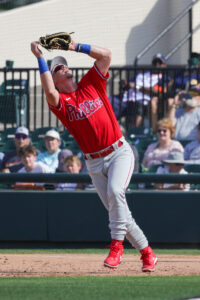
With the Phils coming up a game short of the Fall Classic, the ACL tear marked an unfortunate end to a productive tenure at Citizens Bank Park. Hoskins seemed a potential candidate for the qualifying offer at the beginning of the offseason. The Phils opted against the QO, declaring they were moving Bryce Harper to first base permanently. That made clear Hoskins was headed elsewhere after nearly a decade in the organization.
The Phillies initially selected him in the fifth round of the 2014 draft. Despite the modest draft stock, he hit the ground running in pro ball. He posted huge minor league numbers, mashing his way to the big leagues in the second half of the 2017 campaign.
That excellent production on the farm presaged strong numbers against MLB pitching. Hoskins raked at a .259/.396/.618 clip with 18 home runs over his first 50 games. While he didn’t maintain that pace over any subsequent season, he has been a consistent middle-of-the-lineup presence in Philadelphia.
Hoskins hit between 27 and 34 home runs in his four full seasons between 2018-22. He was on a similar pace in the shortened season, connecting on 10 longballs in 41 games. He has paired that with a walk rate above 10% in every year of his career. That power and patience gives him a solid offensive floor, even if he hasn’t hit above .250 in any season since his rookie year.
Since 2018, Hoskins has posted a .241/.350/.483 batting line. He strikes out in roughly a quarter of his plate appearances. That’s slightly higher than the league average but hardly outlandish, particularly for a player who hits for the kind of power he does. Hoskins has destroyed left-handed pitching at a .250/.399/.522 clip in his career. His .240/.336/.482 slash versus same-handed arms isn’t quite as impressive but remains solidly above average.
The offense carries the overall profile. Hoskins doesn’t offer much as a baserunner. He has graded as a slightly below-average defender throughout his career. It’s unlikely his defense will improve as he’s into his 30s and working back from a significant knee injury.
That’s fine for the Brewers, who needed an offensive upgrade. Milwaukee ranked 17th in runs last season, a subpar figure for a team that plays its home games at hitter-friendly American Family Field. By measure of wRC+, which adjusts for park, Milwaukee ranked 24th in overall hitting production. That was the worst of any playoff team.
First base was particularly problematic. Milwaukee received a dismal .231/.292/.389 showing from the bat-first position. That led the Brew Crew to non-tender Rowdy Tellez. Milwaukee acquired Carlos Santana at the deadline to stabilize first base for the stretch run. The Brewers have remained in contact with Santana this winter, but they’ll instead jump on the opportunity for a more significant lineup upgrade.
The contract aligns with MLBTR’s prediction of two years and $36MM. A few priority rebound targets have landed a two-year guarantee with an opt-out in recent offseasons. That’s appealing for the player, who locks in more security than they’d have received on a straight one-year pact while still allowing them to get back to free agency after one season.
Hoskins’ deal nearly matches the two-year, $36MM pact which Michael Conforto signed with the Giants last winter after missing the ’22 season rehabbing from shoulder surgery. Players like Josh Bell (two years, $33MM) and Lucas Giolito (two years, $38.5MM) have signed similar pacts after terrible finishes to their respective platform seasons. This contract structure isn’t attainable for every bounceback candidate, but it’s one that higher-ceiling free agents of that ilk are increasingly able to secure.
The specific salary structure hasn’t been reported. If the deal guarantees Hoskins $17MM in each season, it’d push Milwaukee’s payroll projection around $122MM, as calculated by Roster Resource. That’s marginally above last year’s $119MM Opening Day mark. Milwaukee’s payroll slate remains manageable even with Hoskins joining Corbin Burnes and Willy Adames (each of whom will make more than $12MM in their final arbitration seasons) on the books.
If Hoskins picks up where he left off before the injury, he’d likely join Burnes and Adames on next year’s free agent market. As with Burnes and Adames, Hoskins would be a candidate for a qualifying offer if he exercises the opt-out. He remains eligible for the QO since Philadelphia opted against the offer this winter. Milwaukee doesn’t have to forfeit any draft picks to add him.
Pete Alonso, Paul Goldschmidt and Christian Walker could all join Hoskins in an interesting first base class next winter. The remaining options for teams this offseason isn’t as robust. Beyond outfielder/first baseman Cody Bellinger, the top first basemen still unsigned are Brandon Belt, Santana, Garrett Cooper and Joey Votto.
Jeff Passan of ESPN first reported that the two parties were closing in on a two-year, $34MM deal with an opt-out next winter (X link). Mark Feinsand of MLB.com reported that they’d finalized the agreement.
Image courtesy of USA Today Sports.
The Top Unsigned First Basemen
In recent days, MLBTR has taken a position-by-position look at the remaining free agent class (catchers, shortstops, center fielders). We’ll turn now to first base. There’s some overlap at the very top of the market.
- Cody Bellinger: Bellinger is more of a center fielder, but he logged over 400 innings at first base for the Cubs last season. Playing him there regularly isn’t ideal — a good portion of his value lies in his ability to play an above-average center field — but a signing team could rotate him through first base on occasion. Bellinger, 28, is coming off his best season since his 2019 MVP campaign. He hit .307/.356/.525 with 26 home runs across 556 plate appearances. His batted ball metrics (a 31.4% hard contact rate, 87.9 MPH average exit velocity) aren’t as impressive as one might assume from his 25+ homers and early-career power impact. Yet his 15.6% strikeout rate last season was a career low, a marked improvement after he fanned in a quarter of his plate appearances between 2020-22. Bellinger declined a qualifying offer from the Cubs. Chicago has been linked to him throughout the offseason, while he’s been tied to the Blue Jays, Giants and (more loosely) Angels as well.
- Carlos Santana: Santana remains a capable veteran option even as he approaches his 38th birthday. He has posted roughly league-average offensive numbers in each of the last two seasons. Santana split the 2023 campaign between Pittsburgh and Milwaukee, running a combined .240/.318/.429 slash with 23 home runs through 619 plate appearances. He has walked in over 10% of his plate appearances in every season of his career. It’s not eye-popping offense for a first baseman, but Santana continues to play strong defense. Defensive Runs Saved graded him 11 runs above average in more than 1100 innings last season; Statcast put him two runs above par. Santana is also a respected clubhouse presence, evidenced by reported interest from his former teams in Seattle and Pittsburgh. The Brewers had also kept in touch with him this offseason but agreed to a two-year deal with Rhys Hoskins this week.
- Brandon Belt: As he has been for most of his career, Belt was a very productive hitter against right-handed pitching last season. He signed a $9.3MM contract with the Blue Jays and turned in a .254/.369/.490 slash with 19 home runs through 404 plate appearances. While he struck out at a career-high 34.9% clip, he also drew a walk more than 15% of the time. Toronto used him almost exclusively in favorable platoon situations. That helps the overall batting line, but Belt remains effective in the role he was asked to play. He’ll be 36 in April and has battled knee injuries throughout his career. He’s likely to take one-year deals at this stage. His camp should look to beat last year’s salary, perhaps seeking something in the $12.5MM range which Joc Pederson recently landed from the Diamondbacks.
- Joey Votto: After 17 seasons with the Reds, Votto will soon join the second organization of his career. Cincinnati has sufficient infield depth to move on from the former MVP, and president of baseball operations Nick Krall has publicly confirmed that as of now, the team plans to do just that. Votto wants to continue playing as he enters his age-40 season. He has been a replacement level performer over the past two years, hitting .204/.317/.394 since the start of 2022. That’s at least partially related to shoulder injuries, as he underwent rotator cuff surgery in ’22 and missed time last summer with shoulder discomfort. Votto still has excellent awareness of the strike zone. He won’t break the bank, but he could find a major league offer to mix in at first base and serve as a veteran clubhouse voice. The Blue Jays have been tied to the Toronto native, as have the Angels.
- Garrett Cooper: A right-handed hitter, Cooper is a first-time free agent. He’d been a quietly productive offensive player for a few seasons with the Marlins. He was amidst an uncharacteristically middling season (.256/.296/.426) when Miami shipped him to the Padres at the deadline. The 33-year-old hit .239/.323/.402 over 41 contests in San Diego. His .251/.304/.419 platform showing wasn’t particularly impressive, but he ran a .274/.350/.444 slash between 2019-22. While Cooper drew reported interest from the Brewers last week, that’s probably off the table with Milwaukee signing Hoskins.
Honorable mentions: C.J. Cron, Donovan Solano
Latest On Jorge Soler’s Market
Jorge Soler is one of the better hitters still available in free agency. He’s surely seeking a multi-year deal on the heels of a 36-homer campaign that led him to decline a $13MM player option with the Marlins.
At the beginning of the month, Soler told reporters in Cuba that Miami hadn’t shown any interest in a reunion. A return to South Florida still seems a long shot. Barry Jackson of the Miami Herald wrote yesterday the Fish have had some contact with the free agent slugger but would likely only bring him back on a cheap deal.
The Marlins opted against a $20.325MM qualifying offer at the start of the offseason. While that wasn’t surprising for a low-payroll franchise, it didn’t bode well for their chances of re-signing him. Even if Soler doesn’t secure that kind of salary on an annual basis, he should handily surpass that guarantee over a two- or three-year term.
Boston, Seattle, Arizona and Toronto have reportedly shown interest in Soler at points this offseason. Of that group, the Blue Jays appear the strongest suitor. The Mariners and D-Backs are almost certainly out; Seattle signed Mitch Garver and acquired Mitch Haniger, while Arizona re-signed Lourdes Gurriel Jr. and agreed to a $12.5MM deal with Joc Pederson this evening.
The Red Sox are still open to adding a right-handed bat, but Boston officials have indicated they’re working without much payroll flexibility. They reportedly didn’t want to go beyond two guaranteed years for Teoscar Hernández; it’s possible they’re taking a similar approach with Soler.
On the other hand, the Jays clearly remain involved in the market. TSN’s Scott Mitchell tweeted this morning that Toronto’s interest in Soler is “very real.” Jon Heyman of the New York Post wrote tonight the sides remain engaged in discussions. The Jays still have a clear need for offensive help, particularly at designated hitter. Toronto allowed Brandon Belt to hit free agency and hasn’t landed a replacement.
Roster Resource projects the Jays right at the $237MM base luxury tax threshold. They surpassed the threshold in 2023, so they’ll be taxed at the rate for second-time payors this year. They’d owe a 32% tax on spending between $237MM and $257MM with escalating penalties beyond the $257MM mark.
Yankees Interested In Ryan Brasier, Phil Maton
As the Yankees continue their search for another middle reliever, they’ve been in contact with Ryan Brasier and Phil Maton, reports Jon Heyman of the New York Post. They’ve also been tied to Héctor Neris and old friends Wandy Peralta and Keynan Middleton in recent reports.
Brasier, 36, had a surprisingly excellent second half to the 2023 campaign. The righty had struggled to a 5.78 ERA over 62 1/3 innings for the Red Sox in 2022. When he began last year with a 7.29 mark over 21 innings, Boston designated him for assignment. The Dodgers brought him in on a minor league deal, selecting him onto the MLB roster in late June.
From then on, Brasier was among the best relievers in the game. He pitched to a microscopic 0.70 ERA through 38 2/3 innings in Los Angeles. He punched out nearly 27% of batters faced, a marked jump over the 18.9% rate he carried in Boston. Brasier also kept the ball on the ground at a robust 51.1% rate and limited his walk percentage to a modest 7% clip as a Dodger.
There’s no question Brasier pitched himself to a major league contract now that he’s back on the open market. It’s possible he could drum up enough interest to land a two-year deal, unexpected as that seemed a few months ago. The Cardinals, Orioles, Cubs and incumbent Dodgers were linked to Brasier a few weeks back. The Rangers and Angels were also tied to him at that point, although they’ve since made notable additions to their bullpens — David Robertson to Texas, Robert Stephenson and Matt Moore to the Halos.
Maton, who turns 31 in March, has been a solid middle innings pitcher for the Astros. Acquired at the 2021 deadline for center fielder Myles Straw, Maton worked to a 3.67 ERA over two and a half seasons in Houston. He’s coming off arguably the best season of his career. The right-hander allowed an even three earned runs per nine through 66 frames. He fanned 27% of opponents behind an excellent 15.4% swinging strike percentage.
As with Brasier, Maton has a solid case for a two-year contract. He’s not a prototypical late-innings power arm. Maton’s fastball sat at just 89 MPH on average. Yet he hasn’t had any issues missing bats thanks to an excellent breaking ball. Maton uses a curveball as his primary offering. Opponents hit only .169 against the pitch last year. St. Louis has also shown interest in the Illinois native this offseason.
Cubs, Red Sox Have Shown Reported Interest In Ryne Stanek
The Cubs and Red Sox are among the teams that have shown interest in reliever Ryne Stanek, reports Bob Nightengale of USA Today (X link). MLB.com’s Mark Feinsand also tied the right-hander to the Mets earlier this week.
Stanek, 32, profiles as a rebound candidate. He’s coming off a pedestrian season with the Astros. Over 50 2/3 innings, he turned in a 4.09 ERA with a league average 23.9% strikeout percentage. He issued walks at a slightly elevated 9.9% clip and surrendered 1.42 home runs per nine innings.
That platform showing paints Stanek as a fairly nondescript middle reliever. There’s more intrigue in both his pre-2023 performance and his velocity. He’d turned in a brilliant 1.15 ERA over 54 2/3 frames two seasons ago. While it’d have never been reasonable to expect him to maintain that kind of run prevention, Stanek’s overall production between 2018-22 was strong. Over that five-year span, he managed a 3.16 ERA while punching out more than 28% of opponents between the Rays, Marlins and Astros.
There’s reason to believe Stanek can recapture that form. The 6’4″ hurler remains one of the hardest throwers in the game. His fastball sat above 98 MPH last year, as it has for the bulk of his career. While that didn’t result in his customary strikeout tally, he still remained tough to hit on a pitch-for-pitch basis. Stanek induced a swinging strike on 14.7% of his offerings, placing him among the top 50 relievers in MLB (minimum 30 innings) in that regard.
Stanek’s age and mid-level results last season should limit him to a two-year deal at most. That’s part of the appeal for both Chicago and Boston. The Cubs haven’t been keen on significant bullpen investments in recent years. As shown on MLBTR’s Contract Tracker, Chicago hasn’t signed a single reliever to a multi-year contract since their three-year deal with Craig Kimbrel halfway through the 2019 season. President of baseball operations Jed Hoyer recently spoke generally about the risk in investing heavily in the bullpen because of the volatility associated with many relievers.
Boston hasn’t been as averse to spending on the relief crops, although new chief baseball officer Craig Breslow comes over from the Cubs front office. The Sox are seemingly working with financial limitations at this point of the winter. A deal for Stanek shouldn’t be prohibitive for either team.
The Cubs arguably need to add to the relief corps more than the Sox do. Chicago’s bullpen is led by Adbert Alzolay, Julian Merryweather and Mark Leiter Jr. While the group turned in roughly average results last season, it’s a potential weak point on an otherwise well-rounded roster. Boston has a pair of effective veterans at the back end in Kenley Jansen and Chris Martin, while John Schreiber joins Rule 5 pick Justin Slaten and a handful of starter/reliever hybrids as options for the middle innings. Jansen has been the subject of recent trade speculation (as has Martin to a lesser extent), but there’s no indication Boston is on the verge of a deal.
Blue Jays, Orioles Have Shown Interest In Domingo German
The Orioles and Blue Jays are among six teams that have shown interest in free agent starter Domingo Germán, reports Mark W. Sanchez of the New York Post. Sanchez adds that the Mets have also checked in but casts doubt on the chance of the right-hander heading to Queens.
Germán has spent his entire MLB career with the Yankees, who acquired him as a prospect in a 2014 trade with the Marlins. At times, he looked like a key mid-rotation arm in the Bronx, yet his tenure was marred by off-field issues. After working as a depth arm between 2017-18, he tallied a career-high 143 innings over 27 appearances (24 starts) in 2019. Germán was having a productive season, working to a 4.03 ERA with a near-26% strikeout rate.
That September, MLB placed Germán on administrative leave after he reportedly assaulted his girlfriend at a charity event. MLB finished its investigation that offseason and suspended him for the first 81 games of the 2020 season. That year wound up being shortened by the pandemic, so MLB reinstated him after he missed the entire 60-game schedule.
Germán returned to the Yankees in 2021. He missed parts of the next two seasons battling shoulder issues, combining for a 4.17 ERA over 170 2/3 innings. He held a spot in the New York rotation for the early portion of last year. Germán’s start to the year was middling and he was suspended for 10 games in mid-May after failing a foreign substance inspection.
He carried a 5.10 ERA through his first 14 appearances into a late-June start in Oakland. Germán turned in a legendary performance at the Coliseum that night, throwing MLB’s 24th perfect game, the first since Félix Hernández’s outing in 2012. Germán followed that up with a 4.61 ERA over five starts in July.
On August 2, the Yankees announced they were placing Germán on the restricted list so he could report to an inpatient treatment facility for alcohol abuse. Lindsey Adler of the Wall Street Journal subsequently reported that an apparently intoxicated Germán had argued with teammates and coaches in the New York clubhouse and flipped a couch amidst those confrontations.
That ended Germán’s tenure with the Yankees. He spent the rest of the season on the restricted list. At year’s end, New York placed him on outright waivers. Once he went unclaimed, he elected free agency.
Sanchez writes that Germán has completed the requirements of his inpatient treatment and is seeking a return to the majors in 2024. According to Sanchez, his camp has received two formal contract offers (although it isn’t clear if those proposals have come from Baltimore and Toronto specifically). If he lands a major league deal, it’d surely be a cheap one-year pact.
Of the two AL East teams known to have shown interest, Baltimore has the greater need for rotation help. Aside from depth righty Jonathan Heasley, the O’s have yet to add a starting pitcher this offseason. They’re slated to begin the year with Grayson Rodriguez, Kyle Bradish, John Means and likely Dean Kremer in the top four spots. Cole Irvin and Tyler Wells (each of whom worked out of the bullpen at points last year) would be the best options for the #5 job at present. The starting staff is the weakest point on an otherwise loaded roster coming off a 101-win season.
It’s unlikely Baltimore will come away from the offseason completely empty-handed. Yet they’ve thus far resisted dealing from the top of their vaunted farm system to add starting pitching via trade. While they seemed a candidate to at least play in the middle tiers of the free agent rotation market, the organization again hasn’t shown that kind of appetite for spending.
The O’s signed Craig Kimbrel to a $13MM guarantee to take the ninth inning after losing Félix Bautista to Tommy John surgery. They’ve otherwise sat out MLB free agency this winter. Roster Resource projects their 2024 spending around $81MM. That’s well above last year’s approximate $61MM Opening Day figure but puts them in the league’s bottom five in terms of estimated payroll.
Toronto took some early swings at the top of the free agent market. They’ve pivoted to the middle tiers in recent weeks, including a rotation acquisition. The Jays agreed to terms with Cuban right-hander Yariel Rodríguez on a four-year, $32MM deal last week. He’ll likely compete for the final spot with Alek Manoah, who is trying to bounce back from a dismal 2023 season. With Kevin Gausman, Chris Bassitt, José Berríos and Yusei Kikuchi occupying the top four positions, it’s unlikely they’d give Germán a look in the season-opening rotation. If Rodríguez doesn’t take them out of the market for Germán entirely, they’d probably view him as a long relief option.
Reds Notes: India, Marte, Candelario
The Reds infield has been a story as far back as last summer, as opposing teams have tried to leverage Cincinnati’s depth in that regard in trade discussions. GM Nick Krall and his front office have resisted that kind of move, maintaining they’re happy to stockpile position player talent which they can rotate through the outfield and/or keep in Triple-A.
Manager David Bell addressed the infield mix this afternoon, again pointing to an expectation they’ll bounce players to various positions (relayed by Mark Sheldon of MLB.com). That’s particularly true of Jonathan India, who has played exclusively second base in nearly 3000 career innings on defense. Krall suggested earlier in the offseason that Cincinnati could get India work at first base, while Sheldon writes that the 27-year-old could also see some left field reps.
Bell affirmed today that India is on board with a multi-positional role. “He just wants to be on the field and in the lineup as much as possible,” the manager said. “Obviously as a second baseman, but depending on how things shake out, to be able to get him on the field as much as he wants to be and as much as I want him to be, there may be other positions that he’ll need to play.”
India has graded as a below-average defender at the keystone over his three MLB seasons. Seeing increased action at first base or in the corner outfield could improve his defensive metrics, although more frequent work at a bat-first position would put additional pressure on him to rebound at the plate. India hasn’t taken the expected step forward since his Rookie of the Year campaign in 2021. He owns a league average .246/.333/.394 slash over the past two seasons.
While India’s mediocre defensive grades are a factor in potentially moving him to a bat-first utility role, the bigger driver is Cincinnati’s glut of young middle infield options. Matt McLain, Elly De La Cruz and Noelvi Marte all debuted last season. McLain was excellent, hitting .290/.357/.507 over 89 games while splitting his time between the middle infield positions. De La Cruz flashed the massive physical tools that made him a top prospect, but he ultimately struggled to a .235/.300/.410 line while striking out more than a third of the time in 98 contests.
Marte had the least amount of experience of the group. He played in 35 games after being promoted in the middle of August. He made a strong first impression, running a .316/.366/.456 slash while playing mostly third base. He’s in the mix for the Opening Day job at either shortstop or the hot corner. Marte’s winter ball season was cut short by a hamstring injury, but Krall said this morning that the young infielder is recovering well and remains on track for Spring Training (relayed by Charlie Goldsmith of the Cincinnati Enquirer).
While the Reds weren’t generally expected to pursue infield help this offseason, they bucked expectations by adding Jeimer Candelario on a three-year, $45MM free agent deal. Unsurprisingly, Bell stated that the veteran switch-hitter will be in the lineup on an everyday basis but could see action at a few different spots. “Between DH, first base, third base — he’s going to be an everyday player,” he said of Candelario. “There’s plenty of playing time to go around there.”
Christian Encarnacion-Strand also finds himself in the corner infield/DH mix. Spencer Steer impressed as the primary first baseman a season ago, hitting .271/.356/.464 with 23 homers in his own rookie campaign. The Candelario signing is expected to push Steer to left field on most days, although he’ll likely pick up stray DH and first base reps as the season goes along. There are a lot of options at the organization’s disposal, at least so long as everyone is healthy.
Latest On Marlins’ Rotation Trade Possibilities
As the free agent starting pitching market thins, there’s been some chatter about the Marlins as a team that might subtract a pitcher in trade. That attention has generally been centered on left-hander Jesús Luzardo and young righty Edward Cabrera. Last week, The Athletic’s Ken Rosenthal wrote that Cabrera had the better chance of that duo of changing hands, although it wasn’t clear how likely Miami was to move either player.
Barry Jackson of the Miami Herald added some context on the trade possibilities involving Miami’s starters this afternoon. Jackson writes that the Fish are willing to consider offers on each of Luzardo, Cabrera and left-hander Braxton Garrett, although he indicates there aren’t any proposals under “active consideration.”
A trade still seems a possibility but isn’t necessarily likely. The Fish haven’t done much under first-year president of baseball operations Peter Bendix. Miami is the only team that still hasn’t signed a free agent to a major league deal this offseason. Their biggest moves were trade pickups of catcher Christian Bethancourt, reliever Calvin Faucher and out-of-options infielder Vidal Bruján.
It’s an underwhelming offseason for a team coming off a surprising Wild Card berth. The Fish seem likely to lose a 36-homer hitter after Jorge Soler declined his player option. They’re looking to add at shortstop, but the free agent class at the position is dismal. They could use another bat in the corner outfield/designated hitter mix.
For all the lineup questions, their biggest loss in 2024 is one to injury. Sandy Alcantara underwent Tommy John surgery during last year’s postseason. With the 2022 NL Cy Young winner missing the entire season, the Fish project for a season-opening starting five of Eury Pérez, Luzardo, Garrett, Cabrera and Trevor Rogers.
That’s still a promising group, but their once vaunted rotation depth has thinned. In addition to the Alcantara injury, the Fish dealt Pablo López and prospect Jake Eder last year. Depth options beyond their front five include Ryan Weathers and Bryan Hoeing. Miami should get a boost from former #3 overall pick Max Meyer, who is 18 months removed from his own Tommy John procedure. Jackson writes that the new front office still considers Meyer a viable starting pitcher; prospect evaluators were divided on whether he was better suited for a high-leverage relief role before the injury.
Meyer only made two MLB starts before the unfortunate ligament tear. Rogers was limited to four starts, all in April, last year by biceps and lat injuries. Pérez, widely regarded as the sport’s top pitching prospect before an impressive rookie season, logged 128 innings between Triple-A and the majors last season. Miami could still be cautious about expanding the 20-year-old’s workload too far beyond 150 frames.
Luzardo and Garrett are Miami’s only healthy starters who topped 100 MLB innings a season ago. They both had strong seasons. The former posted a 3.58 ERA while punching out more than 28% of opposing hitters in 32 starts. With three years of arbitration control and a fastball approaching 97 MPH on average, he likely has more trade value than anyone in the Miami rotation aside from Pérez (who certainly isn’t getting moved).
Garrett has a more extended control window, as he won’t get to free agency for another five seasons. The former #7 overall pick allowed 3.66 earned runs per nine in just under 160 frames. Garrett doesn’t have the huge velocity of most of his rotation mates, sitting around 91 MPH with his heater. Yet his strong secondary offerings and plus command have translated into mid-rotation results for the last two seasons.
Cabrera is a more volatile young arm. The 25-year-old righty worked to a 4.24 ERA across 99 2/3 MLB frames. He generated an impressive 27.2% strikeout rate and 54.3% ground-ball percentage with a fastball that sits above 96 MPH. His control remains a significant question, however. Cabrera walked more than 15% of opposing hitters last season and has handed out free passes at a 14% rate over parts of three years in the big leagues. As with Garrett, he’s under club control for five more seasons.