
The Top Unsigned Center Fielders
We’re less than three weeks from pitchers and catchers beginning to report to Spring Training. While the offseason is theoretically winding down, there are still a number of noteworthy players on the open market. The top unsigned position player headlines the group of remaining center fielders.
- Cody Bellinger: Bellinger rejected a qualifying offer from the Cubs at the beginning of the offseason. That was an easy call as he sought a long-term deal after a successful rebound campaign in Chicago. The 28-year-old is coming off his best season since his 2019 MVP campaign. He hit .307/.356/.525 with 26 home runs across 556 plate appearances. Bellinger’s batted ball metrics (a 31.4% hard contact rate, 87.9 MPH average exit velocity) aren’t as impressive as one might assume from his 25+ homers and early-career power impact. That said, he seemingly made a concerted effort to put more balls in play. His 15.6% strikeout rate last season was a career low, a marked improvement after he fanned in a quarter of his plate appearances between 2020-22. The Cubs are most often linked to Bellinger, who has also been loosely tied to the Blue Jays and Angels at points this offseason.
- Michael A. Taylor: Taylor is a solid glove-first regular. Even as he nears his 33rd birthday, he continues to post well above-average defensive grades. Defensive Runs Saved and Statcast estimated he was between five and seven runs better than the standard center fielder in a little under 1000 innings for the Twins last year. Taylor paired that with one of his better offensive showings. He hit a career-high 21 home runs and swiped 13 bags in 129 contests. That came with a subpar .220 average and .278 on-base percentage, as he struck out more than a third of the time. The whiffs are part of the package with Taylor, but he has enough power to profile as a bottom-of-the-lineup regular so long as he continues to defend at this level. The Angels, Padres, Pirates and Red Sox are among the teams that have been linked to Taylor.
- Adam Duvall: It’s debatable whether Duvall qualifies as more than an emergency option in center field. He’s been a left fielder for the majority of his career. The Red Sox moved him more frequently into center last year, an odd choice for a player in his age-34 season. Duvall’s defensive grades in 478 innings of center field work were predictably below-average. He’s still a solid defender in left who can moonlight up the middle, however. More importantly, Duvall had a rebound year at the plate. He blasted 21 homers in only 353 plate appearances, running a .247/.303/.531 slash. As is the case with Taylor, teams looking at Duvall will have to live with some strikeouts and a low OBP. He has a trio of 30-homer seasons on his résumé and might have gotten a fourth last year had he not missed a couple months with a wrist fracture. The Angels and incumbent Red Sox have been tied to Duvall this offseason; Jon Heyman of the New York Post suggested last week the bidding may come down to those two clubs.
- Aaron Hicks: By late May, it wasn’t clear how much longer Hicks would remain in the big leagues. He was released by the Yankees as he seemed en route to a third straight poor season. The Orioles somewhat surprisingly added him on a big league deal. From that point, the switch-hitting Hicks had a resurgence. He closed the year with a .275/.381/.425 slash over 236 plate appearances in Baltimore. Hicks walked at a massive 14.8% clip while striking out only 20.8% of the time. That won’t erase the memories of his struggles toward the end of his tenure in the Bronx, but it should land him a guaranteed MLB roster spot again. He’d be essentially a free pickup for whatever teams signs him. The Yankees are still on the hook for next year’s $9.5MM salary and a $1MM buyout on a 2025 option. A signing team would only pay Hicks at the $740K league minimum rate for whatever time he spends on the MLB roster, which would be subtracted from New York’s obligations.
- Travis Jankowski: The lefty-swinging Jankowski had a nice year as a role player for the World Series champion Rangers. He hit .263/.357/.332 and stole 19 bases in 20 attempts over 107 games. That should be enough to land him another MLB deal on a low base salary. Jankowski’s offensive upside is limited by bottom-of-the-scale power. He has excellent contact skills, a patient approach, and enough speed to factor in on the bases and at all three outfield positions. He’s a solid bench piece.
Orioles Sign Daniel Johnson To Minor League Contract
The Orioles have signed Daniel Johnson to a minor league deal, the team announced. The outfielder is represented by CAA Sports.
Johnson was once a fairly notable prospect in the Washington and Cleveland farm systems. The Nats dealt him to the Indians in 2018 for catcher Yan Gomes. Johnson made it to the big leagues during the shortened season and appeared in 30 games during the ’21 campaign. The New Mexico State product struggled to a .202/.245/.337 slash while striking out 32 times over 94 plate appearances.
Cleveland sent him off the 40-man roster at the end of the 2021 season. He split the 2022 campaign between the Nationals and Mets systems without reaching the majors. Johnson signed a minor league pact with the Padres last winter. He had a solid year between the top two minor league levels. The 28-year-old ran a .271/.348/.469 slash over 537 cumulative plate appearances.
Johnson has tallied a little more than 1000 plate appearances over parts of four Triple-A seasons. He’s a .254/.326/.446 hitter at that level. Johnson can play all three outfield spots but has more experience in a corner, with his top-of-the-scale arm strength playing best in right field.
Pirates Showing Interest In Noah Syndergaard
The Pirates are among multiple teams that have expressed interest in free agent righty Noah Syndergaard, reports Robert Murray of FanSided. According to Murray, both Syndergaard and right-hander Michael Lorenzen threw a bullpen session in front of teams today.
While it’s unclear which teams are involved in Lorenzen’s market, Pittsburgh is apparently considering Syndergaard as a rebound target. He’ll certainly settle for a one-year contract for a third straight offseason. After locking in a $21MM guarantee from the Angels in 2021-22 and a $13MM pact from the Dodgers last winter, he’s looking at a cheaper deal this time around.
That’s a reflection of Syndergaard’s trouble finding his form since he returned from Tommy John surgery. He underwent the elbow procedure in March 2020, essentially wiping out two seasons. During his first year back, he turned in a 3.94 ERA over 25 appearances for the Halos. While that’s decent run prevention, the righty wasn’t nearly as overpowering as he’d been before the surgery. He fanned just 16.8% of opposing hitters, nearly eight percentage points below his 2019 mark.
The Dodgers hoped that Syndergaard would rediscover that level in his second year after surgery. Instead, the lack of missed bats caught up to him. He was tagged for a 7.16 ERA over 12 starts in Los Angeles. The Dodgers placed him on the injured list and flipped him to the Guardians in a change-of-scenery swap that sent infielder Amed Rosario to Southern California.
Things didn’t get much better in Cleveland. Syndergaard returned from the IL to start six games. He pitched to a 5.40 ERA while allowing 10 home runs in 33 1/3 innings. The Guardians released him at the end of August. He didn’t sign elsewhere and finished his year with a 6.50 ERA across 88 2/3 frames. His 14.3% strikeout percentage and 8.2% swinging strike rate were each personal lows, while he allowed a career-worst 2.23 home runs per nine innings. Once one of the sport’s hardest throwers, the righty has lost a lot of velocity in recent seasons. His fastball was down around 92 MPH on average last year.
Syndergaard is still just 31 years old, so it stands to reason some clubs have optimism about helping him rediscover some of that lost arm speed. He has excellent control and has walked fewer than 6% of opposing hitters in each of the past two seasons. If he can even find the 93-94 MPH he brandished in 2022, he’d be a potential back-of-the-rotation starter.
The Pirates would benefit from that kind of production. Pittsburgh’s rotation is led by Mitch Keller. They’ve already targeted Martín Pérez and Marco Gonzales as rebound fliers, while players like Luis Ortiz, Bailey Falter, Roansy Contreras and Quinn Priester could vie for back-end jobs.
Pittsburgh’s signing of Aroldis Chapman pushes their projected player payroll to roughly $79MM, above last year’s $73MM Opening Day figure. It’s unclear how much budgetary room remains at the front office’s disposal.
Astros Open To Adding Lefty-Hitting Outfielder
The Astros finalized their big move of the offseason yesterday, announcing a five-year deal for star reliever Josh Hader. Between the Hader signing and the addition of Víctor Caratini on a two-year pact to serve as backup catcher, they’ve addressed their two biggest questions of the winter.
General manager Dana Brown pointed to another area they’re exploring as Spring Training draws nearer. “If we could somehow get a left-handed bat, preferably an outfielder with some speed, that type of package we’ll pounce on it,” he told reporters (including Brian McTaggart of MLB.com). That’s not to say that player type is an imperative, as Brown added the team is “really good” already.
Houston lost a left-handed hitting outfielder when Michael Brantley reached free agency (and subsequently retired). They project for a starting group of Kyle Tucker, Jake Meyers and Chas McCormick. Star DH Yordan Alvarez could see some action in left field. Righty-hitting Corey Julks is on hand as a depth option, while Mauricio Dubón can bounce from the infield to the outfield in a utility capacity.
Tucker clearly isn’t in jeopardy of losing any time in right field. McCormick is coming off a very productive season. He hit .273/.353/.489 with 22 homers and 19 stolen bases over a personal-high 457 plate appearances. Even with a slightly elevated strikeout total, he looks like an above-average regular.
It’s a little less clear in center field. Brown declared at the Winter Meetings that the team was planning to use Meyers as their primary center fielder. Those comments were partially designed to cut off speculation that Houston could trade the 27-year-old. Even if the Astros are legitimately interested in giving Meyers first crack at the center field job, they could look for a potential platoon partner or contingency plan.
A right-handed hitter, Meyers is coming off a .227/.295/.382 showing in 342 trips to the plate. That’s not far off the .243/.296/.375 career batting line that he carried into last season. Meyers has had particular issues against righty pitching. He’s a career .220/.288/.351 hitter against same-handed arms. His production against southpaws (.270/.316/.440) is solid on the surface, although that’s inflated by a .365 average on balls in play that masks a 30% strikeout rate.
Overall, Meyers has been a below-average offensive player. To his credit, he’s an asset on the other side of the ball. Defensive Runs Saved and Statcast have each graded him as an easy plus defender in nearly 1500 career innings in center field. Giving Meyers the bulk of the center field at-bats wouldn’t be a disaster, but he’s probably the weakest hitter in an otherwise loaded Houston lineup.
With the Astros firmly in a win-now mindset as they battle the defending champion Rangers in the AL West, it’s sensible to look for alternatives. There aren’t a ton of available options in free agency. While Cody Bellinger fits the description of an athletic, lefty-swinging outfielder, it’d be shocking to see Houston meet his asking price — particularly after signing Hader.
Travis Jankowski is a fourth/fifth outfield type who should be available on a cheap one-year deal. He doesn’t hit for any power, but he’s an excellent runner who gets on base and can play all three outfield spots. While Eddie Rosario remains unsigned, he’s essentially limited to left field at this point. That’s not a great fit unless the Astros are willing to play McCormick in center regularly.
On the trade front, Max Kepler and MJ Melendez have been loosely floated in rumors this winter. Players like Akil Baddoo and switch-hitting Dylan Carlson could theoretically be available. None of that group seems all that likely to change teams at this stage of the offseason, but they’re among various players about whose availability Houston could inquire.
How much spending room is at the front office’s disposal is difficult to gauge. Houston’s surprising strike for Hader pushed the franchise into uncharted waters. Roster Resource projects their Opening Day payroll around $239MM, their first time north of $200MM in season-opening spending. Houston will exceed the luxury tax threshold for the first time since 2020. They’re at nearly $255MM in CBT commitments, well clear of the $237MM threshold and on the verge of the $257MM second penalization marker. Owner Jim Crane demonstrated a willingness to stretch the budget to build an elite back of the bullpen, perhaps in response to losing Kendall Graveman to shoulder surgery. It’s not clear how much farther he’ll go for what could be seen as a luxury addition in the outfield.
Pirates To Sign Aroldis Chapman
The Pirates are in agreement with Aroldis Chapman, as first reported by Francys Romero (X link). It’s a one-year, $10.5MM guarantee, reports Joel Sherman of the New York Post (on X). Chapman is a Wasserman client. The deal is pending a physical; Pittsburgh will need to make a corresponding 40-man roster move once the contract is finalized.
Chapman, who turns 36 next month, lands a one-year free agent deal for the second straight offseason. Limited to a fairly modest $3.75MM guarantee from the Royals a year ago, he lands a raise on the heels of an impressive season that culminated in his second World Series win. Chapman turned in a 3.09 ERA over 58 1/3 innings, striking out a laughable 41.4% of opposing hitters. Among relievers with 50+ innings, only Orioles star closer Félix Bautista punched hitters out more frequently.
The lefty split his year between two teams. He turned in dominant results for three months in Kansas City. Over 29 2/3 frames with the Royals, he pitched to a 2.45 ERA with a 43.4% strikeout rate. That production and his affordable salary made Chapman arguably the top rental reliever on the trade market. K.C. moved early, sending him to the Rangers in a one-for-one deal for former first-round pick Cole Ragans at the end of June.
It’s the kind of result that rebuilding teams envision when signing a veteran to a one-year deal. Ragans had an excellent 12-start run to close the year and looks like a potential mid-rotation or better pitcher whom Kansas City controls for five more seasons. Texas knew they were getting a short-term acquisition, but Chapman provided them a much needed high-leverage bullpen arm.

Over 29 regular season innings in Arlington, he posted a 3.72 ERA while fanning nearly 40% of batters faced. Chapman saved four games and picked up six holds in front of nominal closer José Leclerc. He continued to pitch in meaningful games during the Rangers’ run to the first title in franchise history. He picked up six more holds in nine playoff appearances, totaling eight innings of two-run ball. That came with only six strikeouts and five walks, but Chapman wiggled out of trouble more often than not in October.
It was frequently an adventure when Chapman took the mound. While he has never had great command, his control has reached particularly worrisome levels over the last three years. He walked 14.5% of batters faced last year, the fifth-highest rate among pitchers to log at least 50 innings. That was nevertheless the southpaw’s lowest walk percentage since 2020.
While Chapman is going to hand out his share of free baserunners, he remains one of the sport’s toughest pitchers to hit when he’s around the strike zone. His four-seam fastball averaged 99 MPH last year, while his sinker sat above 101 MPH. That’s above the 97.5 MPH he averaged on the four-seam during his final season with the Yankees. His slider, which had averaged between 85-86 MPH for the previous few years, jumped to 88.1 MPH. That high-octane arsenal translated to plenty of whiffs. Only Robert Stephenson and Bautista had a lower opponents’ contact rate. Hitters put the bat on the ball on only three-fifths of their swings against Chapman.
The Bucs will live with the free passes to add that kind of swing-and-miss potential to the back of their bullpen. David Bednar is entrenched in the ninth inning. Chapman will work in a setup capacity with the ability to step into the ninth should Bednar suffer an injury. He joins Ryan Borucki as left-handed bullpen options for skipper Derek Shelton. Colin Holderman projects as Pittsburgh’s top righty setup arm.
MLBTR predicted Chapman to receive a two-year, $24MM pact. He’ll instead settle for one season. The $10.5MM salary makes him the highest-paid player on the Pittsburgh roster this year (after accounting for cash considerations from the Mariners and Braves paying down Marco Gonzales’ $12MM deal). He’s the fourth player to ink a one-year free agent deal with the Pirates this winter, joining Martín Pérez, Andrew McCutchen and Rowdy Tellez.
The deal brings Pittsburgh’s projected player payroll around $79MM, as calculated by Roster Resource. The low-payroll club opened last season with roughly $73MM in commitments, per Cot’s Baseball Contracts. They’re now set to raise spending this year, as GM Ben Cherington suggested at the beginning of the offseason, although it remains to be seen if the front office has any more room at its disposal. Pittsburgh could still seek rotation help and potentially a veteran option at second base, where they have a handful of young players (e.g. Liover Peguero, Nick Gonzales, Ji Hwan Bae) set to compete for at-bats.
Owner Bob Nutting suggested over the weekend he anticipated the team staying in the playoff mix for the entire season. Pittsburgh hasn’t reached the postseason since 2015 and hasn’t advanced to the Division Series in a decade. If that doesn’t materialize, Chapman could find himself on the rental trade market for a second straight summer.
Image courtesy of USA Today Sports.
D-Backs Sign Dylan File, Dakota Chalmers To Minor League Deals
The Diamondbacks have signed right-handers Dylan File and Dakota Chalmers to minor league contracts, according to their Triple-A team in Reno. Chalmers will get an invite to big league Spring Training.
File returns to affiliated ball after a brief stint in Korea. A 21st-round draftee by the Brewers in 2017, he secured a spot on the 40-man roster three years later. Elbow surgery limited him during the 2021 campaign and Milwaukee outrighted from the roster the following May without ever calling him to the majors.
The 27-year-old signed with the KBO’s Doosan Bears last winter but only made two starts. His season debut was delayed when he was hit with a comebacker in preseason play. Not long after making his return, he was diagnosed with elbow soreness (link via Jee-ho Yoo of Yonhap News). The Bears released him in June to sign left-hander Brandon Waddell.
Chalmers, also 27, was a third-round pick by the A’s in 2015. Oakland traded him to the Twins for Fernando Rodney three years later. Like File, he was added to a 40-man roster (Minnesota’s in 2019) to keep him out of the Rule 5 draft but never got to the big leagues. The Cubs nabbed Chalmers off waivers during the 2021 campaign but ran him through outright waivers shortly thereafter. The 6’3″ righty has a 4.83 ERA while striking out just over a quarter of opponents across parts of seven seasons in the minors.
Orioles Acquire Tyler Nevin
The Orioles announced they’ve reacquired infielder Tyler Nevin in a trade with the Tigers. Baltimore sends cash to Detroit, who had designated the right-handed hitter for assignment last week. The O’s now have 39 players on the 40-man roster.
Nevin heads back to Baltimore after a year away. During the 2022-23 offseason, the Orioles had designated Nevin for assignment and traded him to the Tigers for cash. The 26-year-old spent the year on the Detroit 40-man roster but worked mostly in Triple-A. He posted excellent numbers in the minors, where he raked at a .326/.400/.543 clip with 15 homers through 385 plate appearances.
That brings Nevin to a .276/.355/.464 slash in more than 1000 plate appearances at the top minor league level. He hasn’t found the same success in scattered looks against MLB pitching. He’s a .203/.310/.301 hitter in 105 big league contests over the past three seasons. Nevin played in 64 games with the Orioles from 2021-22 and got into 41 games as a Tiger.
The O’s are clearly familiar with the former Rockies draftee. With a pair of openings on the 40-man, they’ll bring him back for a minimal cost. Nevin is out of minor league options, so he’d have to break camp with the MLB team if the O’s don’t want to again DFA him. That could be a tough task on a team with plenty of infield depth, but there’s little harm for Baltimore in giving him a look in Spring Training.
Designated Hitter Possibilities For Diamondbacks
The defending National League champions were among the most aggressive teams early in the offseason. They acquired Eugenio Suárez to address third base and fortified the rotation via a four-year, $80MM contract with Eduardo Rodríguez. Just before Christmas, they reunited with left fielder Lourdes Gurriel Jr. on a three-year, $42MM guarantee.
Arizona hasn’t made a major league addition since finalizing their new contract with Gurriel a month ago. They’re not done, however. GM Mike Hazen has said a few times the Snakes are looking for a hitter they can plug in at the DH spot. He reiterated that in a chat with Nick Piecoro of the Arizona Republic not long after the new year, suggesting at the time they felt they were likelier to add another bat in free agency than through trade. While Arizona was focused primarily on right-handed hitters early in the winter, their deals with Suárez and Gurriel have balanced the lineup. Hazen indicated they’re considering DH options of either handedness at this point.
A few of their reported targets remain on the market. Some potential fits:
Right-Handed Free Agents
- J.D. Martinez: Martinez, who mashed in a two-month stint for Arizona at the end of the 2017 season, remains one of the more productive hitters in the majors. He’s coming off perhaps his best year since 2019. He blasted 33 home runs in only 479 plate appearances for the Dodgers a season ago. His .271/.321/.572 batting line was stellar and he turned in his highest hard contact rate (54.8%) of the Statcast era. The huge power production partially masks an uptick in whiffs, as he struck out at a career-high 31.1% clip. That’s a bit alarming, but teams would happily live with the strikeouts if they anticipate Martinez hitting for that kind of power again. Arizona was tied to Martinez, who did not receive a qualifying offer from L.A., in early December. The Blue Jays, Angels and Mets have also been tied to his market.
- Jorge Soler: Soler, 32 next month, drilled 36 homers for the Marlins a season ago. His .250/.341/.512 showing was a huge improvement on the .207/.295/.400 mark he turned in during his first year in Miami. Soler made the easy call to decline a $13MM player option in search of a multi-year pact. The Marlins decided not to issue a QO and, according to the slugger, haven’t shown any interest in a reunion. While Soler is one of the sport’s streakiest hitters, he’s near the top of the league in raw power. He draws plenty of walks and trimmed his strikeouts to a managable 24.3% clip last season. Soler should find at least two guaranteed years and has an argument for a three-year pact. Arizona checked in on his market in early December. They’ve been joined by the Blue Jays, Red Sox and Mariners in that regard (although Seattle is probably out of the mix after signing Mitch Garver and reacquiring Mitch Haniger).
- Justin Turner: Arizona has been linked to Turner in consecutive offseasons. Even at 39, he continues to produce at the plate. He’s coming off a .276/.345/.455 showing with 23 longballs in 626 trips to the dish for the Red Sox. His is a balanced offensive profile. He walks at an average rate, makes a decent amount of hard contact and remains very difficult to strike out (17.6% strikeout percentage last year). Turner is no longer capable of playing every day at third base, but he can factor in at either corner infield spot while logging the bulk of his at-bats at DH. Toronto, the incumbent Red Sox, and Mets have also been linked to him this winter.
- Rhys Hoskins: Hoskins is the only player in this group to whom the D-Backs haven’t been connected. Perhaps he’s simply not interested in signing as a full-time designated hitter. With Christian Walker at first base, the Snakes would have to push Hoskins into a bat-only role on most days. If he’s open to that possibility, Hoskins makes sense as one of the more consistent offensive players still on the market. The longtime Phillie missed last year after tearing his ACL in Spring Training. Between 2019-22, he hit .240/.349/.479 in more than 2000 trips to the plate. Philadelphia did not issue him a qualifying offer.
Left-Handed Platoon Bats
- Brandon Belt: While Arizona hasn’t been tied to Belt this offseason, that’s true of essentially everyone. There haven’t been any public revelations on his market despite his strong 2023 season in a platoon capacity for the Blue Jays. The longtime Giant hit .254/.369/.490 with 19 homers through 404 plate appearances. That came almost entirely against right-handed pitching, but he’s still a productive three-true-outcomes hitter when he holds the platoon advantage.
- Joc Pederson: Last year wasn’t a great showing for Pederson, who hit .235/.348/.416 with 15 homers across 425 trips for the Giants. That’s not what San Francisco envisioned when extending him a near-$20MM qualifying offer last winter. Pederson won’t come close to that kind of salary this time around. Still, he’s only a year removed from a .274/.353/.521 line. Pederson continues to post hard contact rates near the top of the league and has five 20-homer seasons on his résumé.
Trade Possibilities
While Hazen indicated a free agent pursuit was likelier than a trade, they’re not going to close off the latter market entirely. If they don’t find an agreeable price point with any of their targets on the open market, there are a few speculative possibilities on the trade front.
- Eloy Jiménez: Jiménez is a right-handed hitter who has flashed 30-homer power upside. His career has been interrupted by frequent injuries, including extended absences in 2021 and ’22 (for a ruptured pectoral tendon and a hamstring tendon tear, respectively). Last year was only the second time in his career that he surpassed 100 games. It was also among his least productive seasons, as he hit .272/.317/.441 with 18 homers through 489 plate appearances. Jiménez will make $13MM next year and is guaranteed a $3MM buyout on the first of two club options for 2025-26. The Sox reportedly haven’t found much interest on the trade market as a result.
- Harold Ramírez: The Rays have floated Ramírez in trade discussions as a potential sell-high candidate. The 29-year-old had an impressive .313/.353/.460 showing last year. He’s up to a .306/.348/.432 slash in nearly 900 plate appearances since Tampa Bay acquired him on the eve of the 2022 season. That production is built around a batting average on balls in play above .350 as opposed to prototypical DH power. While that and an aggressive offensive approach could give some teams pause, he’s a high-contact righty hitter with gap power and the ability to take the ball to all fields. Ramírez is on track to go to an arbitration hearing with Tampa Bay to determine his 2024 salary. He filed at $4.3MM, while the team countered at $3.8MM. He’ll be eligible for arbitration once more after that.
- Brent Rooker: Rooker, 29, turned in a career year for the A’s. Claimed off waivers from Kansas City last offseason, he popped 30 homers with a .246/.329/.488 showing in 526 plate appearances. The right-handed hitter posted excellent numbers against southpaws (.279/.354/.519) and acceptable production versus same-handed arms (.230/.316/.472). He struck out in nearly a third of his trips but tapped into the huge raw power that made him the 35th overall pick in the 2017 draft. Rooker is still a year from arbitration and under club control for four seasons. The A’s don’t have any urgency to trade him, but they probably wouldn’t consider him a core piece of their long-term rebuild given his age and defensive limitations.
Angels Sign Robert Stephenson To Three-Year Contract
The Angels announced the signing of reliever Robert Stephenson to a three-year contract on Tuesday afternoon. Stephenson, a client of Apex Baseball, is reportedly guaranteed $33MM. There’s also a conditional team option for the 2027 campaign based on Stephenson’s elbow health. If the pitcher suffers an elbow ligament injury that causes him to miss 130 consecutive days, the Halos would have a $2.5MM option on his services for a fourth season. He will otherwise make $11MM annually over the next three years.
Stephenson, 31 next month, was the top remaining free agent reliever once Josh Hader came off the board. Within a couple hours of Hader agreeing to a five-year, $95MM pact with the Astros, Stephenson decided to join him in the AL West.
A three-year guarantee for Stephenson would have seemed outlandish six months ago. Until last summer, he looked like a volatile middle innings arm. A former first-round pick and highly-regarded prospect with the Reds, Stephenson struggled early in his career as a starter. He moved to relief full-time in 2019 and had an up-and-down trajectory.
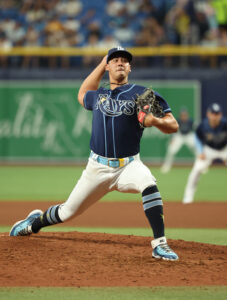
The 6’3″ righty turned in a sub-4.00 ERA in 2019 and ’21 before a rough 2022 campaign. He split the year between the Rockies and Pirates, allowing a 5.43 ERA through 58 innings. Stephenson opened last season with 14 innings of nine-run ball in Pittsburgh.
An early June trade sending him to the Rays for infielder Alika Williams didn’t result in a ton of fanfare. It wound up being one of the more adept rental acquisitions of the summer, though, one that completely changed his fortunes in free agency.
Stephenson was arguably the most dominant pitcher in the majors for the season’s final four months. During his time in Tampa Bay, he worked to a 2.35 ERA across 38 1/3 innings. He punched out a laughable 42.9% of hitters while walking fewer than 6% of batters faced. Among relievers with 30+ innings after June 1, only Félix Bautista, Aroldis Chapman and Pete Fairbanks punched hitters out at a higher rate.
Even that doesn’t capture how overpowering he was on a pitch-for-pitch basis. Opponents whiffed more often than they made contact. Hitters put the bat on the ball on 49.3% of their swings against Stephenson in Tampa Bay. That wasn’t simply the best mark in MLB. It was almost 10 percentage points lower than anyone else over that stretch. Chapman, against whom batters made contact on 59% of their swings, was second.
It’s not hard to pinpoint a reason for that excellence. Before he went to Tampa Bay, he paired a near-97 MPH four-seam fastball with a mid-80s slider. With the Rays, he leaned mostly on an upper-80s breaking ball that Statcast classifies as a cutter. Opponents couldn’t do anything with that pitch. They swung through it nearly three-fifths of the time and hit .101 in 79 at-bats. By the season’s final month, he was using the pitch at a near-75% clip.
Whether Stephenson adopted the cutter from scratch or just found a way to add a couple ticks of velocity to his former slider isn’t clear. In any event, it’s a pitch he’ll surely lean on frequently in Orange County. The Angels can’t expect him to maintain quite the level he showed in Tampa Bay — that’d be a tough ask for anyone — but they’re surely anticipating him stepping in as a quality high-leverage arm.
That’s not without risk. Stellar as Stephenson’s finish was, his time in Tampa Bay comprised fewer than 40 innings. From his 2019 bullpen transfer through his stint in Pittsburgh, he tallied a 4.53 ERA in 192 2/3 frames between three teams. Some of that can be attributed to playing in hitter-friendly home venues in Cincinnati and Colorado, but he clearly wouldn’t have been a candidate for a three-year pact had he not finished the way he did. His 26.9% strikeout rate over those four-plus seasons was a solid but hardly elite number.
It’s the first significant acquisition of the offseason for the Halos. While Stephenson is their fourth bullpen pickup overall, the other three signings were modest one-year investments. Luis García landed a $4.75MM deal, while Adam Cimber inked a $1.65MM pact after being non-tendered by Toronto. Adam Kolarek, who signed for $900K, was already outrighted off the 40-man roster.
Stephenson will work in the late innings. He doesn’t have any closing experience, so the Halos could elect to leave last year’s key bullpen pickup, Carlos Estévez, in the ninth inning. The pair of righties should take the bulk of the most important work late in games. García and Cimber will occupy middle relief roles, while Ben Joyce and José Soriano could hold setup jobs.
It’s a high-octane group built around some of the hardest throwers in the sport. Joyce averaged nearly 101 MPH on his heater and famously was clocked as high as 105 MPH in college. Estévez and García sit north of 97 MPH on average. Soriano and Stephenson have upper 90s velocity in their back pocket as well, even if both lean more frequently on their breaking stuff.
New manager Ron Washington should appreciate the stable of power arsenals at his disposal, although the Halos likely need to add another left-hander to the mix. That could put the finishing touch on the bullpen, yet there’s still plenty of work for GM Perry Minasian and his front office.
The Halos haven’t made any acquisitions on the offensive side to compensate for Shohei Ohtani’s departure. That’s also true in the rotation. They’ve looked for ways to add a top-end starter. In addition to scouring the trade market, the Halos have reportedly shown interest in defending NL Cy Young winner Blake Snell.
There should still be plenty of payroll room at their disposal. Roster Resource projected the 2024 player payroll around $153MM before the Stephenson signing. Evenly distributing his salaries pushes that around $164MM. The Halos opened last season with a payroll at roughly $212MM, as calculated by Cot’s Baseball Contracts. They’ll still be almost $50MM shy of that mark. They’re also nowhere near next year’s $237MM base luxury tax threshold. Stephenson’s $11MM average annual value will push the Angels’ projected CBT number to roughly $179MM.
The contract comes in just below MLBTR’s prediction of four years and $36MM. It’s in line with the going rate for high-leverage relievers with some inconsistency in their career track record, as shown on MLBTR’s Contract Tracker. Stephenson’s deal generally aligns with those signed by Taylor Rogers (three years, $33MM), Rafael Montero (three years, $34.5MM), Joe Jiménez (three years, $26.5MM), former Angel Reynaldo López (three years, $30MM) and Jordan Hicks (four years, $44MM) over the last two offseasons.
@Jolly_Olive first reported the Angels and Stephenson had agreed to a three-year deal exceeding $30MM with a 2027 option. Sam Blum of the Athletic reported the $33MM guarantee. Jeff Passan of ESPN reported the $2.5MM conditional option based on Stephenson’s arm health. The Associated Press reported the 130-inning provision and the evenly distributed salaries.
Image courtesy of USA Today Sports.
Joel Kuhnel Elects Free Agency
Reliever Joel Kuhnel elected free agency this week, according to his MLB.com transaction log. That was his right after being outrighted by the Astros, marking the second time in his career that he cleared outright waivers.
Kuhnel, 29 next month, split last season between the Reds and Houston. He pitched 13 innings over nine MLB appearances, allowing eight runs with five walks and a trio of strikeouts. Kuhnel spent more of the season in Triple-A. He combined for a 6.18 ERA in 43 2/3 innings at the top minor league level between the two organizations. Kuhnel fanned a below-average 15.5% of opponents over that stretch.
While it wasn’t a great showing, he’s only a year removed from soaking up 58 innings of low-leverage relief in Cincinnati. Kuhnel’s 6.36 ERA that year isn’t particularly impressive, but he induced ground-balls at a 52.2% clip. Kuhnel has generally done a solid job keeping the ball on the ground throughout his career behind a mid-90s sinker. He could find a minor league contract from a team seeking bullpen depth.