
Rays, Angels, Reds Agree To Three-Team Trade Involving Josh Lowe, Gavin Lux
While Kyle Tucker dominated baseball’s headlines, the Rays, Angels and Reds worked out a three-team trade. Outfielder Josh Lowe heads from Tampa Bay to the Angels. The Rays acquire utilityman Gavin Lux from Cincinnati and minor league pitcher Chris Clark from the Halos. The Reds get left-handed reliever Brock Burke from Los Angeles. The deal was finalized on Friday morning.
It’s the second trade involving an everyday outfielder for the Angels this offseason. This time, the player is coming their way. Lowe will fill the outfield void left by Taylor Ward, who was shipped to Baltimore for Grayson Rodriguez. Tampa Bay entered the winter with a pair of Lowes, but the club will head into 2026 without either one. The versatile Lux can fill the void left by the Brandon Lowe deal. Cincinnati nets a veteran southpaw, while also getting off the $5.525MM contract Lux received in arbitration. Burke will make about half of that this season.
Lowe seemed like a fixture in Tampa Bay’s lineup after a massive 20/30 campaign in 2023. He posted a 135 wRC+ in his first season as a regular. Injuries would stifle his production the next two seasons. Oblique and hamstring issues delayed the start of his 2024 season. The oblique cost him time later that year, and then again at the beginning of this past season. He wasn’t productive when healthy this year, stumbling to a career-worst 79 wRC+ behind a .220/.283/.366 batting line. Lowe hit .139 with a 35.3% strikeout rate in his final month with the team.
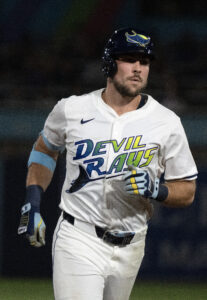
With Ward gone and Mike Trout penciled in at DH, the Angels had limited options in the outfield prior to the move. Lowe will now slot in alongside Jo Adell and Jorge Soler. The Rays shielded him from lefties for much of his time there, and with good reason. Lowe has a .504 OPS and a 33% strikeout rate in his limited work against same-handed pitching (288 plate appearances). He could be ticketed for regular at-bats given the lack of a platoon partner. The right-handed bench outfielder is currently Bryce Teodosio, a glove-first option. Trout only made 22 starts in the outfield last season, but that could change considering the alternatives.
A former first-round pick, Lowe is a plus runner who has slightly above-average bat speed. The aforementioned 20-30 season hints at his physical upside, but the durability and strikeout concerns kept him from establishing himself as a cornerstone player. He has only once reached 500 plate appearances in a season.
Lowe played a little bit of center field early in his career. The vast majority of his experience has come in right, and he has only logged seven innings up the middle over the past two seasons. He’d be stretched in center defensively, yet that’s also true of Trout and Adell. The Halos will probably need to live with rough up-the-middle defense from Lowe or Adell to get a better bat than Teodosio’s in the lineup, at least until 20-year-old center field prospect Nelson Rada arrives.
Tampa Bay and Lowe settled on a $2.6MM deal to avoid arbitration this year. It was his first trip through the process. He’s controlled for three seasons and still has a minor league option remaining, so the Halos could send him down without putting him on waivers. The Angels’ estimated payroll on RosterResource still sits at about $30MM below last year’s mark.
The Reds acquired Lux last offseason in a trade with the Dodgers. He delivered league-average results at the plate in his lone season in Cincinnati, hitting .269/.350/.374 with five homers over a career-high 503 plate appearances. Lux made most of his appearances in left field, while also spending time at second base and third base. He was also used frequently as a pinch hitter.
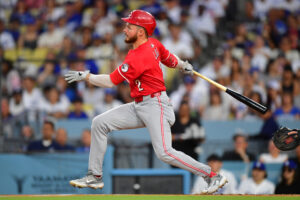
Lux was one of Cincinnati’s more reliable on-base hitters, but he has never developed into much of a power threat. The former top prospect hasn’t hit more than 10 homers in any of his five-plus MLB seasons. Last winter’s change of scenery trade and move to Great American Ball Park didn’t really move the needle. The left-handed hitter has a solid offensive floor but probably doesn’t have much untapped upside as he enters his age-28 season.
The bigger drawback is that Lux has never settled into a clear positional home. He has moved around less because he’s an incredibly versatile and more due to his defensive struggles at various positions. His throwing accuracy has been an intermittent issue on the infield, even at second base. Defensive metrics haven’t looked favorably upon his work in the corner outfield.
The Rays had a clear gap at second base after the (first) Lowe trade. The internal choices were uninspiring, though Richie Palacios has some similarities as a left-handed hitter whose game is built around his on-base skills. Lux should step into a near-everyday role, with Tampa Bay’s typical platoon shenanigans likely capping his reps against left-handed pitching. He could also get some rotational corner outfield work, replacing Josh Lowe as a lefty bat in an outfield that remains without much certainty. Lux is a one-year addition who’ll reach free agency for the first time next winter.
The Angels claimed Burke, coincidentally a former Rays’ draftee, off waivers from the Rangers in August 2024. His one-and-a-half years with the club represented one of the better stretches of his big league career. Burke put together a 3.40 ERA across 90 appearances as an Angel. He pitched in a career-high 69 games last year. The 29-year-old is in his final year of arbitration and will hit free agency next season.
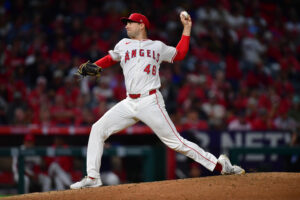
Burke was able to tap into more velocity after joining the Angels. He sat 94-95 mph after transitioning from the rotation to the bullpen with the Rangers. In L.A., Burke bumped his heater to 96 mph. He also upped his slider usage with the club. Burke had a career-high 30.5% strikeout rate with the Angels in 2024. That number fell by more than 10 points in 2025, but he counteracted it with a career-best 53.3% ground-ball rate. Burke doesn’t have huge platoon splits and isn’t a situational specialist so much as a generally steady arm whom Terry Francona can use in the middle innings.
Cincinnati relied on Taylor Rogers as its primary lefty last season, until he was sent to the Cubs at the deadline. The Reds have added Burke and Caleb Ferguson to fill the role for 2026. They also tendered a contract to the out-of-options Sam Moll, so it seems they’ll begin the season with three veteran lefties in the relief corps.
Clark was a fifth-round pick by the Angels in 2023. He posted a 4.73 ERA across 28 minor league appearances this past season. Eric Longenhagen of FanGraphs praised Clark’s developing changeup and loose arm action heading into the 2025 campaign. The righty uses a sinker and sweeper as his two main pitches. A changeup would fit in nicely. The 24-year-old Clark topped out at Double-A last year. He made just one start at the level and will likely be back there to open the 2026 season.
Jeff Passan of ESPN was first on the trade. Respective images via Chris Tilley, Gary A. Vasquez of Imagn Images.
Mariners Designate Samad Taylor For Assignment
The Mariners designated utilityman Samad Taylor for assignment. That creates a 40-man roster spot for reliever Yosver Zulueta, whose previously reported acquisition from Cincinnati is official.
Taylor was on Seattle’s 40-man roster for the majority of last season. He didn’t get much of a big league opportunity, only stepping to the plate nine times over four games. The M’s otherwise kept him on optional assignment to Triple-A Tacoma. Taylor had an excellent season in the Pacific Coast League, batting .296/.378/.461 with 27 doubles, seven triples and 17 home runs across 657 plate appearances. He posted better than average walk and strikeout rates while stealing 44 bases in 54 attempts.
The right-handed hitting Taylor has consistently produced against minor league pitching. He owns a .281/.373/.432 slash line in nearly 2000 Triple-A plate appearances over four seasons. Teams have remained skeptical about his ability to carry that over against big league pitching. Taylor has minimal power, as he’s listed at 5’8″ and 160 pounds.
Despite last year’s decent home run total, his exit velocities in Triple-A have been well below average. He has used his smaller strike zone to his advantage and worked a lot of walks against minor league pitchers. That could be difficult to maintain against MLB arms, who have better command and should be more equipped to challenge Taylor within the zone.
Seattle successfully ran Taylor through waivers unclaimed last offseason. That’d give him the right to elect free agency if he clears this time around. Taylor’s minor league production and ability to play second base and anywhere in the outfield could get him a look on the waiver wire. He’s now out of minor league options, however, so a claiming team would need to carry him on the MLB roster or send him back to DFA limbo.
Diamondbacks Sign Taylor Clarke
The Diamondbacks announced they’ve signed reliever Taylor Clarke to a one-year contract. They designated right-hander Gus Varland for assignment to open a spot on the 40-man roster. It’s a $1.55MM guarantee, reports Nick Piecoro of The Arizona Republic. The deal includes incentives that could push the Ballengee Group client’s earnings above $2MM.
Clarke, 33 in May, should be a familiar name to Arizona fans. The Snakes selected him out of the College of Charleston as a third-round pick in 2015. He debuted in a swing role four years later and spent parts of three seasons with the MLB club. Clarke moved almost permanently to the bullpen by the shortened season and has been a full-time reliever for most of the last half-decade. He got some work as a starter with Milwaukee’s Triple-A team in 2024 but has worked from the bullpen as a big leaguer.
Arizona non-tendered Clarke after he posted a near-5.00 earned run average during the 2021 season. He landed a big league deal with the Royals a couple weeks later and spent the next two seasons in the Kansas City bullpen. Clarke posted decent strikeout and walk numbers but was plagued by an elevated average on balls in play, leading to a combined 5.08 ERA over those two seasons. The Royals traded him to Milwaukee, who ran him through waivers and kept him in Triple-A.
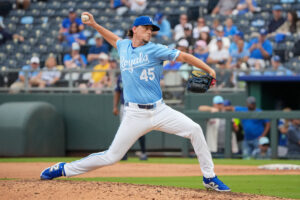
The Royals liked Clarke enough to bring him back on a minor league deal last offseason. They called him up by the beginning of May and were rewarded with the best season of his career. The 6’4″ righty tossed 55 1/3 innings of 3.25 ERA ball. His 21.4% strikeout rate and 10.1% swinging strike percentage were each a little worse than average. Clarke was the beneficiary of an unsustainably low .208 BABIP against him, but he limited his walks to an excellent 4.4% clip and pitched particularly well in the second half.
It came as a surprise that Kansas City nevertheless opted not to tender him an arbitration contract that would likely have landed in the $2MM range. That set the stage for a reversal of the sequence from the 2021-22 offseason. Clarke follows up a non-tender from K.C. by signing a major league deal with Arizona.
Clarke has over five years of service time, meaning he cannot be sent to the minors without his consent. He’s locked into the Opening Day bullpen alongside Ryan Thompson and Kevin Ginkel. The Diamondbacks don’t have any elite back-end arms to cover leverage situations while A.J. Puk and Justin Martinez are injured. Clarke raises the floor in the middle innings but doesn’t have much high-leverage experience. The back of the bullpen remains arguably the biggest weakness as Arizona tries to compete for a playoff spot.
Varland, the older brother of Toronto righty Louis Varland, was a waiver claim from the White Sox in August. The 29-year-old righty was on the minor league injured list at the time due to a season-ending lat strain. He held a spot on Arizona’s 40-man roster for a few months but hasn’t thrown a pitch for the organization. The former 14th-round pick has a 4.82 ERA in 42 big league appearances between 2023-24. Varland divided that time between Milwaukee, the Dodgers, and the White Sox.
Arizona has five days to trade Varland or put him on waivers. He has never been outrighted and doesn’t have three years of big league service, so he’d remain in the organization if they get him through waivers unclaimed.
Image courtesy of Denny Medley, Imagn Images.
Orioles Claim José Suarez, DFA Marco Luciano
The Orioles announced they have claimed left-hander José Suarez off waivers from the Braves. It wasn’t previously reported that Atlanta had bumped Suarez from their roster but they apparently tried to quietly sneak him through waivers. The Orioles have swooped in to claim him and have designated outfielder Marco Luciano for assignment as the corresponding move. Atlanta’s 40-man count drops to 39.
Suarez avoided arbitration with Atlanta on a $900K deal in November. The 28-year-old southpaw had seemed a non-tender candidate after spending the majority of the season in Triple-A. Acquired from the Angels in a Spring Training swap for former third overall pick Ian Anderson, Suarez made just seven MLB appearances for the Braves. He pitched 19 1/3 innings and surrendered five runs (four earned), albeit with a middling 16:10 strikeout-to-walk ratio.
Injuries hampered Suarez for much of the season, but he pitched well when healthy at Triple-A Gwinnett. He posted a 3.53 ERA over nine appearances, fanning 28% of opponents against a 5% walk rate. Suarez is out of options, however, meaning the O’s cannot send him to Triple-A without exposing him to waivers.
There’s a decent chance they’ll do that eventually. Baltimore is the most active team in MLB in claiming depth players only to look to run them through waivers themselves. Suarez has a little over four years of MLB service time. That means he could refuse a minor league assignment if he clears, but he’d forfeit his salary to do so. If the O’s keep him on the roster into Spring Training, he’d compete for a long relief role.
Luciano has found himself amidst the aforementioned waiver churn. The one-time top prospect has gone from the Giants to Pittsburgh to Baltimore this offseason. He’ll very likely be waived again within the next five days. Luciano once ranked among the sport’s top 15 minor league talents at Baseball America. He was then a teenage shortstop with massive raw power upside in a 6’1″ frame. His bat has stalled against higher level pitching and he has moved to left field after struggling with errors on the dirt.
San Francisco gave Luciano limited looks in 2023 and ’24. He hit .217/.286/.304 while striking out 45 times in 126 trips to the plate. The Giants kept him in Triple-A for the entire 2025 season. Luciano connected on 23 home runs while walking more than 15% of the time, but he struck out at a near-31% rate. He whiffed on more than 35% of his swings against Triple-A pitching. While Luciano hits the ball hard when he makes contact, the swing-and-miss and limited defensive profile have dropped his stock. He’s also out of minor league options, so he’ll need to stick on an MLB roster or continue bouncing around via DFA limbo.
Rockies Sign Michael Lorenzen
Jan. 15: The Rockies have formally announced the signing.
Jan. 7: The Rockies are in agreement with Michael Lorenzen on a one-year, $8MM contract, reports Jeff Passan of ESPN. The deal includes a $9MM club option for the 2027 season. Colorado has an available 40-man roster spot and will finalize the deal once Lorenzen passes a physical. He’s represented by CAA Sports.
It’s the first MLB signing of the winter for Colorado, meaning it is also Paul DePodesta’s first notable pickup as their head of baseball operations. (The Red Sox are now the only team that hasn’t signed a big league free agent this offseason.) It’s likely to be the first of a few pitching adds for the rebuilding club. General manager Josh Byrnes said this week that they were hoping to bring in two experienced starters.
The Rockies very rarely add to their rotation via free agency. This is the first time they’ve added a free agent starter on a $5MM+ guarantee since the Kyle Kendrick signing in 2015. Coors Field obviously isn’t a preferred destination for most pitchers. A seven-year streak of finishing fourth or fifth in the NL West doesn’t help matters.
One thing they can certainly offer is opportunity. Lorenzen would be a sixth starter or swing arm for a lot of teams. He’ll get a guaranteed rotation spot in Colorado, where he lands behind Kyle Freeland as their most established arms. The 34-year-old righty has spent the past season and a half with the Royals. He worked at the back of Kansas City’s rotation for most of that time, including 26 starts last year. Lorenzen pitched to a 4.64 earned run average over 141 2/3 innings.

A multi-inning reliever early in his career with the Reds, Lorenzen prioritized a rotation opportunity upon getting to free agency after the 2021 season. He has bounced around on a handful of one-year deals that have generally given him a back-end starting job. This is the fifth consecutive offseason in which he commanded exactly one year on an MLB contract. The deals have all guaranteed between $4.5MM and $8.5MM and have come with five different teams: the Angels, Tigers, Rangers, and Royals. He has also been traded twice and is now on his seventh team overall.
Lorenzen has surpassed 130 innings in each of the past three seasons. He has required an injured list stint in four consecutive years, but a 2022 shoulder strain led to his only lengthy absence. His recent IL stints have been for minor issues: groin, hamstring, neck and oblique strains — none of which cost him more than a month.
The 6’3″ righty works with one of the deepest arsenals of any pitcher in MLB. Statcast’s tracking metrics identity seven distinct pitches, none of which he uses more than a quarter of the time. His four-seam fastball checks in around 94 MPH. He also throws a sinker, changeup, and four breaking pitches (slider, curveball, cutter, sweeper). Nothing stands out as plus in isolation, but he carves out decent results by mixing and matching. Lorenzen has a 4.10 ERA with a modest 19.3% strikeout rate against an average 8.7% walk percentage over the past four seasons.
Anything close to that production would make him one of Colorado’s best pitchers. Freeland was their only pitcher who made more than six starts and allowed fewer than 6.33 earned runs per nine innings. The rotation’s 6.65 ERA was historically terrible. Germán Márquez isn’t expected back in free agency. Antonio Senzatela was demoted to the bullpen late in the season and is expected to remain in long relief.
Freeland and Lorenzen are locked into the top two rotation spots. Ryan Feltner, Chase Dollander, Gabriel Hughes, Bradley Blalock, Tanner Gordon, McCade Brown and waiver claim Keegan Thompson are the other options on the 40-man roster. Feltner is the only one of the bunch who has had any kind of MLB success, and he’s coming off an injury-plagued season. Dollander is a former top 10 pick who held his own on the road but was terrible at Coors Field as a rookie. They’re penciled into the rotation for now, while the fifth starter job would be wide open if they don’t succeed in bringing in anyone else this offseason.
Lorenzen will eat some innings and raise the floor when he takes the ball. He’s not the caliber of pitcher who’s going to net a huge trade return, but the Rox will hope for a solid first half that allows them to flip him for a lottery ticket prospect at the deadline.
Image courtesy of Jay Biggerstaff, Imagn Images.
The Braves Need To Make A Rotation Splash
The Braves have been aggressive this offseason, signing four free agents (Raisel Iglesias, Ha-Seong Kim, Robert Suarez and Mike Yastrzemski) to deals that pay eight figures annually. They also bolstered their infield depth with the Mauricio Dubón trade, taking on nearly $5MM for the difference in arbitration salaries between Dubón and Nick Allen.
Their free agent activity has already been out of character compared to Alex Anthopolous' previous offseasons. They love to re-sign their players, so it wasn't a huge surprise they brought Kim and Iglesias back, yet they hadn't given out more than one free agent deal with a $10MM+ annual value in an offseason since 2020. Their four such contracts this offseason are more than they'd dished out in the previous four winters combined.
It's still not enough. They've ticked off shortstop and late-inning relief. Those were indeed key needs, but neither was as worrisome as the rotation. Injuries exposed Atlanta's lack of starting pitching depth in 2025. They haven't done anything to address that thus far, and they should be as motivated as any team in MLB to add a mid-rotation arm before Opening Day.
The Braves will enter the season with a rotation that'd line up as Chris Sale, Spencer Schwellenbach, Spencer Strider, Hurston Waldrep and one of Reynaldo López or Grant Holmes. If they could push a "turn off injuries" button, they'd be in excellent shape. Every team wishes they could keep pitchers healthy, of course, but the Braves look particularly vulnerable. AJ Smith-Shawver underwent Tommy John surgery in June and isn't coming back until the second half at the earliest. Their other six starters have limited track records or durability questions, and no one behind that group should be starting games at the MLB level.

Unlock Subscriber-Exclusive Articles Like This One With a Trade Rumors Front Office Subscription
- Access weekly subscriber-only articles by Tim Dierkes, Steve Adams, and Anthony Franco.
- Join exclusive weekly live chats with Anthony.
- Remove ads and support our writers.
- Access GM-caliber tools like our MLB Contract Tracker
Braves Hire Johnny Washington As Hitting Coordinator
The Braves are hiring Johnny Washington as minor league hitting coordinator, reports Sam Blum of The Athletic. The 41-year-old has spent the last two seasons as MLB hitting coach with the Angels.
Washington is an experienced instructor who has three seasons as a big league hitting coach on his résumé. He held that role for one year in San Diego (2019) amidst four seasons in various roles with the Padres. Washington then spent a season coaching hitters in Korea with the Hanwha Eagles before returning to affiliated ball as an assistant with the Cubs. He made the jump to Los Angeles two years later under skipper Ron Washington (no relation).
The Angels ranked 27th in scoring over the last two seasons. They were one of the better power-hitting teams in MLB, finishing fourth with 226 home runs a year ago. The team’s approach didn’t progress as needed, as they’re one of three teams — alongside the White Sox and Rockies — that had an on-base percentage below .300 between 2024-25. No team had a higher strikeout rate last season, and only Colorado fanned more often within the past two years.
It’s difficult to parse a coach’s performance from the roster with which they’re working. The Halos have a lineup mostly stacked with right-handed power hitters. Zach Neto has developed into a quality hitter, while Jo Adell has become a potent power bat even if his OBP still leaves much to be desired. On the other end, Logan O’Hoppe went backwards last year after showing offensive promise during his first two seasons.
The Halos moved on from Ron Washington at the end of the season. New skipper Kurt Suzuki overhauled the staff, including a fascinating hitting coach hire. They tabbed three-time All-Star Brady Anderson, who hasn’t worked in affiliated ball since 2020.
Rays Finalize Coaching Staff
The Rays announced their full coaching staff on Tuesday, tabbing Will Bradley as an assistant hitting coach to round out the group. He had spent the 2025 season as a minor league hitting coordinator.
Bradley is a former college player and coach who moved into the professional ranks with the Angels in 2019. He began his Rays tenure as a Triple-A hitting coach before moving into the coordinator role. Bradley has also coached for the Australian national team. This is his first season on an MLB staff, and he’ll split the assistant hitting coach duties with Ozzie Timmons.
Tampa Bay announced last month that former All-Star Corey Dickerson would take over as first base coach. He replaces Michael Johns, who left the organization to become Blake Butera’s bench coach in Washington.
The majority of Kevin Cash’s staff is intact from the 2025 season. Bench coach Rodney Linares, pitching coach Kyle Snyder, hitting coach Chad Mottola, third base coach Brady Williams, assistant pitching coach Rick Knapp, bullpen coach Jorge Moncada, field coordinator Tomas Francisco, and process/development coach Kris Goodman are all back.
Blue Jays Sign Rafael Lantigua To Minor League Deal
The Blue Jays brought infielder Rafael Lantigua back to the organization on a minor league contract, the team announced. Toronto also added infielder Carlos Mendoza and confirmed previously reported agreements with Jorge Alcala, Eloy Jiménez and Michael Plassmeyer. All five players receive non-roster invitations to big league camp.
Lantigua, 27, initially signed with the Jays out of the Dominican Republic during the 2016 amateur signing period. The righty-hitting utilityman played his way to Triple-A by the end of the 2022 season. He spent the next two full seasons with their top affiliate in Buffalo before qualifying for minor league free agency. Lantigua signed with the Phillies last winter and again played the majority of the year in the International League.
The 5’7″ infielder batted .230/.356/.330 across 495 plate appearances for Philly’s farm team. Lantigua walked at a 15.6% clip while only striking out 14.7% of the time. While that propped up his on-base percentage, he did very little damage on contact. He hit seven homers and had a .260 average on balls in play. There was probably some poor luck in the latter number, as his BABIP in the previous two seasons was much higher, but he did himself no favors by only making hard contact on a quarter of batted balls.
Lantigua received his first major league call in September thanks to an injury to Edmundo Sosa. The Phils optioned him three days later without getting him into a game. They outrighted him from the roster at the beginning of the offseason. Lantigua has reached the majors but hasn’t gotten an opportunity to debut, which he’ll hope will arise with his original organization at some point in 2026.
Mendoza is also a smaller infielder whose game is built around getting on base. He’s a lefty bat who hit .287/.394/.409 with more walks than strikeouts in the Detroit system last year. The Miami native spent the majority of the season in Double-A. He can play second or third base but has no shortstop experience. Mendoza didn’t crack Detroit’s 40-man roster before qualifying for free agency at the end of his seventh season in the minors.
Nationals Depart MASN, Turn Broadcasts To MLB
The Nationals announced Wednesday that they’re stepping away from their local broadcasting deal with the Mid-Atlantic Sports Network. Major League Baseball will handle in-market distribution via streaming on the league’s MLB.tv platform and through yet to be announced cable/satellite partnerships. Chelsea Janes of The Washington Post and Mark Zuckerman of MASNsports.com were among those to cover the news.
“Today’s announcement represents a new chapter for Washington Nationals baseball,” owner Mark Lerner said in a press release. “Partnering with MLB offers us several new opportunities that will greatly improve the on-air product, including technological enhancements, the ability to work more closely with our broadcasters, and create added opportunities for our valued corporate partners.”
It officially concludes a fraught relationship with MASN, the network which had been jointly owned by the Nationals and Orioles since the former relocated to D.C. in 2005. Those two decades were marred by disputes over rights fees. The Orioles held a majority stake in the network as a condition of the Nationals relocating into their geographic territory. The sides went to arbitration to resolve calculations over rights fees, and the uncertainty was reportedly a stumbling block in the Lerner family’s efforts to sell the Nationals in 2022. The enmity also kept the teams from making any trades with one another.
David Rubenstein purchased the Orioles from the Angelos family two years later. That allowed for a fresh start in negotiations that resulted in a deal last March resolving all past disputes and settling on fees for the 2025 season. The agreement provided that the Nats could explore other opportunities in ’26.
This comes as the RSN model continues its decline around the league. The Nationals are the seventh team to turn broadcasts over to MLB. The Diamondbacks, Padres, Twins, Guardians, Rockies and Mariners have also done so. Those clubs don’t have the certainty of fixed rights fees because their previous providers were unable to meet their contractual obligations. Most of those organizations had agreements with Main Street Sports, the corporation that operates the FanDuel Sports (formerly Bally Sports) Networks.
Main Street Sports is back in hot water. The company recently missed payments to the Marlins and Cardinals. That led all nine teams that had agreements with Main Street to pull out of their contracts last week. Main Street is seeking a buyer and has otherwise said it plans to shutter operations at the end of the NBA and NHL seasons, which would leave the nine MLB teams in limbo. Evan Drellich of The Athletic writes that Main Street is hoping to renegotiate three-year deals with MLB clubs that would run through the 2028 season. Those could involve a hybrid arrangement that includes some fixed fees and a revenue sharing agreement that responds to the broadcaster’s loss of profits as consumers continue to move away from cable.