
Padres Claim Tyrell Jenkins
The Padres have claimed righty Tyrell Jenkins off waivers from the Reds, San Diego announced. Cincinnati evidently sought to slip the 24-year-old through waivers, but he’ll land on the 40-man roster of a new organization instead.
This isn’t the first time Jenkins has changed hands this winter, of course. He previously went from the Braves to the Rangers via trade before being designated by Texas and claimed by Cincinnati.
It’s obvious that plenty of teams still like Jenkins’s arm, despite his less-than-inspiring 2016 season. A sandwich-round selection in the 2010 draft, Jenkins has posted excellent run-prevention numbers in the upper minors, but lacks the peripherals to match them.
Over 129 career frames at Triple-A, Jenkins owns a 2.86 ERA with 5.9 K/9 and 3.8 BB/9. Things got worse when he received a call to the majors for the first time in 2016. He worked to a 5.88 ERA, recording just 26 strikeouts while allowing 33 walks and 11 home runs over his 52 innings.
Marlins Announce Non-Roster Invitations
The Marlins have announced a slate of non-roster invitations for the team’s upcoming spring camp. While many of the players have already been reported to have joined the Miami organization, the announcement includes word of some new additions as well.
Shortstop Ryan Jackson, righty Scott Copeland, and southpaw Kelvin Marte have all inked minor-league deals with the Fish. That trio will take aim at MLB roster spots or (perhaps more likely) minor-league depth roles over the course of Spring Training.
Jackson, 28, has seen three brief stints in the majors but never earned an extended look. He split his time last year between the Triple-A affiliates of the Angels and Phillies, posting a combined .248/.350/.286 batting line over 343 plate appearances.
The 29-year-old Copeland cracked the bigs with the Blue Jays in 2015 but pitched to a 6.46 ERA over 15 1/3 frames. In 2016, he struggled in a 13-start stint with the KBO’s LG Twins but did have nine productive outings at Triple-A for the Jays.
Marte, also 29, provides another lefty depth option for Miami. He made a brief MLB debut in 2016 for the Pirates but spend most of the year at Triple-A. Converting to a nearly full-time relief role, he provided 73 2/3 innings of 3.67 ERA ball with 7.0 K/9 and 2.6 BB/9.
Additionally, the Marlins announced the following MLB spring participants:
- First baseman Tyler Moore
- Outfielders Brandon Barnes, Matt den Dekker, Isaac Galloway, and Moises Sierra
- Catcher Carlos Paulino
- Righties Juan Benitez, Stephen Fife, and Javy Guerra
- Lefties Kyle Lobstein and Caleb Thielbar
Giants Interested In Jae-Gyun Hwang
The Giants are “showing continued interest” in infielder Jae-gyun Hwang, according to Jon Morosi of MLB Network (via Twitter). Hwang, 29, is a free agent who would not require any posting arrangement to acquire.
The Korean star has spent much of his career with a different Giants organization — the KBO’s Lotte Giants. He held a showcase in the fall in hopes of landing an opportunity with a major league club.
Hwang is likely to factor as a third baseman, meaning that he’ll be competing with open-market options such as Luis Valbuena and Trevor Plouffe. Also potentially a factor is Todd Frazier of the White Sox, who’s available via trade. While Justin Turner‘s signing may have been expected to clear the way for some more action at the hot corner, the market has largely been quiet since.
Though Hwang drew no bids when he was posted last winter, he ended up turning in rather an intriguing 2016 season. He not only continued to exhibit a power boost, hitting 27 home runs for the second consecutive season, but this time did so while nearly halving his strikeout totals (from 122 to 64) and slightly increasing his walk rate. While the overall .335/.394/.570 output came in the hitter-friendly KBO, and can’t be taken at face value, Hwang’s overall profile is much more promising now than it was this time last year.
For San Francisco, Hwang could represent an interesting lottery ticket who could play a reserve role or perhaps turn into something more. The club is said to be eyeing improvements at third base and the corner outfield, while remaining hesitant to expend too many resources to do so. While Hwang’s market price will be supported by demand from his native Korea — even if there’s a relative dearth of needy MLB organizations — he figures to be available at a relatively palatable rate by major league standards.
Nationals Willing To Discuss New Deal With Dusty Baker
The Nationals are prepared to discuss a new deal with manager Dusty Baker this offseason, Jorge Castillo of the Washington Post reports. As of yet, however, the Washington organization has yet to engage in any chatter with the skipper’s reps.
Baker, 67, guided the Nats to a 95-win season and a National League East title, the organization’s third in the last five years. But D.C. fell agonizingly shy of making it out of the divisional round yet again, falling to the Dodgers in five games.
Having signed only a two-year pact when he took the helm before the 2016 season, Baker already occupies lame-duck status. It seems only natural for the sides to come together on a new deal, then; as Castillo explains, all parties have expressed pleasure with what appeared to be a mutually beneficial relationship. Just how long Baker hopes to keep the gig isn’t known, but it appears the team will be receptive to an extension.
Managerial contracts have never been a straightforward matter for the Nats, however. Even Baker’s hiring came with some drama, rising out of the ashes of the club’s dalliance with Bud Black. MASNsports.com’s Pete Kerzel recently discussed that recent history in assessing Baker’s current situation; his piece, too, is well worth a read.
Assuming that the sides are able to see eye to eye on the term of a contract — presumably, Baker won’t be trying to achieve a particularly lengthy pact — it’ll remain necessary to work out a new salary. The current pact promises the veteran skipper $4MM over its two years, with $3MM worth of incentives also available.
MLBTR Poll: Will The Twins Trade Brian Dozier?
We’ve heard plenty over recent weeks about the Twins’ negotiations with rival clubs over star second baseman Brian Dozier. Minnesota reportedly asked interested suitors for their final offers in late December, but nothing more has emerged since (at least, not yet).
The Dodgers have been tied most heavily, and probably represent the cleanest fit. But the two organizations are said to be haggling over a complementary piece to accompany intriguing righty Jose De Leon, who’d seem to represent a worthwhile centerpiece. We’ve heard suggestions that the division-rival Giants could also be involved, though it has never been apparent whether San Francisco is fully engaged on Dozier. Likewise, the Cardinals and Nationals have been mentioned as possibilities, but it’s questionable at best whether either could represent a serious pursuer. There are a few other organizations that seem like hypothetical matches on paper, but we have yet to hear any suggestion of broader interest.
That’s hardly an optimal situation for the Twins, who would obviously prefer to see some bidding on a player who has compiled about 14 fWAR over the last three seasons and is owed just $15MM for his age-30 and 31 seasons. While it’s fair to wonder whether Dozier can maintain anything like the power surge he showed last year (.278 ISO, 42 home runs), he’s not dependent upon gaudy dinger tallies for all of his value. Dozier also rates as an outstanding overall baserunner and solid-enough up-the-middle defender, and has never slipped below league-average offensive production since establishing himself in the majors, so there’s a solid floor to go with his newly established ceiling.
All said, it would be hard for Minnesota to part with that package for anything less than what it deems to be fair value. If that can’t be found now, then perhaps the organization will just have to take Dozier into the season and take on the risks of waiting for a trade-deadline deal. That approach has paid off in some cases (Cole Hamels, Jonathan Lucroy) while backfiring in others (Tyson Ross). Ultimately, if the Giants aren’t willing to push the envelope, and no additional teams step into the fray, then this may simply turn into a staring contest between Derek Falvey and Andrew Friedman.
So, MLBTR readers, what do you think is most likely? Will the Twins strike a deal at some point in the coming weeks, or will Dozier still be at second base in Minnesota for the coming season (or, at least, part of it)? (Link for app users.)
Will The Twins Trade Brian Dozier This Offseason?
-
No 52% (6,922)
-
Yes 48% (6,452)
Total votes: 13,374
Indians, Edwin Encarnacion Expected To Finalize Contract This Week
The Indians are expected to finalize their deal with free-agent slugger Edwin Encarnacion this week, Paul Hoynes of the Plain Dealer reports. The sides reportedly agreed to terms on December 22, but have yet to announce the pact formally.
Encarnacion, 33, is set to arrive in Cleveland tomorrow and take a physical on Wednesday. Assuming all goes well with the medicals, he’ll be introduced as the newest member of the Indians on Thursday. His agent, Paul Kinzer, says that he doesn’t expect any issues given Encarnacion’s solid recent health history.
Of course, the market has surely already absorbed the soon-to-be-official signing, which seems to take Cleveland out of play for other significant bats while forcing other pursuers to consider alternatives to Encarnacion. Still, we’ve yet to see any appreciable uptick in the action on the many remaining sluggers, none of whom have agreed to terms since the signing.
The next man up could be Mike Napoli, who had been in conversation with the Indians about a return before the Encarnacion agreement. He has been tied closely to the Rangers, but it seems that other organizations remain in the hunt as well. Other still-unsigned power bats who fit the same general profile include righties Mark Trumbo and Chris Carter as well as lefty hitters such as Adam Lind, Brandon Moss, and Logan Morrison.
Trade Candidate: Todd Frazier
There’s no denying that the White Sox are engaged in an aggressive rebuilding plan. After all, the organization has now traded away two of its best, established MLB assets in Chris Sale and Adam Eaton, and is said to be engaged in talks to do the same with Jose Quintana. If those affordable, controllable players can be had, then surely it stands to reason that more expensive, shorter-term assets are also on the table.
While players like David Robertson and Melky Cabrera make good sense as trade chips, perhaps no single player on the ChiSox roster carries a “trade me” sign quite as visible as that of third baseman Todd Frazier. Unlike Robertson, he’s entering the final year of contract control. And unlike Cabrera — who’s owed $15MM in the final year of his deal — Frazier is still projects to be useful in the field.
Frazier did take a big step back in the eyes of defensive metrics last year after consistently rating as a plus gloveman at third. And his .225/.302/.464 batting line represented his worst offensive output since a down 2013 season. But Frazier is young enough (31 in February) to think that he can regain his lost step at third, and perhaps its unwise to put too much stock in one year’s worth of defensive ratings given his strong track record. Also, he still swatted forty home runs in 2016 — rather an impressive total from a player capable of playing the hot corner — and boosted his walk rate to a career-high 9.6% (though his K rate also crept up). Frazier still runs well, too, as he swiped 15 bags in 2016.
Really, if you’re looking for a solid everyday player who could bounce back to being an All-Star-level performer, there aren’t many better bets than Frazier. His .236 BABIP makes him an obvious candidate for some positive regression, though it’s fair to note that he earned that mark to some extent by putting the ball in the air more than ever before (48.7%) and posting-career worst line-drive (15.7%) and soft contact (20.7%) rates. With Frazier showing greater selectivity than ever and maintaining his career swinging-strike rates, there’s hope that he can boost his OBP while retaining much of the power he has achieved by gunning for the long ball.
Even if he remains much the same hitter he was in 2016, Frazier would look to be a more defensively useful version of Mark Trumbo. Frazier will only require a single-season commitment, which is appealing. And he could also allow a new acquiring team to recoup a draft pick after the season, if he proves himself worthy of a qualifying offer.
Still, there’s probably a reason that it has mostly been crickets on the demand side for Frazier. In particular, there just isn’t that much demand for third basemen around the game. The Dodgers were rumored to have interest, but ended up bringing back top-available free agent Justin Turner. And the open market still includes at least two useful options at the hot corner in Luis Valbuena and Trevor Plouffe. Then, there’s the fact that MLBTR projects him to earn a hefty $13.5MM, which would make a dent on any team’s balance sheet.
Under the circumstances, the Sox could take Frazier into the year and hope he becomes a summer trade chip (or, perhaps, a QO candidate after the season). Holding onto him is hardly an unfathomable outcome if there’s truly no serious interest, particularly since there doesn’t appear to be a major salary-trimming imperative behind the team’s sell-off. Indeed, many of the teams discussed below seem rather unlikely to offer enough of a return to force the White Sox’ hand. But several organizations that might not give prospects and take on $13.5MM or so in salary right now may well end up having a need in the middle of the season.
It still makes eminent sense for the South Siders to explore all avenues for a trade this winter, but a deal probably isn’t as likely as it might seem at first glance. Let’s take a look at some hypothetical suitors (listed in alphabetical order):
[Team links to MLB Depth Charts]
Athletics — Sure, Oakland has Ryon Healy at third, and he’s more than entitled to a full-season run after his impressive debut. But he has never been viewed as much of a defensive player, and could simply be shifted over to first to make way for Frazier. The A’s have already shown a somewhat surprising amount of payroll availability in pursuing Edwin Encarnacion; adding Frazier could have nearly the same overall impact at a lesser cost (at least, in dollars) because of the defensive upgrade he’d bring.
Braves — While Atlanta seems amenable to going with Adonis Garcia at third, there’s little reason to expect much out of him. The organization can also plan to bump Sean Rodriguez to the hot corner if and when Ozzie Albies rises to the majors. And it’s fair to wonder at what point the Braves will stop taking on 2017 salary. Still, after expending some resources for near-term improvements, perhaps pursuing Frazier would be a finishing touch that could make Atlanta a plausible contender (with a few good breaks).
Cardinals — St. Louis was reportedly lingering around on both Turner and Encarnacion, suggesting that the club is intrigued at the prospect of boosting its infield productivity. Like those possibilities, adding Frazier would likely mean trading another player (Jhonny Peralta, Kolten Wong, or Jedd Gyorko) to create space. And it’s not clear whether the Cards would see enough upside in Frazier to go through with all that. Still, it’s a reasonably plausible landing spot.
Dodgers — Any continued interest depends upon whether the Dodgers would consider playing Turner at second base. He has seen less and less time there over the years, and didn’t make a single appearance at second in 2016, so there’s no particular reason to think that Los Angeles would move him to make way for Frazier. Adding a true second baseman still seems much more likely.
Giants — Eduardo Nunez remains the odds-on favorite to man third, in concert with Connor Gillaspie. But if San Francisco feels it’s better able to improve its offensive production with Frazier than by adding a corner outfielder, with Nunez turning back into a quality utilityman, then perhaps the Giants could make for an interesting fit.
Orioles — The O’s are said to be looking at sluggers, and may prefer one that plays the outfield, but there still could be a fit here. Frazier could spell Manny Machado at third and Chris Davis at first while lining up as the DH. If shortstop J.J. Hardy needs a rest, is hurt, or isn’t effective, then Machado could slide in for him and Frazier could return to full-time duty at the hot corner. It’s not a perfect fit, but Frazier could be a more appealing target for Baltimore than the remaining open-market options.
Rangers — Texas is in the market for a first baseman and/or DH, and might not hate the idea of adding someone who could fill in for Adrian Beltre at the hot corner at times. But there are plenty of hitters in free agency, and the Rangers have other infielders who could man third, so this doesn’t feel terribly likely as things stand.
Red Sox — Boston has given signals that its offseason is largely in the books, but a pivot can’t be ruled out. As things stand, the organization appears to be putting an awful lot of trust in Pablo Sandoval. There’s room for Frazier’s salary, perhaps, after dealing Clay Buchholz. He could split time between first and third (with Mitch Moreland), allowing Hanley Ramirez to be a full-time DH while increasing the Sox’ platoon opportunities.
Rockies — Somewhat like the Orioles, the Rockies could potentially have interest in Frazier to fill a different need. If Colorado trades an outfielder and moves Ian Desmond to the outfield, it would need a regular first baseman. While Frazier’s true utility is somewhat wasted there, that’s perhaps less true than it is in Desmond’s case.
Yankees — Chase Headley has underwhelmed with the bat, so perhaps Frazier could mix in with him and first baseman Greg Bird to inject some pop and increase the Yanks’ overall versatility. But New York still has other needs, and Frazier would represent a pretty significant cost to function in that kind of capacity. Unless Headley were to be dealt, the fit is something of a stretch.
Others — You could argue for the Pirates, especially if Jung Ho Kang is lost, though perhaps corresponding moves would be needed to make it even plausible that the Bucs would take on that much salary (particularly with David Freese and Josh Bell already on hand). The Indians might have made sense were it not for the acquisition of Edwin Encarnacion, but Frazier seems too costly and uncertain to justify relegating Jose Ramirez to corner outfield/utility duties. It’s hard to see the Rays coughing up the cash (and talent) needed to land Frazier, though he’d be a possible first base/DH candidate in Tampa Bay. The Marlins need a righty bat, but re-upped Martin Prado to play third and seem to like Justin Bour as at least a semi-regular at first; without a DH slot, there likely isn’t any kind of match there. Likewise, you could argue for the Mets to add Frazier (at least assuming they deal one or more outfielders); he could share time with Lucas Duda at first and otherwise play third, in theory, but this seems rather implausible unless/until New York trades one or more outfielders and the team has reason to believe that David Wright won’t be able to play in 2017. It’s at least somewhat more possible to imagine the Mariners or Blue Jays taking a look, but those also feel like iffy fits. Neither needs a third baseman or DH, and while they could stand to add Frazier’s pop at first, the presences of Dan Vogelbach and Justin Smoak reduce the utility of adding a fairly expensive piece like Frazier.
3 Remaining Needs: AL West
To set the stage for the remainder of the offseason, we’ll take a look at the most pressing remaining needs of every team in baseball over the coming week or so, division by division. (Hat tip to MLBTR commenter mike156 for the idea.) We often discuss things through the lens of an organization’s trajectory; thus, a rebuilding team might “need” to move some salary, while a contender might “need” an expensive starter. But with camp in sight, every club is making final calls on who’ll compete for big league jobs in the season to come (while also pursuing broader opportunities), so the focus here is on specific positions on the MLB roster. Fortunately, the task of roster analysis is made much easier by the MLB depth charts available at RosterResource.com. Each team listed below is linked to its respective depth chart, so you can take a look for yourself.
So far, we’ve checked in on the AL Central, NL West, NL East, AL East, and NL Central. To wrap things up, let’s stop in on the AL West:
- First Baseman/DH: The Rangers make obvious sense for a first base/DH addition after watching Mitch Moreland and Carlos Beltran depart via free agency. Texas can utilize Joey Gallo and/or Jurickson Profar in those roles, but neither has hit to expectations in the majors. The club has been tied frequently to Mike Napoli, but there are other options on the open market as well. Relatedly, the Rangers will need to decide what to do with both Gallo and Profar in the near term, as both appear to have uncertain futures in Texas.
- Starting Pitcher: Though the Rangers already slotted in Andrew Cashner after declining a club option over Derek Holland, the team also lost Colby Lewis from last year’s staff. He is among the veterans still available in free agency, presumably on short-term arrangements, and Texas could certainly stand to bolster the back of its rotation. At present. A.J. Griffin seems likely to take the fifth slot, though a few upper-level youngsters could also factor in. Texas would do well at least to enhance the overall depth here, at a minimum.
- Sorting out the bullpen: Texas has a variety of interesting arms available to take closing duties, with last year’s ninth-inning man Sam Dyson returning. But the club has been rumored to be dangling some of its righty arms in trade, and could conceivably deal from what is something of a surplus to improve elsewhere (or even just to bolster its prospect pool).
- Starter: Seattle’s first three rotation spots are set. Behind that group, though, the club is currently set to sort through Ariel Miranda, Nathan Karns, Chris Heston, Rob Whalen, Brad Mills, and Christian Bergman in camp. Adding another established arm isn’t perhaps an outright necessity, but it would go a long way to firming up the roster.
- First Base/Corner Outfield mix: Currently, the M’s project to utilize some sort of platoon involving youngster Dan Vogelbach (a lefty hitter) and Danny Valencia (a righty). But the latter could also factor into the outfield mix while also providing a reserve at third. Meanwhile, the corner outfield situation includes a whole variety of options, including lefty Seth Smith, who is said to be on the trade block. Adding a righty slugger from the still-stocked free-agent market while thinning the corner outfield herd could make good sense for Seattle.
- Utility Infielder: With Jean Segura locked in at shortstop and the durable Robinson Cano set to return at second, there’s not a huge need in the middle infield. But projected reserve Shawn O’Malley has never hit much in the upper minors or in his brief MLB time, so at least adding some camp competition would be worthwhile.
- Left-handed Reliever: Entering the winter, Houston was said to be looking for a southpaw to pair with Tony Sipp, who disappointed after returning via free agency last winter. Jerry Blevins, Boone Logan, J.P. Howell, and Travis Wood (who’d also represent some rotation depth) are among the open-market options. Houston could also continue exploring the trade market; the club is said to have checked in on Justin Wilson of the Tigers.
- Starter: Houston has a five-man rotation mix in place after already adding Charlie Morton early in the offseason, and possesses some quality young arms as well, but the team could certainly stand to improve its starting staff as a way of rounding out an aggressive winter. The club has been tied to pitchers such as Jose Quintana, Danny Duffy, and Yordano Ventura, while the free-agent market still includes Jason Hammel and a few bounceback options. Even if a larger strike doesn’t prove achievable, adding a minor-league free agent could make sense.
- Another bat? There are limits to the number of true needs for some organizations, and that’s particularly true of Houston, which has accounted for most of its roster holes and touts plenty of versatility on its roster. But the club has looked for ways to add yet more talent in a variety of ways, and reportedly stayed involved on Edwin Encarnacion right up to his eventual signing. It would rate as a surprise at this point, but the ‘Stros could conceivably add a power bat at first base (bumping Yulieski Gurriel into the corner outfield mix) or acquire a center fielder (shifting George Springer back to a corner spot) if an opportunity arises.
- Closer: While Los Angeles has options for the ninth inning — Huston Street could re-take the reins if he can return to form, Cam Bedrosian has the arm for the job, and Andrew Bailey is back after spending time as the closer late last year — that doesn’t mean the organization should rest on its laurels. Several experienced late-inning arms remain available in free agency, potentially creating a solid value opportunity and adding what could be an open camp competition for the closer’s job.
- Left-handed Reliever: Jose Alvarez has turned in two solid campaigns as a lefty setup man, but he’s hardly an overwhelming pitcher. Adding another lefty — some possible options are noted above — might provide a nice boost to the late-inning mix while allowing the club to use Alvarez for matchups earlier in a game.
- Rotation Depth: Signing Jesse Chavez likely rounds out the Halos’ staff, but that doesn’t mean there’s adequate depth. That’s especially true given the health questions surrounding Garrett Richards, Tyler Skaggs, and Matt Shoemaker. While pitchers like Alex Meyer, Nate Smith, Chris Jones and perhaps Manny Banuelos and John Lamb provide upper-level depth, it wouldn’t hurt to plug in a veteran on a minor-league deal (or perhaps even aim higher, if a good value can be found on a pitcher such as Hammel).
- Center Fielder: The A’s currently project to utilize some combination of Brett Eibner and Jake Smolinski up the middle, making for one of the least promising center-field situations in baseball. At a minimum, adding a veteran, left-handed hitter (such as Michael Bourn) would allow the team to set up a platoon. There are also some bounceback players on the open market (including Austin Jackson and Desmond Jennings), and the A’s could still pursue a more impactful asset via trade.
- First Base: It came as something of a surprise when Oakland reached agreement on an arb deal with Yonder Alonso, who had seemed a non-tender candidate. But the club has still looked to improve at first, most notably chasing Encarnacion, despite also possessing some other internal possibilities. Stephen Vogt is one, though he could serve as the DH and still appear at times behind the dish; Mark Canha is back as a righty bat; and Ryon Healy may profile as a first bagger if he can’t handle the hot corner defensively. With so many sluggers still floating around in free agency, Oakland could add some thump while deepening its overall roster. As an alternative, the A’s could add a third baseman (Luis Valbuena and Trevor Plouffe remain available) while bumping Healy into the first base/DH mix.
- Veteran Starter: While the A’s are said to be high on their rather expansive mix of young starters, the current staff is short on MLB experience outside of staff ace Sonny Gray, who will be looking to return to form in 2017. There’s not a need, strictly speaking, for innings, but Oakland has had success in the past with short-term starters, and a targeted strike could pay dividends — by improving the team’s near-term outlook, but also by adding depth to account for a hypothetical mid-season trade of Gray and reducing the need to press less-established arms into major-league service.
Exploring January Free Agent Signings
The month of January isn’t always a big month for free agent signings, but it can be at times. In 2016, in particular, a wide variety of high-profile free agents had yet to sign when the calendar flipped. As things stand entering 2017, players like Mark Trumbo, Jose Bautista, Jason Hammel, Matt Wieters, Michael Saunders, Mike Napoli, Greg Holland, Travis Wood, and Neftali Feliz all remain available despite entering the winter listed among the top 25 players on MLBTR’s annual ranking of the top 50 free agents. Other unsigned players include Brandon Moss, Luis Valbuena, Nick Hundley, Chase Utley, Rajai Davis, Angel Pagan, Adam Lind, Pedro Alvarez, Kurt Suzuki, and Colby Rasmus, along with a variety of relievers (e.g., Joe Blanton, Sergio Romo, Santiago Casilla, Fernando Salas, Boone Logan, Jerry Blevins, Drew Storen).
To see the difference between this year and previous winters, here’s a look at key January transactions from the last six offseasons, via MLBTR’s Transaction Tracker. As we’ll see, January frequently contains at least some drama, but the 2015-16 open-market period still seems like an outlier (which likely occurred due to the sheer volume of high-end talent that was available).
- 2016: There was a lot of meat left on the free-agent bone this time last year. Plenty of money ended up changing hands over the month of January, with Chris Davis landing seven years and $161MM from the Orioles while Justin Upton got six years and $132.75MM plus an opt-out from the Tigers. Big, multi-year deals were also awarded to Wei-Yin Chen ($80MM over five years with opt-out), Yoenis Cespedes ($75MM over three years with opt-out), Alex Gordon ($72MM over four years), and Ian Kennedy ($70MM over five years). Less significant, but still-substantial guarantees were struck by Denard Span ($31MM), Gerardo Parra ($27.5MM), Howie Kendrick ($20MM), Antonio Bastardo ($12MM), and Doug Fister ($7MM).
- 2015: The only significant free agent move in January was indeed a big one: the Nationals’ agreement with Max Scherzer to a seven-year, $210MM deal on the 19th. Beyond that, the largest deal was the Astros’ $8MM pact with Colby Rasmus. James Shields ($75MM) and Francisco Rodriguez ($13MM) were the only key free agents who signed in February.
- 2014: This was the other recent offseason with the most post-New Year’s activity. The Yankees signed Masahiro Tanaka to a $155MM contract in late January, and the Brewers got Matt Garza on a four-year, $50MM deal at around the same time. In addition, James Loney agreed to a three-year, $21MM pact with the Rays, who also signed Grant Balfour for two years and $12MM. A number of key free agent signings (Ubaldo Jimenez, Bronson Arroyo, A.J. Burnett, Fernando Rodney, Nelson Cruz) were delayed until February, while Ervin Santana (whose market, like that of Cruz, was depressed by the qualifying offer) did not sign until March. Two other qualifying offer free agents, Stephen Drew and Kendrys Morales, did not sign until after the season had begun.
- 2013: Nick Swisher and Edwin Jackson both signed right after New Year’s, each getting four-year deals in excess of $50MM. Later that month, Rafael Soriano and Adam LaRoche each got two-year deals in the $20MM-$30MM range. Two free agents with qualifying offers attached, Michael Bourn and Kyle Lohse, signed later.
- 2012: The Tigers signed Prince Fielder to a huge nine-year, $214MM contract in late January. The other key free agent deals that month were those of Coco Crisp and Hiroki Kuroda, both of them comparatively minimal in value. In early February, Jackson agreed to a one-year, $11MM deal with the Nationals.
- 2011: Soon after the new year, Adrian Beltre agreed to a five-year, $80MM deal with Texas. Later in the month, Soriano got three years and $35MM from the Yankees. The only significant February signing was Vladimir Guerrero‘s one-year, $8MM deal with the Orioles.
An obvious common denominator with many of these signings was that a number of key players were represented by Scott Boras, including Davis, Scherzer, Fielder, Beltre, Chen, Kennedy, Bourn, Jackson, Lohse, Span, Soriano, Rodriguez, Drew and Morales. As is widely known, Boras operates on his own timeline, and his clients’ frequent late signings reflect that. For this year, that’s worth keeping in mind for Wieters and Holland.
The other obvious common denominator is the qualifying offer, which had obvious effects on free agents like Ian Desmond, Kendrick, Bourn, Lohse, Santana, Cruz, Drew and Morales. Trumbo and Bautista are the only two remaining QO decliners on this year’s market, but it’s not hard to see how the draft compensation may continue to impact their markets.
This time around, negotiations over the new CBA may well have played a role in the timing at the top of the market. That likely slowed things down for Edwin Encarnacion, who is now one of several notable, veteran bats who have signed — helping to explain why so many lumbering sluggers still remain available. With three top-end closers and a variety of other relievers also chasing big money this winter, it’s perhaps not surprising to see a fair bit of bullpen help still floating around, too.
This post is adapted and updated from a post by Charlie Wilmoth that was originally published on January 2, 2016.
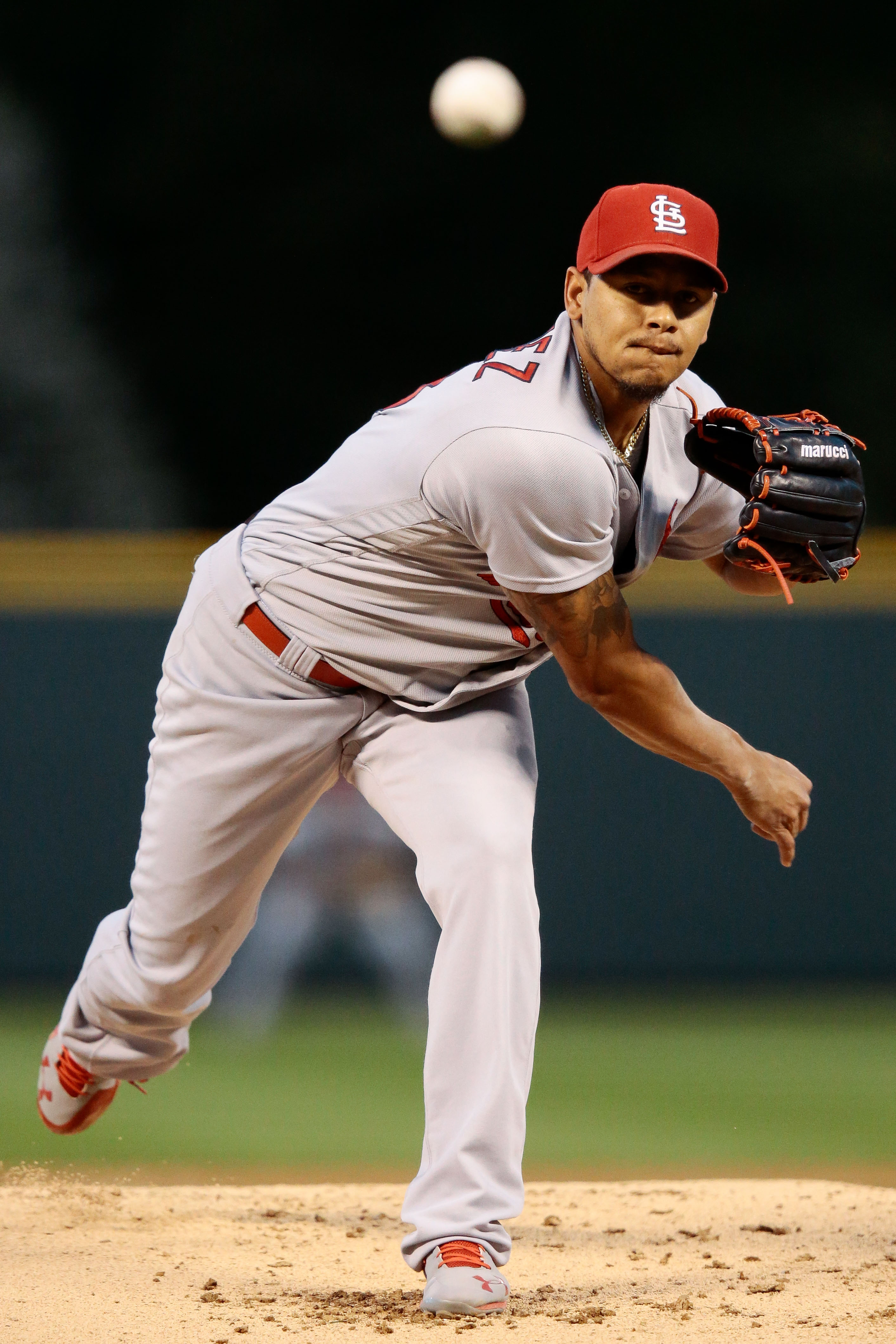
Extension Candidate: Carlos Martinez
We know that the Cardinals are interested in exploring an extension with righty Carlos Martinez, though there’s no news of progress (or even earnest engagement) to this point. But new contracts are often sorted out during the spring, and the sides will need to discuss money one way or another since Martinez is entering his first season of arbitration eligibility.
Only 100 days past his 25th birthday, Martinez is young enough to believe he has plenty of good years ahead of him. He’s also among the game’s hardest-throwing starters. Though his average fastball velocity took a slight step back in 2015, it bounced back to a robust 96.5 mph in his most recent campaign. And the results have followed, as Martinez posted a combined 3.02 ERA over the last two seasons. That combination of age, the liveliness of his arm, and results make the Octagon client an appealing candidate for an investment for a St. Louis club that has faced a few questions in its still-talented rotation of late.
Of course, the arbitration process provides an important starting point for weighing Martinez’s value. MLBTR and contributor Matt Swartz project him to earn $5.3MM in his first season of eligibility, a rather lofty sum for a first-year-eligible starting pitcher. (Dallas Keuchel set a new record last year with a $7.25MM deal, blowing away the long-standing $4.35MM record held by Dontrelle Willis and David Price.) If Martinez continues his current trajectory, he could follow Price in landing some truly significant arb salaries, though unlike the talented lefty, he won’t be able to build off of a Super Two campaign.
For Martinez to max out his earning capacity, though, he’ll need to extend his outings. He topped 180 innings for the first time in 2016, ending up with 195 1/3 frames on the ledger. Durability will be a key consideration for the Cards. Though there haven’t been any significant health concerns to date, Martinez’s combination of youth and propensity for relying on hard pitches gave him a somewhat elevated Tommy John risk profile in the study completed earlier this year by MLBTR contributor Bradley Woodrum (see here for an explanation; here for individual player results).
All told, there’s plenty of reason for confidence in Martinez’s outlook. Increased confidence and usage rates in his changeup — the only one of his four pitches that didn’t score as a top-level offering in 2016 — has allowed him to make strides against lefties, who battered him in 2014. Though he still surrendered a .256/.342/.387 batting line to opposing southpaws in 2016, that’s enough to make him a high-quality starter when combined with his dominating work against right-handed batters (who hit just .204/.270/.269).
Though he lost over one strikeout per nine as against his prior season’s results in 2016, and his swinging-strike rate dwindled a bit to 9.4%, Martinez posted a career-best 56.4% groundball rate. He also worked in the zone more than he had in the preceding two years, though his walk rate has remained relatively consistent. Martinez continues to be tough to take deep — he has allowed 0.6 dingers per nine for his career — and has given up hard contact on less than three of ten balls put in play against him in every one of his seasons in the majors.
So, assuming that St. Louis is prepared to do what’s reasonably necessary to make a deal, what kind of contract might we be looking at? It has been quite some time since we saw a reasonably comparable pitcher in the 3+ service class strike a long-term deal. Johnny Cueto got $27MM over four guaranteed seasons while giving up one option year, but that was way back in 2011, and his platform wasn’t as impressive. Before that, Ervin Santana earned $30MM in a similarly situated deal.
Those numbers seem well shy of what Martinez can command in a market where top-end starters have earned increasingly significant sums. Indeed, the Cards recently reached an arb-only deal with fellow righty Lance Lynn, who took a similarly compelling case into his first year of arbitration eligibility ($5.5MM projection), that priced his arb years at $22MM. For Martinez to give up any free-agent seasons, particularly by way of option, St. Louis will need to up the ante.
Expanding the search a bit, there are some other contracts worth considering. Corey Kluber landed $38.5MM over five years, with two options attached, on the cusp of his age-29 season. He was coming off of a Cy Young campaign, and would have qualified for Super Two status after the season in which he signed his deal (which came in early April of 2015). The contract valued Kluber’s bought-out free-agent years at $13MM and between $13MM and $17MM (depending upon escalators). Before that, Chris Sale took down a $32.5MM guarantee on an identical structure. Sale was just 23 years old at the time, and already pitching like an ace; his contract could well represent the tail end of an old model rather than a truly relevant mark going forward. Looking at 4+ service deals, and excepting ace-level performers (Justin Verlander and Felix Hernandez), Matt Harrison owns the high bar in recent contracts at five years and $55MM (plus an option). He was 27 years of age at the time that deal was struck.
In Martinez’s case, a five-year arrangement (including the 2017 season) would put him under contract for two would-be free-agent years and take him through at least his age-29 campaign, with options perhaps extending the Cards’ control into his early thirties. Taking Lynn’s $22MM and adding another $25MM or so to cover two free agent years — with Martinez’s age roughly balancing off Kluber’s advantage in quality in pricing those seasons — would put the total guaranteed value to roughly the midpoint between Kluber’s and Harrison’s contract. Arguing for a guarantee that reaches or exceeds Kluber’s could represent a sticking point in and of itself. On the other hand, the Cards have perhaps been more willing to spend big in extensions than have the budget-minded Indians, while Kluber’s meteoric rise at a relatively advanced age made him a unique case. Plus, Martinez can reasonably argue that his age-28 and 29 seasons can be expected to earn him much greater sums than even the numbers just noted; relatively youthful free-agent starters such as Jordan Zimmermann have commanded over $20MM annually.
That’s all just a spitball range, of course, and it’s certainly plausible to imagine any number of creative scenarios, including escalators, opt-outs, and options that could play a significant role in determining the final value. Regardless, it’s somewhat uncharted territory; the sides figure to have plenty to talk about over the coming months.
Photo courtesy of USA Today Sports Images.