
Minor MLB Transactions: 12/19/16
Here are the day’s minor moves:
- The Tigers have a minor-league deal with infielder Brendan Ryan, per Jon Heyman of Fan Rag (via Twitter). The 34-year-old can earn $625K in the big leagues. Once a slick-fielding, semi-regular shortstop with the Cardinals and Mariners, Ryan has received just 241 MLB plate appearances over the past three seasons, slashing just .188/.231/.251 in that span. He spent the bulk of 2016 at the Triple-A level in the Nationals and Angels organizations.
- Outfielder Shane Peterson is headed to the Rays on a minors pact, per Ken Rosenthal of FOX Sports (Twitter link). Peterson, 28, hit .259/.324/.353 in a 226 plate appearance stint with the Brewers in 2015, his first real crack at the big leagues, after showing well at Triple-A that year. An arm injury limited the left-handed hitter to just 15 games in 2016, but he did continue to hit well when he was on the field. All told, the former second-round pick owns a productive .298/.385/.468 slash across 1,775 plate appearances at the highest level of the minors.
Astros To Sign Juan Centeno
The Astros have struck a minor-league deal with catcher Juan Centeno, according to Jake Kaplan of the Houston Chronicle (via Twitter). He’ll join the MLB side of spring camp as part of the arrangement.
Centeno, who recently turned 27, was outrighted a month ago by the Twins. While the relationship didn’t continue with Minnesota, he got his first real look at the majors there in 2016. Previously, Centeno had seen action in three MLB seasons, but appeared in only 24 games.
Over 192 plate appearances with the Twins, Centeno slashed .261/.312/.392 — good for a 91 OPS+, which is just fine for a backstop. But he also rated as one of the game’s worst pitch framers, by measure of both StatCorner and Baseball Prospectus, which doubtlessly did not endear him to a new Minnesota front office that ended up signing catcher Jason Castro (one of the game’s best at earning strikes for his pitchers) away from Houston. (It’s fair to note that Minnesota did offer him a minors pact, per ESPN1500’s Darren Wolfson, via Twitter.)
Despite that solid showing at the plate, offensive expectations remain limited for Centeno, a long-time Mets farmhand who spent 2015 in the Brewers organization. In parts of four seasons at the highest level of the minors, after all, he has demonstrated good contact skills but also an utter absence of power. Over 681 Triple-A plate appearances, Centeno carries a .293/.333/.355 batting line with a pair of home runs.
For Houston, the move adds another plausible major league option to the organization. Brian McCann and Evan Gattis are expected to handle things at the MLB level, and youngsters Max Stassi and Tyler Heineman remain on hand, but Centeno will represent another experienced backstop to call upon if a need arises.
Blue Jays Have Not Offered Jose Bautista More Than Qualifying Offer
Since slugger Jose Bautista declined the one-year, $17.2MM qualifying offer made to him by the Blue Jays at the outset of the offseason, the club has not made him a formal offer that exceeds that amount, Jon Morosi of MLB Network tweets.
That’s not exactly surprising, perhaps, as Bautista’s market has seemingly not yet developed — in large part, perhaps, because former teammate Edwin Encarnacion and several other power bats (particularly Mark Trumbo) also remain unsigned. But it’s notable that Toronto hasn’t even seen fit to put that kind of cash on the table yet, as the team reportedly dangled four years and $80MM to Encarnacion at one point (though that offer seemingly no longer stands).
We took a look at Bautista’s market recently, upon Morosi’s suggestion that a reunion with the Jays could make the most sense at this point. That may well turn out to be the case, but it doesn’t seem likely to happen any time soon unless Toronto’s interest perks up or Bautista decides to settle for a lot less than he surely hoped for when he turned down the QO.
MLBTR’s Tim Dierkes predicted that Bautista could earn $51MM over three years on the open market, but there was always some downside in his case given his age, defensive limitations, and recent power drop, as well as (especially) the presence of so many other appealing power hitters in free agency. Because he rejected the qualifying offer, of course, Bautista would also cost a signing team a draft choice (or prevent the Jays from adding an additional selection), which further dents his value.
As Dierkes noted at the outset of the offseason, a one-year arrangement always seemed a plausible outcome, and a pillow contract now seems more likely than ever. Of course, it’s far too soon to say that a multi-year guarantee won’t be found; ongoing market developments may yet decide that question. Since our latest snapshot of the overall market for Bautista, we’ve heard some updated chatter on the potential connection to the Rays and the seeming unlikelihood of a match with the Mariners.
Phillies Extend Odubel Herrera
SATURDAY: Heyman tweets that Herrera will receive a $1.75MM signing bonus, $1.25MM in 2017, $3MM in 2018, $5MM in 2019, $7MM in 2020, and $10MM in 2021.
FRIDAY: The options come with $2.5MM and $1MM buyouts, respectively, Jon Heyman of Fan Rag tweets.
THURSDAY: The Phillies have announced a five-year extension for center fielder Odubel Herrera, which comes with a $30.5MM guarantee, per Matt Gelb of the Philadelphia Inquirer (via Twitter). The deal includes club options for the 2022 and 2023 seasons, which are valued at $11.5MM and $12.5MM, respectively, per MLB.com’s Todd Zolecki (on Twitter). Herrera is represented by Victor Tranquillo.
With the move, the Phils will add control over three projected free-agent seasons over their present and future center fielder. Herrera entered the year with two full years of MLB service, meaning he would have expected to qualify for arbitration next winter and hit the open market in advance of the 2021 season.
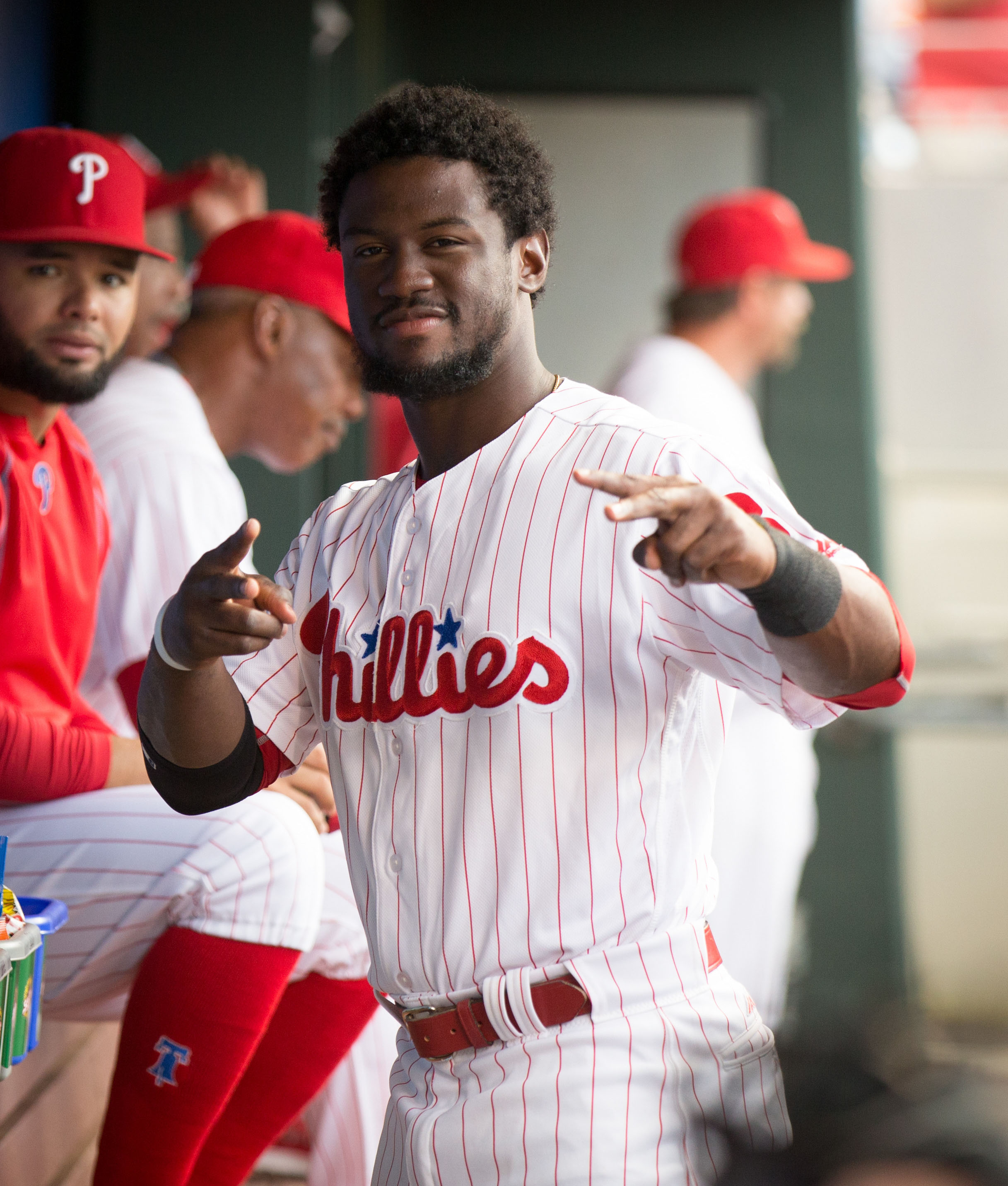
Instead, Herrera — who’ll soon turn 25 — will be under contract through at least his age-29 season. As Gelb notes on Twitter, it appears to be the first significant contract extension the team has struck with a player of such little experience.
Taken as a Rule 5 pick from the Rangers under the former regime, led by much-maligned GM Ruben Amaro Jr., Herrera immediately blossomed into a quality regular. In his first season in the majors, Herrera slashed .297/.344/.418 and contributed eight home runs and 16 steals (though he was also gunned down on eight other attempts). With high-quality, up-the-middle glovework and strong overall baserunning contributions factored in, Herrera was a four-WAR player right out of the gates.
Though his overall offensive output remained at about 10% better than league average in 2016, it’s certainly arguable that Herrera took a big step forward at the plate. He not only trimmed his strikeouts to a 20.4% rate that falls just below league average, but nearly doubled his walk rate to a strong 9.6%. Herrera also jumped to 15 home runs, though he’s still below-average in overall power (.134 ISO), and stole 25 bags (against seven times caught stealing). While both UZR and DRS were somewhat less enamored of his glovework in the sophomore campaign, he still rated comfortably above average in the field and also on the bases.
Even if Herrera’s batting average on balls in play comes back down to earth a bit — he carried a .387 mark in his first year and .349 in his second — he seems a solid bet to deliver at least average offensive work for the foreseeable future. And there’s perhaps room to grow still in the power department after showing some strides, which was especially promising given that it occurred along with the step forward in his plate discipline.
Though Herrera was less productive in the second half — his power and K/BB numbers dipped — the total package is quite appealing. That made this a rather easy deal to make for the Phillies, an organization with massive untapped spending capacity in the future. Even in a true downside scenario, there’s little chance that Herrera’s contract (which is worth only $6.1MM on an average basis annually) will significantly harm the team’s ability to add major league talent.
While a team in the Phillies’ situation doesn’t need to strike early to lock up talent, as the organization can afford to do so later, that doesn’t mean that such a move can’t yield huge dividends. Indeed, as the pre-2015 Adam Eaton extension shows — particularly in light of his recent trade to the Nationals — it’s possible to add quite a bit of value to player control rights by buying out arb years and picking up some options. The Herrera pact is structured identically (five guaranteed years plus two options), though his guarantee handily beats the $23.5MM that Eaton received. Of course, it also fell well shy of the $50MM+ promised to 2+ players such as Matt Carpenter and Andrew McCutchen.
That’s certainly not to say that the deal isn’t a fair one from Herrera’s perspective. He was not a major bonus recipient as an amateur free agent out of Venezuela — various internet reports suggest he was inked for a modest $160K — and had only earned at (and then just over) the MLB minimum in each of the last two seasons. While his current trajectory suggests there would’ve been big earnings to come, none of that was guaranteed, and Herrera’s skillset would not have been particularly lucrative in the arbitration process.
It remains to be seen whether Philadelphia will move to negotiate with any of its other younger assets, though none are quite as established as Herrera. Third baseman Maikel Franco is the other most likely candidate, perhaps, though he may have already secured his downside protection by striking a deal with Fantex. Pitchers such as Aaron Nola, Jerad Eickhoff, and Vince Velasquez could conceivably draw consideration as well, though there’s no rush in any of their cases and the club may allow things to play out before reaching any decisions. Looking further down the line, top talent J.P. Crawford and others could eventually be candidates for long-term deals — even, perhaps, before or just after they reach the majors — though we’ve heard nothing to suggest that any such aggressive moves are in the works.
Photo courtesy of USA Today Sports Images.
Six Teams Set To Pay Luxury Tax
Six major league organizations will pay a luxury tax for exceeding the $189MM salary level, as the Associated Press reports (via Sportsnet.ca). With a new collective bargaining agreement set to go into effect, we’ve never seen more teams subject to the tax.
It’s no surprise which organizations lead the way yet again, but they’ll be joined by a few more others than usual. Here’s the full list:
- Dodgers, $31.8MM tax bill
- Yankees, $27.4MM
- Red Sox, $4.5MM
- Tigers, $4MM
- Giants, $3.4MM
- Cubs, $2.96MM
That’s four years in a row for Los Angeles and a remarkable fourteen straight for the Bronx Bombers, the AP notes. Also of note, this is the first time the Cubs have ever exceeded the luxury tax ceiling.
While the line will move up to $195MM next year, under the new CBA, the penalties will begin to rise — especially for consecutive offenders. Dipping back under the limbo stick may prove tough for the Dodgers, whose future obligations draw down more the following year. But the Yankees could well finally be set to re-set their luxury tax status this time next year.
Minor MLB Transactions: 12/16/16
Here are the latest minor moves from around the league:
- The Rays added catcher Michael McKenry on a minor-league contract, Jon Heyman of Fan Rag tweets. Heyman further adds that McKenry will receive $900K if he’s in the Majors, plus a possible $475K in incentives. He has opt-outs on March 30 and June 1. With Wilson Ramos not expected to be ready to take over behind the plate for at least the first month or two of the year, there’s a need for depth. McKenry will presumably battle with pre-existing options Luke Maile and Curt Casali for a roster spot to open the season.
- Outfielder Brandon Barnes is headed to the Marlins on a minors pact, Chris Cotillo of SB Nation tweets. The deal includes a Spring Training invite. Barnes, 30, figures to function as a depth piece after seeing time in the majors over parts of the last five seasons. He struggled to a .220/.250/.320 batting line in just 109 MLB plate appearances last year.
- Lefty Jeff Beliveau is headed to the Blue Jays on a minors deal with a spring invite, per a club announcement. The 29-year-old has thrown 45 MLB frames spread over four years, with an even 4.00 ERA and 9.4 K/9 against 4.2 BB/9. Last year, he didn’t pitch above the Double-A level in the Orioles system, but provided 49 2/3 innings of 2.54 ERA pitching with a dozen K/9 to go with a sub-optimal 5.3 BB/9.
- Righty Erik Johnson is back with the Padres on a minor-league arrangement, Heyman tweets. Johnson will continue to work back from Tommy John surgery with San Diego, which had recently non-tendered him.
- The Orioles announced a series of minors signings. Among those not previously covered at MLBTR, the club will bring back outfielder Chris Dickerson and take a shot on Tomo Ohka. Dickerson joined Beliveau at Double-A in the Baltimore organization last year, hitting well in brief action there, but hasn’t seen the bigs since 2014. Ohka, 40, is a much more speculative addition; he’s trying to return to the majors for the first time since 2009 by turning himself into a knuckleballer.
- Anther pitcher seeking to make it back after a long run away from the majors is lefty Andy Oliver, who’ll try things out with the Brewers, per Heyman (via Twitter). Heyman adds that can opt out of his deal on June 15 if he’s not on the big-league roster, and Oliver also receives a foreign team inquiry clause. Oliver blitzed through the Tigers system after being taken in the 2nd round of the 2009 draft. He cracked the bigs briefly in 2010-11, but has plied his trade at Triple-A ever since. Oliver moved back to the rotation for half of his appearances last year with the Orioles’ top affiliate, which may have helped as he finally quelled some of his control issues. Oliver ended 2016 with a 3.43 ERA over 86 2/3 frames and 8.7 K/9 against 3.7 BB/9 (his lowest walk rate since his debut year in full-season professional ball).
- The Tigers added third baseman Zack Cox on a minor-league arrangement, the indy ball Wichita Wingnuts announced. Once a highly regarded prospect, Cox never earned a major league call-up during his time in the Cardinals and Marlins systems, but hit .290/.348/.452 last year in 460 plate appearances for Wichita.
- Five players are returning to the Rangers organization on minor-league pacts, per Stefan Stevenson of the Fort Worth Star-Telegram (Twitter links). Utilityman Alex Burg will join right-handed hurlers Dario Beltre, Austin Bibens-Dirkx, Anthony Carter, and David Perez in returning to Texas. There’s a new farmhand coming in, too, as the Rangers added righty James Dykstra from the White Sox in a cash deal. Dykstra, 26, reached Double-A last year, throwing 102 1/3 innings of 4.93 ERA ball with 5.8 K/9 against 3.4 BB/9.
- Two previously designated players — catcher Justin O’Conner (Rays) and lefty Williams Jerez (Red Sox) — have been outrighted by their organizations, per club announcements.
Marlins To Sign Brad Ziegler
The Marlins have struck a two-year, $16MM deal with reliever Brad Ziegler, according to Ken Rosenthal of FOX Sports (via Twitter). Ziegler can also earn $2MM through incentives, per SB Nation’s Chris Cotillo (via Twitter).
The agreement won’t be finalized until the veteran takes a physical, but he’s slated to earn $7MM for 2017 and $9MM in the following year, Jon Heyman of Fan Rag tweets. Ziegler’s total guarantee lands exactly where MLBTR’s Tim Dierkes predicted in rating Ziegler 27th in earning power among free agents.
[RELATED: Updated Marlins’ Depth Chart]
Ziegler, 37, will join the just-signed Junichi Tazawa in a revamped Marlins’ bullpen. That unit had lost Carter Capps to injury (and then trade) before watching Mike Dunn depart via free agency. While the hoped-for addition of Kenley Jansen did not come to pass, Tazawa and Ziegler will plug two quality arms into the late-inning mix on a much less onerous overall commitment. Just who’ll take what role remains unclear, but there are plenty of options (albeit, perhaps, still also an ongoing need for an additional left-hander).
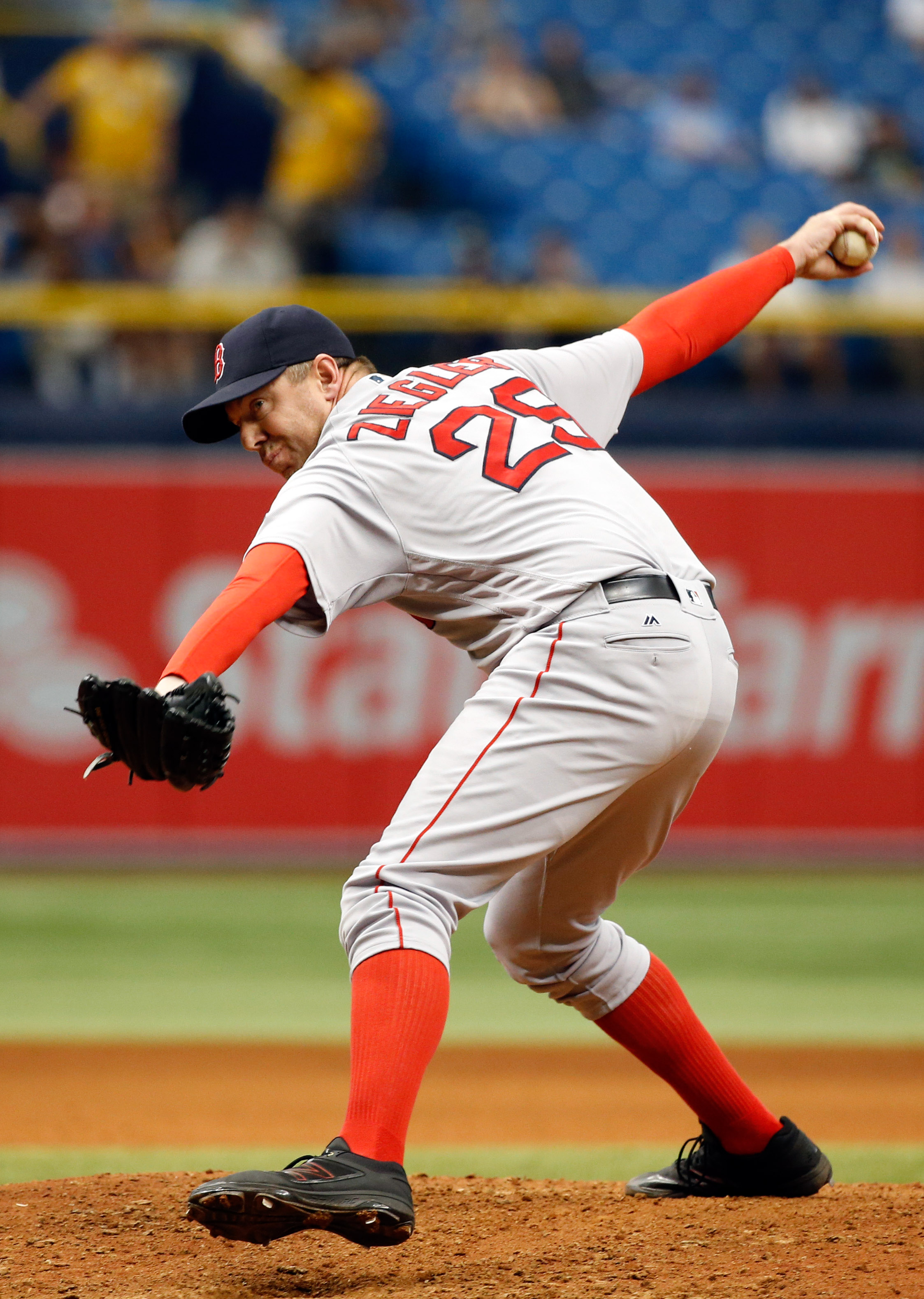
Though he didn’t reach the big leagues until he was 28 years of age, has long worked in the mid-eighties with his fastball, and has always posted pedestrian strikeout and walk numbers, Ziegler has still yet to end a single season having allowed over 3.5 earned runs per nine. In nearly 600 major league frames, he owns a stellar 2.44 ERA.
The reason? Ziegler’s submarine delivery has enabled him to draw groundballs on just under two out of every three balls put in play against him. He’s also exceedingly difficult to take out of the yard, having allowed just 0.35 HR/9 over his career. And despite his lack of velocity, Ziegler is basically impossible to run off of (17 stolen bases allowed lifetime) — which helps enhance the value of his groundball-inducing sinker, by keeping the double play in order when a runner does reach base. It’s an utterly unique profile, but one that has had undeniable success.
Whether Ziegler can continue his magic act is anyone’s guess, but he has shown no signs of slowing down and Miami won’t take on too big a risk in the contract. And there are some encouraging signs even beyond the still-dominant groundball and earned-run figures. Ziegler’s 11.7% swinging-strike rate in 2016 was a personal high, as he successfully baited hitters to offer and whiff at pitches out of the zone more than ever before.
Beyond age, and the lack of strikeouts, the biggest limitation in Ziegler’s package lies in the platoon department. He has dominated opposing righties while showing some vulnerability to lefties over his career. Hitters stepping in with the platoon advantage have hit .271/.365/.392 against Ziegler, drawing 121 walks against just 115 strikeouts.
Photo courtesy of USA Today Sports Images.
Red Sox Avoid Arbitration With Brandon Workman
The Red Sox have avoided arbitration with Brandon Workman, per a club announcement (h/t Tim Britton of the Providence Journal, via Twitter). It’s a $635K deal, per ESPN.com’s Scott Lauber (via Twitter), coming in just over MLBTR’s $600K projection.
Workman, 28, was eligible for the first time despite the fact that he hasn’t pitched in the majors since 2014. He underwent Tommy John surgery in 2015, and never quite made it back to the big leagues last season — though did throw twenty minor-league rehab frames.
While there may still be some risk in the health of Workman’s right arm, Boston isn’t staking much on its bet. Most of the already limited salary figure won’t even be guaranteed until camp is about to break next spring. Mostly, it’s a matter of occupying a 40-man spot, which the Sox are evidently willing to do to get another look at the former second-round pick.
In his 128 2/3 total major league frames, Workman owns a 5.11 ERA with 8.2 K/9 against 3.6 BB/9. But he has generally been better in the minors, including 17 starts at Triple-A, over which he owns a 3.63 ERA with 8.3 K/9 and 2.8 BB/9.
Marlins Designate Nefi Ogando, Announce Junichi Tazawa Signing
The Marlins have designated righty Nefi Ogando for assignment, per a club announcement. His departure from the 40-man creates space for the addition of fellow right-hander Junichi Tazawa, whose signing was reported yesterday.
Ogando, 27, allowed just four earned runs on ten hits in his 15 2/3 major league innings in 2016. And he showed a mid-nineties fastball. But he recorded only eight strikeouts with eight walks in that stretch, reflecting longstanding questions.
Ogando has had effective seasons in the minors, but has never flashed all that much functional strikeout ability and has never managed to tamp down the free passes. Ultimately, there’s enough to like about his live arm that another organization will surely have interest in attempting to harness it — if the Marlins don’t retain him — but it’s not difficult to see why the Fish were willing to cut bait to make way for Tazawa.
Jeffrey Loria Open To Considering Sale Of Marlins
Marlins owner Jeffrey Loria is “receptive to the possibility of selling” the organization, Barry Jackson of the Miami Herald reports. Loria has at least floated the rather lofty price tag of $1.7B, Mike Ozanian of Forbes reported yesterday, though Jackson says that he dangled a lower asking price (by how much isn’t known) to one prior would-be buyer who checked in.
While the news is notable — as Jackson says, Loria previously has balked at the idea of a sale — it’s important to recognize its limitations. For one thing, the current ownership group has not hired a firm to broker a deal. For another, it has reportedly already failed to progress in talks with several interested suitors in recent months.
As has been rumored, one of the entities to pursue the Marlins was Mitt Romney’s Solomere Capital, which brought an offer of less than $1.7B to the table and was rejected. It’s not immediately clear where the market might land for the Miami organization (along with its stadium-rights agreement and other revenue sources), though Jackson cites one “potential buyer” who says he’d consider paying something in the neighborhood of $1.3B — nearly double Forbes’ $675MM valuation.
Of course, that paper valuation doesn’t necessarily reflect the market situation; MLB organizations are obviously in high demand and can deliver long-term returns to owners that aren’t strictly tied to annual earnings. There may be some untapped potential in the Marlins’ franchise, too, though surely another stadium bonanza won’t occur again for some time. Stadium naming rights and a new TV rights deal (which would go into effect after the 2020 season) certainly hold out the promise for a cash-flow boost. And it’s at least worth wondering if other prospective owners see opportunities to boost attendance, which continues to lag behind most of the league, or otherwise enhance the margin.
Ultimately, whether a serious bidder emerges for the Marlins remains to be seen. And Major League Baseball would certainly need to be involved in approving any sale that ultimately is arranged — which, obviously, has not yet occurred. But it’s interesting to consider that the controversial Loria could seriously weigh a divestiture of his interests in the organization, which he is said to have purchased for $158.5MM back in 2002.