
Josh Ravin Receives 80-Game PED Suspension
Dodgers righty Josh Ravin has received an 80-game PED suspension, according to Jeff Passan of Yahoo Sports (Twitter link). That is the penalty for a first-time offender under MLB’s Joint Drug Prevention and Treatment Agreement.
Ravin, 28, was on the 60-day DL after breaking his non-pitching arm in a car accident during the offseason, so he wasn’t expected back for some time. Now, he’ll be unavailable until late July, at the earliest.
Last year was Ravin’s first at the major league level. He allowed seven earned runs on 13 hits in 9 1/3 innings of relief, but did impress with a 12:4 K:BB ratio and showed an upper-90s fastball. Ravin spent most of 2015 at Triple-A, where he worked to a 3.86 ERA in 28 frames with 12.2 K/9 against 5.1 BB/9.
Padres Designate Michael Kirkman
The Padres have designated lefty Michael Kirkman for assignment, per a club announcement. His spot on the active roster will go to outfielder Alex Dickerson.
Kirkman, 29, made just one appearance on the year, surrendering six hits and four earned runs in 1 1/3 innings. Long a member of the Rangers organization, Kirkman spent most of last year at the Triple-A level with the Brewers before receiving his release in August. He carried an impressive 2.81 ERA on just 19 hits over 32 innings at Colorado Springs, but his 9.6 K/9 was accompanied by a troubling 7.9 BB/9.
AL East Notes: Mirabelli, Bautista, Kiermaier, Lohse
Tim Healey of The Hardball Times paints a fascinating portrait of an oddball deal in a deep look at the Red Sox’ 2006 re-acquisition of catcher Doug Mirabelli from the Padres. Truth be told, I don’t have any observations on the piece other than that it demands to be read and is well worth your time.
Here are a few notes from the AL East:
- MLB Network’s Jon Heyman tweets that while he believes Blue Jays slugger Jose Bautista would take less than his reported asking price of more than $150MM over five to six years, he doesn’t believe Bautista would entertain any offers for less than $100MM. Bautista’s alleged asking price was the source of a great deal of controversy in Spring Training, and while $150MM+ doesn’t seem particularly realistic, he would probably have a strong case for $100MM on the open market this winter. Bautista may be 35, but he’s been remarkably consistent since his 2010 breakout and is off to a strong start, batting .247/.394/.519 with four homers and an AL-leading 20 walks drawn.
- In other extension-related news, the Rays have not seriously engaged with center fielder Kevin Kiermaier about a deal over the last several months, according to Chris Cotillo of SB Nation (Twitter link). Nevertheless, Tampa Bay has given some indication of interest at some point. The 26-year-old seems like the type of player the Rays would target for a bargain contract, as he had only accumulated 1.131 years of service entering the season and is a glove-first player whose on-field value may not translate particularly well into arbitration earnings. Even if he can’t replicate last year’s magical season in the field, he seems like a good bet to continue as a solid asset for years to come. While it seems unlikely that the sides will get anything started in the near term, last year’s Juan Lagares extension looks like as good a comp as one could hope for. Lagares was the same age and featured a similar profile, though he was much more certain at the time to reach Super Two status (and, it’s fair to note, has done less with the bat in his career).
- Even after adding veteran Wandy Rodriguez, the Orioles continue to stay in touch with righty Kyle Lohse, Dan Connolly of BaltimoreBaseball.com reports. As we’ve heard previously, Baltimore has made an offer to Lohse but, obviously, has yet to reach agreement. It’s still not clear what the 37-year-old is prioritizing in deciding upon a club with which to attempt a bounceback, but the O’s rotation certainly seems to offer a reasonable likelihood of opportunity over the coming months.
Sam Fuld Will Miss Season After Rotator Cuff Surgery
Athletics outfielder Sam Fuld requires surgery on a torn rotator cuff, MLB.com’s Jane Lee reports on Twitter. He’ll undergo the procedure on May 18 and will not be ready to return during the 2016 season.
Fuld, a 34-year-old veteran of eight MLB campaigns, avoided arbitration with Oakland at a $1.93MM salary. He’ll continue to accrue service while he’s shelved, and will qualify for free agency after the season.
While he’s seen fairly consistent reserve action since 2011, Fuld has never been very productive with the bat. He owns a .227/.307/.325 career slash line over 1,535 plate appearances. He does add some value with his legs, with 67 career stolen bases and generally excellent baserunning metics. Most of all, Fuld has long been known as a quality defender, with advanced metrics placing strong ratings on his work in left and center.
Oakland would surely have preferred to have Fuld as a depth option, but doesn’t have a particulary strong need for him at present. Indeed, the team’s addition of Chris Coghlan — like Fuld, a left-handed hitter — seemed to occupy his most obvious place in the organization.
Grant Balfour Retires
Longtime MLB reliever Grant Balfour has officially wrapped up his 12-year MLB career, he tells Marc Topkin of the Tampa Bay Times. Balfour, 38, last pitched briefly in early 2015 with the Rays.
Last we checked in, Balfour expressed interest in continuing to pitch. Of course, that was at the end of May of 2015, and he hasn’t appeared in the majors since being cut loose by Tampa Bay. The veteran tells Topkin that he mulled a return this spring, but decided not to look for a spring invite after beginning to throw.
“It was honestly a great ride, meeting a lot of people and developing friendships along the way,” said the Australian native. “I now look forward to sitting home and being a spectator and be able to spend more time with my family.”
Balfour took some time establishing himself in the majors, but had a nice run of success once he did. Between 2008 and 2013, Balfour run up 380 1/3 innings of 2.74 ERA pitching with 9.7 K/9 against 3.5 BB/9. That made him one of the most reliable pen arms in baseball; eventually, Balfour would take over the Athletics’ closer role, picking up 62 saves in the final two years of that solid stretch of pitching.
After wrapping up a strong three-year run in Oakland, Balfour returned to the Rays after a deal with the division-rival Orioles fell apart over his physical. That represented a homecoming for the reliever, who had finally locked down a steady MLB job in Tampa Bay after prior stints with the Twins and Brewers.
Unfortunately, Balfour didn’t make good on his two-year contract, with age, velocity decline, and control issues telling in the results. Balfour ended 2014 with a 4.91 ERA in 62 1/3 frames, and was removed from the roster just six appearances into 2015 after failing to record strikeout and allowing three runs in 4 1/3 innings. He signed a minor league deal to stay with the Rays organization, and ultimately made eight Triple-A appearances, but didn’t experience enough improvement to make it back to the bigs.
MLBTR congratulates Balfour on his career and wishes him the best in his future endeavors.
PED Incentives And The Next JDA
The following article originally appeared at MLBTradeRumors.com on November 29, 2013. With the recent suspensions of Dee Gordon and Chris Colabello, the subject of PED incentives has once again entered the spotlight. Although the post initially addresses the situation of a player reaching the free agent market after a positive PED test, it represents an effort to consider functional punishments for a variety of scenarios by attempting to distinguish between players in different situations in setting PED disincentives.
Gordon, of course, is in the first season of a five-year extension. The general rule framework proposed below would result in a much greater financial loss than his actual suspension will cause him, which arguably provides a stronger disincentive — all while limiting the skewing of team incentives and market function to the extent possible. Read the full post below:
—
We’ve all seen the range of responses to the four-year, $53MM deal that Jhonny Peralta inked with the Cardinals right on the heels of serving a fifty game suspension for violating the performance enhancing substances prohibitions contained in the league’s Joint Drug Prevention and Treatment Program (JDA). Rather than rehash them here, or take a moral stand in one way or another, I’d like to look at things from a practical perspective.
By guaranteeing four years at over $13MM per, the contract went well beyond the biggest multi-year deals given to other players recently hit with a suspension just before hitting free agency. That doesn’t change the moral calculus, but it does highlight that — as MLBTR’s Steve Adams has explained — teams may not be substantially reducing their valuation of a player based on his past usage of PEDs. Though clubs may factor in some negative PR value, discount past performance during periods of use, or add in a bit of an additional risk adjustment, the net just isn’t that great.
Peralta may well have landed his deal because of his steady production and defense at a position in great demand on the present market, rather than his PED use. But he just as surely did not lose his deal because of the banned substances that he took.
This matters most, it seems to me, because of what it says about incentives. Teams’ market-driven decision-making is apparently not going to provide a significant disincentive on its own. And the fact is, as Cards’ GM John Mozeliak correctly points out, “at this point in the game, there’s nothing that says [Peralta] can’t go play or isn’t free to go sign with another club.”
And, arguably, neither is the JDA itself doing enough to shift the PED equation. Like all punitive systems, the JDA sets up upon negatives incentives to outweigh positive incentives to engage in the behavior it wishes to prohibit. As Diamondbacks reliever and union rep Brad Ziegler said on Twitter: “We thought 50 games would be a deterrent. Obviously it’s not.”
This may be somewhat overstated: the shaming effect (especially given the shift in player sentiment) and suspension process seem to be having at least some effect, as most observers acknowledge that PED usage is not nearly as rampant as it once was. On the other hand, Ziegler is definitely on to something. At least for some players, in some situations, the benefits to using PEDs outweigh the drawbacks — even, perhaps, if they are caught. The meager weight of the current suspension system, I think, is the most worrying lesson from the Peralta deal.
Viewed in its worst light, the suspension system creates a mental process much like the kitchen table scene in Office Space. Playing the devil on the shoulder of his would-be co-conspirators, Peter Gibbons seals their agreement to skim cash from their hated employer by dismissing the downside: “This isn’t Riyadh. … The worst they would ever do is they would put you for a couple of months into a white-collar, minimum-security resort!”
But is it really the case that the use of banned substances could, in some cases, present only de minimus downside for a player? Is Ziegler right that Peralta shows that “it pays to cheat”?
In some ways, that certainly could be the case. Players who get caught with their hand in the cookie jar often claim they used PEDs to help recover from injury, not to artificially boost performance. Now that we’re past the era of cartoonishly outsized sluggers, that may even be the most common and impactful use of PEDs. You know, just getting back to a player’s regular level of production and giving him a chance to demonstrate his value at an opportune time. Sure, he may pay for it later by giving up fifty games worth of salary. But the chance to, say, highlight performance before hitting free agency, or jump at an early-career MLB opportunity, can often be invaluable to a ballplayer.
So, assuming that a blanket ban on the list of disallowed PEDs is in fact the goal — putting aside, in other words, the debate on their use in injury rehab — it seems to me that a more thoughtful disincentive system is plainly needed. As a baseline, it is important to recognize that PED prohibition is an agreed-upon rule of the game, and its enforcement is as much about fairness to clean players (and to fans) as it is about keeping dirty players from using to their own long-term health detriment.
Click below to see my conceptual proposal for some methods that might be employed, individually or in concert, to arrive at a more effective system of PED disincentives. These include: eliminating suspensions altogether; varying punishment based upon service time and/or contract status; and utilizing financial disincentives while minimizing impact on competition and the market.
Diamondbacks Designate Matt Buschmann
The Diamondbacks have designated righty Matt Buschmann for assignment, per a club announcement. His roster spot was needed for southpaw Edwin Escobar, who was just claimed off waivers.
Buschmann, 32, had already been optioned back to Triple-A after making his MLB debut earlier in the year. He threw well in three appearances, allowing only one earned run on three hits and an intentional walk over 4 1/3 innings while retiring three via the strikeout.
The Triple-A level represents familiar territory for the minor league veteran. Buschmann has racked up 598 1/3 frames there over parts of eight seasons, most of them as a starter, working to a 5.08 ERA with 7.3 K/9 against 3.6 BB/9.
Dee Gordon Receives 80-Game PED Suspension
10:39am: Gordon tested positive for the pair of substances in Spring Training, a league source tells ESPN’s Jayson Stark.
12:20am: In a stunning development, Marlins second baseman Dee Gordon has been hit with an eighty-game suspension for PEDs, according to a league announcement. He tested positive for the banned substances exogenous testosterone and clostebol.
Needless to say, the news represents a sudden turnaround for a player who had risen to become one of the game’s more celebrated personalities. Gordon, the 28-year-old son of longtime major leaguer Tom Gordon and brother of Twins’ prospect Nick Gordon, inked a five-year, $50MM extension with the Marlins over the winter after an excellent 2015 season.
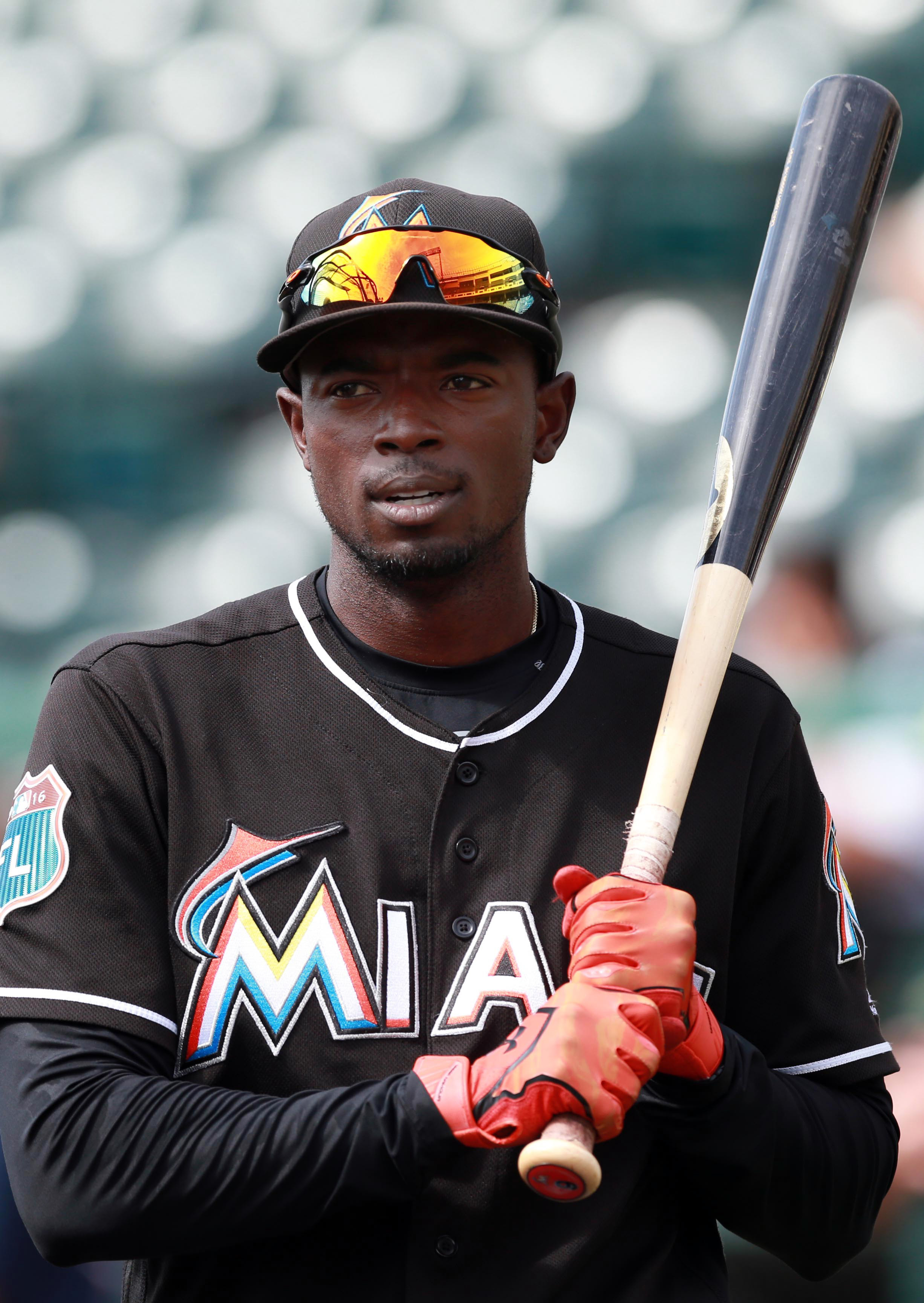
Gordon will sacrifice about half of his $3MM salary for the present season under that contract. He’ll also obviously miss out on a chance to defend his National League batting and stolen base titles from a year ago. And if Miami manages to right the ship — an even taller order now with Gordon out — he won’t be eligible for postseason play.
It seems likely that the Fish will turn to Derek Dietrich to occupy at least a good portion of the time at the keystone. He has plenty of experience there, though he’s not much of a fielder. The left-handed-swinging 26-year-old is a promising hitter, though. Alternatively, the club could utilize Martin Prado at second while deploying Dietrich and/or Chris Johnson at third base.
Regardless, the overall mix is substantially weakened. Gordon was off to a slow start this year, but he doesn’t need to keep up quite his 2015 pace to be of value. He had already enjoyed a breakout in the season prior before being dealt by the Dodgers, but Gordon stepped up even further in his first year in Miami with a .333/.359/.418 slash, 58 stolen bases, and highly-regarded glovework.
To be sure, Gordon is not the lumbering slugger who is traditionally associated with performance enhancing drugs. But this represents the latest reminder that such substances aren’t reserved for bulking up; they can also improve athletic performance in other ways and, especially, aid in injury recovery.
Quite unlike the situation facing the Blue Jays with regard to Chris Colabello, who was also just suspended, the Marlins are committed to Gordon via the aforementioned contract. Miami will simply need to hope that he’s able to repair his image and maintain his performance on the field upon his return.
That’s the message given by club president David Samson, who said the organization was disappointed but would welcome Gordon back when his suspension ends. (Video via the Miami Herald.) The Marlins did not learn about the suspension until today, per Samson. Miami has obviously have placed high expectations on Gordon to “do whatever is necessary to make it up to our fans, to his teammates, and to this organization.”
Gordon apparently decided to drop his appeal at this time, making the suspension effective after tonight’s game, Tim Brown of Yahoo Sports tweets. (Notably, Gordon just finished helping the club to a four-game sweep of his former team.) It’s still not clear precisely when the positive test occurred, though it’s certainly possible that — as with Colabello — it took place at some point during Spring Training.
Photo courtesy of USA Today Sports Images.
Braves Seeking To Trade For Draft Picks
The Braves have reached out to teams with competitive balance draft selections — the only kind that can be traded — in an attempt to bolster their number of draft choices and available bonus pool, Jeff Passan of Yahoo Sports reports (Twitter links). Atlanta is offering to take on bad contracts from other organizations to facilitate such arrangements.
It’s not exactly a new strategy for the Braves. Most recently, the club added a comp selection from the Marlins in last summer’s 13-player blockbuster and effectively purchased the recently-drafted Touki Toussaint from the Diamondbacks by taking over the contract of Bronson Arroyo. Before that, it added a 2015 comp pick in the Craig Kimbrel deal and got another from Arizona for young outfielder Victor Reyes.
With the club off to a miserable start, which more or less precludes any hope of contending in the present season, it isn’t surprising to learn that Atlanta is looking to pad its draft pool. Their current record has no bearing on the team’s draft assets this summer, of course, but it does suggest that the club will be going all-out to acquire young talent rather than holding or, especially, looking to add to the major league roster at the deadline.
The Braves currently are set to pick 3rd, 40th (via Miami), and 44th in the upcoming draft, and carry the fourth-most pool money. At present, the Padres have leapfrogged Atlanta in total bonus availability (by just under $500K) despite a lower draft position, which is due to San Diego’s supplemental first-round picks.
In terms of trade partners, the organization could conceivably try to add selections from the Reds (#35), Athletics (#37), Rockies (#38), Diamondbacks (#39), or Pirates (#41). Those choices range in value from just over $1.8MM on the high end, down to just over $1.5MM. Picks 71 through 77 can also be traded (excepting #74); they are controlled by the Padres, Indians, Twins, Brewers, Orioles, and Rays, respectively, and none is worth over $905.9K.
Of course, in many cases, Atlanta would be trying to pry draft resources from clubs that have just as much incentive as they do to preserve the ability to spend on amateur talent this summer. That’s certainly evident in the case of the Padres and also the Reds, who currently possess the highest bonus pool, but the Rockies (fifth), A’s (sixth), and Brewers (eighth) also sit in the top ten. Arizona could be positioned to be a draft pick seller again, but the club has already packaged most of its bad contracts with young talent in other swaps, and seemed determined not to part with this particular selection over the winter by signing a second qualifying offer-declining free agent.
AL East: Eovaldi, Blue Jays, Shaw, Sandoval
Right-hander Nathan Eovaldi lost a no-hitter in the seventh inning Wednesday after Nomar Mazara beat the Yankees‘ infield shift with a ball that would’ve been scooped up by a more traditional defensive alignment, but general manager Brian Cashman tells John Harper of the New York Daily News that he’s a steadfast believer in infield shifts. Cashman is dismissive of the the notion of abandoning infield shifts, likening the decision not to use them to playing hunches at the blackjack table. “It’d be like sitting next to the guy who’s hitting on 19,” said Cashman. “You’d be like, ‘dude, what are you doing?'” Cashman tells Harper that the Yankees have their own independent definitions for what constitutes a shift and adds that in some instances, the data can point to an 85 percent (or higher) likelihood of a ball being hit to a certain side of the field. “If a guy beats you on a 13 percent tendency, you tip your hat,” says the GM. Regardless of the results of that single batted ball, New York has to be pleased with what it’s seen from Eovaldi thus far. He’s running a 10.2 K/9 strikeout rate against just 1.8 BB/9, and his unexciting earned run average (4.38) has likely suffered in large part due to a somewhat unlucky 16.0% HR/FB rate.
Here’s more from the AL East:
- Blue Jays head trainer George Poulis provided a number of medical updates on injured players, writes MLB.com’s Gregor Chisholm. Notably, Poulis said that second baseman Devon Travis, recovering from shoulder surgery, will begin taking at-bats in extended Spring Training games, though he’s not yet ready to play in the field. Travis, 25, underwent shoulder surgery in mid-November that was said to come with a 16- to- 20-week recovery period. It’s already been 23 weeks since his operation, so his rehab has apparently been slower than expected, but a return to taking at-bats in a game setting is nonetheless a positive first step. Poulis also provided updates on Franklin Morales, Aaron Loup, Bo Schultz and some others that have day-to-day maladies.
- Red Sox third baseman Travis Shaw is not only impressing on the stat sheet, he’s making believers of his teammates, Tim Britton of the Providence Journal writes. He’s not alone in that regard, either. Per GM Mike Hazen, the team’s younger players have “done a very good job of ingratiating themselves by understanding the game, knowing that they have to play hard day-in, day-out — and that’s what the veterans respect and expect day-in, day-out — and keeping their mouth shut and going about it until they earn their stripes.” It doesn’t hurt, of course, that Boston has several quality young performers, and Shaw is the latest. He is off to a .329/.410/.548 slash in 83 plate appearances, though a .423 BABIP likely reflects not only solid contact but also some good fortune.
- Of course, Shaw improbably beat out Pablo Sandoval for the Red Sox‘ starting third base job this spring, and the Panda has since gone onto the DL with a still-mysterious shoulder ailment. Rob Bradford of WEEI.com has the latest on his situation, including several notes about his original signing with Boston. Bradford notes that the Sox do not have any weight target requirement in place for Sandoval, and adds that the club has “been encouraged by his approach — and results — the last two weeks.”