
Craig Kimbrel Elects Free Agency
Craig Kimbrel has elected free agency, according to his transaction log on MLB.com. The Mets designated the right-hander for assignment last week, and he passed through outright waivers unclaimed. The nine-time All-Star is now free to look to continue his career elsewhere.
Kimbrel will turn 38 later this week, and he no longer has the dominant strikeout stuff he once possessed. His fastball, which used to touch triple digits, now averages 93.6 mph. His curveball doesn’t miss bats the way it did for so many years. While he has diversified his arsenal to try to compensate, there’s no denying that his best days are behind him. Nonetheless, he has shown a clear desire to prolong his career. Since being released by the Orioles in September 2024, he has signed deals with the Braves, Rangers, Astros, and Mets. He hasn’t been afraid to pitch in the minor leagues if it means another shot to prove he’s still worthy of the majors.
To Kimbrel’s credit, he has never stopped showing signs of promise, even if there have been more downs than ups the past few years. Despite his 5.33 ERA in 2024 and his 6.00 ERA this year with the Mets, he owns a 4.28 xERA and a 3.51 SIERA over the last three seasons, thanks to solid strikeout numbers and a continued ability to suppress hard contact. Although his present-day arsenal might look disappointing compared to his vintage self, he still has better stuff than most pitchers you’ll find in Triple-A. So, while Kimbrel might never have another chance to add to his career saves total (440, fifth all-time), he should be able to find another club willing to give him a chance on a minor league contract.
Luis García Elects Free Agency
Luis García made nine appearances for the Twins this season, giving up 10 runs in 8 2/3 innings of work. Over the weekend, Minnesota designated the right-hander for assignment. Today, he rejected an outright assignment in favor of free agency (per Dan Hayes of The Athletic).
García, 39, has pitched 618 games over the last 14 seasons. Only five active pitchers have thrown more games – and that’s being generous with the word “active.” The righty debuted with the Phillies in 2013 and spent the next six years of his career in Philadelphia. He then pitched for nine different teams from 2019 to ’26: the Angels, Rangers, Cardinals, Padres, Red Sox, Dodgers, Nationals, Mets, and Twins. All told, he owns a 4.20 ERA and a 3.94 SIERA in 598 1/3 innings of work. He is 28-31 with 19 saves, 118 holds, and 553 strikeouts. A groundball pitcher, García has induced 945 grounders in his career, second-most among relievers since his debut; only T.J. McFarland induced more batted balls on the ground.
Even in his best years, García was rarely a high-leverage arm. What he is is an innings eater, and he has continued to be just that into his late thirties. From 2023-25, his age-36 to 38 seasons, he tossed at least 55 innings each year, pitching to a 4.14 ERA and 3.82 SIERA. Unfortunately, the 2026 season hasn’t gone quite as well for him. He’s given up 16 runs (15 earned) in 15 innings for the Mets and Twins, with just six strikeouts and a career-worst 38.3% groundball rate. That explains why the veteran passed through waivers so quickly. Still, considering his track record, it wouldn’t be surprising to see García quickly latch on with a team in need of bullpen depth. Teams like that are never in short supply.
A Closer Look At The Best Offense In Baseball
Ah yes, the team we all expected to lead the majors in scoring nearly 50 games into the 2026 season: the New York Yankees (no?), the Los Angeles Dodgers (really?), the Washington Nationals. Wait, what?
Through 48 games, the Nationals are two games below .500 with a run differential (-22) that suggests they’re lucky to have won as many as they have. Their pitchers and defense have allowed a league-worst 284 runs. Yet, their run prevention struggles are hiding just how well they’re done on the other side of the ball.
Through 48 games, the Nationals have scored an MLB-leading 262 runs. That’s 12 more than the Braves in second, 18 more than the AL-leading Yankees, and 95 more than the last-place San Francisco Giants. If they maintain this pace, their 5.46 runs per game would set a new franchise record, surpassing the World Series-winning 2019 club (5.39) and the dominant 1994 Montreal Expos (5.13).
I don’t mean to say I expect the Nationals to keep this up all year. I doubt anyone does. Even so, what they’ve done to this point is impressive, especially considering preseason expectations. Coming into the year, you could have predicted Washington would score the fewest runs in the league, and nobody would have batted an eye. FanGraphs still projects the Nationals to rank last in runs per game over the rest of the season. Yet, they’ve already piled up so many that even if they score at their projected last-place pace (4.28 runs per game) over their final 114 contests, they would finish the year with 750 runs. That would be the fifth-highest total in franchise history.
The Expos/Nationals franchise is in its 58th season, and this is only the ninth year in which the team has scored at least 262 runs over any 48-game stretch. Those other years were 1987 (.562 winning percentage), 1994 (.649), 1996 (.543), 2012 (.605), 2017 (.599), 2018 (.506), and 2019 (.574). All eight seasons were winning campaigns. And heck, the eventual World Series champions in each of the last three seasons (2023-25) led the majors in scoring through their respective 48th games. Once again, I’m not trying to say Washington will win the World Series. I’m not trying to say Washington will finish with a winning record. But 48 games isn’t nothing, and through 48 games, the Nationals’ offense has been a lot more productive than you probably realized.
I’ll admit that the title of this post is a little tongue-in-cheek. However, the Nationals really have hit well this year. Their .740 OPS ranks fifth in MLB, and their 108 wRC+ is sixth. There’s certainly some good luck in their high run total, but it isn’t just the result of timely hitting or balls finding holes. Their .331 expected wOBA ranks seventh in the majors, while their numbers with runners in scoring position are only in the middle of the pack. The BaseRuns formula at FanGraphs, which estimates the number of runs a team would be expected to score based on their underlying offensive stats, suggests that Washington “deserves” to have scored 5.10 runs per game. That’s less than 5.46, but it’s still excellent. Only the Cubs, Dodgers, and Braves have a higher BaseRuns expectation. Meanwhile, Baseball Prospectus’s DRC+, a metric that considers quality of contact instead of just results, ranks the Nationals as MLB’s sixth-best offense – and that’s without giving them credit for their excellent baserunning.
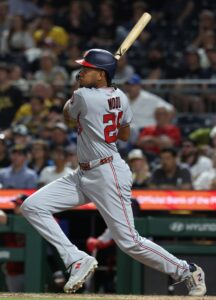
Turning to the individual players, the memory of Juan Soto is powering the Nationals’ lineup in 2026. Shortstop CJ Abrams and outfielder James Wood, both of whom came to Washington in the Soto trade, are tearing the cover off the ball. In fact, they’re both outhitting Soto himself. Wood, the leadoff hitter, is pacing the majors in runs scored, while Abrams, batting cleanup these days, ranks third in RBI. They’re each among the top 20 qualified hitters in OPS and wRC+.
Wood is hitting for a bit more power, and his 17.5% walk rate leads the National League. Abrams puts the ball in play more often, and he’s been flirting with a .300 average for much of the year. The question for Abrams going forward is whether he can avoid another midseason collapse. He started strong in 2024 and ’25 before struggling badly in each season’s second half. As for Wood, the only question is how high he can climb. The numbers are already remarkable, and the way he impacts the baseball suggests his ceiling is even higher. His .393 wOBA ranks 11th among qualified NL batters, but his .425 xwOBA leads the Senior Circuit.
After Wood and Abrams, Daylen Lile is the team’s only other qualified hitter with a wRC+ above league average. That goes to show how much Washington’s two best hitters have done for this offense, but Lile deserves his fair share of credit as well. The left fielder isn’t lighting the world on fire like he was down the stretch last year, but he has continued to be a power threat against right-handed pitching. A deeper team might platoon him more often, but his overall 112 wRC+ is solid, even if a 78 wRC+ against southpaws is dragging that number down.
Speaking of platoons, the Nationals’ best hitter this season – without any playing time minimums – has technically been Joey Wiemer. The righty-batting outfielder began the season by reaching base safely in his first 10 trips to the plate. All in all, he has slashed .300/.410/.529 with a team-best 165 wRC+ in 83 plate appearances. Wiemer’s track record and the underlying numbers made it clear that none of it was sustainable, and the Nationals saw that, optioning him in favor of Dylan Crews earlier today. Regardless, Wiemer is a part of this story, and a pretty important one at that.
So is fellow right-handed batter Curtis Mead, who is finally starting to look like the promising hitter he was in the Phillies’ and Rays’ minor league systems. A .213 isolated power and more walks than strikeouts through 114 plate appearances have resulted in a 133 wRC+. Washington has shielded the infielder from same-handed pitching, but to his credit, his early numbers are equally strong against lefties and righties alike. While the sample is small, Mead is swinging at the right pitches and hitting the ball hard. The Nationals are surely grateful the White Sox designated him for assignment at the beginning of the year.
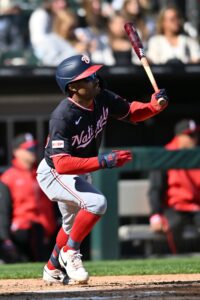
One last player worth highlighting is Nasim Nuñez. With a .187 batting average and a 54 wRC+, the second baseman has hurt his team’s offense more than he’s helped. Still, he walks enough that he gets on base at a passable rate, and once he reaches base, he might be the most dangerous player in the game. His 20 stolen bases are tied for the MLB lead, while his 3.4 baserunning run value (per FanGraphs) ranks second to only José Ramírez. That accounts for two-thirds of the Nationals’ league-leading 5.1 baserunning runs.
I’ve only touched on six of the 14 players who have stepped to the plate for the Nationals this year, and one of them isn’t even on the active roster anymore. That’s a big reason why this level of success doesn’t seem sustainable. Wood is the closest thing this offense has to a sure bet, and he’s still just a 23-year-old who has never hit this well over a prolonged period of time. The Nationals earned their 262 runs, and they earned the praise I’m giving them. Yet, this praise shouldn’t be confused with confidence. The Nationals have had the most successful offense in baseball over the first eight weeks of the season, but there are a whole lot of weeks left to play.
Stats up-to-date entering play on Tuesday, May 19. Images courtesy of Rafael Suanes, Charles LeClaire, and Patrick Gorski – Imagn Images
The Yankees’ Other Young Ace In The Making
If you weren’t familiar with Cam Schlittler before this season, I’m sure you are now. The 25-year-old owns an AL-leading 1.35 ERA across nine starts. The Yankees are 7-2 in his outings, and opposing batters are hitting .176 against the righty and his devastating three-fastball mix. With Tarik Skubal on the shelf, Schlittler has emerged as an early frontrunner to start for the AL All-Stars this summer in Philadelphia. Some might tell you he’s the Cy Young favorite, too. But Schlittler isn’t the only reason the Yankees’ starting staff has exceeded expectations in 2026.
Will Warren, 27 next month, has a 3.42 ERA through nine starts of his own. With 59 strikeouts, he’s tied with Schlittler for fourth-most in the American League. His 5-1 record also matches Schlittler’s, as does New York’s 7-2 record in his starts. Under the hood, the numbers are just as impressive. Warren ranks among the AL’s top 10 qualified arms in xERA and FIP, while his xFIP and SIERA put him into the league’s top five. The only AL pitchers ahead of him in all four metrics are Schlittler, Dylan Cease, and Jacob deGrom.
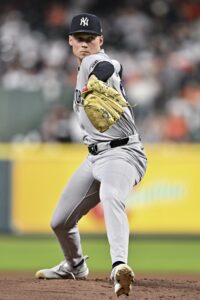
One thing all of those “ERA estimators” appreciate is the significance of strikeouts, walks, and their relationship to one another. Warren’s strikeout rate is up from 24.1% in 2025, his first full season, to 29.8% in 2026. His walk rate has dropped by nearly one third, from 9.1% to 6.1%. Accordingly, his 23.7% K-BB% (strikeout rate minus walk rate) is more than 10 percentage points higher than the league average for a starting pitcher. K-BB% is a stat that stabilizes relatively quickly. It’s also one of the strongest predictors of future run prevention. Warren still needs to prove he can pitch this well over a full season, but his much-improved K-BB% is a powerful indicator that his early success is more than smoke and mirrors. Schlittler is turning heads with a 24.8% K-BB% after 202 batters faced. As far as strikeouts and walks are concerned, Warren has been almost equally excellent in a similar-sized sample.
It isn’t hard to see that Warren has been pitching better than he was last year. It’s a little harder to understand how and why. His strikeouts are up and his walks are down, but he isn’t throwing substantially more pitches in the strike zone or generating more swings. His swing-and-miss rate is middle of the pack, while his chase rate is well below league average. Even more curiously, his strikeout and whiff rates are down on his sweeper, which was widely considered his bread and butter in his prospect days. When Warren put up a 4.44 ERA in 33 starts last season, many were quick to note that he did so despite opponents hitting .336 with a .569 slug against his supposed “best pitch.” Instead of being a weapon, it was the least effective sweeper in the game, with a run value of -10, per Baseball Savant. So, it would have made perfect sense to presume that Warren needed to harness his sweeper if he was going to take the next step.
It would have made perfect sense, and yet… the explanation for his success isn’t that simple. Warren throws his four-seam fastball, sinker, and sweeper each about one third of the time against right-handed batters. When he doesn’t have the platoon advantage, he also mixes in a changeup and a curveball to keep lefty batters on their toes. All five of those offerings have above-average (or better) raw stuff this year, according to models like Stuff+ and PitchingBot at FanGraphs.
However, most of his pitches had good stuff last year too. What Warren has really improved in 2026, according to those models, is his command, specifically on his four-seam, sweeper, and changeup. Indeed, a glance at his heat maps will confirm that he’s been hitting his spots with those pitches more frequently. He isn’t letting his four-seam fastball drift to the sides, he’s wasting fewer sweepers, and he’s punishing opposite-handed hitters with his changeup low and away. The righty might not be throwing more pitches in the zone, but he’s throwing pitches where he needs to throw them to earn more strikes.
Just as consequential as where Warren is throwing his pitches is when and where he’s throwing them in relation to one another. In other words, all five of his pitches work in tandem. His changeup works because it plays off his sinker. His sinker works because he pairs it with his four-seam. They all work because his sweeper gives him such a different look. His arsenal is more than the sum of its parts.
To that point, Stuff+ and PitchingBot give Warren strong scores for the stuff and location of each of his individual pitches, but his overall scores – scores that take into account physical pitch characteristics, pitch locations, and situational usage for his entire arsenal – are nothing short of elite. His 118 Pitching+ (a sister metric to Stuff+) ranks third among qualified arms across MLB, trailing only stuff god deGrom and stuff prodigy Jacob Misiorowski. Warren’s overall PitchingBot score is even better, leading all 79 qualified pitchers in the major leagues. It may be just one metric, but it’s a metric that puts him ahead of names like deGrom, Skubal, Skenes… and Schlittler. Pitching+ and PitchingBot aren’t stats you hear about every day, but they’re powerful tools for predicting rest-of-season runs allowed in smaller samples. When all is said and done, what matters is preventing runs and winning ballgames. The pitch models tell us that Warren has the skills to do exactly that.
Gerrit Cole has been out all season. Carlos Rodón only just returned. If Clarke Schmidt pitches at all this year, it won’t be until the latter half of the schedule. Luis Gil is hurt too, and even before he landed on the Triple-A injured list, he was pitching like something was wrong. Those four pitchers made up the Yankees’ rotation as recently as the 2024 World Series. Yet, even without meaningful contributions from any of them, New York’s starters lead the Junior Circuit in wins, xERA, and FanGraphs WAR. Their 3.14 ERA ranks second, and their 16.5% K-BB% ranks third. Not all of that is Warren’s doing – he’s had plenty of help from Schlittler, Max Fried, and Ryan Weathers – but it would be hard to overstate how much he has meant to his team so far in 2026. Cole, Fried, Rodón, and now Schlittler are much bigger names, but Warren is looking like another future ace for New York.
Photos courtesy of Maria Lysaker, Imagn Images.
Astros Select J.P. France, Taylor Trammell
April 10th: The Astros announced the expected moves today. Trammell and France have been added, with Blanco transferred to the 60-day IL. Javier’s injury was listed as a grade two shoulder strain and Meyers’ is a grade two oblique strain. Both are retroactive to April 9th.
April 9th, 11:13 am: Brian McTaggart of MLB.com reports that the Astros are also planning to select outfielder Taylor Trammell. This almost certainly indicates that fellow outfielder Jake Meyers is headed to the injured list. Meyers exited on Wednesday with lower back tightness. Like France, Trammell will require a spot on the 40-man roster, and currently, Houston only has one opening. That means the Astros will have to free up one more space to add both France and Trammell before tomorrow’s game. Ronel Blanco, who is recovering from Tommy John surgery last June, is a likely candidate to move from the 15-day IL to the 60-day IL.
Trammell, 28, is a five-year MLB veteran. After bouncing from the Mariners to the Dodgers to the Yankees in 2024, he was traded to the Astros ahead of the 2025 campaign. A pair of IL stints limited him to 52 games for Houston, though that was still a career-high for the lefty batter. He slashed .197/.296/.333 with an 80 wRC+, mostly splitting his time between left and center field. He was DFA’d and sent outright to Triple-A after the season. However, a hot spring (.904 OPS, 136 wRC+) and an even hotter start for Sugar Land (1.003 OPS, 177 wRC+) have earned him another chance in the majors. He’s likely to serve as at least the strong half of a platoon in center field while Meyers is on the shelf.
10:00 am: The Astros will select J.P. France’s contract from Triple-A Sugar Land before tomorrow’s game against the Mariners, reports Chandler Rome of The Athletic. He will be able to take the 40-man roster spot left vacant after Roddery Muñoz was designated for assignment on Monday.
As for the 26-man roster, there’s a good chance France is replacing Cristian Javier, who exited his start on Wednesday with shoulder tightness. It’s also possible the Astros won’t be ready to make a decision about Javier by tomorrow, but that they still want a fresh arm for the bullpen, given the workload their relievers shouldered in yesterday’s 9-1 loss. In that case, they might consider optioning AJ Blubaugh, who has given up nine runs on nine hits in his last two outings. Meanwhile, Spencer Arrighetti is the most likely candidate for a call-up if Houston needs a longer-term replacement for Javier in the rotation. Jason Alexander is also available at Triple-A.
France, 31, made 23 starts for the Astros in 2023, his rookie campaign. Unfortunately, a shoulder injury ruined his next two seasons. He made just seven appearances for Houston between 2024 and ’25 and struggled in a handful of minor league outings as well. The team designated him for assignment this past offseason and sent him outright to Triple-A. However, if the early results from 2026 are any indication, France seems to be throwing with a healthy shoulder again. He struck out 13 batters in 11 2/3innings this spring and another eight in his first 5 1/3 frames for the Sugar Land Space Cowboys. The righty has yet to allow a run at Triple-A, with just one walk and two hits allowed to the 19 batters he’s faced.
If France can get back to pitching the way he did in 2023 – whether he’s starting or working in long relief – the Astros will surely be grateful. Through 13 games, Houston’s pitchers have the highest ERA in the AL (6.05). Walks and home runs have both been serious problems. What’s more, two of the team’s most important arms are on the injured list: Hunter Brown (shoulder strain) and Josh Hader (biceps tendinitis). Losing Javier for any period of time would only further weaken a beleaguered staff. While the team still has depth arms to call on for the rotation and the bullpen, those options are starting to wear thin.
Dodgers Release Nick Nastrini
The Dodgers have released Nick Nastrini, according to his transaction log on MLB.com. The right-hander made one appearance for the Tulsa Drillers, L.A.’s Double-A affiliate, earlier this season. He failed to record an out and walked all three batters he faced.
Nastrini, 26, began his professional career in the Dodgers organization. They took him in the fourth round of the 2021 draft, and he worked his way up to Double-A Tulsa. He was traded to the White Sox ahead of the deadline in 2023, along with Trayce Thompson and Jordan Leasure, in the deal that sent Lance Lynn and Joe Kelly back to L.A.
The following season, Nastrini made his MLB debut for the White Sox, pitching in nine games (eight starts). Unfortunately, the righty went 0-7 with a 7.07 ERA. He finished with more walks (36), hits (32), and earned runs (28) than strikeouts (26).
Nastrini has not appeared in the majors since September 2024. He started the 2025 season down at Triple-A Charlotte. The Marlins and then the Dodgers claimed him off waivers in quick succession last July, and he finished the 2025 Triple-A season with an 8.56 ERA in 47.1 innings for three organizations. Once again, he walked more batters (50) than he struck out (49). Now a free agent, he is eligible to sign with a new organization that can hopefully help him improve his command and get back to the big leagues.
Nationals Have Not Yet Made Extension Offer To Daylen Lile
The Nationals only have one player on a guaranteed contract past the 2026 season: catcher Keibert Ruiz, who signed an eight-year, $50MM extension ahead of the 2023 campaign. So, president of baseball operations Paul Toboni should have plenty of financial flexibility for 2027 and beyond. After all, his team’s payroll right now is less than half of what it was during Washington’s World Series-winning 2019 season. As Spencer Nusbaum of The Athletic recently acknowledged, some of those savings have been put toward improving the club’s scouting and player development. Even so, it would be surprising if Toboni weren’t at least considering extending any of the Nationals’ talented young players.
If there’s anyone the Nationals and their fan base would most love to lock up long-term, it’s outfielder James Wood. However, the All-Star slugger isn’t the only extension candidate on the roster. He isn’t even the only left-handed hitting, 23-year-old, corner outfield extension candidate on the roster. And while this second outfielder might not be a star of Wood’s stature, he would certainly be easier (and less expensive) for Washington to extend: Daylen Lile.
Nusbaum wrote about Lile earlier this week. Crucially, he acknowledged that “the Nationals have yet to broach Lile with an extension offer.” Meanwhile, Lile’s thoughts on the matter boiled down to “whatever happens, happens.” Yet, Nusbaum also reported that Beverly Hills Sports Council, Lile’s agency, is “always open to engaging with teams in extension conversations.” Two of their notable clients include Jackson Chourio and Kristian Campbell, both of whom signed similar early-career extensions. It’s worth noting that Lile already has more MLB service than either Chourio or Campbell had when they signed their deals, and he was never anywhere close to being the same caliber of prospect. In other words, Chourio and Campbell are far from perfect comps. Nonetheless, it does matter that Lile’s representatives are open to negotiating this type of contract, especially because Wood’s agency, Boras Corporation, has a reputation for opposing pre-arbitration extensions. (Although, the deal that fellow Boras client Cooper Pratt just signed is proof that’s not a hard-and-fast rule).
Lile debuted last May and earned a regular role in the starting lineup by mid-June, looking more and more comfortable as his rookie year went on. His .956 OPS in the second half ranked second among qualified NL hitters, trailing only MVP Shohei Ohtani. His 1.212 OPS in September bested even Ohtani’s, and his 1.83 Win Probability Added in the month was the highest in Major League Baseball. All told, Lile finished his first MLB campaign with an .845 OPS and a 132 wRC+. He hit nine home runs, 15 doubles, and an incredible 11 triples in just 91 games. His strikeout rate and whiff rate both put him among the best 20% of hitters in the league. Only three players took as many trips to the plate as Lile and posted both a higher contact rate and a higher isolated power: José Ramírez, Cody Bellinger, and Isaac Paredes. At season’s end, 11 of 30 BBWAA voters named Lile on their NL Rookie of the Year ballots. He finished fifth.
The sample was small, just 351 PA, and Lile’s success was largely limited to one red-hot month within that already small sample. He also dragged his overall numbers down with shockingly poor defensive metrics (-14 DRS, -8 OAA, -10 FRV) and disappointing baserunning for a player with his speed (8-for-14 in stolen base attempts). Still, he demonstrated real promise, giving himself a strong foundation to build upon in his first full MLB season. Nusbaum notes that evaluators within the Nationals organization “believe in the bat.”
So, despite Lile’s slow start in 2026 – his swing decisions have been worse, and his groundball rate has spiked – it’s not hard to see why an extension might appeal to Washington’s front office. Lile showed off his high ceiling in 2025, but he remains far from a sure thing. If the Nationals truly believe in his bat, now would be their chance to secure him beyond his arbitration years before his price shoots up.
White Sox Place Austin Hays On IL, Select Dustin Harris
As manager Will Venable told reporters last night (including James Fegan of Sox Machine), the White Sox have placed Austin Hays on the 10-day injured list with a right hamstring strain. In a corresponding move, they selected the contract of Dustin Harris from Triple-A Charlotte. Mike Vasil has been transferred from the 15-day IL to the 60-day IL to free up space on the 40-man roster.
Hays, 30, signed a one-year, $6MM contract with the White Sox this offseason. He started in left field in eight of Chicago’s first 10 games, though he was off to a slow start, with a .586 OPS and a 56 wRC+ through 33 trips to the plate. During the fourth inning of yesterday’s game, Hays injured his hamstring while tracking down a fly ball. It was immediately apparent he was hurt as he hopped the last several feet toward the ball, and he exited after the play. The White Sox have not yet revealed the severity of the strain.
With no more healthy position players left on their 40-man roster, the White Sox called on Harris to replace Hays. The 26-year-old signed a minor league contract with Chicago this past winter. He appeared in 21 games with the Rangers from 2024-25, playing all three outfield positions and slugging two home runs and four doubles. While his days as a top-10 organizational prospect for Texas are behind him, he runs well and once flashed promising power with his lefty swing. Unfortunately for Harris, the fact that he’s a lefty batter could make it difficult for Venable to get him in the lineup; fellow White Sox outfielders Andrew Benintendi and Tristan Peters also bat left-handed.
As for Vasil, this move was inevitable. The right-hander recently underwent Tommy John surgery and will sit out the 2026 season. After they swapped Harris in for Vasil, the White Sox’s 40-man roster remains full, though they will be able to move Brooks Baldwin to the 60-day IL the next time they need a 40-man spot. Baldwin recently underwent a season-ending internal brace procedure.
Brooks Baldwin Undergoes Internal Brace Procedure
White Sox utility player Brooks Baldwin underwent an internal brace procedure to repair his right UCL earlier this month. The team broke the news to reporters (including MLB.com’s Scott Merkin) this morning. Baldwin will miss all of the 2026 season, but he is expected to be ready to go for spring training in 2027.
The White Sox selected Baldwin in the 2022 draft. Though he was never a highly-ranked prospect, he hit his way up the minors in 2023 and ’24 and debuted in the second half of the 2024 season. His first taste of the majors wasn’t pretty (.566 OPS, 59 wRC+ in 33 games), but he made some meaningful improvements the following year. In 2025, Baldwin significantly increased his hard-hit rate and more than doubled his barrel rate, finishing with 11 home runs, 27 extra-base hits, and a wRC+ that was only 8% below league average. His walk rate was low, he grounded into a fair number of double plays, and his defensive metrics were shockingly poor across the board. Still, given his near-average offense and impressive versatility (he played second, third, shortstop, and all three outfield positions), it wasn’t hard to imagine the switch-hitting Baldwin blossoming into a productive major league utility player.
The 25-year-old appeared in eight games this spring before the White Sox shut him down with elbow soreness. He was hoping to compete for a more regular role with the club in 2026, likely in center field. Now, he will have to wait until 2027 to try to prove he can take his next step forward at the big league level.
In addition to Baldwin, Chicago recently lost fellow outfielders Austin Hays (hamstring) and Everson Pereira (ankle) to the injured list. Catcher Kyle Teel (hamstring) has also been on the IL since the World Baseball Classic. The team has no more healthy position players on its 40-man roster, though experienced major leaguers such as LaMonte Wade Jr., Jarred Kelenic, and Korey Lee are available at Triple-A.
Guardians Place Gabriel Arias On 10-Day IL, Recall Juan Brito
The Guardians announced this morning that they have placed Gabriel Arias on the 10-day injured list with a left hamstring strain. To replace Arias on the roster, the team recalled fellow infielder Juan Brito from Triple-A Columbus. Brito will make his major league debut in today’s game against the Royals, playing second base and batting sixth (per MLB.com’s Tim Stebbins). Guardians Prospective reported last night that Brito would be getting the call.
Arias, 26, took over as Cleveland’s primary shortstop last season and held onto the role entering 2026, starting at short in 10 of his team’s first 11 games. His offense leaves much to be desired – he owns a career .632 OPS and 76 wRC+ in 330 games – but he has proven to be a capable defender, with 2 DRS and 7 OAA in 1,484 innings at shortstop. Arias exited early yesterday with hamstring tightness and went for an MRI. The Guardians have yet to offer further details about the severity of his injury, but evidently, they decided he’ll need to miss at least the next 10 days.
In place of Arias, Brayan Rocchio is likely to take over at shortstop. Rocchio, 25, was Cleveland’s regular shortstop in 2024 and early 2025 before moving to second base. Like Arias, he has yet to show he can make much of an impact at the plate (career .622 OPS, 78 wRC+ in 292 games), but he was a Gold Glove finalist at shortstop in 2024 after posting 11 DRS and 5 OAA in 1,102 innings.
As for Brito, it looks like he will get a chance to prove himself at the keystone. The 24-year-old is generally considered one of the Guardians’ top 20 prospects. Entering the season, MLB Pipeline ranked him No. 16, while Baseball America put him at No. 15 and Baseball Prospectus at No. 14. The Athletic’s Keith Law was a little more optimistic about Brito, placing him at No. 9 before the season, while FanGraphs was less sold, putting him all the way down at No. 32 on their organizational list. He may have been difficult for some to rank entering the year because he missed most of 2025 with injuries, and because his future defensive home is still unclear. Those who are higher on Brito see him as a capable everyday second baseman, while others envision him as more of a utility player. He has hit consistently well at Triple-A in parts of several seasons, with 24 home runs, a 13.9% walk rate, and an .811 OPS in 182 games. A switch-hitter, Brito doesn’t necessarily need to be platooned, but the lefty-batting Daniel Schneemann and fellow switch-hitter Angel Martínez can also play second base if needed. Meanwhile, top prospect Travis Bazzana will stay at Triple-A for now, but he is certainly a candidate to play second base for the Guardians at some point in 2026.