
Brewers Outright Mitch White
Brewers right-hander Mitch White went unclaimed on outright waivers and has been assigned to Triple-A Nashville, reports Todd Rosiak of the Milwaukee Journal-Sentinel. He’s been outrighted once in the past, so he’ll have the opportunity to reject the assignment in favor of free agency, if he prefers to look for opportunities elsewhere.
The Brewers acquired White from the Giants in exchange for cash last month. San Francisco had also designated the right-hander for assignment prior to that swap. White made six appearances with the Brewers, pitching 8 1/3 innings and yielding six earned runs on eight hits and four walks (two of them intentional). He punched out six batters. On the season as a whole, White has tossed 23 2/3 innings and been roughed up for a 7.23 ERA between the Blue Jays, Giants and Brewers. He’s fanned just 11.8% of his opponents against a matching 11.8% walk rate.
Once a prospect of note within the Dodgers organization, the now-29-year-old White has pitched in parts of five big league seasons. The 2016 second-rounder had a nice early-career run in L.A. but has struggled since being traded away from Los Angeles. In 105 2/3 frames as a Dodger, White recorded a 3.58 ERA with a 22% strikeout rate and 8.3% walk rate. He’s since pitched to a 5.45 ERA with a diminished 17.7% strikeout rate between the Blue Jays, Giants and Brewers.
If he accepts his outright assignment, he’ll stick with the Brewers organization and suit up for their Triple-A affiliate, the Nashville Sounds, while hoping to pitch his way back into another major league opportunity. If he opts to test free agency, he’ll likely find some interest on minor league deals from clubs seeking to stockpile experienced pitching depth.
Orioles Designate Thyago Vieira For Assignment
The Orioles announced Monday that they’ve designated right-hander Thyago Vieira for assignment. His spot on the roster will go to top infield prospect Connor Norby, whose previously reported promotion to the big leagues has now been formally announced by the team. Baltimore also placed infielder/outfielder Jorge Mateo on the 7-day concussion list and recalled left-hander Nick Vespi from Triple-A Norfolk.
The Orioles only recently acquired the 30-year-old Vieira in a trade with the Brewers, who’d also designated him for assignment. Baltimore added Vieira and righty Aneuris Rodriguez, sending minor league right-hander Garrett Stallings back to Milwaukee. Based on the way things played out with Vieira, it seems Rodriguez was the more interesting component of that swap for the O’s.
Vieira made only one appearance as a member of the Orioles, and went about as poorly as a debut could go. The right-hander faced five hitters but didn’t retire any of them, yielding a hit and four walks before being lifted from the game. He wound up being charged with three runs in what could very well end up an extremely brief stay in the organization.
Vieira is one of baseball’s hardest throwers, averaging 98 mph on a fastball that has often touched triple digits. He’s now appeared in 17 big league games this season and yielded runs in ten of them, however. In 22 1/3 frames between the Brewers and O’s, he’s logged an ugly 6.85 ERA. Despite his premium velocity, Vieira’s shaky command has undercut his ability to pile up strikeouts. This year’s 22.5% strikeout rate is effectively league-average (22.3%), but his 15.3% walk rate is one of the highest marks in baseball. He’s also struggled with home runs, yielding an average of 2.42 big flies per nine innings.
Though his MLB experience is limited, Vieira had a mostly solid run with Japan’s Yomiuri Giants in Nippon Professional Baseball from 2020-22. Command was still a problem for him even when pitching overseas, but he notched a 3.61 ERA there and whiffed 26.2% of his opponents. His pre-NPB track record in the majors was nearly as spotty as his results so far in 2024, however. Overall, he’s totaled 51 MLB innings but posted a 6.71 ERA with a 20.7% strikeout rate and 13% walk rate. The Orioles will have a week to trade Vieira, attempt to pass him through outright waivers, or release him.
As for Mateo, he’ll head to the concussion list on the heels of a freak injury. He was clipped in the head by teammate Cedric Mullins‘ bat when Mateo reached into the on-deck circle to grab a weight for his bat (X link with video). Ramon Urias subsequently pinch-hit for Mateo.
Once the Orioles’ primary shortstop, Mateo has instead seen the bulk of his action at second base this year, in addition to four appearances in center and two at his now-former shortstop slot. He’s hitting .246/.294/.447 with three homers and ten stolen bases in 128 plate appearances on the year.
Twins Option Edouard Julien; Royce Lewis Expected To Return Tuesday
The Twins have optioned second baseman Edouard Julien to Triple-A St. Paul, per the team’s transaction log at MLB.com. Dan Hayes of The Athletic reported last night that the move was likely on the horizon, as the Twins need to clear roster space for the return of infielder Royce Lewis, who’s expected to join the team tomorrow for their series opener against the Yankees.
Julien, 25, graduated from top prospect status to the Twins’ apparent everyday second baseman last year when he hit .263/.381/.459 with 16 homers in 408 plate appearances as a rookie. Minnesota felt comfortable enough with the Canadian-born slugger at second base that they traded stalwart infielder Jorge Polanco to the Mariners this offseason when looking for ways to pare back the payroll.
Julien hit .223/.330/.500 with seven homers through the end of April, but he’s since fallen into a slump that’s seen him post a bleak .169/.274/.181 slash over a span of 95 trips to the plate. He’s still walking at a hefty 12.6% clip but has also fanned at a 38% rate during that slump (and in 34% of his plate appearances on the season overall). Julien’s extremely patient approach has helped him walk in nearly 15% of his MLB plate appearances, but that patience can border on passivity as well. Jonathan India is the only qualified hitter in baseball who’s swung at fewer pitches than Julien’s 37%.
The monthlong slump will make Julien the roster casualty for the return of Lewis, who’s been Minnesota’s best hitter when healthy dating back to his 2022 debut. Injuries have marred Lewis’ career to date — he’s twice torn his right ACL and has been out since Opening Day due to a quad strain — but the 2017 No. 1 overall draft pick is a .313/.369/.564 hitter (159 wRC+) in 282 MLB plate appearances. He also swatted four homers in 26 postseason playoff appearances last year (in addition to homering in his first at-bat of the 2024 regular season).
With Lewis reclaiming the regular third base job and Julien headed to St. Paul, the Twins’ infield will take on a different look. Jose Miranda has been the team’s primary third baseman and, after a lost 2023 season, has reemerged as a key contributor. The 25-year-old Miranda (26 later this month) is another former Twins top prospect who impressed as a rookie in 2022, popping 15 homers and batting .268/.325/.426 in 483 plate appearances. He tried to play through a shoulder impingement that eventually required surgery last season, hitting just .211/.263/.303 in 40 big league games.
Now that his shoulder is back at full strength, Miranda looks like his old self. He’s taken 151 turns at the plate and delivered a quite-productive .280/.311/.469 slash with six homers and nine doubles. Miranda doesn’t walk much (3.3% this season, 5.3% career) but puts the ball in play at a very high rate (14.6% strikeout rate this year, 17.4% career) and has plenty of extra-base pop. Though he played some second base in the minors, it doesn’t seem likely he’ll do so at this point. He’ll rotate between the infield corners and designated hitter, but utilityman Willi Castro figures to pick up the bulk of playing time at second base. The switch-hitting Castro is out to a .260/.335/.420 start and has experience playing all over the diamond.
The Twins could’ve made a more aggressive roster decision, cutting ties with a struggling veteran instead. But Carlos Santana has rebounded from an awful start to bat .253/.340/.434 over the past 30 days. Kyle Farmer and Manuel Margot both have ugly numbers on the whole, but as Hayes notes, Margot is hitting left-handers fairly well and Farmer is valued both for his defensive versatility and his leadership in the clubhouse. Optioning Julien also preserves depth in a way that parting with someone like Farmer or Margot would not; both players could reject outright assignments to the minors in favor of free agency.
The Twins’ infield crunch falls into the “good problem to have” bucket of cliches. Julien’s demotion certainly doesn’t change the organization’s view that he can be a valuable long-term contributor, but he’ll head to Triple-A for what’s likely to be a relatively short-term reset. Presumably, in the event of an injury in the infield or at just about any non-catcher spot among the team’s position-player corps, Julien would be the first man back up. (Castro could slide right back into a super-utility role or into an everyday outfield role.)
From a service time vantage point, Julien’s slump could potentially cost him, however. He entered the season with 135 days of MLB service. Had he stayed in the majors for good, he’d have been a slam-dunk Super Two player following the 2025 season. It’s still possible he reaches that designation but is now far from a sure thing. Julien has already reached one full year of MLB service, so this assignment won’t impact his timeline to free agency, but it could potentially cost him a fourth trip through the arbitration process.
The One-Year Anniversary Of Yusei Kikuchi’s (New) Curveball
Few pitchers have had an up-and-down career in the majors like Yusei Kikuchi. The former Seibu Lions star made the jump from Nippon Professional Baseball to Major League Baseball in the 2018-19 offseason when he signed a four-year, $56MM contract with the Mariners. That deal contained a series of complicated options that allowed the Mariners to pick up an additional three years of control over Kikuchi — with that decision coming after year three of the contract — but also allowed the left-hander the opportunity to opt out if that three-year option was declined.
For much of Kikuchi’s time in Seattle, the four-year guarantee looked regrettable. Kikuchi made 32 starts in his rookie season but posted an ERA north of 5.00 with a lackluster 16.1% strikeout rate and velocity that didn’t line up with what he’d shown previously in Japan. The 2022 season brought some signs of encouragement, as the southpaw’s average fastball jumped by a hefty 2.5 mph (from 92.6 mph to 95.1 mph). Kikuchi saw a 50% increase in his strikeout rate, climbing from that ugly 16.1% mark to an above-average 24.2%. But his walk rate also jumped to nearly 11%, and he ultimately posted a second straight ERA north of 5.00.
Starting in early 2021, Kikuchi’s results took a turn for the better. He maintained the prior season’s velocity spike and strikeout gains but did so while improving his command. For a stretch of 11 starts in the middle of the 2021 season’s first half, Kikuchi was one of the most effective pitchers in baseball: 69 2/3 innings, 2.33 ERA, 27.5% strikeout rate, 8.3% walk rate, 58% ground-ball rate. Kikuchi was a deserving first-time All-Star and was pitching so well at the season’s midway point that I wrote about how he’d suddenly begun to make the question of whether to exercise a quartet of $16.5MM options one worth pondering. The extra four years and $66MM would’ve brought Seattle’s total commitment to the left-hander to seven years and $109MM in total.
Kikuchi wound up making it an easy call for the Mariners — though not in the way he and the team hoped. From July 5 through season’s end in 2021, the pendulum swung in the completely opposite direction for him. He was rocked for a 6.22 ERA as his walk rate spiked back over 10% and he became problematically homer-prone. Hackneyed as the line may be, 2021 was a true tale of two seasons for Kikuchi. A dominant, All-Star-caliber first half followed by a catastrophic second half in which he had the seventh-worst ERA of any pitcher with at least 60 innings pitched.
The Mariners unsurprisingly opted not to pick up their four-year, $66MM option on Kikuchi. While it originally looked as though Kikuchi would exercise his $13MM player option, he surprised some onlookers by instead declining that guaranteed sum and heading back to the market. There were plenty of critics at the time of his decision, but his eventual three-year, $36MM deal with the Blue Jays proved that he’d come out ahead on the gambit.
Kikuchi’s time in Toronto has been similar to his run with the Mariners. A disappointing first campaign saw him lose his rotation spot at one point and finish out the year with a 5.19 ERA in 100 2/3 innings. Heading into 2023, he wasn’t even guaranteed a spot in the rotation. And through his first 11 starts of the season, Kikuchi was again performing his typical highwire act. His 4.47 ERA was passable, but the lefty was averaging a staggering 2.4 homers per nine frames and showing a diminished 21.5% strikeout rate.
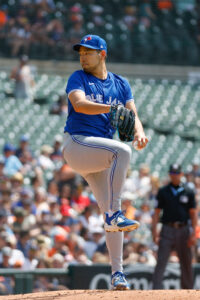
On June 4, something interesting happened. Kikuchi threw a curveball. It’s an unremarkable statement in and of itself, but it was the first time Kikuchi had thrown a hook since his rookie season in Seattle. Scouting reports on Kikuchi when he was headed stateside for the first time praised his curve as one of his top pitches, in fact. But major league hitters absolutely teed off against the pitch in 2019, posting an outrageous .353/.371/.632 slash against the suddenly ineffective curveball.
Kikuchi scrapped the pitch entirely for the 2020-22 seasons and hadn’t thrown it through 11 starts in ’23. For the remainder of the season, just under 13% of Kikuchi’s pitches were curveballs, per Sports Info Solutions. This, however, wasn’t the same curveball he showed in that rookie season. Kikuchi’s 2019 hook averaged just over 75 mph, featuring a huge 63.7 inches of vertical break and 6.9 inches of horizontal break, per Statcast.
The new breaker is a harder, sharper curveball that sits 83 mph with 43.5 inches of vertical break and 4.4 inches of horizontal break. The esteemed Rob Friedman — aka Pitching Ninja — has highlighted the offering on several occasions since last June. Compare that to this video of Kikuchi’s old curveball, and you can see it’s an entirely different pitch. The new curve wasn’t a dominant pitch last year — opponents hit .277/.306/.447 in plate appearances ending with a curveball — but the change in repertoire seemingly helped keep hitters off balance and make his other pitches more effective.
The 2024 season has been another story. Kikuchi has fully embraced the new curveball by throwing it at a 28% clip, and batters have been almost wholly unable to do damage against the pitch. Opponents are hitting .258/.290/.318 in 69 plate appearances that have ended with a curve, and their only four extra-base hits have been doubles. Nearly 53% of batted curveballs against Kikuchi have been grounders. This has helped him tamp down his longstanding struggles against right-handed opponents, and Statcast lauds the curveball as a plus pitch, giving opponents an “expected” .221 batting average, .293 slugging percentage and .240 wOBA against the pitch.
The uptick in curveballs has led Kikuchi to use his slider and changeup at some of the lowest rates of his career. All three of his non-fastball pitches have flummoxed opponents this season. His heater is averaging a career-high 95.6 mph despite Kikuchi pitching in his age-33 season, but it remains hittable and has been his weakest pitches in terms of opponent results. However, the incorporation of an effective curveball also makes it harder for opponents to sit on the heater.
Through 11 starts this season, Kikuchi has posted a 3.25 ERA. He’s totaled 61 innings, fanned 24.1% of opponents against an outstanding 5.1% walk rate and kept the ball on the ground at a solid 44.1% clip. Kikuchi is still giving up a fair bit of hard contact (mostly on that heater) and will surely see his tiny 7.7% homer-to-flyball ratio trend tick upward. League average tends to be in the 12-13% range, and Kikuchi’s career mark is 17.4%. Even with a couple extra homers on his 2024 ledger, however, Kikuchi would look like a clearly above-average starter.
And it’s not just the 2024 season where he’s been effective with this new offering. It’s now been almost one year to the day since Kikuchi broke out the new curveball, and his numbers over the past calendar year could catch some onlookers by surprise. His 3.45 ERA ranks 12th among 78 qualified starting pitchers, and he’s 28th in total innings (172 1/3). By measure of FanGraphs’ version of WAR, which is calculated off his 3.09 FIP rather than his raw run-prevention numbers, Kikuchi has been baseball’s fifth-most valuable pitcher. RA9-WAR, which is simply based on the number of runs he’s allowed (rather than FIP) has Kikuchi tied for 18th.
Regardless of one’s preferred method of pitcher evaluation, Kikuchi has been one MLB’s 10 to 20 best starters over the past calendar year — a remarkable turnaround for someone who entered the 2023 campaign fighting for a rotation spot with the team whose rotation he’s now anchoring.
Kikuchi’s gains are all the more interesting in light of the Blue Jays’ disappointing 2024 campaign. Toronto currently sits at 26729 on the season, placing them last place in the hyper-competitive AL East. They’ve rattled off four straight wins but are still 11.5 games out of first place in the division and 4.5 games out of a Wild Card spot (with three teams standing between Toronto and the third spot, currently held by the Twins). The Blue Jays’ playoff odds are hardly shot, but they’ve undeniably diminished relative to their preseason projections. There’s already speculation about the potential of a sell-off, with names like Bo Bichette and Vladimir Guerrero Jr. the subject of particular wishcasting.
But if the Jays do end up selling, it’s Kikuchi — not Bichette, Guerrero, Chris Bassitt, etc. — who stands as Toronto’s likeliest trade commodity. He’s playing out the final season of that three-year, $36MM deal and earning what now looks like a highly reasonable $12MM salary. The majority of contending clubs should be able to absorb some or all of the remaining salary on his deal, although the Jays could always offer to pay it down in order to sweeten a return. Kikuchi has pitched himself into qualifying offer candidacy, so the Jays would likely need some real prospect value to come their way in order to make the trade, but so long as he continues pitching close to his pace over the past 365 days, that’d also be a reasonable ask.
Further, Kikuchi’s status as an impending free agent makes his past calendar year all the more intriguing. If he can make another 20 or so starts at this pace, he’ll hit the market on the back of an impressive run and be able to stake his claim as one of the better mid-tier starters on the market. He’s not going to elevate himself into the Corbin Burnes or Max Fried tiers of the upcoming free-agent market, but another lucrative three-year deal would be in play. Both Bassitt and Sonny Gray scored three-year pacts at annual rates higher than $20MM covering the same age-34 to age-36 seasons Kikuchi will be peddling.
Kikuchi has a ways to go before he’s squarely in that conversation, his turnaround over the past year has him heading in that direction. It’s worth pointing out that he lasted only three innings during his last start, showing reduced velocity and failing to record a strikeout. That could be a red flag, but it could also just be a blip on the radar. The Jays haven’t pointed to any kind of medical issue for Kikuchi. We don’t know if there’s an injury, illness, pitch tipping or simple fatigue at hand, or whether it was just off day for the lefty.
What we do know is that over the past year, very few pitchers have been more successful and more valuable than Kikuchi. Adding a new pitch isn’t always a ticket to greener pastures, but it certainly has been for Kikuchi, who’s shaping up to be a potential impact deadline arm and a much more appealing free agent than anyone could’ve reasonably expected a year ago.
Photo courtesy of USA Today Sports Images
Guardians Designate Estevan Florial For Assignment
The Guardians have designated outfielder Estevan Florial for assignment, tweets Zack Meisel of The Athletic. His spot on the roster will go to outfielder Steven Kwan, who’s been reinstated from the injured list and is back in the Cleveland lineup tonight.
Acquired from the Yankees in a December swap that sent right-hander Cody Morris back to New York, the out-of-options Florial won a spot on Cleveland’s Opening Day roster but has yet to hit with his new club. The once-vaunted prospect has appeared in 36 games with the Guards and tallied 111 plate appearances while mustering only a .173/.264/.367 slash. Florial has shown some extra-base pop, with three homers, six doubles and a pair of triples, but he’s also gone down on strikes in a staggering 36.9% of his plate appearances.
Strikeout woes are nothing new for Florial, who’s now punched out in 33.5% of his 245 big league plate appearances. Even as Florial put up gaudy numbers in Triple-A with the Yankees organization in 2022-23, he did so while fanning in three out of every ten trips to the plate. The Yankees largely left him in Triple-A to try to sort through his lack of contact skills, but it’s not a flaw that Florial has been able to overcome to this point.
Florial’s combination of power and speed has long been tantalizing, but he’s now a .192/.291/.329 hitter in the big leagues who can’t be sent to the minors without first clearing waivers. Another club that’s not in contention could perhaps afford to take a flier and place a waiver claim, but it’d be hard for any team with postseason aspirations to give Florial any kind of meaningful playing time when he’s clearly a project. The Guardians will have a week to try to trade him, pass him through outright waivers, or release him. If he clears outright waivers, Florial can reject the assignment and elect free agency by virtue of the fact that he’s been outrighted once in the past (with the Yankees in April 2023).
Rays Select Justin Sterner, Option Tyler Alexander
The Rays have selected the contract of right-hander Justin Sterner from Triple-A Durham, per a team announcement. He’ll be making his MLB debut when he first gets into a game. Left-hander Tyler Alexander was optioned to Durham in a corresponding move to create space on the active roster. Tampa Bay already had a vacancy on the 40-man roster, so no additional move was necessary. Their 40-man roster is now at capacity.
Sterner, 27, is a reliever whom the Rays acquired in 2021 swap sending right-hander David Hess to the Marlins. The 2024 season marks the third in which he’s logged time in Triple-A but the first in which he’s found much success. Sterner allowed eight runs in seven Triple-A frames back in 2022 and pitched to a 5.80 ERA in 35 2/3 innings there last season.
This year in Durham, however, Sterner has notched a much-improved 3.60 ERA in 25 innings, thanks in large part to huge gains in his ability to miss bats and limit walks. Sterner has fanned one-third of his opponents in Triple-A after posting a 26.1% strikeout rate a year ago. His 8.1% walk rate in 2024 is more than three percentage points south of last year’s 11.8% mark.
For the 29-year-old Alexander, this will be his first optional assignment since way back in 2019. The Rays acquired the southpaw via a November waiver claim after he’d been designated for assignment in Detroit. He’s effectively been the Rays’ fifth starter for much of the season, though only six of his 11 outings have been true starts. Alexander has frequently followed a one- or two-inning opener, but even his relief appearances have averaged five innings apiece this season.
Alexander had a decent stretch from mid-April to mid-May, but he’s been shelled for a dozen runs in just 9 2/3 innings over his past two appearances. He’s now yielded four or more runs in three of his past four outings. That ugly stretch has left the southpaw with a 6.19 ERA on the season, although fielding-independent metrics are more bullish (particularly his 4.09 SIERA). Alexander has a below-average 19.4% strikeout rate on the season but also a very sharp 5.3% walk rate. He’s also an extreme fly-ball pitcher (48.6% fly-balls, 29.6% grounders) who’s seen a larger-than-average 15% of his fly-balls leave the yard this year — an average of 2.06 homers per nine innings.
Alexander entered the season with 4.058 years of big league service time and is up to 4.122 as of this assignment. He’ll reach five full years of service with another 50 days on the active roster or major league injured list, at which point he’d gain the right to refuse an optional assignment to the minors. For now, he’ll get a reset in Durham while the Rays go with a rotation of Zack Littell, Aaron Civale, Taj Bradley and Ryan Pepiot.
Right-hander Zach Eflin went on the injured list due a lower back issue on May 20, and the Rays are awaiting returns from injured pitchers Jeffrey Springs, Drew Rasmussen and (in 2025) Shane McClanahan. Longtime top prospect Shane Baz could be a rotation candidate at some point as well. He very recently wrapped up his rehab from 2022 Tommy John surgery and was reinstated from the 60-day injured list and optioned to Triple-A himself.
Cardinals Place Lars Nootbaar On Injured List
The Cardinals announced Friday that outfielder Lars Nootbaar has been placed on the 10-day injured list, retroactive to May 30, with an oblique strain. Infielder Jose Fermin is up from Triple-A Memphis to take Nootbaar’s spot on the active roster. St. Louis also announced that reliever Giovanny Gallegos is headed to Memphis on a minor league rehab assignment.
Nootbaar, 26, missed the first two weeks of the season with a rib injury and will now head back to the injured list. He’s out to a .234/.337/.404 start to the season, with plenty of underlying indicators that improved performance could be on the horizon once healthy. Nootbaar’s 13.4% walk rate remains characteristically excellent, as does his 20.6% chase rate on pitches off the plate. He’s been slightly more aggressive on pitches within the strike zone this season, and Nootbaar’s 92.1 mph average exit velocity, 21.7% line-drive rate and massive 52.8% hard-hit rate are all career-high marks. Given the plate discipline and quality of contact, an uptick in his offensive output seems quite likely — provided this oblique injury doesn’t hinder him upon his return.
With Nootbaar headed to the injured list, the Cardinals will likely give more playing time in right field to Alec Burleson and Dylan Carlson. The switch-hitting Carlson is the vastly superior defender but has also posted a woeful .139/.244/.139 slash in a tiny sample of 41 plate appearances. Burleson is a poor defender but sports a far more impactful .289/.321/.428 slash with five homers in 160 turns at the plate.
Fermin was up with the big league club earlier this season but went just 3-for-18 with a trio of singles in that brief look. The 25-year-old has decimated Triple-A pitching this season, raking at a .346/.461/.615 pace with six homers and 10 doubles to along with a 10-for-10 showing in attempted stolen bases. He’s walked 19 times — a hearty 14.8% rate — against a minuscule five punchouts in Memphis this year (3.9%).
Gallegos, 32, allowed a dozen runs in nine innings this season before landing on the injured list due to a shoulder impingement. It was a wildly out-of-character showing for the typically solid Gallegos — one that included a career-low 92.5 mph average fastball. From 2019-23, Gallegos was one of the Cardinals’ steadiest bullpen arms, logging a combined 3.14 ERA with a very strong 30.7% strikeout rate against just a 6.4% walk rate in 238 1/3 innings.
Gallegos is in the second season of a two-year, $11MM contract that includes a $6.5MM club option. If he looks like his typical self in his return from the IL, that’ll be an easy call for the Cardinals to pick up, but the right-hander’s disastrous start to the 2024 season has rendered what looked like a straightforward call something of an open question.
Teams Inquiring On Marlins’ Tanner Scott
The Marlins’ awful start to the season and uncommonly early trade of star infielder Luis Arraez served as clear indicators of the direction they’ll take as this summer’s trade deadline approaches, and Ken Rosenthal of The Athletic reports this morning that teams have already been inquiring on closer Tanner Scott.
Given the state of the Marlins, it shouldn’t come as a surprise if and when virtually any player on the roster is discussed as a potential trade candidate. Nevertheless, it’s somewhat notable that clubs have already been gauging the asking price on Scott. That’s especially true since the left-hander stands as the Marlins’ most logical and likeliest trade candidate. He’s a free agent at season’s end and earning a notable (by Miami’s standards) $5.7MM salary. It’d be a shock if the Marlins didn’t trade him at some point in the next two months.
Scott was one of the best relievers in all of baseball in 2023, pitching to a 2.31 ERA with a huge 33.9% strikeout rate. The now-29-year-old southpaw had battled alarming command troubles throughout his career but in ’23 looked to have put them in the rearview mirror. Scott walked hitters at a lower-than-average 7.8% clip — the first season of his career with a walk rate under 11.6%. Improved command, paired with a blazing heater (96.9 mph average) and wipeout slider made Scott virtually automatic. He converted 90% of the time in a save situation, picking up a dozen saves and 24 holds with only four blown saves.
This season has been more of a mixed bag. Scott’s 1.57 ERA is pristine, but his longstanding command problems have returned. He’s walked 17.8% of his opponents this year, making that microscopic ERA something of a mirage. That said, much of Scott’s trouble in that area occurred early in the season. The lefty walked nine hitters through his first 5 2/3 innings but has walked only nine men since that time — in a span of 17 1/3 frames. Things have been even better of late; Scott has just one walk in his past six innings. The southpaw’s strikeout rate is still down this season, sitting at a roughly average 22.8%, but he’s inducing grounders at a hefty 54.5% clip and his Scott’s fastball remains as potent as ever.
Dating back to Scott’s 2020 breakout with the Orioles, he’s pitched 238 1/3 innings of 3.32 ERA ball. His 13% walk rate in that time is problematic, but last year’s gains and the recent improvement after some early-season struggles suggest that a lower rate could reasonably be expected. Scott has also fanned 30% of his opponents dating back to the ’20 season, while keeping more than half the batted balls against him on the ground. Even in the modern era of power arms, left-handers with this type of velocity aren’t common. Only four southpaw relievers in baseball have averaged better than Scott’s 96.8 mph on his heater dating back to 2020 (Gregory Soto, Jose Alvarado, Aroldis Chapman, Genesis Cabrera).
As of this writing, the Marlins still owe Scott $3.7MM of this season’s salary. That’s an affordable sum for most clubs throughout the game, even those that have luxury-tax concerns. However, Miami showed in the aforementioned Arraez trade that the club would pay down additional salary in order to extract what the front office believes to be a stronger return. If the Fish are willing to cover the bill on some or all of the money yet owed to Scott, that would only figure to strengthen whatever prospect package they ultimately acquire.
Barring a major injury, a trade of Scott seems all but inevitable. Fellow impending free agents Josh Bell and Tim Anderson would be clear trade candidates themselves if either were performing up to career levels, but Bell has been a roughly league-average bat this season while Anderson’s production has been even worse than his disastrous 2023 showing in Chicago.
Beyond Miami’s impending free agents, just about any player who’s already into or approaching his arbitration years seems like a candidate to move. Lefty Jesus Luzardo is one of the most obvious trade candidates in all of baseball, and teams will surely inquire on fellow starters Trevor Rogers (controlled through 2026) and Braxton Garrett (controlled through 2027 but Super Two eligible this offseason). Outfielders Jazz Chisholm Jr., Bryan De La Cruz and Jesus Sanchez are also potential trade candidates, though only Chisholm is in the midst of a particularly strong season at the plate. Both Chisholm and Luzardo are controlled two more seasons beyond the current year. Chisholm is earning $2.625MM. Luzardo is earning $5.5MM.
Mets To Designate Omar Narvaez, Acquire Luis Torrens, Option Brett Baty, Christian Scott
10:20am: The Mets are sending cash to the Yankees in the deal for Torrens, tweets Sherman. Specifically, it’ll be a $100K return for the Yankees.
9:50am: The Mets are shaking up the roster with a broad-reaching set of roster moves. Catcher Omar Narvaez is being designated for assignment, reports SNY’s Andy Martino. His spot on the roster will go to catcher Luis Torrens, who is being acquired from the Yankees and selected to the MLB roster, according to Daniel Alvarez Montes of El Extra Base. Meanwhile, third baseman Brett Baty and righty Christian Scott will be optioned to Triple-A Syracuse, ESPN’s Jeff Passan reports. They’ll be replaced on the roster by infielder Jose Iglesias, whose contract will be selected from Syracuse, and righty Dedniel Nunez, who’ll be recalled from Syracuse, Joel Sherman of the New York Post reports.
It’s a significant slate of roster moves that’ll see the Mets jettison the veteran Narvaez, option two of their top prospects to Triple-A for more seasoning, and thus clear a full runway for Mark Vientos to get an opportunity as the everyday third baseman.
Narvaez, 32, inked a two-year deal worth a guaranteed $15MM in the 2022-23 offseason — the second season of which was a player option. After a lackluster debut campaign in Queens that saw him hit just .211/.283/.297, Narvaez unsurprisingly opted into the second season of his contract. This year’s production has been even more feeble, however. In 69 trips to the plate, Narvaez has managed only a .154/.191/.185 batting line with a dismal 22.2% hard-hit rate.
Prior to his time with the Mets, Narvaez was a quality regular with the White Sox, Mariners and Brewers from 2018-22 — even making an All-Star team with Milwaukee in 2021. That five-year span saw Narvaez bat .254/.337/.397. He was inconsistent with the bat on a year-to-year basis but wound up producing at a roughly league-average level overall during that half-decade run. On top of that, the Brewers — who have a reputation for improving catcher defense — revamped Narvaez’s skill set behind the plate. He rated as one of the game’s worst defenders in 2018-19 with Chicago and Seattle but posted seven Defensive Runs Saved and was worth an even more impressive 19 runs behind the plate in Statcast’s eyes — thanks largely to massive improvements in his framing.
The injury to Francisco Alvarez appeared to create an opportunity for Narvaez to get back to that previous form, but he’s been outhit by the defensively superior Tomas Nido, who returned to the big leagues after being outrighted to Syracuse last season. Nido hasn’t been great at the plate himself — his .233/.260/.370 batting line is well below par — but has handily outperformed his fellow backstop. That’ll allow Nido to stick around in what’ll likely be the lead catching role until Alvarez’s return.
Alvarez suited up for Double-A Binghamton yesterday, kicking off a 20-day window for his minor league rehab assignment. That could make for a short-lived stay on the roster for the newly acquired Torrens. The Mets will choose between him and Nido once Alvarez is ready for activation. In 124 Triple-A plate appearances with the Yankees, the journeyman Torrens hit .279/.339/.469 with five homers and six doubles.
Once a well-regarded catching prospect with the Padres and Mariners, the now-28-year-old Torrens is a career .227/.289/.354 hitter in 807 MLB plate appearances. He has a knack for hard contact, but too many of those well-struck balls are of the grounder variety. A hefty 49.9% of Torrens’ career batted balls in the majors have been on the ground, which is clearly suboptimal for a plodding catcher who ranked in the 24th percentile of big league players in sprint speed from 2022-23, per Statcast.
In Baty and Scott, the Mets are sending two of the organization’s most touted prospects back to the minors. Baty, 24, has now seen MLB action in three straight seasons but has yet to cement himself as the everyday third baseman — or even as a viable big league bat. This year’s .225/.304/.325 batting line is 12% worse than average, by measure of wRC+, but nonetheless stands as his most productive season in the big leagues. Since making his debut late in the 2022 season, Baty carries a .214/.281/.325 line in exactly 600 plate appearances.
Baty, the No. 12 pick in the 2019 draft, has been particularly cold of late, tallying just six hits in his past 54 trips to the plate. He’s considered a superior defender to the also-24-year-old Vientos, but Vientos’ bat has been too loud for the Mets to ignore. Also long considered one of the organization’s better prospects, Vientos is hitting .295/.354/.591 with three homers in just 48 plate appearances. The former No. 59 overall pick’s performance emphatically warrants greater playing time. With Baty sent to Triple-A, he’ll receive that chance and could well establish himself as a long-term corner option for the Mets with a strong showing.
Scott, who’ll turn 25 in a couple weeks, has pitched well through his first five MLB starts. In 27 2/3 frames, he’s worked to a 3.90 ERA with a 22.3% strikeout rate and excellent 5.4% walk rate. However, the right-hander was a reliever in college whom the Mets have moved into a rotation role since turning pro. He’s thus never worked a full starter’s workload, with last year’s 87 2/3 frames standing as a career-high. The Mets have multiple off-days on the schedule in the near future, lessening the need for rotation arms. As such, they’ll send Scott to Syracuse, where they can more easily manage his innings and simultaneously afford the big league club an extra reliever.
Passan does note that Scott is expected to return to the big leagues before long. His promotion to date certainly warrants that. And if the Mets continue on their current trajectory, it wouldn’t at all be surprising to see other members of the rotation dangled in trade scenarios. For now, Luis Severino, Sean Manaea, Jose Quintana, Tylor Megill and David Peterson are lined up to make the next five starts. Severino is on a one-year deal, while Manaea has a opt-out at season’s end and Quintana is in the second season of a two-year contract.
In place of Baty, the Mets will turn to the veteran Iglesias. He’s carved out a reputation as a plus defensive shortstop with good contact skills but minimal impact when he does put bat to ball. Iglesias didn’t play in the majors last season but is a career .279/.319/.382 batter in more than 4000 plate appearances. He’s come to the plate 175 times in Syracuse this season and turned in a .273/.309/.442 slash.
Iglesias will give the Mets a true backup shortstop to Francisco Lindor, something they previously lacked, and is plenty capable of spelling Vientos at the hot corner or stepping in for Jeff McNeil at second base even if the overwhelming majority of his career has been spent at shortstop.
As for Nunez, this will mark his third stint with the Mets already this year. He was up earlier this week as the 27th man for a doubleheader and also had a four-game run earlier in the season. He’s pitched 8 1/3 innings over five appearances, holding opponents to three runs on seven hits and three walks with 13 strikeouts.
Marlins Acquire Shaun Anderson, Designate Woo-Suk Go
The Marlins on Thursday acquired recently DFA’ed right-hander Shaun Anderson from the Rangers in exchange for cash, reports Craig Mish of SportsGrid (X link)*. In order to open a spot on the 40-man roster, Miami designated right-hander Woo-Suk Go for assignment.
Anderson, 29, appeared in only two games with Texas, logging 3 1/3 innings and yielding a pair of runs on six hits and a walk with three strikeouts. This marks the fifth MLB season in which he’s seen action at the game’s top level. Anderson has previously suited up for the Giants, Twins, Orioles, Padres and Blue Jays — in addition to a prior run in the Rangers’ minor league ranks. He’s pitched 139 big league innings but struggled to a 5.83 earned run average in that time. He’s intrigued several teams over the years thanks in large part to a high-spin slider that has the potential to be a true bat-missing offering, but the rest of his arsenal hasn’t helped him reach passable results.
Anderson split the 2023 season between the Phillies’ Triple-A club and the Korea Baseball Organization’s Kia Tigers, making 14 starts for the latter. During that brief KBO run, he notched a respectable 3.76 ERA with a 19% strikeout rate, 7.7% walk rate and 61.7% ground-ball rate (though ground-ball rates in the KBO always tend to be higher than in MLB, it should be noted). Anderson is in his final minor league option year, so he can be sent back and forth between Miami and Triple-A Jacksonville freely without needing to pass through waivers.
Go, 25, was one of the top relievers in the KBO in recent years and made his way to North American ball via the posting system this winter. The Padres signed him to a two-year, $4.5MM contract but almost immediately cut bait on him, sending him to the Marlins as a financial counterweight in the Luis Arraez trade earlier in the month. He’s pitched well in Triple-A since the trade, logging nine innings with a 3.00 ERA. However, he’s fanned only 8.3% of his opponents against a 5.6% walk rate.
During his outstanding run with the KBO’s LG Twins from 2019-23, Go posted a collective 2.39 ERA with 139 saves, a 30.2% strikeout rate, a 10% walk rate and a ground-ball rate north of 60%. He missed time in 2023 with a lower back injury but still pitched 44 innings of 3.68 ERA ball with a 31.1% strikeout rate, 11.6% walk rate and massive 65.8% grounder rate.
Scouting reports on Go had his fastball topping out at 98 mph in the KBO, but when he reported to spring training reports out of Padres camp suggested he was in the 92-94 mph range, topping out just shy of 95 mph. Though the Friars had envisioned him as a potential entrant into their late-inning mix, the decision to instead option him (to Double-A) and then include him in the Arraez trade suggests they quickly became less enamored of him once he joined the organization. That the Marlins are now jettisoning him from the 40-man roster suggests they’re similarly unenthused about the right-hander’s chances of contributing at the MLB level.
Because of that $4.5MM contract, Go seems like a lock to clear waivers if he makes it there. Miami will have five days to explore trade possibilities before placing him on waivers becomes a necessity. Waivers themselves would then be a 48-hour process. If Go clears, he’d likely accept an outright assignment to Jacksonville, allowing him to continue collecting his salary while endeavoring to pitch his way into the Marlins’ big league bullpen plans.
*MLBTR originally mistakenly indicated the Marlins had formally announced the trade for Anderson and DFA of Go. The team had not done so yet at the time. We regret the error.