
Lucas Giolito Diagnosed With Partial UCL Tear, Flexor Strain
March 6: Giolito will receive a second opinion from Dr. Jeff Dugas, Cora said this morning (X link via McCaffrey). Cora conceded that surgery is indeed an option, but no final decisions will be made until the right-hander receives that second opinion.
March 5: Red Sox right-hander Lucas Giolito experienced discomfort in his right elbow after his most recent throwing session, manager Alex Cora announced Tuesday morning (X link via Jen McCaffrey of The Athletic). He’ll undergo additional testing, but ESPN’s Jeff Passan reports that the initial diagnosis is a partial tear of the right ulnar collateral ligament and a flexor strain. A determination on treatment won’t be made until Giolito receives additional opinions, but season-ending surgery is obviously now on the table.
It’s a brutal blow for the Red Sox, who signed Giolito to a two-year, $38.5MM contract that allows the right-hander to opt out following the 2024 campaign. Assuming additional opinions confirm the team’s initial diagnosis, Giolito’s decision on next year’s $19MM player option will be rendered a foregone conclusion before the season even begins. If he indeed picks up that player option, the team would be granted a $14MM club option for the 2026 season. Giolito could then convert that into a mutual option by pitching 140 innings in 2025.
Giolito, 29, signed his current deal in hopes of putting a rough couple years behind him and reentering the market in a stronger position. From 2022-23, the right-hander logged 346 innings but pitched to an ineffective 4.89 ERA between the White Sox, Angels and Guardians. A spike in Giolito’s home run rate contributed heavily to the downturn in performance, but he maintained a better-than-average 25.5% strikeout rate against a slightly higher-than-average 9% walk rate in that span.
The primary culprit in Giolito’s struggles was a spike in home run rate; metrics like xFIP (4.08) and SIERA (4.01) felt he was better over the past two seasons than his earned run average would indicate — but also still worse than he was in 2019-21 peak, when he fanned nearly 31% of his opponents against a stronger 8% walk rate.
Now, with Giolito’s entire season in doubt, any chances of rebounding could well be placed on hold for a year or more. At the very least, he’s in for a lengthy IL stint and will be absent to begin the season. That leaves Brayan Bello, Nick Pivetta, Tanner Houck, Kutter Crawford and Garrett Whitlock as the likeliest options to open the season in Boston’s rotation. Others on the 40-man roster include Brandon Walter, Chris Murphy and Cooper Criswell. The Sox have not yet added much in the way of veteran arms on non-roster deals to compete for jobs this spring, and they traded lefty Chris Sale to the Braves in the swap that brought second baseman Vaughn Grissom back to Boston.
A major injury to Giolito will undoubtedly fuel speculation regarding the top remaining arms on the market. Red Sox fans have clamored for Jordan Montgomery for much of the offseason. The team has spoken to him and shown interest at multiple points, including just prior to the start of spring training. The Boston connection for Montgomery is particularly strong, as his wife is doing her medical residency in the city. To this point, ownership and/or the front office have resisted meeting the 31-year-old’s asking price, but pressure to make some kind of move will only increase.
While fellow Boras Corporation clients Cody Bellinger, Matt Chapman and (reportedly) Blake Snell shifted from seeking long-term deals and instead pursued opt-out laden short-term deals, all indications regarding Montgomery to this point have been that he’s still seeking a long-term deal. The Red Sox will need to weigh that ask while determining whether they want to throw more resources at a team that appears poorly positioned to contend for a postseason spot.
Montgomery wouldn’t cost the Sox a draft pick or international money, as he didn’t receive a qualifying offer, and the Sox are about $35MM from the luxury tax threshold, so Montgomery wouldn’t push them to that point either. Snell did reject a QO and would thus cost the Sox their second-best draft pick and $1MM of space in next year’s bonus pool for international amateur free agency. There are, of course, alternative options who’ve also not yet signed. Michael Lorenzen and Mike Clevinger, for instance, are both still available and both performed reasonably well in the majors just last season.
Michael Lorenzen Reportedly Seeking Two-Year Deal
With spring training fully underway, right-hander Michael Lorenzen remains unsigned and in search of a new club for the upcoming 2024 season. Ken Rosenthal of The Athletic reports that the 32-year-old righty has been searching for a two-year contract and is continuing to focus his efforts on landing a multi-year pact.
After a lengthy run as a setup man in the Reds’ bullpen, Lorenzen has signed one-year deals to work as a starter in each of the past two offseasons. He landed with the Angels on a $6.75MM deal in 2022 and pitched for the Tigers on an $8.5MM deal in 2023. After pitching a career-high 153 innings in 2023 and making his first All-Star team, it seems Lorenzen is prioritizing a multi-year pact so as to avoid yet another swift return to the market. That’s only natural, but at this stage of the winter, it’s far from a lock that one will present itself.
[Related: Let’s find a home for Michael Lorenzen]
Lorenzen started 25 games and made four relief appearances last season. He carried a 4.03 ERA through 87 innings into the All-Star break and was named the Tigers’ lone All-Star representative. His second half began with an otherworldly hot streak, and Lorenzen was flipped from Detroit to Philadelphia along the way, scarcely missing a beat early in his Phillies stint following the trade.
From July 6 through Aug. 9, Lorenzen piled up 40 2/3 innings with a 1.11 ERA and strong 31-to-12 K/BB ratio. He capped off his stellar run with an eight-inning, two-run gem against the Marlins and a 124-pitch no-hitter against the Nationals in his first start at Philadelphia’s Citizens Bank Park. That dropped his season-long ERA to a tidy 3.23, and while Lorenzen’s pedestrian 19.4% strikeout rate and tiny .244 average on balls in play didn’t fully support the extent of his success, he still looked well on his way to a possible multi-year deal in free agency.
His season took a sharp downturn from there. Perhaps wearing down as he pushed into uncharted territory in terms of workload, Lorenzen was rocked for 27 runs over his next 26 1/3 innings. The Phillies moved him to the bullpen in September, and although he finished with a handful of scoreless relief outings, Lorenzen’s 4.18 ERA was a far sight higher than it was at peak levels. His 17.8% strikeout rate was well shy of the league average, while his 7.5% walk rate and 41% grounder rate were closer to par among starters. But Lorenzen’s lack of whiffs, solid-but-not-elite command and susceptibility to home runs caused fielding-independent metrics to cast a far more bearish outlook on his season overall (4.46 FIP, 4.87 SIERA).
Lorenzen and his camp could perhaps make the claim to teams that he wore down or that his late-season struggles were fluky in nature, but teams could surely make similar claims that his torrid run from mid-July to mid-August doesn’t accurately represent his ability either. A two-year deal with a modest bump in AAV has always seemed plausible, though. MLBTR predicted a two-year, $22MM deal back in November. Just last offseason, we saw Ross Stripling ($25MM), Sean Manaea ($25MM), Drew Smyly ($19MM) and Jordan Lyles ($17MM) all sign two-year guarantees at or north of Lorenzen’s 2023 salary level — the first three with opt-outs included.
It’s plenty understandable if Lorenzen entered free agency thinking such a deal generally represented a floor of sorts for him. Perhaps early in the offseason, such offers would’ve been more attainable. Now, it’s increasingly difficult to convince teams to dole out guaranteed money on multi-year deals, particularly for starting pitchers who might not be able to fully build up in the remaining three and a half weeks of camp.
One thing that could yet help Lorenzen find a deal to his liking is the mounting slate of pitching injuries around the league as camps progress. The Red Sox may have lost their marquee offseason pickup, Lucas Giolito, for the season already. Giants fifth starter Tristan Beck won’t throw for eight weeks, and one of their top depth options is dealing with an elbow sprain. The Cardinals and Astros will begin the season with their would-be Opening Day starters on the injured list. The Blue Jays and Marlins are both dealing with possible injuries to notable starters.
Any one of those issues could cause the market for Lorenzen to pick up steam, but the longer he waits to sign, the more likely it is that he’ll need some minor league starts to ramp up before joining a big league rotation. We’re not necessarily to that point on the schedule just yet, but it’s getting close.
MLBTR Chat Transcript
Click here to read a transcript of Tuesday’s chat with MLBTR’s Steve Adams.
Giants’ Tristan Beck Won’t Throw For Eight Weeks; Sean Hjelle Diagnosed With Elbow Sprain
The Giants announced this morning that right-hander Tristan Beck underwent successful surgery to repair an aneurysm in his right shoulder. He won’t throw for at least eight weeks. San Francisco also announced that right-hander Sean Hjelle has an elbow sprain and will be reevaluated in two weeks’ time. That represents a further blow to the team’s pitching depth, though Andrew Baggarly of The Athletic tweets that Hjelle’s ulnar collateral ligament is intact. A timetable for his return won’t be known until that reevaluation, however.
It’s already been known that Beck would be facing a long absence after testing late last month found the aneurysm. The Giants placed him on the 60-day injured list this week when opening a roster spot for newly signed Matt Chapman. An eight-week shutdown period would stretch from now until April 30. Beck would then need to slowly ramp up, starting with light throwing on flat ground, to pitching off a mound, to facing live hitters and eventually pitching in minor league rehab games.
That process would require more than a month, in all likelihood, putting a potential return date somewhere in June, at the earliest. Of course, that’s all contingent on avoiding any setbacks and on Beck’s body recovering as hoped. The Giants will surely have updates along the way.
The news on Hjelle likely subtracts another depth option who could’ve stepped up to help fill Beck’s spot early in the season. Hjelle, a towering 6’11” 26-year-old, posted strong numbers in Double-A back in 2021 but has since struggled both as a starter and reliever in Triple-A and in the big leagues. The former second-round pick worked primarily as a starter in Triple-A Sacramento last year, struggling to a 6.00 ERA in 19 starts (plus three relief appearances) in that ultra-hitter-friendly setting. He made another 15 relief appearances with the big league club, posting 29 innings with a similarly disheartening 6.52 earned run average.
Hjelle sports an unsightly 6.17 ERA in 54 MLB innings but his 23.2% strikeout rate, 8.3% walk rate and huge 56% ground-ball rate all portend better results over a larger sample. He’s been plagued by a sky-high .399 average on balls in play despite yielding just an 89 mph average exit velocity. Metrics like FIP (3.89) and SIERA (3.35) feel Hjelle has been far, far better in his limited big league time than his ERA would indicate.
Giants skipper Bob Melvin had already called out Hjelle as someone who could perhaps move into a rotation role to help compensate for the injury to Beck and provide some insurance in the event that right-hander Keaton Winn‘s elbow issue flares back up. (Winn was briefly shut down earlier in camp due to a nerve issue but has since resumed throwing without issue.) Instead, it appears quite likely that Hjelle will also open the season on the injured list. A two-week period without throwing will conclude with just over a week to go until Opening Day. Even if Hjelle were able to immediate pitch in games — which seems unlikely — it’s hard to imagine him ramping up to the point where he could be a viable rotation option.
At the moment, the Giants’ rotation consists of Logan Webb, top prospect Kyle Harrison, reliever-turned-starter Jordan Hicks and the aforementioned Winn. A competition for the fifth spot could include trade acquisition Ethan Small, prospect Kai-Wei Teng (already on the 40-man roster) and perhaps in-house nonroster pitchers like Carson Whisenhunt and Mason Black.
It was a perilously thin group even when all of Winn, Beck and Hjelle looked healthy. The Giants have been banking on this mix to carry them into the middle portion of the season. Alex Cobb will open on the injured list while rehabbing from October hip surgery but could be back within the first couple months of the season. Trade acquisition Robbie Ray is rehabbing from Tommy John surgery and will be out until the final third of the season or so. Injuries to Beck and to Hjelle have only further called into question whether such an unproven group can steady the course until the Giants’ more veteran reinforcements arrive.
The Giants have been active in free agency late in the offseason, with signings of Chapman and Jorge Soler both completed after the beginning of spring training. Even with that pair of additions — plus their earlier pickups of Hicks and center fielder Jung Hoo Lee — reigning Cy Young winner Blake Snell is reportedly still a consideration. Fellow southpaw Jordan Montgomery is also still on the market, as are lower-tier arms like Mike Clevinger, Michael Lorenzen, Eric Lauer and others.
San Francisco currently projects for a payroll just under $182MM, per RosterResource. Their projected luxury tax ledger currently sits at $231MM — just $6MM or so shy of the first threshold. Signing Snell or Montgomery will assuredly put the team over that line, and Snell would require further forfeitures in the amateur draft and international free agency. The Giants already punted their second-highest pick and $500K of next year’s international bonus pool space to sign Chapman; Snell would require surrendering their third-round pick and an additional $500K of international spending capacity. Both players would also result in the Giants paying a 20% tax for the first $20MM by which the luxury barrier is exceeded, plus a 32% tax on the next $20MM.
It’s possible that even Lorenzen or Clevinger could push the Giants into tax territory, although there are other moves that could be made to counteract that. The signing of Chapman, for instance, could make J.D. Davis and his $6.9MM salary more expendable. If the Giants were able to move Davis and some/all of that salary, they could create as much as $13MM in breathing room between themselves and the $237MM tax line.
Sonny Gray Diagnosed With Hamstring Strain, Could Open Season On Injured List
Cardinals right-hander Sonny Gray has been diagnosed with a “mild” strain of his right hamstring, president of baseball operations John Mozeliak announced Tuesday morning (X link via Derrick Goold of the St. Louis Post-Dispatch). While Mozeliak called it “encouraging” news that Gray had dodged a more serious strain, he acknowledged that it could be “challenging” to get Gray ready for the beginning of the season and that Opening Day is now “in question” for the team’s top offseason acquisition.
Gray missed time with a pair of strains in this same hamstring as a member of the Twins back in 2022, though Mozeliak told reporters today that the team is confident this is less severe. It’s a mild enough issue that Mozeliak has already spoken out against the possibility of Gray’s injury spurring further additions on the starting staff (X link via John Denton of MLB.com).
“I definitely feel it’s not something that is required at this point,” Mozeliak said when asked about potentially bringing in some additional help for the rotation. “Obviously if something changes, we’d have to look at it differently, but we’re not thinking we’ll have to do anything now.”
The Cardinals haven’t spoken with the Boras Corporation about either Blake Snell or Jordan Montgomery recently, and a “mild” injury for Gray would’ve been an unlikely catalyst for such a major response anyhow. Mozeliak’s comments make it unlikely that remaining second-tier arms like Michael Lorenzen and Mike Clevinger will be considered, though it’s possible the Cards could look to add some modest depth either via waivers or perhaps with a minor league deal for a veteran who’s amenable to a non-guaranteed pact.
With Gray presumably on the shelf to start the season, the Opening Day nod feels likelier to fall to veteran Miles Mikolas. He’d be followed by lefty Steven Matz and righties Lance Lynn and Kyle Gibson, both of whom signed a one-year contract in free agency this past offseason. (Matz is entering the third season of a four-year, $44MM free agent deal himself.) The top in-house options to step into the fifth starter spot, if needed, are lefties Matthew Liberatore and Zack Thompson. Fellow southpaw Drew Rom made eight starts for the Cards last season but struggled to an ERA north of 8.00 in the process.
The Cardinals signed Gray to a three-year, $75MM contract this offseason and forfeited their second-highest draft pick as well as $500K of space from next year’s international bonus pool in order to do so. He’d already been tabbed the team’s Opening Day starter. Gray finished second to Gerrit Cole in American League Cy Young voting last season after giving the Twins 184 innings of 2.79 ERA ball through 32 starts. He fanned 24.3% of his opponents against a 7.3% walk rate.
The Cardinals, meanwhile, posted the fifth-worst ERA in baseball at 5.08 — a number that includes 21 starts from Montgomery (3.52 ERA) and 20 from Jack Flaherty (4.43 ERA) — both of whom were traded at the deadline. The trio of Gray, Gibson and Lynn was signed in large part to provide some stable veteran innings, though Gray obviously comes with a front-of-the-rotation ceiling as well. For now, his ability to lead the staff will be placed on hold, but if it’s a short enough absence there’ll still be time for Gray to perhaps make 30 starts for the Cards when all is said and done.
Justin Verlander To Begin Season On Injured List
Astros ace Justin Verlander will begin the season on the injured list, manager Joe Espada announced Tuesday morning (X link via Matt Kawahara of the Houston Chronicle). There’s been no setback for Verlander after he initially reported some soreness in his right shoulder, Espada emphasized, but the 41-year-old will simply need more time to get ramped up for the season. Espada added that Verlander is “doing really well” in his progression, but the team wants to be “smart” rather than try to rush the three-time Cy Young winner back for the Opening Day nod.
Verlander has tossed multiple bullpen sessions since initially revealing he was behind schedule due to his right shoulder — including one as recent as Sunday. Espada didn’t place a firm timeline on Verlander’s return, but there’s been no indication from the team or the player himself that any of his throwing sessions have gone poorly thus far. That’s all reason for some cautious optimism and to hope for a short-term IL stint that sees Verlander miss only a couple of starts.
Fans might be tempted to draw some parallels between the Verlander news and the Kendall Graveman injury that prompted the team’s signing of Josh Hader — but a short-term absence for Verlander doesn’t seem likely to push the ‘Stros to one of the high-profile arms remaining on the market. Signing Hader cost the Astros a draft pick but only a 20% tax (about $3.8MM overall), and that move was made largely in response to a season-ending injury. Verlander’s case is quite different both in terms of his recovery timetable and the associated tax ramifications.
The Astros are already well into luxury-tax territory thanks to that Hader deal and are about $1.3MM from crossing the into the second tier of penalization, per RosterResource. Signing either Blake Snell or Jordan Montgomery would require incurring relatively substantial taxes and, quite likely, crossing into the third tier of penalty and having their top pick in the draft pushed back 10 places. Houston will be taxed at that same 20% clip on the next $1.3MM added to the payroll, followed by a 32% tax on the next $20MM and a 62.5% tax on the next $20MM spent. A $25MM AAV deal, for instance, would come with $8.9725MM of taxes. A $30MM AAV deal would trigger about $12.1MM of taxes. Adding anything more than $21-22MM in terms of AAV would also be enough to trigger that hit to their top pick in the draft, and Snell in particular would cost Houston their third-round pick. Like Hader, he rejected a qualifying offer.
Verlander’s timetable to recover will be worth keeping a close eye on not just for the potential roster ramifications and any contingency plans, however. He also has a vesting $35MM player option for the 2025 season that’ll kick in if he pitches 140 innings and if a third-party doctor confirms that Verlander does not have an arm injury (at season’s end) that’d keep him from being ready for the 2025 campaign. Notably, as a condition of the trade sending Verlander from Queens to Houston, the Mets are on the hook for $17.5MM of that option’s value if it vests and if Verlander picks it up.
It’s not yet clear just how long Verlander will be sidelined, but his season-opening IL stint paves the way for lefty Framber Valdez to make his second straight Opening Day start. He’d presumably be followed by a combination of right-handers Cristian Javier, Jose Urquidy, Hunter Brown and, if he’s healthy, J.P. France.
Like Verlander, France has been slowed by some shoulder troubles this spring, although all reports out of Astros camp on his progress have been encouraging. The team has not yet indicated that Opening Day is in jeopardy for France. If he’s also sidelined, he’d join Verlander, Lance McCullers Jr. and Luis Garcia as Houston starters on the injured list. In that scenario, right-handers Ronel Blanco and Brandon Bielak would likely be ticketed for the fifth spot on the staff.
Phillies Sign Zack Wheeler To Extension
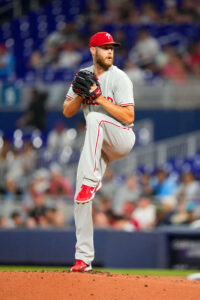
Phillies president of baseball operations Dave Dombrowski has been open with his desire to extend ace Zack Wheeler before he reaches free agency at the end of the 2024 season, and he got it done Monday, announcing that Wheeler has signed a three-year extension covering the 2025-27 seasons. The Wasserman client will reportedly be guaranteed $126MM on the contract, which does not include any options or opt-out opportunities.
As shown in MLBTR’s Contract Tracker, that $42MM annual rate is the largest on any contract extension in the sport’s history and the fourth-largest AAV on any contract ever, placing Wheeler only behind Shohei Ohtani, Max Scherzer and Justin Verlander. Wheeler has now been added to MLBTR’s list of the game’s largest AAVs ever, as well.
That the contract begins in 2025 rather than overriding the final season of the right-hander’s current five-year, $118MM contract is notable for luxury tax purposes. Because the deal goes into place in 2025, Wheeler’s CBT hit will remain $23.6MM for the upcoming season before vaulting substantially in 2025. The Phillies were already into the second tier of luxury penalization, and a significant boost for Wheeler would’ve pushed them into the third tier, dropping their top pick in the draft by 10 spots.
Wheeler already has more than ten years of major league service time, and he’ll hit five years with the Phillies at the end of the 2024 season. That’ll give him 10-and-5 rights, granting Wheeler the power to veto any potential trade over the life of his new contract with the Phils.
It’s rare for any nine-figure deal in free agency to wind up being considered a bargain, but Wheeler has been worth every penny of his original $118MM contract — and then some. Currently 33 years old, Wheeler ranks fourth in Major League Baseball with 629 1/3 innings pitched dating back to 2020, the first season of the contract. His 3.06 ERA, 2.90 FIP and 3.42 SIERA rank 11th, fourth and 15th among 121 qualified big league pitchers in that time.
Since signing with the Phils, Wheeler has punched out 26.7% of his opponents against a sparkling 5.3% walk rate. Despite the homer-friendly nature of Philadelphia’s Citizens Bank Park, Wheeler has yielded an average of just 0.74 homers per nine frames — closely in line with his career mark of 0.83.
Wheeler’s 96 mph average fastball velocity in 2023 was down from its 97.3 mph peak (set in 2021), but he actually posted excellent swinging-strike and opponents’ chase rates, sitting at 13.% and 36.6%, respectively. Those two marks were not only his best as a Phillie but the best single-season marks he’s posted in either category in his entire career to date. When opponents did manage to make contact against Wheeler, it was typically of the feeble variety. Hitters averaged a dismal 86.9 mph exit velocity against Wheeler this past season, placing the right-hander in the 88th percentile of big league pitchers.
Detractors can point to Wheeler’s 3.61 ERA in 2023 as a sign of decline, but as already laid out, Wheeler missed bats at career-best levels in 2023, maintained plus velocity and kept his walk rate among the league’s best. The primary skill change in Wheeler’s approach was a decline in grounders (41.2% — down from 49.6% in his first three years with Philly). That led to a few more home runs but correlated with the uptick in missed bats. Given that the Phillies annually trot out a poor defensive alignment behind their pitchers, the increase in missed bats is a better portent of long-term success than a reliance on keeping balls on the ground anyhow. Wheeler’s 71.3% strand rate — an outlier mark when looking at his year-to-year levels — figures to regress closer to the 74.3% mark he carried into the 2023 season. Assuming that indeed plays out, so long as Wheeler maintains something close to his current K-BB%, there’s a good chance his ERA will improve accordingly.
The dominance for Wheeler stretches far beyond his regular season work, however. He’s been an integral part of the Phillies’ deep playoff over the past two seasons — his first two tastes of postseason action to this point in his career. Wheeler has made 11 appearances (10 starts, one relief) and piled up 63 1/3 innings of 2.42 ERA ball with a 28.6% strikeout rate against a 4.2% walk rate while pitching in the postseason.
With Wheeler now entrenched in Philadelphia through the 2027 season and Aaron Nola also re-signed for another seven seasons, the Philadelphia rotation is set for the foreseeable future. That pair will continue to lead the way, with Ranger Suarez, Cristopher Sanchez and Taijuan Walker all controlled/signed for multiple additional seasons. Suarez is arbitration-eligible through the 2026 season, while Walker is signed through 2027 and Sanchez is controllable all the way through 2028. Strong as that group may be, the Phillies continue to be linked to a possible short-term deal with reigning NL Cy Young winner Blake Snell — though signing Snell would catapult the team into the top tier of luxury penalization, which would push the team’s top draft choice back ten spots and likely mean more than $35MM in taxes on top of any salary.
Barring a one final, surprising splash on the free agent or trade market, the Phillies have other depth options in house. Former Tigers righty Spencer Turnbull and former Braves/Rangers southpaw Kolby Allard both signed big league deals over the winter. The Phils also have a stable of touted pitching prospects including Andrew Painter (currently rehabbing from Tommy John surgery), Mick Abel and Griff McGarry all working their way toward MLB debuts, giving them some quality young options. Painter isn’t likely to pitch at all in 2024 while recovering from last summer’s surgery, but he was in the mix to be the team’s fifth starter last year in spring training despite being just 19 years old during camp. He’ll be firmly in the 2025 rotation mix, though the team will presumably have him on some form of innings limit.
The Wheeler extension will take the Phillies north of $200MM in payroll commitments for the 2025 season before the first pitch of the 2024 campaign is even thrown, and with him now signed through the 2027 season, the Phils have a quartet of nine-figure deals they’ll be paying out at least four years down the road (Wheeler, Nola, Trea Turner, Bryce Harper). From a CBT standpoint, the Wheeler deal all but ensures that the Phillies will again be luxury tax payors next season at the very least. RosterResource projects Philadelphia for a hefty $229MM of luxury obligations next season, and that doesn’t even include next offseason’s dealings or any of the team’s arbitration-eligible players.
Wheeler would have been one of the top arms available in a deep class of free agent pitchers next winter. The 2024-25 offseason will still feature Corbin Burnes, Max Fried, Shane Bieber, Walker Buehler, Scherzer and Verlander — pending further extensions among the group. Gerrit Cole also has an opt-out in his contract next winter, though the Yankees can (and very likely will, barring any sort of major injury) override that opt-out by picking up a club option for a tenth season at $36MM.
Wheeler would’ve landed behind younger aces like Burnes and Fried in terms of overall earning power, but as this extension shows, his earning power on a strict AAV basis very well could have been the highest of the bunch. Instead, he’ll anchor a deep Phillies rotation that’ll take aim at a third consecutive NLCS appearance in 2024 and look to secure the World Series title they fell just short of back in 2022.
ESPN’s Buster Olney first reported that the two parties had agreed to a multi-year extension. Matt Gelb of The Athletic first reported the terms of the contract.
Orioles Notes: Mullins, Henderson, Bradish, Rotation
Orioles center fielder Cedric Mullins exited Monday’s Grapefruit League contest against the Twins with discomfort in his hamstring, the team announced. Mullins drew a leadoff walk and advanced to second base on a grounder. He then walked off the field under his own power two pitches into the next at-bat. Enrique Bradfield Jr. replaced him on the bases.
Fortunately for O’s fans, it seems the situation is relatively minor. Manager Brandon Hyde called Mullins’ exit “precautionary” following the game (X link via Andy Kostka of the Baltimore Banner). Concern is low enough that the team isn’t even planning on performing an MRI or any other imaging to determine if there’s a more serious issue at play. Mullins is considered day-to-day for now, according to Hyde.
The 29-year-old Mullins has been a steady contributor on both sides of the ball for the Orioles over the past three seasons, although the 2023 campaign was his worst and, perhaps not coincidentally, least healthy of the three. Mullins had a pair of IL stints last season due to right groin strains, finishing out the season with a .233/.305/.416 slash (99 wRC+), 15 home runs and 19 stolen bases in 116 games. He missed only nine total games the two seasons prior, batting a combined .274/.339/.460 with 46 big flies and 64 steals. If there’s any sort of setback, infielder/outfielder Jorge Mateo and top outfield prospect Colton Cowser are on hand as options to see time in center field.
Mateo has traditionally been a shortstop, but the team has already suggested that the wealth of infield talent on the Baltimore roster will likely push Mateo into the outfield more frequently in 2024. The fleet-footed Mateo’s primary spot in recent years, shortstop, sounds as though it’ll be handled primarily by reigning AL Rookie of the Year Gunnar Henderson in 2024. While Henderson is capable of playing both shortstop and third base at a high level, the 22-year-old said yesterday that his playing time would be “leaning more toward shortstop” (X link via the Baltimore Sun’s Matt Weyrich).
Henderson has played shortstop, third base and (much more briefly) second base so far in the big leagues. He split his time between the two left-side infield positions nearly evenly in 2023, logging 594 innings at third base and 584 at shortstop. Defensive metrics touted his glovework at both spots, but he drew stronger marks at shortstop (particularly from Defensive Runs Saved, which pegged him at +10). Third base, then, will likely be left to a combination of Jordan Westburg, Ramon Urias and prospect Coby Mayo, though Mateo could also see time there. Current No. 1 overall prospect Jackson Holliday has been playing second base this spring, while each of Westburg and Urias can play basically anywhere in the infield. Mayo’s primary position is third base, though there’s some thought he could eventually move to first base or an outfield corner. Regardless, he’s not yet on the 40-man roster.
Of course, a substantial part of the focus in Orioles camp right now is on right-hander Kyle Bradish, who’s currently attempting a rest/rehab approach to mending a sprain in his right ulnar collateral ligament. Bradish had a platelet-rich plasma injection before the O’s even publicly announced the injury, and Weyrich writes that he’s been throwing pain-free from flat ground.
While general manager Mike Elias struck an optimistic tone, he also preached caution and declined to place a timeline on the right-hander’s potential return. Bradish himself noted that follow-up MRIs have shown “accelerated healing” of the ligament so far, Weyrich writes, though that doesn’t yet mean he’s dodged a long-term absence. Bradish has yet to throw off a mound and currently isn’t throwing at full intensity. The early results are perhaps cause for some cautious optimism, but there’s a ways to go in the process.
For the time being, it doesn’t seem as though Bradish’s injury will prompt the Orioles to make another notable acquisition. Roch Kubatko of MASNsports.com downplayed the possibility of the Orioles signing a big-name free agent, writing that the team appears satisfied with its depth at present. Baltimore picked up Julio Teheran on a minor league deal late last week and could give him a look early in the season, but Kubatko more specifically noted that he’d be “floored” to see the O’s pursue an opt-out-laden deal with a top free agent like Jordan Montgomery.
Sonny Gray Headed For MRI After Early Exit; Tommy Edman May Not Be Ready For Opening Day
Top Cardinals starter Sonny Gray exited today’s spring start with a trainer in the middle of an at-bat against Washington’s Nick Senzel. The team announced shortly afterward that Gray was experiencing tightness in his right hamstring. Gray declined to comment on the potential injury after exiting, instead stating that he wanted to talk to the team’s training staff and learn more about the issue before speaking with the media (link via Derrick Goold of the St. Louis Post-Dispatch). Gray missed roughly a month of the 2022 season with a strain in that same right hamstring as a member of the Twins back in 2022. Goold further tweets that Gray is headed for an MRI to determine the severity of the issue.
An absence of any real note would be a nightmare scenario for the Cardinals. While the Cards overhauled their rotation this winter, Gray is the lone front-of-the-rotation arm the team brought in. Lance Lynn isn’t far removed from posting high-end results himself, but he’s 36 years old and coming off arguably the worst season of his career. He, like fellow mid-30s veteran Kyle Gibson, was signed more as a durable source of innings than to be a clear playoff-caliber starter.
Gray, 34, is fresh off a Cy Young runner-up finish in the American League. He pitched 184 innings of 2.79 ERA ball last season, fanning 24.3% of his opponents against a 7.3% walk rate. Gray’s 2.83 FIP was a near-identical match with his ERA, though metrics like xFIP and SIERA, which normalize home run rate, were more bearish and pegged him in the mid- to upper-3.00s. Gray’s 5.2% homer-to-flyball ratio was less than half the 12.3% career mark he carried into the 2023 campaign. The Cardinals signed him for three years and a total of $75MM back in November. He’s slated to be joined by Gibson, Lynn, Steven Matz and Miles Mikolas in one of the game’s oldest rotations.
Even if Gray can’t quite replicate his 2023 performance, he’s the clear top starter on that St. Louis staff. Were he to miss time, the drop-off between Gray and his replacement would be substantial. At present, the top options to step into the staff in his stead would presumably be lefties Matthew Liberatore, Zack Thompson and Drew Rom. Righties Sem Robberse and Adam Kloffenstein are both on the 40-man roster as well, though neither has made his MLB debut yet.
The Cardinals, at least thus far, haven’t brought in any veteran big league starters on non-roster deals. That’s understandable, as most players open to that type of deal would take a look at the veteran rotation in St. Louis and see a lack of opportunity — but the lack of any proven depth could also be an issue in 2024, depending on how the rest of the staff holds up.
Gray isn’t the only key member of the Cardinals who’s facing some health-related uncertainty. Tommy Edman, formerly the team’s shortstop and now slated to serve as the Cardinals’ everyday center fielder, isn’t recovering from arthroscopic wrist surgery as swiftly as the team hoped. Katie Woo of The Athletic reports that “internal concern is growing” that Edman might not be ready for Opening Day. Edman still hasn’t been cleared to face live pitching, Woo writes, and despite the fact that Opening Day is just over three weeks away, there’s not even a timetable for when that might happen.
Fourth outfielder Dylan Carlson would step into the starting job in center field if Edman is on the injured list to begin the season, per the report. Lars Nootbaar played plenty of center field last season, but perhaps if the plan is for him to play left field regularly when Edman is healthy this season, the team simply wants Nootbaar getting as many reps in that position as possible. Carlson’s role as a fourth outfielder would be cycling through all three spots anyhow.
Edman, 28, had a disappointing 2023 at the plate while playing through pain in that now surgically-repaired wrist for much of the season. The versatile switch-hitter spent nearly a month of the ’23 season on the injured list due to inflammation in that wrist, and when he was healthy his output at the plate dropped from .265/.324/.400 in 2022 (106 wRC+) to just .248/.307/.399 in 2023 (92 wRC+).
In the event that Edman indeed requires a stint on the injured list to begin the season, that’d open up a spot on the bench for the Cards. That wouldn’t necessarily need to be an outfielder, as utilityman Brendan Donovan is no stranger to the outfield, and as previously noted, Nootbaar can handle center field work as well. That said, an outfielder would be the most logical candidate. Lefty-swinging Michael Siani and Alec Burleson are both on the 40-man roster already and both have minor league options remaining. Siani is regarded as a plus defender in center field and would offer premium speed off the bench, while Burleson would be limited to first base and the corners but give the Cards some power that the bench currently lacks.
Boras: New Teams Have Reached Out On Snell, Montgomery Since Spring Training Began
Both Blake Snell (Giants, Yankees) and Jordan Montgomery (Red Sox) have had their teams to which they’ve been frequently connected throughout the offseason, but the opening of spring training has brought about some new suitors — at least… according to their agent. Scott Boras tells USA Today’s Bob Nightengale that four clubs who hadn’t been active suitors for Snell and Montgomery have checked in on the pair of lefties since camps opened in mid-February (X link).
On the one hand, it’s a wholly unsurprising comment. Both pitchers remain unsigned with seemingly limited markets — at least, insofar as who could offer them the of long-term deal or (in Snell’s case), short-term, opt-out laden, high-AAV deal they’re reported to be seeking. As such, it’s only natural their representative would work to dispel the notion that there are few viable landing spots.
On the other, there’s also surely at least some truth to the statement. Spring training annually brings about pitcher injuries of note. Already, we’ve seen Orioles starter Kyle Bradish diagnosed with a UCL sprain that will impact his availability for the regular season and could portend a long-term absence, depending how he progresses after receiving a platelet-rich plasma injection. Mets righty Kodai Senga has been diagnosed with a capsule strain in his shoulder and is expected to open the year on the injured list. The Astros announced some early shoulder concern for Justin Verlander and J.P. France, though both righties have progressed well since. The Giants will be without fifth starter Tristan Beck for quite some time as he undergoes surgery to treat an aneurysm in his shoulder.
The shifting of contract goals for the pair of lefties is sure to bring about new interest as well. Several reports over the past week have indicated that Snell is increasingly amenable to a short-term deal with a high annual value and multiple opt-out opportunities. Fellow Boras clients Cody Bellinger and Matt Chapman signed similar deals. Montgomery, by most accounts, is still looking for a long-term arrangement, but it’s only natural for teams to check the extent to which (if any) his ask on a long-term pact might have fallen. It also bears mentioning, of course, that a team reaching out to inquire on where things stand with a player’s market is far from the same as expressing legitimate interest in meeting what’s sure to be an enormous asking price on either left-hander.
The further the potential length of a contract drops, the more additional suitors could join the fray. The Twins’ original signing of Carlos Correa, for example, only came about after it became clear he’d be open to a three-year deal with multiple opt-outs. Reports all offseason suggested the Cubs were reluctant to go too long-term on Bellinger, but he wound up back at Wrigley Field once he pivoted to the short-term route. Any lower-payroll club with a win-now mindset and ample payroll space in the short-term could perhaps convince itself to stretch beyond comfort levels in 2024 if it means signing a player who’d be wholly out of their price range under more conventional market conditions.
Suffice it to say, there’s ample reason to take Boras’ comments with a hefty grain of salt — but it’s also surely true that circumstances surrounding the rotation mix of several clubs have changed. Whether that leads to any new offers remains to be seen. Even with Bradish ailing, for instance, MASNsports.com’s Roch Kubatko writes that he’d be “floored” if the Orioles pursued a short-term opt-out-laden deal with Montgomery and adds that any high-profile free agent addition remains very unlikely in Baltimore.