
White Sox Sign Corey Knebel, Dominic Leone
The White Sox announced Tuesday that they’ve signed veteran right-handed relievers Corey Knebel and Dominic Leone to minor league contracts. Both will be in big league camp as non-roster invitees.
Knebel, a client of Excel Sports Management, didn’t pitch last season after suffering a capsule tear in his shoulder with the Phillies late in the 2022 campaign. He pitched 42 2/3 innings of 3.43 ERA ball with the Phils that season and saved a dozen games. The 32-year-old been severely limited by injuries in recent years, including Tommy John surgery that wiped out his 2019 season and a lat strain that sent him to the 60-day IL and kept him to just 25 2/3 innings with the Dodgers in 2021.
Lengthy as Knebel’s injury track record is becoming, there’s little questioning his ability when healthy enough to take the mound. A 2017 All-Star who saved 39 games for the Brewers and led the NL with 76 appearances, Knebel has a career 3.26 ERA and 31.8% strikeout rate in 306 2/3 MLB frames. His 11.2% walk rate is too high, but he’s worked around that flaw with plenty of missed bats and weak contact over the years. His 3.17 SIERA and 3.44 FIP both generally align with his strong ERA, and if Knebel is back to full strength he could be a nice low-cost bullpen pickup for a rebuilding ChiSox club.
Leone, also 32, pitched for the Mets, Angels and Mariners in 2023, working to a combined 4.67 ERA with a 23% strikeout rate and 11.9% walk rate in 54 innings. It wasn’t his best work by a long shot, although Leone’s 2.33 HR/9 mark and jarring 21.2% homer-to-flyball rate both seem due for regression toward his career levels (1.06 and 11.8%, respectively).
Looking beyond the shaky bottom-line results, Leone, who’s represented by ACES, maintained his velocity (95.7 mph average fastball) and posted respective swinging-strike and opponents’ chase rates of 16% and 35.3% — both excellent numbers. Prior to the ’23 campaign, he’d enjoyed a nice two-year run with the Giants, working to a 2.71 ERA in 103 frames with similar K/BB numbers and velocity. The spike in home runs last season was Leone’s primary downfall, and while a potential move to the launching pad at Guaranteed Rate Field won’t help in that regard, he’s had success in homer-friendly venues like Toronto in the past. On a no-risk minor league deal, he’s a perfectly sensible addition.
The White Sox traded righty Gregory Santos and lefty Aaron Bummer this offseason, subtracting two of the only locks for their bullpen from the roster in exchange for a plethora of younger players. They also could deploy Garrett Crochet as a starting pitcher, further thinning out the bullpen mix. Knebel and Leone will join fellow veteran Jesse Chavez as the most interesting NRIs in camp this spring. That trio will compete for roster spots in a relief corps where free-agent signees John Brebbia and Tim Hill are currently the only experienced names with any semblance of consistent MLB success.
Dodgers Re-Sign Clayton Kershaw
February 12: Ronald Blum of the Associated Press reports the specifics on Kershaw’s performance bonuses and escalators. The future Hall of Famer would earn a $1MM bonus for his sixth start next season, $1.5MM for each of his next three starts, and $2MM if he reaches 10 starts. A relief appearance in which he accrues at least nine outs also qualifies, protecting Kershaw in the event he follows an opener.
The $5MM base value of his 2025 player option would escalate based on his ’24 workload by the following amounts:
- $2MM for six starts
- $3MM apiece for seven through nine starts
- $4MM for 10 starts
If he exercises the option, the deal includes additional bonuses for 2025 depending on the number of starts he makes in each of the next two years.
February 9: Clayton Kershaw is heading back to the Dodgers. The team announced Friday that the left-hander has re-signed on a two-year guarantee — the second season of which is a player option. Kershaw, a client of Excel Sports Management, is recovering from November shoulder surgery and isn’t expected to pitch until the second half of the season, at the earliest. He’s reportedly guaranteed $10MM on the pact: $5MM in each season of the deal.
Joel Sherman of the New York Post reports that Kershaw’s 2024 incentives are contingent on him making six to ten starts this season. Any increases to this year’s base salary will also be reflected in the value of his player option. Sherman further adds that between those escalators and incentives specific to the 2025 season, Kershaw could earn as much as $25MM in year two of the contract. That’d give him a total earning power of $37.5MM over the two years of the contract.
Kershaw can boost that 2024 salary to $12.5MM based on the number of games he starts this season. The number of games he starts can also boost the base value of his 2025 player option. Right-hander Tony Gonsolin was moved to the 60-day IL to open a 40-man roster spot for Kershaw. If and when the Dodgers need another 40-man spot, Kershaw himself can be transferred to the 60-day IL.
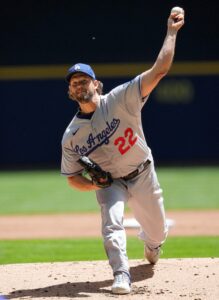
Assuming he’s able to suit up at some point in the second half, the 2024 season will be Kershaw’s 17th pitching for the Dodgers, who selected him with the No. 7 overall pick in the 2006 draft. Injuries have begun to take their toll on Kershaw, who hasn’t reached 30 starts in a season since 2015, but the quality of his results remains largely constant. From 2009-15, Kershaw averaged 32 starts per year, won four straight ERA titles and took home three Cy Young Awards. Since 2016, he’s averaged just 24 starts per 162-game season but maintained a brilliant 2.55 ERA — including sub-2.50 marks in three of the past four seasons.
Kershaw clearly wasn’t pitching at 100% for much of the 2023 season. A shoulder strain landed Kershaw on the injured list in July, and manager Dave Roberts candidly acknowledged in September that he was pitching at less than full strength. Los Angeles limited Kershaw to five innings per start for all but one start in his return from the injured list (a 5 1/3-inning outing in his final appearance of the season). Along the way, Kershaw’s average fastball dipped to career-low levels; he averaged just 89.4 mph on his fastball in his return — including just an 88.7 mph average through his final four starts.
Diminished velocity notwithstanding, Kershaw remained quite effective. In eight post-IL starts he turned in a pristine 2.23 ERA. His 22.2% strikeout rate and 11.1% walk rate were both a ways from his pre-injury levels (27.7%, 6.3%), but Kershaw looked to making the most of what he had to offer on any given day. He didn’t allow more than three runs in any of those final eight appearances and in fact held opponents to one or zero runs in six of them. The D-backs ambushed him for six runs in the first inning of his lone NLDS start, however, ending his season on a low point.
It’s not yet clear when Kershaw might be able to rejoin the Dodgers’ staff, though they’ll presumably provide an update when announcing his deal and discussing it with the media. A returning Kershaw in the second half will provide some high-end insurance for a Dodgers rotation that is teeming with uncertainty. Right-hander Yoshinobu Yamamoto will be adjusting to a new culture and a new league in his debut campaign this year. Right-hander Walker Buehler is in his first full season back from Tommy John surgery. Southpaw James Paxton is a perennial injury risk. Young righties Bobby Miller, Emmet Sheehan, Gavin Stone and Kyle Hurt haven’t pitched full big league seasons.
As already noted, Kershaw won’t be the only potential second-half addition for the Dodgers. The aforementioned May underwent a Tommy John revision and flexor tendon repair in early July but could potentially be back for the stretch run. Gonsolin, who underwent Tommy John surgery in late August, feels like a longer shot to make it back but could potentially do so in a bullpen capacity if his rehab plays out in a best-case scenario.
The Dodgers are set to pay the luxury tax for a third straight season and are already well into the final tier of luxury tax penalization. As such, any dollars committed to Kershaw will be taxed at a 110% rate. That apparently won’t be a deterrent as they welcome the future Hall of Famer back for a 17th season.
In 2712 2/3 innings though his big league career, Kershaw owns a 210-92 record, a 2.48 ERA, a 27.6% strikeout rate and a 6.3% walk rate. He’s a ten-time All-Star with five NL ERA titles, three Cy Young Awards and a National League MVP Award under his belt.
Joel Sherman and Jon Heyman of the New York Post first reported the Dodgers and Kershaw had reached an agreement. The Athletic’s Andy McCullough reported the presence of a 2025 player option. Fabian Ardaya of The Athletic reported the terms of the deal.
Mets Sign Ben Gamel To Minor League Deal
3:20pm: Gamel will make a salary of $1.2MM in the majors or $35K per month at Triple-A, per Joel Sherman of The New York Post.
11:55am: The Mets have signed veteran outfielder Ben Gamel to a minor league contract, per a team announcement. The Wasserman client will be in big league camp as a non-roster invitee during spring training.
It’s the latest in a lengthy series of minor league deals and waiver claims of veteran depth options for the Mets this winter. The 31-year-old Gamel has appeared in eight big league seasons, spending the majority of his time with the Mariners and Pirates. He’s a career .252/.332/.384 hitter with strong plate discipline but minimal power. Gamel has walked in 10.1% of his career plate appearances, including an 11.8% clip since 2021 (838 trips to the plate). He’s never topped 11 homers in a season, however, and his career .131 ISO (slugging minus batting average) is well shy of average.
Defensively, Gamel has played all three outfield positions in the big leagues, but he’s best suited for left field work. Between the majors and minors, he’s played more than 2600 innings in center, but he’s only appeared at the position for one inning over the past two seasons. He’s also appeared sparingly at first base, giving him a bit of extra versatility.
There’s no immediate path to a roster spot for Gamel, as the Mets have the trio of Brandon Nimmo, Harrison Bader and Starling Marte slated to handle regular work, plus outfielders DJ Stewart and Tyrone Taylor on the 40-man roster. Gamel seems likely to join Trayce Thompson as a depth option in Triple-A Syracuse, where he’ll be the most experienced outfielder. That could make him the first man up in the event of an injury that creates a need for either an extra outfielder or a left-handed bat off the bench.
Getz: White Sox Expect Cease To Be Opening Day Starter
Trade chatter on White Sox ace Dylan Cease has died down over the past month amid reports that first-year general manager Chris Getz has set an extremely high asking price and has shown no willingness to back down, even as the season draws nearer. Getz himself threw more cold water on the possibility of trading Cease today, plainly telling the Sox beat: “I expect [Cease] to be our Opening Day starter” (X link via Chuck Garfien of NBC Sports Chicago).
Like the majority of baseball executives, Getz didn’t speak in absolutes. There’s always the chance of a late offer that’s simply too good to turn down — particularly if a contending team loses a starting pitcher to a long-term injury this spring and feels emboldened to make a trade that was previously deemed too costly.
That said, Getz also didn’t need to go out of his way to frame it as likely that Cease would be on the Opening Day roster, either. Choosing to voice that is a firmer stance than speaking in generalities about remaining open-minded and considering all avenues. That’s the route Getz took just one month ago, publicly stating that a Cease trade could potentially come in the offseason, at the deadline or even at an atypical time like May or June, if the right offer presented itself then.
Entering the offseason, Cease stood out as one of the likeliest trade candidates on the market. The White Sox fired longtime GM Rick Hahn and executive vice president Kenny Williams last summer, promoting Getz from assistant GM. He began the offseason making clear that the Sox would be open for business, even going so far as to candidly state, “I don’t like our team.” The South Siders have indeed proven active, trading relievers Aaron Bummer and Gregory Santos, acquiring young outfielder Dominic Fletcher and swinging a trade for veteran catcher Max Stassi.
Many of the Sox’ dealings have focused on improving the defense; Getz said in today’s media session that early talks with free agent pitchers this winter showed a reluctance to sign in Chicago because of the team’s poor glovework (X link via CHGO’s Vinnie Duber). Recognizing that limitation, Getz acquired Nicky Lopez and glove-first infield prospect Braden Shewmake (in the Bummer deal), signed Paul DeJong, and landed a pair of catchers with good defensive reputations (Stassi and free agent Martin Maldonado). Fletcher, acquired from the D-backs in exchange for pitching prospect Christian Mena, is regarded as a plus defender at all three outfield spots.
Amid all that roster shuffling, there was a general expectation that Cease would eventually be moved. That no longer seems nearly so certain. There’s clear risk in hanging onto the 28-year-old righty. A spring or early-season injury could prove catastrophic for the Sox, tanking the value of their clear best trade chip. At the same time, trading Cease this summer won’t necessarily reduce the asking price, particularly if teams simply weren’t putting forth compelling packages for him this winter.
Cease is coming off a pedestrian 4.58 ERA, but he’s only one season removed from a runner-up showing on the AL Cy Young ballot, when he pitched 184 innings of 2.20 ERA ball. His strikeout rate and velocity both dipped a bit in ’23 from their ’22 levels, and he gave up more hard contact than usual. The extent to which those red flags combined to impact offers for him can’t be known, but if Cease can come out looking like the 2022 version of himself, it’s conceivable he could even command more near the deadline — particularly since the supply of starting pitching will be much smaller than in the offseason, when there’s a wide bank of free agents to consider.
Cease is controllable through the 2025 season via arbitration. He and the White Sox agreed to a one-year, $8MM deal earlier this winter, avoiding an arb hearing in the process. The right-hander leads all of Major League Baseball with 109 starts dating back to the 2020 season. In that time, Cease sports a 3.58 ERA with a 28.5% strikeout rate, 10.4% walk rate, 36.5% ground-ball rate and 1.03 HR/9.
Twins Still Exploring Starting Pitching Market
The Twins lost a trio of starters in free agency, as Sonny Gray signed with the Cardinals, Kenta Maeda signed with the division-rival Tigers, and Tyler Mahle signed with the World Series-champion Rangers. The acquisition of Anthony DeSclafani helps to replenish some depth, but they’re still poking around the market for further starting pitching help.
Both Bobby Nightengale of the Minneapolis Star-Tribune and Jon Morosi of MLB Network (video link) have suggested recently that Minnesota could make some further additions before long. The Twins, who’ve scaled back payroll while spending much of the offseason facing questions about their television broadcast rights, aren’t likely to sign Blake Snell or Jordan Montgomery. The Twins reportedly had interest in Michael Lorenzen prior to adding DeSclafani, and Morosi suggests that pitchers like Lorenzen and Noah Syndergaard are in the general price range the Twins are actively considering.
As things stand, the Twins still have a solid group of starters, though the depth isn’t as strong heading into 2024 as it appeared to be in 2023. Pablo Lopez had the third-most strikeouts in all of baseball last season while finishing ninth innings pitched and logging a 3.66 ERA. He’ll lead the staff, followed by righties Joe Ryan and Bailey Ober. The former carried a sub-3.00 ERA with outstanding K/BB marks through his first 15 starts before fading down the stretch. He’ll look for a stronger finish to the 2024 season but has nonetheless cemented himself as a useful big league starter. The latter touts a 3.37 ERA, 24.5% strikeout rate and 5% walk rate in 200 1/3 frames dating back to 2022.
Beyond that trio, the Twins are hoping to get a full season’s worth of starts from righty Chris Paddack, who returned from Tommy John surgery late in 2023 and pitched well out of the bullpen. The former Padre allowed three runs in 8 2/3 innings between the regular season and postseason, turning in an electric 14-to-1 K/BB ratio in that time (41.8% strikeout rate, 2.9% walk rate). However, the 28-year-old has just 40 2/3 innings total since 2022 (minors and postseason included), and he’s only reached 100 innings in two MLB seasons. Counting on him for 30 starts seems wildly optimistic.
The veteran DeSclafani and 26-year-old right-hander Louie Varland will vie for the final starting job. DeSclafani, 34, has battled injuries over the past two seasons and pitched poorly when on the field, but he gave the Giants 31 starts of 3.17 ERA ball as recently as 2021. The Twins are only on the hook for $4MM of this season’s $12MM salary, with the Giants paying $6MM and the Mariners kicking in $2MM as part of the Jorge Polanco trade with the Mariners that also brought reliever Justin Topa and top prospect Gabriel Gonzalez to Minnesota. Varland has pitched 94 innings of 4.40 ERA ball in the big leagues. He was immensely homer-prone in 2023 (2.12 HR/9), but he boasts strong strikeout, walk and ground-ball rates, leading metrics like SIERA and xFIP (which normalize home-run rate) to peg his 2023 performance at solid marks of 3.77 and 3.81.
It’s a fine top six, but the departure of Maeda and particularly Gray, who finished second in AL Cy Young voting this past season, still loom large. The Twins will surely be banking on more consistency from Ryan and more innings from Paddack, but there’s no getting around the fact that the group looks weaker than it did in 2023 — particularly late in the season, when Gray and Maeda were both pitching quite well.
Barring some type of surprising trade, it doesn’t seem likely that the Twins will find a way to replace the quality of Gray’s innings. Free agents Blake Snell and Jordan Montgomery are still out there, but the Twins have been cutting payroll due to their murky television situation. Minnesota formally announced a one-year extension of their deal with Diamond Sports Group/Bally Sports today, though presumably at a lesser rate than they received in 2023. The outlook beyond that point remains unclear, too. A major splash for Snell or Montgomery would come as a shock.
Deepening the group by bringing in someone like Lorenzen probably wouldn’t give the Twins the same type of Game 1 or 2 playoff starter they had in Gray, but springing for quantity has some merit as well. Even adding 150 or so league-average innings would help to safeguard against injury concerns among the current group (Paddack and DeSclafani, most notably), push DeSclafani to a long-relief role to open the season and push Varland to Triple-A, where he could work out of the rotation and be summoned as injuries dictate. Roster Resource currently projects a $123.5MM payroll for the Twins — more than $30MM shy of last year’s season-end mark but in the general $125-140MM vicinity they were reportedly targeting for the upcoming season.
Latest On Jorge Soler
Free agent slugger Jorge Soler has seen his potential landing spots dwindle a bit, with previously reported suitors like the Blue Jays (Justin Turner), Mariners (Mitch Garver) and Diamondbacks (Joc Pederson) all going in different directions to sign their primary designated hitters this winter. MLB Network’s Jon Morosi touched on Soler’s market this morning (video link), reporting that the 31-year-old is still seeking a three-year contract in free agency. The length of the pact has been a hold-up, as Soler has had teams willing to go to two years but has yet to be offered a guaranteed third season.
The Giants were reported to be in talks with Soler last week, and Morosi suggests they’re among the teams comfortable at two years but balking at the third season. Other teams that have been tied to Soler this offseason include the Red Sox, Nationals and, to a much lesser extent, the incumbent Marlins. Soler himself said last month that Miami hasn’t shown real interest in a reunion, however. The D-backs, notably, are still looking for a right-handed bat to pair with the lefty-swinging Pederson, but it’s hard to imagine Soler signing anywhere without a clear path to full-time at bats. A timeshare with Pederson at DH plus some occasional corner outfield work would be a surprise.
That’s due in no small part to the fact that Soler is coming off one of the best seasons of his career. He belted 36 home runs for the Fish in 2023, slashing a robust .250/.341/.512 (126 wRC+). Long known as a strikeout-prone player, Soler’s 24.3% strikeout rate last year was the second-lowest of his career and only 1.6 percentage points higher than the league average. His 11.4% walk rate, meanwhile, was the second-highest of his career. He paired that improved K/BB profile with his typical brand of loud contact. Soler averaged 91.3 mph off the bat, hit 48% of his batted balls at 95mph or greater, and barreled 15% of his batted balls — all ranking in the 81st percentile of MLB hitters or better, per Statcast.
Spring training’s looming start date could put some added pressure on Soler and other free agents to consider a drop in asking price, although that cuts both ways. Teams seeking offensive upgrades have watched alternative options come off the board and have fewer avenues to pursue. The onset of camp also generally brings about quite a few injury scenarios of note, any of which could radically alter the market for Soler and other free agents. An injury for someone on one of Soler’s rumored suitors (Giants, Red Sox, etc.) or even on a contending club that hasn’t yet shown interest could prove to be a catalyst for his market, just as we saw with the Astros and Josh Hader (who signed in Houston following a season-ending injury to Kendall Graveman).
Soler opted out of the final season of a three-year, $36MM contract with the Marlins at the beginning of the offseason, turning down a $13MM player option. That he’s had teams willing to offer two years suggests he indeed had more earning power than that $13MM on the open market, but many free agents have seen muted interest as teams throughout the league deal with uncertainty regarding their television contracts. A multi-year deal still seems likely for Soler. Speculatively speaking, however, if no three-year pact presents itself and the two-year interest he’s received has been at average annual rates that aren’t to his liking, Soler could follow Teoscar Hernandez and max out on the largest one-year commitment he can find, then take another shot at free agency next winter.
Matt Barnes Throws For Scouts
Former Red Sox closer Matt Barnes, who was traded to the Marlins prior to the 2023 season and wound up undergoing season-ending hip surgery in May, threw for big league scouts last week and could land a deal with a team before spring training for most teams commences next week, Alex Speier of the Boston Globe reports. Barnes is still building arm strength but was in the low 90s with his fastball.
An All-Star with the Red Sox in 2021, Barnes has experienced a sharp decline in recent years, at least in part to a hip issue that’s plagued him for some time. The right-hander saved 24 games for the ’21 Sox but had all two dozen in the books by August 4. At that point, Barnes was sporting a pristine 2.25 ERA with a dominant 42% strikeout rate against a strong 6.8% walk rate. He’d pitched like one of the best relievers in baseball, and Boston rewarded him over the summer in the form of a two-year, $18.75MM contract extension that kept him from reaching free agency at season’s end.
Barnes pitched well for the first month of that contract, but things went south quickly thereafter. Over his final 15 appearances, the right-hander was shelled for a 10.13 ERA with significantly worsened strikeout and walk rates (26.7% and 15%). Barnes had walked only 11 hitters and surrendered just four homers through his first 44 innings but doubled that home run total and issued nine more walks in those final 10 1/3 innings.
It was a miserable way to close out the season, but Barnes’ track record was strong enough that a rebound didn’t seem far-fetched. Even with that calamitous finish to the season, his overall numbers from 2017-21 were sound: 3.82 ERA, 38 saves, 76 holds, 34.8% strikeout rate, 11.1% walk rate.
To Barnes’ credit, he rebounded from that finish to at least some extent in 2022, pitching to a 4.31 ERA in 39 2/3 innings. However, his 19.3% strikeout rate was less than half what it had been during his overpowering four-month run in 2021, and his 11.9% walk rate was still a clear red flag. He wound up missing more than two months of that ’22 season due to shoulder inflammation, and over the winter, the Red Sox designated Barnes for assignment and flipped him to the Marlins in exchange for another bounceback bullpen candidate: lefty Richard Bleier.
The trade didn’t work out well for either party. Barnes pitched just 21 1/3 innings of 5.48 ERA ball with Miami, sitting at a career-worst 93.6 mph with his average fastball. His 20.2% strikeout rate was only marginally better than his ugly mark the year prior, and while he cut his walk rate to 10.1%, that was still well north of the league average. Barnes underwent femoral acetabular impingement surgery on his left hip in late July, and the Fish bought out a club option on the right-hander at season’s end.
Barnes spoke with Speier in a full column for the Globe, speaking about the frustration of not being able to live up to his own expectations for himself over the past couple years. “Looking back on it, I’m realizing now that the hip was such a limiting factor in my ability to get into my lower half, subconsciously knowing that it was there,” Barnes told Speier. “The nature of the injury with the hip, it didn’t allow me to get over my front side and truly rotate and create power.”
Time will tell whether Barnes can ever recapture the form he showed from Opening Day through early August in 2021, though with a shoulder injury and notable hip surgery separating present-day Barnes from that peak version, it feels like something of a long shot. But even if Barnes never gets back to fanning more than 40% of his opponents, there’s a middle ground where he can be an effective late-inning reliever. Just about every club in baseball is looking for low-cost, low-risk ways to beef up their bullpens this time of season. Barnes’ track record should hold appeal in that regard, though the ultimate price tag will come down to how he looks in bullpen sessions. Most clubs will likely want to bring him to camp on a non-roster deal, but a 40-man spot doesn’t seem out of the question if he looks promising enough in a workout for clubs.
Reds, Jonathan India Agree To Two-Year Deal
The Reds have agreed to a two-year deal with infielder Jonathan India, per a team announcement. The Boras Corporation client will be paid $3.8MM in 2024 and $5MM in 2025, Mark Sheldon of MLB.com reports. He can earn an additional $2.05MM in 2025 based on plate appearances and games started. India had filed for a $4MM salary in his first trip through the arbitration process, while the Reds countered with a $3.2MM figure.
As a result of this agreement, the two parties will avoid an arbitration hearing both this year and next. India, the 2021 National League Rookie of the Year, remains under club control through the 2026 season and will be eligible for arbitration one final time following the 2025 season.
India burst onto the scene with the Reds in ’21, hitting .269/.376/.459 (122 wRC+) with 21 home runs, 34 doubles, a pair of triples, a dozen steals, an 11.3% walk rate and a 22.3% strikeout rate. That performance led to a near-unanimous Rookie of the Year selection over runner-up Trevor Rogers, but India’s stock has dipped a bit since that early-career highlight.
Over the past two seasons, a hamstring strain and a bout of plantar fasciitis have limited India to 222 games and quiet possibly contributed to a decline in his production. He hasn’t been a bad hitter, but the 27-year-old’s .246/.333/.394 slash over the past two years (98 wRC+) is a good ways shy of that more impressive rookie output. Couple that with poor defensive ratings at second base (-21 Defensive Runs Saved, -16 Outs Above Average in 2022-23) and at least some of the shine has come off the 2018 No. 5 overall draft selection.
Between his downturn at the plate, the Reds’ wealth of young infield talent (e.g. Matt McLain, Elly De La Cruz, Spencer Steer, Noelvi Marte, Christian Encarnacion-Strand) and the signing of Jeimer Candelario to a three-year deal, there was a good bit of talk about a potential India trade this winter. However, Cincinnati president of baseball operations Nick Krall was nonplused with what was being offered in return for India throughout the winter and downplayed the chances of the infielder changing hands a few months back.
The addition of Candelario to an already-crowded infield mix creates something of a logjam, though Cincinnati plans to at least somewhat alleviate that crunch by moving Steer to left field on a full-time basis this coming season. Krall has previously stated that India could also begin to see some time at first base, in addition to designated hitter and his more typical work at second base.
Even with that broadening of his role, there’s still more infield options than positions for the Reds. Candelario will split time between the corners. Marte can play both positions on the left side of the infield. De La Cruz figures to get the chance to be the primary shortstop but will need to bounce back from a dreary finish to the season. McLain spent the bulk of his time in 2023 at shortstop, finishing fifth in Rookie of the Year voting himself. With De La Cruz likely back at shortstop, he could slide to the other side of the second base bag. Encarnacion-Strand has experience at the hot corner but is likely ticketed for first base and DH work.
It’s a crowded mix of players, but outside of Candelario and India, no one from the group has more than one full season of big league action under his belt. The potential for regression from one or more of those infielders is obvious, and injuries are an inevitability. The Reds, who were in the market for pitching help this winter, clearly recognized that India alone wouldn’t fetch them a meaningful rotation upgrade and have opted to hold onto the depth and stability he provides in relation to their collection of impressive but still fairly inexperienced young outfielders. An eventual trade remains plausible, particularly if enough of the young wave of big leaguers cement themselves as cornerstone pieces, but for the time being India seems quite likely to open the 2024 campaign on Cincinnati’s roster.
Padres Have Shown Interest In Jarren Duran; Still Considering Free Agent Starters
The Padres have shown interest in Red Sox outfielder Jarren Duran, reports Jon Heyman of the New York Post. They’re not alone in that regard, per the report, which indicates that multiple clubs have reached out to the Boston front office to express interest. There’s no indication any sort of deal is nigh, but Dennis Lin of The Athletic similarly hears that the Sox and Padres have had “recent” trade discussions as part of the Friars’ ongoing search for outfield help. San Diego has also considered a reunion with outfielder Tommy Pham, per Lin, though he further notes that no formal offer has been made.
Duran, 27, would fill an acute need for the Padres, whose only established MLB outfielder at the moment is Fernando Tatis Jr. Beyond Tatis and Jose Azocar, San Diego doesn’t even have an outfielder on its 40-man roster. Non-roster invitees to spring training like Oscar Mercado, Bryce Johnson and Cal Mitchell are among the current options to vie for a roster spot in spring training, although Ken Rosenthal of The Athletic reported earlier in the week that the Padres have also been considering the idea of deploying top shortstop prospect Jackson Merrill in the outfield this season as well. Merrill, the team’s first-round pick in 2021 and the game’s No. 17 prospect according to Baseball America, would also need to be added to the 40-man roster.
Duran is a former top-100 prospect himself, though he just broke through with his first real major league success as a 26-year-old in 2023. The now-27-year-old former seventh-round pick appeared in 102 games for the Red Sox and batted .295/.346/.482 with eight home runs, 34 doubles, a pair of triples and a 24-for-26 showing in stolen base attempts. Duran also trimmed his formerly problematic strikeout rate to a more manageable 24.9%, although his 6.6% walk rate is two percentage points shy of league-average.
While Duran has elite speed — 95th percentile, per Statcast — his route running and lack of arm strength have led to well below-average grades in center field. Defensive Runs Saved is most bearish, pegging him at -19 in just shy of 1200 innings, while Ultimate Zone Rating has him at -10.5 and Outs Above Average has him at -2. Azocar is capable of handling center field, however, so an acquisition of Duran could lead to him slotting into left field in San Diego, where his glovework would grade more favorably.
There are fair questions about whether Duran can sustain last year’s production at the plate, however. Last year’s .381 average on balls in play may not regress all the way to league-average levels, as players with elite speed can turn grounders into hits at a far higher clip, but Duran’s penchant for chasing pitches off the plate (career 35.1%) and below-average contact rate on such offerings has a tendency to undercut his above-average contact skills on pitches within the zone (92.1%).
Boston’s appetite for dealing Duran remains to be seen, but it’s worth noting that he was drafted back in 2018 and the Sox have now turned over their front office twice since making that selection. First-year chief baseball officer Craig Breslow doesn’t have the connection with Duran that predecessors Chaim Bloom and Dave Dombrowski may have. And while Duran is ticketed for a regular role with the Sox as the roster is currently constructed, Boston isn’t short on outfield alternatives.
Were Duran to be moved, the Sox could turn to Tyler O’Neill, Ceddanne Rafaela and Wilyer Abreu from left field to right field, with designated hitter Masataka Yoshida also mixing into the corners on occasion. Roman Anthony, Boston’s second-round pick from the 2022 draft, has already climbed as high as Double-A and recently placed 21st on BA’s Top 100 prospect rankings, creating further depth.
The Padres don’t have that type of outfield depth, due in no small part to years of aggressive win-now trades that have combined to thin out the system. San Diego has also been working to scale back payroll, which would make a pre-arbitration player like Duran a natural target. He’ll very likely be arb-eligible next winter as a Super Two player, but he’d fit the team’s desire to manage payroll during the 2024 campaign. And with just 1.155 years of big league service under his belt, Duran could be controlled for five more seasons.
Lin further reports that while the outfield is the greater focus at the moment, San Diego is still exploring the free-agent market for rotation help. He lists Michael Lorenzen, old friend Eric Lauer, and Hyun Jin Ryu as pitchers with whom the San Diego front office has spoken. Heyman, too, lists Ryu as a potential target for the Padres.
Of the three, Lorenzen is coming off the best and healthiest season. An All-Star for the 2023 Tigers, Lorenzen was traded to the Phillies at last summer’s deadline and thrust himself into the spotlight with a pair of dominant performances to begin his Phillies tenure. The converted reliever began to fade after a masterful 124-pitch no-hitter against the Nationals in early August, however, and his struggles snowballed to the point that the Phils dropped him from the rotation to the bullpen. Lorenzen closed out the year with a dismal 27 earned runs in 30 1/3 innings following that no-hit gem.
Lauer, 28, is a former Padre who went from San Diego to Milwaukee alongside Luis Urias in the trade bringing Trent Grisham to the Friars. He looked to be on his way to a breakout in Milwaukee after adding a slider to his repertoire in 2021, and from ’21-’22 he posted a combined 3.47 ERA in 277 1/3 innings. The 2023 campaign was a disaster that saw Lauer torched for a 6.46 ERA in 46 2/3 innings. Milwaukee optioned him to Triple-A to try to get him back on track, but Lauer yielded a 5.15 earned run average in a near-identical sample of 43 2/3 innings there.
Elbow and shoulder injuries have both sent Lauer to the injured list over the past two seasons. It’s possible that he wasn’t at full strength in 2023, given that pair of IL trips and a major dip in his average fastball (93.3 mph in 2022; 91.2 mph in 2023). If Lauer is at full strength, he’d be a nice buy-low option — particularly since his 4.111 years of MLB service make him controllable through the 2025 season for any team that signs him.
As for Ryu, he pitched well in his return to the Blue Jays following Tommy John surgery. The ten-year MLB veteran notched a 3.46 ERA over 11 starts and 52 innings, though his performance wasn’t without its own reasons for hesitation. Ryu only pitched beyond the fifth inning once in 2023, and the Jays never let him reach even 90 pitches in an appearance. Last year’s 88.8 mph average fastball was a career-low mark, and his 17% strikeout rate was his third-lowest in ten MLB seasons. Ryu was quite homer-prone in 27 innings in 2022 before undergoing surgery, but he was even more susceptible to the long ball last year, yielding nine in his 52 innings (1.56 HR/9).
Lorenzen might still have enough track record and interest to generate a two-year offer in free agency, but it’s likely Ryu and certainly Lauer will be available on one-year pacts that check in under $10MM — well under in the case of Lauer, who’d been projected by MLBTR contributor Matt Swartz for a $5.2MM salary before being non-tendered. San Diego’s current $159MM payroll and $215MM luxury tax projection (via Roster Resouce) should leave some room for additional spending, even as the team looks to cut spending. Last year’s Padres payroll climbed as high as $255MM.
Latest On Jordan Montgomery
Many Rangers fans have thought throughout the offseason that an eventual reunion with left-hander Jordan Montgomery made good sense and would represent the team’s big splash in free agency this winter. Reporting connecting the two sides has been sparse, however, outside of general speculation on the strength of the fit and the Rangers’ need for durable innings. Evan Grant of the Dallas Morning News casts even more doubt on the Rangers’ chances of re-signing Montgomery in his latest mailbag column.
Grant has written previously that a deal between the two sides doesn’t seem likely, though some Rangers fans might’ve hoped that the recent resolution of the team’s television situation for the 2024 season might bring about a long-awaited agreement. A deal still feels like a reach, Grant suggests, rightly pointing out that given the team’s current luxury tax status, Montgomery would likely cost the Rangers more than $30MM this season. Texas will be a second-time luxury payor this season and already has $243MM of projected luxury obligations, per Roster Resource. They’ll pay a 30% tax on any dollars up to $257MM, plus a 42% tax on the next $20MM they spend.
That outlook doesn’t necessarily mean the Rangers can’t bring in Montgomery under any circumstances, but the team has operated with a good bit of financial restraint throughout the winter. Signing Montgomery would mean pushing their 2025 contractual commitments to around $160MM a full year in advance and would give the Rangers well over $100MM in guarantees on the books as far out as 2027. (Currently, they have $94.5MM committed to the 2027 roster.)
Furthermore, WEEI’s Rob Bradford reports that the Rangers haven’t been “actively involved” in Montgomery’s market for some time now due to the lefty’s price tag. Again, that doesn’t close the door entirely, but it’s another indicator that a Rangers/Montgomery reunion is hardly the fait accompli that some have suggested it to be.
If not Texas, there are a handful of other teams that have been connected to Montgomery — the Giants, Angels, Yankees, Red Sox and Phillies among them. Jon Heyman of the New York Post writes that the Angels remain in contact with Montgomery and agent Scott Boras (who also reps Blake Snell). The Angels currently project for a $173MM payroll — about $40MM shy of last year’s franchise-record mark — and are nearly $50MM from the first luxury tax threshold. Owner Arte Moreno has historically avoided long-term deals for pitchers, however, and Heyman suggests he’s yet to green-light his front office on the addition of a pitcher of this caliber.
On the Phillies, specifically, USA Today’s Bob Nightengale wrote recently that several executives around the league suspect the Phillies may be waiting to see if the price point on any of the remaining top-tier free agents drops to the point where they can make an opportunistic addition.
That’s largely speculative from what seems like a series of non-Phillies sources, but it’s worth noting that Philadelphia president of baseball operations Dave Dombrowski at least alluded to something along those lines in a radio appearance on Wednesday. Dombrowski noted that he’s happy with his rotation and with his lineup but also wouldn’t definitively rule out making another addition if the circumstances become favorable enough: “I can’t tell you that somebody doesn’t fall into your lap at some point where you say, ’Gee, that’s an opportunity we can’t turn down,'” the Phillies’ president stated on 94 WIP.
As with the Rangers, the Phillies are projected luxury tax payors. They’re $5MM from the second threshold and, as a third-time payor, would pay a 50% tax on their next roughly $5MM and then 62% on the next $20MM after that. Signing Montgomery at a $25MM AAV, for instance, would cost the Phils $14.9MM in taxes (nearly $40MM in total for this season alone, assuming an even distribution of the yearly salaries in that theoretical scenario). Perhaps if Montgomery’s price drops and the Phillies begin to lose confidence in their ability to extend Zack Wheeler, that might begin to sound more palatable, but signing him would be a rather costly endeavor at the moment, given the team’s tax outlook.
Montgomery, 31, has made at least 30 starts in each of the past three seasons. In that time, he’s pitched 524 1/3 innings of 3.48 ERA ball with a 22.5% strikeout rate, a 6.2% walk rate, a 44.5% ground-ball rate and just 1.00 HR/9. His 2023 campaign was arguably the finest of his career, featuring a personal-best 188 2/3 innings of 3.20 ERA ball, plus another 31 innings of 2.90 ERA ball in the postseason — a strong performance that helped push the Rangers to their first-ever World Series title.