
NPB’s Hanshin Tigers Sign Javy Guerra, Re-Sign Sheldon Neuse
The Hanshin Tigers of Japan’s Nippon Professional Baseball announced this week that they’ve signed right-hander Javy Guerra for the 2024 season (Japanese language link via Yahoo Japan). Hanshin has also re-signed infielder Sheldon Neuse and right-hander Jeremy Beasley, per the team’s web site. It’ll be the second season with the Tigers for both former big leaguers and Guerra’s first overseas.
Guerra, 28, once ranked as one of the top prospects in all of baseball while rising through the Red Sox and Padres systems as a shortstop. After struggling at the plate as he climbed the minor league ladder, however, he moved to the mound and has now appeared in each of the past five big league seasons, splitting time between the Padres, Rays and Brewers. Guerra is one of the game’s hardest throwers, averaging 98 mph on his heater and at times climbing into triple digits, but he’s battled significant command issues that have hampered his results.
In 63 MLB innings, Guerra has walked 14.3% of his opponents. He hasn’t balanced that out with the type of gaudy strikeout rate one might imagine either, setting down just 15% of his opponents on strikes. The poor command of his power repertoire has contributed to an ugly 6.43 ERA in the big leagues, but Guerra sports a career 2.87 ERA, 28% strikeout rate and far more palatable 9.6% walk rate in 78 1/3 Triple-A innings across two seasons. He’ll look to match that form more closely with the Tigers. And, at 28 years of age, if Guerra can harness his power arsenal in NPB and improve his command, he’s young enough to parlay this stint into a big league return down the road.
As for Neuse, he’ll be a familiar name for fans of the A’s, Dodgers and perhaps the Nationals (who selected him in the second round of the 2016 draft and traded him to Oakland alongside Jesus Luzardo for both Ryan Madson and Sean Doolittle). The now-28-year-old infielder hit .212/.262/.296 in parts of three seasons between Oakland and Los Angeles (420 plate appearances) and turned in a .240/.295/.328 batting line with Hanshin last season.
As for Beasley, the 28-year-old pitched 24 2/3 innings of 5.84 ERA ball between the D-backs and Blue Jays from 2020-22. He tossed 41 innings for the Tigers’ top-level club in 2023 (plus 44 innings with their minor league squad) and handled himself quite nicely, logging a 2.20 ERA with a 25.3% strikeout rate and 7.6% walk rate in that time.
White Sox Outright Nicholas Padilla; Adam Haseley Elects Free Agency
The White Sox passed right-hander Nicholas Padilla through waivers unclaimed and have assigned him outright to Triple-A Charlotte, per Scott Merkin of MLB.com. He adds that outfielder Adam Haseley, who was designated for assignment earlier this week, cleared waivers and elected free agency. Chicago’s 40-man roster is currently at 39 players.
Padilla, 26, pitched 4 2/3 innings with the Sox this past season and another 1 2/3 frames with the Cubs in 2022. That’s the full extent of his MLB experience, and during those 6 1/3 frames he allowed four runs on 11 hits and three walks with seven punchouts. Padilla posted a terrific 2.21 ERA in the minors in 2022 but did so with worrisome command issues that caught up to him in 2023, when he was tagged for a 5.52 ERA in 45 2/3 innings with Charlotte, walking 17.6% of his opponents along the way.
Padilla has missed bats at average or better levels in the upper minors, and he sits around 94 mph with a sinker that generates huge ground-ball rates (58% in Triple-A this past season). If he can improve his strike-throwing, he could find his way back to the 40-man roster, but he’ll have to earn his way back as a non-roster invitee in spring training this year. If he doesn’t make the club this spring, he’ll likely open the ’24 season with the Knights.
The 27-year-old Haseley was the No. 8 overall pick by the Phillies back in 2017 but hasn’t yet produced in line with those considerable draft expectations. He’s spent parts of five seasons in the Majors between Philly and Chicago but managed only a .259/.319/.356 batting line — with much of his production at the plate coming early in his career. He’s struggled considerably over the past three seasons.
This past season, Haseley spent the bulk of the season in Charlotte, hitting .264/.338/.386 for the Knights. He walked at a respectable 8.9% clip, showed solid bat-to-ball skills (16.6%) and swiped 10 bags in 14 tries. He has considerable experience at all three outfield spots and has posted average or better defensive grades at each in the majors. The lefty-swinging Haseley has struggled against same-handed opponents throughout his career but does carry a decent .262/.320/.371 slash against right-handers. He’ll likely latch on with a club looking for some speed and/or versatile outfield depth on a minor league deal.
Marlins’ Edward Cabrera, Trevor Rogers Drawing Trade Interest
It wouldn’t be an offseason or trade deadline without the annual tradition of rumors regarding the Marlins’ collection of young starting pitchers. Ken Rosenthal of The Athletic writes this morning that Miami has received interest in right-hander Edward Cabrera and lefty Trevor Rogers this winter, though there’s no indication a deal involving either has been seriously discussed.
Miami’s wealth of starting pitching has been the focus of other clubs for several years now, although the extent of that depth is probably overstated now. The Fish traded Pablo Lopez as part of their Luis Arraez acquisition and will be without 2022 NL Cy Young winner Sandy Alcantara in 2024 due to Tommy John surgery. Pitching prospect Jake Eder was traded at the deadline to acquire Jake Burger from the White Sox. Fellow prospects Max Meyer (2022 TJS), Dax Fulton (2023 elbow surgery) and Sixto Sanchez (shoulder surgeries in 2021, 2022) have all seen injuries slow their trajectories as well — particularly in the case of Sanchez.
Currently, the Marlins project to trot out a rotation including Jesus Luzardo, Braxton Garrett, Cabrera, Rogers and ballyhooed young right-hander Eury Perez. There’s no way the Marlins would move Perez, who entered 2023 as arguably the top pitching prospect in the sport and debuted as a 20-year-old with 19 starts of 3.15 ERA ball. Similarly, Rosenthal suggests that Luzardo and Garrett are likely considered off limits. Beyond that top quintet, the Marlins’ top in-house options are 27-year-old Bryan Hoeing and lefty Ryan Weathers, whom they acquired in a buy-low deal from the Padres over the summer.
The extent to which Cabrera or Rogers is available will depend on the strength of offers made by other clubs, as there’s no urgency for Miami to move either pitcher. Rogers, the 2021 NL Rookie of the Year runner-up, has three years of team control remaining. Cabrera has five. Rogers has had a pair of disappointing years since a brilliant rookie campaign, pitching to a 5.26 ERA in his past 125 frames (just 18 of which came in an injury-ruined 2023 season). Cabrera has been better but inconsistent while showing worrying command; he’s logged a 3.73 ERA and fanned 26.6% of his opponents in his past 171 1/3 innings but has also issued walks at a 13.7% clip in that time.
Between the greater amount of club control and the better recent track record (both in terms of health and performance), Cabrera has the greater trade value of the pair. He’ll likely be eligible for Super Two status next winter and thus be arbitration-eligible four times rather than three, but Rogers is already into his arb years and projected to earn a modest $1.5MM this coming season, via MLBTR contributor Matt Swartz.
With their past trades and all of the injuries throughout the prospect ranks, the Marlins are no longer as deep as some may believe them to be. It’s still feasible that they could trade someone like Cabrera or Rogers in an effort to acquire help at another area of need like catcher, shortstop or center field (depending on the new front office’s plans for Jazz Chisholm Jr.‘s defensive home). It’s a thin free-agent market for bats, after all, and the Marlins likely don’t have extensive financial flexibility anyhow.
That said, if new president of baseball operations Peter Bendix does deal from the rotation to address another need, it’d likely just create a hole on the starting staff that would need to be filled via free agency or a subsequent trade. The Marlins tried this last year when dealing Lopez and signing Johnny Cueto, but the results weren’t at all what the team had hoped, as Cueto posted a 6.02 ERA in 52 1/3 innings.
Twins Expect To Add At Least One Starting Pitcher
Much of the focus of the Twins’ offseason thus far has been on their intent to scale back payroll amid the collapse of their RSN deal with Diamond Sports Group/Bally Sports, and potential trades of veterans like Jorge Polanco, Max Kepler, Kyle Farmer and Christian Vazquez. However, while all of those storylines remain valid, the Twins’ desire to reduce payroll doesn’t preclude them from spending at all. Minnesota has a projected payroll of about $125MM right now and figures to end up in the $125-135MM range. Trades of Kepler ($10MM salary in 2024), Polanco ($10.5MM), Farmer ($6.6MM projected salary) and/or Vazquez ($10MM) could leave them with room for some spending.
To that end, it’s worth highlighting that both Bobby Nightengale of the Minneapolis Star Tribune and Dan Hayes of The Athletic have written this week that the Twins expect to add at least one starting pitcher this winter. That’s not likely to be a top-of-the-market name but rather someone to compete with Louie Varland for the final spot in the rotation, Nightengale suggests. Minnesota also hopes to bring in a second veteran arm (if not more) on a minor league deal, Hayes adds.
As it stands, even with the departures of Sonny Gray and Kenta Maeda, Minnesota has a respectable front five. Pablo Lopez, Joe Ryan, Bailey Ober, Chris Paddack and the aforementioned Varland are currently at the top of the depth chart, with minor league arms like Simeon Woods Richardson, Brent Headrick and yet-to-debut prospects David Festa and Matt Canterino (who missed the 2023 season due rehabbing from 2022 Tommy John surgery) next in line.
It’s a nice group of arms, but Paddack figures to be on an innings count in his first full season back from his second career Tommy John surgery. He looked excellent in 8 2/3 innings of bullpen work late in the regular season and during the playoffs, but overall he pitched just 18 1/3 frames between his minor league rehab stint, brief regular-season return, and that playoff showing. He pitched 22 1/3 innings the year prior.
The Twins don’t yet know how many innings they can count on from Paddack, but it’ll surely be fewer than his career-high 140 2/3 frames. Even reaching 100 frames would have to be considered a success, given his recent lack of innings. All four of their other starters topped 140 innings in 2023 (Triple-A time for Varland and Ober included), but the Twins can’t presume each of Lopez, Ryan, Ober and Varland will be healthy enough for 30-plus appearances for a second straight season in 2024 (again, including Triple-A time for the latter two). They’re also losing a combined 288 1/3 innings from the departures of Gray and Maeda.
Even if the Twins can safely be crossed off the list of expected suitors for Blake Snell, Jordan Montgomery and the like, there are plenty of experienced arms who could slot into the mix in the final two rotation spots. A veteran like Wade Miley would provide steady innings on a short-term deal. The Twins could also pursue an upside/rebound play like Jack Flaherty or Frankie Montas, the latter of whom they targeted in trades a couple years back. On the lower end of the salary spectrum, the Twins’ existing depth makes them a reasonable candidate to roll the dice on former top prospect and reigning KBO MVP Erick Fedde, who’s eyeing a possible MLB return. In general, it’s a deep class of free-agent pitchers. It’s also plausible that they could acquire a younger back-of-the-rotation candidate in a deal involving one of those previously mentioned trade candidates, simultaneously bolstering depth and scaling back payroll in the process.
The Twins probably aren’t going to be major free-agent players this offseason, as they’ve been in the past couple winters, but between their pursuit of some additional innings/rotation depth and president of baseball operations Derek Falvey’s recent acknowledgment that he’ll likely explore the first base market, Minnesota could still be active in the middle and lower tiers of free agency — in addition to their expected activity on the trade market.
Cardinals Still Showing Interest In Dylan Cease
Even after revamping their rotation with a rapid-fire trio of free agent signings, the Cardinals are still in the mix for White Sox righty Dylan Cease, reports Ken Rosenthal of The Athletic. President of baseball operations John Mozeliak said at the press conference to introduce Sonny Gray that he “doubted” his next move would be to add more starting pitching but conceded that he remains “open-minded” to further rotation additions (link via Derrick Goold of the St. Louis Post-Dispatch).
The Cardinals, of course, signed Gray, Kyle Gibson and Lance Lynn in just over a week’s time, adding a trio of arms who combined for 97 starts in 2023. The addition of Gray added a front-end presence to the St. Louis rotation, while Lynn and Gibson at the very least provided some reliable bulk innings on the back end. It seems clear that the Cards prioritized some stability after years of injury-related starting pitching crunches at Busch Stadium, and Cease would be a fourth addition in that vein.
In terms of pure results, the 27-year-old Cease (28 next month) has been on both ends of the spectrum recently. In 2022, he finished runner-up to Justin Verlander in AL Cy Young voting, while his 2023 campaign saw his ERA more than double from 2.20 to 4.58. Cease’s velocity dipped by a mile per hour, his strikeout rate fell three percentage points, and he yielded far more hard contact than he did during that elite 2022 campaign. What remained constant, however, was the righty’s availability. Cease made 33 starts this past season — his fourth straight year with a full slate of starts. Since 2020, Cease leads all MLB pitchers with 109 games started.
As things stand, the Cardinals project for a five-man rotation of Gray, Miles Mikolas, Lynn, Gibson and Steven Matz. Mikolas and Matz are both signed through 2025 — Mikolas at a total of $32MM and Matz at $24MM. There’s been some speculation about the possibility of an eventual Matz trade, but the Cardinals are also surely reluctant to thin out their depth too much after being burned by a lack of depth in multiple seasons recently.
Cease would give the Cardinals even more bulk innings but do so while carrying more upside than perhaps any member of their current staff. He’d surely benefit from a move out of the White Sox’ homer-happy stadium and away from their poorly ranked defense. With two years of club control remaining, a projected $8.8MM salary in arbitration (courtesy of MLBTR contributor Matt Swartz) and clear Cy Young-caliber upside on the mound, bidding for Cease’s services will be fierce.
Already this winter, he’s been connected to the Braves, Dodgers, Reds and Orioles. That’s surely just a fraction of the teams who’ve at least reached out to the ChiSox to gauge the asking price. The Cardinals’ recent free-agent activity might lessen their urgency relative to some of those other suitors, but it’s nevertheless of note that they remain in the mix at all.
From a payroll perspective, they can likely make a Cease acquisition work without even dramatically raising their spending from last year’s levels. The Cards backloaded Gray’s three-year, $75MM contract such that he’ll be paid just $10MM in 2024. Roster Resource projects a $180MM payroll right now, which is only narrowly higher than last year’s Opening Day mark. And the Cards could yet trade arbitration-eligible names like Tyler O’Neill and Dylan Carlson, which would impact that payroll projection.
Someone like O’Neill — a free agent at season’s end — isn’t likely to hold much appeal to the White Sox, who’ll be looking for controllable talent to build around in the near future. But generally speaking, the Cardinals have a bevy of young, MLB-ready talent that could interest Chicago. Names like Carlson, Brendan Donovan, Nolan Gorman, Alec Burleson, Luken Baker and Matthew Liberatore all have at least three seasons of club control remaining, and that’s not even counting some interesting upper-minors prospects who’ve yet to debut but are relatively close to the Majors (e.g. Gordon Graceffo, Tink Hence).
As for the timing of a potential Cease trade, reports on the matter are conflicting in nature; MLB.com’s Jon Morosi suggested just yesterday that Cease’s market was heating up and a trade could come together by Sunday evening. Not 18 hours later, Rosenthal reported nearly the opposite — that Sox GM Chris Getz has been indicating to teams he prefers to wait until after the top free-agent names have come off the board.
MLB Tenders Status Check On KBO Reliever Deok Ju Ham
Major League Baseball has tendered a status check with the Korea Baseball Organization on left-handed reliever Deok Ju Ham, reports Jee-ho Yoo of South Korea’s Yonhap News Agency. The status check is a formal procedure when big league clubs are showing interest in a KBO player. Ham is a true unrestricted free agent due to the fact that he’s already accrued more than nine years of service time in the KBO. As such, he can sign with any team — KBO, MLB, NPB or otherwise — without requiring a transfer via the posting system.
Ham, 29 in January, was a key bullpen arm for the KBO champion LG Twins this past season, pitching to an outstanding 1.62 earned run average with a 26.6% strikeout rate, 9.9% walk rate and 59.8% ground-ball rate in 55 2/3 innings. Injuries limited his innings and effectiveness in 2021-22, but overall Ham possesses a strong track record. Dating back to 2018, he sports a 3.04 ERA with a 23.4% strikeout rate. He’s walked an unsightly 12% of his opponents over that span, but a good portion of those command struggles came during his injury-shortened 2021-22 campaigns (when he dealt with elbow troubles and frequent blister issues, per Yoo). In his past two full, healthy seasons (2020 and 2023), Ham posted walk rates of 8.8% and 9.9%. Those are still sub-par marks but not quite as alarming as walk rates he posted while batting injuries.
The status check from MLB to KBO is a clear indicator that Ham has drawn at least some level of interest from one or more MLB clubs, though the extent of that interest isn’t clear — nor is the identity of the team(s) in question. Status checks on KBO players do not always portend a deal with a big league club, either. It’s possible Ham ultimately prefers to stay in South Korea and/or simply finds more lucrative deals in his current setting.
Yoo notes that Ham features four pitches — four-seamer, slider, curveball, changeup — the best of which is his changeup. That explains Ham’s reverse splits in 2023, as the changeup gives him a weapon to neutralize opposite-handed opponents. Ham is not a hard-thrower, however, and relies more on a deceptive delivery than overpowering stuff.
Because Ham is a true free agent, there’s no set negotiation window with MLB clubs and thus no good way of knowing when he might decide between testing the MLB waters or returning to the KBO (be it with the Twins or a new team in free agency). Given his track record and his excellent platform year with the eventual Korean Series champions, Ham should have offers to remain in South Korea if MLB teams don’t make any compelling offers.
The offseason market for left-handed relievers includes a handful of solid veterans beyond top dog Josh Hader, who could establish a new benchmark for bullpen contracts this winter. Aroldis Chapman, Matt Moore, Wandy Peralta, Brent Suter, Will Smith and star NPB left-hander Yuki Matsui are among the non-Hader options available. One point in Ham’s favor is that he’s considerably younger than most of the other free agents; Matsui is heading into his age-28 season, but the most established lefties on this winter’s market are all in their mid-to-late 30s.
Looking For A Match In A Corbin Burnes Trade
Of all the names that figure to populate the trade market this offseason, there’s perhaps no starting pitcher more intriguing than former National League Cy Young winner Corbin Burnes. As far as trade options go, Burnes is any team’s best shot at adding a bona fide front-of-the-rotation starter whose salary is in just about any team’s wheelhouse. His durability also sets him apart from some of the other marquee arms on the market.
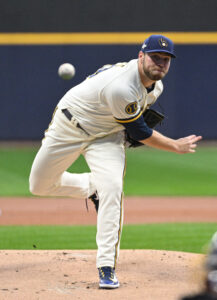
With all due respect to Rays ace Tyler Glasnow, Burnes will earn something like 60% of his $25MM salary in arbitration and has a track record of innings that Glasnow simply can’t match. White Sox right-hander Dylan Cease is a former Cy Young finalist himself … but he also posted a mid-4.00s ERA last year and has never had even an average walk rate. Guardians right-hander Shane Bieber is another fellow Cy Young winner with a comparable — likely lesser — salary coming in his final arbitration year. He also has seen his average fastball drop by about three miles per hour since winning that 2020 award, while his strikeout rate has quite literally been cut in half (a bit more than that) — falling from 41.1% to 20.1%.
Burnes’ 2023 season wasn’t his best, but the 2021 NL Cy Young winner pitched 193 2/3 innings of 3.39 ERA ball, punching out more than a quarter of his opponents against a solid 8.4% walk rate. After a shaky couple months in April and June, Burnes looked like himself down the stretch. From July 1 onward, he logged a pristine 2.72 ERA with a 28.4% strikeout rate and 8.4% walk rate. Again — it’s not quite the peak Burnes we saw during his Cy Young-winning season, but Burnes was a clear No. 1 starter for the final three months of the year, just as he was from 2020-22.
Detractors can raise red flags about a dip in strikeout rate and a slight uptick in walks, and there’s some merit to both, but the simple fact is that over the past four seasons, Burnes has had all of three single months with an ERA north of 4.00. Two of them came early in 2023, but the bulk of his season was excellent — just as the bulk of this 2020-23 run has been on the whole.
Will the Brewers actually trade Burnes? That’s another story. It’s a distinct possibility, but Milwaukee isn’t going to be shopping him and simply accepting the highest bid. Yes, Burnes is a free agent following the 2024 season. And yes, he had some choice words about the Brewers organization following last offseason’s arbitration hearing. He also hired the Boras Corporation not long after his loss in an arb hearing, and generally speaking, most marquee players don’t hire Scott Boras & Co. to negotiate an extension when they’re on the cusp of free agency. In all likelihood, Burnes is going to be one of the premier free agents on the 2024-25 class, barring an injury or an uncharacteristically poor season.
The Brewers, then, know there are two realities in front of them. The 2024 season will be Burnes’ last with the team, or he’s already pitched his final game for them. It’s a sobering and unwelcome reality for Milwaukee faithful, but not an unfamiliar one for a fanbase that’s accustomed to seeing star players leave for the type of lucrative paydays Brewers ownership can rarely match (Christian Yelich standing as the primary exception to that rule).
At the same time, the Brewers also expect to compete in 2024. They won the NL Central in 2023 and, if they hang onto Burnes, can run back a rotation including him and Freddy Peralta at the top of the group. They have one of the best relievers in baseball (Devin Williams), a high-end shortstop (Willy Adames), a burgeoning star at catcher (William Contreras), a resurgent Yelich and one of the game’s very best outfield prospects (Jackson Chourio) on the cusp of the Majors. In a weak division, the Brewers can certainly keep Burnes and take a run at contending. Worst case scenario, they fail and flip Burnes at the deadline for a still-strong (albeit not as strong) return. They could also keep Burnes, contend in the NL Central, possibly enjoy one more playoff push with him, and then make a qualifying offer at the end of the year.
Burnes’ projected $15.1MM salary in 2024 — courtesy of MLBTR contributor Matt Swartz — is a selling point for interested trade partners because it could fit into just about any team’s payroll. However, that inherently means it’s also true of the Brewers, whose only guaranteed contracts are Yelich, Peralta and affordable arms Colin Rea and Aaron Ashby. Even with Burnes, Roster Resource projects the team’s 2024 payroll at just $101MM. They can afford to keep Burnes and add to the roster around him this winter.
If the Brewers are to trade Burnes, they’ll surely require some MLB-ready talent and/or controllable prospects who are on the very cusp of reaching the Majors. Burnes ranked second on MLBTR’s list of the Top 25 offseason trade candidates, though that’s not necessarily an indication that he’s the second-likeliest player to move this winter. In writing that piece, MLBTR’s Anthony Franco noted that the rankings are an admittedly subjective blend of a player’s perceived availability, trade value and potential impact to a new club.
Burnes has a legitimate chance to be moved, but it’s not a situation where the Brewers will decidedly trade him for the best offer, nor is it one where they have to move him. If he ultimately changes teams, it’ll be because another club made a genuinely compelling offer containing long-term value that was too difficult to turn down for a player who is a veritable one-year mercenary at this point.
For the purposes of this exercise, we’ll rule out the rest of the NL Central. It’s unlikely that the Brewers will want to deal him within the division, and it’s perhaps even more unlikely that the Cardinals, Reds, Pirates or Cubs would want to part with the requisite type of controllable talent who could haunt them into the 2030s. Clubs in the midst of a rebuild/retool (e.g. Athletics, Nationals, White Sox, Royals) aren’t going to be considered here either. The Guardians develop pitching like it’s a cheap card trick. The Mariners’ rotation is already stacked with high-end names. We know the Rays, Padres and Twins are trying to cut payroll to varying extents. Clubs like the Rockies, Angels, Tigers and Marlins probably don’t feel they’re in a strong enough position to pay a premium for one year of Burnes, knowing he’s a lock to test the market next winter.
Here’s a broad-reaching look at some clear fits…
Astros: GM Dana Brown has already suggested that he doesn’t have tons of financial flexibility this offseason, downplaying needs in the rotation while talking up his desire to add to the bullpen and grab a backup catcher. That said, Brown was also candid about his openness to adding someone who could be a No. 3 starter or better, and Burnes clearly fits that billing in spades. Adding Burnes to a rotation including Justin Verlander and Framber Valdez would be a statement addition for an Astros club that just ceded the division title for the first time since 2017.
Blue Jays: Rumors about the Jays wanting to make a splash this offseason abound. A one-year match with Burnes would certainly fit the bill, giving Toronto a juggernaut rotation of Burnes, Kevin Gausman, Jose Berrios, Chris Bassitt and Yusei Kikuchi, with wild card Alek Manoah in the mix (if he himself isn’t part of a theoretical trade package for Burnes or shipped out elsewhere in a separate deal). Toronto can easily add Burnes to the roster without coming close to the luxury tax threshold, and as they’ve shown with trade acquisitions of Matt Chapman, Daulton Varsho and Berrios in the past two calendar years, they’re not afraid of parting with top prospects to make a big splash.
Braves: Atlanta reportedly had interest in both Aaron Nola and Sonny Gray but came up empty in each pursuit. They’ve since been connected to Dylan Cease, another Boras client who comes with half the projected arb salary as Burnes but twice the club control. The Braves tend to like to trade for players they have a chance at extending/re-signing (e.g. Sean Murphy, Matt Olson, Joe Jimenez, Pierce Johnson), but that’s not a hard-and-fast rule and Atlanta’s clear priority this offseason is adding a playoff-caliber starter. Young MLB-ready names like Vaughn Grissom and AJ Smith-Shawver would surely hold some appeal to the Brewers, and the two teams have recently lined up on multiple trades (William Contreras, Orlando Arcia).
D-backs: Arizona’s core of hitters is beyond impressive. Corbin Carroll, Christian Walker, Ketel Marte, Geraldo Perdomo and Gabriel Moreno all had strong years at the plate. Jordan Lawlar, one of the game’s top-ranked prospects, debuted late in the season. In the rotation, Zac Gallen and Merrill Kelly is a strong one-two punch, with an up-and-coming Brandon Pfaadt sure to factor in prominently. The D-backs were stung by their starting pitching in the end, however, with the Rangers scoring a combined 16 runs in the first, second and third innings of the World Series’ five games. The Snakes would know Burnes is a one-year play who’d be a veritable lock to sign a deal beyond their financial comfort zone next winter. But as a revenue-sharing recipient, they’d also be positioned to receive the top compensation possible for a qualified free agent: a pick at the end of the first round in 2025.
Dodgers: The Dodgers were tied to Burnes earlier in the offseason, and they’re a perennially logical candidate to make a play for virtually any high-profile acquisition on the trade market. The Dodgers need pitching more than usual heading into 2024, with Clayton Kershaw not only standing as a free agent but also expected to miss at least half (if not more) of the 2024 season following shoulder surgery. Walker Buehler will be in his first full season post-Tommy John. Dustin May had flexor tendon surgery/TJS revision back in May. Tony Gonsolin underwent TJS in August. It’s a brutal batch of luck for Dodger arms, and while young options like Bobby Miller, Emmet Sheehan, Gavin Stone, Ryan Pepiot and Nick Frasso give the Dodgers upside in abundance, they need some sure things as well. A one-year run with one of the NL’s top arms at a reasonable price point makes perfect sense here, and the Dodgers could make the deal knowing they’d get at least some draft compensation in return if Burnes signs elsewhere next winter, even if their status as a likely luxury tax payor would push the pick placement down to after the fourth round.
Giants: San Francisco is perhaps more focused on acquiring star-caliber talent it can control for the long haul, with names like Shohei Ohtani, Cody Bellinger and Yoshinobu Yamamoto among the team’s reported targets. If they succeed in adding such a marquee player, however, it’d likely embolden president of baseball ops Farhan Zaidi to pursue shorter-term upgrades. Pairing Burnes with any one of those free agents would represent a transformative couple moves for a Giants team that has now had back-to-back disappointing seasons on the heels of an out-of-the-blue 107-win season in 2021. It cuts both ways, too; if the Giants are looking to sell Ohtani on their competitive outlook, a strike to acquire Burnes would help show him just how serious they are.
Mets: It’s not fully clear how aggressively the Mets will push for contention in 2024 after a disappointing year. Following his trade to the Rangers, Max Scherzer candidly said (perhaps to the chagrin of Mets brass) that his former club was looking at the ’24 season as something of a transitional year. If that’s the case, paying a prospect premium for Burnes with little hope of extending him might not be prudent. But the Mets have the money and big-market resources to push for a deal if new president of baseball ops David Stearns — the former Brewers president of baseball ops — wants to pursue his former ace with his new club. Then again, acquiring a second Boras client in a walk year who’ll have a massive price tag in extension talks (joining Pete Alonso) could give Stearns some trepidation. That’s especially true since he knows owner Steve Cohen will surely support him next winter if he wants to sign Burnes in free agency.
Orioles: At some point, one would imagine the Orioles will have to do … something? Baltimore rode a core of breakout hitters and some underappreciated pitchers (Kyle Bradish, most notably) to a 101-win season and an AL East title in 2023. But the O’s haven’t signed a free agent to a multi-year deal since Mike Elias was named GM and haven’t acquired any impact veterans on the trade market. It’s hard not to wonder what their 2023 season would’ve looked like had they aimed higher than Kyle Gibson and Cole Irvin when looking for rotation help last winter. Baltimore has an almost comical surplus of MLB-ready position players. There’s just not enough playing time for all of Jordan Westburg, Connor Norby, Joey Ortiz, Heston Kjerstad, Colton Cowser and Coby Mayo, to say nothing of the game’s No. 1 overall prospect: Jackson Holliday. He’s likely to emerge as the shortstop of the future in ’24, pairing with Rookie of the Year Gunnar Henderson on the left side of the infield. Sooner or later, the Orioles have to act like potential postseason behemoth they are.
Phillies: Adding another starter probably isn’t a top priority for the Phils after re-signing Nola, but Philadelphia is surely hungry to get to the finish line after a consecutive NLCS appearances. The Phillies had hoped top prospect Andrew Painter could solidify his spot on the staff in 2023, but he wound up having Tommy John surgery instead. Cristopher Sanchez makes a fine fifth starter, but acquiring Burnes and deploying a rotation including him, Nola, Zack Wheeler, Ranger Suarez and Taijuan Walker is undoubtedly tantalizing for a president of baseball operations who’s never shy about making big trades. Dave Dombrowski has World Series rings from his time with the Marlins and the Red Sox, but he has the payroll space and high-end pitching prospects to pursue this if he wants to make an all-out push for a third ring with a third team.
Rangers: The reigning World Champs have been MLB’s most aggressive bidders in free agency over the past couple offseasons, and their recent championship isn’t going to prompt them to sit back and coast from here on out. Texas will be players for Shohei Ohtani and other top free agents, but it ownership reaches the point where another free agent mega-deal becomes too much to stomach, trading for Burnes is a clearly appealing alternative. Jacob deGrom will be sidelined for much of the year due to Tommy John surgery. Jordan Montgomery could depart in free agency. The Rangers have a need for another high-end starter, and many of their top position prospects — specifically MLB-ready bats like Justin Foscue and Dustin Harris — are blocked at the MLB level right now. Neither would headline a Burnes trade, but both could hold some appeal as secondary pieces.
Red Sox: Boston was linked to Burnes earlier this week. New chief baseball officer Craig Breslow is seeking at least one marquee arm to plug into a rotation that’s teeming with question marks — be they due to injury (Chris Sale) or limited MLB track record (Brayan Bello, Tanner Houck). Installing Burnes into the rotation would be a boon for the team’s 2024 outlook, but it remains to be seen whether a rookie baseball operations leader would want to part with substantial long-term talent for a one-year acquisition of Burnes on the heels of the Red Sox’ last-place finish in the division.
Yankees: Speaking of disappointing 2023 seasons from AL East powers, the Yankees barely eked out a winning season (82-80) and missed the playoffs entirely. They have serious long-term questions in the outfield, the infield and in the rotation. Burnes would be a short-term patch unless he can be re-signed next winter, but the Yanks might get their long-term arm if they can successfully sell Yamamoto on pitching in the Bronx. If they succeed in landing the righty, who many consider their top pitching target, then a trade to add Burnes to a starting staff also featuring Gerrit Cole, Yamamoto and Carlos Rodon (who can scarcely have a worse 2024 season than his 2023 Yankees debut) could give the Bombers a potential pitching powerhouse.
—
Overall, the best fits for Burnes are going to be win-now clubs with payroll space, strong farm systems and strong enough 2024 playoff expectations that there’s little fear of giving up too much for a pitcher ahead of a season that culminates in a postseason miss. In my view, that points to the Dodgers, Orioles, D-backs, Phillies and Rangers, although Burnes is talented enough that you can make a compelling case for just about any pseudo-contender to take the plunge and meet Milwaukee’s surely steep asking price.
Erick Fedde Weighing Interest From KBO, MLB Clubs
Former Nationals first-round pick and top prospect Erick Fedde just wrapped up a dominant season with the Korea Baseball Organization’s NC Dinos, which saw the 30-year-old righty take home league MVP honors in his first season overseas. He’s unsurprisingly drawn MLB interest on the heels of that performance, but Fedde will have to weigh that interest against a considerable raise from his incumbent team. Jee-ho Yoo of South Korea’s Yonhap News Agency reports that Fedde has an offer in hand from the Dinos, which GM Sun-Nam Lim describes as the “best” possible offer his team can make “within the rules” of the KBO.
The KBO caps teams’ spending on foreign players, with first-year players able to earn a maximum of $1MM. Fedde earned that $1MM maximum in 2023. As Yoo further explains, KBO clubs are capped at $4MM to be divided among three foreign players. Each player they’re planning to re-sign for a subsequent season can increase that cap by $100K — up to a maximum of three players.
The maximum offer to Fedde, then, would be $4.1MM — although Lim did not expressly state such an offer has been made. Doing so would require forgoing other foreign signings entirely. It’s plenty feasible that Lim was suggesting they’ve offered what they feel is the most they can while still retaining enough pool space to sign two other foreign players on minimal commitments. Yonhap’s initial report indicates that the Dinos have offered Fedde “at least” one additional year; it’s plausible the team has put forth a multi-year deal, which could technically clock in at just over $4MM in AAV (again, if the Dinos are comfortable entirely forgoing other foreign additions). Near as we at MLBTR can recall, no KBO team has ever gone to such lengths to retain a foreign player. One source who has ample experience dealing with KBO clubs expressed serious doubt to MLBTR that a team would commit its whole pool to one player.
Fedde spoke with Yoo about the decisions he faces this winter, noting that it’s still early in the process and that he faces “so many unknowns” on the heels of leading the KBO in wins (20), strikeouts (209) and ERA (2.00). Fedde touted his faith in agent Scott Boras, voiced his appreciation for everything the Dinos have done for him, and suggested he’ll ultimately do what he feels is best for him and his family.
Fedde’s debut campaign in the KBO was nothing short of remarkable. He pitched 180 1/3 innings of 2.00 ERA ball, averaging six innings per outing along the way. He fanned 29.5% of his opponents against a 4.9% walk rate and recorded an enormous 70% ground-ball rate. KBO hitters don’t tend to focus on elevating the ball as much as their MLB counterparts, so it’s common to see larger ground-ball rates among pitchers there, but a 70% clip is nevertheless excellent.
Presumably, given the demand for starting pitching throughout MLB, Fedde will find guaranteed offers to return to the Majors. The former No. 18 overall pick climbed as high as No. 52 on Baseball America’s top-100 rankings prior to his MLB debut, so there’s certainly some track record and prospect pedigree that adds to his appeal for big league clubs.
Had he just enjoyed a strong season while following the same gameplan he did throughout his time in the Majors and in Triple-A, perhaps interest would be a bit more muted, with teams chalking up his success to facing lighter competition. That’s surely a factor, but Fedde also chatted with Jesse Dougherty of the Washington Post back in September about how he’s worked to change the shape of his breaking ball, change the release point on his heater, alter the grip on his changeup and adding a newly adopted sweeper to his repertoire. It’s a notable enough series of changes — particularly the incorporation of an entirely new offering — that Fedde will be viewed as a decidedly different pitcher than he was during his run with the Nats organization.
The extent to which teams are sold on the changes will obviously determine the strength of offers he’ll receive from MLB teams. In recent years, we’ve seen Merrill Kelly, Chris Flexen and Josh Lindblom parlay strong KBO showings into big league deals — Flexen after spending only one year in South Korea. We’ve not yet seen a former big league pitcher coming back from the KBO reach $10MM in guaranteed money, though Fedde’s performance was more dominant than Kelly and Flexen, and he’s three years younger than Lindblom (another former KBO MVP) was when he returned.
On the other hand, even if an MLB team is willing to offer something like two years and $10-12MM total, Fedde could also consider further betting on himself with another year leading the Dinos’ staff. If he were to repeat this performance or even show improvement, he could take home a healthy raise on this past year’s $1MM salary and then hit the open market next winter in search of a two-, three- or even four-year deal from an MLB club at a much heartier annual rate than is likely available to him right now.
It all boils down to a matter of risk tolerance for Fedde, who’ll have to weigh the options of maxing out on his earning power right now or taking a lesser 2024 contract in pursuit of a heftier deal next offseason. Regardless of which route he chooses, the mere fact that he’s in this position is a testament to the strength of his 2023 performance, which stands a clear-cut example of the earning upside players chase when taking their game overseas.
MLBTR Chat Transcript
Click here to read a transcript of Tuesday’s chat with MLBTR’s Steve Adams.
Brewers Agree To Minor League Deals With Easton McGee, Brewer Hicklen
The Brewers have signed right-hander Easton McGee and all-too-appropriately-named outfielder Brewer Hicklen to minor league contracts, reports Adam McCalvy of MLB.com. They’ll both be in major league camp during spring training, though McGee won’t be pitching, as he’ll still be rehabbing from last May’s Tommy John surgery. McCalvy further adds that McGee’s minor league deal is a two-year pact, so he’ll be in the Brewers system through at least the 2025 season.
McGee, 26 next month, appeared briefly in the big leagues with the 2022 Rays and 2023 Mariners, combining for 9 2/3 shutout innings. He fanned three hitters and walked just one during that time. He’s a soft-tosser by today’s standards, averaging 91.5 mph in ’22 and seeing that number drop to 90.1 mph prior to this past season’s surgery.
McGee was Tampa Bay’s fourth-round pick back in 2016, and though he doesn’t have power stuff or a history of elite run prevention in the upper minors (4.78 ERA in 141 Triple-A frames), he does boast outstanding command. He’s faced just shy of 2100 hitters since being drafted and walked only 4.6% of them. At 6’6″, his lanky frame likely helps his pedestrian fastball velocity play up a bit, and that standout command is difficult to develop in players. On what amounts to a no-risk minor league pickup for the Brewers, he’s a nice arm to stash in the system in hopes that he can eventually emerge as a back-end starter or perhaps a multi-inning reliever.
Hicklen, 28 in February, made his MLB debut with the 2022 Royals but went hitless in a minuscule sample of six plate appearances. He’s a 2017 seventh-round pick with a career .244/.348/.486 line at the plate in 853 Triple-A plate appearances.
While he didn’t hit for much power in 2023 (10 homers in 72 games), Hicklen popped 28 long balls with Kansas City’s Triple-A club in 2022 and has drawn praise for his plus-plus (70-grade) speed. Those wheels have been on display in Triple-A, where he’s swiped 56 bags in 61 tries. Overall, he’s stolen 186 bases in the minors with a hefty 85% success rate. He’s worked primarily in left field during his minor league career, but Hicklen has 1310 innings in right field and another 621 frames in center, so he’s capable of playing all three spots.