
A Likely Trade Chip In The Rockies’ Outfield
As recently as a few months ago, the Rockies’ 2022 swap of Raimel Tapia for Blue Jays outfielder Randal Grichuk looked like a no-win trade for both parties. Tapia lasted one season in Toronto before being non-tendered and signing a minor league deal with the Red Sox. Grichuk’s offense didn’t tick up in his first year at Coors Field, as many had expected it to. He posted his typical sub-.300 OBP and surprisingly had his lowest power showing (by measure of ISO) since his rookie campaign. He was essentially a replacement-level player in 2022.
The 2023 season has brought about better results, however. Grichuk still isn’t hitting for the same level of power he did during his Toronto days (five homers, .172 ISO in 225 plate appearances), but he’s walking at a career-best 7.6% clip and currently has a 20.9% strikeout rate that ties his career-low mark.
Grichuk has undoubtedly had some good fortune on balls in play — his .368 BABIP is 70 points north of his career-high — but his .300/.364/.473 batting line is impressive all the same. The 31-year-old’s 90.6 mph average exit velocity and 45.2% hard-hit rate are both well above-average and only narrowly short of his career-best levels. His 24.2% line-drive rate is a personal best by a wide margin.
Things have gone particularly well for the veteran outfielder as of late. After a brief but dismal slump in the first couple weeks of June, Grichuk has bounced back with a .322/.375/.610 slash over his past 64 trips to the plate. Today’s front offices generally aren’t going to overreact to a short hot streak, but Grichuk’s recent uptick in production is particularly notable given that he’s slugged four of his five home runs in that stretch. After posting just a 33.6% fly-ball rate through mid-June, he’s had a 44% fly-ball rate during this heater.
While he’s having an undeniably productive season at the plate, Grichuk’s game has ostensibly taken a step back in other areas. Defensive Runs Saved (-8) and Outs Above Average (-6) agree that this is among the worst defensive seasons of his career — if not the worst.
As a rookie, Grichuk ranked in the 91st percentile of big leaguers in terms of average sprint speed, per Statcast. It’s only natural for a player to slow down as he ages, but Grichuk had well above-average speed as recently as 2021 (76th percentile) and 2022 (68th percentile). He’s down to the 46th percentile of MLB players in 2023 — the first below-average season of his career. His arm strength remains above average, but Statcast now places him in just the fourth percentile of MLB outfielders in terms of his outfield jumps.
Taken in totality, it’s a somewhat limited skill set. Grichuk can play all three outfield spots but has generally rated best in right field. He’s hitting well against righties in 2023 (.295/.357/.439) and tattooing lefties (.313/.380/.537), but his career body of work is below-average when he’s not holding the platoon advantage.
Grichuk is a solid enough role player who’s been thrust into an everyday role with the Rockies. The results in ’23 have been decent enough, but combined with his 2022 season he still looks better deployed in a more limited capacity.
That’s likely how many contenders will view him. Grichuk is a career .264/.311/.498 hitter against southpaws who’s made gains in terms of his overall plate discipline this season, albeit at the expense of some power. His defensive ratings are down, but that’s partially due to being played in center field, where he’s no longer a good fit, and in left field, where he hadn’t logged an innings since 2018 (when he played six frames there).
A contending team could install Grichuk as a part-time DH and right fielder whose primary role is to step into the lineup and help against southpaws. He can cover center field in a pinch and has enough bat that he’s not a total liability when needed to play against righties.
There are plenty of clubs in need of just this type of skill set. The Giants, Guardians, Twins and Brewers are all playoff hopefuls whose team-wide production against left-handed pitching ranks in the bottom seven of MLB clubs (by measure of wRC+). The D-backs, who have an all-left-handed outfield, are only slightly better, at 21st.
In seasons past, it might’ve been fair to wonder whether the Rockies would move Grichuk at all. Frankly, based on their history of hanging onto impending free agents, it still is. However, Rockies manager Bud Black said on MLB Network Radio on SiriusXM just today that he believes his team’s front office will be “more active” than in seasons past at this year’s trade deadline.
Grichuk is a natural candidate to be moved. He’s a free agent at season’s end who’s earning $9.333MM this season. The Blue Jays are on the hook for $4.333MM of that sum as part of the trade that brought him to Denver in the first place, however, meaning an acquiring team would only be responsible for $2.02MM of the $5MM the Rockies are paying him (as of tomorrow). Colorado, of course, could pay down some of that money to increase his appeal.
Grichuk isn’t going to be a contender’s marquee addition, but he can can deepen a team’s bench and — based on Black’s comments today — seems like a player with a good chance to change teams in the next 14 days.
Athletics’ Drew Rucinski, Yacksel Rios Require Season-Ending Surgery
Athletics right-handers Drew Rucinski and Yacksel Rios will see their 2023 seasons draw to a close early due to injury, per MLB.com’s Martin Gallegos (Twitter links). Rios underwent surgery yesterday to repair an axillary branch aneurysm in his right shoulder. Rucinski will require back surgery to address what was described by the team in late June to be a degenerative condition. Both players are on the 60-day injured list already.
Rucinski, 34, had hoped to establish himself in the big leagues this season after starring in the Korea Baseball Organization for the past several years. The journeyman righty had just 54 big league innings under his belt prior to this season, all coming between 2014-18. He didn’t pitch particularly well in that time (5.33 ERA) but spent the 2019-22 seasons with the NC Dinos of the Korea Baseball Organization, pitching to a combined 3.06 ERA in 732 2/3 innings of work. The right-hander displayed remarkable consistency overseas, with his ERA sitting between 2.97 and 3.17 in all four of his KBO campaigns.
When his latest contract with the Dinos expired after the 2022 campaign, Rucinski set his sights on a return to North American ball. The A’s, hoping to find similar success to the D-backs (Merrill Kelly) and Mariners (Chris Flexen) in their own KBO dealings, signed Rucinski to a one-year deal worth a guaranteed $3MM.
Clearly, things haven’t gone as hoped. Rucinski pitched just 18 innings for Oakland, missing time first with a stomach illness, then with a knee sprain and now this current back injury. He was perhaps never at 100 percent, as the righty was tagged for 18 runs on 27 hits and 14 walks with just six strikeouts in his 18 frames for the A’s. His contract has a $5MM option for the 2024 season, though that’ll surely be bought out.
Rios, acquired in a cash deal with the Braves last month after he triggered an upward mobility clause in his contract, pitched in just three games for the A’s. In a total of 1 2/3 frames, he yielded seven runs on three hits and six walks. It was a substantial downturn from the excellent 2.49 ERA, 30.3% strikeout rate and 8.1% walk rate the hard-throwing Rios had posted in Triple-A with the Braves.
Rios has seen time in parts of six big league seasons, pitching to a combined 6.32 ERA in 98 1/3 frames. He throws hard, misses bats and has had decent results in Triple-A (4.12 ERA in six seasons), so he should get another look as a depth option somewhere in the offseason. For now, he’ll accrue Major League service time and salary on the 60-day IL. That’ll take him over three years of MLB service, making him eligible for arbitration this winter. He’ll be a non-tender candidate for the A’s following the season.
Brewers Place Wade Miley On Injured List
The Brewers placed left-hander Wade Miley on the 15-day injured list due to elbow discomfort and recalled righty Trevor Megill from Triple-A Nashville, per a team announcement. Miley tells Curt Hogg of the Milwaukee Journal-Sentinel that he’s not dealing with a ligament issue (Twitter links). Rather, he’s been pitching through bone spurs in his elbow. Miley has already received a platelet-rich plasma injection to help combat the pain, and manager Craig Counsell told Hogg and others today that the team is hopeful it’ll just be a minimal absence.
It’s the second IL stint of the season for Miley, who went on the injured list back on May 17 due to a lat strain. He was out until June 17 with that injury and will now be shelved again for a yet-to-be-determined period of time.
Miley, 36, has pitched to an excellent 3.06 ERA in 67 2/3 innings this season and was particularly sharp in between IL stints, logging a 2.08 ERA with a 22-to-10 K/BB ratio and 45.1% ground-ball rate in 26 innings across five starts. Overall, he’s fanned a well below-average 16.7% of his opponents in 2023 but also sports a strong 6.9% walk rate. He’s done a good job limiting hard contact (87.6 mph average exit velocity) and keeping the ball in the yard (1.06 HR/9) despite a homer-friendly home venue.
Miley joins righty Brandon Woodruff and fellow lefty Aaron Ashby on the injured list. Milwaukee figures to deploy Corbin Burnes, Freddy Peralta, Julio Teheran, Adrian Houser and Colin Rea in the rotation for the time being.
That could be a short arrangement, however. Woodruff is headed out on a minor league rehab assignment on Saturday, according to Counsell (Twitter link via Sophia Minnert of Bally Sports Wisconsin). Ashby is also trending toward a rehab assignment, Hogg tweets, though the plan for right now is to bring him back to the big leagues as a reliever rather than a starter.
If both Miley and Woodruff remain on track for returns sooner than later, the Brewers could well feel they have sufficient rotation depth. But there’s minimal depth beyond the current group — hence the earlier signing of Teheran, who’s been a staff savior in eight starts — so if either incurs any kind of setback it could prompt Milwaukee to look for additions between now and the Aug. 1 deadline.
Athletics, Zack Godley Agree To Minor League Deal
The A’s have agreed to a minor league contract with right-hander Zack Godley, MLBTR has learned. He’d been pitching with the Gastonia Honey Hunters of the independent Atlantic League. He’s headed to Triple-A Las Vegas for the time being and will make his first start for the Aviators on Friday.
Godley, 33, hasn’t appeared in the big leagues since a brief look with the 2021 Brewers. The right-hander was a solid member of the Diamondbacks’ rotation back in 2017-18 when he tossed 333 innings of 4.10 ERA ball with an above-average 24.7% strikeout rate against a higher-than average 9.4% walk rate.
Though Godley looked to have locked down a spot at the back of the Arizona rotation with that performance, he struggled in three subsequent seasons, in part due to injury. He spent time on the injured list with a flexor strain in 2020 and finger injuries in 2021. Overall, in the three seasons following that nice run in ’17-’18, Godley limped to a 6.75 ERA in 124 innings at the big league level.
Since 2022, Godley has been pitching in the Atlantic League, where he’s amassed 125 2/3 innings of 4.73 ERA ball. It’s not an eye-catching number, but he’s posted nice strikeout and walks rates, fanning 28% of his opponents against a 7.8% walk rate.
For the A’s, adding any and all veteran rotation depth they can find makes sense. Oakland starters have MLB’s second-worst ERA this year, with their 6.37 mark narrowly leading the 30th-ranked Rockies (6.44). Left-hander JP Sears, who has a 3.99 ERA in 106 innings on the year, is the only A’s starter with an ERA under 5.00. Oakland also has James Kaprielian, Mason Miller and Drew Rucinski on the injured list — the latter two on the 60-day IL. Down in Triple-A, 40-man options include Kyle Muller and Adrian Martinez, but both have struggled in a hitter-friendly Vegas setting.
Godley will add some experienced depth to Oakland’s group and give them an option for a spot start or simply to eat some innings at the back of the big league staff if they’re concerned about potential workload management for younger arms in the season’s second half.
Pirates Sign No. 1 Overall Pick Paul Skenes
The Pirates announced Tuesday that they’ve officially signed right-hander Paul Skenes, whom they selected with the No. 1 overall pick in this year’s draft. The now-former Louisiana State University ace will receive a $9.2MM signing bonus, Jim Callis of MLB.com reports. It’s the largest draft bonus ever issued under the current slotting system in Major League Baseball. Full slot value for the top overall selection was $9,721,000.
Skenes, 21, spent this year dominating for LSU. He made 19 starts for the Tigers with a 1.69 ERA in 122 2/3 innings. He struck out 209 of the 462 batters he faced, an incredible 45.2% rate, while walking just 20 for a 4.3% rate in that department.
Coming into the draft, he was a consensus top three pick by all of the major outlets alongside his LSU teammate Dylan Crews. ESPN, FanGraphs and Keith Law of The Athletic gave Skenes the #3 slot, Baseball America had him at #2, while MLB.com had him in the very top spot. MLB Pipeline puts an 80-grade on his fastball, the top mark possible on the 20-80 scale, noting that he averaged 98 mph this year while getting as high as 102. They also heap praise on his slider and compliment his changeup as well. He is described as a “classic” starter in that he is 6’6″ and 235 pounds, with the profile at MLB.com describing him as the best pitching prospect since Stephen Strasburg in 2009.
Even the profiles that didn’t have Skenes in the #1 slot admitted that there was a case to have done so, though the greater injury risk for pitchers played a factor in bumping him to #2 or #3. All observers consider him to be a potential future ace some think he is talented enough to pitch in the big leagues today. That’s not to say the Pirates will consider such a path, since pitchers are often shut down in their draft year and Skenes already logged a significant workload this year.
How the Bucs will proceed with Skenes will be a fascinating development to watch this winter and into next year, given that some evaluators think he’s ready for the big leagues. The Pirates showed some signs of life earlier this year and had some hope of emerging from their rebuilding phase, but they’ve faded in the past couple of months and seem likely to be out of contention this year. But if they think they are ready to make a leap in 2024, they will have to come up with a plan for where Skenes fits in there.
The club has been aggressively promoting its prospects this year, with Henry Davis, Endy Rodríguez, Jared Triolo, Nick Gonzales and Liover Peguero all called up in recent weeks, but there’s plenty of room in the rotation. Mitch Keller will undoubtedly be in the mix as he’s in his second straight solid season. Johan Oviedo is posting passable results behind him. 43-year-old Rich Hill could be traded this summer but is an impending free agent even if he doesn’t get moved. Other options like Osvaldo Bido, Luis Ortiz and Roansy Contreras have shown some encouraging signs at times but are still question marks right now, as in Quinn Priester, who was just promoted to make his debut in recent days. Mike Burrows was considered one of the club’s better pitching prospects coming into the year but required Tommy John surgery in April.
Baseball America has already updated its top 100 prospects lists after the draft and has Skenes #5 across the entire league. Skenes was the first #1 pick in MLB’s new lottery era, which was just implemented for this draft. The Pirates got the #1 selection despite the Nationals and A’s having slightly worse records in 2022.
Padres Designate Rougned Odor For Assignment, Option Austin Nola
The Padres announced a broad-reaching slate of roster moves Tuesday, most notably designating infielder/outfielder Rougned Odor for assignment and optioning catcher Austin Nola to Triple-A El Paso. San Diego also optioned utilityman Brandon Dixon to El Paso.
That trio of moves creates space for the team to reinstate catcher Luis Campusano from the 60-day injured list, select the contract of outfielder Taylor Kohlwey and recall infielder Alfonso Rivas from Triple-A. The Padres also announced that righty Reiss Knehr has been transferred from the 15-day IL to the 60-day IL. He’s been on the shelf with elbow discomfort since late June and will now be sidelined until at least late August.
It’s a notable shakeup for a struggling Padres club that has gotten negligible production from the bench and from its catching position this season. Odor, who’ll be traded or released within a week’s time (he can reject an outright assignment), has batted just .210/.306/.370 in 157 trips to the plate this season. Nola (.146/.260/.192 in 154 plate appearances) and Dixon (.204/.244/.329 in 86 plate appearances) have been even less productive. They’ll both remain in the organization in Triple-A, at least for the time being.
The Padres were Odor’s fourth team in as many years. He hasn’t had an above-average season at the plate since 2016 but has continually gotten looks around the league thanks to his glove and considerable left-handed pop. He’s been with the Rangers, Yankees and Orioles in the past three seasons, respectively, and cracked the Padres’ Opening Day roster in 2023 despite a combined .199/.269/.374 showing from 2020-22. In doing so, he continued the long line of former Rangers who’ve made cameos with the Padres under president of baseball operations AJ Preller — a longtime assistant GM in Texas (e.g. Ian Kinsler, Keone Kela, Mitch Moreland, Nelson Cruz, Nomar Mazara, Jurickson Profar, Yu Darvish, Nick Martinez, Carl Edwards Jr.).
Nola, 33, has been San Diego’s primary catcher in recent seasons after coming over from the Mariners in what’s become a lopsided deal for Seattle. San Diego acquired Nola, Austin Adams and Dan Altavilla in exchange for infielder Ty France, reliever Andres Munoz, outfielder Taylor Trammell and catcher Luis Torrens. France has since settled in as the Mariners’ primary first baseman and made the All-Star team in 2022. Munoz has stepped up as Seattle’s closer.
While Nola had been enjoying a breakout with the Mariners in 2019-20 and was solid in his first season-plus with San Diego, his bat has since cratered. Dating back to Opening Day 2022, he’s a .222/.304/.291 hitter (75 wRC+) in exactly 162 games and 551 plate appearances. His once-strong framing ratings have also deteriorated, and Nola has thwarted just 16.8% of stolen base attempts over the past two seasons.
With Nola now in El Paso, the Padres will rely on Campusano and Gary Sanchez behind the plate. Sanchez started hot after signing in San Diego, clubbing five dingers in his first 50 plate appearances. However, he’s since gone ice cold at the dish, batting just .150/.253/.250 in his past 91 turns at the plate.
That could open the door for Campusano to at last get a legitimate look behind the plate. The longtime top prospect has appeared in each MLB season since 2020 but has only 114 career plate appearances to his name. He’s mustered only a .198/.237/.302 output in that time, but Campusano is a career .297/.366/.513 hitter in 702 Triple-A plate appearances and has outstanding batted-ball metrics in his limited MLB work. Despite the pedestrian bottom-line results, Campusano has an average exit velocity of 90.6 mph and a massive 48.7% hard-hit rate, per Statcast. Opponents have gone 16-for-16 against him in stolen bases at the MLB level, but Campusano has a 25% caught-stealing rate in the minors.
Also joining the Padres’ roster will be Kohlwey, who’ll be in line for his MLB debut just two days prior to his 29th birthday. A 21st-round pick out of the University of Wisconsin La Crosse back in 2016, Kohlwey has experience at all three outfield spots and is batting .261/.377/.437 with nine homers, 16 doubles, a pair of triples, 10 steals and nearly as many walks (50) as strikeouts (51) in 328 trips to the batter’s box.
Rivas, 26, signed with the Padres over the winter after spending the past two seasons with the Cubs. He’s gone 2-for-7 with a double in his limited sample with the Friars so far this year and is a career .248/.332/.325 hitter in 344 MLB plate appearances. Rivas boasts a colossal .332/.462/.582 slash in Triple-A this season and carries a lifetime .313/.424/.492 line in 150 games at that level.
The Royals’ Breakout Reliever Should Draw Trade Interest
Heading into deadline season, the Royals’ stance as sellers was obvious — painfully so, for Kansas City faithful. Confirmation of that fact was hardly needed, but the Royals’ early trade of Aroldis Chapman to the Rangers cemented their already obvious status. The widespread expectation is that closer Scott Barlow will be marketed to other clubs over the next couple weeks, and even in something of a down season (by his high standards), his track record and affordable price tag should place him in demand.
The Royals aren’t exactly deep in straightforward trade candidates elsewhere on the roster. Zack Greinke is on the injured list at the moment and seems content to wind down his career in the place where it all began. Offseason signees Jordan Lyles and Ryan Yarbrough haven’t performed well. Last year’s breakout starter, Brady Singer, has regressed significantly. Infielder Nicky Lopez could change hands but would be viewed as a light-hitting utilityman by most contending clubs. He’s not likely to fetch a big return. Royals GM J.J. Picollo has made clear he has no intention of trading Salvador Perez, and Perez has full no-trade rights anyway. Kansas City just released Amir Garrett, who might’ve been an appealing rental trade candidate were it not for a sky-high 17.9% walk rate.
There’s at least one other reliever in the Royals’ bullpen who deserves some attention, however, even if he’s far from a household name. After three seasons floundering while bouncing between the rotation and bullpen, right-hander Carlos Hernandez has stepped up as a setup man to Barlow (now that Chapman’s been traded anyway) and looks the part of an impact late-inning arm.
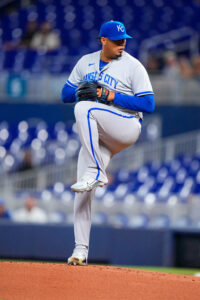
Hernandez, 26, doesn’t exactly have numbers that leap out at first glance. His 3.86 ERA is a bit better than the league-average 4.13 ERA for relievers. His 28.5% strikeout rate is well above-average but isn’t quite elite. Ditto for his 7% walk rate.
A closer look at Hernandez, however, reveals quite a bit more to like. After sitting 97.1 mph with his fastball from 2020-22, he’s up to a massive 99.2 mph in 2023. That places him fifth among all relievers, trailing only Jhoan Duran, Jordan Hicks, Felix Bautista and the aforementioned Chapman. Hernandez is sitting on a 14.5% swinging-strike rate and huge 36% opponents’ chase rate on pitches off the plate — both considerably better than the respective league averages of 11.1% and 31.7%. He’s also excelled at keeping the ball in the yard, yielding just three homers in 46 2/3 innings — and none since April 22.
That’s not the only reason that Hernandez’s April game log is worth taking a closer look at. Five of the 20 earned runs he’s allowed this season came in a single outing that month — a brutal drubbing at the hands of the Rangers on the 18th. Hernandez used his curveball at a season-high 21.4% that day. Since that time, he’s largely shelved the pitch, instead leaning more on his improved fastball, his slider and his splitter.
Through April 18, Hernandez was throwing his curve a bit less than 15% of the time. Since then, he’s thrown the pitch at just a 5.1% clip — including a lowly 2.8% rate dating back to mid-June. Since narrowing his arsenal and ramping up the usage of his heater in mid-April, he’s sporting a 3.12 ERA with a 1.90 FIP, 31% strikeout rate and 5.8% walk rate.
That’s not to say the curveball was necessarily the source of his early struggles in and of itself, but the more focused arsenal and elevated use of his fastball have clearly paid dividends. In general, a reliever scrapping his fourth-best pitch to lean more heavily into his best offering is good practice. And, Hernandez still has an effective splitter to keep lefties off balance and a quality slider he uses against righties. It’s a nice recipe for success, evidenced by southpaws hitting just .195/.247/.276 against him and righties hitting only .202/.258/.345. Handedness hasn’t mattered much for Hernandez this year; he’s been good against everyone.
The Royals don’t need to feel any pressure to trade Hernandez. Beyond the fact that he’s just 26 years of age, he entered the year with one year, 145 days of Major League service time. He’ll pass two years this season and finish out the year at 2.145 years of service. That’ll put him in line as a surefire Super Two player, making him arbitration-eligible four times rather than three, but his salary in 2024 will be minimal — likely in the $1MM range. Furthermore, that limited service time means he’s under team control all the way through the 2027 season.
That said, reliever performance is volatile on a year-to-year basis, and pitchers in general carry greater risk of major injury than their position-player counterparts. And, the four-plus years of club control and minimal salary commitment required in the short-term only makes Hernandez more intriguing to clubs looking for bullpen help not only this year but beyond.
It’s rare but not unheard of for teams to trade relievers with this type of club control; the Cubs traded five years of righty Scott Effross to the Yankees just last summer and received a largely MLB-ready starting pitcher, Hayden Wesneski, in return. Granted Wesneski hasn’t exactly cemented himself in the Chicago rotation, but getting six-plus years of control over a generally well-regarded, MLB-ready prospect was still a strong return for a controllable reliever.
Hernandez has one less year of club control but is arguably equally or even more desirable. He’s two years younger now than Effross was last year and has the type of power arsenal that tends to tantalize modern front offices. Effross did not (91 mph average fastball). It’s certainly plausible that a team would be willing to part with potentially impactful, near-MLB talent to secure four-plus seasons of a 26-year-old with baseball’s fifth-hardest fastball, minimal platoon concern and rapidly improving results.
Broadly speaking, this is the type of trade the Royals have been unwilling to make in recent years. They’ve held onto the majority of their controllable talent even through ongoing rebuilding efforts. For instance, Whit Merrifield drew trade interest for years before the Royals finally traded him last summer, only to command a much lesser return than he otherwise might have had they pulled the trigger a couple seasons prior. The Royals waited until Danny Duffy was a rental player on the injured list to move him at the deadline. They’ve frequently preferred to keep controllable players they feel can contribute to the next contending club, but that contending season has yet to come around (arguably in large part because they’ve opted not to sell controllable pieces at peak value).
That trend, however, was a hallmark of the Dayton Moore-led Royals, and Moore was dismissed from his position as president of baseball operations last year. The Royals stayed in house to replace him, elevating Picollo to the top spot in the baseball operations department, so perhaps he’s philosophically cut from the same cloth as his predecessor and longtime colleague. But we’ve yet to see a full deadline of Picollo at the helm in Kansas City, and it’s at least possible he’ll run things a bit differently.
Even if the Royals don’t want to trade Hernandez, they ought to listen to what other clubs have to say. There’s little doubt that he’ll draw considerable interest, given his breakout and the wide swath of teams in search of bullpen help. For a Royals club with needs all around the diamond and little in the way of meaningful trade chips to peddle on a flawed roster, Hernandez’s well-timed breakout could be an unexpected means of addressing at least one of those needs sooner than later.
Image courtesy of USA Today Sports.
MLBTR Chat Transcript
Click here to read a transcript of Tuesday’s chat with MLBTR’s Steve Adams.
Black: Rockies Could Be “More Active” On Summer Trade Market
At 36-58, the Rockies sit at the bottom of the National League and have MLB’s third-worst record overall, leading only the A’s and Royals. While Colorado has developed a reputation for hanging onto potential trade candidates at the deadline instead of moving them at peak value, manager Bud Black said in an appearance on MLB Network Radio on SiriusXM today that the Rox will likely be more active in 2023 (audio link).
“I think there’s probably more potential this year,” Black told Power Alley hosts Jim Duquette and Mike Ferrin. “…This year is the year where, possibly, you could see more movement out of us. With the players that we have, and what we have going on in the second half of this year, and going into next year and the years beyond, it could make more sense to be a little bit more active.”
Unfortunately for the Rockies, a number of their would-be trade chips are on the injured list — many with serious injuries. German Marquez won’t pitch again this year after undergoing Tommy John surgery. He has a club option for next season, but that’ll likely be declined, as his recovery will span into next summer. Righty Antonio Senzatela is also set for Tommy John surgery, and lefty Kyle Freeland is on the IL with a subluxation in his non-throwing shoulder. Lefty reliever Brent Suter is a rental in the midst of a strong season, but he’s been out since late June with an oblique strain.
Others on the roster are sensible trade candidates from a contractual standpoint but aren’t performing well enough to maximize their value. Reliever Pierce Johnson is on a one-year, $5MM deal and is a natural candidate to change teams, but he’s also toting a grim 6.14 ERA and 13.2% walk rate. Daniel Bard, whom the Rockies extended in lieu of a trade last summer, has spent time on the injured list with anxiety issues. He’s seen a three mile per hour drop in velocity and has nearly as many walks as strikeouts in 32 2/3 innings. C.J. Cron and Jurickson Profar are both free agents at season’s end, but both have played below replacement level in 2023.
The Rox do have a handful of interesting names to peddle. Veterans Randal Grichuk and Brad Hand are both impending free agents at season’s end and could draw interest. Hand was enjoying a strong rebound season before being tagged for seven runs across three recent appearances, sending his ERA ballooning up to 4.99. He’s still an affordable lefty with a 26.1% strikeout rate. If the Rockies aren’t afraid of dealing controllable relievers — particularly a pair who are of the late-blooming variety — both Justin Lawrence and Jake Bird should generate interest.
Catcher Elias Diaz, a first-time All-Star in 2023, is perhaps the team’s most appealing trade candidate, as I explored at greater length last week. Diaz is signed affordably through next season, and it’s unlikely Colorado will be in contention by the time his three-year, $14.5MM deal expires at the end of the 2024 campaign. There’s been no indication the Rockies would entertain offers on third baseman Ryan McMahon — at least not yet — but he’s signed through the 2027 season and is again playing superlative hot corner defense with solid offensive contributions as well (albeit in spite of a career-worst 31% strikeout rate that is an obvious red flag).
There’s sure to be some degree of frustration among Rockies fans to hear these types of comments in 2023 — when the Rockies have their worst roster in years — rather than in recent non-contending seasons. The Rockies, for instance, declined to trade either Trevor Story or Jon Gray when both were in their final seasons of club control. They received a compensatory draft pick when Story declined a qualifying offer but chose not to even make a QO to Gray, losing him with no compensation. GM Bill Schmidt recently suggested to Patrick Saunders of the Denver Post that he simply didn’t receive “legitimate” offers.
It was a similar story last summer with Bard, who was in the middle of a dominant season and viewed as one of the top trade candidates on the market. Rather than trade the 37-year-old flamethrower a couple months ahead of him reaching the open market, Colorado inked him to a two-year, $19MM extension that has quickly gone south. The Rockies also held onto Cron at the ’21 deadline and later extended him on a two-year deal that looked good this time last summer. Again, however, they hung onto Cron and, as with Bard, have seen his trade value plummet.
Time will tell how aggressive the Rockies will be and how much interest the healthy players on their roster will draw. But it’s abundantly clear the team is in need of some changes. Colorado is 19th in the Majors with 411 runs scored and 24th with 89 total home runs. The Rockies rank 13th in MLB with a .253 batting average but are 22nd with a .313 OBP and 18th with a .403 slugging percentage.
The pitching has been even worse. Injuries have surely contributed, but the Rockies’ staff looked highly questionable even coming into the season. To this point, Colorado starters have baseball’s worst combined ERA (6.44), and their bullpen ranks 27th with a 4.81 mark. Colorado pitchers have MLB’s worst strikeout rate (18.3%) and fifth-highest walk rate (9.7%). Their 1.51 HR/9 mark is the worst in baseball as well.
Rockies Agree To Terms With First-Rounder Chase Dollander
The Rockies have agreed to terms with right-hander Chase Dollander, the No. 9 overall pick in this year’s draft, Jim Callis of MLB.com reports. The University of Tennessee right-hander will receive his full slot value of $5,716,900.
A breakout season in 2022 positioned Dollander as one of the top arms in this year’s draft class. Dollander’s sophomore season with the Vols was sensational, as the 6’2″ righty pitched 79 innings of 2.39 ERA ball with a 35.3% strikeout rate against a 4.2% walk rate. However, Dollander’s junior season in 2023 was shakier. In 89 frames, he posted a 4.75 ERA with a diminished (though still strong) 31.3% strikeout rate and a 7.8% walk rate that nearly doubled his rate from the prior season. Dollander also plunked eight hitters after hitting just two the year prior.
Despite the uneven performance, Dollander still rated as one of the top arms in this year’s class. Baseball America rated him as the draft’s No. 6 overall prospect — the No. 2 pitching prospect behind LSU ace and eventual No. 1 overall pick Paul Skenes. FanGraphs ranked him eighth in the class, while MLB.com ranked Dollander as the class’ No. 9 overall prospect and Keith Law placed him No. 15 at The Athletic.
Scouting reports on Dollander will universally praise a mid-90s fastball that topped out around 99 mph at his most dominant in 2022, but Law and others note when breaking down his 2023 season that the shape of the right-hander’s slider changed for the worse in ’23. Dollander’s command also wasn’t nearly as sharp, and he’ll need further develop his curveball and/or changeup in pro ball to give him a third consistent offering.
Dollander adds some substantial upside to a Rockies system that is generally devoid of top-end pitching prospects. He’s not as polished or MLB-ready as Skenes, who went with the top pick, but he entered the 2023 season widely regarded as the top college arm in this year’s class and should immediately become the system’s top pitching prospect.