
Derek Jeter Forgoing Salary Indefinitely; Other Marlins Execs Taking Pay Cuts
Marlins CEO Derek Jeter is forgoing his salary on an indefinite basis, SportsGrid’s Craig Mish reports (on Twitter). Other high-ranking Marlins executives have also taken pay cuts as the organization continues to evaluate the economic impact of the COVID-19 pandemic.
Additional cost-cutting measures that the Marlins’ executive and ownership club may take aren’t clear, but the cuts among some of the team’s brass will surely aid in avoiding layoffs and furloughs elsewhere in the organization. The news comes at a time when Major League Baseball is reportedly set to announce that clubs can begin to furlough or cut pay of non-playing personnel (e.g. coaches, scouts, executives). In late March, all 30 teams agreed to pay non-player employees through the end of April. MLB teams have also pledged $1MM apiece to help cover lost wages for gameday/park employees during the shutdown. Some teams have taken further steps to help cover those part-time wages.
The impact that pay reduction among club leadership will have throughout the organization can’t yet be known, but it’s nevertheless a notable gesture. It’s easy to cynically say that Jeter can afford to do so — indeed, he earned more than $265MM in player salaries during his career and was able to purchase a minority stake in the Miami franchise — but that much is true of many owners and high-ranking executives who have not opted to do so (both in and outside of baseball).
It’s of course possible that other clubs have already taken similar measures — top Rangers execs were reported to be taking cuts earlier this month — or that they’re prepping to do so in the near future. But it also seems inevitable that the economic weight of the pandemic will be felt throughout the league as uncertainty regarding the state of play persists.
Yasiel Puig Says Multiple Teams Have Made Offers
Lest we forget, there are a number of established big-leaguers who went unsigned this winter and are still available to MLB teams. And while there aren’t any Dallas Keuchels or Craig Kimbrels out there, teams could still find some value in free agency. Undoubtedly, the biggest name still on the market is 29-year-old outfielder Yasiel Puig. The former Dodger, who is no longer the dynamite rookie who burst onto the scene in 2013, had some trouble securing a deal during the winter, and the delayed season means that he’ll have to spend more time without a team.
It was reported that Puig turned down a $10MM contract offer from a National League team during the offseason, and the consensus is that it was the Marlins who made that offer. But Puig said in an interview with Jorge Ebro of el Nuevo Herald that there are teams besides the Marlins that have offered him a deal since then. He says that the Marlins were among the first to make an offer, adding that his price tag was higher for Miami, where his native Cuban fanbase might unreasonably expect him to go 5-for-5 every night.
Of course, with rosters currently frozen and transactions on hold, Puig won’t be able to sign until MLB has set a date for Opening Day and baseball operations are able to operate as normal. With that said, there may be enough interest that when that time comes, Puig’s extended free agency will come to an end.
We don’t know how many teams have made offers, or the identities of those teams. Many teams who entered the offseason with outfield needs have already addressed those positions, so there are relatively few good fits remaining for Puig. Still, the Giants have had their name floated as a team that could be in the market for Puig’s services and were rumored to be considering him before the stoppage. Speculatively, a rebuilding team like the Tigers might be in the mix, but there hasn’t been anything concrete to suggest that.
Puig said that he doesn’t think there will be an MLB season in 2020, but if there is, he will be on the field for a team. And if not, he’s confident he’ll be back in 2021. There’s no doubt that he brings a unique spice to the game, so we hope that he finds a way onto an MLB roster by the time baseball is back.
The Marlins Built An Interesting Rotation Via Trade
The Marlins’ rotation has a collection of young hurlers with plenty to like. It’s not a group chock full of certainty, but the unit performed reasonably last season and comes with varying degrees of future upside. Four of the team’s starters came up in trade rumors over the offseason, but the Fish elected to hold onto all of them.
Taking a look at the options on hand, a common thread emerges. Most of the Marlins’ hurlers were acquired via trade. Of the club’s projected rotation at Roster Resource, only José Ureña was signed as an amateur. To some extent, that’s expected for an organization that has spent a good portion of the past two decades selling off pieces for future assets. For the most part, though, the club’s starters came over as relatively unheralded trade pieces. Whether because of quality scouting, player development or a mere string of good luck, the Fish have turned a few under-the-radar prospects into decent MLB starters.
Staff leader Sandy Alcantara came over from the Cardinals in the Marcell Ozuna trade. He and Magneuris Sierra co-headlined that deal, but Alcantara’s early career results dwarf those of his outfield counterpart. The 24-year-old has a 3.83 ERA in 239.2 innings. His strikeout and walk numbers are unimpressive, but Alcantara has done well at avoiding hard contact. He’s miscast as a staff ace, but he alone would’ve been a solid return for two years of Ozuna (more on that in a bit).
Caleb Smith and Pablo López were further off the radar at the time of their respective acquisitions. Smith, a former fourteenth-round pick who never ranked among the Yankees’ top thirty prospects at Baseball America, was acquired alongside first baseman Garrett Cooper for pitching prospect Mike King and international bonus pool space in 2017. Smith had performed well in the high minors in the New York system, but it’s doubtful anyone would have foreseen him posting a 25.9% strikeout rate and 12.3% swinging strike rate in his first 249.1 MLB innings. Unlike Alcantara, Smith gives up a lot of authoritative contact, but his swing-and-miss stuff is no doubt intriguing.
López, meanwhile, was a low-level flier acquired from Seattle in 2017 as part of a package for David Phelps. Injuries limited Phelps to just ten appearances as a Mariner, while López looks to be a solid long-term rotation piece in Miami. He throws a ton of strikes, induces a fair amount of grounders, and ran a serviceable 20.3% strikeout rate last season.
Jordan Yamamoto was the fourth piece in the four-player package acquired from the Brewers for Christian Yelich. That deal turned sour quickly, but Yamamoto had a decent fifteen start cameo in 2019. His long-term future’s still up in the air, but he’s an interesting arm to have in the mix. Prospects Nick Neidert and Robert Dugger were acquired from the Mariners for Dee Gordon and are near-ready rotation depth pieces.
The best under-the-radar starter the Marlins have acquired in the last few years is the one they’ve since traded away. Zac Gallen was the third piece of the Ozuna package, but his stock has skyrocketed since. After combining for a 2.93 ERA in 245.1 Triple-A innings, Gallen had a strong seven start MLB debut in Miami. The Marlins flipped him to the D-Backs for shortstop prospect Jazz Chisholm, Baseball America’s #88 overall prospect, last July. However one feels about the Gallen-Chisholm swap, it’s clear the right-hander was a fantastic get as the tertiary piece from St. Louis.
It’s been less than smooth sailing for the Marlins in a number of ways in recent years. But the Miami organization has picked up a few notable starting pitchers from elsewhere along the way. Whether some or all of these young arms will form the core of the Marlins’ next contending club or themselves wind up on the move for future assets remains to be seen.
Marlins’ Michael Hill On Alfaro, Stanek, NRIs
Marlins president of baseball operations Michael Hill spoke with reporters on a conference call today, providing updates on multiple injured players and addressing the status of the wave of veterans who’d been in camp on non-roster deals this spring (all Twitter links via the Miami Herald’s Barry Jackson and SportsGrid’s Craig Mish).
Catcher Jorge Alfaro, who had been questionable for Opening Day due to a strained left oblique, now seemingly has put that injury behind him. Had Alfaro required an IL stint to open the season, Miami would’ve begun the year trotting out Chad Wallach and offseason signee Francisco Cervelli as the top two catching options, as there are no other backstops on the 40-man roster. (Alternatively, the club could’ve selected non-roster invitee Ryan Lavarnway.) If play does resume in 2020 now, they’ll instead take a continued look at the 26-year-old Alfaro, who came over from the Phillies in the J.T. Realmuto swap and slashed .262/.312/.425 with a career-high 18 home runs in 465 plate appearances for the Fish.
Updates on a pair of relievers were a bit less concrete. Flamethrowing righty Ryne Stanek, whom the Marlins acquired in the deal that sent unexpected breakout reliever Nick Anderson to the Rays last July, has been receiving some treatment for back discomfort and is now doing well. Fellow right-hander Jeff Brigham was slowed by a biceps injury in Spring Training and is still working his way back from that issue. A timetable for him wasn’t provided.
Stanek, 28, was impressive for the Rays in ’19 but saw his control completely disappear upon being traded to Miami. While he upped his strikeout rate with the Marlins, he also went from respectable walk rates with the Rays (3.2 BB/9, 8.8% overall) to astonishingly high levels with the Marlins (8.0 BB/9, 19.2%). At the time of the trade, Stanek seemed like a potential closing option for Miami — although so did Anderson — but his late struggles might’ve contributed to the Marlins’ offseason desire to add a veteran ninth-inning option (which they did in Brandon Kintzler).
Like most other clubs, the Marlins had a slew of big league veterans in camp on non-roster deals hoping to secure a spot on the club. The aforementioned Lavarnway, Matt Kemp, Sean Rodriguez, Brad Boxberger, Ryan Cook, Pat Venditte and Josh A. Smith were among the names hoping to secure a job. Everyone from that group is still with the organization, per Hill, despite any spring opt-out dates they might’ve had worked into their deals. However, until another iteration of training camp resume and teams know how many players they’ll be carrying on their rosters, Hill indicated that the club can’t make determinations or even indicate who is likely to be on the roster.
Mish and MLB.com’s Joe Frisaro had both previously reported that Boxberger seemed very likely to break camp with the team. Kemp, Mish noted again today, appeared unlikely to make the club prior to the leaguewide shutdown — and Hill himself acknowledged that the former All-Star had gotten out to a poor start (4-for-28, no extra-base hits, 11 strikeouts in 30 plate appearances). With Corey Dickerson, Matt Joyce, Garrett Cooper, Lewis Brinson, Magneuris Sierra, Harold Ramirez, Monte Harrison and Jesus Sanchez all on the roster as potential corner candidates — Jonathan Villar is expected to play center field — Miami isn’t exactly hurting for options.
This Date In Transactions History: Give The Padres A Hand
In terms of on-field results, it hasn’t been a fruitful tenure in San Diego for general manager A.J. Preller, who hasn’t even overseen a .500 team since his hiring in 2014. But it was on this day four years ago that Preller made one of his best moves as the head of the club’s baseball department. On April 8, 2016, Preller’s Padres claimed left-handed reliever Brad Hand from the Marlins via waivers. It’s now fair to say the decision counts as one of the biggest steals of the past several years.
When the Padres put in their claim, Hand – a 2008 second-round pick and a then-26-year-old – had failed to distinguish himself as either a quality starter or a solid reliever. As a member of the Marlins, he totaled 90 appearances (43 starts) and 288 2/3 innings of 4.71 ERA/4.54 FIP ball with just 5.9 K/9 against 3.7 BB/9. The Marlins designated him for assignment as a result, but the light bulb immediately went on in San Diego in 2016, when he switched to a full-time relief role.
Owing in part to an increased reliance on his slider, Hand notched a 2.92 ERA/3.07 FIP with 11.18 K/9 and 3.63 BB/9 in 89 1/3 innings during his initial Padres season. The good times have kept rolling since then for Hand, who has earned three straight All-Star nods. Since the Marlins cut ties with him, Hand has logged a 2.75 ERA/3.04 FIP and 12.23 K/9 against 3.08 BB/9 across 298 frames. And he has cashed in along the way, having inked a three-year, $19.75MM guarantee in advance of the 2018 season. Odds are that Hand will collect another $10MM in 2021, as it’s difficult to see his employer turning down that reasonably priced option in favor of a $1MM buyout.
While the Padres were the ones who made that financial commitment to Hand, he’s no longer on their roster. After Hand generated significant trade interest from around the game, the Padres sold high on him in in July 2018. They sent him and fellow reliever Adam Cimber to Cleveland for catcher/outfielder Francisco Mejia, then one of the highest-ranked prospects in baseball.
Hand has been an effective closer for the Indians (Cimber struggled somewhat last year), whereas Mejia hasn’t quite lived up to the hype he drew in his younger days. However, that’s not to say Mejia is a lost cause by any means. The switch-hitting 24-year-old is coming off his first extensive action in the majors, where he batted a decent .265/.316/.438 (96 wRC+) with eight home runs in 244 plate appearances last season. Mejia did have difficulty behind the plate, throwing out only 17 percent of would-be base stealers and earning a below-average pitch-framing grade, though the Padres are no doubt still hopeful that he’ll emerge as their long-term solution at catcher. Even if he doesn’t, it’s hard to argue with the value they received in the Hand trade, and it never would have happened had they not made the wise decision to grab him off the waiver wire four years back.
Prospect Faceoff: May v. Sanchez
There is no question that Marlins right-hander Sixto Sanchez and Dodgers righty Dustin May are among the most promising pitching prospects in baseball. Outlets such as MLB.com, Baseball America and FanGraphs each rank them as two of the 50 best prospects in the game. The only site that puts much of a gap between the two is FanGraphs, which has May at No. 14 and Sanchez 48th. They’re otherwise neck and neck – MLB.com places Sanchez 22nd and May 23rd, while BA also gives Sanchez a bit of an edge (16th to May’s 20th).
As we continue comparing the two, it’s worth taking a look at their professional careers to this point. Now 22 years old, the 6-foot-6, 180-pound May joined the Dodgers as a third-round pick in 2016. His quality repertoire consisting of a fastball that can reach the upper 90s, a cutter and a curveball has helped him mow down the competition so far. He got to the Triple-A level for the first time last season and thrived over 27 1/3 innings, notching a 2.30 ERA with 7.9 K/9, 2.96 BB/9 and a 60 percent groundball rate. That’s obviously not a large sample of work (just five starts), but it was enough to convince the Dodgers to promote May to the majors on the final day of July.
How much time May will spend with the Dodgers in 2020 (if there is a season) remains to be seen, but the man known as “Gingergaard” made a compelling case that he’s a major league-caliber hurler during his initial MLB action. May totaled 14 appearances (four starts) and logged a 3.63 ERA/2.90 FIP with 8.31 K/9, a stunningly low 1.3 BB/9 and a respectable 44.4 percent grounder rate across 34 2/3 innings. Maybe he won’t realize his potential this year, but May has “All-Star, mid-rotation” upside, FanGraphs’ Eric Longenhagen wrote in February.
The Dominican-born Sanchez, 21, has been a much-needed ray of hope for the Marlins since he joined the franchise in a blockbuster trade in February 2019. Sanchez was the headlining prospect the Marlins received from the division-rival Phillies for star catcher J.T. Realmuto, and continued to boost his stock in his first year with the Miami organization. He carved up the competition during his first try in Double-A, where he recorded a 2.53 ERA/2.69 FIP, struck out almost a hitter per inning, walked fewer than two per nine and induced grounders at a 47.9 percent clip in 103 frames. Sanchez can throw very hard, even reaching triple digits on occasion, though Longenhagen cautions that his “fastball plays beneath its velocity right now because it has sub-optimal underlying components.” There are also concerns about Sanchez’s injury history, but thanks in part to great secondary offerings and plus command, there’s front-of-the-rotation potential if he stays healthy.
Sanchez and May certainly count as a pair of the most exciting young pitchers in the game. But if you can only take one, which one would you choose? (Poll link for app users)
Dustin May or Sixto Sanchez?
-
May 68% (2,864)
-
Sanchez 32% (1,370)
Total votes: 4,234
Transaction Retrospection: Reds Rob Marlins
We’re approaching the four-year anniversary of an under-the-radar Reds move that has paid and could continue to pay massive dividends for the franchise. On April 1, 2016, the Reds claimed right-hander Dan Straily off waivers from the Padres. At that point, Straily was coming off an up-and-down few years divided among the Athletics, Cubs and Astros, and he spent the vast majority of the 2015 campaign as part of Houston’s Triple-A affiliate. But the Straily pickup proved to be incredibly shrewd for Cincinnati, with which he overcame unimpressive underlying metrics to post a 3.76 ERA across a career-high 191 1/3 innings in 2016.
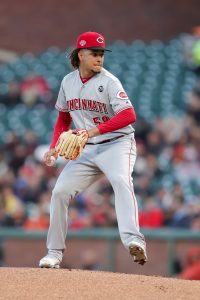
As a team, the Reds didn’t capitalize on Straily’s presence, winning a mere 68 games and finishing with more losses than wins for the third straight year. They still haven’t registered a .500 or better season since then, though the effect of taking a low-risk flier on Straily a few years back could be felt for a significant amount of time. After all, on the heels of his solid season as a Red, they flipped him to the Marlins in January 2017 in what’s arguably one of the biggest heists in recent baseball history.
In exchange for Straily, the Reds received three players – a pair of righties, Luis Castillo and Austin Brice, as well as outfield prospect Isaiah White. Brice didn’t amount to much in Cincinnati (he actually spent last season back with the Marlins and is now a member of the Red Sox organization), while the 23-year-old White hasn’t advanced past the Single-A level yet.
On the other hand, Castillo has become a gem – a hurler the Marlins no doubt rue trading at all, let alone for someone who was an unspectacular performer in their uniform. Straily was a Marlin from 2017-18, both losing seasons for the club, and pitched to a 4.20 ERA during that 304-inning span. The Marlins wound up releasing him heading into last season, which proved to be a disastrous year in the Orioles org for Straily. He’s now with the Lotte Giants of the Korea Baseball Organization.
Meanwhile, Castillo has morphed into an electrifying major league starter. After a respectable first two seasons in Cincy, the heat-throwing Castillo truly came into his own in 2019. The 27-year-old pitched to a 3.40 ERA/3.70 FIP with 10.67 K/9 and 3.73 BB/9 across a a personal-best 190 2/3 frames. Along the way, Castillo ranked second among all qualified starters in groundball percentage (55.2) and fourth in swinging-strike percentage (15.9), placing him between Cy Young winners Justin Verlander and Jacob deGrom. And Statcast loved Castillo’s work, ranking him near the top of the league in several important categories.
The fact that Castillo has evolved into such a standout isn’t wholly surprising. Remember, when the Marlins parted with Castillo, he was regarded as one of their handful of best prospects. Baseball America posited then that Castillo, who was coming off a season of stellar production at the High-A and Double-A levels, had mid-rotation potential. Nevertheless, despite his upside, it was the second time the Marlins had agreed to part with Castillo. They previously tried to send him to the Padres in a notable July 2016 trade, but they got him back after fellow righty Colin Rea‘s medicals proved problematic. Had the Castillo aspect of that deal gone through, it also would have blown up in Miami’s face.
It seems fair to say that the Marlins did not properly value Castillo while he was with the organization. The Reds are profiting from that right now. In Cincinnati, Castillo currently finds himself as an integral piece of a quality starting rotation that could help the Reds push for a playoff berth this year (if there is a season). Castillo still has another pre-arbitration campaign left and the Reds have the ability to control him through 2023, making him all the more appealing. If the Reds are going to return to prominence in the near future, there’s a good chance that the Castillo trade will have something to do with it.
Photo courtesy of USA Today Sports Images.
10 Players Switch Agencies
Agent Rafa Nieves’ newly-founded Republik Sports agency will represent several players formerly represented by Nieves at Wasserman. A video published earlier today on Republik’s official Twitter feed reveals the names of 11 players who will continue to be represented by Nieves at this new firm.
We already heard last night that Nationals outfielder Victor Robles (a Nieves client at Wasserman) was joining Republik, and the other ten names cited in the video include a mix of prominent veteran and up-and-coming stars. The list consists of Indians infielder Jose Ramirez, Reds right-hander Luis Castillo, Pirates outfielder Gregory Polanco, Athletics right-hander Frankie Montas, Blue Jays outfielder Teoscar Hernandez, Rockies righty Antonio Senzatela, Padres outfielder Franchy Cordero, Marlins catcher Francisco Cervelli, and White Sox relievers Alex Colome and Kelvin Herrera.
As we’ve seen in several past cases of representatives changing agencies or starting new agencies, it’s quite common for players to continue using the same agent even after that rep becomes part of another company. We saw this in 2017 with Nieves himself, as several of the aforementioned players (namely Ramirez, Robles, Herrera, Colome, Cervelli, Polanco, and Montas) all went with Nieves when the agent moved from the Beverly Hills Sports Council to Wasserman.
The 10 changes have all been updated in our Agency Database. If you see any notable errors or omissions within the database, please let us know via e-mail: mlbtrdatabase@gmail.com.
Marlins Option Monte Harrison, Nick Neidert
The Marlins have optioned a pair of prospects to Triple-A Wichita, per multiple reporters (including Jordan McPherson of the Miami Herald). Outfielder Monte Harrison and right-hander Nick Neidert are headed to the Pacific Coast League.
Both Harrison, 24, and Neidert, 23, finished last season at the minors’ highest level, but each looked in need of a bit more seasoning. Harrison hit a passable .274/.357/.451 in 244 plate appearances with New Orleans (Miami’s previous Triple-A affiliate) last season. However, the former second-rounder’s longstanding strikeout troubles in the minors persisted.
Neidert, meanwhile, worked to a 5.05 ERA in nine Triple-A starts. That’s better than it seems on the surface given the hitter-friendly nature of the PCL. The control artist’s walk rate spiked dramatically in his 41 innings there, though, and his ground ball rate fell precipitously.
Both Harrison and Neidert still look to be solid, near-ready assets for the Marlins’ organization. They’re each among the club’s top 15 prospects, per Baseball America.
Today is the final day teams can option players before MLB’s roster freeze kicks in. As Sahadev Sharma of the Athletic points out, there’s a rationale behind teams’ recent spate of options around the league. By optioning players who didn’t figure to crack the Opening Day roster, the Marlins (and other teams who make similar moves) insulate themselves from paying an MLB salary if the players involved were to suffer a long-term injury while the sport is on hiatus. Upon the league’s resumption, such players would go on the minor-league injured list, where they would receive a minor-league salary and (presumably) not accrue MLB service time.
Rookie Radar: NL East
MLBTR’s Jeff Todd has recently taken a look at some potential impact rookies throughout the AL Central and AL West. Steve Adams handled the NL West. Now let’s move on to the NL East, which was one of the strongest divisions in baseball in 2019, with four teams finishing .500 or above. 2020 figures to be just as competitive. Perhaps a strong rookie season could be a difference-maker for one of these teams. Who could it be? Let’s take a look at some of the contenders.
Braves
The Braves already have a crowded outfield at the big league level. But if any kind of opportunity should present itself, Cristian Pache is going to be waiting in the wings. The 21-year-old has received more praise for his defense and speed than for his offense. But his bat seemed to turn a corner in 2019. Over 433 plate appearances at Double-A, he put up a slash line of .278/.340/.474, good enough for a wRC+ of 134. His Triple-A numbers aren’t as strong, with a line of .274/.337/.411 and a wRC+ of 92. That was over a smaller sample of 105 plate appearances, though, and he was only 20 years old.
Pache could have competition in the form of fellow outfield prospect Drew Waters, who is following a similar trajectory. Waters was also 20 last year and spent the bulk of the season at Double-A, where he managed a lofty 144 wRC+. He also had a cup of coffee at Triple-A, where his wRC+ dropped to 84 at Triple-A. While both Pache and Waters while played 26 games at Triple-A, Waters dwarfed Pache in the strikeout column, 43 to 18.
On the pitching side, the Braves have a pile of young arms who are slated to be in Triple-A to start the year, fighting to be the first one to get the call. The 24-year-old Kyle Wright has electric stuff but hasn’t been able to translate it into success at the big league level yet. It’s a similar story for 22-year-old Bryse Wilson. Ian Anderson is only 21 and isn’t on the 40-man, but he has already been bumped up to Triple-A after dominating in Double-A.
Marlins
The rebuilding Marlins already have lots of promising youngsters on the roster right now, and there are more on the way. Sixto Sanchez hasn’t reached Triple-A yet, but after dominating in Double-A with a 2.53 ERA over 103 innings, it’s possible he won’t need too much time there. Same goes for Edward Cabrera, whose Double-A ERA was just a smidge higher at 2.56, though in a smaller sample of 38 2/3 innings. Evaluators are split as to which of the two should be ranked higher. If you’re the Marlins, that’s a good problem to have.
In terms of position players, the most exciting options are outfielders. Jesus Sanchez has a tremendous bat but lacks plate discipline. Monte Harrison‘s defensive skills give him a decent floor. But the bat will need to take another step for him to reach his ceiling. He put up a decent line of .274/.357/.451 in Triple-A in 2019, good enough for a wRC+ of 97, just below league average.
Mets
The Mets’ rotation took a big hit when it was announced that Noah Syndergaard will undergo Tommy John Surgery. And while they may turn to veterans like Michael Wacha or Seth Lugo to pick up the slack, they could also look to some of the rookies they have in the minors. David Peterson hasn’t reached Triple-A just yet, but he threw 116 Double-A innings in 2019, with an ERA of 4.19 and 9.47 K/9. Franklyn Kilome missed all of last season after undergoing Tommy John surgery in 2018, but he was the Mets’ fifth-best prospect at that point. Stephen Gonsalves was once a highly-touted prospect in the Twins’ system, though an injury-plagued 2019 led to them losing him to the Mets on waivers. He’s still 25 and could be a wild-card factor if he can get healthy and regain his form.
As far as position players go, shortstop Andres Gimenez is an exciting prospect (mostly because of his speed and defense). The 21-year-old swiped 66 bags from 2018-19, so the big question is how he’ll do with the bat. Gimenez spent 2019 at Double-A, slashing a mediocre .250/.309/.387, but he’s still young. And since the Mets have plenty of middle infield options such as Amed Rosario, Robinson Cano, Jeff McNeil and maybe even Jed Lowrie, it will be difficult for Gimenez to contribute as soon as 2020.
Nationals
For the Nats, the most important rookie is definitely Carter Kieboom, one of the best prospects in baseball. The infielder had an excellent 2019 at the Triple-A level, slashing .303/.409/.493 for a wRC+ of 123. The 22-year-old wasn’t able to carry those numbers into his MLB debut last season, but it was only an 11-game sample size.
With Anthony Rendon moving to California, there’s an opening for Kieboom to be the everyday third baseman. He’ll have to earn it because the Nats brought back Asdrubal Cabrera as a fallback option, but they’d surely prefer for the 22-year-old Kieboom to take the job. That would enable the Nats to use Cabrera in a utility role.
Phillies
Alec Bohm‘s calling card is his bat. As a 22-year-old in 2019, he played 22 games in A-ball and produced a wRC+ of 196. In A+, he played 40 games with a wRC+ of 165. In 63 games at Double-A, the wRC+ was 146. If he can keep hitting in Triple-A, the question will be where to put him. Bohm mostly plays third, but many evaluators feel that his defense is too weak for the hot corner and suggest a move to first. The Phillies would surely love for Bohm to prove those evaluators wrong because they have Rhys Hoskins entrenched at first. Their current plan for the rest of the infield is to deploy Jean Segura at third, Didi Gregorius at short and Scott Kingery at second. But since Segura can also play shortstop or second, Bohm could nudge his way into the picture if any one of them goes down with an injury.
On the mound, the big name to watch is Spencer Howard. Despite injuries limiting his total output in 2019, he still put up great numbers when healthy. In 30 2/3 innings at Double-A, his ERA was 2.35. And Howard, 23, capped off his season with 21 1/3 innings of 2.11 ERA ball in the Arizona Fall League. The Philly rotation is a bit flimsy, with guys like Vince Velasquez, Zach Eflin keeping a tenuous hold on back-end spots, so a healthy Howard could shove his way into the equation.