
Quick Hits: Latest On The Impact Of Coronavirus Around The Game
As players and owners work on negotiating a financial accord to allow for the start of play, opinions have trickled in from all reaches of the baseball-sphere with personal stances about how best to reboot gameplay. After Blake Snell set off a bit of a firestorm with his concerns about returning to the field, many players have chimed in to support the lefty hurler. Obviously, many players are justifiably concerned about what gameplay would mean for their safety and the safety of their families. No one understands this as much as Yoan Moncada, whose 1-year-old daughter was recently hospitalized. She’s doing better now, and Moncada, despite the scare, is ready to return to play should that become a possibility, per Daryl Van Schouwen of the Chicago Sun-Times. Van Schouwen provides a quote from Moncada, who said, “[My family is] concerned, as everybody is. But if the conditions are safe, they’re going to be good with it. But it is a concern no matter what.” Obviously, everyone has been affected in some form or fashion by this pandemic, and players face difficult personal decisions ahead before returning to play. Of course, COVID-19 has hurt not just the players and owners…
- While most of the focus has remained on the league’s attempts to return to the playing field, the consequences of the shutdown are hitting home for many professionals in the field. The Reds, Rays, and Marlins have announced furloughs that are to begin in June, and the latest from MLB Network’s Jon Heyman (via Twitter) has the Angels among the teams considering the same. Officially, the Angels are still on the fence. It is nonetheless an unfortunate and troubling development for those involved. Hopefully, some of the larger market franchises will be better equipped to weather the storm for their employees.
- Beyond the question of will-they-or-won’t-they play a 2020 season, there are ancillary questions that need answering in the event of a shortened 2020 season. Joel Sherman of the New York Post runs through a whole host of those issues that will require answers at some point. Among Sherman’s inquiries are topics ranging from a potential trade deadline to drug testing to the practical concerns of the games themselves. Baseball is in a better position than heavy-contact sports like basketball and football, but the game still cannot be played with players keeping a 6-foot distance from one another. It helps that the primary action takes place between a batter and pitcher standing 60 feet and 6 inches apart, but there is plenty of potential for in-game contact, as well as the mere fact of shuffling 26-man rosters from stadium to stadium together.
- The Red Sox will be able to resume play at Fenway Park this season according to Boston Mayor Marty Walsh. There are, of course, a number of conditions to meet before play resumes at Fenway. For instance, fans will not be allowed in attendance, per Michael Silverman of the Boston Globe. There will also be safety measures that the city of Boston must sign off on before play resumes. Still, it may give players a welcome sense of familiarity to be able to play in their home ballparks, even without fans in the seats. The number of teams that will be able to resume play in their home parks remains up in the air for now, though that does seem to be the goal for most teams.
MLB Teams Preparing Employment Reductions Beginning In June
Major League Baseball teams are preparing for major changes to their operations beginning at the start of June. Most had previously committed to paying employees in full through the end of May.
The Marlins are preparing to furlough approximately two of every five members of their operations department, per Ken Rosenthal of The Athletic (Twitter links). It’s not clear precisely which employees will be impacted. The Marlins are still committing to continuing health benefits through October.
Per Rosenthal, quite a few other teams around the game are also preparing for modifications at the start of the new month. Every organization is free to handle its own internal staffing decisions as it sees fit. Commissioner Rob Manfred previously gave authorization to suspend the basic agreements of salaried employees.
The Mariners are also planning cuts, but will be taking a different approach. Per The Athletic’s Corey Brock, the Seattle organization is planning a twenty percent paycut for employees whose salaries check in at or above the $60K level. The hope there is to avoid taking anyone off the books entirely.
Even as MLB negotiates player salaries and other matters in advance of a hopeful resumption of play in 2020, all involved understand that revenue will fall well shy of original expectations. There’s no real hope of playing before spectators this year and it still remains to be seen just what’ll be possible even for television-only games.
NL East Notes: Mets, Realmuto, Cano, Marlins, Brinson, Sierra
Let’s check in on a pair of teams from the National League East…
- The Mets pushed hard to land J.T. Realmuto before he was ultimately traded from Miami to Philadelphia, and Mike Puma of the New York Post writes in his latest mailbag column that the team’s pursuit of Realmuto might not yet be over. Realmuto is represented by CAA, the former agency of GM Brodie Van Wagenen, and current catcher Wilson Ramos has a club option for the 2021 season that isn’t a lock to be picked up ($10MM or a $1.5MM buyout). The Mets have acquired several of Van Wagenen’s former players since he became GM — Jed Lowrie, Michael Wacha and Robinson Cano — although CAA has a rather large base of clients and Van Wagenen has certainly added plenty of players from other firms (Ramos, J.D. Davis, etc.). Still, there’s no obvious in-house alternative if the team opts to move on from Ramos — or to pick up his option and look to trade him. Realmuto would indeed be an upgrade, particularly on the defensive side of things, which is notable given the questions that arose regarding Ramos’ glove in New York last year.
- The COVID-19 shutdown hasn’t been fun for anyone, but Cano has at least found a silver lining during the delayed season. Cano said Tuesday that the downtime has “been beneficial for me for sure” physically, as Tim Healey of Newsday relays. “My legs feel strong right now,” continued Cano, who’s champing at the bit to return to the diamond. “Just can’t wait to go back on the field, and then play.” If there is a season, the longtime star, 37, will aim to rebound after a rough debut campaign with the Mets. Cano hit just .257/.307/.428 with 13 homers during an injury-limited, 423-plate appearance season.
- Expanded rosters should be quite favorable for several Marlins outfielders who might not have been a lock to make the team, writes Barry Jackson of the Miami Herald. Lewis Brinson has drawn his share of flak having yet to produce after arriving as the centerpiece in the widely panned Christian Yelich trade, and he’d be “very, very” likely to break camp with an expanded roster. Magneuris Sierra is out of minor league options and was a risk to be exposed to waivers given his lack of big league production, but greater roster flexibility and his elite speed make him a likely bench piece at the very least. Sierra, like Brinson, came over in a high-profile swap — the Marcell Ozuna deal — although the Fish have already fared quite a bit better in that deal. Sandy Alcantara was that trade’s headliner, while righty Zac Gallen was also in that deal and has since netted the team top shortstop prospect Jazz Chisholm.
Three Teams Who’ve Yet To Win Their Division
It is somewhat amazing that there are three National League teams – one each for the West, East, and Central – that have yet to win their division.
Make no mistake, the American League has its share of heartbreak. The Mariners have yet to return to the playoffs after their 116-win season in 2001. The Rangers are far away as ever from capturing their first World Series after the so-close-you-can-taste-it near-misses of 2010 and 2011. Fans of the Astros and Red Sox have suffered different brands of heartbreak after the legitimacy of their recent winners was called into question.
But in the National League, the Rockies, Marlins, and Pirates have never won their respective divisions.
Granted, the Pirates were crowned champs of the National League East 9 times, including a three-peat for Jim Leyland’s clubs from 1990 to 1992 and a title-winner way back in 1979 – but since they moved to the NL Central in 1994: goose eggs. That’s a 26-year-run without a divisional crown, a mark of futility eclipsed only by the Rockies and Marlins. Colorado and Florida both entered the league in 1993, and neither has landed the top spot in their division in the 27 seasons since.
Back in the junior circuit, every team in the AL East has won since 2010 (Tampa Bay). In the Central, the White Sox have the longest drought (11 seasons), going back to their first-place finish in 2008. Everyone in the AL West has taken their turn at the top since 2012 – except the Mariners, of course, who won the division in 2001 and 1997.
But each division in the National League has its slow-and-steady competitor, so let’s take a quick look at each.
Colorado Rockies
Of these three clubs, the Rockies’ reputation took the fewest hits over the last 27 years. The Blake Street Bombers hold a particular place in baseball lore, and there’s a general sense of “unfortunate circumstances” around the Rox because of the thin air in Colorado. The impossibility of housing a winning pitching staff at Coors Field is baseball cliche now, but that doesn’t make the challenge any less potent.
Here’s what I wrote of Colorado in their Offseason In Review post back in March: “Colorado pitching, after all, has proven one of the more frustrating team-building challenges in the major leagues. The Sisyphean task of constructing even a league-average pitching staff at Coors Field persists year-after-year. Over the course of their 27-season history, the Rockies posted a league-average or better team ERA just three times (2010, 2009, 2007). In 2010, Jim Tracy’s 83-win squad finished with an exactly-league-average ERA, but those other two seasons — 2009, 2007 — happen to be two of the only three seasons in which the Rockies won 90 games in their history.”
Adding to the task at hand for Colorado, there’s at least a possibility that ownership believes this team is better than it is. They lost 91 games last year and have exhibited zero financial flexibility. If they end up losing close to 90 games again (or the equivalent in whatever kind of season is played in 2020), then the Rockies are still probably in the decline phase, not yet having rebooted into a full-blown rebuild. Rebuilds, of course, are time-intensive when done right, and very time-intensive when rushed.
The Rockies have made the postseason a handful of times, and they won the pennant in 2007, but they’re caught in no-man’s-land now. The Dodgers have won the division 7 years running, and Walker Buehler, Cody Bellinger, and company have plenty left in the tank. The Padres’ stable of young arms makes them one of the more intriguing up-and-coming teams in the league, and the Diamondbacks continue to impress with their ability to retool on the fly. After coming within a play-in game of taking the crown from the Dodgers in 2018, the Rockies might have missed their best shot.
Miami Marlins
The Marlins entered the league at a tough time to be a member of the NL East. The Atlanta Braves held a hammerlock on the division, taking the crown every season from 1995 until 2005 (they were in the NL West before that). To their credit, the Marlins made themselves into a competitive squad pretty quick, making the playoffs as a wild card in 1997, just their fifth season of existence. The organization made its name the year after, however, in selling off the pieces of their World Series winner and cratering into a 108-loss squad. After that horrid 1998 season, it took the Marlins five more years to get back to the playoffs again, at which point it was second-verse-same-as-the-first. They didn’t sink quite so fast or quite so far the second time around, but they also haven’t recovered (no playoff appearances since 2003).
That said, the Marlins have begun to see the light from their decade-plus in limbo. MLBTR’s own Mark Polishuk wrapped up the Marlins offseason back in March with this: “It’s a sign of progress, however, that the scorched-earth phase of the rebuild seems to be over. Villar, Kintzler, or other veterans on short-term deals could well end up being moved at the trade deadline, but it doesn’t seem like younger talent is on the move…Miami seems ready to find out if the young players it already has in the fold could end up being part of that next Marlins winner, and it will be intriguing to see which of the pitchers and position players take that next step in 2020.”
The current era of Marlins baseball is best known for shepherding the likes of Giancarlo Stanton, Christian Yelich, and Marcell Ozuna out of town prior to the 2018 season. But they’re also a unique entrant on this mini-list because they won not just one, but two World Series titles over this span. Derek Jeter now helms the organization, and though they don’t have that face-of-the-franchise type player soaking up their spotlight, they’ve become increasingly competitive. Heading into whichever season of baseball comes next, they’ll have a decent collection of starting pitchers to keep them in games – with a smaller host of position player prospects nearing the majors. Whether they have that franchise-changing talent in the upper ranks is unclear. Business might not yet be booming in Miami, but it’s better.
Pittsburgh Pirates
As stated above, it’s a bit unfair for the Pirates to be lumped in with the expansion clubs from the nineties, as they do have a history of success in the major leagues. They have 9 division crowns, 7 World Series appearances, and 5 World Series banners. But that’s all ancient history.
Since moving to the NL Central in 1994, the Pirates are a firm contender for the most moribund franchise in the sport. The departure of Barry Bonds after the 1992 season put an unfortunate face on their decline – much in the way that Babe Ruth’s departure doomed Boston baseball for so long – but there has been ample time to rebound from those back-to-back game 7 losses to Atlanta in 1991 and 1992.
In the time since the Pirates’ primary distinction is claiming the title for the longest streak of losing seasons in North American sports history. Forget about division titles. The Pirates weren’t able to finish over .500 one time from 1993 to 2012.
Pittsburgh fans finally had something to cheer for in 2013 when Clint Hurdle’s club broke through with 94 wins and a wild card berth. They even won that first playoff game against the division rival Cincinnati Reds and pushed another rival – the Cardinals – to five games in the NLDS. The club followed its star outfield of Andrew McCutchen, Starling Marte, and Gregory Polanco to two more wild card berths in the following two seasons. Unfortunately, they were unable to get more than one playoff game in either of those years.
After finishing over .500 again in 2018, last season brought on a complete reset. Most of the organizations’ management turned over, and the remaining faces of those competitive clubs – Hurdle, Marte – were also sent packing. The organization is now in the hands of GM Ben Cherington, but they’re facing a complete philosophical overhaul. While they have talent, they’re not an easy club to put a timeline on returning to contention. Not until they put together a pitching staff with a more effective (and less pugilistic) philosophy. The division isn’t dominated by one team like the current AL West, but the Cardinals build a winner year after year, and the Cubs and Brewers aren’t far off in terms of their recent consistency.
Looking ahead, a shortened season in 2020 could open the window for a bizarre sort of division champ. All hope is not lost. On the whole, however, I don’t think there are a lot of pundits who would pick any of the Rockies, Marlins, or Pirates to breakthrough next season. Still, it’s bound to happen one day, right? All three teams will work to end their respective droughts, and in the meantime, thank goodness for the wild card.
(Poll link for app users.)
Which fanbase suffered the most over their teams' division title drought?
-
Pirates 67% (3,921)
-
Marlins 18% (1,064)
-
Rockies 15% (859)
Total votes: 5,844
(Poll link for app users.)
Which team will be the first to break through and win their division?
-
Rockies 37% (1,952)
-
Marlins 33% (1,702)
-
Pirates 30% (1,561)
Total votes: 5,215
Did The Marlins Gift The Indians A Setup Man?
Like any club, the Indians have had their share of notable players slip through their fingers, though the losses of Kirby Yates and Gio Urshela can likely be forgiven when looking at the low costs of acquisition for the likes of Corey Kluber and Mike Clevinger. Cleveland’s Feb. 4, 2019 acquisition of righty Nick Wittgren from the Marlins isn’t going to have that type of long-term impact on the franchise, but it nevertheless appears to be another high-quality, low-cost pickup for a team that has had its share of success in that regard in recent years.
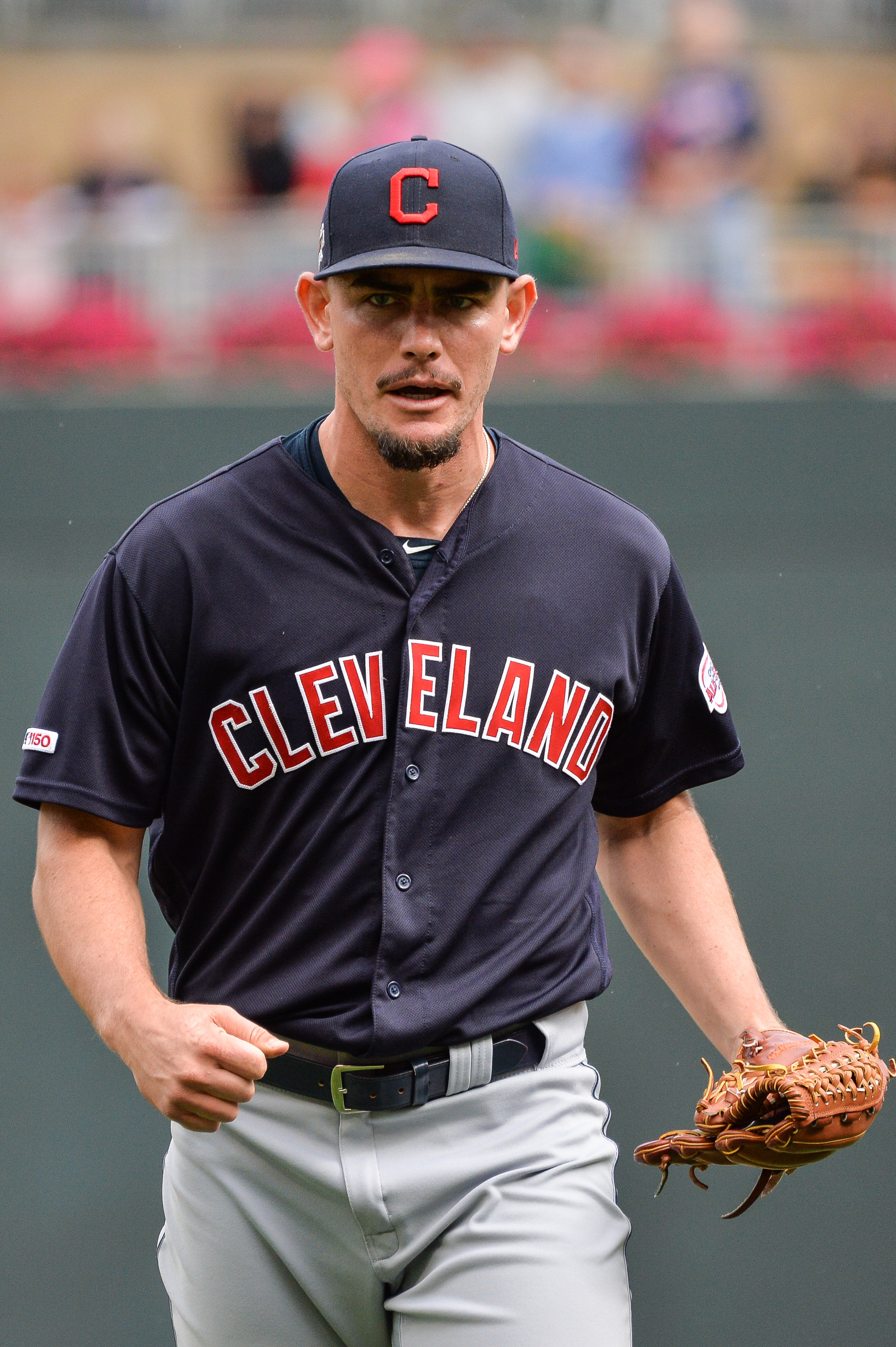
When the Marlins designated Wittgren for assignment in Jan. 2019, it registered as something of a surprise, as noted here at the time. He’d had an up-and-down year in 2018 but finished out the season with a 2.94 ERA, 8.3 K/9, 4.0 BB/9, 0.27 HR/9 and a career-best 46 percent ground-ball rate in 33 2/3 innings with Miami. Wittgren was a 27-year-old with a minor league option remaining, a 3.60 ERA (3.50 FIP) and a 116-to-38 K/BB ratio in 127 2/3 innings of relief for the Marlins. He wasn’t expensive — still pre-arbitration at the time — and could’ve been controlled through 2022.
Whatever the reasons, the Marlins felt Wittgren was the most expendable piece on the 40-man roster when they signed Neil Walker. Five days after being designated for assignment, he was traded to Cleveland in exchange for Jordan Milbrath — a minor league righty who is only about two months younger than Wittgren and, at the time, had only briefly reached Triple-A.
For an Indians club that had moved on from the long-solid trio of Cody Allen, Zach McAllister and Dan Otero and, a year prior, had lost iron man Bryan Shaw in free agency, Wittgren proved to be a godsend. While he didn’t break camp with the team, Wittgren was summoned in early April and made his Cleveland debut by pitching 1 1/3 innings with four strikeouts. At no point in 2019 did the righty carry an ERA higher than 3.34, and by the time the season had drawn to a close, Wittgren was regularly pitching in the eighth inning as one of Brad Hand‘s primary setup men. His 12 holds ranked third on the club behind Oliver Perez and Adam Cimber.
Wittgren doesn’t have the flashy Statcast numbers that some other relievers we’ve profiled recently do. He’s not a hard-thrower (92.3 mph average fastball), and he ranks below average in terms of spin rates and hard-hit rates. His home-run rate looked ripe for regression in 2018 and did indeed spike in 2019 — although the extent of that spike was surely impacted by the juiced ball (as was the case for virtually every pitcher in the league).
But Wittgren has demonstrated above-average control throughout his career and generally been effective against both righties and lefties (last year’s more pronounced platoon splits notwithstanding). Fielding-independent metrics suggest that the sub-3.00 ERA he’s managed over the past two seasons isn’t likely to hold up, but Wittgren has a career 3.71 FIP in 185 1/3 big league innings at this point.
In some ways, Wittgren mirrors the previously mentioned Shaw, who was a similarly unheralded pickup but emerged as a rock-solid late-inning stabilizer in Cleveland for a half decade. He’s not an overpowering righty but generally has solid control and has, to this point in his career, managed to maintain an ERA south of his FIP and (particularly) his xFIP thanks to home run suppression skills. He has a ways to go in terms of matching Shaw’s uncanny durability, but Wittgren still seems like a solid piece in the ‘pen — even if his ERA trends a bit closer to his FIP marks.
As a 28-year-old middle reliever/setup man without huge strikeout totals, we probably won’t see Wittgren named to any All-Star teams in the near future. He’s the type of reliever who even in maintaining success will also maintain relative anonymity. Most seventh- and eighth-inning relievers on smaller market clubs aren’t exactly household names. But considering the cost of acquisition — Milbrath is already out of the Marlins organization after posting a 4.50 ERA an 5.49 FIP in 52 Triple-A frames last year — and the fact that Wittgren can be cheaply controlled through 2022, the trade looks like a nice under-the-radar move that can help Cleveland for the foreseeable future.
10 MLB Teams Whose Business Initiatives Face Coronavirus Hurdles
Like most every person or business, all thirty MLB teams face tough questions during the time of COVID-19. Some are relatively similar for all ballclubs, but there are obviously quite a few unique issues — some more pressing than others.
Dealing with the implications of this pandemic is probably toughest for organizations that are in the midst of executing or planning major business initiatives. We’ll run down some of those here.
Angels: The team has been cooking up potentially massive plans to develop the area around Angel Stadium. Fortunately, nothing is really in process at the moment, but it stands to reason that the project could end up being reduced in scope and/or delayed.
Athletics: Oof. The A’s have done a ton of work to put a highly ambitious stadium plan in motion. Massive uncertainty of this type can’t help. It isn’t clear just yet how the effort will be impacted, but it seems reasonable to believe the organization is pondering some tough decisions.
Braves: Luckily for the Atlanta-area organization, the team’s new park and most of the surrounding development is already fully operational. But with the added earning capacity from retail operations in a ballpark village comes greater exposure to turmoil.
Cubs: Like the Braves, the Cubs have already done most of the work at and around their park, but were counting on big revenue to pay back what’s owed (and then some). Plus, the Cubbies have a new TV network to bring up to speed.
Diamondbacks: Vegas?! Vancouver?! Probably not, but the Snakes do want to find a new home somewhere in Arizona. That effort is sure to be dented. Plus, the team’s recent initiative to host non-baseball events at Chase Field will now go on hiatus.
Marlins: The new ownership group has had some good vibes going and hoped to convert some of the positivity into a healthy new TV deal. That critical negotiation will now take place in a brutal economic environment.
Mets: So … this is probably not an optimal moment to be selling your sports franchise. The Wilpon family is pressing ahead with an effort to strike a new deal after their prior one broke down (at the worst possible time).
Orioles: That bitter television rights fee dispute that just won’t stop … it’s not going to be easier to find a resolution with less cash coming through the door. It was already setting up to be a rough stretch for the Baltimore org, with past TV money due to the Nationals and more bills to come, even while going through brutally lean years on the playing field.
Rangers: The new park is now built. While taxpayers footed much of the bill, the club still has to pay back a $600MM loan. Suffice to say the Rangers (and municipal authorities) anticipated game day revenues of more than $0 in year one when they planned out the loan repayment method.
Rays: The club’s preferred Ybor City option flamed out and it is currently engaged in a somewhat confusing effort to split time between the Tampa Bay area and Montreal. Existing hurdles to that arrangement seem only to be taller in the age of the coronavirus.
Others: We may be missing some, but it seems most other organizations are engaged more in usual-course sorts of business initiatives rather than franchise-altering efforts. For instance, the Nats have an interest in that TV deal as well. The Red Sox have been working to redevelop areas around Fenway Park. The Blue Jays are dabbling in future plans. And the Dodgers have a new TV rights deal, though that came to fruition after the pandemic hit and may not be impacted any more than any other existing carriage arrangements.
The Marlins Are Gambling On Tooled-Up Hitting Prospects
The Marlins found themselves on the butt end of many jokes when they went from having perhaps MLB’s best starting outfield to a 100-loss team in just one winter. After a 2017 season in which they flirted with contention before fading in the second half, their rebuild got off to a slow start with the trades of its premier outfield trio of Giancarlo Stanton, Christian Yelich, and Marcell Ozuna. The organization received its fair share of flak after those three yielded relatively light returns that have provided little payoff to this day while Yelich goes supernova in Milwaukee. The franchise was transitioning to a new ownership group fronted by Derek Jeter, and his orchestration of yet another fire sale—which have become entirely too commonplace in the Marlins’ abbreviated history—did little to ingratiate him to the Miami faithful.
However, over the past year or so, the team’s acquisitions have given rise to a burgeoning minor-league system that is now, by most accounts, one of the ten best farm systems in baseball, a big step up from where they were even after trading away Stanton, Ozuna, and Yelich. The Marlins’ trades in July of last year were illustrative of an organizational preference for physically-gifted, toolsy hitters with a wide range of possible outcomes, both good and bad. Separate deals involving Nick Anderson, Sergio Romo, and Zac Gallen all reflected this thinking, and that’s made it easy to dream on best-case scenario outcomes for the youthful Miami franchise.
Sending Anderson (and Trevor Richards) to the Rays and Gallen to the D-Backs yielded Jazz Chisholm and Jesus Sanchez, respectively, both of whom are consensus top-100 prospects with highly-touted tools. Dealing Romo to the Twins produced Lewin Diaz, a lower-profile prospect but one whose offensive potential is likewise power-dominant.
That said, greater upside is often tempered by uncertainty, and with their revamped farm system, the Marlins are swinging for the fences. Perhaps the front office’s proclivity for energizing talents is just a coincidence, or maybe it’s an organizational recognition that the path to contention is by catching lightning in a bottle—thanks to their notoriously limited monetary resources. Either way, it’s a trend that warrants some discussion.
About those aforementioned prospects: Sanchez, formerly of the Rays, has been lauded for his bat speed and power potential, but those strengths have thus far been mitigated by below-average plate discipline and a groundball-heavy swing path. The thinking is that if he can hone his angle of attack as well as his approach at the dish, his power will start to manifest in games more often. Acquiring Sanchez for Nick Anderson, who hardly fits with the Marlins’ timeline, feels like the kind of move the club should be looking to make, and they’re betting that their player development staff can get the most out of Sanchez’s tantalizing tools.
Similar things can be said for shorstop Jazz Chisholm, though his acquisition was met with more skepticism after the Marlins gave up rookie right-hander Zac Gallen to the Diamondbacks. Gallen, though still far from established, had already pitched in the Majors and, through seven starts, looked like the kind of starter you can build around. Nobody expects Gallen to become a bona fide ace, but you don’t need five aces to win a World Series, and the Marlins could expect to keep him around for at least the next six years. That sounds like a player you want to keep around in a rebuild, but the Marlins saw and seized an opportunity to exchange Gallen, a boring player (in a good way), for one with a little more zest.
Chisholm, a 22-year-old Bahamian shortstop, catches the eye in a way that a command-oriented starter just can’t. Gallen’s high-floor, low-variance profile is contrasted by that of Chisholm, who has a chance to realize an explosive offensive ceiling while playing in the middle of the field. Hey, that sounds an awful lot like Javier Baez! Of course, the caveat is that there’s still too many strikeouts for some scouts’ liking, and there are questions about whether those issues will ever go away. And yeah, that still sounds like Javier Baez circa 2014, but for every Baez, there’s a handful of similarly-built prospects who fizzle out when they swing and miss too much.
J.J. Bleday, the Marlins’ first-round draft choice last June, looks like a good get; he was one of the most polished hitters in last year’s draft class, but supplements that with strong athletic traits. His floor probably isn’t as low as that of Chisholm or Sanchez, and he represents a key draft pick for Miami after missing on top picks in years prior. He should slot into an outfield corner for Miami in the near future—maybe even as soon as the second half of this year, assuming a season is played.
Kameron Misner, Jerar Encarnacion, Osiris Johnson, and Peyton Burdick are lesser prospects that nonetheless deserve a mention. Misner, Burdick, and Encarnacion are all big-bodied outfielders who can hit the snot out of the ball (Misner and Burdick, both 2019 draftees, can run a little bit too) but will need to prove their ability to hit for average and get on base if they’re going to stick in the Majors. Johnson is a versatile infielder who was drafted out of high school in 2018; he’s mired in a lot of uncertainty partly because of injuries, but partly because he doesn’t have a position and he’s still raw as a hitter.
On the pitching side, there’s less evidence for the tools-based approach we’ve described here. The likes of Jordan Yamamoto and Nick Neidert represent a more command- and pitchability-based profile, while on the other hand frontline pitching prospect Sixto Sanchez has run into some speculation about whether he’s ticketed for a bullpen role. Still, Sixto and Edward Cabrera have received a lot of attention as righties who could install themselves in the rotation for the next contending Marlins team.
Of course, not all of the players discussed here will reach their ceiling in the Majors—that just isn’t how player evaluation and prospects work. With that said, the Marlins might only need to hit on a few of their touted minor leaguers to kickstart the MLB team and accelerate the rebuild. The point of inflection for many rebuilds is whether the organization is lucky enough to form a core of players who overlap in their development and ascension to the Major Leagues, allowing the team to invest in those players and construct a roster around them. And if that happens in Miami, their tools-heavy focus in player acquisition could pay off in a big way.
Unfortunately, the only way we’ll see the end of the Marlins story is with time. Farm system rankings can only take us so far, and they mean nothing if the talent doesn’t produce at the Major League level. The Marlins are gambling on their organizational ability to mold talented but raw youngsters into quality MLB players. Their hit rate on those players will determine whether the franchise is ready to move into next phase of its rebuild or if they’ll need to reset and re-evaluate their organizational philosophy.
How The Rays Traded A Top-100 Prospect For A 29-Year-Old Rookie And Came Away Winners
Nick Anderson is not exactly a household name – and he may never be. For most of last season, Anderson was a 28-year-old rookie non-closer pitching for the Marlins (he turned 29 in July). That’s not a recipe for superstardom.
After a deadline deal brought him to Tampa Bay, Anderson did get a moment in the spotlight, striking out four of the five batters he faced in the Rays’ Wild Card Game win over the A’s. That was nothing new for Anderson, who spent most of the season racking up strikeouts at an alarming rate.
Between Tampa and Miami, Anderson appeared in 68 games in 2019, totaling 65 innings with a good-but-not-great 3.32 ERA. The peripherals speak to a much more dominant campaign for the former independent leaguer. His 2.35 FIP suggests a potential high-leverage bullpen arm, while the 2.1 fWAR he racked up confirms it: he tied for 5th overall in the majors among relievers. That puts him on the same plane with firemen/closers like Taylor Rogers, Brandon Workman, Felipe Vazquez and Aroldis Chapman. Make no mistake: Nick Anderson is an elite bullpen piece.
Credit the Marlins for picking up Anderson and turning him into a top-100 prospect in Jesus Sanchez. Sanchez may have lost some luster as a prospect, but he still landed at #96 on Fangraphs’ top-100 list. Yes, he was #47 on their updated list after starting the year at #54 in 2019, but he’s still just 22-years-old and posted a promising line of .246/.338/.446 in the homer-happy PCL after the trade. As a 21-year-old, he was more than 5 years younger than the average player in the PCL.
For their part, the Marlins acquired Anderson for Brian Schales after the Twins signed Anderson from the independent league. The 6’5″ Anderson put up good numbers in the Twins’ system from 2015 to 2017, but he started to pop in 2018, striking out 13.2 hitters per nine innings in Triple-A. At the time, the deal was most notable for bumping Derek Dietrich from the Marlins’ roster.
But Anderson became a different animal entirely during his breakout in 2019. His 15.23 K/9 ranked fourth among relievers in the majors, behind only strikeout artists Edwin Diaz, Matt Barnes and Josh Hader. After joining the Rays, Anderson went into overdrive, striking out a ridiculous 17.3 batters per nine innings. Including his Marlins work, the Minnesota native finished in the bottom 9th percentile in hard hit percentage and bottom 12th percentile in exit velocity.
In adding Anderson from the Marlins, the Rays got a guy who has a legitimate chance to be one of the most dominant relievers in all of baseball, and they have him at the league minimum for another two seasons. This is a guy the Rays can afford, which makes the deal all the more important from their perspective. There’s a reason they could include Ryne Stanek in the deal, a guy who throws 100+ mph and had a 3.40 ERA at the time. There’s a reason they could deal Emilio Pagan to the Padres after he broke out with a 2.3 bWAR season of his own in 2019. That reason is Nick Anderson.
So how does he do it? For Anderson, the recipe is fairly simple. He throws a fastball that averages 96 mph with good spin that he locates up in the zone. His “other” pitch is a curveball – but it’s one of the best in the game. By Fangraphs’ pitch values, his curveball was the second most valuable such offering from a reliever in 2019, behind only Workman’s bender. Batters managed an expected batting average of just .134 off Anderson’s curveball while registering a whiff rate of 54.2%. As of right now, Anderson’s hook is one of the deadliest weapons in the sport.
Anderson could also be in line for some positive regression this season, as opponents had a higher-than-average .349 BABIP against him in 2019. A 14.5 % HR/FB rate was also higher than Anderson had yielded at any point in the minors, and if that number comes down, Anderson could be an even more potent asset for the Rays moving forward.
His ceiling is no lower than Liam Hendriks‘ amazing 2019, though Hendriks has a bit more versatility in his offspeed stuff. Hendriks, of course, was the most productive reliever in all of baseball last season, so there aren’t a ton of comps out there that make sense for him. Anderson, however, is one that does.
The Sale Of An Elite Outfield
Myriad issues have weighed down the Marlins during their 16-year playoff drought, but it wasn’t that long ago they at least boasted an elite outfield. Back in 2017, the trio of Giancarlo Stanton, Christian Yelich and Marcell Ozuna led the Marlins to a first-place ranking in fWAR in the grass (16.8). Stanton enjoyed an NL MVP-winning, 59-home run season; Yelich continued to post underrated production (he’s not underrated anymore); and Ozuna recorded a career year that he hasn’t replicated since. Of course, those players’ contributions weren’t enough to even get the Marlins to the .500 mark, and that season proved to be all three outfielders’ last hurrah in Miami.
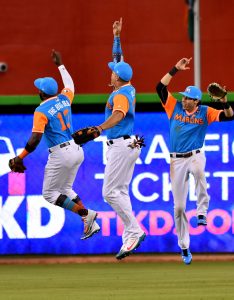
Prior to the 2018 season, the non-contending Marlins and a new ownership group headed by Bruce Sherman and Derek Jeter went on a campaign designed to slash payroll they inherited from predecessor Jeffrey Loria and build up a bottom-of-the-barrel farm system. To achieve those goals, the Marlins decided all three of their star outfielders were expendable, and they moved each of them on the heels of their standout 2017 showings.
Stanton, then 28 years old, was the most accomplished member of the trio at the time. He was also the owner of a historic, franchise-record contract worth $325MM over 13 years that he signed in November 2014. Stanton still had $275MM left on the deal three years ago, making him ripe for a change of scenery from the Marlins’ perspective.
The Giants, Cardinals and Dodgers were among those that pursued Stanton when the Marlins put the slugger on the block. Both San Francisco and St. Louis reportedly agreed to acquire Stanton, but he used his full no-trade clause to block moves to those cities; meanwhile, his hometown Los Angeles club didn’t make a good enough offer for Miami’s liking. That created an opening for the Yankees, Jeter’s team for all of his Hall of Fame playing career, to swoop in and grab Stanton to pair with fellow hulking corner outfielder Aaron Judge.
Stanton and Judge had combined for 111 home runs during the prior season, and the Yankees no doubt had designs on them leading them to championships in the future. Thanks in part to injuries to both players, that hasn’t happened yet, and when healthy, Stanton hasn’t been the same player he was in 2017. While he has been good, the Yankees probably want more out of Stanton going forward with him still guaranteed an exorbitant amount of money through 2027.
As for the details of the trade, the Yankees took on the vast majority of Stanton’s money (the Marlins paid $30MM) in exchange for second baseman Starlin Castro and two prospects in right-hander Jorge Guzman and infielder Jose Devers. Castro had shown himself to be a roughly average regular with the Cubs and Yankees from 2010-17. The widely held belief was that the Marlins would end up flipping him and the $22MM left on his deal before he ever played in their uniform. As it turned out, though, Castro spent the last full two years on his pact in Miami, where he produced – you guessed it – roughly average production (3.6 fWAR in 1,323 plate appearances). He’s now a member of the NL East rival Nationals, who signed him in free agency last offseason.
The Marlins were never going to contend during the remainder of Castro’s contract, so the bigger motivation for them was getting as much of Stanton’s money as possible off the books and trying to bolster their system. Guzman and Devers have helped them do the latter to at least some degree. Now 24 years old, the hard-throwing Guzman ranks as the Marlins’ No. 19 prospect at MLB.com; he climbed to the Double-A level last season and registered a 3.50 ERA/4.37 FIP with 8.24 K/9 and 4.61 BB/9 over 138 2/3 innings. Devers, 20, checks in even higher than Guzman on MLB.com’s list (No. 11), though he failed to hit a homer in 138 plate appearances in High-A ball last season. FanGraphs then wrote that it only considers him “a lefty utility bench piece.”
Thus far, getting out from under Stanton’s onerous contract has been the biggest plus of that trade for the Marlins. Between his deal and his no-trade rights, it was obviously a challenge to find a trade partner for him. The team was in a better position with both Yelich and Ozuna, though.
Unlike Stanton, Yelich – on the cusp of his age-27 season, signed to a sweetheart contract and having combined for 10.0 fWAR from 2016-17 – should have commanded a king’s ransom in return. Yelich wanted out, so the Marlins were extra motivated to move him. Unsurprisingly, a significant number of teams – including the Padres, Cardinals, Rangers, Nationals, Diamondbacks, Athletics, Phillies, Blue Jays and Braves – were connected to him in the rumor mill. The Marlins aimed high in Yelich talks, reportedly asking the Jays for Vladimir Guerrero Jr. and the Braves for Ronald Acuna Jr., but those teams predictably balked at those requests. Ultimately, the Marlins sent Yelich and the $43.25MM in guarantees he had left to the Brewers in January 2018 for a four-prospect package consisting of Lewis Brinson and Monte Harrison, infielder Isan Diaz, and righty Jordan Yamamoto.
Sure, the Marlins were letting go of an eminently valuable player, but they didn’t expect Yelich to turn into an all-world superstar as soon as he arrived in Milwaukee. But that’s what happened. He succeeded Stanton as the NL MVP in his first year as a Brewer, might have won it again last season if not for an injury, and is now the owner of by far the richest contract in Brewers history after inking an extension last month. His acquisition is one of the greatest the Brewers have ever made. The Marlins’ end hasn’t worked out nearly as well.
Brinson was the Marlins’ headlining pickup in the Yelich swap, among the absolute top prospects in baseball at the time, but hasn’t come close to living up to the hype so far. The 25-year-old managed a stunningly poor 25 wRC+ (.173/.236/.221) and failed to hit a homer in 248 trips to the plate as a Marlin last season. He has now accounted for minus-2.9 fWAR in 709 major league PA. Harrison’s still a solid prospect – FanGraphs ranks the 24-year-old No. 102 in the game – and has a chance to turn out as the best part of the return for the Marlins. Diaz, 23, hit well in Triple-A ball last year, but he was in over his head during his first MLB stint. And while it’s not saying much, Yamamoto has actually been the most valuable MLB contributor the Marlins have gotten from this trade to this point. After holding his own in the minors from 2017-19, the 23-year-old debuted in Miami last season and turned in 78 2/3 innings of 4.46 ERA/4.51 FIP ball while averaging better than a strikeout per frame.
Despite his unhappiness, tthe Marlins perhaps could have kept Yelich and tried to build around him. But they just about had to trade Ozuna, then a Scott Boras client who wasn’t going to sign an extension before his last two years of team control ran out. There was widespread interest in Ozuna, whom the Marlins wound up sending to the Cardinals for a quartet of young players – righties Sandy Alcantara and Zac Gallen, outfielder Magneuris Sierra and lefty Daniel Castano.
The Cardinals got two respectable years out of Ozuna before losing him to the Braves in free agency this past winter; because they gave him a qualifying offer beforehand, his departure netted the Redbirds a 2020 compensatory draft pick after Competitive Balance Round B. Perhaps that selection will morph into a valuable young player, as Alcantara and Gallen have at least shown themselves to be. Still just 24, Alcantara parlayed a 95 mph-plus fastball into an impressive MLB season last year, when he tossed 197 1/3 innings of 3.88 ERA/4.55 FIP ball. Gallen may have been able to join him as a long-term linchpin in Miami’s rotation, but the club instead flipped him to Arizona last July in a deal for shortstop prospect Jazz Chisholm.
While Gallen has already proven he can handle the majors – he made an eyebrow-raising 80-inning debut between the two teams in 2019 – Chisholm hasn’t gotten past Double-A ball yet. But the 22-year-old logged great production at that level after the trade and is generally regarded as a top 100 prospect. So, perhaps he’ll develop into a nice MLB consolation prize from the Marlins’ pre-2018 outfield fire sale. On the other hand, it seems less hopeful Sierra or Castano will amount to much. The light-hitting, speedy Sierra hasn’t posed a real threat in the minors. The 25-year-old Castano has prevented runs at a good clip since he joined the Marlins’ system, but he’s not regarded as a prospect of note.
Overall, these certainly aren’t the most inspiring results the Marlins could have hoped for when they sold off their top-notch outfield. The Yelich trade would still look particularly regrettable even if he hadn’t evolved into the superstar he has become since the deal. On the bright side, the Marlins have seen Yamamoto and Alcantara show well in the majors, and there’s also hope for some of the other players they received as products of these trades (especially Chisholm).
Photo courtesy of USA Today Sports Images.
When The Padres Fleeced The Marlins
Padres general manager A.J. Preller’s tenure atop the club’s baseball department certainly hasn’t been a smash success. The Padres hired him late in the 2014 season and haven’t even posted a .500 season since then. To Preller’s credit, though, the Padres have put together an enticing group of young talent with his help. And in one of Preller’s greatest moves to date, the Padres acquired a right-hander who has evolved into a potential ace in exchange for a fading reliever.
If we go back to June 30, 2016, shortly before the trade deadline, the Padres were well under .500 and on their way to a 68-win season. Meanwhile, the Marlins were 41-38. The long-suffering Fish were under the impression they were playoff contenders at that point. As a result, they traded young right-hander Chris Paddack to the Padres for grizzled reliever Fernando Rodney. Big mistake.
After signing for a guaranteed $2MM in the prior offseason, Fernando enjoyed an unbelievable few months in San Diego, where he recorded an almost perfect 0.31 ERA in 28 2/3 innings and converted 17 saves in as many chances. Unsurprisingly, those numbers proved to be impossible to sustain in Miami. As a member of the Marlins, Rodney logged a ghastly 5.89 ERA (thanks in part to 25 walks in just 36 2/3 innings) and blew three of 11 save opportunities. For their part, the Marlins floundered after the trade en route to a 79-82 finish and yet another non-playoff showing. They lost Rodney to the Diamondbacks via free agency in the ensuing offseason.
In hindsight, the Rodney gamble clearly wasn’t worth it for Miami. On the other side, selling high on him has already paid dividends for San Diego and looks as if it will go down as one of the franchise’s top trades in recent memory. In return for Rodney, the Padres received Paddack, then a low minors prospect who Keith Law of The Athletic (then with ESPN) noted when the swap occurred “hasn’t given up a hit in forever.” MLBTR’s Steve Adams observed that “it seems fair to say that his star is on the rise.”
Paddack’s production was indeed ridiculous that year, during which he managed a 0.85 ERA with 15.1 K/9 against 1.1 BB/9 in 42 1/3 innings between the Marlins’ and Padres’ Single-A teams. However, despite those numbers and the aforementioned praise, he wasn’t necessarily viewed as a can’t-miss prospect at the time of the trade. When the deal went down, MLB.com ranked Paddack 17th in a Marlins farm that was not particularly respected.
In August of the year that the trade occurred, Paddack underwent Tommy John surgery. The procedure wound up costing him all of 2017, but he returned the next season to dominate at the High-A and Double-A levels. That was enough to convince the Padres that Paddack was ready for major league action in 2019, and indeed he was. As a 23-year-old pitching in the bigs for the first time, the fiery Paddack tossed 140 2/3 innings of 3.33 ERA/3.96 FIP ball with 9.79 K/9 and 1.98 BB/9 to emerge as one of the brightest up-and-comers in baseball.
For Preller, another 2016 trade – one in which he gave up James Shields for Fernando Tatis Jr. – looks like his most successful move so far. But Paddack for Rodney comes off as a masterstroke in its own right. With Paddack atop their current rotation, and with excellent prospects MacKenzie Gore and Luis Patino closing in on the majors, the Padres’ long-term rotation picture appears to be in enviable shape.
Photo courtesy of USA Today Sports Images.