
Marlins, Twins Have Discussed Trade Possibilities Involving Pablo Lopez, Max Kepler
The Marlins and Twins have discussed trade scenarios involving Miami starter Pablo López, writes Jon Heyman of the New York Post. Heyman reports that Minnesota outfielder Max Kepler and infielder Luis Arraez were among the names who’d come up in those discussions but adds the Twins aren’t interested in parting with Arraez.
Minnesota’s interest in López isn’t a new development. Ted Schwerzler of Twins Daily first reported in mid-December the Twins were in touch with the Fish about López. Obviously, nothing has yet come together and Heyman’s report doesn’t suggest there’s anything particularly close between the two clubs.
López, 27 in March, has been a frequent target in trade rumors for well over a year. The right-hander has posted a sub-4.00 ERA in each of the last three seasons. He hasn’t walked more than 7.5% of batters faced in any of those campaigns and has posted at least a 23.6% strikeout rate in all three seasons. López sits in the 93-94 MPH range with his fastball and owns one of the game’s better changeups. He misses bats and keeps the ball on the ground at an above-average clip and generally manages solid results against right and left-handed hitters alike.
That kind of consistent mid-rotation production has piqued the interest of a number of contenders but Miami has held onto López so far. That’s in spite of a reported willingness to deal from their stable of quality starting pitchers to address a lackluster lineup. While the Venezuelan-born righty has been the most frequently mentioned trade candidate in the Miami rotation, the Fish are reportedly open to offers on any of Trevor Rogers, Edward Cabrera and Jesús Luzardo as well.
That latter trio of pitchers all come with longer windows of club control and high-octane stuff. None has the consistent multi-year track record López has established, though, making him an ideal fit for a team firmly in win-now mode and looking to upgrade its starting five. López is in his second season of arbitration eligibility. MLBTR contributor Matt Swartz projects him for a $5.6MM salary next season; he’ll earn a raise on that during his final trip through the process before reaching free agency for the first time after 2024.
The Twins don’t strictly need a starter, though there’s enough uncertainty in their group they could accommodate another acquisition. That’s particularly true for a pitcher of López’s caliber, as he’d arguably step in as their best arm on staff. Minnesota is set to open the 2023 season with a top five of Joe Ryan, Tyler Mahle, Sonny Gray, Bailey Ober and Kenta Maeda. That group was hit hard by injuries last year, with Ryan leading the way at 147 innings. Mahle, Gray and Ober each had multiple injured list stints, including a two and a half month absence for Ober thanks to a groin strain. Maeda missed the whole season recovering from September 2021 Tommy John surgery.
There’s a decent amount of upside. Young arms like Simeon Woods Richardson, Louie Varland and Josh Winder have potential as depth options and Chris Paddack could return in the season’s second half from last May’s Tommy John procedure. Yet it’s equally easy to see the risk associated with the group considering their collective injury histories. Bringing in another quality starter would be a nice boost to a Minnesota club looking to build off their surprising new agreement with Carlos Correa and could push one or two of the touted young arms into a bullpen that seems the roster’s biggest question mark.
Minnesota has plenty of high-level outfield depth from which they could deal to bolster the pitching. They’re particularly deep in left-handed hitters, with Kepler, Nick Gordon, Alex Kirilloff, Trevor Larnach and Matt Wallner all factoring into the mix around star center fielder Byron Buxton. Kepler is the only member of the group who isn’t still in his pre-arbitration seasons. That has made him the most frequently speculated upon trade candidate but also arguably the least desirable target of the group for other clubs.
Like López, Kepler comes with two remaining seasons of club control. He’ll make $8.5MM this year and is guaranteed at least a $1MM buyout on a $10MM club option for 2024. He turns 30 in February and is headed into his ninth big league season.
Kepler looked to have broken out in 2019, when he connected on 36 home runs and posted a .252/.336/.519 line through 596 trips to the plate. He’s always had quality contact skills and plate discipline, and the seeming power spike elevated his offensive profile enough he secured some down-ballot MVP votes that year. In retrospect, that season seems an anomaly at least partially attributable to the extremely lively ball the league used. Kepler has been fine but unspectacular in the three years since then, hitting .220/.314/.392 in over 1100 plate appearances.
That includes a .227/.318/.348 line with just nine homers last season. His walk and strikeout rates remained excellent but he posted the worst power numbers of his career. Kepler also consistently runs very low batting averages on balls in play. That’s in part thanks to a pull-happy, grounder-heavy offensive profile that has made him susceptible to overshifts. The forthcoming limitations on defensive positioning could lead to a few more base knocks but isn’t likely to help him rediscover his power stroke.
Even with middling offense, Kepler is a valuable player. He’s an elite defensive right fielder who has also held his own in more than 1100 career innings in center field. Buxton, arguably the sport’s best defensive outfielder when healthy, relegates Kepler to the corner in Minnesota. Yet he’d be a viable candidate for everyday center field work on another club. That’s the case for Miami, where younger players like JJ Bleday, Bryan De La Cruz and Jesús Sánchez rotated through center field work in 2022. Each of them is better suited for a corner and has a limited offensive track record at the MLB level. Miami hasn’t addressed center field this winter, currently leaving that trio as an imperfect solution to take up-the-middle reps alongside Avisaíl García and perhaps Jorge Soler in the corners.
Kepler is a sensible trade target for the Marlins, particularly given their reported preference for higher-contact bats. It’s clear, however, that he alone wouldn’t convince general manager Kim Ng and her staff to part with López. An upper mid-rotation starter is going to hold more appeal than an outfielder coming off three roughly average offensive seasons, even one as defensively gifted as Kepler. That’s true even before considering López is a few years younger and will make a bit less over the next two seasons than Kepler will. Including Kepler in a deal involving López could make sense for both sides, but the Twins would have to offer additional young talent to convince Miami to pull the trigger.
Arraez, however, is apparently a bridge too far for Minnesota’s liking. The reigning AL batting champion would certainly fit Miami’s desire for a high-contact hitter and he’s coming off a .316/.375/.420 line over 603 trips to the plate. He’s controllable for three more seasons and projected for a $5MM arbitration salary. The Athletic’s Dan Hayes reported last month the Twins had given some consideration to making Arraez available in a deal that brought back a “top-tier starting pitcher” who was controllable beyond next season.
One could argue whether López fits that description, but it doesn’t seem the Twins feel he’s at the level that’d inspire them to part with one of their best hitters. Arraez is presently penciled in as Minnesota’s primary first baseman, though he’ll also work as a designated hitter and spell Jorge Polanco and José Miranda at second and third base, respectively.
Twins Re-Sign Carlos Correa
Jan. 11: The Twins have formally announced Correa’s return. A press conference is set for 11:30am CT.
Jan. 10: Carlos Correa‘s unprecedented free-agent saga looks to finally be drawing to a close, and it turns out he won’t even have to look for a new place to live. The former Rookie of the Year and Platinum Glove winner has reportedly agreed to a new six-year, $200MM contract with the Twins, which comes with four additional vesting options that can take the value of the contract to $270MM over a decade-long term. The Boras Corporation client does not have any opt-outs in the contract, though he will receive a full no-trade clause. The deal is expected to be finalized on Wednesday.
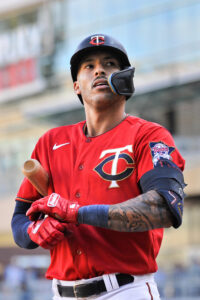
Correa will receive an $8MM signing bonus (paid out between 2023 and 2024) and annual salaries of $32MM in 2023-24, $36MM in 2025, $31.5MM in 2026, $30.5MM in 2027 and $30MM in 2028. The vesting options are valued at $25MM (2029), $20MM (2030), $15MM (2031) and $10MM (2032). Correa would vest his 2029 option by reaching 575 plate appearances the previous season; that number drops to 550 in 2029 (in order to vest his 2030 option), 525 in 2030 (to vest his 2031 option) and 502 in 2031 (to vest his 2032 option). The options would also vest if Correa finishes top five in MVP balloting, wins a Silver Slugger or claims an LCS or World Series MVP in the prior season. The Twins can still choose to pick up any of the options if Correa doesn’t meet the prior year’s vesting threshold.
The new deal between the Twins and Correa marks the latest and likely final twist in perhaps the wildest free-agent saga that’s ever played out. Correa, a two-time All-Star, agreed to terms with three different teams on three contracts of $200MM or more this winter — the first two of which were scuttled by concerns over the aforementioned right leg/ankle. Originally, Correa came to terms with the Giants on a 13-year, $350MM deal that blew the runner-up Twins out of the water. However, the Giants postponed Correa’s introductory press conference after raising some eleventh-hour concerns regarding his physical. The Mets, who hadn’t previously been involved in the Correa bidding, swooped in and agreed to a new 12-year, $315MM deal with Correa just days later, but New York raised similar concerns on Dec. 24, following their own physical.
At issue has been concern regarding the stability of Correa’s right leg and how well it will hold up over the life of a long-term deal. Correa sustained a significant fracture when sliding into third base as a 19-year-old prospect in the Astros’ system, which required surgery and the installation of a plate that is still in place to this day. While Correa has never been on the injured list due to the leg in the nine years since that injury, he did at least have a brief scare with it late in the 2022 season.
Correa was thrown out on a hard slide into second base and remained down on the field for several moments before leaving under his own power. After the game, he told reporters that he’d been hit on the plate in his leg and experienced brief numbness and vibration. Correa didn’t miss any time following that incident, however, and he went on to bat .346/.393/.481 with a homer and four doubles in 56 plate appearances from the day of that scare through season’s end.
The manner in which Correa’s leg and its hardware would hold up gave the Mets enough pause that they’re reported to have halved both the length and total guarantee of their original offer. The Mets still offered Correa the ability to match the original 12 years and $315MM they put on the table, but the back half of the contract was conditional and the team ostensibly would not budge from its stance on the matter. Unsurprisingly, Correa took the larger guarantee and considerably larger average annual value presented by the Twins on what is now the largest deal in franchise history.
The offseason leg drama surrounding Correa won’t do him any favors when it comes to shedding the “injury-prone” label that followed him early in his career, but it’s worth pointing out that over the past three seasons, Correa has appeared in 89.1% of his teams’ possible games. Eight of the missed contests in that time came early in the 2022 season with the Twins, when he spent a bit more than a week on the Covid-related injured list.
Nevertheless, all eyes will be on Correa’s leg for the foreseeable future. The uncertainty surrounding it was enough to drop Correa — a player the Twins adamantly maintained they never wanted to lose — back in Minnesota’s lap at a lesser rate than the ten-year, $285MM offer they put forth just one month ago, before he agreed to terms in San Francisco. It’s a stunning turn of events and a major narrative change for a Twins club that had been so focused on Correa in the offseason’s early stages that the majority of impact players were already off the board by the time it looked as though they’d been outbid by San Francisco.
With Correa now likely installed not only for the 2023 season but for the next six years, at the very least, the Twins’ short- and long-term outlooks are radically altered. Correa, who batted .291/.366/.467 with 22 home runs as a Twin this past season will be slotted back into the top third of a lineup that suddenly looks substantially deeper than it did just hours ago. He’ll follow leadoff man and reigning AL batting champ Luis Arraez, with Byron Buxton, Jorge Polanco, Jose Miranda and offseason signee Joey Gallo among the names behind him in the order.
With Correa back in Minnesota, trade acquisition Kyle Farmer will shift back from starting shortstop to the utility role the Twins initially envisioned when acquiring him. Acquired from Cincinnati in November, Farmer is a former catcher who has seen time all over the infield in recent years. He can back up each of Correa, Polanco and Miranda while providing Minnesota with a potent bat against left-handed pitching. Correa’s return allows Farmer to be utilized in more advantageous platoon matchups, one year after the former Red slashed .309/.380/.568 against lefties (but just .235/.291/.320 against righties).
The return of Correa on a long-term arrangement also calls into question just where fellow shortstop and former No. 1 overall pick Royce Lewis might fit into the equation once he’s back to full health. Lewis has been plagued by miserable luck on the health front, tearing the ACL in his right knee two times in just over one calendar year. He recovered from that first ACL tear and burst onto the scene in 2022 with a .300/.317/.550 batting line in his first dozen MLB games — only to suffer that ligament tear while playing in the outfield. The outfield could well end up Lewis’ long-term home, but he could also be considered an option at third base (with Miranda perhaps moving across the diamond) or at second base as an heir to Polanco, who is entering the final guaranteed season of his contract. (The Twins hold a pair of affordable club options on Polanco, however.)
Correa’s $36MM salary (and half the payout on his $8MM signing bonus) bump the Twins’ payroll to roughly $157MM — a franchise record. The Twins have also added Gallo (one year, $11MM) and catcher Christian Vazquez (three years, $30MM) thus far in the offseason — a trio of moves that should upgrade the team’s defense at various key positions. While Correa didn’t match his 2021 Platinum Glove numbers in his first season with the Twins, he’s still generally regarded as a plus defender and ought to stabilize the position with quality glovework for years to come. If a move to another position is ultimately deemed necessary, he has the arm strength for a move to the hot corner, ranking 14th among all Major League infielders (min. 100 throws) in terms of arm strength in 2022, per Statcast.
The addition of Gallo has only made it seem likelier that Minnesota will eventually find a trade partner for Max Kepler, as the Twins are now flush with left-handed-hitting corner outfielders (Kepler, Gallo, Trevor Larnach, Alex Kirilloff, Matt Wallner). Kirilloff could see most of his time at first base, but even still, the Twins have as many as four viable corner outfielders for two spots — and that’s not even factoring in right-handed-hitting bench options like Kyle Garlick and Gilberto Celestino.
It all falls under the “good problem to have” cliche, as the Twins now have a bevy of options in the outfield corners and around the infield, freeing up the possibility to explore trades designed to augment the starting rotation and/or bullpen that might not otherwise have appeared quite so palatable.
Put more simply, while the jarring reunion with Correa will no doubt be regarded as the most substantial move of the offseason, it’s not likely to be the last. While the Twins might have erred toward gearing up for a transitional year in the wake of missing out on Correa, suddenly retaining him on the largest contract in franchise history figures to spur the front office into further activity.
ESPN’s Jeff Passan first reported the agreement and the terms (Twitter link). Jon Heyman of the New York Post reported the vesting options and details surrounding the Mets’ reduced offer and surrounding Correa’s physical with the Twins (all Twitter links). USA Today’s Bob Nightengale tweeted that the contract did not contain opt-outs. Ken Rosenthal of The Athletic (Twitter links) and Ronald Blum of the Associated Press reported details on the vesting options and salary structure. Heyman reported the vesting thresholds and the no-trade clause (Twitter links), while Dan Hayes of the Athletic reported the Twins’ ability to trigger the options even if Correa doesn’t meet the vesting mark (on Twitter). Nightengale tweeted the contract was likely to be announced on Wednesday.
Twins Designate Kyle Garlick For Assignment
The Twins announced Wednesday that they’ve designated outfielder Kyle Garlick for assignment. His spot on the 40-man roster will go to shortstop Carlos Correa, whose return on a six-year, $200MM contract (with four vesting/club options) has now been formally confirmed by the team.
Garlick, 31 later this month, has spent the past two seasons with the Twins, hitting a combined .233/.283/.446 in 269 trips to the plate. Those numbers don’t necessarily stand out on their own, but Garlick’s platoon splits tell the tale of a useful part-time/platoon outfielder. He’s been overmatched by fellow right-handers, evidenced by a .207/.258/.345 output. However, Garlick has consistently shown plus power against lefties, batting .256/.303/.534 with 10 home runs and seven doubles in just 145 plate appearances versus southpaws since joining the Twins.
Unfortunately, Garlick has also had difficulty staying on the field during his two seasons in Minnesota. Over the past two seasons, he’s had trips to the injured list for a sports hernia (which required surgery), a calf strain, a hamstring strain, a ribcage contusion and a wrist sprain — the latter of which ended his 2022 season. There’s little doubting that Garlick can hit left-handed pitching, but his lengthy list of injuries, combined with sub-par defensive ratings in the outfield corners, have limited his utility as well.
Garlick seemed to have a place on the Twins’ roster heading forward, as he’s a natural platoon partner for their veritable cavalcade of left-handed-hitting corner outfielders and had already agreed to a modest $750K salary for the upcoming season. That’s only $30K north of the league minimum at this point, though, so it’s not as though the Twins had locked Garlick in for a particularly weighty sum.
Any team wishing to claim Garlick would need to take on that mild salary but would also be able to control Garlick for another four seasons, if they choose. The Twins will have a week to trade Garlick or attempt to pass him through outright waivers. He’s been outrighted once previously in his career, so if Garlick goes unclaimed, he’d have the ability to reject an assignment to Triple-A in favor of free agency.
Twins Acquire A.J. Alexy From Nationals
The Twins have acquired right-hander A.J. Alexy from the Nationals, according to announcements from both clubs. Alexy had been designated for assignment by the Nats last week. In exchange, right-hander Cristian Jimenez will be going to the Nats. In order to open a spot on their 40-man roster, the Twins have designated righty Oliver Ortega for assignment.
Alexy, 25 in April, was a Dodgers draftee who went to the Rangers in the 2017 Yu Darvish trade. Since then, he’s posted some strong results in the minors but struggled to be as successful in the majors. He missed much of 2019 due to injury and then the minor leagues were canceled in 2020, but he showed promise in 2021. He tossed 65 minor league innings between Double-A and Triple-A, posting a 1.66 ERA along with a 29.8% strikeout rate. The 10.6% walk rate was certainly high but it was still a solid enough showing to get him into the majors.
Alexy posted a 4.70 ERA in 23 MLB innings that year, despite matching strikeout and walk rates of 17.5%, with both of those numbers being worse than league average. In 2022, he was limited to just seven innings in the show, getting tattooed for an 11.57 ERA in that short time. He tossed 96 innings in Triple-A with a 5.91 ERA, getting strikeouts at a healthy 23.6% clip but with the walks still high at 12.8%.
The Rangers overhauled their rotation this winter and designated Alexy for assignment in the process. Despite his struggles in the majors so far, he’s still young and has some solid results in the minors to build from. He also still has an option year remaining, allowing a team to keep him in the minors as starting depth. The Nats grabbed him off waivers from the Rangers but he got bumped from their roster when they signed Dominic Smith. He’ll now head to the Twins and enter their rotation mix.
The Twins have a solid group of starters with Sonny Gray, Joe Ryan, Kenta Maeda, Tyler Mahle and Bailey Ober the likely front five. However, there are injury concerns scattered throughout that crew. Maeda didn’t pitch at all in 2022 while recovering from Tommy John surgery, whereas the other four all made at least one trip to the IL in 2022 for various ailments. Alexy can now join Josh Winder, Simeon Woods Richardson and others as depth options on Minnesota’s roster.
By claiming Alexy and hanging onto him for a few weeks, the Nats will receive Jimenez for their troubles. He’s still quite young, not turning 19 years old until May. He spent 2022 in the Dominican Summer League, posting a 3.38 ERA over 37 1/3 innings with a 30.2% strikeout rate, 4.3% walk rate and 57.9% ground ball rate.
Ortega, 26, was just claimed off waivers from the Angels last week. He split his time between the majors and Triple-A in 2022, posting matching 22.3% strikeout rates at each level. His 6.6% walk rate in the minors was almost doubled in the majors at 12.2%, yet his major league ERA of 3.71 was somehow a couple runs better than his 5.96 mark in Triple-A. That was probably just bad luck, since his minor league BABIP was almost 100 points higher on the farm and his strand rate was 8% lower. He’s still young and has a couple of option years, making him appealing for any club looking for extra pitching depth. The Nats will now have a week to trade him or pass him through waivers.
Talks Between Twins, Carlos Correa “Have Begun To Accelerate”
Talks between the Twins and Carlos Correa “have begun to accelerate,” report Dan Hayes and Ken Rosenthal of the Athletic. Minnesota rejoined the bidding late last week as talks between Correa’s camp and the Mets continued to drag on after New York had expressed concerns regarding his physical.
Rosenthal and Hayes reiterate that the Mets are not necessarily out of the bidding. The Athletic characterizes discussions as “fluid.” It’s the firmest indication yet, however, that Correa to the Mets no longer appears an inevitability. Minnesota seems very much back in the mix.
The Twins have maintained all offseason they hoped to retain the two-time All-Star after his season in the Twin Cities. There always seemed a strong possibility Correa would opt out of his three-year, $105.3MM pact after one season and land a more significant guarantee elsewhere. That has appeared to be the case on multiple occasions this offseason. The Twins reportedly put forth a ten-year, $285MM offer in December that fell well shy of the 13-year, $350MM pact to which Correa agreed with the Giants.
Of course, the Giants deal fell through after San Francisco’s medical professionals raised concerns about Correa’s right leg. He’d fractured his leg as a prospect back in 2014, requiring surgery that ended that season. Correa returned at the start of the next year and has never had an injured list stint related to his leg as an MLB player. Giants medical staffers raised some questions about its long-term sustainability, however, and the agreement was called off on the eve of the introductory press conference.
Correa and agent Scott Boras immediately pivoted to the Mets, agreeing to terms on a new 12-year, $315MM pact. That contract was also contingent on a physical, of course. New York’s doctors similarly took issue with Correa’s right leg, and the saga took another stunning twist.
Unlike after the collapse of the San Francisco deal, Correa’s camp didn’t immediately pivot to other teams. They negotiated exclusively with the Mets for roughly two weeks (presumably in part delayed by the holiday season). Reports suggested New York was intent on instituting some injury protection in the contract, likely via a clause that’d reduce the club’s financial hit and/or allow them to get out of a certain portion of the deal if Correa missed significant time because of a right leg injury.
Those talks seemingly hit a snag, and Boras reengaged with at least Minnesota last week. Andy Martino of SNY reported at the time that Mets brass was growing increasingly frustrated with discussions and had given some consideration to walking away from the deal entirely. There’s no indication they’ve done so, but Minnesota is again involved.
The Twins will have their own concerns regarding Correa’s physical condition, to be sure. Correa passed a physical to sign his first contract with Minnesota last spring, but it’s possible the organization will evaluate things differently if looking at a commitment nearing or topping a decade in length than they did for a three-year guarantee. Correa spent the season in Minnesota but didn’t seem to undergo a significant medical evaluation after his initial physical, aside from imaging on a bruised finger suffered in May. Hayes and Rosenthal write that Correa didn’t appear in the Minnesota training room at any point in the season after returning from his finger issue.
While that’s not all that surprising, it’s notable considering Correa had a late-September scare with his right leg. He spent some time on the ground after sliding into a base and then limped off the field. He remained in the game and didn’t miss any time, but he acknowledged after the contest he had felt some numbness and vibration in the leg, which he noted contained a metal plate that was put in during his 2014 surgery.
Reports: Mets “Frustrated” By Correa Negotiations; Twins Have Rejoined Bidding
With the 12-year agreement between the Mets and Carlos Correa still in limbo, Jim Bowden of The Athletic reports that the Twins have not only jumped back into the mix for Correa but have emerged as a legitimate candidate to re-sign him (Twitter link, with audio, via MLB Network Radio on SiriusXM). SNY’s Andy Martino, meanwhile, writes that the Mets have grown “very frustrated” with the state of negotiations and have even contemplated walking away from the deal. Talks between the Mets and Correa aren’t dead, Martino emphasizes, but it’s nevertheless a pessimistic turn in what has become a wild, unparalleled free-agent saga for Correa.
The latest wave of drama comes on the heels of an evening report from the New York Post’s Jon Heyman, which indicated Correa and agent Scott Boras had engaged at least one other team as recently as yesterday afternoon. Heyman, too, noted that Minnesota had been in touch with Correa’s camp in recent weeks.
The Twins and Correa have “some momentum,” per Bowden, who adds that Minnesota appears more willing to take on some risk regarding Correa’s medicals than either the Giants or the Mets. The Twins’ most recent offer to Correa was a reported 10-year, $285MM pact, though that came before the Giants blew them out of the water with a 13-year, $350MM bid. It’s unclear whether Minnesota has made any alterations to that offer.
That Giants agreement feels like ancient history, as San Francisco canceled Correa’s introductory press conference after his physical gave the team some trepidation. There’s no indication that the Giants entirely halted their efforts to sign Correa, but while they were determining their next steps, the Mets swooped in and agreed to terms with Correa on a 12-year, $315MM pact. Shortly thereafter, however, the Mets raised their own concerns regarding Correa’s physical. That was nearly two weeks ago. A deal has not yet been finalized.
At issue for both the Giants and the Mets appears to be a nearly decade-old leg injury and corresponding concerns over how that may impact the All-Star infielder down the road. Back in 2014, while playing in the Astros’ minor league system, a then-19-year-old Correa suffered a fractured fibula while sliding into third base. The injury required surgery, and a metal plate was inserted into Correa’s leg.
The exact concern regarding the long-term stability of Correa’s leg isn’t clear, but both the Giants and Mets have at least been concerned enough to pump the brakes on their reported agreements. The Mets have reportedly discussed adding a clause that would alter the terms of the deal in the event of a serious leg injury to Correa. It’s not known whether they’ve also sought to reduce either the length or total guarantee of the agreement.
Correa, of course, spent the 2022 season in Minnesota, where he slashed .291/.366/.467 over 590 plate appearances. That came under the terms of a three-year, $105.1MM contract between the two parties that was struck last March, but Correa triggered the first of two opt-out clauses in the contract following the season, in hopes of securing the long-term deal that eluded him in his last trip through free agency.
While it’s easy to assume the Twins have a full grasp of Correa’s medical situation themselves, The Athletic’s Dan Hayes reported in late December that the team did not conduct an extensive examination of Correa during the course of the season. That’s to be expected, but it’s particularly noteworthy given that Correa had a late-September injury scare with the leg in question, wherein he remained down on the field for several moments after being thrown out on a slide into second base. Correa limped off the field, and although he remained in the game, he acknowledged after the contest that he had briefly felt numbness and vibration in that surgically repaired leg.
That incident occurred on Sept. 20, and Correa did not miss any time in the subsequent, final weeks of the season. If there were any lingering issues, they weren’t made apparent through his performance on the field. Correa batted .346/.393/.481 with a homer and four doubles in 56 plate appearances from Sept. 20 through season’s end.
Bill Campbell Passes Away
Longtime major league reliever Bill Campbell passed away today after a battle with cancer, according to multiple reports. He was 74 years old.
A native of Highland Park, Michigan, Campbell began his professional baseball career with the Twins after a military stint in Vietnam. The war delayed his entry into pro ball until he was 22 years old, but the 6’3″ righty reached the majors within two seasons. A starting pitcher in the minors, Campbell broke into the big leagues as a reliever with Minnesota during the 1973 season. He threw 51 2/3 innings through 28 appearances as a rookie, posting a 3.14 ERA.
That kicked off a stretch in which Campbell was one of the sport’s better late-game weapons. Part of an era in which there were a number of multi-inning “fireman” relievers, Campbell served as a bullpen workhorse. He topped 120 frames in each season from 1974-76, allowing fewer than four earned runs per nine innings in all three years. During the ’76 campaign, Campbell led all big leaguers with 68 games finished and put up a 3.01 ERA over 167 2/3 innings out of the bullpen.
For his efforts, Campbell earned a seventh-place finish in AL Cy Young balloting and an eighth-place tally in MVP voting. That marked an excellent platform showing before he qualified for free agency. He signed with the Red Sox that offseason and had another great year during his first season in Boston. Campbell put up a 2.96 ERA across 140 innings, pacing the American League with 31 saves. He earned an All-Star nod and finished fifth in Cy Young voting and 10th in MVP balloting.
That was Campbell’s last elite season, as he was limited to fewer than 55 innings in each of the next four years with Boston. Campbell signed with the Cubs upon qualifying for free agency during the 1981-82 offseason. He’d top 100 frames again in his two seasons in Chicago, posting a 3.69 ERA during his first year. The Cubs traded him to the Phillies, where he pitched to a 3.43 ERA through 81 1/3 innings in 1984. He’d change teams each year for the rest of his career, following up with successive one-year stops as a Cardinal, Tiger and Expo. The ’85 campaign afforded Campbell his only opportunity to pitch in the postseason, as he tossed 6 1/3 innings of one-run ball for the National League champions.
Campbell appeared in all 15 major league seasons from 1973-87. He played for seven different clubs, particularly thriving during his early work with the Twins and Red Sox. Campbell was named the American League’s reliever of the year in both seasons in which he secured Cy Young and MVP votes. At career’s end, he owned a 3.54 ERA in 1229 1/3 innings over exactly 700 big league appearances. Campbell struck out 864 hitters, won 83 games and finished off 455 outings with 126 saves.
After his playing career concluded, Campbell had coaching stints in the Brewers and Red Sox organizations. MLBTR sends our condolences to Campbell’s family, friends, loved ones and former teammates.
Twins Claim Oliver Ortega, Designate Blayne Enlow
The Twins announced that they have claimed right-hander Oliver Ortega off waivers from the Angels. Ortega had been designated for assignment last month. To create a spot for him on their roster, the Twins designated fellow righty Blayne Enlow for assignment.
Ortega, 26, will now join a new organization for the first time, having spent his entire professional career with the Angels thus far. He was selected to the club’s roster in September of 2021 and made eight appearances in his MLB debut that year, posting a 4.82 ERA.
In 2022, he spent the year oscillating between the majors and minors, throwing 34 innings in the bigs and 25 2/3 in Triple-A. That time in the majors came with solid strikeout and ground ball rates of 22.3% and 49.5%, respectively, but his 12.2% walk rate was on the high side. He managed to keep his ERA to a manageable 3.71 level, but a .297 batting average on balls in play might have helped. In the minors, his strikeout rate was an exact match for his MLB work, coming in at 22.3%. His 44.3% ground ball rate was a bit lower but still strong and his 6.6% walk rate was significantly better. However, a .392 BABIP helped push his Triple-A ERA to 5.96. Ortega still has a couple of option years, allowing him to serve as a versatile depth piece for the Twins. He’s averaged over 96 mph on his fastball in his major league action thus far and could be a useful contributor if he can lower that walk rate.
As for Enlow, who turns 24 in March, he was a highly-ranked prospect going into the 2017 draft but he went undrafted over the first two rounds due to a perceived strong commitment to Louisiana State University. The Twins grabbed him in the third round and were able to get him to sign by going well over slot, giving Enlow a $2MM bonus compared to a $755,400 slot value. The Twins were able to pull that off by signing their first overall pick, Royce Lewis, for about $1MM under his own slot value.
Enlow has been considered one of the better prospects in Minnesota’s system ever since, with Baseball America having him as high as #8 in 2019 and 2020. Unfortunately, the past few years have stalled his progress. The minor leagues were canceled entirely in 2020 and then Enlow required Tommy John surgery after just three starts in 2021. He missed the remainder of that year but was added to the club’s 40-man in November to protect him from being selected in the Rule 5 draft. He returned to the mound in May of 2022 and was able to throw 57 1/3 Double-A innings last year. He posted a 4.40 ERA in that time with a 24.8% strikeout rate but an 11.6% walk rate.
The club will now have one week to trade Enlow or pass him through waivers. He’s had a rough few years but could still find interest from other clubs. He’s still young and has a couple of option years remaining. Baseball America notes that he can touch 97 mph with his fastball and has three secondary offerings. For a club looking for extra pitching depth, they may be attracted to Enlow’s arsenal and prospect pedigree.
Carlos Correa’s Camp In Discussions With At Least One Team Other Than Mets
It has now been more than two weeks since Carlos Correa and the Mets agreed to terms on a 12-year contract. That came within hours of his deal with the Giants falling through because of the club’s concerns with his physical. New York took similar umbrage with Correa’s right leg during their own examination a few days later, however, leaving one of the market’s top free agents in something of a state of limbo.
Since the Mets expressed concern about Correa’s physical a few days before Christmas, the organization and the two-time All-Star’s camp have maintained ongoing optimism about their ability to work through the issue. For the last two weeks, Correa’s representatives at the Boras Corporation had solely been in contact with the Mets as they worked to finalize the deal. That’s apparently changing now, as Jon Heyman of the New York Post reports that Boras engaged at least one other team regarding Correa this afternoon.
To be clear, that’s not to say Correa is moving on from the Mets. Indeed, they still seem his likeliest destination. A Mets official expressed confidence to Heyman they’ll still get the contract done even with Correa opening talks with at least one more team. Andy Martino of SNY similarly tweeted this afternoon the Mets and Correa’s camp were continuing to work on a resolution.
Nevertheless, it’s a notable development that another club is at least peripherally back in the mix. The Post’s Mike Puma reported last week that at least three other teams had reached out to Correa in the wake of the physical snag with the Mets. Correa didn’t engage in those discussions at the time, so today’s development marks a notable change in his camp’s tack.
Heyman writes today the Twins are one of the clubs that have tried to reengage Correa at some point over the past couple weeks. Minnesota maintained throughout the offseason they were hoping to bring him back after his lone season in the Twin Cities. They reportedly made a ten-year, $285MM offer earlier in the winter, but that fell shy of both the $350MM the Giants were originally set to guarantee Correa and the $315MM the Mets had put on the table. According to multiple reports, Minnesota didn’t up that offer between the time the Giants deal fell through and his agreement with New York. Whether the Twins still have a $285MM offer on the table isn’t clear, although it stands to reason they’d have some concerns of their own about the status of Correa’s leg until/unless they conduct a physical as well.
Minnesota still has a vacancy at shortstop, with stopgap veteran Kyle Farmer looking to be the current favorite at the position. Which other teams could be involved is unknown. Giants president of baseball operations Farhan Zaidi told reporters last week it was unlikely the club would circle back to Correa. The Braves and Red Sox each lost star shortstops in free agency this winter, though neither was tied especially strongly to Correa at any point in the offseason. Atlanta seems unlikely to make a massive free agent strike, while Boston just agreed to terms with Rafael Devers on a $313.5MM extension yesterday.
The Orioles were loosely linked to Correa at one point but never seemed to seriously make a run at a top-of-the-market free agent. The Padres, Phillies and Cubs each turned elsewhere in free agency for a star shortstop and the Dodgers reportedly had little interest in Correa thanks to his ties to the 2017 Astros.
All things considered, it’d appear the Twins would be the strongest competition for the Mets. That’d seem to be contingent on talks with New York falling apart. Heyman characterizes those discussions as “sticky” but there’s no suggestion they’re at a dire point.
Multiple reports in recent weeks have suggested the Mets are looking to add language that’d allow them to get out of part of the contract if Correa suffers a serious right leg injury. Puma first reported a week ago such a concept was under discussion. Ken Rosenthal reiterated that on The Athletic’s podcast on Tuesday, suggesting the deal would require some kind of modification to protect the Mets in case of injury.
Heyman echoes those reports, writing the Mets are insistent on including some kind of injury provision. According to Heyman, the club doesn’t want to make any major changes to the base 12-year, $315MM structure. They do, however, apparently want to build in a manner of lowering that guarantee and/or allowing them to get out of the contract early in the event Correa spends a certain amount of time on the injured list with a right leg problem specifically. How long such an IL stint would have to be and how many years or dollars could be voided in the case of an injury would have to be agreed upon by both sides, and it seems those issues are holding up the contract’s finalization.
That kind of clause is rare but not entirely without precedent. As an example, fellow Boras Corporation client J.D. Martinez altered his deal with the Red Sox over the 2018-19 offseason after the team flagged a foot issue during his physical. The sides moved forward with their agreed-upon five-year, $110MM framework but included stipulations that would’ve allowed the Red Sox to opt out of the final two years of the contract in the event Martinez suffered another foot injury that resulted in a lengthy injured list stint (as reported by Evan Drellich, then of NBC Sports Boston). Martinez never suffered a serious injury and wound up playing out the five-year deal before hitting free agency again this winter.
The Mets continue to try to work out a similar provision in this case. Where the winding saga will go next is to be determined, but it’ll remain the offseason’s main storyline until Correa officially signs a contract somewhere.
Twins Agree To Minor League Deal With Tony Wolters
The Twins and free-agent catcher Tony Wolters are in agreement on a minor league contract, tweets Jon Heyman of the New York Post. Wolters, a client of the VC Sports Group, will presumably receive an invitation to Major League Spring Training.
Wolters, 30, was the Rockies’ primary catcher for several years, logging 320 games behind the dish in Colorado from 2017-20 and appearing in 77% of the team’s games between the 2019 season and shortened 2020 campaign. The former third-round pick was long touted for his plus defense, which helped him to offset a lack of offensive prowess. Wolters hit .259/.327/.395 as a rookie in 2016 (although that was just a 77 wRC+ after accounting for Coors Field), but he’s mustered only a .229/.320/.295 output in 1036 plate appearances since that time.
Wolters has spent the past two seasons with the Cubs and Dodgers, respectively, but only appeared in 14 games with the Cubs in ’21 and two games with the Dodgers in ’22. He posted decent Triple-A numbers between the two teams in 2021 (.240/.348/.385 in 260 plate appearances) but limped to a .230/.321/.284 line in 234 trips to the plate with the Dodgers’ top minor league affiliate in 2022.
As noted, however, Wolters has long been a glove-first option behind the plate. He’s thrown out 31% of runners who’ve attempted to steal against him in his career, comfortably better than the league average, has plus framing marks on the whole, and has amassed 24 Defensive Runs Saved in 2827 innings behind the plate.
The Twins signed Christian Vazquez to a three-year, $30MM contract earlier in the offseason, and he’s expected to split time with incumbent Ryan Jeffers behind the dish, comprising Minnesota’s top catching tandem. However, the Twins are thin on catching depth in the upper minors, so Wolters will provide some defensive-minded insurance in the event of an injury at the MLB level.