
Mariners, Evan White Agree To Long-Term Contract
NOVEMBER 25: The Seattle organization has announced the signing.
NOVEMBER 22: The Mariners and first base prospect Evan White are in agreement on a six-year, $24MM contract that contains three club options, Jim Callis of MLB.com reports (via Twitter). The contract, which can max out at $55.5MM if the options are exercised (via Robert Murray), locks up a key piece of the Mariners’ future before he even sets foot in the Majors. White is represented by True Gravity Baseball.
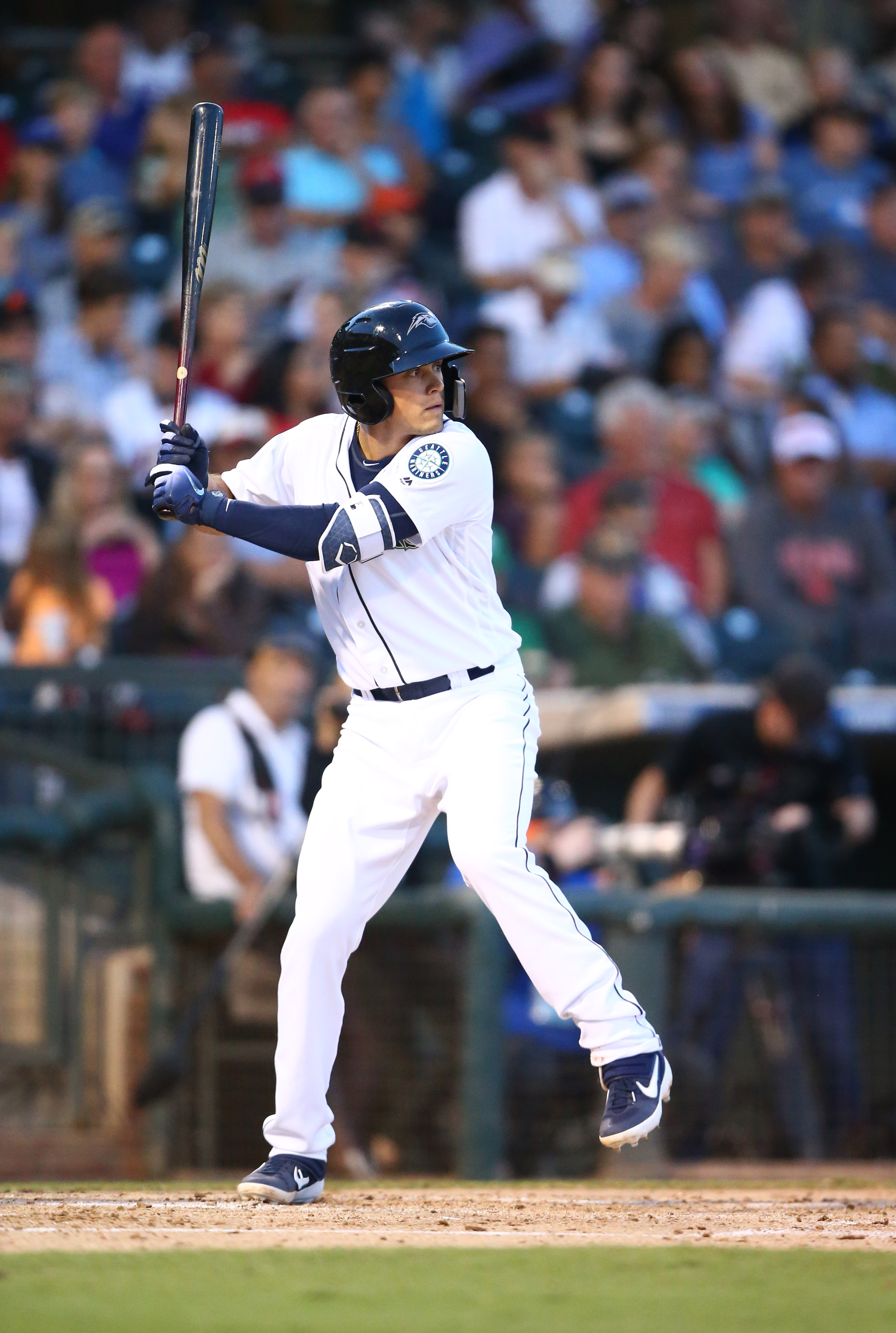
White, the No. 17 overall pick in the 2017 draft, spent the 2019 campaign with the Mariners’ Double-A in Arkansas, where he batted .293/.350/.488 with 18 home runs, 13 doubles, two triples, a 7.3 percent walk rate and a 23 percent strikeout rate in 400 plate appearances. Those numbers were particularly impressive in a pitcher-friendly setting, evidenced by White’s robust 132 wRC+ (indicating that he was 32 percent better at the plate than the average hitter in the Texas League).
From a broader offensive standpoint, the University of Kentucky product has performed well throughout his minor league tenure. He hit .277/.345/.532 in a tiny sample of 14 games of short-season Class-A ball in 2017 after being drafted and followed that up with a .303/.375/.458 slash in a full season at Class-A Advanced in 2018.
White is also regarded as a superlative defensive first baseman, with scouting reports at FanGraphs and MLB.com pegging him as a 70-grade defender. He currently ranks in the game’s top 100 overall prospects at MLB.com (No. 58), Baseball America (No. 73) and FanGraphs (No. 77).
The extension in many ways mirrors the long-term deal signed by Scott Kingery just prior to the 2018 season. As was the case with Kingery at the time, White is a 23-year-old top prospect who is widely expected to be a key contributor for his club in the near future. Both deals guaranteed the player $24MM over six years, though Kingery’s option years are valued at a slightly higher rate, as his contract can max out at $65MM. That’s perhaps reflective of the fact that Kingery, unlike White, had already played in Triple-A and was perhaps on the cusp of making the Opening Day roster out of Spring Training. White, meanwhile, could still be ticketed for some Triple-A time to being the 2020 season, although the long-term deal should increase his chances of breaking camp with the team. There’s no longer any reason to play service-time games and option him to Triple-A if he convinces the team of his MLB readiness with a strong spring effort.
White is suddenly the only player on the Mariners’ roster signed to a guaranteed contract beyond the 2021 season. The 2020 campaign will be a pivotal one for the “reimagining” Mariners, as they’ll get their first glimpse at White and quite possibly (later in the summer) at vaunted outfield prospect Jarred Kelenic (acquired in last winter’s Edwin Diaz/Robinson Cano trade). Lengthy auditions for lefty Justus Sheffield, righty Justin Dunn and outfielders Kyle Lewis and Jake Fraley — each of whom made his MLB debut in 2019 — are likely on the 2020 docket as well.
Rich Hill Undergoes Surgery, Won’t Be Ready For Opening Day
Free-agent lefty Rich Hill won’t be ready for the start of the 2020 season after undergoing primary revision surgery, reports WEEI’s Rob Bradford. It’s unlikely that the 39-year-old would be ready to return until June, and he could be delayed into July as well.
A source familiar with the procedure tells MLBTR that the operation is similar to the Tommy John alternative that right-hander Seth Maness underwent a few years go. Primary revision (also sometimes referred to as “primary repair”) is a less-intrusive repair of a tear in a player’s ulnar collateral ligament and comes with a shorter rehab period. However, not all UCL tears make for good candidates to undergo the operation. The procedure is dependent on the general health of the tissue as well as the placement and extent of the tear. Hill, who actually pitched through the injury for some of the 2019 season, was deemed a good candidate for the lesser-known procedure.
Although he’ll turn 40 next March, Hill has voiced a desire to continue pitching as long as he can and has been vocal about his desire to return to the Dodgers. He’s also expressed some interest in pitching with the Red Sox again, as a Boston native whose family still resides in the area. Now, rather than opening the season in a rotation, Hill could instead be a midseason reinforcement. Whether he’ll sign a contract this winter and attempt to rehab with his 2020 team or wait until he’s able to demonstrate his health for clubs next summer isn’t known.
Knee issues and a forearm strain wiped out a fair bit of Hill’s 2019 season, limiting him to 58 2/3 innings in what was the final season of a three-year, $48MM contract with the Dodgers. But Hill was excellent when healthy enough to take the ball, pitching to a 2.45 ERA with a 72-to-18 K/BB ratio and a 49.6 percent ground-ball rate in that time. Hill missed time in each of the three seasons of that contract with L.A. but did log a 3.30 earned run average with nearly 11.0 K/9 in a total of 327 regular-season innings (plus another 37 innings of 2.43 ERA ball).
Since resurrecting his career with the Red Sox late in the 2015 season, Hill has pitched 466 1/3 innings with a 2.91 ERA, 10.7 K/9, 2.8 BB/9 and 1.0 HR/9.
Braves Sign Travis d’Arnaud
The Braves have signed free-agent catcher Travis d’Arnaud to a two-year contract worth $16MM dollars, according to an official team announcement. The deal will pay him $8MM in both 2020 and 2021.

The Braves continue their busy winter, adding a position player to the healthy crop of relievers they have already inked. Between guarantees handed out to Will Smith, Chris Martin, Darren O’Day, and now d’Arnaud, the Braves are wasting no time adding upgrades to a team that came up a game short of the NLCS in 2019. In d’Arnaud, GM Alex Anthopoulos adds MLBTR’s 26th-ranked free agent on guarantee that slightly exceeds our prediction.
The contract puts a bow on what’s turned out to be a nice year and a surprising turnaround for d’Arnaud, who found himself jobless after the Mets designated him for assignment in May. After a pit stop with the Dodgers, he was dealt to the Rays and proceeded to post a .263/.323/.459 batting line for his new club, representing an integral part of the team’s playoff run. His 16 home runs matched a career-best mark, with d’Arnaud doing much of his damage against left-handers, against whom he notched a 130 wRC+.
Equally notable was d’Arnaud’s ability to stay healthy in Tampa, an issue that plagued his stint with the Mets. After he was acquired as a promising catching prospect in 2012, d’Arnaud appeared in more than 75 games in just two of six seasons with the Mets, including a 2018 season in which he missed all but four games thanks to Tommy John surgery.
As a defensive catcher, d’Arnaud is regarded as an above-average framer, though he saw his numbers in that department dip in 2019 compared to his Mets days. Baseball Savant measures his average pop time in the 55th percentile, which allowed him to throw out 29 percent of would-be base stealers in 2019, a notch above his career mark of 22 percent.
In Atlanta, d’Arnaud will join incumbent Tyler Flowers to make up a solid catching tandem that will earn a combined $12MM this year. With Braves icon Brian McCann retiring and Francisco Cervelli hitting free agency, the team found itself in need of a second option heading into the winter. We’ll see just how Brian Snitker and the Braves’ decision-makers allocate playing time between Flowers and d’Arnaud, but the bet here is that d’Arnaud settles into the primary starting role with Flowers getting into the lineup a couple times every week. Flowers’s framing prowess likely gives him the edge over d’Arnaud defensively, but his offensive track record is spotty.
With top free-agent catcher Yasmani Grandal signing with the White Sox on Thursday and d’Arnaud now off the board, teams who entered the offseason in need of catching help have seen their options thin out considerably in the blink of an eye. It wasn’t an especially deep class of free agents to begin with, and d’Arnaud was widely considered the second-best catcher on the market. The top remaining options include Robinson Chirinos, Yan Gomes, and Martin Maldonado.
Dodgers Extend Andrew Friedman
The Dodgers have signed president of baseball operations Andrew Friedman to a contract extension, Jon Heyman of MLB Network reports. Terms of the deal are unknown, but it figures to be a large payday for Friedman, whose previous deal was worth a reported $35MM over five years. At the time, that was a record-setting pact for a baseball executive.
Locking up Friedman was a long-expected move for Los Angeles, which has been overwhelmingly successful since it pried him from Tampa Bay after the 2014 season. While the Dodgers’ long-running championship drought has continued since then, they have taken the NL West in each season during Friedman’s reign and won two pennants.
Friedman was at the helm when the Dodgers hired Dave Roberts as their manager entering 2016, though some fans of the team haven’t been enamored of that move. Nevertheless, Roberts has a fan in Friedman, who stuck by the skipper after the eventual title-winning Nationals upset the club in the first round of the playoffs this fall.
Roberts has been in charge of an enviable group of talent supplied in part by Friedman, who has acquired several stars during his run in LA. Max Muncy was a waiver claim who has turned into a standout, while the valuable Chris Taylor came over in an under-the-radar trade with the Mariners in 2016. Meantime, newly named NL MVP Cody Bellinger, Corey Seager, Alex Verdugo, Julio Urias and Ross Stripling represent inherited players who have developed well in the Friedman era, and the team has drafted legitimate major leaguers such as Walker Buehler, Will Smith and Tony Gonsolin during his run. It also owns one of the majors’ premier farm systems, a group headlined by Friedman draft picks in Gavin Lux (first round, 2016) and Dustin May (third round, ’16).
Friedman has excelled at loading the ultra-rich Dodgers with cheap talent, but after coming over from a low-budget team, he has largely shied away from huge contracts. Re-signing longtime ace Clayton Kershaw (three years, $93MM), closer Kenley Jansen (five years, $80MM) and and third baseman Justin Turner (four years, $64MM) stand as the largest commitments the team has doled out under Friedman. Kershaw and Turner remain highly valuable, though Jansen has fallen off over the past couple seasons. Furthermore, free-agent signing A.J. Pollock – whom the Dodgers guaranteed four years and $60MM last winter – disappointed in his first season with the club. On the other hand, Japanese righty Kenta Maeda has delivered since the Dodgers inked him to an eight-year, $25MM guarantee in advance of the 2016 campaign.
The Dodgers have the financial might to pull off more headline-grabbing signings before next season, but it remains to be seen whether Friedman will take that route. Their most notable acquisitions may end up coming via trade, as Friedman has aggressively tried to upgrade his roster by swinging deals for the likes of Manny Machado, Yu Darvish, Yasmani Grandal and Enrique Hernandez in the past.
Regardless of how Friedman attempts to improve the Dodgers this offseason, they appear to be in good hands with him at the controls. No matter what happens in the coming months, they’ll be the clear-cut favorites to enter 2020 as NL West favorites and a team on the short list of predicted World Series winners. As such, it’s no surprise the Dodgers decided to keep Friedman under wraps going forward.
Photo courtesy of USA Today Sports Images.
Yankees Intend To Withhold Jacoby Ellsbury’s 2020 Salary
3:56pm: If there was any doubt, the MLBPA erased it in a statement making clear that it’s ready to fight on this issue. (Via Ken Rosenthal of The Athletic, on Twitter.) The statement provides: “The Players Association will vigorously defend any action taken against Jacoby or his contract and is investigating potential contract violations by his employer.”
As Rosenthal notes, the CBA does speak to this subject, providing: “Any treatment a Player receives for a Work Related Injury by a health care provider who is not affiliated with the Club must be authorized by the Club in advance of the treatment in accordance with Regulation 2 of the [Uniform Player’s Contract].” But that general rule does not necessarily leave us with a clear guide to the outcome of the dispute.
For one thing, there are loads of potential factual and interpretive questions to be addressed. Just what constitutes medical treatment, for instance? For another, the current CBA includes letters of understanding exchanged between the league and union. One in particular acknowledges that there are open disagreements regarding what occurs in cases of conflict in medical opinion. There are perhaps also other legal concepts that might limit the extent to which an employer, even if theoretically empowered by a collective bargaining agreement, may dictate the health and medical choices of an employee. Beyond all that, even if it is determined that Ellsbury has breached his contract, it must still be established that the breach justifies the full or partial abrogation of the Yankees’ future salary obligations.
In other news, Ellsbury is said to be planning to attempt a return in 2020, per Jon Heyman of MLB Network (via Twitter). His anticipated timeline for readiness is not evident. Obviously he’d be looking to catch on with another organization if he’s able to show he’s physically capable of giving it another shot.
1:26pm: The Yankees finally cut bait on Jacoby Ellsbury this week, begrudgingly waving the white flag on the center fielder’s ill-fated seven-year, $153MM contract. Ellsbury is still owed $26,142,857 of that deal — his 2020 salary plus a $5MM buyout on his option for the 2021 season. But he may not receive all of that cash without a fight.
It seems the Yankees intend not to pay Ellsbury his salary for the coming season, based upon the premise that Ellsbury underwent outside medical treatment without approval to rehab the injuries that have plagued him since 2017. George A. King III and Ken Davidoff of the New York Post reported the brewing battle, with Jon Heyman of MLB Network adding further details (via Twitter).
We don’t know much about the precise factual underpinnings of this issue, but the reporting suggests the team believes that Ellsbury acted inappropriately for multiple years. Presumably, the organization believes it can establish that the alleged actions not only violated the terms of his contract, but also contributed to his inability to return to the field of play over the past two seasons.
Ellsbury’s outlook for 2020 isn’t really known, though there has been no indication that he’s likely to play. The once-excellent outfielder had a few solid but generally uninspiring years in New York before falling apart physically more recently. We’ve seen a steady stream of generally ambiguous ailments cited over the past few campaigns. The 36-year-old hasn’t even made it into a single rehab game.
What we do now know is the anticipated procedural progression of the dispute. The Yankees will simply refuse to cut Ellsbury his checks, per Heyman, leaving it to him and agent Scott Boras to pursue a grievance action. It is somewhat difficult to imagine that there won’t be a full-throated battle on both the factual and contractual merits of the Yanks’ anticipated course of action, though certainly a settlement will also be possible. No doubt the league, union, and Yankees’ insurer will have major roles to play in this as well.
It’s all but impossible to guess how this’ll turn out based upon what little we know at present. There’s nothing in terms of recent precedent for such a grievance — at least not one that was public knowledge — so it’s difficult to gauge just how much of the contract the Yankees might ultimately be able to avoid paying or whether they even have a legitimate hope of winning their case. But any finances saved will be notable, as the Yankees currently have about $203MM on the books for 2020 (including projected arbitration salaries) and about $210MM worth of luxury tax considerations.
White Sox Extend Jose Abreu
The White Sox announced that they’ve agreed to a three-year, $50MM contract with first baseman Jose Abreu. The 32-year-old slugger had previously accepted a one-year, $17.8MM qualifying offer, effectively making this a two-year, $32.2MM extension.
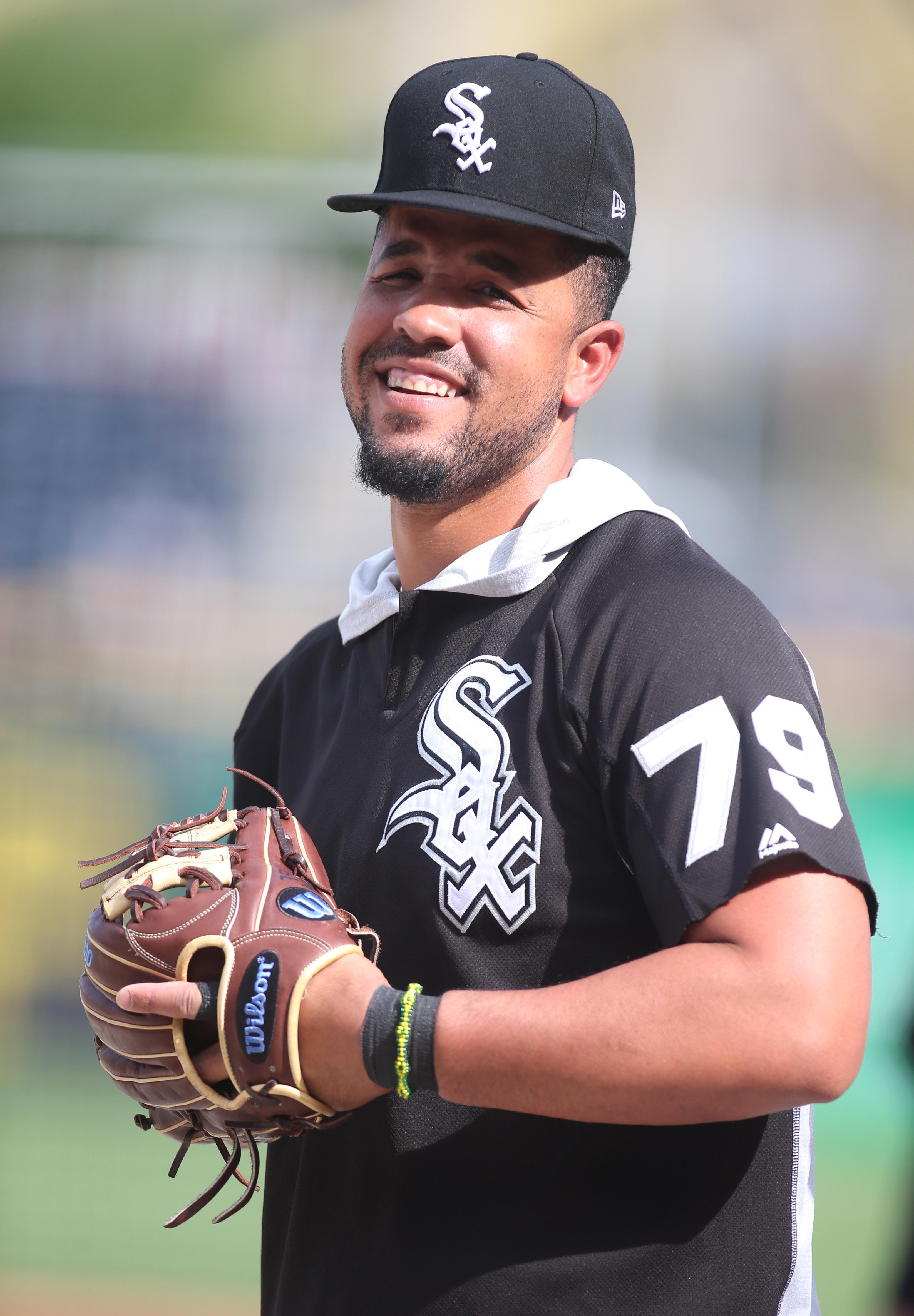
Under the new contract, Abreu will receive a $5MM signing bonus and an $11MM salary in 2020 before being paid $16MM in 2021 and $18MM in 2022. Four million dollars of that 2022 salary will be deferred, according to the team. Abreu is represented by ISE Baseball.
In signing Abreu to this type of extension, the White Sox are effectively betting (in a fairly substantial manner) on a rebound in his age-33 season next year. That’s not to say that Abreu had a poor 2019 campaign; he batted .284/.330/.503 with 33 home runs and was a decidedly above-average hitter overall. But unlike his 2014-17 production, Abreu’s output in 2018-19 has been more good than it has been great. Park- and league-adjusted measures such as OPS+ (119) and wRC+ (117) agree that he’s been nearly 20 percent better than a league-average hitter in that span, but that’s a far cry from the premium levels at which Abreu produced from 2014-17 — particularly in his brilliant 2014 rookie campaign, when he was arguably the best hitter in baseball.
The open market simply hasn’t rewarded players of this age and skill set in recent years, and it’s unlikely that Abreu would’ve had this type of earning power next winter without returning to his previous levels of excellence with the bat. Given the fact that Abreu has never been rated as a strong defensive first baseman and isn’t likely to make considerable improvements as he progresses deeper into his mid-30s, an uptick at the plate is all the more important.
All of that said, it’s also undeniable that Abreu has emerged as the heart of the White Sox in recent years. The front office, ownership and teammates alike have lauded Abreu for his leadership and the manner in which he mentors young players as they arrive on the scene. He’s also a fixture in the community on the south side of Chicago and is generally beloved by Sox fans. All of that surely factors in when pricing out a deal and is particularly likely to resonate with owner Jerry Reinsdorf, who has been vocal about his desire to keep Abreu in a Sox uniform (as has GM Rick Hahn).
From a financial standpoint, the new structure of the deal does give the Sox a bit of extra breathing room when constructing the 2020 roster. Assuming that signing bonus still counts against the 2020 ledger, they’re now at about $93.7MM in projected salary when factoring in projected arbitration payouts. Parting with either Yolmer Sanchez or James McCann, who was displaced as the team’s starting catcher by yesterday’s Yasmani Grandal signing, would create further flexibility. Sanchez is projected by MLBTR contributor Matt Swartz to earn $6.2MM in 2020, while McCann’s projection checks in at $4.9MM.
The extent to which Reinsdorf is willing to spend on the 2020 roster isn’t definitively known by anyone outside of the White Sox’ top decision-makers, but they’re currently about $30MM shy of their record Opening Day payroll mark ($128MM in 2011) — a number that could jump to $40MM depending on the fate of Sanchez and McCann. The Sox now have about $46MM in guaranteed money on the books for the 2021 season and about $53MM on the books in 2020
That leaves them plenty of latitude for an additional long-term signing — particularly since key young players like Tim Anderson and Eloy Jimenez are already locked into long-term deals that provide cost certainty. They’ll still need to budget for pricey arbitration salaries for both Yoan Moncada and Lucas Giolito beginning in 2021, however, meaning multiple long-term additions will begin to clog up the books in a hurry. But if ownership is willing to push payroll beyond its previously established heights moving forward, it’s certainly plausible that the Sox could have more than one addition up their sleeve between now and Opening Day. The club is hopeful of adding both a right fielder and a starting pitcher to the mix, so further additions do indeed seem likely, although either could come on a shorter-term arrangement.
White Sox Sign Yasmani Grandal
The White Sox announced that they’ve signed free-agent catcher Yasmani Grandal to a four-year contract. He’ll be guaranteed a hefty $73MM, the team announced, which will be paid out evenly at $18.25MM per year. As per The Athletic’s Ken Rosenthal (Twitter link), Grandal’s deal includes a full no-trade clause in 2020 and partial no-trade protection for the remaining three seasons. To make room on the 40-man roster, the White Sox designated outfielder Daniel Palka for assignment.
Readers will recall that the 2018-2019 offseason marked a much more frustrating pass through the free agency turnstiles for the now-31-year-old Grandal. After spurning a reported four-year, $60MM offer from the Mets last winter, the former Hurricane bet on himself by agreeing to a one-year, $18.25MM deal with the Brewers.
That gambit appears to have paid off handsomely, with Grandal parlaying his fantastic 2019 into a larger long-term guarantee from Chicago. At $73MM, this contract represents the largest guarantee in White Sox history, surpassing the six-year, $68MM outlay secured by Jose Abreu in advance of the 2014 season.
 From any vantage, that guarantee should provide the club with one of the very best catchers in the game. Since entering the majors with San Diego in 2012, Grandal has posted a cumulative 118 wRC+ figure, second only to Buster Posey among all catchers with more than 3000 plate appearances in that time frame. Similarly, his .348 OBP is tops among catchers since 2012, while his 141 homers since ’12 rank second only to Brian McCann‘s 145. Grandal’s never been a world-beater in the batting average department, but he’s been a consistent source of power and on-base ability for the bulk of his career.
Though his offensive prowess is evident from even a cursory glance at his career numbers, any Grandal evaluation would be remiss to exclude his sterling defensive reputation. Grandal recorded a 20.1 figure in Baseball Prospectus’ Fielding Runs Above Average metric during the 2019 campaign, good for third among catchers in the bigs behind Austin Hedges and Roberto Perez; that the White Sox press release regarding Grandal’s signing made mention of his pitch framing abilities should come as no surprise.
For the Pale Hose, the signing of such a multi-dimensional, high-profile player makes it abundantly clear that their long-running rebuild has come to an end. Last offseason saw the club make a run at third baseman Manny Machado, in a bid that was likely intended to symbolize a similar rallying cry of competitiveness. Though this past season ended up marking their seventh consecutive losing campaign, Grandal’s addition should go a long way toward supplementing a core that showed real promise in 2019.
Though it was White Sox pitchers like Carlos Rodon, Lucas Giolito, and Michael Kopech who were previously thought to be the club’s primary strength, 2019 yielded encouraging breakouts from a handful of South Side swingers. Shortstop Tim Anderson, for one, exploded en route to the 2019 batting title, logging a .335/.357/.508 slash and 3.5 fWAR across 518 plate appearances; 24-year-old infielder Yoan Moncada announced his presence with a .315/.367/.548 line with 25 home runs, ultimately garnering a down-ballot MVP vote in his second campaign of extended MLB action; rookie outfielder Eloy Jimenez was pretty decent, too–all he did was hit 31 home runs in his first 122 games at the sport’s highest level. And this is all before accounting for the impending arrival of uber-prospect outfielder Luis Robert.
All of that said, catcher didn’t, at first glance, appear to be the team’s most glaring need going into this offseason. Incumbent starter James McCann‘s 109 wRC+ and .273/.328/.460 slash in 2019 did indeed compare favorably to other catchers around the league, but a deeper look shows why executive VP Kenny Williams and GM Rick Hahn may have been unable to resist Grandal’s well-rounded allure. Firstly, McCann’s numbers were largely the result of a scintillating first half, as his .226/.281/.413 line after the break would demonstrate; add in McCann’s .359 BABIP on the year, while providing for the defensive upgrade Grandal represents, and it’s easy to see how club leadership saw today’s signing as a necessary investment.
The White Sox fielded an Opening Day payroll of $88.92MM in 2019; the club’s ten-year highwater mark for payroll came back in 2011 when owner Jerry Reinsdorf green-lit a $127.78MM outlay. In addition to Grandal, the Sox will have Abreu ($17.8MM), Kelvin Herrera ($8.5MM), and Anderson ($4MM) under contract with significant guarantees next season, while a considerable number of players will either draw raises in arbitration or find themselves non-tendered. Impact contributors like Giolito remain under affordable club control, so there may yet be some wiggle room to make other improvements around the roster.
Regardless of their moves from here forward, the decision by White Sox brass to bring in Grandal may come at an opportune time. The Twins, despite having retained starter Jake Odorizzi, face uncertainty in their rotation, while the rival Indians continue to endure trade speculation surrounding star shortstop Francisco Lindor and lingering questions about the health of several pitchers, including Corey Kluber. Grandal’s addition to Chicago’s blistering young core should make those teams slightly more uncomfortable with regard to their standing in the AL Central.
With Grandal off the board, the free agent catching market is now likely headlined by Travis d’Arnaud, with Robinson Chirinos and Jason Castro representing something of a third tier. While those players offer varying combinations of offensive and defensive ability to interested teams, there’s little doubt that Chicago acted decisively today in securing itself the most complete backstop on the market.
Photo courtesy of USA Today Sports Images
Yankees Release Jacoby Ellsbury, Designate Greg Bird
The Yankees have released outfielder Jacoby Ellsbury and designated first baseman Greg Bird for assignment as part of a series of roster moves. The club has also designated left-hander Nestor Cortes Jr. and added seven players – outfielder Estevan Florial and right-handers Deivi Garcia, Luis Gil, Brooks Kriske, Luis Medina, Nick Nelson and Miguel Yajure – to its 40-man roster. Ken Davidoff and George A. King III of the New York Post first reported the Yankees were considering releasing Ellsbury.
This brings to an end a hugely disappointing New York tenure for Ellsbury, a former star with archrival Boston who parlayed his success with the Red Sox into a seven-year, $153MM deal with the Yankees after 2013. Ellsbury was merely a decent to good contributor for the Yankees from 2014-17, and a series of injuries prevented him from taking the field at all over the previous two seasons.
The Yankees currently have a need in center field with Aaron Hicks on the mend from Tommy John surgery and Brett Gardner a free agent, so the fact that they’ve moved on from Ellsbury and eaten the remaining $26MM-plus on his contract speaks to how far his stock has fallen. Now, if the 36-year-old is going to continue his career, he’ll likely have to settle for a minor league pact with another organization.
Injuries have also been ruinous for the 27-year-old Bird, whom the Yankees once regarded as their first baseman of the future. Bird was tremendous during a 178-plate appearance debut in 2015, when the left-hander’s swing looked tailor-made for Yankee Stadium, but that’s the only regular-season excellence he has shown to this point. Bird missed all of 2016 after undergoing shoulder surgery and then hit a meager .194/.287/.388 in 522 trips to the plate from 2017-19. Thanks in part to foot problems, he totaled just 41 PA at the MLB level this season. At this point, it wouldn’t be a surprise to see another team trade for or claim Bird, who still has three minor league options left.
Cortes, 24, is also in the DFA pile with Bird. The southpaw, a two-time member of the Yankees organization and also a former Oriole, saw extensive MLB action with New York in 2019. While Cortes limped to a 5.67 ERA/5.57 FIP in that 66 2/3-inning span, he did amass 9.32 strikeouts per nine against 3.78 walks. Cortes also had a solid year at the Triple-A level, where he posted a 3.86 ERA/3.40 FIP with 9.53 K/9 and 2.5 BB/9 over 39 2/3 frames. He has a pair of minor league options remaining.
Marlins Designate Wei-Yin Chen, Add Six To 40-Man Roster
The Marlins announced Wednesday that they’ve designated left-hander Wei-Yin Chen for assignment and added six players to their MLB roster: shortstop Jazz Chisholm, first baseman Lewin Diaz and right-handers Sixto Sanchez, Nick Neidert, Humberto Mejia and Edward Cabrera. Miami owes Chen $22MM in 2020 — the final season of a five-year, $80MM free-agent contract.
Chen, now 34, was a steady source of quality innings from 2012-15 in Baltimore, pitching to a 3.72 ERA in the hitter-friendly AL East while averaging 29.25 starts and 176 innings per year. That durability and reliability led the Marlins to invest a whopping five-year, $80MM contract in the lefty when he hit the free-agent market, but the deal went south almost immediately. Chen barely kept his ERA under 5.00 and tossed just 123 1/3 innings in his first year with the Marlins. A UCL injury wiped out nearly all of his 2017 season and much of the 2018 campaign, and he pitched just 68 1/3 innings of ineffective relief work in 2019. Overall, he recorded a dismal 5.10 ERA in 358 innings with Miami.
Of the prospects protected tonight were acquired via the trade market, Chisholm (Zac Gallen), Diaz (Sergio Romo), Sanchez (J.T. Realmuto) and Neidert (Dee Gordon) were all acquired on the trade market under the team’s current ongoing rebuild. Sanchez is considered to be among the game’s premier pitching prospects, while Chisholm has drawn top 100 billing as well despite a rough showing at Double-A in 2019. Diaz was acquired from the Twins amid a huge rebound campaign. Neidert had an injury shortened ’19 season but profiles as a back-end starter. Cabrera reached Double-A as a 21-year-old this past season, while the 22-year-old Mejia turned in similarly impressive numbers and topped out in Class-A Advanced.
Braves Re-Sign Chris Martin
The Braves announced Tuesday that they’ve re-signed right-hander Chris Martin to a two-year contract. The deal is worth a guaranteed $14MM and will be evenly distributed at $7MM per season, according to the team. Martin is represented by ISE Baseball.
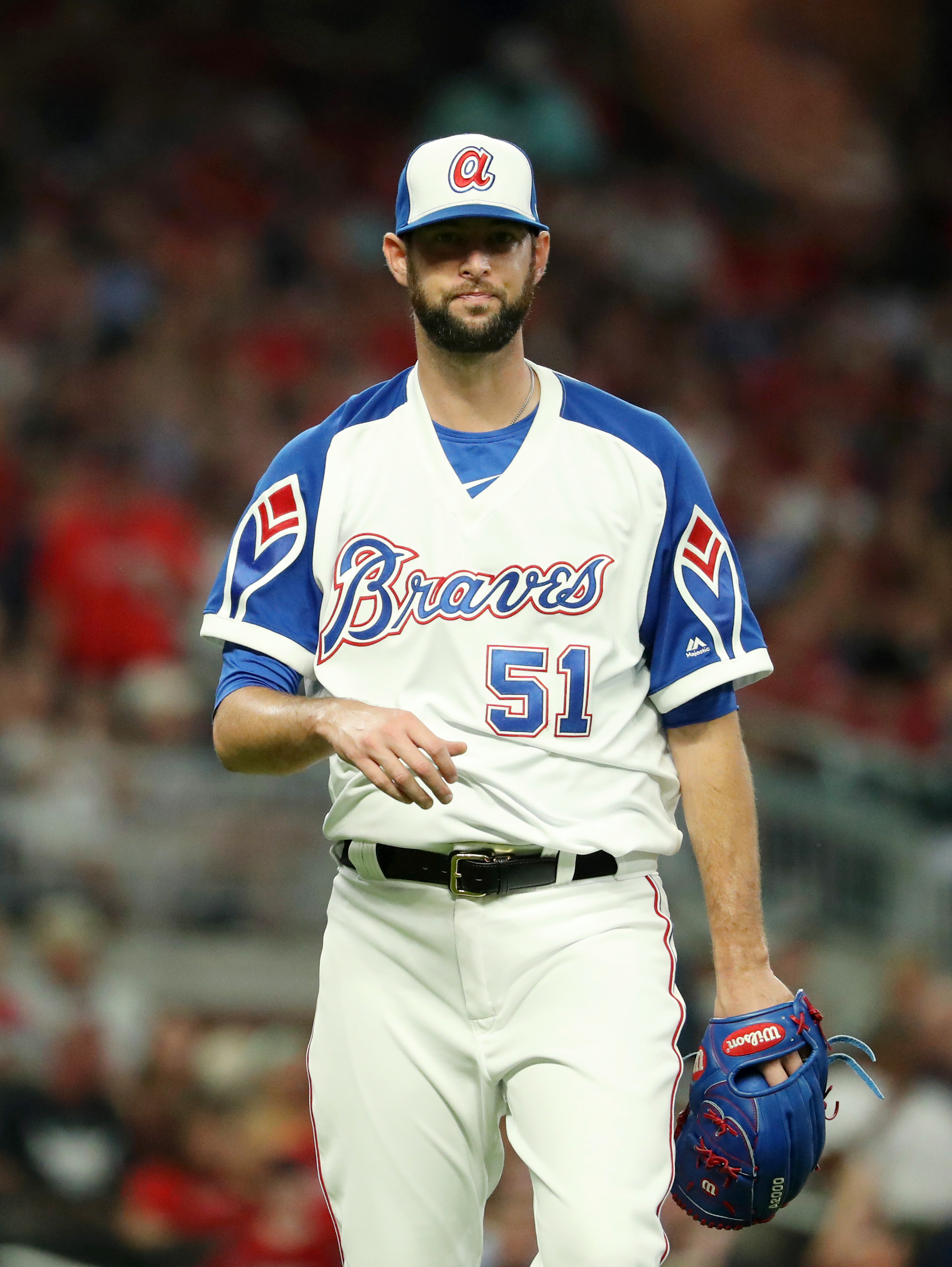
It’s the third notable relief pickup of the past week for the Braves, who already snagged arguably the top reliever on the market last Thursday when signing Will Smith to a three-year, $40MM contract. Atlanta also re-signed veteran righty Darren O’Day to a one-year, $2.25MM deal in the early stages of the offseason. Between Smith, Martin, O’Day, Mark Melancon and Shane Greene, the Atlanta bullpen will head into the 2020 season as both a much more established and much more expensive collective unit than it did in 2019.
Martin, 33, enjoyed the finest season of his professional career in 2019, pitching to a combined 3.40 ERA with a masterful 65-to-5 K/BB ratio in 55 2/3 innings of relief between the Rangers and Braves. The towering righty, listed at 6’8″, opened the season in Texas but found himself pitching for the Braves down the stretch after Atlanta traded former first-rounder and top prospect Kolby Allard to the Rangers to acquire him on July 30. He was set to make his postseason debut against the Cardinals in the NLDS when an oblique injury cropped up and forced him out of the game before throwing a pitch in what proved to be a pivotal moment in the Braves’ postseason loss.
This past season, Martin posted a career-high 95.7 mph average fastball and logged career-high marks in swinging-strike rate (12.4 percent) and opponents’ chase rate (38.3 percent). The only pitcher in baseball (min. 50 innings pitched) who boasted a lower walk percentage than Martin’s 2.3 percent mark was Atlanta teammate Josh Tomlin (2.2 percent), but Martin’s 30.1 percent strikeout rate was nearly double that of Tomlin. The extent to which he can replicate his enormous gains in swinging-strike, chase and walk rates will determine Martin’s success in his second stint with the Braves, but there’s little denying that he was among the most appealing arms available on the market this winter.
Prior to landing far and away the largest contract of his professional career, Martin, has had one of the most fascinating odysseys in all of baseball (as most recently chronicled by the Atlanta Journal-Constitution’s Tim Tucker). Drafted out of high school in ’04 and junior college in ’05, Martin opted not to sign in either instance and ultimately went undrafted in 2006 after undergoing shoulder surgery that he believed would end his baseball aspirations. Years later, after working as a UPS driver and working at Lowe’s, a game of catch with a friend brought about the realization that his surgically repaired shoulder no longer caused him pain.
A second indie ball stint was parlayed into a minor league deal with the Red Sox, who traded Martin to the Rockies in 2013. Just four years removed from delivering packages and driving a forklift, Martin made his MLB debut with the Rockies in 2014. Brief stints with the Rox and Yankees didn’t yield favorable results, and Martin ultimately found his first seven-figure contract pitching overseas for the Nippon Ham Fighters in Japan. His dominance in NPB led to a two-year, $4MM deal with the Rangers. Prior to today’s announcement, Martin’s career earnings between MLB and NPB checked in south of $7MM. The two-year, $14MM agreement matches the prediction included in MLBTR’s Top 50 free agent list, where Martin ranked 27th.
Early in the season the Braves will continue to deploy Melancon as the club’s closer, general manager Alex Anthopoulos suggested following the signing of Smith (link via Matthew Leach of MLB.com). That should lead to a primary setup corps of Smith, Martin, Greene and O’Day, with a number of the Braves’ young arms combining to round out the bullpen mixture. Luke Jackson, Grant Dayton, A.J. Minter, Chad Sobotka and Jacob Webb will be among the names considered by the Atlanta brass, barring additional bullpen acquisitions and or roster moves that send some of those incumbent options elsewhere.