
Pirates Sign Lonnie Chisenhall
Nov. 27: The Pirates have formally announced the signing, via press release.
“Lonnie Chisenhall adds an experienced, productive and versatile player to our Major League Team,” said GM Neal Huntington in a statement accompanying the announcement. “When healthy, Lonnie has been a quality hitter while offering defensive flexibility. He also provides us an immediate option in right field while Gregory Polanco is getting healthy and his abilities and versatility will make our club better once Polanco returns.”
Nov. 26: The Pirates have struck a deal with free agent outfielder Lonnie Chisenhall, per Ken Rosenthal of The Athletic (Twitter link). It’s said to be a one-year, $2.75MM pact.
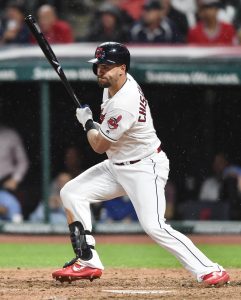
Chisenhall, 30, missed much of the 2018 season owing to a nagging calf injury. If he can avoid the DL, and earn playing time, he’ll have a chance to boost his salary in Pittsburgh. Per Rosenthal, the deal comes with some reasonably hefty potential incentives. Chisenhall will receive $250K upon reaching 250, 300, 350, and 400 plate appearances along with $500K if he makes it to 450, 500, 550, and 600 trips to the dish. That’s a potential $3MM boost.
Of course, it’d be rather surprising to see the left-handed-hitting Chisenhall receive enough action to max out the contract. He has only topped the five-hundred PA barrier once in his career, most of which has been spent in platoon duty. And for good reason: Chisenhall has been 58 OPS points better against right-handed than left-handed pitching in the majors.
For the Bucs, Chisenhall represents a part of a solution for the absence of Gregory Polanco, who is expected to miss a big chunk of the season recovering from shoulder surgery. Frankly, it’s unclear what the club will receive from Polanco in 2019, so it was imperative that a fill-in be found.
While a right-handed hitter might have dovetailed better with the existing unit by the time Polanco is back in action — after all, he and Corey Dickerson both hit from the left side — adding a lefty makes for a cleaner immediate fit with the team’s slate of reserve options. Pablo Reyes, Jose Osuna, and Patrick Kivlehan are among the players who could compete for bench duties. Of course, it’s also still possible that a higher-end asset could fall into the Bucs’ laps at some point over the offseason.
Regardless of how the platoon machinations work out, this is an interesting signing. Chisenhall is a sneaky upside play, given the ceiling he has shown on both sides of the ball.
Offensively, Chisenhall has produced at about a league-average clip over his eight-year career. But he churned out a 117 wRC+ in 2014, the season in which he saw his most extensive playing time (142 games, 533 plate appearances). And since the start of the 2017 season, he’s a .297/.368/.503 hitter with 13 home runs over 365 plate appearances. That represents a notable power surge as against his prior track record, though it came in a short sample and showed up more in ’17 than in his brief ’18 effort.
With the glove, Chisenhall went from a questionable third baseman to a high-end right fielder in 2015. The exuberant defensive metrics have cooled in the years to come, but he generally grades out in sight of average. It’s at best questionable whether he’ll be more than a solid performer in the field, particularly given that he’ll be looking to move past the longstanding lower-leg ailment, but there’s reason to think the Pirates will at least have an average defender for their money.
All things considered, as Jason Rollison of Bucs Dugout noted in tweeting the club’s interest recently, it seems like a nice match that will serve both player and team. Chisenhall joins Jung Ho Kang as a reasonably high-upside early signee, giving the Pirates two roster pieces at a palatable price and leaving a relatively robust amount of spending capacity untapped for further additions. (Of course, some potential payroll space could be held and deployed at midseason if the team proves worthy of further investment.)
Photo courtesy of USA Today Sports Images.
Giants “Willing To Engage” In Talks On Madison Bumgarner
The Giants are “willing to engage” with rival organizations on trade scenarios involving star lefty Madison Bumgarner, according to a report from Jon Morosi of MLB.com. It’s not yet clear just how likely it is that the San Francisco organization will actually move one of its best-loved and most-accomplished players.
Bumgarner is a living baseball legend, owing less to his years of excellent regular-season service than to his incredible postseason feats. The version of the burly southpaw that owned the 2014 World Series will live on no matter the course of the remainder of his career. But after the two seasons he just endured, with a shoulder injury seeming to sap his strength, it’s at best questionable whether the Giants’ staff ace can still deliver a vintage performance.
While front office opinions on the matter no doubt vary, numerous teams figure at least to check in on the lefty. Three, at a minimum, have done so already, according to Morosi. The Brewers and Phillies “have had at least preliminary dialogue,” he writes, while the Braves “checked in” but do not appear to be engaged at the moment.
It’s said that newly installed Giants president of baseball operations Farhan Zaidi is angling for young pitching in a deal, but it’s fair to wonder whether he’ll be able to get any top-flight arms. After all, the upside here is limited by the fact that Bumgarner is one season away from free agency. His $12MM contract is plenty reasonable despite the questions, and the possibility of a qualifying offer (or even an extension) hold out hope for some future value. But the unanswered questions create significant downside, even on a single-season commitment.
At base, acquiring Bumgarner would mean buying a pitcher who has been a solid, not terribly durable performer over the past two seasons. He certainly did what he could to make it back from a shocking early-2017 dirt bike accident, and has somehow maintained a 3.29 ERA since the start of that ill-fated campaign, but it’s hard to look past the warning signs.
Before the injury, the now-29-year-old hurler had been good for about a strikeout per inning with two or fewer walks per nine innings, and a total of 200+ frames per season. He had run up four-straight sub-4.00 ERA campaigns, with peripherals that largely matched, all before his near-unimaginable playoff heroics. At his best, Bumgarner drew swings and misses at more than an 11 percent clip while allowing hard contact on less than a third of the balls put in play against him.
Operating at less than full capacity last year, Bumgarner’s swinging-strike rate fell to 9.2% and his K%-BB% dropped to 12.0%. (He had once sat at over a 10 percent K%-BB% for three-straight seasons.) And his hard-hit rate ballooned to 41.6% (per Fangraphs) — a massive rise for a pitcher who has averaged below 30 percent for his career.
The physical changes certainly appear to have had a role. While he was never a flamethrower, Bumgarner averaged as much as 93 mph with his fastball. It has now been three seasons since his heater average heater topped 92 mph. As the effectiveness of that table-setting offering declined, he increasingly went away from the four-seamer in 2018, throwing it just 34.2% of the time — well shy of his 45.6% career average. While the remainder of his arsenal was still effective, the heater had been the bread to his cutter’s butter.
Whether Bumgarner can regain some of the lost velocity, or find a way to make up for it, remains to be seen. There’s still reason to believe he’ll be at least a useful starting pitcher regardless, if for no other reasons than because of his undeniable competitive fire and remaining youth. While he gutted out the results last year, his 3.99 FIP, 4.32 xFIP, and 4.42 SIERA tell a different story — though it’s not a tale of an irredeemably lost pitcher. Even if he can’t regain much of his former luster, Bumgarner will bring the promise of some solid innings, at least so long as he’s able to remain healthy.
Of course, the allure of the Bumgarner of yore will no doubt play some role in negotiations. Clubs such as those rumored to have interest aren’t looking only for a useful, back-of-the-rotation piece. They all have designs on the postseason, and no doubt at least entertain dreams of Bumgarner not only helping to get there, but also rising to the occasion when the moment calls for it.
Perhaps, too, some teams’ scouts and analysts have sussed out some reasons to believe in a turnaround. It’s fair to guess that Zaidi is about as well-versed on the subject as anyone. His former club, the Dodgers, no doubt analyzed Bumgarner closely as a division rival. And he’s now privy to all that the Giants know about their own leading pitcher. Whether Bumgarner is dealt, and what he draws in return, will also tell us quite a bit about the San Francisco organization’s views — on the southpaw as well as the rest of the roster. After all, the club has the financial means to hold on to Bumgarner, whether to maintain fan interest and boost his value for the summer trade deadline or to pursue another extension.
The broader market is certainly a factor as well. Zaidi can only market one season of Bumgarner, but in some regards that’s a positive. There are plenty of intriguing lefty starters available in free agency — most notably, Patrick Corbin, Dallas Keuchel, J.A. Happ, and Yusei Kikuchi — but all figure to command significant guarantees over multiple seasons. Giving up some young talent, rather than taking on potentially damaging long-term contract commitments, will surely hold appeal. Of course, it’s also true that the presence of so many alternatives — remember that James Paxton (via trade) and CC Sabathia went off the board already, and there are other talented starters available in trade free agency — will tend to reduce demand.
All said, it’s far from clear that there’ll be sufficient interest to force Zaidi’s hand. But the mere fact that there’s a possibility of a pre-season swap is itself notable, especially given Bumgarner’s special status in franchise lore. It’ll certainly be interesting to see how this situation plays out.
Braves Sign Josh Donaldson
7:27pm: The signing is now official, with the Braves announcing it.
1:35pm: The Braves have reportedly made the largest free-agent strike of the offseason so far, agreeing to terms on a one-year contract with former American League MVP Josh Donaldson. The contract is said to guarantee Donaldson the same $23MM salary he earned in 2018 and will give the MVP Sports client an opportunity to re-enter free agency next winter — hopefully on the heels of a healthier, more productive season than the injury-ruined 2018 campaign through which he just struggled.
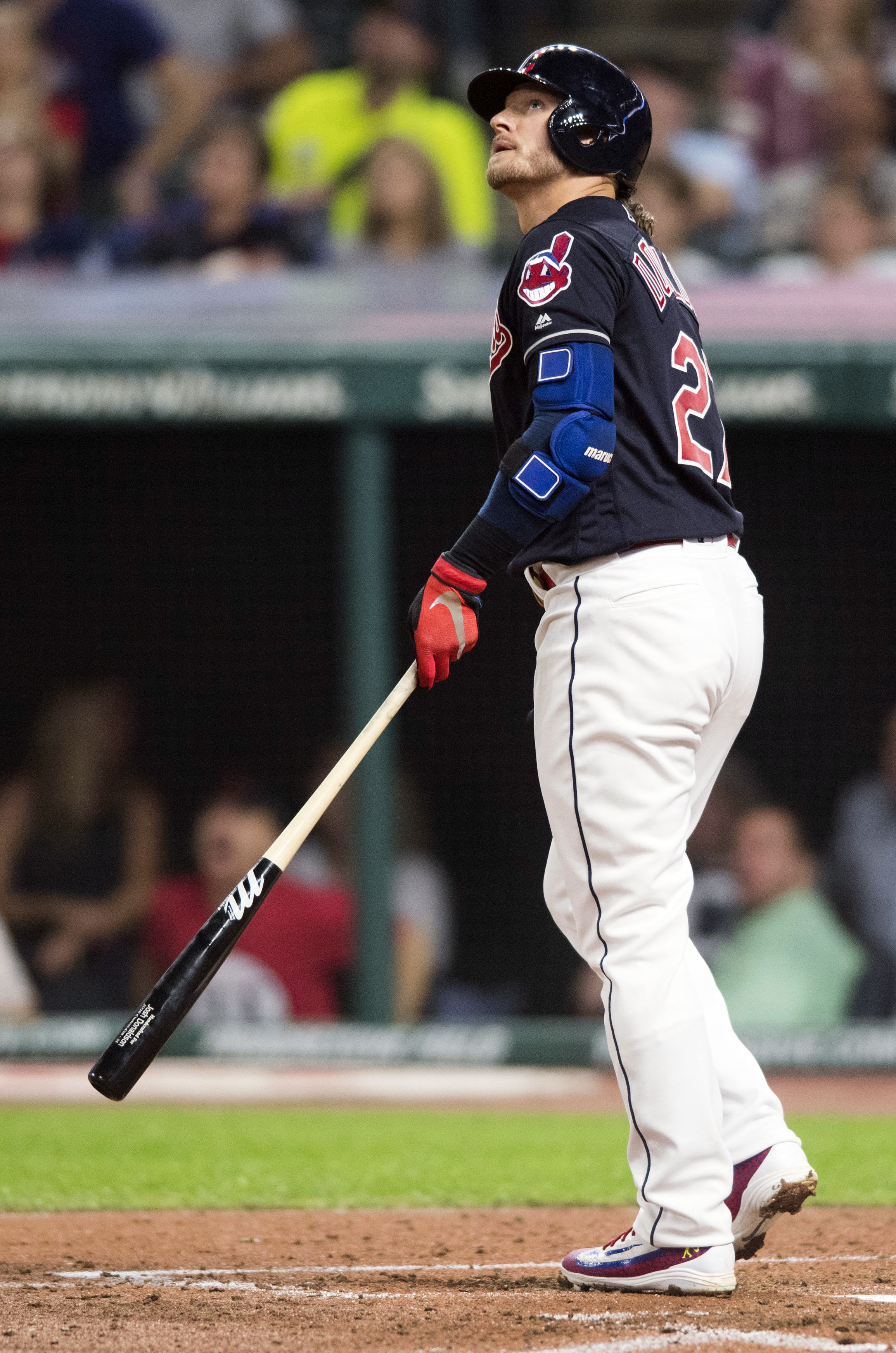
Donaldson, 33 in December, was limited to just 219 plate appearances this year as he battled a shoulder issue early in the season and a calf injury that cost him roughly three months of action. He posted a solid but unspectacular .246/.352/.449 batting line and eight homers when healthy — above-average production relative to the rest of the league but a tremendously far cry from the composite .282/.377/.524 batting line he logged from 2013-17.
[Related: Updated Braves depth chart and Braves payroll outlook]
If healthy, Donaldson will give an already imposing Braves lineup a massive boost — to say nothing of top-shelf defense at the hot corner. Atlanta already had premium glovework at third base thanks to Johan Camargo, but the Braves will now have the luxury to deploy Camargo at a number of positions. Camargo, soon to turn 25, can give the Braves some cover at third base, shortstop and second base at the very least. Speculatively speaking, it wouldn’t be a surprise to see Atlanta try him in the outfield corners during Spring Training as well; if Camargo proved capable, the Braves could deploy him in a Marwin Gonzalez or Ben Zobrist-esque fashion, granting him fairly regular at-bats while spelling Donaldson, Dansby Swanson and Ozzie Albies, among others. The signing of Donaldson could push back the debut of prospect Austin Riley by nearly a full year, but Riley is still just 21 years old and has only played 150 games above Class-A Advanced. Some additional development time certainly won’t hurt — especially when considering his 29.5 percent strikeout rate in Triple-A last season.
The agreement with Donaldson marks a reunion between the slugger and general manager Alex Anthopoulos. The pair are well acquainted from Anthopoulos’ time as the Blue Jays’ general manager, with the trade that brought Donaldson to Toronto standing out as one of the most successful moves of Anthopoulos’ front-office career. (Kendall Graveman, Franklin Barreto, Sean Nolin and Brett Lawrie went to the A’s in return.)
The $23MM salary, combined with the reported $2MM salary the Braves will pay fellow free-agent addition Brian McCann, will push Atlanta’s Opening Day payroll projection to just north of $117MM. That’s already just about $1MM shy of their 2018 mark and $5MM shy of the all-time franchise record, so it seems apparent that the Braves’ NL East title and emerging core have spurred ownership to become more aggressive in terms of payroll. By adding Donaldson to the heart of a lineup that also features Rookie of the Year Ronald Acuna and perennial MVP candidate Freddie Freeman, the Braves have made an early splash that’ll have significant ramifications on the 2019 division race and put additional pressure on rivals like the Phillies, Nationals and Mets to further act to bolster their rosters as they seek to remain competitive in a rapidly improving division.
Steve Phillips of MLB Network Radio on SiriusXM first tweeted that the two sides were nearing a deal. Ken Rosenthal of The Athletic reported the agreement and the terms.
Braves Sign Brian McCann
2:07pm: The Braves announced that they’ve signed McCann to a one-year deal worth $2MM. As agent B.B. Abbott explained to Ken Rosenthal of The Athletic (Twitter links), McCann’s priority this winter was to return to Atlanta.
1:08pm: It’s a one-year deal for McCann, tweets MLB.com’s Jon Morosi.
12:56pm: The Braves have agreed to terms on a contract with free-agent catcher Brian McCann, reports Mark Bowman of MLB.com (via Twitter). It’ll be a homecoming for the Jet Sports client, who is from the Atlanta area and spent the first nine seasons of his Major League career as the Braves’ primary catcher.
McCann, 35 in February, signed a five-year, $80MM contract with the Yankees prior to the 2014 season and spent three years in the Bronx before being traded to the Astros in the 2016-17 offseason. After a solid first season in Houston that saw McCann hit .241/.323/.436 with 18 home runs and win a World Series ring, the 2018 season proved difficult for the veteran receiver. McCann slashed just .212/.301/.339 through 216 plate appearances. Injury troubles plagued McCann throughout the year — most notably a knee issue that required surgical repair over the summer.
In his return tour with Atlanta, McCann figures to share time behind the dish with 33-year-old Tyler Flowers. The pair could form a fairly straightforward platoon, as McCann has remained rather productive against right-handed pitching even into his mid-30s (with the exception of this past season’s injury-marred results). Flowers, meanwhile, has been a nuisance for left-handed pitchers, hitting them at a .278/.387/.444 clip over the past five seasons. The exact division of labor behind the plate may not even be fully determined until Spring Training, however.
Despite his knee troubles, McCann still managed to halt 32 percent of stolen-base attempts against him in 2018. He’s long been considered a plus pitch framer, though he graded out below average in that regard last season, per Baseball Prospectus. His blocking numbers, too, have declined in recent seasons. For the Braves, though, the hope will be that better health and perhaps a lighter workload can help McCann restore some of his offensive and defensive prowess. At the very least, he’ll bring nearly a decade and a half of experience working with pitchers to a young Atlanta rotation — an asset in which Braves decision-makers assuredly see plenty of value.
Twins Claim C.J. Cron
The Twins announced that they’ve claimed first baseman C.J. Cron off waivers from the Rays. Cron was designated for assignment by Tampa Bay last week despite a 30-homer campaign in 2018, and he’s now among the top candidates to see action for the Twins at first base and designated hitter in 2019. Minnesota’s 40-man roster is now at 39 players.
It’s not yet clear whether Cron will represent the Twins’ lone addition at first base/designated hitter this season following the retirement of Joe Mauer, but the fact that he was claimed at all makes it seem likely that they’ll tender him a contract this offseason. (The non-tender deadline looms on Friday.) Cron has ample experience at first base and has received slightly above-average marks there from both Defensive Runs Saved and Ultimate Zone Rating across the past three seasons combined.
Of course, Cron’s real calling card is right-handed power. The 28-year-old (29 in January) hit .253/.323/.493 with 30 homers, 28 doubles and a triple in 560 plate appearances for Tampa Bay this past season. The Rays, though, as they did with Corey Dickerson an offseason prior, elected to designate a fairly productive hitter for assignment in part due to salary concerns and in part because they undoubtedly believe the market will ultimately yield comparable production at a lesser price. Corner bats with limited defensive value haven’t been rewarded in free agency in recent years, and the Rays could either find a more affordable alternative or could simply go with in-house options like Jake Bauers, Ji-Man Choi or Nathaniel Lowe.
Cron is projected by MLBTR contributor Matt Swartz to earn $5.2MM in 2019, making him a reasonably affordable add for Minnesota. Cron is controlled not only through 2019 but also through the 2020 season, so he could potentially be a multi-year piece for Minnesota if the organization is pleased with his 2019 output. Cron should have a fairly easy transition from Tampa Bay to Minnesota, weather not withstanding, as he’s plenty familiar with rookie manager Rocco Baldelli, who was on the Rays’ coaching staff last season as the team’s Major League field coordinator.
While the claim doesn’t technically mean that the Twins are committing a 2019 roster spot to Cron — he could still be non-tendered — it does seem likely that he’s now firmly in the team’s plans. That furthers the likelihood that outfielder/designated hitter Robbie Grossman, who projects to earn $4MM next season, will be non-tendered before Friday’s deadline. Minnesota could yet make some additions to the first base/DH mix next season and could potentially still add a third baseman as well, depending on the organization’s plans for Miguel Sano. A move across the diamond to first has been rumored for Sano, or the organization could simply choose to rotate the slugger between both corner infield slots and designated hitter next season.
Mariners “Actively” Trying To Move Robinson Cano
As the Mariners’ “reimagining” of their Major League roster continues, general manager Jerry Dipoto is “actively “making an effort to trade infielder Robinson Cano, reports Ken Rosenthal of The Athletic (subscription required).
The challenges in moving Cano are obvious. Though the eight-time All-Star remained productive when on the field in 2018, he turned 36 in October, missed 80 games this past season due to a PED suspension and is owed a hefty $120MM over the final five seasons of a 10-year, $240MM contract (signed under former Mariners general manager Jack Zduriencik). Cano also has the ability to veto a trade to any team, which only further muddies an already unenviable situation for Dipoto & Co.
Warts aside, Cano hit .303/.374/.471 with 10 homers and 22 doubles through 348 plate appearances when he wasn’t suspended in 2018 — including a .317/.363/.497 line upon returning from that 80-game ban. Both OPS+ and wRC+ pegged his overall offensive contribution at 36 percent better than that of a league-average hitter (after being weighted for league and his hitter-friendly home park). Defensive Runs Saved and Ultimate Zone Rating each indicated that Cano was an above-average defender at second base in 561 innings there, and he even dabbled at the infield corners a bit in ’18.
It’s more difficult to determine where Cano could realistically be traded, however. Rosenthal adds that the infielder would likely be amenable to a return to New York City, and the report even indicates that the M’s have contacted both the Yankees and the Mets about potential deals. However, the Mariners were understandably hesitant about taking on Jacoby Ellsbury‘s contract and including “significant” cash to help pay down Cano’s deal, according to Rosenthal. The Mets, meanwhile, already possess some younger intriguing options on the right side of the infield and may not want to allocate substantial resources to a 36-year-old who is signed through age 40 — even one who remains a productive hitter. The Mets have a few onerous contracts themselves, but the largest among them, Yoenis Cespedes, has his own no-trade clause.
At this point, Cano figures to be one of the many remaining pieces the Mariners will look to move this offseason. Right-hander Mike Leake and shortstop Jean Segura both surfaced in reports connecting the Mariners to the Padres last week, and Dee Gordon has been an oft-cited potential trade piece as Seattle looks to pare down a bloated payroll. Arbitration-eligible reliever Alex Colome, with a fairly large $7.3MM projected salary (via MLBTR contributor Matt Swartz), also seems like a strong candidate to be dealt.
Trades of Mike Zunino and James Paxton have already shaved more than $12MM off the payroll (per Swartz’s projections) while also netting the Mariners a potential everyday option in center field (Mallex Smith) and their top new organizational prospect (Justus Sheffield). A deal involving Cano likely wouldn’t net that same type of immediate help to the MLB roster, unless it came in the form of an undesirable contract from another club, but would at least create some further payroll flexibility — some of which could be reinvested in the 2019 product.
Active as the Mariners have been to date, both of their major trades and even the rumored talks surrounding them have focused on bringing back some form of MLB talent. While the club may be “taking a step back” in 2019, it doesn’t appear there’ll be a full-fledged dismantling of the roster. Specifically, players like Mitch Haniger, Edwin Diaz, Marco Gonzales and Smith seem unlikely to be sent out, given their pre-arbitration status and four-plus years of remaining team control.
Mets “Seriously Considering” Noah Syndergaard Trade Scenarios
The Mets are “seriously considering” trade scenarios for high-end righty Noah Syndergaard, according to Jon Heyman of Fancred (via Twitter). Per the report, at least six rival organizations are “real players” for the high-octane starter.
This is certainly an interesting development. There have been whispers of a possible deal involving Syndergaard, but the seriousness of the Mets’ intentions have remained in doubt. Now, it seems there’s reason at least for other organizations to dedicate resources to exploring deals.
Importantly, Heyman notes that the key for the Mets in any potential deal would be to “fill multiple holes with real impact.” That suggests, unsurprisingly, that new GM Brodie Van Wagenen will not be looking for lower-level prospects. And it also seems to indicate that there’s a rather high asking price for one of the game’s most talented hurlers.
As presently constructed, the Mets roster is built around a potentially outstanding group of starters — much as it has been for the past several seasons. That has not always worked out in practice, with health problems in particular posing a barrier.
With Zack Wheeler reemerging, and the market largely devoid of compelling arms, it seems the Mets may see an opportunity to get value for Syndergaard. Of course, that’d mean parting with one of the team’s clear elite talents while creating an opening in the pitching staff — one that would presumably be filled by Seth Lugo and/or Robert Gsellman, who could both compete with Jason Vargas to round out the rotation. It’s interesting that the Mets seem inclined to keep Wheeler, who’s a rental hurler that would also be of keen interest to the broader market.
The key question is whether the Mets will manage to get enough in return to make it worth their while. At his best, Syndergaard is on a short list of the game’s most dominant starters. Even in a relatively down 2018, he contributed 154 1/3 innings of 3.03 ERA pitching. Of course, injuries limited him last year and robbed him of much of the prior campaign. But Syndergaard also only just turned 26, projects to earn an easy-to-manage $5.9MM salary in arbitration, and comes with two more seasons of club control.
It stands to reason that the Mets would seek to land assets with at least some amount of control, rather than pure rentals, but also that they’d prefer players that have established themselves to some extent in the major leagues. It’s possible to imagine the club being intrigued by additions behind the plate, in center field, or just about anywhere in the infield. The bullpen is a clear need as well, though it’s tough to see a reliever driving a deal.
Making a volume deal that brings adequate will obviously be tough to swing. Teams with interest in giving up a big talent haul for three years of Syndergaard will, presumably, be interested in near-term contention. Those same organizations are, then, unlikely to be particularly keen to part with the pieces that would most interest the Mets. It’s certainly possible, then, that some kind of three-team arrangement could make the most sense, with the hypothetical team acquiring Syndergaard sending prospect assets to an intermediary that would in turn give the Mets what they seek. Potential permutations abound, making for an interesting thought experiment but also leaving it difficult to make anything approaching a reasonable prediction of the outcome.
Rays Designate C.J. Cron, Announce Other Roster Moves
The Rays will designate first baseman C.J. Cron for assignment, Marc Topkin of the Tampa Bay Times reports on Twitter. He had been projected by MLBTR to earn $5.2MM in arbitration.
That’s just one of a flurry of late-breaking 40-man moves for the Rays. Relievers Oliver Drake and Hoby Milner were also designated, while right-hander Jose Mujica was outrighted.
All those precious roster spaces were needed to allow the team to add a host of new talent — and thereby protect it from the upcoming Rule 5 draft. Lefties Kyle Bird and Brock Burke, righty Ian Gibaut, and outfielders Joe McCarthy and Jesus Sanchez are all now on the 40-man.
It’ll certainly come as a surprise to some that Cron is on his way out of Tampa Bay. After all, the club was rewarded for nabbing him from the Angels last year. Cron drove the ball over the fence thirty times and produced a strong 122 wRC+ with his .253/.323/.493 slash.
Of course, the Rays rarely rest on their laurels — or indulge in excessive spending. While Cron isn’t slated to command an immense salary, and the Rays actually have ample payroll space with which to work, the earning power of players of his kind has been gutted in recent years. That’s not to say that another organization won’t see the value. It doesn’t hurt that Cron is still controllable for another campaign.
Rangers Sign Jeff Mathis
NOVEMBER 20: The Rangers have announced the signing.
NOVEMBER 19: Mathis will receive a $6.25MM guarantee, per Rosenthal (via Twitter). He’ll get $3.25MM in 2019 and $3MM in 2020, Jon Heyman of Fancred adds on Twitter.
NOVEMBER 15: The Rangers have agreed to a contract (pending physical) with free agent catcher Jeff Mathis, according to Ken Rosenthal of The Athletic (via Twitter). It’s said to be a two-year deal for the veteran receiver, with financial details not yet known.
Let’s get the obvious out of the way up front: Mathis is already 35 years of age and he’s an exceedingly unproductive hitter. Of course, even when he was 25 the deficiencies with the bat were well known. Over his 14-year MLB career, Mathis has rarely wavered too far from the anemic .198/.258/.306 mean batting line he has produced through 2,694 trips to the plate.
For virtually any other player, that sort of accumulation of statistics would not even be possible, simply because the opportunity would dry up. Mathis, though, is a rare bird. Not only is he still at the top of the class in many of the measurable tools of the trade, but he’s also regarded as a game-management savant.
Mathis just wrapped up a two-year pact with the Diamondbacks that promised him $2MM annually. For their money, the Snakes got 129 total games and just under 1,000 total innings behind the plate (plus three at second base and one on the hill).
During his time in Arizona, Mathis carried a 48 OPS+ that sits just shy of his lifetime 52 OPS+ mark. He also turned in a masterful 2018 pitch-framing effort, scored better than anyone but Tucker Barnhart at smothering balls in the dirt, and graded as average in controlling the running game. With his famed pitcher-whispering abilities mixed in, it’s eminently arguable that Mathis is the game’s best defender behind the dish — which, in fact, was the assessment of Sports Info Solutions (Twitter link).
For the Rangers, this move comes after the club rather surprisingly chose to bid adieu to Robinson Chirinos. The club chose to pay him a $1MM buyout rather than picking up his option for $4.5MM, an outwardly reasonable sum for the 34-year-old. Chirinos has steadily produced league-average-or-better offensive numbers over recent years but is not valued nearly so much for his efforts behind the dish. In particular, Chirinos received quite poor grades for his throwing and framing in 2018.
While Chirinos is reputedly a valued clubhouse leader, he evidently did not impress the team quite as much in squeezing value from the pitching staff. That’ll be the chief duty of Mathis, who’ll presumably see a fair bit of action and take a leading role in guiding a still-largely-undetermined group of hurlers. He could be paired with (and teach the dark arts to) Jose Trevino, utilityman Isiah Kiner-Falefa, and/or minor-league signee Jett Bandy, though the Rangers could still add options to the mix.
Nationals Sign Kurt Suzuki
Nov. 20: The Nationals have formally announced Suzuki’s two-year deal.
Nov. 19, 11:10am: Suzuki’s contract is a two-year, $10MM deal that’ll pay him $4MM in 2019 and $6MM in 2020, Ken Rosenthal of The Athletic tweets.
10:24am: The Nationals have agreed to a two-year contract with free-agent catcher Kurt Suzuki, reports Mark Feinsand of MLB.com (via Twitter). The deal is pending a physical. Suzuki is represented by the MVP Sports Group.
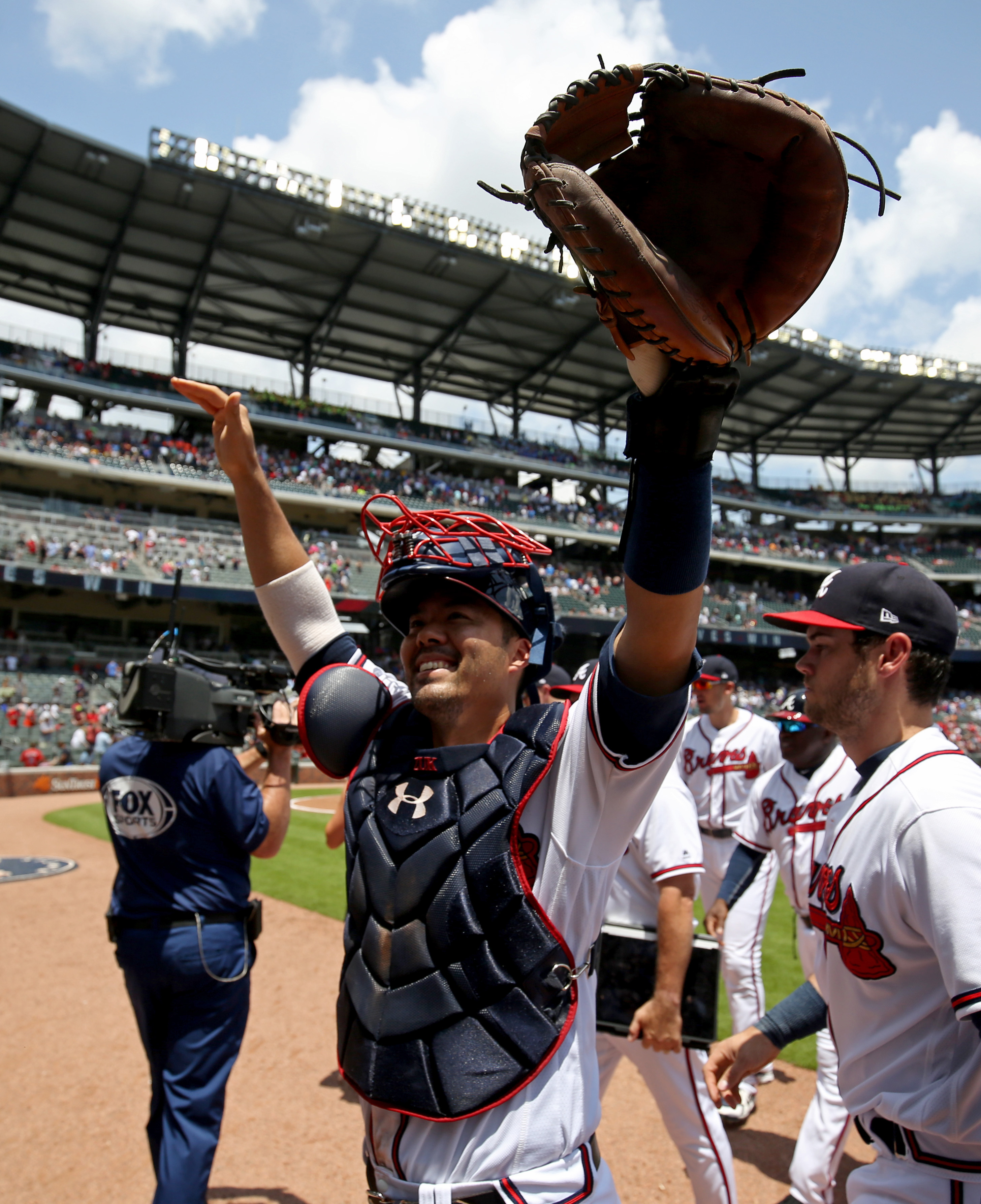
Long a sturdy option, the veteran Suzuki took his offensive game to new heights over the past couple of seasons, hitting at a .276/.341/.485 clip with 31 homers over the course of 697 plate appearances while sharing time with Tyler Flowers.
Unlike many players who experience a significant jump in power production, the 35-year-old Suzuki hasn’t simply “sold out” in terms of sacrificing his typically excellent contact rate for some additional pop. He’s fanned at just an 11.8 percent clip over the past two years — the ninth-lowest among all MLB hitters in that time (min. 600 plate appearances). Suzuki upped his hard-hit rate and homer-to-fly-ball ratio in significant fashion and will look to carry that improved production over to a return stint with the Nationals, for whom he played in 2012-13.
In Suzuki, the Nats will likely find an offensive upgrade over the production (or lack thereof) that they received from Matt Wieters over a previous two-year deal of his own. Getting some help behind the plate was imperative for the Nats, who saw Wieters and a slew of backup options combine to bat just .211/.290/.319 through 1259 plate appearances in 2017-18. Even with some regression in his bat — Nationals Park, notably, is not as hitter-friendly as SunTrust Park — Suzuki should be able to provide an uptick in offensive output at the position.
Defensively, Suzuki hasn’t generated the same level of results. His throwing improved with the Braves after a poor two-year stretch with Minnesota in that regard, but Suzuki’s 21.3 percent caught-stealing rate (25-for-117) over the past two seasons still checks in well below the league average of about 27.5 percent. To Suzuki’s credit, Baseball Prospectus has graded him among the best in the game at blocking pitches in the dirt over the past two seasons, but B-Pro has also rated his framing skills to be below-average in each season dating back to 2008.
It’s not yet clear if Suzuki will represent the Nationals’ sole addition at catcher. Solid as his bat was with the Braves, Suzuki averaged 85 games caught between the two seasons and hasn’t topped 100 games behind the dish since serving as the Twins’ primary backstop in 2015. Pedro Severino, Spencer Kieboom and Raudy Read represent the organization’s other three catching options on 40-man roster, and while any could conceivably serve as a backup to Suzuki, none has experienced big league success to date. Suzuki’s excellent production in 2017-18 should assure him of a prominent role in the Washington lineup, but the rest of the outfit still looks uncertain.
The addition of Suzuki is the third notable pickup in what has been an active offseason for Nationals general manager Mike Rizzo and his front office. The Nats have already acquired righty Kyle Barraclough from the Marlins in exchange for international bonus allotments, and Washington also rolled the dice on a one-year deal with former Cardinals closer Trevor Rosenthal, who’ll be returning from Tommy John surgery in 2019. Of course, the biggest question surrounding the Nats will be whether they retain former NL MVP Bryce Harper in free agency or if they let him sign with another organization. Certainly, the money promised to Suzuki on this new contract won’t stand as any real impediment to those efforts, but the Nats have holes to fill in the rotation and possibly at second base, as well.
As for the Braves, they won’t receive compensation for the loss of Suzuki, and they’ll now have to watch the former fan and clubhouse favorite suit up for one of their top division rivals. Atlanta already extended Flowers through the 2019 season, but it seems quite likely that they’ll be adding a catcher of some note to step up and handle a significant chunk — if not the vast majority — of playing time for the 2019 season.
Suzuki checked in 46th on MLBTR’s ranking of the Top 50 free agents this offseason, with an estimated two-year pact worth a total of $8MM. In our corresponding Free Agent Prediction Contest, just 3.87 percent of respondents correctly guessed that he’d return to the Nats.