
Miguel Sano Accused Of Assault
2:15pm: The Twins issued the following statement:
“Today the Minnesota Twins were made aware of allegations involving Miguel Sano at an offsite appearance during the 2015 season. The Twins, along with Major League Baseball, take these allegations very seriously. Until more information is gathered, the Twins will have no further comment.”
A short while later, Sano issued the following statement:
“I unequivocally deny the allegation made against me today — it never happened. I have the utmost respect for women, especially those working in professional sports, and I deeply sympathize with anyone who has experienced sexual harassment. There is no place for it in our society.”
12:53pm: Photographer Betsy Bissen has accused Twins third baseman Miguel Sano of assault, in a post on social media this morning. Bissen, a photographer who has covered Twins games and events, describes an incident in 2015 with Sano at an autograph signing. Bissen says Sano recognized her from Twins games she worked as a photographer. In her account, she describes how Sano flirted without reciprocation during the signing, and later “grabbed my wrist and made me go” with him, his agent, and her employer to an Apple Store. Bissen further describes the incident as follows:
“We spend around a half hour inside that store before it was time for him and his agent to leave. Their car was pulled around to a back hallway door. As we got outside, the athlete decided he needed to use the restroom. I asked my boss where it was and pointed to the door we just walked thru. Apparently I was too close, and the athlete took that as a signal that I wanted him to grab me and try to take me back thru that door.
I pulled back as he held onto my wrist. It hurt, how badly he was grasping at my wrist, but he wouldn’t let go. I wasn’t going to give up my fight though. He then leaned down and tried to kiss me, more than once. Every time he did, I said no and kept pulling back. I was in a squatted position with my wrist throbbing. I screamed, no one came to help me. He finally gave up after a solid ten mins of fighting to pull me thru that door. I don’t even want to think of what he may have done, had he got me thru that door. No, he didn’t rape me, but he sure did assault me. When I said no, it should have been the end of it. He should have respected that and stopped. Instead, he hurt me and kept going.
The next day, my body was sore all over from having to fight off this athlete that thought he was entitled to take advantage of me against my will.”
MLB and the players’ union agreed to a domestic violence, sexual assault, and child abuse policy in August 2015. It seems likely that MLB will investigate this incident, which could result in a suspension for Sano. It appears the Twins may just be learning about this incident. This year’s #metoo movement seems to have compelled Bissen to share her story publicly. I asked Bissen in a Twitter message whether she would cooperate with MLB if they contact her, and she replied, “If they do, I will cooperate. I honestly don’t want anything from this other than to feel free from what happened to me.”
Astros, Rangers Reportedly Set To Meet With Yu Darvish
DEC. 24: The Rangers remain in contact with Wolfe, writes Wilson, who adds that Darvish hasn’t ruled out a reunion with the club. However, it’s up in the air whether Rangers ownership would pay the necessary amount to bring back Darvish, Wilson suggests.
DEC. 19, 10:35pm: Wilson reports that Darvish and Daniels are planning to have dinner this week, but Darvish’s agents will not be in attendance and the two do not plan to discuss business. The two are simply having dinner, per Wilson, adding that Daniels has continually maintained the stance that Texas will not play at the top of the free-agent market. The dinner was actually planned for November but was pushed back to this point. Darvish himself confirmed as much by quote-tweeting Wilson and adding the comment, “Tomorrow night!”
Evan Grant of the Dallas Morning News reports the same sentiment, noting that Daniels and Darvish never had much of a chance to have a conversation when Darvish was traded to the Dodgers. Grant likens the meeting to an “exit interview” and emphasizes that Darvish’s lead agent, Joel Wolfe, will not be present.
All of that said, it’s still a bit of an eyebrow-raiser to see Daniels, whose rotation is rife with uncertainty, meet with the top free-agent pitcher on the market under the guise that no business will be discussed.
6:41pm: Darvish is set to meet with the Rangers after he sits down with the Astros, a club source tells Jim Bowden of MLB Network Radio on SiriusXM (Twitter link). That seemingly runs counter to what GM Jon Daniels told Jeff Wilson of the Fort Worth Star-Telegram earlier today, as Wilson tweeted that Daniels said there was no meeting planned with Darvish at that point.
Obviously, the Rangers are more familiar with Darvish than any other club, and there’s certainly a need in their rotation. Texas has added Mike Minor as a potential starting option this winter and has also swung a trade for Matt Moore and signed Doug Fister. Still, there’s room for improvement among a shaky group of Texas starters.
What remains to be seen, though, is exactly how much payroll capacity the Rangers have remaining. Texas is reportedly aiming for its 2018 payroll to come in around the $155MM mark, and signing Darvish would almost certainly take them beyond that point, barring a heavily backloaded deal.
The Rangers could see a substantial amount of cash come off the books after the 2018 season, depending on Cole Hamels‘ option and Elvis Andrus‘ opt-out provision, but a long-term Darvish deal would likely mean boosting their commitments for 2020 season north of $85MM. Certainly, finding a taker for Shin-Soo Choo‘s albatross contract would alleviate some of that crunch, though that’s a daunting proposition for the Texas front office.
5:00pm: One day after Yu Darvish reportedly met face-to-face with the Cubs, he’s sitting down for a similar meeting with the Astros, Jon Heyman of FanRag Sports reports. Houston joins the Cubs and Twins as teams that have now been prominently linked to Darvish, who topped MLBTR’s free agent rankings at the beginning of the offseason. The Rangers, Heyman writes, are “monitoring” the Darvish market.
The Astros, of course, got an up-close look at Darvish for years when he fronted the division-rival Rangers’ rotation and when they clobbered him in a pair of World Series starts. Though that rough pair of outings was obviously a sour note upon which to end an otherwise solid season, the tiny sample of two starts against a powerhouse offense isn’t likely to alter his perception much among big league teams. (Notably, one unnamed Astros player revealed to Sports Illustrated’s Tom Verducci that Darvish was tipping his pitches in both World Series outings.)
Houston isn’t exactly in dire need of a rotation upgrade, as their current group of Justin Verlander, Dallas Keuchel, Lance McCullers, Charlie Morton and Brad Peacock is already strong. Houston also still has Collin McHugh as an option for the back end of the rotation as well as a number of upper-level prospects (e.g. Francis Martes, David Paulino) that could eventually emerge as rotation options.
That said, adding Darvish to a rotation that already includes Verlander, Keuchel, McCullers and Morton would make for a potent starting five. Peacock thrived in a multi-inning relief role on multiple occasions in 2017 and could function in a similar capacity in 2018, should the ‘Stros ultimately elect to add a significant arm to their rotation. Picking up Darvish could also bode well for the club in the long term, as both Keuchel and Morton are set to become free agents at the conclusion of the 2018 season.
From a pure payroll standpoint, Houston can certainly absorb a significant multi-year deal. The Astros do have just shy of $150MM committed to the 2017 payroll (including projected arbitration salaries), but that number plummets to $56MM on the books for 2019 when Keuchel, Morton, Evan Gattis, Tony Sipp and Marwin Gonzalez are all eligible for free agency.
[Related: Houston Astros depth chart and payroll outlook]
The ‘Stros will no doubt look to lock up Jose Altuve beyond the 2019 campaign, when their control over the 2017 AL MVP runs out, though, and they probably want to keep George Springer around beyond 2020 as well. Those will be considerations when deciding whether to offer a long-term deal to any high-priced free agent, though it’s worth pointing out that Houston only has $21.5MM committed to the 2020 roster at present and does not have a single guaranteed contract for the 2021 season on its current books.
Indians Sign Yonder Alonso
Dec. 23, 10:32am: Jordan Bastian of MLB.com provides some additional details on Alonso’s 2020 option. It’s reportedly a $9MM vesting option that vests following a successful physical after 2019, on the added condition that he makes 550 trips to the plate during the 2019 season, or accumulates 1,100 PA combined across the 2018-2019 campaigns. In line with previous reports, the option becomes a $9MM club option with a $1MM buyout if the vesting criteria aren’t met.
9:32am: The Indians have officially announced the signing.
Dec. 21: MLB.com’s Mark Feinsand tweets that Alonso will earn $7MM in 2018 and $8MM in 2019. The vesting/club option comes with a $1MM buyout.
Dec. 20, 8:55pm: It’s a two-year deal that comes with a $16MM guarantee, according to Ken Rosenthal of The Athletic (Twitter link). There’s also an $8MM vesting option for a third season.
8:38pm: The Indians have agreed to a deal with free-agent first baseman Yonder Alonso, reports Bob Nightengale of USA Today Sports (via Twitter). Alonso is a client of MVP Sports.
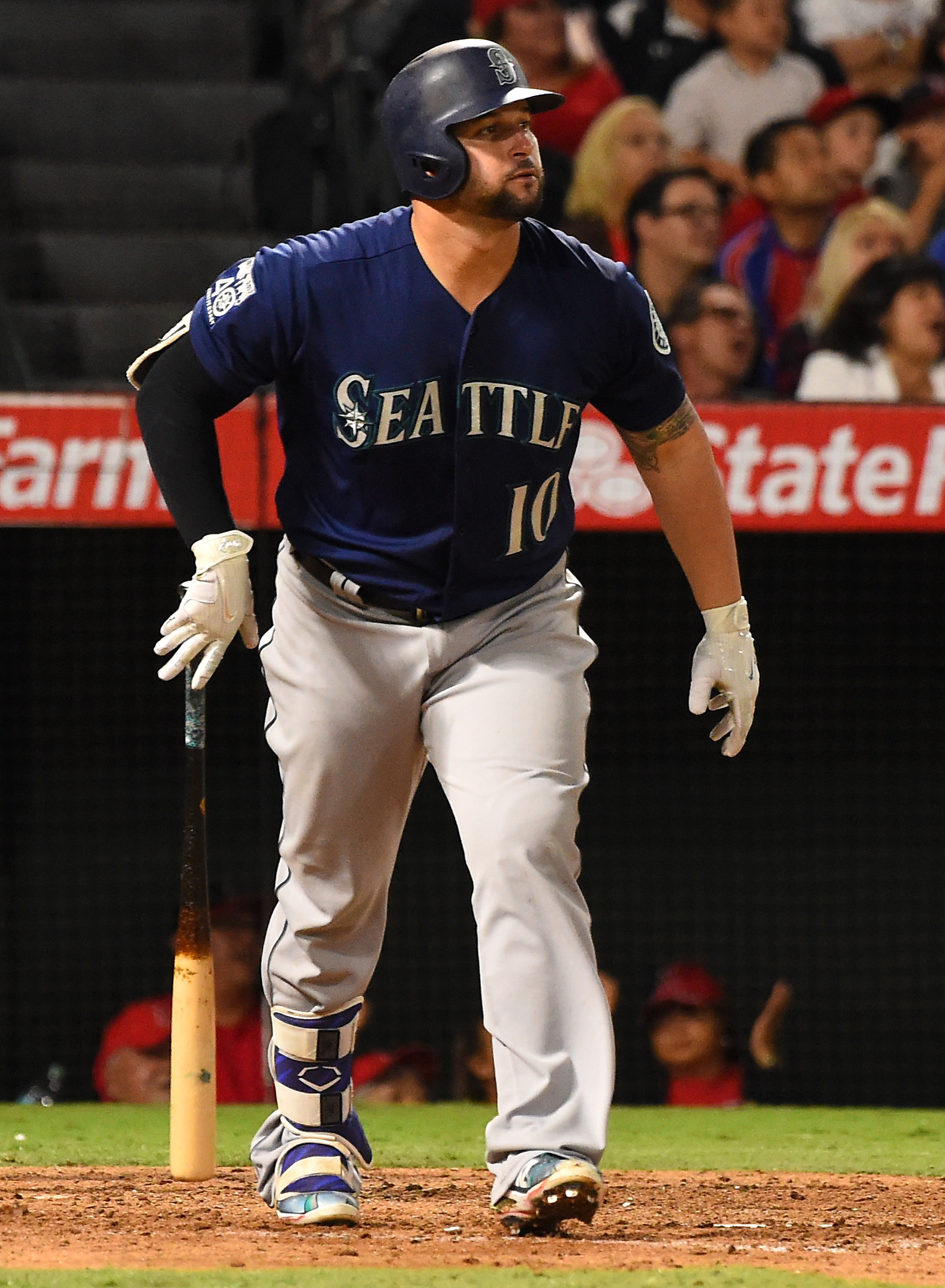
Alonso, 31 in April, will step into the void that was created when longtime Indians first baseman Carlos Santana signed a three-year, $60MM contract with the Phillies. The former first-round pick and top prospect just wrapped up a career year in which he slashed .266/.365/.501 with a personal-best 28 home runs — shattering his previous highwater mark of nine long balls in a season. That quality season landed him 22nd on MLBTR’s list of the top 50 free agents, with a prediction of a two-year, $22MM contract.
Alonso was, for much of the 2017 season, the poster boy for the “fly-ball revolution,” as he made a concerted effort to lift the ball and experienced great success with that newfound approach in the season’s first half. Through 298 plate appearances prior to the All-Star break, Alonso sported a 48.7 percent fly-ball rate and batted a hefty .275/.372/.562 despite playing his home games in Oakland’s cavernous Coliseum. Alonso’s fly-ball rate fell to 36.1 percent in a second half that was far more pedestrian, though his post-break output of .254/.354/.420 was still generally solid.
Overall, Alonso’s average exit velocity (89.2 mph) was comfortably among the top quarter of hitters in the league (min. 100 batted ball events), and his 36 percent hard-contact rate ranked 47th among 144 qualified MLB hitters. That uptick in power for Alonso came at the cost of his previously excellent contact skills, as he whiffed in a career-worst 22.6 percent of his plate appearances this past season (though that mark comes in barely north of the league average 21.2 percent for non-pitchers). Even if there’s some regression in terms of his power, Alonso has long shown a penchant for getting on base, with a career walk rate just under 10 percent — including a strong 13.1 percent walk rate in 2017.
Of course, while Alonso enjoyed a terrific overall year at the plate in ’17, he’s not without his warts. His strong offensive production was in some part due to the fact that both the A’s and Mariners shielded him from facing left-handed pitching; Alonso absolutely clobbered righties (.283/.384/.519) but struggled to hit for average and get on base against fellow lefties, as evidenced by a .181/.263/.417 slash in just 72 plate appearances. In his career as a whole, Alonso has batted just .234/.303/.349 against same-handed opponents.
[Related: Updated Cleveland Indians depth chart]
On the plus side for Cleveland, they have a ready-made platoon partner in the form of Edwin Encarnacion. While Encarnacion will obviously be in the lineup on a regular basis as the team’s DH, he can also shift to first base on days when the Indians face a left-handed starter, should skipper Terry Francona ultimately decide to keep Alonso out of the lineup for those matchups. That’d free the DH slot to keep other regulars fresh, or it could allow the Indians to sign a right-handed-hitting outfielder/first baseman to occupy a reserve role on the bench.
Cleveland currently has righty bats Brandon Guyer, Erik Gonzalez and Giovanny Urshela ticketed for bench spots, though president of baseball operations Chris Antonetti, GM Mike Chernoff and the rest of the staff may yet look to augment the team’s stock of reserve options.
As far as his defense is concerned, Alonso doesn’t stack up to the stellar work that Santana provided in 2017. Alonso rated as an above-average defender at first base per both Defensive Runs Saved and Ultimate Zone Rating each season of his career up until the 2016 campaign. Both metrics pegged him slightly below average in ’16, and while UZR had him only slightly below average again in 2017 (-2.8), DRS graded him out at -9.
Alonso becomes the fourth first baseman to come off the board in the past week — the latest domino in a market for position players that is slowly beginning to pick up after a largely stagnant offseason. Beyond the agreements for Alonso and Santana, the Red Sox announced yesterday that they’ve re-signed Mitch Moreland on a two-year deal, while the Nationals earlier today reportedly agreed to terms on a one-year deal with Matt Adams. With that group now off the board, Eric Hosmer, Logan Morrison and Lucas Duda are the most notable names remaining on the free-agent market for first basemen.
Photo courtesy of USA Today Sports Images.
Diamondbacks Sign Yoshihisa Hirano
The Diamondbacks have dipped into the Japanese market in an effort to bolster their bullpen, announcing on Friday a two-year contract with right-handed reliever Yoshihisa Hirano. The deal will reportedly guarantee Hirano $6MM in total — $3MM annually plus another $1MM worth of available incentives each season. Left-hander Henry Owens was placed on outright waivers to clear room for Hirano, and he’s already been claimed by the division-rival Dodgers.
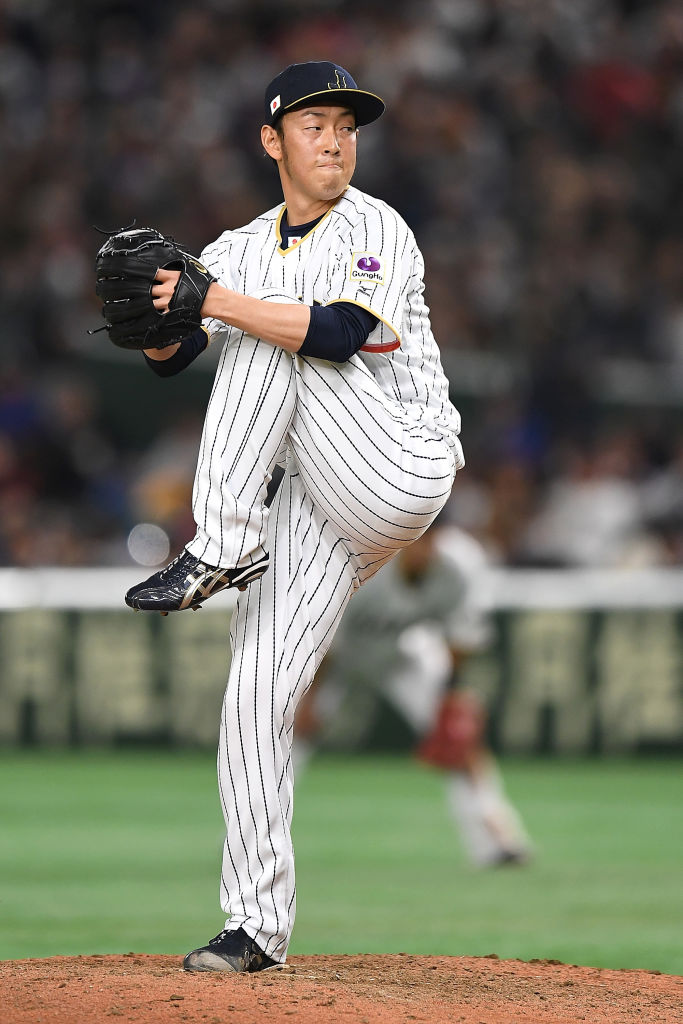
Hirano, 34 in March, has long been a dominant closer in Japan, amassing 143 saves with a 2.62 ERA, 9.4 K/9 and 2.4 BB/9 through 271 1/3 innings for the Orix Buffaloes from 2013-17. Because of his age and his professional experience in Nippon Professional Baseball, Hirano is exempt from both international bonus pools and the NPB/MLB posting system.
The D-backs weren’t prominently linked to Hirano prior to the agreement, though he’d reportedly drawn interest from multiple MLB clubs, including the Dodgers, Tigers and Cardinals. Jim Allen of the Kyodo News tweets that in speaking to big league scouts at the Winter Meetings, there was a consensus that while Hirano’s velocity is down from its peak earlier in his career, his splitter will still play in the Majors. Meanwhile, the Arizona Repbulic’s Nick Piecoro tweets that scouts to whom he’s spoken peg Hirano’s velocity in the 90-94 mph range and also credit him with a plus splitter and good deception in his delivery.
Fernando Rodney, who served as Arizona’s closer throughout the 2017 season, recently signed with the Twins, subtracting one late-inning arm from what was, on the whole, a generally successful group in 2017. Arizona also bid farewell to veteran lefty Jorge De La Rosa and righty J.J. Hoover this offseason, who soaked up a combined 92 2/3 innings out of the ‘pen — further creating a a need to add some innings to the back of the relief corps.
[Related: Updated Arizona Diamondbacks depth chart and payroll outlook]
While it’s a stretch to assume that Hirano will simply be handed the closer’s role in Arizona right out of the gate, there’s no clear-cut ninth-inning presence for the Diamondbacks at present. Hirano will likely compete with Archie Bradley and others for that distinction this spring, and it’s not out of the question that he could find himself in save opportunities later in the year, even if he doesn’t win the job out of camp.
The D-backs are already headed for a record payroll in 2018, though Hirano’s contract will only modestly bump the current $126MM projection ever so slightly north. That said, it doesn’t seem especially likely that they’ll be particularly aggressive spenders on the free-agent market between now and Opening Day.
While they’re fresh off an NLDS appearance and are entering into the first season of a new television contract said to be worth more than one billion dollars, the D-backs aren’t merely setting a new record payroll — they’re shattering their previous high point. Arizona is on track for a near-$30MM payroll increase over its 2017 Opening Day mark and an increase of roughly $17MM over its previous franchise high. Arizona has only opened a season with a payroll north of $100MM once in its history (2014) and has averaged a $93MM Opening Day payroll over the past three seasons.
Jim Allen of the Kyodo News first suggested that Hirano could be headed to the D-backs (Twitter link). Nick Piecoro of the Arizona Republic reported there was an agreement in place and provided financial details (Twitter links). USA Today’s Bob Nightengale tweeted that he’d get a multi-year deal and added the annual breakdown as well.
Photo courtesy of Getty Images.
Pirates Reportedly “Motivated” To Move Gerrit Cole
10:19am: Joel Sherman of the New York Post reports (via Twitter) that the Yankees would also likely balk at including either of Justus Sheffield or Estevan Florial in a package for Cole. Sherman suspects that any package would be structured around Clint Frazier and Chance Adams.
10:07am: Feinsand tweets that there’s been no change since this morning, reporting that the two sides aren’t close to a deal. Like Heyman and Bowden (as well as the YES Network’s Jack Curry), Feinsand adds that the Yankees have no plans to trade Torres.
9:45am: Jim Bowden of MLB Network Radio on SiriusXM now tweets that the Pirates and Yankees are close to a deal that would send Cole to New York. Torres is not a part of those talks, according to Bowden.
Dec. 22, 8:17am: Both Feinsand and Heyman throw some cold water on the talks with the Yankees, as Feinsand now hears that the advancement in talks last night may have been “overstated.” Heyman notes that there’s no positive momentum in talks between the two sides at this time.
Dec. 21, 9:49pm: Passan adds more context in a full column, reporting that the Yankees are “hopeful” that they can entice the Pirates to agree to a deal that does not include Torres, who is the leading candidate to succeed Starlin Castro as the everyday second baseman in the Bronx. Passan suggests that Cole could very well be traded before Christmas and adds that the Pirates may also market McCutchen as they prepare for a rebuilding effort.
8:59pm: MLB.com’s Mark Feinsand tweets that talks between the Yankees and Pirates are “getting hot,” though he notes that it remains unclear if a deal is on the verge of completion.
8:24pm: FanRag’s Jon Heyman tweets that the primary sticking point in talks has been that the Yankees want to headline a package for Cole with Frazier, while the Pirates want Torres to be the headliner.
8:08pm: The Pirates and Yankees are again discussing a trade that would send right-hander Gerrit Cole to New York, according to Jeff Passan of Yahoo Sports (Twitter links). While there’s been plenty of trade talk surrounding Cole this winter, Passan now reports that the Pirates are “motivated” to get a deal done and there’s a “very strong”likelihood that he’ll be traded.
The Yankees, according to Passan, are the likeliest landing spot for Cole, with one source telling him that it’s a matter of “when” a trade will ultimately be agreed upon rather than a matter of “if.”
Talks between the Bucs and Yanks have been ongoing, to some extent, since the Winter Meetings at the least, though The Athletic’s Ken Rosenthal reported earlier this week that those negotiations had “cooled” to some extent. The Pirates at one point were said to have been pushing for Gleyber Torres to be included in the deal, though it’d be tough for the Yankees to part with the touted young infielder. Other names that have been mentioned in rumors include young outfielder Clint Frazier and right-hander Chance Adams, though the permutations of the current talks remain unreported.
Cole, 27, is controlled for another two years and comes with a projected arbitration salary of $7.5MM, per MLBTR contributor Matt Swartz. He’d give the Yankees another high-octane arm to add to the top end of a rotation that also includes Luis Severino, Sonny Gray, Masahiro Tanaka, CC Sabathia and Jordan Montgomery at present. Certainly, that strong group and the presence of Adams and Justus Sheffield in the upper minors presents the Yankees with an enviable stock of starters, but Cole, a former No. 1 overall pick, also comes with a Cy Young caliber season on his resume and stands out as a nice rebound candidate on the heels of a down season (by his standards).
Cole was one of just 15 pitchers to top 200 innings in 2017, and in his 203 frames he averaged 8.7 K/9 and 2.4 BB/9 with a 45.8 percent ground-ball rate and a fastball that averaged 96 mph. A huge spike in Cole’s HR/9 rate (from 0.54 in 2016 to 1.37 in 2017) led to a bloated 4.26 ERA, but he also maintained an ability to miss bats, limit walks and keep the ball on the ground. All of those trends point to the possibility of a return to form, though moving to the AL East (and, specifically, Yankee Stadium) isn’t necessarily a great recipe to cut back on one’s home run rate.
If Cole is ultimately traded, the question then becomes just how far the Pirates will go in terms of selling off veteran assets. Josh Harrison and Andrew McCutchen have both been oft-mentioned trade candidates this winter — speculatively speaking, Harrison could hold appeal to the Yankees — with each becoming increasingly expensive and moving closer to free agency. McCutchen will hit the open market next offseason, while Harrison is controlled through 2020 by virtue of a pair of club options but is now commanding $10MM+ per season.
Download Our Free Trade Rumors App
MLB Free Agents – 2017-18 Updated Tracker
Here at MLB Trade Rumors, we’ve been following the hot stove religiously since 2005. MLB free agents have seen a delayed market that may play out largely in the new year, with players such as Yu Darvish, Jake Arrieta, and Eric Hosmer still looking for homes. For anyone looking to keep tabs on who’s signed and who’s still out there, our tracker for MLB free agents is the best on the Internet. It’s constantly updated and lets you filter by tons of criteria, including team, position, signing status, handedness, qualifying offers, years, amounts, and option types. Check it out today!
Brewers Sign Jhoulys Chacin
TODAY: The contract is now official. It’s for $15.5MM, reports Jon Heyman of FanRag Sports (Twitter links), with a $1.5MM signing bonus and consecutive salaries of $8MM and $6MM.
YESTERDAY, 1:49pm: The sides are working to finalize a two-year pact for something approaching $8MM annually, per ESPN.com’s Jerry Crasnick (Twitter links). That’s right around the contract value that MLBTR suggested entering the winter.
11:19am: The Brewers are closing in on a contract with free agent righty Jhoulys Chacin, according to Ken Rosenthal of The Athletic (via Twitter). Terms of the prospective deal are not known at this time. Chacin is a client of the Legacy Agency.

Chacin, 30 next month, is fresh off one of the best seasons of his career, having notched a 3.89 ERA with 7.6 K/9, 3.6 BB/9 and a 49.1 percent ground-ball rate over the life of 180 1/3 innings with the Padres, who signed him to a modest one-year commitment last offseason. Chacin’s strong output in 2017 positions him to handily top the $1.75MM guarantee he received in San Diego last winter. He’d join a Brewers rotation that will be without top starter Jimmy Nelson for a yet-undetermined portion of the 2018 campaign following September shoulder surgery.
Assuming the deal is ultimately completed, Chacin will join Chase Anderson and Zach Davies in the Milwaukee rotation, with Josh Hader, Brent Suter, Brandon Woodruff and Junior Guerra among the other candidates vying for opportunities to start. Chacin may not bring significant upside to the table, but he’s been a durable mid-rotation arm over the past two seasons and should help to stabilize a group that carried significant questions about the number of innings it could be reasonably expected to provide to manager Craig Counsell.
Chacin’s solid 2017 season did produce its fair share of skeptics — most notably owing to his significant home/road splits. In 100 1/3 innings at the pitcher-friendly Petco Park, Chacin logged a sensational 1.79 ERA, but that number spiked to a ghastly 6.59 in 80 road innings. Chacin also dominated right-handed hitters to the tune of a .213/.284/.318 opponents’ slash line, while lefties posted a much more adept .251/.356/.433 slash against him.
The move to a more hitter-friendly Miller Park, then, will undoubtedly raise some questions. However, Chacin enjoyed success earlier in his career in the game’s worst pitching environment, Coors Field, and he’s long limited home runs better than the average pitcher. Despite spending parts of six seasons in Colorado and despite the recent uptick in homers throughout the league, Chacin has averaged just 0.85 HR/9 as a big leaguer.
Newer metrics paint Chacin in a favorable light, as well; Statcast pegs Chacin’s average exit velocity on balls in the air (91.3 mph) and overall exit velocity (85.4 mph) among the weakest in the game for qualified pitchers. His .303 xwOBA, while not elite, places him alongside names like Danny Duffy, Jake Arrieta and Madison Bumgarner. That’s not to say, of course, that Chacin should be expected to produce at comparable levels to those three starters, but rather that his solid results and overall penchant for weak contact could be more conducive to success than his surface-level home/road splits would suggest.
Photo courtesy of USA Today Sports Images.
Giants Acquire Evan Longoria
10:04pm: The Associated Press reports that the Rays will pay $14.5MM to the Giants and are responsible to the $13MM that is yet owed to Span. Specifically, the Rays will pay $2MM to the Giants by the end of 2017 to cover Longoria’s $2MM trade bonus, and they’ll also pay another $3MM by Oct. 31, 2022. The remaining $9.5MM, per the AP report, will be deferred in payments from 2025-29.
In essence, then, the Giants are adding $60.5MM to their long-term ledger in order to acquire the final five years of Longoria’s contract. Moreover, it doesn’t appear that San Francisco will take much of a hit at all in terms of the luxury tax. So, when paired with the shedding of Matt Moore’s contract, the move should afford the team ample opportunity to add at least one outfielder on a multi-year deal while remaining comfortably south of the $197MM luxury tax threshold.
7:30pm: Marc Topkin of the Tampa Bay Times reports (via Twitter) that the Rays will send between $10MM and $15MM to the Giants to cover a portion of Longoria’s remaining $86MM as well as a $2MM trade bonus.
11:51am: The Rays and Giants have agreed to a deal that will send Evan Longoria to San Francisco. Young infielder Christian Arroyo headlines the return, with veteran outfielder Denard Span going along with him to offset some of Longoria’s salary. Young pitchers Stephen Woods and Matt Krook are also bound for the Tampa Bay organization.
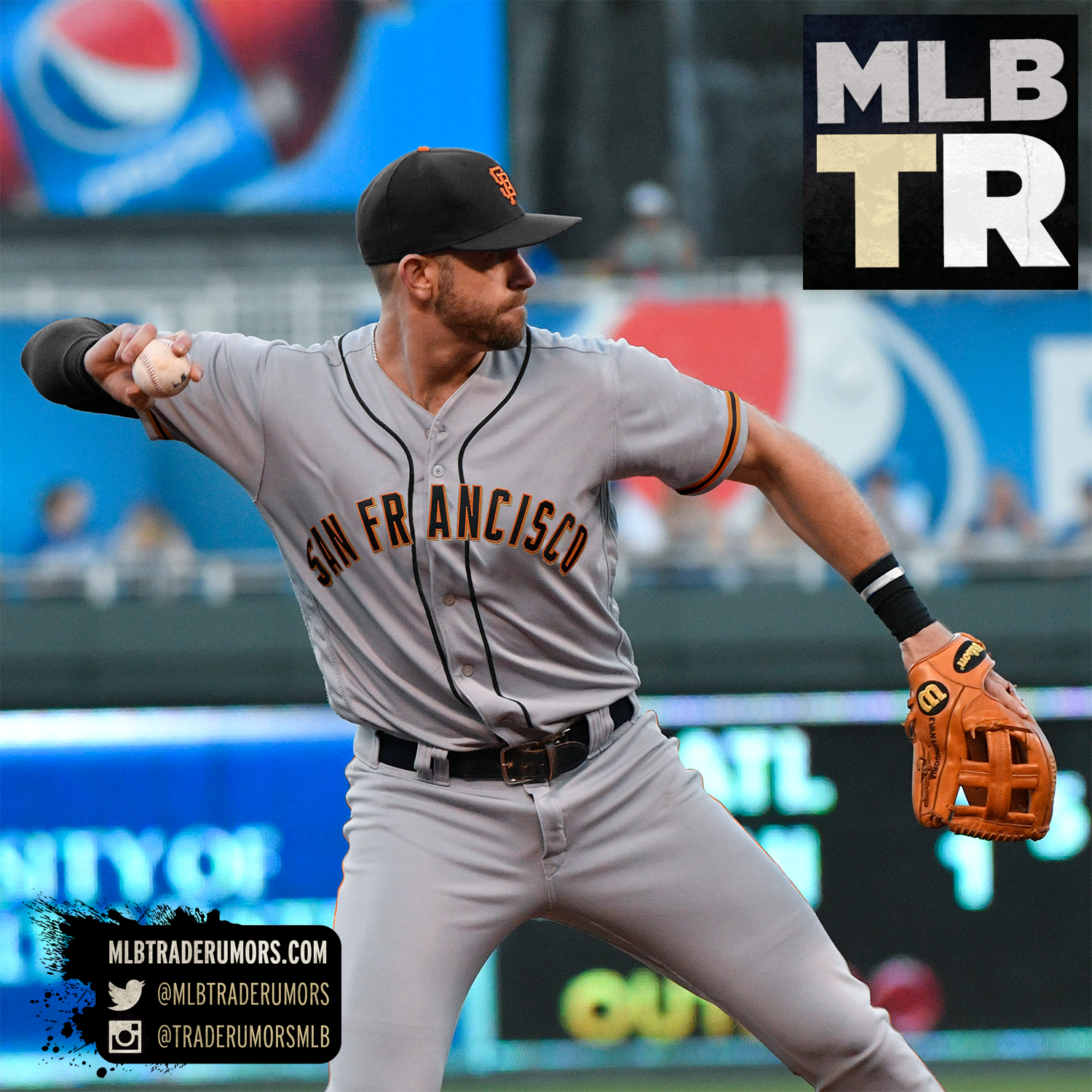
In addition to taking on Span’s contract, Tampa Bay will ship an as-yet-unknown amount of money to the Giants. The 32-year-old Longoria is owed another $86MM between now and 2022, including a $5MM buyout on a $13MM option for the 2023 campaign. He will also receive a $2MM assignment bonus.
Just how much of that will end up on the Giants’ books remains to be learned. The precise cash exchange has yet to be reported. Plus, there’s a bit of uncertainty surrounding Span’s future obligations. He is owed $9MM for 2018, along with a $4MM buyout of a $12MM mutual option for the ensuing season. Those obligations seem destined for San Francisco, but it’s not yet clear what’ll happen with the remaining $3MM signing bonus payment owed to Span in one month.
For both organizations, there’s quite a bit of risk in a transaction involving Longoria. The Giants are taking on a high-priced player who struggled to a career-low .261/.313/.424 batting line in 2017 — adding to a collection of costly, aging veterans. But the Rays are parting with the long-time face of the franchise.
If Longo can bounce back, the rewards could be significant. His days of top-level offensive production are likely in the past, but Longoria was a .273/.318/.521 hitter as recently as 2016, when he also swatted 36 home runs. Of course, that followed two less-than-excellent campaigns, so the overall trajectory of late has framed Longoria more as a solidly above-average hitter than an excellent one.
That said, it’s important to bear in mind that Longoria has also long delivered value with his glove. Though Defensive Runs Saved had observed a downturn of late, it credited him with a substantial bounceback (+11 runs) in 2017. Despite the tepid offensive output, then, Longoria contributed 3.6 rWAR and 2.5 fWAR in 2017.
In return for Longoria, the Rays will get not only salary relief but also some young talent. Arroyo is the chief piece here. He had a messy MLB debut and missed time due to injury in 2017, but is only 22 years of age and destroyed Triple-A pitching in a limited sample in the just-completed campaign. In the best-case scenario for the Rays, Arroyo may be able to compete for a job out of camp.
Span’s inclusion is mostly about cost. Still, he remains a useful player even as he closes in on his 34th birthday. In 2017, Span slashed .272/.329/.427 with a dozen home runs over 542 plate appearances. Though he’s no longer really capable of regular time in center and has battled through core and hip injuries in recent years, Span ought to be capable of at least average work in a corner spot and has long been a productive baserunner.
Padding the return here for the Rays are a pair of interesting young arms. As Eric Longenhagen of Fangraphs tweets, both have quality stuff that still remains to be harnessed. The 22-year-old Woods just threw 110 innings of 2.95 ERA ball at the Class A level, with 9.2 K/9 against 5.2 BB/9. The righty is considered a relief prospect, as is the left-handed Krook, who will play the coming season at 23 years of age. Krook was unsigned as a first-round pick in 2013 and landed with the Giants as a fourth-rounder in 2016. Over his 91 1/3 frames at High-A in the just-competed season, Krook worked to a 5.12 ERA with 10.3 K/9 and 6.5 BB/9.
For the Rays, this move may be a precursor to further action. The club has been in talks on closer Alex Colome all winter. Many anticipate the team will trade a starter, with star Chris Archer representing the most intriguing possibility. Replacing Longoria with Arroyo means there’s arguably still some excess infield depth to work from. And Span could either be used as a part-time player or sent elsewhere to realize further cost savings.
The Giants, meanwhile, still have needs and will be looking to fill them without going over the luxury tax line. It seems this swap won’t impact their spending capacity too significantly, since the average annual values of the two contracts involved aren’t too far apart. But the move takes one outfielder out of the equation while filling the gap at third, possibly leaving the Giants still searching for both a center and corner piece.
Marc Topkin of the Tampa Bay Times first reported Longoria was going via trade (via Twitter). Jeff Passan of Yahoo Sports (links to Twitter) and Robert Murray of Fan Rag (via Twitter) reported the other pieces involved. Murray was first to note on Twitter that the sides had struck a deal, with Jon Morosi of MLB Network (Twitter link) and Ken Rosenthal of The Athletic (Twitter link) mentioning the key names involved.
Photo courtesy of USA Today Sports Images.
Mets, Sandy Alderson Agree To New Contract
The Mets announced that general manager Sandy Alderson has signed an extension of undisclosed length with the team. “I’m excited that Sandy will continue to lead the organization,” Mets COO Jeff Wilpon says in a press release announcing the extension. Previous reports had indicated that Alderson was likely to sign agree to a new two-year deal following the expiration of his previous contract, which ran through the end of 2017.
“I feel that we have some unfinished business,” says Alderson. “Spring Training is around the corner and our quest to return to the postseason will continue.”
The 70-year-old Alderson is entering his eighth season as general manager of the Mets, having been first appointed to the post as the successor to Omar Minaya after the conclusion of the 2010 campaign. Alderson’s Mets have posted winning records in just two of his seven years at the front office’s helm, though one of those positive seasons was a 90-win effort that saw the Mets advance to the World Series against the Royals in 2015. The Mets advanced to the postseason the following year as well, though quickly ousted by the Giants in the National League Wild Card game.
While Alderson takes his fair share of flak from the Mets’ faithful — some of it deserved — an extension has been rumored to be in the works for awhile now, and he’s made plenty of quality moves to better position the team for success. Alderson was in the GM’s chair when the Mets traded half a season of Carlos Beltran for then-prospect Zack Wheeler, and he opted trade R.A. Dickey to the Blue Jays in a package that netted Noah Syndergaard and Travis d’Arnaud rather than extend Dickey on the heels of his NL Cy Young victory. Alderson was also the top decision-maker when the Mets traded for and twice re-signed Yoenis Cespedes. Other, lower-profile moves such as opting to keep Lucas Duda over Ike Davis when the Mets had a pair of young, MLB-ready first base options also proved shrewd.
Of course, like any top-level baseball executive, Alderson has had his share of misses in his tenure. Allowing Daniel Murphy to walk and sign with the division-rival Nationals stands out perhaps chief among some missteps for the organization, and the 2017 season in general devolved into somewhat of a circus due to rampant injury issues and poor communication (both with the media and, reportedly, internally as well). Among the most eye-opening issues was the fact that Syndergaard reportedly declined a request to undergo an MRI just days before pitching and ultimately being diagnosed with a partially torn lat muscle.
The Mets are oft-criticized by the New York media for their failures to spend like a large-market powerhouse, though much of that is out of Alderson’s hands. Newsday’s Marc Carig, for instance, recently reported that Alderson and his front office often had to enter the offseason “flying blind,” with little to no information from ownership as to the level at which they’ll be able to spend. The Wilpons drew plenty of criticism over the summer amid the Mets’ medical turmoils, with ESPN’s Jerry Crasnick reporting back in May that Jeff Wilpon “meddles” to a considerably greater extent than most owners.
It remains to be seen exactly how long Alderson will remain at the helm, though Kristie Ackert of the New York Daily News reported back in October that assistant GM John Ricco could be in line to succeed Alderson, whether that happens at the conclusion of the 2019 season or further down the line.