
Astros Not Planning To Trade Jake Meyers
Chatting with reporters from the Winter Meetings, Astros general manager Dana Brown indicated this evening that the team is planning to give Jake Meyers and Chas McCormick regular outfield run (relayed by Ari Alexander of KPRC 2). Meyers will get the first shot at holding down the center field job, while McCormick is expected to play primarily in left field.
It’s a more notable announcement with regard to Meyers. MLB.com’s Jon Morosi suggested a couple weeks ago that the Astros were discussing the 27-year-old in trade talks. Brown downplayed that possibility, acknowledging that while the club received some calls on Meyers, they have no interest in moving him.
Entering the season with Meyers atop the center field depth chart is a fairly risky play for a team that intends to compete for a division title. The Nebraska product hasn’t provided much offensively over parts of three big league campaigns. He’s a career .235/.296/.379 hitter. Meyers ran a similar .227/.296/.382 batting line in a personal-high 347 plate appearances last season. He hit 10 homers but posted worse than average walk (7.6%) and strikeout (25.8%) rates.
While Meyers hasn’t been much of a factor with the bat, he has played very well on the other side of the ball. Public metrics grade him as a plus defender in center field. In just under 1500 career innings at the outfield’s most demanding position, he has rated 12 to 18 runs better than average by measure of Defensive Runs Saved and Statcast.
The Astros are evidently sufficiently pleased with Meyers’ glove to pass on whatever trade overtures they’ve received. That moves McCormick to left field on most days, although Brown suggested McCormick would still see some work up the middle as needed. While the 28-year-old has yet to tally 500 plate appearances in any MLB season, he has been consistently excellent when plugged into the lineup. McCormick posted a .273/.353/.489 slash with 22 homers over 457 plate appearances a season ago.
Kyle Tucker is entrenched in right field. It seems the Astros are content with a McCormick, Meyers, Tucker outfield alignment on most days, with Yordan Alvarez rotating between left field and designated hitter. Mauricio Dubón is on hand as a utility option who can cover center field off the bench. That aligns with prior comments from Brown, who has consistently suggested he doesn’t view the outfield as a significant offseason priority.
Jed Hoyer Denies Cubs Are Out On Shohei Ohtani
Earlier today, a report from Bob Nightengale of USA Today said that the Cubs were falling out of the bidding for Shohei Ohtani, saying that their “optimism of landing Ohtani has now significantly waned.” However, the club’s president of baseball operations Jed Hoyer denied that framing at the Winter Meetings. “I don’t know where that came from,” Hoyer said to Maddie Lee of the Chicago Sun-Times. “There’s no nothing to report whatsoever.”
The Ohtani sweepstakes have been notably unusual since he and his camp reportedly prefer a shroud of secrecy over the proceedings. Reporting appears to indicate that the field is down to five clubs: The Dodgers, Angels, Blue Jays, Cubs and Giants. Ohtani is “believed” to have met with the Jays recently and there were “indications” of a meeting with the Giants prior to that. Dodgers manager Dave Roberts decided not to play the cloak-and-dagger games, straight up admitting that his club recently met with Ohtani.
Overall, information has been tougher to come by than a typical free agency, but Hoyer felt compelled to address today’s reporting. He said they have not been given a “status check” from Ohtani’s reps but wouldn’t discuss the club’s interest beyond that. Earlier today, manager Craig Counsell was asked about having meetings with Ohtani and replied “I have not,” per Meghan Montemurro of the Chicago Tribune. When asked if the front office had met with Ohtani, he repeated his “I have not” response.
The Cubs currently have a payroll of $178MM, per Roster Resource. That’s $25MM shy of their franchise high payroll of $203MM, per the figures at Cot’s Baseball Contracts. Ohtani is expected to require a contract with an average annual value somewhere in the $40-50MM range, but it stands to reason the Cubs would probably have some willingness to go beyond previous spending levels for such a uniquely talented player as Ohtani. Beyond his on-field talents, he is a big international star who should be able to provide his next club with extra revenue via increased ratings, merchandise sales and ticket sales.
One club that seems to be in the opposite position is Atlanta. It was reported recently by Jon Morosi of MLB.com that the club was “actively involved” in the Ohtani bidding. But president of baseball operations Alex Anthopoulos seemed to contradict that in speaking to the media today. When asked about the club’s interest in Ohtani, he said the only position player they’ve pursued this offseason is Jarred Kelenic, per Justin Toscano of the Atlanta Journal-Constitution. They acquired Kelenic earlier this week and Anthopoulos says they are now happy with the lineup and group of position players.
Ohtani would upgrade any team in the world but it’s unclear where his priorities lie. He could go for the largest guarantee or a contract with multiple opt-outs, or perhaps something different like geography or a club’s ability to win, or perhaps a combination of those factors. Given the secrecy around the meetings, it’s also unclear how each club is pitching Ohtani or what kind of offers they are discussing.
Guardians Win Draft Lottery
The second ever MLB draft lottery was conducted at the Winter Meetings this afternoon. The Guardians were surprisingly awarded the first overall pick, followed by the Reds and Rockies. Cleveland entered the event with just a 2% chance of securing the highest selection.
Cincinnati also surprisingly drew near the top of the league. The Reds’ chances of landing the first pick were less than 1%. While they didn’t quite get to #1, they jump up to second despite having the 14th-worst record this year.
Here’s the first round order:
- Guardians
- Reds
- Rockies
- Athletics
- White Sox
- Royals
- Cardinals
- Angels
- Pirates
- Nationals
- Tigers
- Red Sox
- Giants
- Cubs
- Mariners
- Marlins
- Brewers
- Rays
- Mets
- Blue Jays
- Twins
- Orioles
- Dodgers
- Padres
- Yankees
- Braves
- Phillies
- Astros
- Diamondbacks
- Rangers
As part of the Players Association’s efforts to reduce the incentive for non-competitive teams to lose games, the latest collective bargaining agreement introduced a lottery to determine the top six overall selections. A team’s odds of landing a higher pick are still weighted in favor of the clubs with the worst records, although the three worst teams all had identical chances of landing the top selection.
All non-playoff teams ostensibly have a chance to win the lottery. However, the CBA also prevents a team that is not a revenue sharing recipient from landing within the top six in consecutive seasons. That ruled out the Nationals this year, as they selected 2nd overall a season ago. (As an interesting aside, J.J. Cooper of Baseball America relays that a ball for Washington was actually chosen on the initial drawing for the first pick. As a result of the CBA provision capping them from picking higher than 10th, that result was voided. Cleveland’s winning ball was drawn on the second trial.)
This year, the A’s, Royals and Rockies had the best chance of securing the #1 overall selection. Each had an 18.3% probability for the pick. The White Sox (14.7%) and Cardinals (8.3%) had the fourth and fifth highest odds, respectively.
Also of note: none of the Mets, Yankees or Padres were drawn into the top six. Those teams surpassed the third luxury tax tier. As a result, their highest choices were dropped by 10 spots apiece. Had any of them received a lottery pick, their second-highest pick would have been moved back instead.
The lottery only comes into play for the first round of the draft. From the second round onwards, pick order is determined in inverse order of the prior season’s standings, aside from compensatory and competitive balance selections.
While the 2023 draft was extremely highly regarded at the top — particularly with the first five selections — the ’24 class isn’t as lauded. Much can change with the upcoming amateur baseball season in the spring, of course, but early indications are that having a top selection may not be quite as impactful as it would be in a typical season (and certainly not last summer). Baseball America recently updated its Top 100 draft prospects.
Reds Sign Erik González To Minor League Deal
4:18pm: It is indeed a minor league deal, per Mark Sheldon of MLB.com, with an invitation to camp.
1:00pm: Infielder Erik González has signed with the Reds, per Jon Heyman of The New York Post. There are no details but it’s presumably a minor league deal.
González, now 32, signed a minors deal with the White Sox last offseason. He spent the 2023 season playing for Triple-A Charlotte, getting into 131 games for that club. He hit .272/.322/.360 in that time for a wRC+ of 72 while playing second base, third base and shortstop.
Though he didn’t get called up to the big leagues at any point in 2023, he has 352 games of major league experience. He served part-time roles in each season from 2016 to 2022, suiting up with Cleveland, Pittsburgh and Miami. He hasn’t hit much in that time, with a career batting line of just .242/.276/.340 but he’s been a solid glove-first utility option. He’s received strong marks for his defense at all four infield positions and has even played the outfield on occasion.
The Reds are already loaded with young infielders, as some combination of Matt McLain, Elly De La Cruz, Noelvi Marté, Spencer Steer, Jonathan India and Christian Encarnacion-Strand will be looking for regular playing time while Jose Barrero will likely be in line for a bench role. But injuries are inevitable over a long season and you never know when depth will be needed. The Reds also added Mark Mathias on a minor league deal earlier today and Gonzalez joins him as a non-roster depth option.
Rays Re-Sign Chris Devenski
The Rays are bringing back a member of their late-season relief corps, announcing Tuesday that they’ve re-signed veteran righty Chris Devenski to a one-year contract with a club option for the 2025 season. Devenski will reportedly be guaranteed $1.1MM in the form of a $1MM salary and $100K buyout on a $2MM option. There are incentives baked into each year of the contract, which also contains escalators in 2024 that can boost the base value of the option.
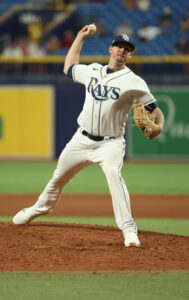
The deal marks a reunion between the two parties, as Devenski closed out the 2023 season on Tampa Bay’s big league roster after signing a Major League contract in late August. Devenski spent the bulk of the season in the Angels’ bullpen, pitching to a 5.08 ERA with more encouraging secondary marks (23.6% strikeout rate, 6.4% walk rate, 46.3% grounder rate).
As has been the case so many times in the past, a match with the Rays helped him unlock better results. It’s admittedly a small sample, but Devenski yielded just two runs on five hits and two walks with nine strikeouts in 8 2/3 frames following the change of scenery. With Tampa Bay, he leaned on his longtime plus changeup even harder, throwing it at a career-high 56.5% clip.
Early in his career, Devenski was an absolute powerhouse with the Astros, pitching to a 2.38 ERA with a 28.2% strikeout rate and 6.4% walk rate in 189 innings over the life of 110 appearances (five starts, 105 relief outings) from 2016-17. Devenski’s numbers backed up in 2018-19 as he became extremely susceptible to home runs (1.71 HR/9) and also battled a hamstring injury. Elbow soreness wiped out the majority of the already-shortened 2020 season for him, and Devenski underwent Tommy John surgery in 2021. He struggled mightily through 14 2/3 innings between the D-backs and Phillies in his 2022 return.
This past season was Devenski’s first year with at least 15 big league frames since 2019. His 94 mph average fastball was right in line with peak levels, and he posted better-than-average swinging-strike and opponents’ chase rates (13% and 33.3%, respectively). He’ll give the Rays a low-cost bullpen flier for as many as two seasons.
Devenski joins a deep Rays bullpen mix that also includes Pete Fairbanks, Jason Adam, Andrew Kittredge, Colin Poche, Kevin Kelly, Shawn Armstrong, Garrett Cleavinger and waiver claim Tyler Alexander. Righties Colby White and Manuel Rodriguez are all on the 40-man roster, too, though each has minor league options remaining. Most of the relievers in the Tampa Bay bullpen are far from household names, as is common for the Rays, but every name listed (minus Alexander, White and Rodriguez) had an ERA of 3.09 or better in the majors this past season.
ESPN’s Jeff Passan first reported the agreement and length of the deal. Marc Topkin of the Tampa Bay Times reported the financial terms.
Mets Sign Jose Iglesias To Minor League Deal
The Mets signed veteran shortstop Jose Iglesias to a minor league contract, per a team announcement. The MVP Sports Group client will be invited to big league camp in spring training.
The 2023 season was the first year in which Iglesias, 33, didn’t play in the big leagues since he missed the 2014 season due to injury. Iglesias went to spring training with the Marlins, didn’t make their Opening Day roster, and opted out of his minor league deal with Miami on April 20. He signed multiple minor league deals with the Padres thereafter, opting out of each.
Despite a solid showing with San Diego’s Triple-A club, Iglesias didn’t get a call to the big leagues with the Padres or another club. He played in 28 games with El Paso, batting .317/.356/.537 in 135 trips to the plate.
Prior to the 2023 campaign, Iglesias was a mainstay on big league rosters. Though he’s rarely provided huge value at the plate, he has a track record of strong glovework at shortstop and is also capable of playing both second base and third base. From 2018-22, Iglesias batted .287/.322/.404 — albeit with much of that production coming at very hitter-friendly home venues like Coors Field and Great American Ball Park.
Iglesias has long displayed excellent bat-to-ball skills, evidenced by his career 12.4% strikeout rate. However, he also rarely walks (career 4.3%), regularly leading to strong batting averages with middling on-base percentages and below-average slugging percentages.
With Francisco Lindor at shortstop, Jeff McNeil at second base and a series of third-base options including Brett Baty, Mark Vientos, Ronny Mauricio and Joey Wendle, there’s no clear path to a regular role for Iglesias on the Mets’ roster. That said, he’ll join Zack Short as a potential utility infield option off the bench and give the Mets an experienced veteran they can stash in the upper minors for depth.
Adding depth has been a major focus for new president of baseball operations David Stearns in his first month-plus on the job. In addition to adding Iglesias, signing Wendle to a big league deal, and claiming Short off waivers, the Mets have added catchers Tyler Heineman and Cooper Hummel via waivers; signed pitchers Andre Scrubb, Kyle Crick and Cole Sulser to minor league contracts, and added righty Austin Adams on a split MLB deal.
Roberts: Dodgers Met With Shohei Ohtani Recently
After droves of secrecy and anonymous reporting about secret meetings between Shohei Ohtani and various suitors, Dodgers skipper Dave Roberts refreshingly came right out and told reporters that his club recently hosted Ohtani for a visit at Dodgers Stadium (link via Jack Harris of the L.A. Times). Roberts added that Ohtani is “clearly our top priority.” Asked why he was so direct when other clubs have gone to great measures to conceal their efforts to negotiate with Ohtani, Roberts replied (via MLB.com’s Anthony Castrovince): “I don’t feel like lying is something I do. I was asked a question. … It’s going to come out at some point.”
The Dodgers have long been viewed as the likeliest team to sign Ohtani. That’s due to myriad factors, ranging from Ohtani’s prior preference for a West Coast club (during his original foray into MLB free agency) and the Dodgers’ virtually limitless payroll capabilities, among others. The L.A. front office declined to make designated hitter J.D. Martinez a qualifying offer on the heels of a resurgent 33-homer season, reportedly in large part to keep the DH spot in the lineup clear for a potential run at Ohtani.
Ohtani has drawn interest from a wide array of teams, as one would expect from the most prominent two-way star the sport has ever seen. Over the past few days, however, several clubs have appeared to believe their chances to land Ohtani have shrunk. The Red Sox, Mets and Rangers are said to have shifted their focus to other players, while just a couple hours ago it was reported that the Cubs’ optimism in their own pursuit has “significantly waned.”
The Dodgers currently project for a $157MM payroll, per Roster Resource, with just shy of $175MM of luxury tax obligations on the books. That leaves ample room to sign Ohtani without even reaching the $237MM tax threshold, although subsequent additions following a theoretical Ohtani deal could still put the Dodgers firmly into tax territory. That hasn’t been a concern for them in the past, however; the Dodgers have incurred luxury penalties each year since 2019.
Ohtani is believed to have had meetings with the Blue Jays and the Giants in recent days as well. Los Angeles, Toronto, San Francisco and the incumbent Angels are the four prominent names reported to remain in the bidding, although given the cloak-and-dagger nature of Ohtani’s free agency, it’s certainly possible there are other clubs still lurking in the mix to sign him.
Cubs, Rhys Hoskins Have Discussed One-Year And Multi-Year Deals
First baseman Rhys Hoskins has been on the Cubs’ radar for much of the offseason, and Jon Morosi of MLB.com tweets that the two sides have remained in contact throughout the winter and discussed both one-year and multi-year proposals.
Word of continued interest in Hoskins comes not long after USA Today’s Bob Nightengale reported that the Cubs’ optimism about their chances of landing Shohei Ohtani had “significantly waned.” Perhaps the timing is sheer coincidence, but it also wouldn’t be a surprise for the Cubs to begin exploring contingency plans more earnestly if they indeed believe they’ve fallen behind in their efforts to lure Ohtani to Wrigley Field.
Hoskins, 31 in March, is a logical fit for a Cubs roster that lacks clearly defined options at both first base and designated hitter. Young slugger Christopher Morel is expected to get some reps at first base, but the 24-year-old has to this point in his big league career fanned in just shy of 32% of his plate appearances, making it hard to bank on him as a productive option moving forward — impressive as his power output may be. There’s also the possibility that Morel himself could be part of a trade package to address other needs on the roster; president of baseball ops Jed Hoyer acknowledged when explaining that Morel was likely to see some time at first base that Morel is blocked at his best position (second base) on the Cubs’ roster but “another team might be able to put him there.”
The Cubs also have 32-year-old slugger Patrick Wisdom in both the first base and designated hitter mix, but Wisdom has fanned at a jarring 35.2% clip over the past two seasons while hitting .206/.295/453 in 836 plate appearances. He’s slugged 48 homers in that time, to his credit, but the bulk of Wisdom’s damage has come against left-handed pitching and he could be viewed as more of a part-time player as a result.
Hoskins missed the 2023 season after suffering a torn ACL in spring training. He was a sensible qualifying offer candidate all the same, given his track record, but the Phillies opted not to make the QO and announced early in the offseason that Bryce Harper would be moving to first base on a regular basis. With Kyle Schwarber and Nick Castellanos both also on the roster and in need of DH time, that all but closed the door on a reunion with Hoskins, who’d been the Phillies’ primary first baseman since 2017 (save for a one-year dalliance into left field that did not yield good results).
In parts of six big league seasons, Hoskins is a .242/.353/.493 hitter with 148 home runs. He’s walked at a stout 13.5% clip, and while his 23.9% strikeout rate is worse than average, it’s not that far north of this past season’s 22.7% leaguewide mark. He’s hit between .245 and .247 in four of his past five seasons, with OBPs ranging from .332 to .354 and slugging percentages sitting between .462 and .530. Broadly speaking, even though Hoskins hits for a fairly pedestrian average, his robust walk rate and plus power have made him an above-average performer with the bat. He’s typically graded as a below-average defender at first base but not a complete liability by any means.
That the Cubs and Hoskins have described various permutations of a potential structure shouldn’t come as a surprise. He’s a clear candidate for the conventional one-year pillow contract that so many prominent free agents have taken on the heels of injury-ruined seasons over the years. At the same time, it’s become increasingly common for players to secure two-year pacts wherein the second season is a player option. Such structures might’ve once been reserved for the game’s truly premier players, but we’ve now reached a point where even relievers (e.g. Emilio Pagan), swingmen and back-end starters (e.g. Nick Martinez, Ross Stripling, Sean Manaea) have landed such opportunities.
Agent Scott Boras, who represents Hoskins, has negotiated two-year deals with opt-outs for the aforementioned Martinez and Manaea, in addition to Carlos Rodon and perhaps most relevant to Hoskins, Michael Conforto. Like Hoskins, Conforto missed an entire season due to injury (shoulder surgery), but he nonetheless inked a two-year, $36MM deal with the Giants that allowed him to opt out this winter if he chose. The opt-out was contingent on Conforto reaching 350 plate appearances, which he did, though the former All-Star wound up staying put after an unspectacular first year in San Francisco.
That type of structure could well hold appeal to Hoskins. We at MLBTR placed him 26th on our annual ranking of the game’s top 50 free agents, pegging him for that exact same contract structure signed by Conforto.
White Sox GM Downplays Possibility Of Luis Robert Trade
The primary focus around the White Sox’ offseason at present is their ongoing slate of trade negotiations surrounding righty Dylan Cease, the 2022 AL Cy Young runner-up. Rookie ChiSox GM Chris Getz said last month that there are no players on the roster that he deems untouchable, Cease included, but he continues to describe center fielder Luis Robert Jr. differently that others on his roster.
Getz openly acknowledged widespread interest in Cease yesterday (link via Scott Merkin of MLB.com), noting that there’s no club in MLB that “doesn’t have a level of interest” before eventually adding that Cease is “right at the top” of the offseason market for starting pitching. On Robert, however, Getz understandably struck a different tone.
“Luis Robert is a very difficult player to move and expect that your club is going to get better because of it,” said Getz. “We’re talking about one of the best players in baseball, and we’re very fortunate to have him with the Chicago White Sox. So I have a tough time seeing him wearing another uniform next year.”
Getz again sidestepped the type of firm denial his Anaheim counterpart, Perry Minasian, put forth today on former AL MVP Mike Trout. But Getz also continues to characterize Robert as someone who’s all but assured of staying put on Chicago’s South Side. The reasoning isn’t hard to see. While the Sox are coming off a disastrous 101-loss season, Robert was nothing short of sensational i 2023, hitting .264/.315/.548 with 38 home runs, 36 doubles, 20 steals (in 24 tries) and plus defense in center field. Had the White Sox not been all but eliminated from contention by the end of April, Robert quite likely would’ve found himself on more MVP ballots. (He finished 12th as it is.)
Beyond Robert’s general excellence on the field, he’s also just 26 years old and is signed for another two seasons with two subsequent club options thereafter. In all, he can be controlled through the 2027 season at a combined total of $67.5MM. That type of commitment over a four-year term from a prime-aged center fielder with an MVP-caliber ceiling is a staggering bargain — particularly when the last two seasons aren’t even guaranteed (thus affording the team an eject option if Robert incurs a significant injury).
Ultimately, a trade feels decidedly unlikely. We haven’t seen an established player with this level of affordable contract/team control traded in some time; Juan Soto might be the best recent comparison, but he had just two and a half seasons of control remaining and was expected to earn more than Robert over the course of his remaining control as a player going year-to-year through arbitration (with enormous counting stats).
Once Shohei Ohtani and other top free agents are off the board (ditto Juan Soto and other prominent trade candidates), clubs who miss out on those top targets could well circle back to the White Sox and Robert. However, the type of farm-depleting haul that Robert would command is probably one from which nearly any of Getz’s peers would shy away.
Minasian: Mike Trout “100 Percent” Not Getting Traded
Angels general manager Perry Minasian spoke to the media at the Winter Meetings today, emphatically declaring that a Mike Trout trade is not happening, with Rhett Bollinger of MLB.com among those to pass along his comments. “Mike Trout is not getting traded,” Minasian said. “100 percent.”
There was never really any concrete reporting to suggest that a Trout trade was actually being considered, just speculation from outside observers. The argument for contemplating a trade was essentially that the club hasn’t been good enough in recent years, despite having both Trout and Shohei Ohtani on the same team. They haven’t had a winning season since 2015, haven’t made the postseason since 2014 and haven’t won a playoff game since 2009. With Ohtani now a free agent and perhaps signing elsewhere, it was suggested by some that the club should look to blow up the roster and start over.
But that is clearly not how the Halos are viewing things. Last month, Minasian made it clear that the club is not rebuilding and is actually planning on being aggressive this winter in adding to the roster. That may involve luring Ohtani back to Anaheim or perhaps pivoting to other notable transactions, but trading Trout doesn’t make sense in any scenario where the club is still trying to win in the short term.
Even if the club were to decide to make Trout available at some point down the road, there would be challenges in doing so. For one thing, Trout has a full no-trade clause and would therefore have to give the green light to any deal. Back in September, he spoke about how he intended to play for the Angels in 2024.
It’s also fair to wonder how much trade value he actually has at this point. Various injuries have limited him to 237 games played over the past three seasons, less than half of the club’s 486 contests for that time frame. He was able to get into 82 games in 2023, with a left hamate fracture wiping out much of his second half, but had diminished production when on the field. His batting line of .263/.367/.490 was still well above average, translating to a wRC+ of 134, but he had never previously had a wRC+ below 167 in a full season. He also hasn’t reached double-digit steals since 2019 and the advanced defensive metrics have been split on his glovework in recent years.
That’s not to say Trout isn’t still a very good player. FanGraphs still pegged him as being worth 3.0 wins above replacement in 2023, even with the drop from his own ridiculous standards and only playing half the year. But he’s now 32 years old with his health becoming a growing concern and he is still being paid at an elite level.
Trout’s contract still has seven more years on it with $248.15MM still to be paid out, a rate of $35.45MM per year through 2030. Even if the club decides to change their plans a year from now, he will still have six years and $212.7MM remaining, going into his age-33 season. Using MLBTR’s Contract Tracker to look at data going back to 2010, we can see that the largest guarantee secured by a player going into his age-33 season or older is Jacob deGrom‘s $185MM deal from last offseason. Among position players, Josh Donaldson‘s $92MM tops the list.
Unless Trout can suddenly return to total health and MVP-caliber production, there’s likely not any surplus value in the deal. Though he’s still a valuable player, it would be hard for him to secure this elite-level salary if he were on the open market. That means the Angels would either have to settle for a middling return to clear the money off the books or eat some cash in order to secure a more notable return. That figures to put the club in an awkward spot on terms of public relations with Trout having been the face of the franchise for so long, and that goes double if Ohtani also ends up leaving for another club this winter.
Ultimately, with the Angels set on competing, keeping Trout and hoping for a return to form is the most sensible option. The rest of the offseason will determine if his supporting cast will be stronger than it has been in recent years.