
Minor MLB Transactions: 2/2/2019
We’ll use this post to track some of the smaller moves made around the MLB today…
- The Oakland A’s will bring lefty Wei-Chung Wang to spring training as a non-roster invitee, per the Athletic’s Melissa Lockard (via Twitter). Wang spent last season in Korea, where he earned a 4.26 ERA in 25 games for the NC Dinos of the KBO. He made brief appearances at the major league level for the Brewers in 2014 and 2017, but both cups of coffee returned disheartening results – a combined 11.09 ERA across 18 2/3 innings – including a somewhat noteworthy 2017 in which he recorded only 4 outs across 8 outings. Wang pitched well in the upper minors as recently as 2017, however, when as a then-25-year-old, he turned in a 2.05 ERA in 47 appearances out of the pen for the Brewers’ top affiliate.
Blake Treinen Wins Arbitration Case
Closer Blake Treinen won his arbitration case against the Oakland A’s, per ESPN’s Jeff Passan (via Twitter). Treinen, represented by Sosnick, Cobbe, and Karon, is now slated to make $6.4MM for the 2019 season, with one more season of arbitration eligibility remaining in 2020. The A’s had submitted a bid of $5.6MM.
This is a notable victory for players, as Treinen sets a new record for year-over-year increase in salary for a second-time arb-eligible reliever, a raise of 4.25MM on his 2018 salary. The largest previous increase had been the $3.575MM raise Greg Holland received in his heyday with the Royals. Of course, the Athletics were winners here too, beneficiaries of a significant jump in production from Treinen this season, as their closer recorded 11.2 K/9 en route to his first All-Star appearance, a 6th place finish in Cy Young voting, and a 15th place finish in MVP voting.
Treinen, 30, came to Oakland after a disappointing start to the 2017 season left him sporting a 5.73 ERA in July, struggling to get swings and misses with only 7.6 K/9. The Nationals were counting on him to be a key cog in their late-inning bullpen rotation that year, expecting a big year after he established himself with 73 appearances and a 2.28 ERA the year before. Given the opportunity to reset their bullpen in one fell swoop, the Nats sent Treinen and two minor leaguers (more on them later) to Oakland for Sean Doolittle and Ryan Madson. The deal panned out for Washington, as the duo stabilized the pen en route to an NL East title. Doolittle ably stepped into the closer’s role, affirming himself as both a production and personality fixture in Washington.
The A’s didn’t do so bad on their side of the deal either, as Treinen put together a massively successful 2018 campaign as the A’s closer: 38 saves, 9 wins, and 0.78 ERA. The minor leaguers in the deal look like good gets as well. Southpaw Jesus Luzardo has a real chance at acedom, coming into 2019 as Baseball America’s 7th ranked prospect overall (subscription link). Sheldon Neuse, the other prospect in the deal, lands as the A’s 9th ranked prospect, per BA, as he looks to build upon his first full season in Triple A, where he hit .263/.304/.357 as a 23-year-old.
Notably, in the other arbitration case settled thus far, the Washington Nationals defeated spare outfielder Michael A. Taylor, who will make $3.25MM in 2019 after submitting a bid of $3.5MM.
NL Central Notes: Cardinals, Senzel, Cubs Comeback
It doesn’t sound as if the Cardinals are planning to make another addition to their roster. Rick Hummel of the St. Louis Post-Dispatch quotes president of baseball operations John Mozeliak in stating that the team has accomplished much of what it set out to do this winter. “Any move we would make now would sort of complicate things,” said Mozeliak. “Even if we were to break (camp) today, we’re going to have guys competing for at-bats already. And we still feel we have a lot of depth in our pitching.” Beyond that, Mozeliak indicated that he “[sees] no reason” that left fielder Marcell Ozuna wouldn’t be ready for Opening Day. Ozuna played through a shoulder injury in 2018 and underwent offseason surgery, but Mozeliak notes that the outfielder is already swinging a bat and is on track to begin a throwing program when he reports to Spring Training in February.
More from the division…
- Nick Senzel will be given every opportunity to earn starting centerfield duties this season, per John Fay of the Cincinnati Enquirer. The Reds have no shortage of outfielders, with Yasiel Puig, Scott Schebler, Jesse Winker and Matt Kemp all in the corner outfield mix, but none of them are natural fits in center. Phil Ervin will have the chance to take some at-bats, but he profiles better in the corners as well. The hope appears to be that Senzel will prove a quick study, able to secure his spot in the bigs by learning yet another new position. Senzel, of course, comes to big league camp a third baseman by trade, and he’s spent some time at second base as well – but with Eugenio Suarez locked into a long-term deal at third, and Scooter Gennett at least temporarily installed at second, Senzel’s path to the the bigs goes through the only position on the Reds lineup card without a starter in place.
- Former first round pick Luke Hagerty is attempting a comeback at age 37, writes ESPN’s Jeff Passan. Hagerty hasn’t pitched professionally since 2008 when a case of the yips drove him from the game. Hagerty has reworked his arsenal and his mindset at the Driveline Baseball Program, the same facility where Kyle Zimmer of the Royals trained last season. At a recent Driveline pro day tryout, the 6’7″ Hagerty averaged a 96.9 mph fastball, impressing himself and the area scouts in attendance. Sixteen and a half years after they signed him the first time, the Cubs signed Hagerty again, this time to a minor league deal. The first time through the Cubs system, Hagerty suffered from the yips, a hiccup rooted in psychology wherein an automatic physical ability, like throwing a baseball over the plate, suddenly and without apparent cause, becomes no longer automatic. The yips are a hurdle that Hagerty appears to have cleared, however, and the southpaw is throwing electric stuff. If Hagerty does make it to the show, he would be the oldest player (without international experience) to make his major league debut since Satchel Paige in 1948. Even Jim Morris, made famous by Dennis Quaid in Disney’s The Rookie, was three years younger than Hagerty when he took his last/best shot at the bigs.
Free Agent Notes: Phillies, Yanks, Giants, Gonzalez
While we already know this through observation, Phillies GM Matt Klentak made clear again that his organization intends to remain patient in its blockbuster free agent pursuits, as Jim Salisbury of NBC Sports Philadelphia recently reported. Klentak says he won’t be rushed into a decision by the onset of camp, saying that there’s no “deadline” to get a deal done before Spring Training. Generally, he said, “The fans are well aware that we’re pursuing the top end of free agency. When that’s going to resolve itself, we don’t really know.”
As we wait for some movement at the top of the market — particularly, regarding reputed Phillies targets Bryce Harper and Manny Machado — let’s check in on a few other situations further down the priority list, all courtesy of MLB Network’s Jon Heyman (links to Twitter) …
- The Yankees still want to boost their rotation depth, Heyman says, though it’s a bit unclear as of yet how they’ll go about doing so. He lists Gio Gonzalez and Ervin Santana as at-least-hypothetical targets, but it stands to reason that both will want to sign somewhere that they’ll be promised a rotation spot. Gonzalez is one of the best remaining starters and should have little trouble finding at least a clear rotation placement, if not a multi-year deal. Santana does seem to be an interesting bounceback candidate, but he’ll surely be seeking a chance to take the ball every fifth day, which the Yanks can’t promise.
- Unsurprisingly, the Giants appear to be hunting for value on the market in their search for a new slate of outfielders. That seemed reasonable to suspect when last we checked in on the situation, as the San Francisco organization seemingly wants to remain competitive while also embarking upon an effort to get younger and enhance payroll efficiency. There could be some interesting free agent opportunities, though perhaps the most intriguing possibility would be for the Giants to pick up some pieces that become available after late-breaking signings.
- The Rockies have some level of interest in yet again bringing back outfielder Carlos Gonzalez, Heyman adds. This particular item is frankly difficult to understand, as the Rox are working with a limited budget and still need to improve behind the dish, in the bullpen, and perhaps on the bench. Meanwhile, the team has a nice assortment of left-handed-hitting outfielders already on hand, making the veteran former star a tough fit on paper. In any event, other teams are also said to be interested in CarGo.
Nationals To Sign J.J. Hoover
The Nationals have agreed to a minor-league deal with righty J.J. Hoover. Remaining terms of the pact are not yet known.
Hoover, 31, has thrown in parts of seven seasons in the majors, including a brief stint last year with the Brewers. He was bumped from the Milwaukee roster early in the season but never ended up joining another club.
All told, Hoover carries a 4.17 ERA with 9.3 K/9 and 4.5 BB/9 through 285 MLB innings. He sported a career-high swinging-strike rate of 12.0% in his last full season (2017, with the Diamondbacks), so there’s reason to believe he could be a big league contributor. For the Nats, Hoover represents a fairly notable depth piece to support the high-powered, high-risk relief unit they have compiled.
Twins To Sign Wilin Rosario
The Twins have reportedly inked catcher/first baseman Wilin Rosario to a minors deal, with Roberto Carlos Feble seemingly first to tweet the news. It comes with a MLB spring invite, per Darren Wolfson of 1500 ESPN (Twitter link).
After running out of opportunities with the Rockies, Rosario took his slugging talents to Asia for the past three seasons. He thrived as a power-hitting first baseman in the KBO for two years before landing in Japan’s Nippon Professional Baseball in 2018. He struggled there, however, producing a meager .242/.285/.374 slash in 302 plate appearances.
Rosario remains most notable for his pop, which is significant enough largely to make up for his on-base deficiencies — or, perhaps more accurately, that was the case when he was still considered capable of serving behind the dish. Unfortunately, Rosario never impressed defensively as a backstop, so he’s now mostly limited to playing first base or serving as a DH. He’ll have to do better than his lifetime MLB 98 OPS+ if he hopes to carve out a role at the game’s highest level. Rosario turns thirty later this month.
Red Sox To Sign Brian Ellington
In yet another item on what has turned into Boston bullpen night here at MLBTR, the Red Sox have reportedly struck a deal with flamethrowing righty Brian Ellington. Per Alex Speier of the Boston Globe (Twitter link), the 28-year-old receives a minors pact; it’s unknown whether it includes a spring invite.
Like several of the team’s other recent, low-cost pen additions, Ellington is long on tools but lacks an established track record of success at the MLB level. He owns a 4.65 ERA in 102 2/3 career frames in the majors. Ellington was dropped early in 2018 by the Marlins and didn’t last long with the Diamondbacks organization after being added on a minors deal.
Ellington has averaged a whopping 98.5 mph with his average fastball in those innings, helping him to generate an 11.4% swinging-strike rate despite infrequent use of offspeed offerings. But he has also handed out free passes like candy in the majors (5.6 per nine). Both player and team will surely enter camp hoping to find a way to harness Ellington’s arm strength.
A Closer Look At The Red Sox And The Luxury Tax
The Red Sox’ bullpen — or, really, its lack of fortification this offseason — has garnered plenty of recent attention. President of baseball operations Dave Dombrowski has not only downplayed the possibility of a reunion with Craig Kimbrel but also the addition of any notable arm. While Dombrowski has stated that there’s no mandate to remain south of the top luxury tax border, it also seems increasingly likely (if not apparent) that that’s exactly what the team is planning to do. Most onlookers have at least a cursory awareness of what that entails, but I felt it worth a deeper look to see exactly what the Sox are deeming the theoretical breaking point — if they are indeed set on avoiding that barrier.
This isn’t necessarily a call for the Red Sox to spend more, to be clear. Boston is poised to carry Major League Baseball’s highest payroll for the second consecutive season and stomached the hit when they incurred top-level luxury penalization last year. This offseason, ownership green-lit a $68MM expenditure on Nathan Eovaldi and another $6.25MM on Steve Pearce. The Sox have hardly refused to spend. Every team, though, has its limit, and at the very least Boston seems close to that point.
At present, Roster Resource’s Jason Martinez has the Red Sox with a 2019 payroll of $238,373,928. That’s how much money they’ll pay out to players — those on the roster and those either no longer on the 40-man (Rusney Castillo) or no longer even in the organization (Pablo Sandoval).
For the purposes of the luxury tax (labeled as the Competitive Balance Tax in baseball’s collective bargaining agreement), however, payroll is calculated by the average annual value of the contracts for which a team is responsible (in addition to a set level of player benefit costs, which include medical costs, moving/travel expenses, etc.). Jason has Boston’s luxury tax payroll (“actual” payroll, as termed in the CBA) projected at $241,269,197. Those numbers, both the 2019 payroll and the “actual” payroll, are estimates and aren’t exact, but they’re both close approximations that provide a reasonably accurate depiction of what the organization’s expenses currently entail. Before delving further into what additional spending would mean for the Red Sox, it’s important to note what those numbers mean for the team’s current taxation penalties.
For the 2019 season, the luxury tax line has been set at $206MM. Even without re-signing Eovaldi and Pearce, the Sox were always going to be well north of that line. The collective bargaining agreement stipulates that a second-time offender — the Red Sox were over the luxury line in 2018 but stayed shy of it in 2017 — will pay a 30 percent tax on the first $20MM over the initial luxury line. Teams are subject to an additional 12 percent tax on the next $20MM spent. If a team crosses the luxury limit by more than $40MM, it will pay an additional 45 percent tax from that point forward and also see its top pick in the next year’s draft dropped by 10 spots. Put otherwise:
- $206MM to $226MM: 30 percent tax (a total of $6MM)
- $226MM to $246MM: 42 percent tax (a total of $8.4MM)
- $246M or more: 75 percent tax and a loss of 10 spots in the following year’s draft
Using Jason’s figures above, the Red Sox are paying the full $6MM of that first level and are $15,269,197 into the second level of tax penalization. That sum is taxed at a 42 percent rate, meaning the Sox are paying a $6,413,063 tax on it. At present, then, the Red Sox are committed to paying about $12.413MM worth of luxury tax penalties. There’s a $4,730,803 gap between their current projection and the $246MM top luxury line. If they were to, theoretically, add another reliever for a dollar less in order to avoid top-level penalization, the Red Sox would be taxed an additional $1,986,937. Of course, that’d leave them unable to make a single in-season addition should the need arise.
That, however, is the gripe for many critics. A bullpen headlined by Matt Barnes, Ryan Brasier, Heath Hembree, Brandon Workman, Tyler Thornburg and Brian Johnson seems quite likely to necessitate trade-deadline augmentation — and that’s before even allowing for the possibility of an injury to a key player that would also require a trade acquisition. It’s not only possible that the Red Sox will have crossed the top luxury line by the time the July 31 non-waiver trade deadline has passed — it seems downright likely. Perhaps the plan is to find trade acquisitions whose salaries can be largely paid down by their current team, but doing so would require paying up a greater premium in terms of prospects and thus weaken an already thin farm system.
Should paying more in terms of prospects be preferable to lessening the 2020 draft budget? Some might argue that it’s preferable to go ahead and commit to taking the draft hit in order to gain the advantages of a bolstered bullpen from the start of the season. After all, the division is hardly a shoo-in and the Sox obviously have designs at chasing an elusive repeat title. But what does that actually mean from a financial standpoint?
For the sake of argument, let’s take a look at what the Red Sox would have to pay in order to sign Kimbrel at the four-year, $70MM term projected by MLBTR in our Top 50 Free Agent Predictions back in November. In trying to peg Kimbrel’s eventual contract, Tim Dierkes, Jeff Todd and I all felt that Kimbrel would seek to top Aroldis Chapman‘s record guarantee (which he reportedly has indeed pursued) but ultimately fall shy and instead, ahem, “settle” for breaking Wade Davis‘ $17.33MM annual salary record for a reliever over a four-year term. Kimbrel may very well fall shy of our $70MM prediction, but he could still set a new AAV standard with a three-year, $52.5MM deal. Even a one-year deal at the $17.5MM level would come with the same CBT hit for 2019. For purposes of this hypothetical, that seems a reasonable figure to work with.
If the Sox were to pay Kimbrel a $17.5MM annual salary, the first $4,703,803 of that salary would close the gap between Boston’s current “actual” payroll and the $246MM threshold. As noted above, that’d come with a $1,986,937 luxury hit, coming to a total of $6,690,740. The remaining $12,769,197 would come with a hefty tax of $9,576,898. That’s a total of $11.564MM just in taxes before considering the money the team would actually owe to Kimbrel himself.
Viewed through that lens, Boston would effectively be on the hook for a stunning $29,036,835 in 2019 if they were to sign Kimbrel at the record rate he’s quite likely eyeing. (A multi-year deal, of course, might have greater or lesser salaries in its various seasons, though that’s all averaged for the CBT.) Frankly, even beyond any concerns about lengthy commitment to a not-so-youthful reliever, it’s pretty clear to see why the Sox don’t have much interest in retaining Kimbrel unless his price tag craters (at which point a plethora of other teams would join the bidding). Though the total luxury tax bill would still not make up an enormous amount of the team’s total payroll-related spending, it would perhaps turn a Kimbrel signing from a hefty investment to an eye-popping splurge.
That math is also informative when examining why the Sox have passed over other top-end relievers. For instance, beating the Yankees’ three-year, $27MM offer to Adam Ottavino by a margin of $500K annually would’ve still been costly for Boston. As with any contract, the first $4,703,803 of the deal would’ve been taxed at $1,986,937. The remaining $4,796,197 would come with a $3,597,148. In total, signing Ottavino at a $9.5MM annual salary would effectively cost $15.084MM in 2019.
Boiled down, any relief addition for the Red Sox with an annual salary north of the $4,703,803 gap that exists between their current “actual” payroll and the $246MM luxury line could be viewed as such (where X = the average annual value of a new contract):
(X – 4,703,803) + (X – 4,703,803)*0.75 + 6,690,740 = Total 2019 expenditure
All of that, of course, is before even acknowledging the 10-spot drop they’d face in the draft for a second consecutive season. There’s no way of knowing precisely how much the Sox would be costing themselves in the 2020 draft, or even how much they stand to lose in the 2019 draft after crossing the top level last year, as 2019 slot values aren’t yet known. However, dropping from No. 30 in 2018 to No. 40 (the drop they’re facing this year) would have resulted in a loss of $489,500 in the team’s draft pool. Draft slot values increase incrementally each season, and the Red Sox’ exact placement in the draft order obviously can’t be known. But generally speaking, the Sox would be looking at a 10-spot drop and a loss of at least $500K in their 2020 draft pool.
Clearly, the price to add a reliever of any significance will be steep for Boston — possibly more so than most would expect before truly diving into the math behind further additions. That said, it’s still worth questioning the Red Sox’ decision to draw a line in the sand at this juncture. The current state of the ‘pen makes it seem likely that Boston will need to add a reliever during the season anyhow, and that could still put the team over the limit while also costing prospects.
Beyond that, this it’s quite likely that this is the last time Boston will ever enjoy the Chris Sale, Xander Bogaerts and J.D. Martinez all on the same roster. Sale and Bogaerts are free agents after the 2019 season, and Martinez has an opt-out provision that he’ll presumably exercise if he produces anywhere near his 2018 levels. Add in the fact that Mookie Betts can become a free agent after the 2020 season — though the Sox surely hope to extend their franchise player — and there’s all the more urgency for Boston to go all out in its pursuit of another championship.
Further spending truly doesn’t appear to be in the cards for Boston, though perhaps they’ll be able to secure one of the market’s remaining relievers at a modest $2-3MM commitment that’d still allow them to avoid the top line. But the Sox look like they’re genuinely poised to enter the season with a glaring weakness — one that’ll be tough to account for during the season. While the staggering level of taxation they’d have had to pay on another notable ‘pen arm (or two) makes their reluctance understandable, that’ll still be a tough sell to fans if the current group of relievers doesn’t exceed expectations in dramatic fashion. It’s an illustration of the potency of the current luxury tax rules — though, of course, the payrolls of virtually every other team in baseball presently reside comfortably out of range of this level of penalties.
Red Sox To Sign Dan Runzler
The Red Sox have added reliever Dan Runzler on a minors deal, per John Dreker of Pirates Prospects (via Twitter). It isn’t yet known whether he’ll receive an invitation to participate in MLB camp.
A southpaw who’ll soon turn 34, Runzler has appeared in five big league seasons, though he hasn’t been a substantial contributor since 2013. All told, he owns a 3.89 ERA with 9.7 K/9 and 5.4 BB/9 over 76 1/3 innings at the game’s highest level.
Runzler has mostly toiled at Triple-A and in the Atlantic League over recent years, but did briefly crack the bigs with the Pirates in 2017. He possesses mid-nineties heat from the left side, but hasn’t consistently been able to command it. In 2018, he threw 48 innings of 2.81 ERA ball with the Sugar Land Skeeters, racking up 58 strikeouts but also doling out 27 free passes.
Boston fans clamoring for some bullpen help likely won’t be appeased by this addition, any more than they were by the club’s prior winter moves. Runzler joins Colten Brewer, Zach Putnam, and Jenrry Mejia as low-risk relief candidates that have been brought on board this winter.
Cubs Sign Tony Barnette, Outright Ian Clarkin
5:55pm: The deal also includes roster bonuses, with $250K available if Barnette breaks camp on the active roster and again if he lasts there for 155 days of the season, per Bob Nightengale of USA Today (via Twitter). There’s also a quarter-million-dollar incentives package.
It’s worth noting, too, that if the Cubs do pick up the option, they’ll be required to release Barnette thereafter rather than tendering him a contract and offering arbitration.
3:04pm: The Cubs have now announced the Barnette signing.
2:40pm: The Cubs and right-handed reliever Tony Barnette have agreed to a one-year contract with a club option for the 2020 season, reports Mark Gonzales of the Chicago Tribune (Twitter links). Barnette will receive a $750K salary for the 2019 season and has a club option valued at $3MM for a second season, per Gonzales. Barnette is represented by Wasserman.
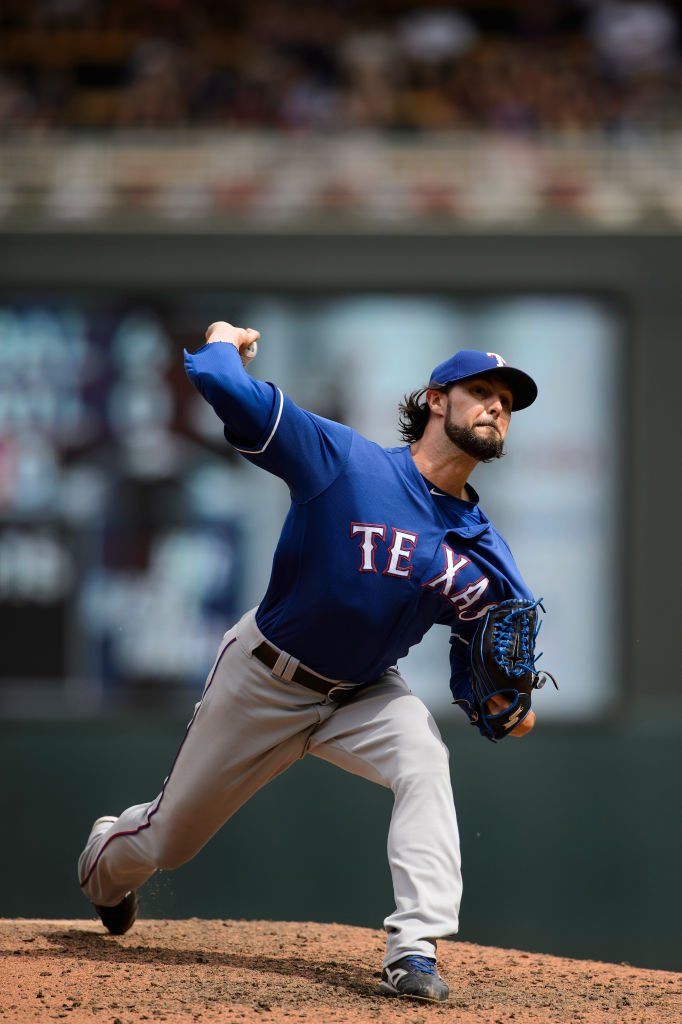
Additionally, Gonzales tweets that lefty Ian Clarkin cleared waivers and been assigned outright to Triple-A Iowa. That move wasn’t made to accommodate the addition of Barnette, though, as the Cubs already had a spot open on the 40-man roster.
Barnette, 35, pitched brilliantly for the Rangers in 2018 but had his season truncated by shoulder issues. The right-hander logged a 2.39 ERA with 8.9 K/9, 1.7 BB/9, 0.68 HR/9 and a 51.4 percent ground-ball rate in 26 1/3 innings but made his final appearance on July 3.
That season wrapped up an uneven three-year stint with the Rangers organization for Barnette, whose track record is among the more unique in today’s game. A 10th-round selection of the Diamondbacks in 2006, Barnette spent four years toiling in the Diamondbacks’ system before accepting an offer to go pitch for the Yakult Swallows of Japan’s Nippon Professional Baseball. That initial one-year offer was parlayed into a six-year run with Yakult, where Barnette emerged as one of the top closers in Japan. He saved 97 games there after ascending to that role and pitched to a 1.29 ERA in his final season there before signing a big league deal with the Rangers.
The righty justified the hype surrounding him with a 2.09 ERA in 60 1/3 innings during his rookie season, but he was clobbered for a 5.49 ERA a year later in 2017 as he also dealt with finger injuries. In all, Barnette comes to the Cubs with a long track record of success in Asia and a 3.50 ERA with a 132-to-43 K/BB ratio in 144 Major League innings — all with Texas.
The Cubs’ budgetary constraints this offseason are well known, as the team had to trade Drew Smyly and his $7MM salary to the Rangers simply to pick up their option on Cole Hamels. Since that time, the team’s only expenditures have been small deals for utility infielder Daniel Descalso, right-hander Brad Brach and now Barnette. While the limitations are an understandable point of contention for fans who’d hoped to see ownership support a run at a franchise-altering talent like Bryce Harper, the front office has seemingly done well in adding a pair of potentially useful setup men (Brach and Barnette) for a combined total south of $6MM.
As for Clarkin, he’s a former first-round pick (No. 33 by the Yankees in 2013) that has bounced back and forth via waivers between the Cubs and White Sox on multiple occasions this winter. Clarkin was hit hard in 68 innings of Double-A ball last year, turning in a 4.98 ERA with nearly as many walks (4.1 BB/9) as strikeouts (4.6 K/9), and he’ll now stick with his new organization and likely head to Major League Spring Training as a non-roster invitee.