
Mets “Nearly” Struck Trade With Indians For Jason Kipnis
The Mets and Indians very nearly pulled off a deal that would have sent Jason Kipnis to New York, according to Jon Heyman of Fan Rag. Upper management — Heyman hints on the Mets side — ended up scuttling a deal that seemed to be in place.
Kipnis was widely rumored to be on New York’s radar last month. For the Mets, the veteran would have plugged a hole at second base. And for the Indians, the considerations were mostly financial, as Kipnis is due $30.5MM on his deal (covering two more seasons along with a buyout on a 2020 option).
It was money, it seems, that caused the hang-up here. While the prospect cost was not prohibitive, Heyman says that “Mets higher-ups didn’t see Kipnis as good value.” Whether Cleveland would have paid down any portion of the remaining obligations in the proposed agreement is not known.
At this point, it would appear that the odds of talks re-opening are low. The Mets just landed free agent slugger Jay Bruce in a move that will occupy a significant portion of their remaining payroll availability. On the Indians’ side, moving the Kipnis contract likely would have helped facilitate their pursuit of Carlos Santana, but he reportedly agreed to terms with the Phillies on December 15th — right after the Mets/Kipnis talk heated up and before it died down.
In any event, the Mets do still need a second baseman — or, perhaps, a third baseman who’d bump Asdrubal Cabrera over to second. As Mike Puma of the New York Post wrote this morning, it seems the club still has a variety of open-market possibilities to consider in the infield. Todd Frazier, Howie Kendrick, Neil Walker, and Jose Reyes are evidently still on the team’s radar, while other trade options are presumably still on the table. (Puma does suggest that free agent Mike Moustakas and trade candidate Starlin Castro are not seen as viable options.)
For the Indians, meanwhile, the latest indication is that the team will utilize Kipnis at his native position of second base after having bumped him to the outfield late last year. Presumably he could still be moved in the right deal, but the organization may also mostly be preparing to hang on and hope he can return to form. While Kipnis limped to a .232/.291/.414 batting line in an injury-limited 2017 season, he carried a composite .289/.357/.460 line over the prior two seasons and has typically graded as a quality defender.
Arbitration Breakdown: Jacob deGrom
Recently, I have been discussing some of the higher-profile upcoming arbitration cases as part of MLBTR’s Arbitration Breakdown series. I rely partly on my arbitration model developed exclusively for MLB Trade Rumors, but will also break out some interesting comparables and determine where the model might be wrong. Full arbitration projections for 2018 are also available.
Jacob deGrom enters his second year of arbitration eligibility poised to earn a solid bump up from his $4.05MM salary from 2017. He went 15-10 with a 3.53 ERA in 201.1 innings and struck out 239 batters, so my model places him at $9.2MM, good for a $5.1MM raise. This is probably too high based on comparables, as I discuss below, but it should easily be enough to earn him a large raise.
Players who are past their first year of arbitration eligibility general get raises based on their platform year performance only. So we just need to look for pitchers with roughly 15 wins and a ton of strikeouts, along with respectable ERAs. One such player who got a very large raise is David Price—he got a $5.76MM raise back in 2013 after going 20-5 with a 2.56 ERA and 205 punch outs. That is probably somewhat stale by now, although it certainly looks like a ceiling given the much stronger performance in terms of wins and ERA. A more recent ceiling might be Jake Arrieta’s $7.07MM raise two years ago after going 22-6 with a 1.77 ERA. Like Price, he won a Cy Young, and clearly has better numbers. I think both Price and Arrieta cap how high deGrom’s raise can get.
More within striking distance is Stephen Strasburg three years ago. He went 14-11 versus deGrom’s 15-10. And his 3.14 ERA is better than deGrom’s 3.53, but when you consider run environment it’s nearly a dead ringer. A panel might not consider run environment, but either way both have ERAs in the 3’s. Strasburg’s 242 strikeouts are of course very similar to deGrom’s 239. Strasburg took home a $3.43MM raise. Add in some salary inflation, and you might get closer to $4MM for deGrom.
Strasburg is actually the largest raise in the last five years excluding the two Cy Young Award winners (Arrieta and Price), so that might be the best comparable. Tyson Ross had a 13-14 record the same year as Strasburg and just 195 strikeouts, but had a 2.81 ERA. He got a $3.27MM raise. But that is likely to fall below where deGrom gets, and could be viewed as something of a floor. ERA is generally not as important in arbitration as you might expect.
Garrett Richards is the only other comparable that makes sense to me. His $3.23MM raise two years ago off a 15-12/3.65 performance came with only 176 strikeouts, though. So he also likely helps to establish a floor for deGrom.
Overall, I think there is a good case case for deGrom to get a raise closer to $4MM than the $5.1MM projection. Look for a salary around $8MM when push comes to shove.
Yu Darvish Choosing Among Six Teams
Yu Darvish is widely considered to be the top starting pitcher available in free agency, and while his market — like the market of nearly every other top free agent this winter — has been slow to progress, Jeff Wilson of the Fort Worth Star-Telegram reports that Darvish has whittled the decision down to a handful of teams: the Rangers, Cubs, Astros, Twins and Yankees. Darvish himself has hardly been shy about stirring the pot on social media this winter, though, and he created an additional layer of intrigue tonight when he responded to the report by tweeting: “I know one more team is in.” The Dodgers may very well be the sixth team to which Darvish alluded, as Andy McCullough of the Los Angeles Times tweeted tonight that Los Angeles “remains in the mix” to bring Darvish back to L.A.
In his column, Wilson once again cautions that the Rangers aren’t a prime suitor for Darvish. The right-hander, according to Wilson, would prefer to return to Arlington were all things equal, but the Rangers aren’t expected to pursue top-tier free agents, as has reportedly been the case for the entire winter. Wilson reported three months ago that Texas was aiming to trim payroll by about $10MM for the coming season, which would leave them around $155MM overall. A backloaded contract for Darvish could technically still make that goal possible, but Wilson strongly suggests that the Rangers won’t be making any moves of the “all-in” variety this winter. The Rangers’ payroll projects to check in around $144MM as things presently stand.
Both the Yankees and Astros have been prominently linked to another high-end rotation candidate recently, as both have been said in recent weeks to be in talks for Pittsburgh righty Gerrit Cole. Astros GM Jeff Luhnow earlier today shot down a report that his team had struck an agreement to acquire Cole, but both New York and Houston appear to have some level of interest more cost-effective trade candidates.
The Yankees, of course, have been hard at work trying to bolster their 2018 roster while simultaneously remaining south of the luxury tax barrier (to great success thus far), while Ken Rosenthal of The Athletic reported just yesterday (subscription required and recommended) that Houston prefers to trade for a pitcher like Cole rather than shell out a massive contract to Darvish or another free-agent starter. If the Yankees can find a way to shed a significant portion of Jacoby Ellsbury‘s contract (which seems unlikely) or if the Astros ultimately deem all of their trade targets too expensive in terms of prospects, then perhaps on of those clubs will take a more serious look at Darvish.
Minnesota, meanwhile, has long been reported to be one of the more aggressive teams on Darvish, who knows Twins GM Thad Levine quite well from the pair’s time with the Rangers. Of all the teams in the mix, the Twins’ payroll outlook is by far the most open (zero dollars on the books beyond the 2019 season). As for the Cubs, they’ve been tied to Darvish, Jake Arrieta and fellow righty Alex Cobb as they seek to round out their rotation and remain atop a competitive NL Central division.
The Dodgers, like the Yankees, are facing some self-imposed financial restrictions. Both clubs are trying to reset their luxury tax penalty level, and the Dodgers look to have done so in the Adrian Gonzalez/Scott Kazmir/Brandon McCarthy/Matt Kemp trade. Bringing Darvish back into the fold would once again push them north of the tax line, L.A. is also looking for ways in which to shed Kemp’s contract. As is the case with the Yankees and Ellsbury, finding a taker for a notable portion of that deal could create additional flexibility.
Arbitration Breakdown: Charlie Blackmon
Recently, I have been discussing some of the higher-profile upcoming arbitration cases as part of MLBTR’s Arbitration Breakdown series. I rely partly on my arbitration model developed exclusively for MLB Trade Rumors, but will also break out some interesting comparables and determine where the model might be wrong. Full arbitration projections for 2018 are also available.
Charlie Blackmon put up some gaudy numbers in 2017, hitting .331 to go along with 37 home runs and 104 RBIs. As a result, my model projected him for a very high raise. However, the model also utilizes something called the Kimbrel Rule– which states that no player gets projected for an increase more than $1MM higher than the record raise for his service class. This limits Blackmon to a $6.1MM raise, which lands him at a $13.4MM projection for the 2018 season. Truth be told, though, the model actually spit out a $16.8MM salary estimate!
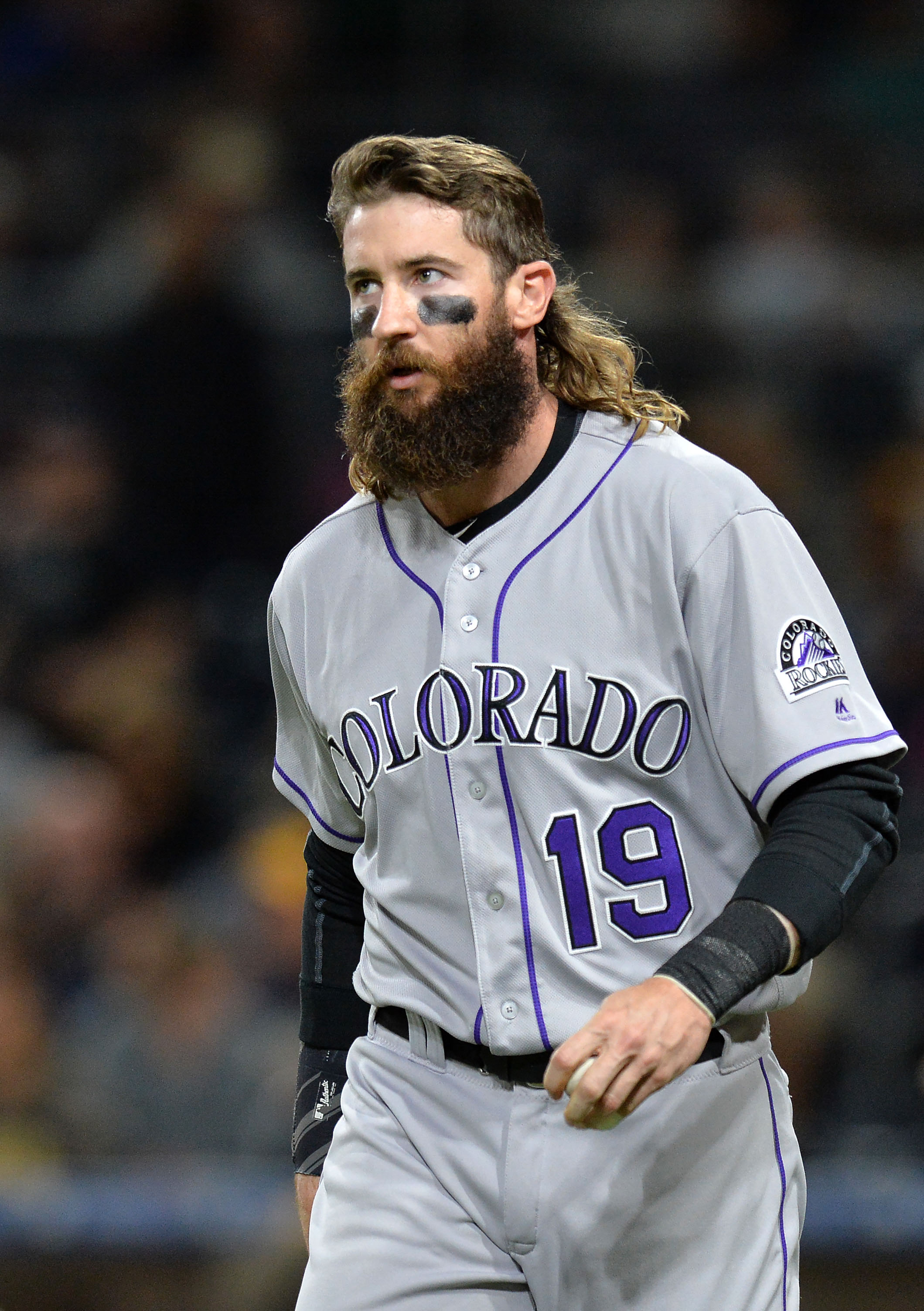
There are two different run environment factors to consider for Blackmon that could be inflating the way his number would be viewed by an arbitration panel. Blackmon plays his home games at Coors Field, a notorious home run park. FanGraphs gives Rockies’ players a 116 park factor, suggesting Blackmon’s 37 home runs might be the equivalent of 32 home runs in a more neutral setting.
Further inflating Blackmon’s home run total is something that will affect a great number of cases this year—the dramatically increased level of home runs throughout the league. This past season set a league record with 6,105 total home runs—this was 26 percent higher than the average from the last five years. So when I look at players with similar totals over the last five years, it is unclear whether an arbitration panel (or teams and agents that are negotiating in the shadow of what an arbitration panel would say) would treat home runs from Blackmon as similar to other players with the same number of home runs, or as someone with maybe 26 percent fewer home runs.
My model does not adjust for league or park home run environment in this way; in general the data has shown that run environment is not a big consideration in arbitration. Hitters in high-scoring years benefit from being compared to hitters in lower-scoring years. Pitchers in low-scoring years benefit from being compared to pitchers in high-scoring years.
If you knock down Blackmon’s home run total by league and park effects, he lands somewhere around the equivalent of 25 home runs in a neutral park in a prior season. But of course, that may not be what the panel considers. Most likely, they will just compare him (favorably) to the current record-holder in this service class, which is Chase Headley from 2013. Headley hit .286 with 31 homers, 115 RBIs and 17 stolen bases in the platform season for his final trip through the arbitration process.
Blackmon outperformed Headley in both homers and average, and he also stole 14 bags, further helping his case. It seems likely to Blackmon will be seen as favorable to Headley — especially considering the fact that Headley’s case is already five years old — so I think earning a raise north of $6MM seems likely.
If we’re looking for other recent players with a lot of home runs who reached arbitration, Todd Frazier’s name emerges. He hit 40 home runs in his platform season, but at .225, his average was more than a hundred points below Blackmon’s. Frazier got a $3.75MM raise, which Blackmon should easily crush.
Eric Hosmer is another potential comparable, but he’s also clearly a player with an inferior case to that of Blackmon. In 2016, Hosmer’s platform before his final trip through arbitration, he hit .266 with 25 homers and 104 RBIs. Blackmon has him handled in every category, so Hosmer’s $4MM raise is another example of a potential floor for Blackmon’s raise.
I think it’s clear that Blackmon is going to set a new record. The “Kimbrel Rule” has worked very well since its inception, and I think it will apply well here. Look for Blackmon to land somewhere between $13-14MM, with some chance of going slightly above that if and when he settles on a one-year deal for the 2018 season.
Photo courtesy of USA Today Sports Images.
Indians, Cody Allen Avoid Arbitration
The Indians have avoided arbitration with closer Cody Allen by agreeing to a one-year deal worth $10.575MM, as Tom Withers of the Associated Press was first to report (via Twitter). Allen, a client of Meister Sports Management, had a projected arbitration salary of $10.8MM, per MLBTR contributor Matt Swartz.
Allen, 29, will take home a raise of more than $3MM over last season’s $7.35MM salary. The raise was well-deserved, as Allen turned in his fifth consecutive season with a sub-3.00 ERA out of the Cleveland bullpen. Since taking over as Cleveland’s closer in 2014, Allen has pitched to an outstanding 2.62 ERA with 12.1 K/9, 3.2 BB/9 and a total of 120 saves. Allen has averaged better than 70 appearances per season and 53 games finished per year in that time, and he’s been even better in the postseason, where he owns a minuscule 0.47 ERA with a ridiculous 33-to-8 K/BB ratio in 19 1/3 innings.
This past season, Allen worked to a 2.94 ERA and averaged 12.3 K/9, 2.8 BB/9 and 1.2 HR/9 with a 33.5 percent grounder rate and a fastball that averaged 94.3 mph. This will be his final trip through the arbitration process, as Allen is poised to hit the open market for the first time following the 2018 season, adding to an impressive overall crop of free agents. He’ll join Craig Kimbrel, Andrew Miller, Zach Britton, Brad Brach and Kelvin Herrera on what should be a strong market for top-end relievers.
With Allen’s case now resolved, the Indians have four remaining cases, as can be seen in MLBTR’s 2018 Arbitration Tracker. Trevor Bauer, Lonnie Chisenhall, Danny Salazar and Zach McAllister are the Indians’ remaining arb-eligibles that have yet to agree to terms on a contract for the upcoming season.
Jay Bruce Nearing Agreement With Unreported Team
Free-agent outfielder Jay Bruce is closing in on an agreement with a yet-unreported team, per ESPN’s Jerry Crasnick (Twitter link). The deal “should be completed tonight,” however, according to Crasnick, so it may not be long before some additional light is shed on the matter. Bruce is represented by Sosnick, Cobbe & Karon.
Notably, Mike Puma of the New York Post tweeted earlier today that the Mets have been in recent touch with Bruce’s camp. While Puma didn’t imply that anything was close to fruition between the two sides, he did note that Bruce is still “very much a possibility” for the Mets. Bruce has also been prominently linked to the Giants in recent weeks.
Agent Jason Wood Fired From Agency, Suspended By MLBPA
6:48pm: Evan Drellich of NBC Sports Boston reports that Benintendi is not involved in the allegations against Wood. To this point, law enforcement is not involved in the matter, either. Drellich notes that a source “confirmed the nature of the allegation” to him.
6:12pm: Wood reached out to Passan to issue a staunch denial of the reported allegations against him (Twitter link):
“The allegations that have surfaced today are absurd and untrue. Over the past 13 years I have worked tirelessly to build a successful agency through integrity and hard work. I am disappointed that there are those who have chosen to spread such irresponsible and harmful rumors.”
3:27pm: Certified player agent Jason Wood has been fired from his post as head of the baseball division of the Career Sports Entertainment agency and suspended by the MLB Player’s Association, Jeff Passan of Yahoo Sports reports on Twitter. As Passan notes, and Robert Murray of Fan Rag Sports reports in more detail, Wood stands accused of using a hidden camera on his own clients.
Clearly, it’s premature to jump to any conclusions in this odd and troublesome story. Murray, though, says that seven sources tell him that Wood is under investigation by the union for “allegedly filming numerous clients while they were using his shower” — including one that found a camera and confronted the alleged perpetrator.
CSE has issued a statement from president Danny Martoe, which Passan conveyed on Twitter. It reads as follows:
“For over 32 years, CSE Talent has prided itself on our moral and ethical standards and have built a solid reputation within the industry. We take pride in working with people who represent these values. It’s unfortunate that CSE Talent aligned itself with someone who didn’t uphold these same standards and therefore we chose to terminate with cause Wood’s employment.”
Identities of the apparent victims of Wood are not known at this time. It’s also not clear whether there is any criminal investigation, though the situation certainly could warrant such treatment.
MLBTR’s agency database shows many of Wood’s client relationships. He had operated an entity known as Arland Sports, which is still reflected in the database but has since been purchased by the CSE agency. Just which of those players was still represented by Wood at the time the allegations arose is not known (agency switches often go unreported), though Andrew Benintendi was a known client, and Wood has also repped other notable MLB players such as Jake Odorizzi and David Phelps, as well as prospects Riley Pint, Joey Wentz, and Mitch Keller, among others.
Many of the players that had been represented by Wood are now said to be seeking alternative agencies. Keller has already terminated his relationship with CSE and hired Excel Sports Management, Murray tweets.
Arbitration Breakdown: Marcell Ozuna and Jose Abreu
Recently, I have been discussing some of the higher-profile upcoming arbitration cases as part of MLBTR’s Arbitration Breakdown series. I rely partly on my arbitration model developed exclusively for MLB Trade Rumors, but will also break out some interesting comparables and determine where the model might be wrong. Full arbitration projections for 2018 are also available, for those interested.
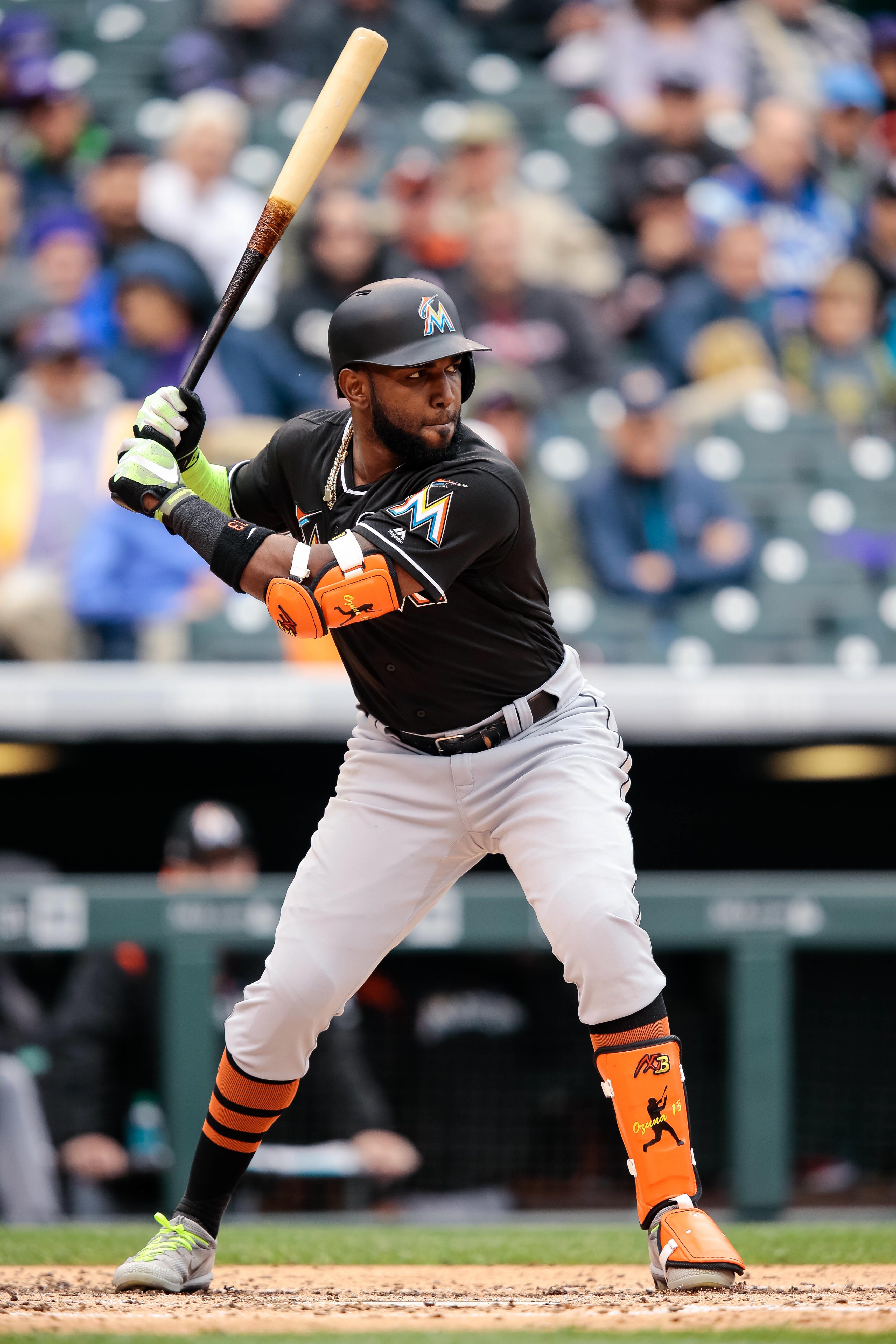
Before Marcell Ozuna reports for his first Spring Training as a Cardinal, he will have to start the potentially uncomfortable process of salary arbitration with them. Ozuna has quite a resume to boast, which is part of what made him so attractive to the Cardinals in the first place. He hit .312 with 37 home runs and 124 RBIs last year, giving him few comparables among second-time arbitration-eligible players.
My model projects a substantial raise for him of $7.4MM — all the way to a $10.9MM salary. This may be high, given the lack of exact historical comparables and the potential for an arbitration process to discount some of the home runs hit in a very high league home run environment (2017 set a record). That said, it still suggests that Ozuna is going to get a large raise anyway.
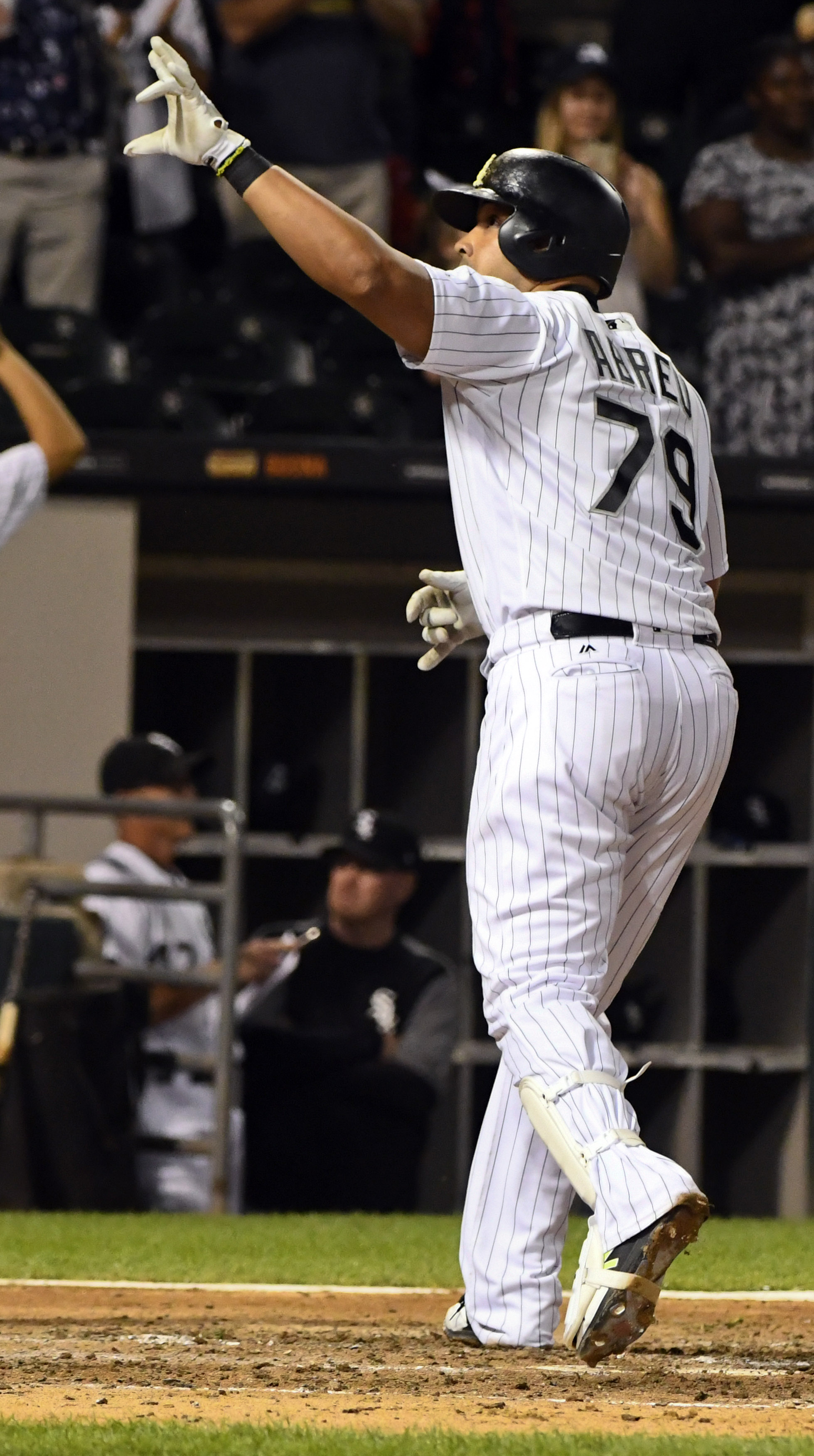
Jose Abreu had a comparable season, and his projection is accordingly similar. He hit .304 with 33 homers and 102 RBIs, making the primary difference in their cases the lower RBI total for Abreu. The White Sox slugger is projected for a $7.1MM raise instead of Ozuna’s $7.4MM, but he starts from a higher base salary and is therefore projected to land at $17.9MM.
No other players in the past five years have entered arbitration with the elusive .300/30/100 slash line. However, several players did so in the prior five years, including Jacoby Ellsbury in 2012 (.321/32/105), Josh Hamilton in 2011 (.359/32/100), Matt Holliday in 2008 (.340/36/137) and Miguel Cabrera in 2008 (.320/34/119). Those players got raises between $5.65MM (Ellsbury) and $3.9MM (Cabrera), although both Hamilton and Holliday got raises above $5MM, thus making Cabrera the exception.
It seems quite likely that Ellsbury, with 39 stolen bases to Ozuna’s one stolen base, would have a better case. However, the fact that Ellsbury’s case is six years old could put them closer together and could even put Ozuna and Abreu ahead. One thing that is important to note is that only Ellsbury got a one-year deal. The other raises mentioned above are part of multi-year deals, which are usually not very applicable in arbitration cases (although they could be in this scenario with few comparables).
If we look for a player more recent, we might consider Manny Machado last year at .294/37/96. He got a $6.5MM raise and clearly looks like a relevant player. The home run environment difference in just one year is pretty limited as well.
The record raise for a second-time eligible hitter belongs to Chris Davis, who got a $7.05MM raise after his .286/53/138 campaign in 2014. That would probably compare favorably to Ozuna’s numbers because of the home run difference, but the four years’ lag could render that number stale and push Ozuna and Abreu above him after all, as the model predicts. However, I think it may serve as a ceiling, leaving Ozuna and Abreu south of theor projections and slightly south of Davis.
Charlie Blackmon hit .324/29/104 last season, but did so in Coors Field, so he might be seen as less impressive than Ozuna and Abreu. His $3.8MM raise is probably a floor, and perhaps not that close of one.
I think it may be more likely that Ozuna and Abreu both get raises somewhere around $6MM. The triad of players with .300/30/100 slash lines and raises over $5MM back in 2008-12 are probably floors, whereas Davis’ raise seems like a ceiling. If that proves true, Ozuna might end up around $10MM instead of closer to $11MM, and Abreu might end up closer to $17MM than $18MM.
Photos courtesy of USA Today Sports Images.
MLBTR Chat Transcript: Astros Rotation, Cain, Cashner, Harrison
Click here to read the transcript for MLBTR Chat With Jason Martinez: January 10, 2018
Athletics, Khris Davis Avoid Arbitration
The A’s announced on Wednesday that they’ve agreed to a one-year deal with outfielder/designated hitter Khris Davis, thus avoiding arbitration. Terms of the contract weren’t announced, but FanRag’s Jon Heyman reports that Davis, an Octagon client, agreed to a $10.5MM salary for the 2018 season (Twitter link). The slugger had a projected arbitration salary of $11.1MM, per MLBTR contributor Matt Swartz.
The 30-year-old Davis just wrapped up his second consecutive season of 40-plus homers, belting 43 round-trippers and hitting .247/.326/.528 with 91 runs scored and 110 RBIs on the season overall. Those gaudy counting stats should position him nicely for a pay raise in what will be his second trip through the arbitration process. Davis will be arb-eligible once more next offseason before reaching free agency upon completion of the 2019 season.
Oakland has now avoided arbitration with both Davis and Jake Smolinski, leaving them with six unresolved cases, as can be seen in MLBTR’s Arbitration Tracker. Marcus Semien, Kendall Graveman, Chris Hatcher, Liam Hendriks, Josh Phegley and Blake Treinen are all still eligible for arbitration. The deadline to exchange figures looms this Friday evening.