
Central Notes: Zambrano, Brewers, Robert, Gose
Long-time Cubs righty Carlos Zambrano will return to the hill, per Bruce Levine of 670thescore.com (via Twitter). At this point, though, there’s no indication he has his sights set on a return to the majors; rather, the soon-to-be-36-year-old will suit up for Venezuelan Winter League action. Zambrano last pitched in the majors in 2012 and spent time in the minors in 2013 before hanging up his spikes. Before that, he threw 1,826 2/3 innings of 3.60 ERA ball for the Cubs from 2001 through 2012.
Let’s take a look at the latest from the game’s central divisions:
- Brewers GM David Stearns talked about his team’s promising start and what it might (or might not) mean for his deadline planning, as Tom Haudricourt of the Milwaukee Journal-Sentinel writes. Stearns is undeniably pleased with the fact that his club sits atop the NL Central standings, and didn’t shy away from the possibility that the wins could continue to come sooner than had been anticipated. But he also suggested that the imperative of sustainable building would largely remain the same. “The plan is to consistently win major league games over a period of years,” he said. “If that process begins a little bit sooner than people expected, that’s great. And we’ll react accordingly. But it doesn’t change our strategy; it doesn’t change our plan.”
- With the White Sox reportedly beating out the Cardinals to sign Cuban prospect Luis Robert, Bernie Miklasz of 101sports.com wonders whether St. Louis should have been more aggressive in its bidding. You’ll need to read through his entire argument to see how you feel, but the gist is the view that the organization ought to have been willing to stake a greater bet on a potential impact talent — particularly given the fact that it had a unique opportunity with many big spenders unable to go after Robert and plenty of available resources given the team’s meager draft assets this summer.
- The Tigers‘ efforts to transition Anthony Gose from outfielder to pitcher became official today, as he was activated at Class A Lakeland to work out of the pen. While he didn’t escape from his first inning of action unscathed, Gose did make quite an impression. Per Lakeland assistant GM Dan Lauer, on Twitter, Gose was clocked at 99 mph with his debut heater.
Injury Notes: Matz, Hughes, Cardinals, Span, Flaherty
The Mets may welcome back lefty Steven Matz sooner than later, David Lennon of Newsday reports on Twitter. Indeed, if he has a strong outing tomorrow at Triple-A, the club may allow him to make his next start at the major league level. That would obviously represent welcome news for the beleaguered Mets staff. Whether Matz can stay on the hill the rest of the way will no doubt go a long way toward determining whether New York can climb back into the postseason picture.
Here’s more on some health situations from around the game:
- Though he’s still heading to the 10-day DL, Twins righty Phil Hughes will do so with a somewhat more optimistic outlook than had been feared, as Phil Miller of the Star Tribune was among those to tweet. Hughes is dealing with right biceps tendinitis, the team says, which seems quite a bit less worrisome than the hints of a shoulder problem that had been given previously.
- The Cardinals have provided a few injury updates, as MLB.com’s Jenifer Langosch reports. Notably, lefty Tyler Lyons is nearing a return from an intercostal strain, though the precise timing of his activation isn’t yet clear. The Cards don’t expect a prolonged absence from second baseman Kolten Wong, meanwhile, who is still out with some elbow soreness but doesn’t figure to hit the DL. Interestingly, Langosch also notes, lefty Zach Duke is lining up an effort to return more quickly than is typical from his Tommy John surgery. Duke is already eyeing work against live hitters in hopes of ramping up in time to return to the Cards in August.
- Giants center fielder Denard Span is limited by a left thumb problem, he told reporters including Alex Pavlovic of NBC Sports Bay Area (Twitter link). It doesn’t appear as if it’s something that’ll require a DL stint, but it does represent yet another nick for the 33-year-old. Span is hitting just .258/.296/.398 on the year thus far, with a shoulder injury also having limited him in the early going.
- It seems the Orioles will go without infielder Ryan Flaherty for a reasonable stretch. Per Steve Melewski of MASNsports.com, via Twitter, the veteran utilityman is going to need a platelet-rich plasma injection after suffering an injury to his shoulder/upper-back area. Flaherty, 30, is expected to need more than the minimum ten-day stay on the DL.
- Phillies prospect Jesmuel Valentin may need shoulder surgery that could end his season, Ryan Lawrence of the Philly Voice reports on Twitter. The 23-year-old second baseman, who was taken 51st overall in the 2012 draft, came to the Philadelphia organization as part of the 2014 trade that sent veteran righty Roberto Hernandez to the Dodgers. Valentin, who occupies a 40-man spot, had struggled to a .229/.282/.292 batting line this year but has shown a quality approach in the past and slashed .269/.341/.395 with nine home runs last year in the upper minors.
2017 Opt-Out Clause Update
Recently, I took a quick look at all of the players with vesting options for the 2018 season, noting that many of the outcomes within will have significant ramifications for both the upcoming free-agent market and the future of those players’ respective teams. The implications are even greater for the eight players that have opt-out provisions of some type at the end of the current season. In some cases, the opt-out in question could either liberate that player’s team from more than $80MM in future commitments or saddle them with that same burdensome amount. (And, in most cases, if the player isn’t opting out, the remaining salary is indeed a burden, as the player either performed too poorly to opt out and/or got hurt.)
Here’s a look at the opt-out decisions that are looming at season’s end…
- Justin Upton, Tigers: The disastrous start to Upton’s six-year, $132.5MM contract now looks like a distant memory. After struggling to a .228/.286/.369 batting line through his first three months in the Motor City, Upton has surged with a .255/.342/.535 slash and 31 home runs over his past 471 big league plate appearances. Strikeouts are still an issue for Upton, but he’s also walking more than ever (15 percent in 2017). He’s on pace to finish the season right around the 30-homer mark, and if he can do so with an OBP in the mid-.300s and respectable marks in left field — he’s currently at +4 DRS and +3.4 UZR — then the remaining four years and $88.5MM on his contract will pose an interesting decision for Upton, who is currently playing out his age-29 season.
- Johnny Cueto, Giants: Cueto looked like an ace in his first year with San Francisco but has stumbled to a 4.50 ERA through his first 58 innings with the Giants in 2017. He’s still averaging better than eight punchouts per nine innings to go along with solid (but diminished) control. However, he’s seen his ground-ball rate plummet from 50 percent to 39 percent, and paired with the increase in walk rate (1.8 BB/9 to 2.5 BB/9), that has led to some issues. There’s still plenty of time for Cueto to get back on track, but the remaining four years and $84MM on his contract doesn’t look quite as easy to walk away from as it did just seven weeks ago. He’ll be 32 next season.
- Masahiro Tanaka, Yankees: Cueto’s slow start looks Cy Young-worthy when juxtaposed with Tanaka, who has logged a ghastly 6.56 ERA through 48 innings in 2017. Like Cueto, Tanaka has seen his control take a step back, though his strikeout and ground-ball rates are consistent, and his velocity is fine. Tanaka’s average on balls in play is up, however, and his homer-to-flyball rate has skyrocketed from 12 percent to 24.5 percent. Given his age (29 in November), Tanaka would be a virtual lock to opt out of the remaining three years and $67MM on his contract with a good season. If he can’t overcome his home-run woes, however, he may instead opt for the substantial amount of guaranteed cash remaining on his deal.
- Wei-Yin Chen, Marlins: Chen’s opt-out is perhaps the easiest to determine of any player on this list. Unfortunately for the Marlins, that’s due to the fact that he’s currently sidelined indefinitely due to arm troubles. Chen is on the disabled list with arm fatigue, though it’s been reported previously that he’d been pitching through a slight tear in his ulnar collateral ligament, which was sustained in 2016. Chen hasn’t pitched well as a Marlin even when healthy, and at this point it would take a quick recovery and a dominant finish for him to even consider opting out of the remaining three years and $52MM on his contract.
- Ian Kennedy, Royals: Kennedy has logged a solid 3.74 ERA in 233 1/3 innings since signing a five-year deal with Kansas City, but he’s already in his age-32 season. His strikeout rate and control have taken a step back in 2017 as well, and he’s remained homer-prone despite pitching half his games at the spacious Kauffman Stadium. Kennedy turned in a very strong final four months in his last contract season — which helped him land this surprising contract in the first place — but it doesn’t seem likely that he’ll opt out of the remaining three years and $49MM on his current contract.
- Greg Holland, Rockies: To be clear, Holland cannot technically opt out of his contract just yet. The one-year, $7MM contract that he signed with the Rox contained a $10MM mutual option that can vest as a $15MM player option if Holland finishes 30 games. At this juncture, though, it seems as if an injury is all that can stop Holland’s player option from vesting. He’s already finished 20 of the 30 games he needs, and he’s currently boasting a preposterous 0.96 ERA with a 26-to-6 K/BB ratio through 18 2/3 innings. Apparently, pitching at Coors Field suits Holland just fine, though if he keeps this up, it’s a foregone conclusion that he’ll turn down the one year and $15MM he’d receive for a second season at Coors and hit the market in search of a lucrative three- or four-year contract.
- Matt Wieters, Nationals: The stagnant offseason market for Wieters’ services culminated in a two-year, $21MM contract with the Nats that offers Wieters the opportunity to test free agency once again next winter, if he wishes. To this point, it’s looking likely that Wieters will pass on that player option. His walks, hard-hit rate and BABIP are up, none of which has come at the expense of his strikeout rate. Wieters is hitting a solid .283/.358/.442 with four homers on the year. His caught-stealing rate is down (23 percent), and his framing remains questionable, but the improved offense makes it seem likely that, even if Wieters again struggles to find the strong multi-year deal he craves, a contract comparable to the one year and $10.5MM he can opt out of will once again be available on the open market.
- Welington Castillo, Orioles: Castillo’s two-year, $13MM contract with the Orioles was a pleasant surprise for a player who had previously been locked into arbitration in Arizona before surprisingly being non-tendered. He’s off to a torrid .348/.375/.543 start to the season with four homers and six doubles through 96 plate appearances. There’s a fair bit of luck involved in that production, as evidenced by the 30-year-old’s .418 BABIP. But his strikeouts are down this season, and he’s thrown out a career-best 41 percent of attempted base thieves. His framing marks, while still below average, have improved on a per-pitch basis as well. His glove may prevent him from fully cashing in, but Castillo’s bat could make the remaining one year and $7MM on his contract easy enough to walk away from, assuming he’s healthy.
Cubs Designate Jake Buchanan
The Cubs have designated righty Jake Buchanan, per a club announcement. His 40-man spot will go to lefty Zac Rosscup, whose contract was selected. In a corresponding move, right-hander Dylan Floro was optioned to Triple-A.
Buchanan, 27, has seen limited MLB action in each of the past three seasons. He landed in Chicago early last year after he was released by the Astros. Buchanan had been working at Triple-A to open the 2017 campaign, posting a 4.75 ERA with 6.3 K/9 against 4.1 BB/9 over 41 2/3 innings.
As for Rosscup, he’ll return to the majors for the first time since 2015. He spent all of 2016 rehabbing after shoulder surgery, but had shown well thus far at Triple-A. Through 15 2/3 innings over nine appearances, Rosscup owns a 3.45 ERA with an impressive combination of 25 strikeouts against just three walks.
Tigers Option Anibal Sanchez
The Tigers have optioned veteran righty Anibal Sanchez to Triple-A, manager Brad Ausmus told reporters including Anthony Fenech of the Detroit Free Press (Twitter links). Sanchez, who would’ve had the right to reject any minor-league assignment, will return to working as a starter at Toledo.
The move was driven by Sanchez himself, per Ausmus. He would like to return to working from the rotation after opening the year in the bullpen. Through 21 innings over 11 outings, Sanchez had allowed 21 earned runs on 34 hits while compiling 22 strikeouts against nine walks.
That was the first time Sanchez had functioned as a reliever for such a dedicated stretch. The vast balk of his dozen-year MLB career has come from the rotation, where Sanchez once thrived. But the results just haven’t been there over the past two seasons — he owns a 5.65 ERA since the start of 2015 — and Detroit wasn’t willing to give him a starting role this year.
It seems optimistic to hope that Sanchez can turn things around by returning to a starting role, though stranger things have happened. It’s worth noting that he’s registering a 10.1% swinging-strike rate in the early going, his best since 2013, and could perhaps boost that yet further if he can get batters to chase outside the zone at a rate closer to his career average. Sanchez’s batted-ball results — .379 BABIP; 3.86 HR/9; 55.9% strand rate — may fall at his feet to large extent, but there’s probably some poor fortune mixed in as well.
Regardless of how things go, Sanchez will earn $16MM this season — the final guaranteed year of the contract he signed before the 2013 campaign. He’ll also earn a $5MM buyout over the winter, unless the Tigers make the surprising decision to pick up his $16MM option.
James Loney Granted Release From Braves
Veteran first baseman James Loney asked for his release from the Braves and was granted that request, according to a club announcement. He had only just signed a minor-league deal with Atlanta last Thursday.
The Braves were clearly searching for solutions in the wake of an injury to starting first baseman Freddie Freeman. While Loney would have represented a plausible fill-in, the club ended up finding a piece with somewhat greater long-term interest not long after coming to terms with Loney.
Atlanta acquired Matt Adams from the Cardinals over the weekend, and he’ll represent the team’s top option at first until Freeman returns. That left little room for Loney on the active roster.
“We wish him all the best going forward,” the Braves when announcing the move. Loney will now look to latch on with another club that has a clearer path to a spot on the big league roster.
Loney, 33, opened the year at Triple-A in the Tigers organization, struggling to a .200/.351/.222 batting line in 57 plate appearances before he was released. Last year, he hit .265/.307/.397 in 366 trips to the dish at the major league level for the Mets.
Minor MLB Transactions: 5/22/17
Here are Monday’s minor moves from around the league…
- Paul Hoynes of the Cleveland Plain Dealer reports that right-hander Carlos Frias has accepted an outright assignment to Triple-A Columbus after clearing waivers (Twitter link). The Indians designated the longtime Dodgers reliever for assignment over the weekend. Frias, 27, has a 4.50 ERA with 5.9 K/9, 2.7 BB/9 and a 53.7 percent ground-ball rate in 114 Major League innings spread across parts of three seasons. He’s struggled in Triple-A this year, however, surrendering 17 earned runs on 20 hits and nine walks with eight strikeouts in 17 innings.
Earlier Moves
- The Astros will select the contract of right-hander Jordan Jankowski from Triple-A Fresno today, reports Brian McTaggart of MLB.com (Twitter link). He’s not on the 40-man roster, meaning the team will need to make another move to accommodate him. Jake Kaplan of the Houston Chronicle reports that Jankowski will replace lefty Ashur Tolliver on the active roster, though Tolliver has minor league options remaining, so he needn’t be designated for assignment and can rather be optioned. Houston selected Jankowski in the 34th round of the 2008 draft, but he elected to attend college at Catawba College, in Salirbury, N.C. Four years later, the Astros again selected Jankowski — once again in the 34th round. The 28-year-old owns a pristine 1.42 ERA with a 22-to-9 K/BB ratio in 19 innings this season in Triple-A.
Astros Designate Andrew Aplin For Assignment
The Astros announced that they’ve designated outfielder Andrew Aplin for assignment in order to clear a spot on the 40-man roster for right-hander Jordan Jankowski, whose contract has been selected from Triple-A Fresno.
The 26-year-old Aplin was a fifth-round pick of the Astros back in 2012, and while he reached Triple-A for the first time as a 23-year-old in 2014, his career has stalled somewhat at that level. Aplin has now spent parts of four seasons there, hitting a combined .245/.341/.329 with eight homers and 47 steals through 249 games (953 plate appearances). That includes a .250/.375/.345 batting line in 2017 — his age-26 campaign.
Jankowski, 28, was drafted by the Astros out of high school in 2008 and out of college in 2012 — both in the 34th round. He’s worked to an excellent 1.42 ERA with a 22-to-9 K/BB ratio in 19 innings this season in Triple-A and has a lifetime 3.24 ERA with 11.9 K/9 against 4.4 BB/9 in 153 innings at that level.
Angels Option C.J. Cron To Triple-A
The Angels announced on Monday that they’ve optioned first baseman/designated hitter C.J. Cron to Triple-A Salt Lake and recalled infielder Nolan Fontana in his place.
Entering the season, Cron was a popular trade candidate once the Angels signed Luis Valbuena, as it was reported that Valbuena would spend quite a bit of time at first base. The 27-year-old Cron, though, injured his left foot late in Spring Training and has hit poorly in 90 plate appearances since being activated: .232/.281/.305 with just one homer (a grand slam in yesterday’s game).
[Related: Updated Los Angeles Angels depth chart]
Slow start notwithstanding, Cron’s demotion comes as a mild surprise. He spent the entire 2016 season on the Angels’ Major League roster and hasn’t been optioned to the minors since early June of the 2015 campaign. And from the time of his recall from that most recent Triple-A stint through the end of the 2016 season, Cron slashed an impressive .281/.325/.481 with 31 long balls over the life of 735 Major League plate appearances. While that’s not quite elite production, it’s considerably better than the league average (121 wRC+).
From a service time vantage point, however, the move isn’t likely to impact Cron one way or another. He entered the year with two years, 110 days of Major League service time, meaning he needed just 62 days in the Majors to reach his third full year of service, thereby keeping him on track to reach free agency following the 2020 season. While he hasn’t quite reached the requisite 62 days, he needs just 12 more days of service time in order to do so. Even if Cron were to spend the bulk of the season in Triple-A, he’d still accrue those final 12 days as a September call-up, so the only real way this would delay his free agency would be if he were to incur a season-ending injury in the minors and finish out the year on the disabled list.
With Cron in the minors and Yunel Escobar on the disabled list, it seems likely that Valbuena will spend a considerable amount of time at third base, with Jefry Marte handling duties at first base. Albert Pujols could see a bit of action at first as well, though he’s played in the field just twice in 40 games this season, so the team doesn’t appear to view him as a regular option there.
Angels Sign Doug Fister
12:15pm: Fletcher reports that Fister also has an out clause in his contract and will be released if he’s not in the Majors by June 21 (Twitter link). Cotillo noted that the contract has up to $1.2MM worth of incentives available, and as the Associated Press reports, $1MM of those incentives are tied to starting, while $200K are tied to relief work. According to the AP, Fister will earn $100K for making each of his eighth, 10th and 12th starts as an Angel. He’d also earn $150K apiece for reaching 14, 16 and 18 starts, plus another $250K if he starts a 20th game. The deal also has $200K worth of relief incentives — $50K for his 25th and 30th appearances plus $100K for his 35th.
MAY 22, 7:38am: Cotillo reports that Fister will received a pro-rated $1.75MM base salary in the Majors. Fister’s salary is not guaranteed, Fletcher tweets.
MAY 20: The Angels have made the signing official, with Fister inking a one-year deal (hat tip to Jeff Fletcher of the Orange County Register). He will be assigned to Class-A ball in order to get himself ready for big league action. In a corresponding move to create 40-man roster space, Andrew Bailey was shifted to the 60-day DL.
MAY 18: The Angels are in agreement with free-agent right-hander Doug Fister on a Major League contract, reports SB Nation’s Chris Cotillo (via Twitter). Fister is a client of PSI Sports Management.
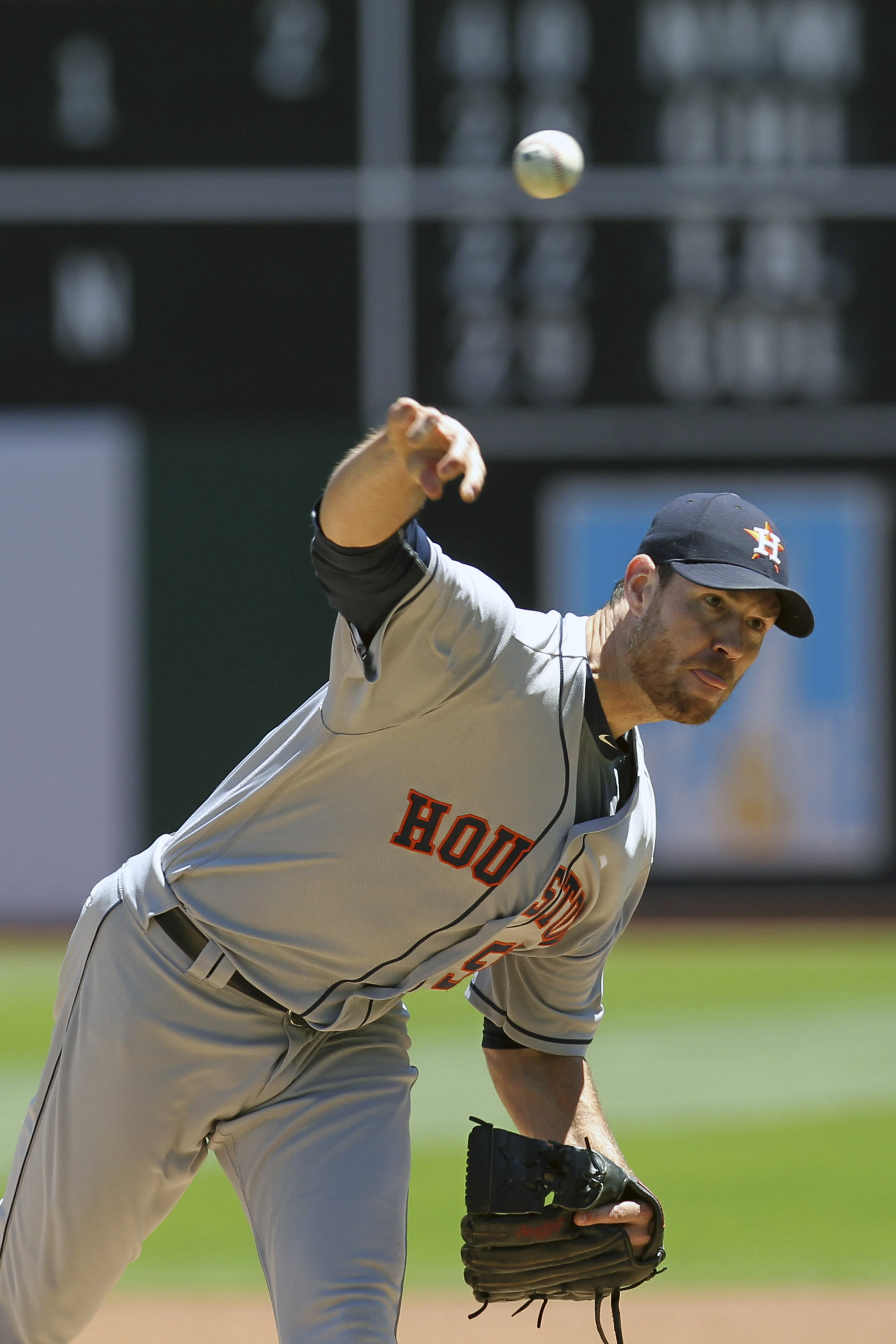
As of last week, the 33-year-old Fister was said to be close to signing, and Cotillo listed the Angels as one of five clubs in the mix for him at that time. Presumably, though his contract is of the Major League variety, the veteran Fister has consented to be optioned to the minors in order to ramp up to the point where he’s big league ready. Due to the fact that he didn’t sign a contract this past offseason, Fister hasn’t been pitching competitively anywhere and isn’t likely to be ready to step right onto a big league pitching staff.
Pitching depth is a clear area of need for the Halos, who entered the season with Andrew Heaney and Nick Tropeano mending from Tommy John surgery and have since lost Garrett Richards (biceps strain) and Tyler Skaggs (oblique strain) to long-term injuries. (Skaggs, who is expected to miss more than two months, could be moved to the 60-day DL to create room for Fister on the 40-man roster).
With those four arms on the shelf, the Halos have been utilizing Ricky Nolasco, Matt Shoemaker, J.C. Ramirez, Jesse Chavez and Alex Meyer in the starting rotation. Fister could conceivably step into the spot of either Chavez or Meyer, though he could also begin the year in a long relief role if the Halos’ incumbent starters are performing well by the time he’s ready to join the staff.
It came as something of a surprise when Fister went unsigned this winter. Perhaps the veteran was holding out in hopes of securing a MLB roster spot, as he has now done. Whatever the reason, there ere plenty of organizations that surely would’ve liked to bring him in to compete in camp. After all, he was a high-quality starter as recently as 2014, when he gave the Nationals 164 innings of 2.41 ERA pitching.
That’s not to say that Fister had entered the open market on a high note. He inked a one-year, make-good deal with the Astros last year after struggling (and losing velocity) in 2015. Things did not go as hoped, as Fister ended with a 4.64 ERA with 5.7 K/9 against an uncharacteristically high 3.1 BB/9.
Looking underneath the hood a bit, that 2016 effort doesn’t look a whole lot better. Fister worked out of the zone less than ever (46.1% versus 52.3% career) even as he drew less chases than he had previously (28.9% versus 32.0% career). His typically strong groundball rates have fallen somewhat over the past two years, with Fister also allowing more dingers (over 1.2 per nine) than he had during his peak years.
If there was a positive to be found in Fister’s 2016 campaign, it was definitely in the health department. He made it through 32 starts for the first time since 2013 and did rebound a bit in the velocity department — though he still averaged about a tick less with the fastball than he did in 2014. If Fister can build on that, with an extra-long winter rest under his belt, then perhaps there’s a resurgence still to be found for the respected veteran.
Photo courtesy of USA Today Sports Images.